Pathé treasures

patheposters

http://www.fondation-jeromeseydoux-pathe.com

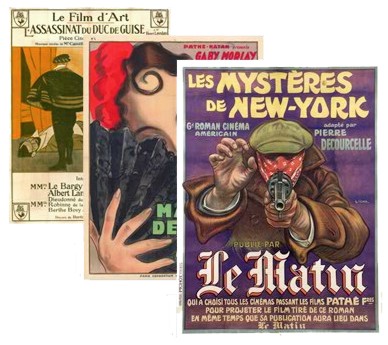
Here’s a real treasure trove. The Fondation Jérôme Seydoux Pathé is an organisation deciated to collecting documents and artefacts (everything, in effect, except the films) relating to Pathé. Their collection, based in Paris, comprises photographs, posters, business documents, cinematograph machinery, books, periodicals, scripts, brochures, designs… seemingly everything connected with the business empire created by Charles Pathé.

Examples of these can be found on their stylish, Flash-driven website, which has background information on each type of collection, and a useful historical timeline from the 1890s to the present day. There is also information on a Pathé filmography which they are producing, building on the herculean work undertaken by Henri Bousquet (who has produced several volumes documenting the output of Pathé in the silent era) and others. The site is, please note, all in French.

pathesearch

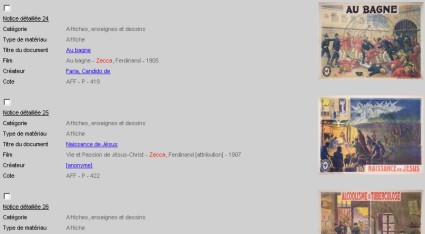
Sample search results from the Fondation Jérôme Seydoux Pathé database

The Fondation has now produced a database of its holdings (accessible from this link or via the Collections section of the site – click on Base de données). The database provides preliminary information on over 25,000 artefacts, designed to assist any researcher prior to their visiting the Fondation in person. It’s easy to use (again, all in French), and a sample search under Ferdinand Zecca (Charles Pathé’s right-hand man in the early days) yields 219 results. Many of the search results come with an associated image, creating a marvellously rich gallery of Pathé history (just look at all the extraordinary posters for the first Pathé productions if you search under Zecca).

Jérôme Seydoux is head of the Pathé and his brother Nicolas Seydoux head of the Gaumont group. Gaumont and Pathé cinemas are now merged (as EuroPalaces), as are the Gaumont-Pathé Archives. You can find the whole complex history the Ketupa site (a useful resource in itself for media ownership history).

My thanks to Mariann Sträuli for alerting to me to this site.

Update (June 2009): The filmography is now available (1896-1913).

Quebec and Québec

F. Guy Bradford (left), Joe Rosenthal (right) and the Living Canada travelling company, c.1903 (Cinémathèque québécoise)

Another day, another site goes up with unique silent film content, richly contextualised. Truly the online world is our archive. This time it is Le cinéma au Québec au temps du muet/Cinema in Quebec in Silent Era, an impeccably bilingual site giving us the history of early cinema in Quebec, Canada.

Quebec has a distinctive early film history. It is a tale coloured by its geography, its French heritage, local regulations, audiences and enthusiasms, and by snow. Particularly, it is a tale shaped by the dedicated efforts of a hardy band of pioneers, such as James Freer, Henry de Grandsaignes d’Hauterives and Léo-Ernest Ouimet. It is a tale of travelling cameramen (Joe Rosenthal, William Paley) and travelling exhibitors (F. Guy Bradford), an adventurous cinema with a spirit of newness and discovery about it.

The site has been put together with impressive thoroughness and local pride. There are extensive, knowledgable texts on such themes as the history of cinema in the area, biographies, audiences, film companies, sponsorship (the Canadian Pacific Railway made much use of film to promote its activites), censorship and travelling cinema. There are twenty or so films, available in low and high bandwidth, mostly non-fiction, including such titles as Skiing at Quebec (Edison 1902), Mes espérances en 1908 (Ouimet 1908), The Building of a Transcontinental Railway in Canada (Butcher 1909), Put Yourself in their Place (Vitagraph 1912 – fiction film set in Quebec) and the sobering Forty Thousand Feet of Rejected Film Destroyed by Ontario Censor Board (James and Sons 1916). All have musical accompaniment by Canada’s own Gabriel Thibaudeau.

There are also three lively ‘interactive journeys’ which you can take through the ‘Rural Milieu (1897-1905)’, ‘Working-Class Milieu (1906-1914)’ and ‘Middle-Class Milieu (1915-1930)’, which is an interesting way in which to divide up cinema history. Plus you will find documents, photographs, further background texts (some in French, some in English, some in both), and educational activities and a good, eclectic set of links (where you may learn that The Bioscope is ‘Plus qu’un blogue’ – merci beaucoup). An historical timeline is also offered, though I’ve not been able to make the link work. All in all, an exceptional piece of work, lovingly constructed, with discoveries a-plenty to be made.

The site is a collaborative effort between GRAFICS, the Bibliothèque et Archives nationales du Québec and the Cinémathèque québécoise. Acknowledgments to Bruce Calvert on the indispensible silent film forum Nitrateville for information on this site.

Let Google do your digitising for you

As regulars will know, the Bioscope tries to keep track of digitised historical newspaper collections around the world, with an eye to their value for researching early film history. And we’ve told you before about Google’s News Archive Search option which allows you to search across multiple historic news resources, both free and subscription-based.

Now Google is upping the ante considerably by offering newspapers to pay for the digitisation of their collections if the owners will then let Google show the stories for free. Here’s an Associated Press report on the story:

SAN FRANCISCO (AP) — Google Inc. is trying to expand the newspaper section of its online library to include billions of articles published during the past 244 years, hoping the added attraction will lure even more traffic to its leading Internet search engine.

The project announced Monday extends Google’s crusade to make digital copies of content created before the Internet’s advent, so the information can become more accessible and, ultimately, Google can make more money from ads shown on its Web site.

As part of the latest initiative, Google will foot the bill to copy the archives of any newspaper publisher willing to permit the stories to be shown for free on Google’s Web site. The participating publishers will receive an unspecified portion of the revenue generated from the ads displayed next to the stories.

Google is touting the program as a way to give people an easier way to find a rich vein of history. The initiative also is designed to provide a financial boost to newspaper publishers as they try to offset declining revenue from print editions that are losing readers and advertisers to online news sources.

“I believe this could be a turning point for the industry,” said Pierre Little, publisher of the Quebec Chronicle-Telegraph, which touts itself as North America’s oldest newspaper, with editions dating to 1764. “This helps us unlock a bit of an asset that had just been sitting within the organization.”

Besides the Chronicle-Telegraph, other newspapers that have already agreed to allow Google to copy and host their archives include the Pittsburgh Post-Gazette and the St. Petersburg Times in Florida. Google declined to specify how many other papers have signed up or how much the company has budgeted for the project.

Google already has committed to spending tens of millions of dollars to make electronic copies of books and other material kept in dozens of libraries around the world. The book-copying program, launched in 2004, has triggered a lawsuit from group of authors and publishers that alleges it infringes on copyrights — a charge that Google is fighting.

Major newspapers including The New York Times and The Washington Post began to give Google’s search engine access to some of their electronic archives in 2006. But those results frequently displayed only news snippets. Readers often had to pay a fee to see the entire article.

Besides being free, the newspaper archives hosted by Google will be presented in the same way they originally appeared in print, said Adam Smith, Google’s product management director.

Finding the old newspaper stories initially will require searching through Google’s “news” or “news archive” section. The newspaper archives should start showing up on Google’s main results page within the next year, Smith said.

Well, we’ll keep an eye on this, and hope soon to have for you a round-up of all the newspaper collections in past Bioscope posts with update on new collections appearing worldwide.

Grace’s guide

W. Vinten Cinematograph Engineers, from http://www.vinten.com

This is something for the specialist, but intriguing for all that. Grace’s Guide bills itself as “the most comprehensive source of information on the engineering industry in Britain between 1750 (the start of the Industrial Revolution) and the 1960s”. Put together by ‘volunteers’ in wiki form, the site (which started life in 2007) is a reference guide to personalities, products and companies in engineering, taken in the main from a wide range of original journals, directories and reference guides, as well as web resources. Entries are are in the form of bullet-point histories, with numerous links, and references assiduously cited. Though much of the site is dedicated to the motor industry, shipbuilding, aircraft and such like, but there is also some information to be found on the early cinematograph industry.

There isn’t a page dedicated to the cinema industry, nor a keyword to use so far as I can see, but enter ‘cinematograph’, ‘bioscope’ or ‘film’ in the search box, and you’ll find plenty. Some of the records are no more than company names taken from directories (particularly the 1914 Whittaker’s Red Book and a 1922 British Industries Fair listing). But a few more give much more detail, and for the film historian it is possible to find useful information on some familiar (and not so familiar) names and their careers in engineering outside film – a useful reminder that for many their professional lives were not necessarily wholly circumscribed by film. Among the people covered I’ve found Birt Acres, William Vinten, and Ernest Moy, while among the businesses there is J.A. Prestwich (rather better known for motorcycles than the cinematograph equipment that the company also produced), W. Butcher & Sons, the Williamson Kinematograph Co. and Werner Frères (another business operating on the motorcycle-motion picture interface).

There’s a huge amount that could be there that isn’t (yet), there are no illustrations, and some of the film information comes from familiar sources (Screenonline, Who’s Who of Victorian Cinema, Wikipedia), but if you know what you’re looking for, this is a resource to keep an eye on (or, indeed, to contribute to).

Lost sites

Here at The Bioscope we do our best to alert you to interesting new web resources on the subject of silent cinema, or indeed sites that have been around for a while but aren’t necessarily well known. But what about sites that are no more? We’ve all experienced the frustration of the dead link, discovering that some site or page has been taken down because the domain registration wasn’t kept up, the page was taken down because the owner thought it no longer of interest, or the web links on a site have all been changed. Whatever the reason, the Net is an impermanent place, and many worthwhile sites in our field are around no more.

Happily we have the Internet Archive and its ‘Wayback Machine‘, which has archived a great deal of the Internet (85 billion web pages from 1996 to 2008), taking ‘snapshot’ records of sites periodically (usually every few months). Images are not always retained, and you can’t find movie files, databases or other such complexities in the archive, but you will find the plain HTML. But how do you know what to look for? There is no subject guide or keyword searching (yet). You have to know the web address, and even then that only find you what you knew was there to find. What about those lost sites that you never knew were lost?

Despair not. The Bioscope presents this initial guide to some of the silent cinema sites and web pages which can no longer be found on the Web as such, but do lurk within the Internet Archive. There will be many more than those listed below, of course, but it’s a start (do let me know if you know of any). All links will take you to the Internet Archive record.

The Silents Majority
Old hands will have recognise the gentleman at the top of this post as ‘Merton of the Movies’, the silent town crier who featured on Diane MacIntyre and Spike Lewis’ The Silents Majority, the essential silents information site before it disappeared in 2003 and Silent Era took its place. Here you can still find biographies, reproductions of articles, featured books and videos, photo gallery, guest articles and Cooking with the Stars. Not everything remains (some images and the QuickTime movies won’t be found there), but it’s still a treasure trove. Check also for the final year of its existence when it changed its URL and became www.silentsmajority.com.

A Trip to the Moon
A simple but engaging site dedicated to Georges Méliès’ Voyage Dans La Lune, with an essay on the film, Méliés’ own outline and commentary for the film, film stills (not of terribly high quality, unfortunately), and extracts from the associated imaginative literature of Wells, Verne, Poe and others.

Questions Regarding the Genesis of Nonfiction Film
A stimulating essay on early non-fiction filmmaking, its essence, problems of definition, and neglect by film scholars, by renowned Japanese scholar Komatsu Hiroshi. It does exist elsewhere in print in the journal Documentary Box, but a key text like this ought not to be lost to the online research community.

The Human Motor
This stems from a scientific project to map the human body by the University of Colorado, and was part of a larger site, Building Better Humans. It has sound information on the chronophotography of Etienne-Jules Marey and Eadweard Muybridge, complete with a fine selection of images.

Les Frères Lumière et le Japon 1895-1995
This site accompanied a touring exhibition of films shot in Japan in the 1890s by the Lumière cameramen François-Constant Girel and Gabriel Veyre. It comprises an excellent essay (in French) on the first films and filmmaking in Japan by Hiroshi Komatsu.

Eadweard Muybridge: Father of Motion Pictures
An imaginative, beautifully-designed site on the master photographer who captured motion. Some of the photographs no longer appear, but there some animated gifs of Muybridge sequences, and the whole thing is just done with such style.

Dive cinema muto
Italian site (in Italian) devoted to silent film actresses, especially the Italian ‘divas’ such as Lyda Borelli and Francesca Bertini, plus other femme fatales such as Asta Nielsen and Theda Bara. With biographies, essays and illustrations.

Archiving the Internet is becoming a subject of increasing concern. The Internet Archive leads the field, of course, but the UK Web Archiving Consortium is building up to the day when every UK website will be archived as a matter of legal deposit. For those intrigued by dead sites in general, take a look at Ghost Sites of the Web (these are sites that still exist on the Web, but which have been abandoned).

Please let me know of any lost sites (as opposed to dead ones that just aren’t updated any more) on silent cinema, and I’ll update this list. Note also that not every lost site may necessarily be found on the Internet Archive – the website whose passing I most regret, Charl Lucassen’s beautiful Anima site on chronophotography and other optical delights, once one of the genuine treasures of the Web, is nowhere to be found at all. Such a loss.

Feature attractions

The Cabinet of Dr Caligari, Kino DVD (left) and Republic Pictures Home Video laserdisc, from Steven Hill’s Movie Title Screens Page

Now here’s an epic undertaking, which some (most) may dismiss as mad, while the dedicated few may admire for its imagination and method. When I used to work as a cataloguer adding records to the BFI’s database, I used to ponder how useful – or at least interesting – it would be to have a frame grab of the title of a film appearing on the front page of a film’s record. It would help pinpoint the correct way of describing the film (except for such notorious example as Manhattan, which has no opening title, or Olivier’s Henry V, whose opening title is something quite different – go check), the source of possibly the most ruthlessly accurate of all film reference books, Markku Salmi’s National Film Archive Catalogue of Stills, Posters and Designs (1982). Even now (I will confess it), whenever I see a film title, something in me thinks, how useful if someone were to collect those. Ridiculous, yes, but surely useful, somehow.

And dang me if someone isn’t doing just that. Welcome to Steven Hill’s Movie Title Screens Page. Hill has taken on the task of publishing screen grabs of every film title frame that he can, mostly from VHS and DVD copies, giving title, year, director, image source, aspect ratio and Amazon link. Several films are represented more than once for different release versions. It’s arranged alphabetically, with no search option unfortunately, so there’s no immediate way of finding which silent titles are included, but silents there are. On quick inspection I found The Cabinet of Dr Caligari, The Cat and the Canary, The Manxman, The Adventure of Prince Achmed, The Gold Rush, The Golem, The Last Laugh, The Ten Commandments, Waxworks, London After Midnight (no kidding, it’s there) and many more.

Steven Hill has apparently been working on this for eleven years, and receives contributions from others dedicated to the cause. The Movie Title Screens page is but one section of his personal site, which has several other film sections, of which Fay Wray Pages has the most relevance to silents.

Anyway, a magnificent undertaking in its own way. And I’m sort of glad that he decided to take on the task, and not me.

For your selection

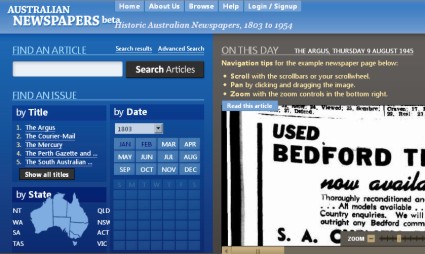
Australian Newspapers beta, http://ndpbeta.nla.gov.au/ndp/del/home

As regular readers will know, the Bioscope tries to keep an eye on the various newspaper and journal digitisation projects taking place around the world, some commercially-driven, some undertaken with public money. One long-awaited project has been the Australian Newspaper Digitisation Program, which has just reached the Beta test stage.

The National Library of Australia, in collaboration the Australian State and Territory libraries, is undertaking a huge, long-term programme to digitise out of copyright Australian newspapers. The aim is to produce a free online service allowing full-text searching of newspapers published in each Australian state an territory, from 1803 (when the first Australian newspaper was published, in Sydney), to 1954, when copyright kicks in (intriguingly late).

The programme is ongoing, but on 25 July a Beta service was released to the public, offering 70,000 newspaper pages from 1803 onwards, with additional pages to be added each week (as of 8 August there are 91,577 pages available). The service is very much in test mode, and they request that users provide feedback (while bearing in mind that the service is not official as yet).

So, how do we go about using it, and what is there to find on silent film? Simple search options are by any word within a text (uncorrected OCR), newspaper title (currently eleven on offer), state and date (with an attractively laid-out calendar option). You can use inverted commas to search on a phrase. The many advanced search options include combinations of terms, range of dates, length of article, and the option to search under types of article – advertising, detailed lists etc., family notices, news, and illustrated. You can also sort results by relevance, earliest or most recent date. In short, all the useful options that you would hope to see.

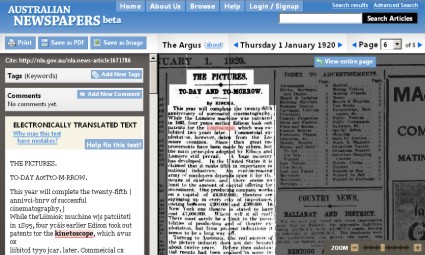
Article display page

Search results give a list of article titles with the name of the newspaper, date, page number and the first few lines of OCRed text. Most usefully, you are also given links for the same search term to the Australian National Bibiliographic Database and Picture Australia. The Article Display page, as illustrated above, shows the article with the search term highlighted, a zoom option and option to see the full page. On the left is the uncorrected OCR text, and options to add your own tags or comments (if you are logged in). And you can print, save as PDF, or save as image. Which pretty much covers everything.

On film subjects, there is plenty – though with some surprising gaps, probably explained by the absence of those editions yet to be digitised. Inevitably, there much to be found on the early Australian film business itself. So, our traditional text term ‘kinetoscope’ yields only two hits (both from the 1920s). ‘Charlie Chaplin’ scores 927, ‘Mary Pickford’ 600, ‘Norma Talmadge’ 175, ‘Kinemacolor’ 32, ‘Vitagraph’ 123, ‘Cinematograph’ 685, and so on. Turning to Australian silent films, good subjects to investigate include ‘On Our Selection’ (280, but that includes stage versions and the 1932 sound film as well as the 1920 silent), ‘West’s Pictures’ (281 for a renowned exhibitor), ‘Frank Hurley’ (83 for Australia’s national photographer), ‘Australasian Films’ (79 for the leading native film company) and ‘Raymond Longford’ (27 for the film director).

Finally, if you visit the Browse page, there’s a list of all the tags (keywords) that have been used to classify items – these include ‘classic movies’, ‘movie stars’ and ‘silent films’, but sadly only one article so far is so described. Time for us all to get tagging.

I’ll be doing a fresh round-up of newspaper digitisation sites some time soon. Meanwhile, go explore.

Welcome to Newsfilm Online

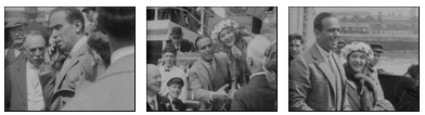
Southampton: Arrival of Mary Pickford & Douglas Fairbanks, Gaumont Graphic, 21 June 1920, from http://www.nfo.ac.uk

Quietly launched this week (with an official launch due in October) is Newsfilm Online. This is 3,000 hours of UK cinema newsreel and television news content, dating 1910s-2000s, all of it taken from the collection of ITN Source. ITN is the UK’s largest commercial footage library, (if you don’t count the BBC as such), and doesn’t just own ITN news programmes, such as News at Ten and Channel 4 News, but most of the UK’s newsreel archives (Pathe, Paramount, Gaumont, Universal). The 3,000 hours (about 2% of the ITN news collection) have been digitised and made available for free downloading and re-use, so long as you are a member of a subscribing UK institution of higher or further education. Sadly that’s going to leave out a lot of you, but the project was funded by the Joint Information Systems Committee, which exists to support UK HE/FE (as we call it in the trade), and the conditions under which the newsfilms were digitised stipulated that they would be available to HE/FE users only.

But despair not, because although you may not be able to see the films, the catalogue records are searchable and browsable by all. And for the silent era, there are 1,241 news stories from the 1910s and 5,091 from the 1920s, making this a marvellously rich resource for historical study, even without the films themselves – not least because you get thumbnail images, like those of Doug and Mary illustrated above. It’s supposed to be every example of the Gaumont Graphic newsreel held by ITN, and shopws how alert the newsreels were to the stories, concerns, fads and personalities of their era. The thumbnails alone excitingly bring the 1910s and 20s back to vivid, varied life.

Remarkably, the publication of Newsfilm Online means that the majority of British newsreels (I’d guess between 80-85%), 1910-1979, are now digitised, encoded and available on the Web in one form or another, albeit with restricted access in some cases (the Paramount and Universal newsreels are the big gaps). That’s a sensational thing to be able to report, achieved in little over five years by a mixture of public money (around £3.5M, at a rough guess, though the £2M that Newsfilm Online cost was for TV news as well as its Gaumont newsreels) and private (no idea how much). The four main sources (with the silent newsreels that they include) are:

  • British Pathe – including Pathe Gazette, Eve’s Film Review, freely available (low resolution)
  • British Movietone News – Movietone itself was a sound newsreel, but the site include a rag-bag collection of silent actualities, freely available (low and middling resolution)
  • Newsfilm Online – includes Gaumont Graphic, movies available to subscribing UK educational institutions only
  • Screenonline – the BFI online ‘encyclopedia’ has many examples of the Topical Budget newsreel, movies available to UK schools, colleges and libraries only

What a fantastic achievement. Having played a small part in making NfO (as we call it in the trade) happen, I’m just a little bit chuffed to see it published at last. For a record of most British newsreel stories in one place, I warmly recommend the British Universities Newsreel Database (still has some gaps to fill for silent newsreels), which also lists other digitised newsreel collections around the world (Australia, France, Germany, Italy, Sweden – America, alas, lags seriously behind).

Let’s have every newsreel around the world available online – it can be done; it would delight and benefit so many if it could be done.

Watching silents online

Harry Langdon, Mabel Normand, Roscoe Arbuckle and Max Linder, from http://slapstick-comedy.com

The recent post on the British Film Institute’s YouTube page made me think it would be useful to provide a round-up of the major online sources where you can legitimately and freely view and sometimes download silent films. It’s important to note that most mainstream silents are not going to be found online (except illicitly) but only on DVD (if at all). Online sources are most likely to have very early and non-fiction films, either because there are no rights issues or, conversely, because it is to someone’s advantage to advertise such content for footage sales (notably the newsreel libraries).

If you follow the Online Videos link in the Categories section on the right-hand column you’ll find all the posts in the past which have discussed such sources, in one form or another, but here’s that handy overview:


American Memory
The Library of Congress’ American Memory digitised materials site remains a world beater. There are several sections on the site which include silent films, such as Edison titles, early animation, variety films and films of New York – see the Bioscope’s guide to the site for more information.

australianscreen
First-rate Australian educational resource, with 100 years of Australian feature films, documentaries, television programmes, newsreels, short films, animations, and home-movies, including much silent material. The guide written here will help locate things.

Black Film Center/Archive
A selection of downloadable early films (QuickTime) showing African-Americans, including Edison’s The Pickanninies (1894) and A Morning Bath (1896). Produced by Indiana University’s Department of Afro-American Studies.

British Film Institute
The BFI has several outlets for online video. Its Screenonline resource is an encyclopedia of British film and television, with extensive silent film materials (with strong emphasis on non-fiction) but licensing issues means that the video content itself is only accessible to schools, colleges and libraries in the UK. Free to all is its YouTube channel, which has a fascinating mix of oddities, including many silents. Its Creative Archive site makes a small number of mostly silent videos available for free download and re-use, under licence.

British Movietone News
Unlike British Pathe (see below), this freely-available British newsreel collection (covering 1929-1979) is little-known outside the commercial footage sector. However, it also contains a fascinating and varied collection of pre-1929 material, much of it the Henderson Collection of early film subjects. The post on this collection supplies a guide to some of the gems to be found there. It’s all freely-available, but prior registration is required.

British Pathe
This British newsreel collection covers the period 1896-1970, though the pre-WWI material is a peculiar mishmash of news and some fiction material, a guide to which is available here, with a guide to the silent newsreel collection itself available here. The films can all be downloaded for free, in somewhat frustratingly low resolution form, for which prior registration is required.

DG
QuickTime extracts from the films of D.W. Griffith – Biograph shorts as well as the feature films – part of the range of interconnected silent film sites maintained by David B. Pearson.

The Early Cinema
A selection of Quick Time movie clips of films made by Biograph and Edison from the 1897-1905 period, which derive from the Library of Congress Paper Print Collection.

Europa Film Treasures
Rich pot pourri of mostly silent films from archives around Europe, bringing together dramas, comedies, tricks films, travel, animation, propaganda and pornography. The Bioscope report on the resource is here. The site owners, Lobster Films, promise an improved service (some have had problems with download times) soon.

Gallaudet University Video Library
Uncovering something of the history of deaf people and silent cinema has been one of the real pleasures since starting the Bioscope; this site includes several films for the deaf made during the silent period. The Bioscope post on the collection explains the history and how to find the relevant titles.

Gaumont Pathé Archives
Database of the French Gaumont, Pathé and Éclair newsreels, from 1896, searchable by keyword and date. It has large number of streamed video copies of the newsreels, for which log-in access is required.

Internet Archive
The Internet Archive’s Movies section offers a huge number of freely available and downloadable movies, which we must assume are all in the public domain (under US law). The silents can mostly be traced through the keywords option under Feature Films, and range from early Chaplin to 1930s Chinese dramas. Key titles available include 20,000 Leagues under the Sea, Man with a Movie Camera, Battleship Potemkin, Nosferatu, Sherlock Jr, The Cabinet of Dr Caligari and The Hunchback of Notre Dame.

Open Video Project
An international repository of digitised video content designed for the research community, which includes nearly 200 early Edison titles, most of which won’t be found on the American Memory site (see above). More information on the contents is in the Bioscope posting on the collection.

Realmilitaryflix
650 freely-available films covering conflicts from the First World War to Afghanistan today. See this report on some of the remarkable First World War documentary and actuality content available on the site.

Scottish Screen Archive
Over sixty films from the silent era are available among the 1,000 or so films included on this exceptional resource from the Scottish Screen Archive, Scotland’s national film collection.

Slapstick
A range of silent comedy clips from David B. Pearson in MPEG4 format: Chaplin, Keaton, Lloyd, Normand, Langdon, Arbuckle, Linder, Semon, Pollard, Lane…

Videos with Bibi
YouTube is awash with silent material, much of it lifted from DVDs. It’s immoral if not criminal for the most part, but it also makes so much available that most would never otherwise see, and some of what’s available is legitimately there (how is the average punter to judge?). This site provides a guide to vintage film content on YouTube, and has a silents section.

WildFilmHistory
Clips from 100 years of filming wildlife, with thirteen (so far) precious titles from the silent era, from filmmakers such as Percy Smith, Oliver Pike and Cherry Kearton. More information here.


There are many other sites with a small number of clips, and some which are only available to university users (e.g. Film and Sound Online, which has many First World War titles from the Imperial War Museum). There are a number of download sites offering public domain (US) titles, but most of these films turn up on the Internet Archive in any case. Undoubtedly others that should be listed above that I’ve forgotten or never knew about in the first place. Do let me know of other such sites and I’ll add them to this post to make it a standard reference guide.

The Silent Film Bookshelf

The Silent Film Bookshelf was started by David Pierce in October 1996 with the noble intention of providing a monthly curated selection of original documents on the silent era (predominantly American cinema), each on a particular theme. It ended in June 1999, much to the regret to all who had come to treasure its monthly offerings of knowledgeably selected and intelligently presented transcripts. The effort was clearly a Herculean one, and could not be sustained forever, but happily Pierce chose to keep the site active, and there it still stands nine years later, undeniably a web design relic but an exceptional reference resource. Its dedication to reproducing key documents helped inspire the Library section of this site, and it is a lesson to us all in supporting and respecting the Web as an information resource.

Below is a guide to the monthly releases (as I guess you’d call them), with short descriptions.

October 1996 – Orchestral Accompaniment in the 1920s
Informative pieces from Hugo Riesenfeld, musical director of the Rialto, Rivoli and Critierion Theaters in Manhattan, and Erno Rapee, conductor at the Capitol Theater, Manhattan.

November 1996 – Salaries of Silent Film Actors
Articles with plenty of multi-nought figures from 1915, 1916 and 1923.

December 1996 – An Atypical 1920s Theatre
The operations of the Eastman Theatre in Rochester, N.Y.

January 1997 – “Blazing the Trail” – The Autobiography of Gene Gauntier
The eight-part autobiography (still awaiting part eight) of the Kalem actress, serialised over 1928/1929 in the Women’s Home Companion.

February 1997 – On the set in 1915
Photoplay magazine proiles of D.W. Griffith, Mack Sennett and Siegmund Lubin.

March 1997 – Music in Motion Picture Theaters
Three articles on the progress of musical accompaniment to motion pictures, 1917-1929.

April 1997 – The Top Grossing Silent Films
Fascinating articles in Photoplay and Variety on production finance and the biggest money-makers of the silent era.

May 1997 – Geraldine Farrar
The opera singer who became one of the least likely of silent film stars, including an extract from her autobiography.

June 1997 – Federal Trade Commission Suit Against Famous Players-Lasky
Abuses of monopoly power among the Hollywood studios.

July 1997 – Cecil B. DeMille Filmmaker
Three articles from the 1920s and two more analytical articles from the 1990s.

August 1997 – Unusual Locations and Production Experiences
Selection of pieces on filmmaking in distant locations, from Robert Flaherty, Tom Terriss, Frederick Burlingham, James Cruze, Bert Van Tuyle, Fred Leroy Granville, H.A. Snow and Henry MacRae.

September 1997 – D.W. Griffith – Father of Film
Rich selection of texts from across Griffith’s career on the experience of working with the great director, from Gene Gauntier, his life Linda Arvidson, Mae Marsh, Lillian Gish and others.

October 1997 – Roxy – Showman of the Silent Era
S.L. Rothapfel, premiere theatre manager of the 1920s.

November 1997 – Wall Street Discovers the Movies
The Wall Street Journal looks with starry eyes at the movie business in 1924.

December 1997 – Sunrise: Artistic Success, Commercial Flop?
Several articles documenting the marketing of a prestige picture, in this case F.W. Murnau’s Sunrise.

January 1998 – What the Picture Did For Me
Trade publication advice to exhibitors on what films of the 1928-1929 season were likely to go down best with audiences.

February 1998 – Nickelodeons in New York City
The emergence of the poor man’s theatre, 1907-1911.

March 1998 – Projection Speeds in the Silent Film Era
An amazing range of articles on the vexed issue of film speeds in the silent era. There are trade paper accouncts from 1908 onwards, technical papers from the Transactions of Society of Moving Picture Engineers, a comparative piece on the situation in Britain, and overview articles from archivist James Card and, most importantly, Kevin Brownlow’s key 1980 article for Sight and Sound, ‘Silent Films: What was the right speed?’

April 1998 – Camera Speeds in the Silent Film Era
The protests of cameramen against projectionsts.

May 1998 – “Lost” Films
Robert E. Sherwood’s reviews of Hollywood, Driven and The Eternal Flame, all now lost films (the latter, says Pierce, exists but is ‘incomplete and unavailable’).

June 1998 – J.S. Zamecnik & Moving Picture Music
Sheet music for general film accompaniment in 1913, plus MIDI files.

July 1998 – Classics Revised Based on Audience Previews
Sharp-eyed reviews of preview screenings by Wilfred Beaton, editor of The Film Spectator, including accounts of the preview of Erich Von Stroheim’s The Wedding March and King Vidor’s The Crowd, each quite different to the release films we know now.

August 1998 – Robert Flaherty and Nanook of the North
Articles on the creator of the staged documentary film genre.

September 1998 – “Fade Out and Fade In” – Victor Milner, Cameraman
The memoirs of cinematographer Victor Milner.

October 1998 – no publication

November 1998 – Baring the Heart of Hollywood
Somewhat controversially, a series of articles from Henry Ford Snr.’s anti-Semitic The Dearborn Independent, looking at the Jewish presence in Hollywood. Pierce writes: ‘I have reprinted this series with some apprehension. That many of the founders of the film industry were Jews is a historical fact, and “Baring the Heart of Hollywood” is mild compared to “The International Jew.” [Another Ford series] Nonetheless, sections are offensive. As a result, I have marked excisions of several paragraphs and a few words from this account.’

December 1998 – Universal Show-at-Home Libraries
Universal Show-At-Home Movie Library, Inc. offered complete features in 16mm for rental through camera stores and non-theatrical film libraries.

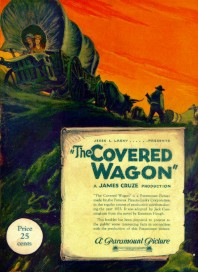
January 1999 – The Making of The Covered Wagon
Various articles on the making of James Cruze’s classic 1923 Western.

February 1999 – From Pigs to Pictures: The Story of David Horsley
The career of independent producer David Horsley, who started the first motion picture studio in Hollywood, by his brother William.

March 1999 – Confessions of a Motion Picture Press Agent
An anonymous memoir from 1915, looking in particular at the success of The Birth of a Nation.

April 1999 – Road Shows
Several articles on the practive of touring the most popular silent epics as ‘Road Shows,’ booked into legitimate theatres in large cities for extended runs with special music scores performed by large orchestras. With two Harvard Business School analyses from the practice in 1928/29.

May 1999 – Investing in the Movies
A series of articles 1915/16 in Photoplay Magazine examining the risks (and occasional rewards) of investing in the movies.

June 1999 – The Fabulous Tom Mix
A 1957 memoir in twelve chapters by his wife of the leading screen cowboy of the 1920s.

And there it ended. An astonishing bit of work all round, with the texts transcribed (they are not facsimiles) and meticulously edited. Use it as a reference source, and as an inspiration for your own investigations.