The spice of life

One of the frustrating things for the online early film researcher has been the lack of film reviews available from the film trade press, as opposed to those in newspapers, whose digitised availability has been covered here several times. One exception in the Pacific Film Archive’s Cinefiles database, mentioned recently. Another is the venerable American film journal Variety, a selection of whose archive reviews are being put online.

It’s only a selection, so one hopes that it will continue to grow, but what’s there already is choice stuff, not least because they’ve selected some of the more familiar titles from the silent era. Seaching is either by word or by year, with a calendar of hyperlinks to individual years (some of them divided up into quarters). So, for the earliest year of the archive, 1914, you can find reviews on The Battle of the Sexes, The Escape, Home Sweet Home, Judith of Bethulia, Tess of the Storm Country and Tillie’s Punctured Romance. While for 1923 you get Anna Christie, Safety Last, The Christian, The Covered Wagon, Fury, Hollywood, The Hunchback of Notre Dame, Our Hospitality, Peg O’ My Heart, Ruggles of Red Gap, Scaramouche, The Ten Comandments, The Three Ages, The Wandering Jew and A Woman of Paris. Quite a year.

As a sample (from 1923) of what you’ll find, here’s that rarity for the time, Variety saying something positive about a British film:

The Wandering Jew

Stoll. Director Maurice Elvey; Screenplay Alicia Ramsey

Matheson Lang
Hutin Britton
Malvina Longfellow
Isobel Elsom
Florence Sanders
Shayle Gardner

With this Stoll picture Matheson Lang established a right to be regarded as a screen star. Throughout his impersonation of the Jew, condemned to wander through the ages, arrogant, proud, though broken-hearted, ever within reach of happiness, but always overtaken by disaster just as he is about to grasp his heart’s desire, is masterly.

The story follows the Temple Thurston play fairly close. In the opening scenes we see the Jew, Matathias, and his lover, Judith, his reviling of the Saviour on His way to Calvary and the dreadful outlawry which sent him into the world a wanderer. Thirteen hundred years pass and he is among the Crusaders; again a lovely woman loves him, but again fate stands between him and happiness, and so the story goes down the years until at last the Inquisition gives him the peace and eternal rest which before have always been denied him.

Spectacularly, the production is very fine and the subject is treated with great reverence by Maurice Elvey.

Conversely, here’s Variety in 1928 somewhat at variance with posterity, dismissing a film now widely considered to be one of the outstanding masterworks of the silent cinema:

The Wind

M-G-M. Director Victor Seastrom; Screenplay Frances Marion, John Colton; Camera John Arnold; Editor Conrad A. Nervig; Art Director Cedric Gibbons, Edward Withers

Lillian Gish
Lars Hanson
Montagu Love
Dorothy Cumming
Edward Earle
William Orlamond

Some stories are just naturally poison for screen purposes and Dorothy Scarborough’s novel here shows itself a conspicuous example. Everything a high pressure, lavishly equipped studio, expert director and reputable star could contribute was showered on this production. Everything about the picture breathes quality. Yet it flops dismally.

Tragedy on the high winds, on the desolate desert prairies, unrelieved by that sparkling touch of life that spells human interest, is what this picture has to offer. It may be a true picturization of life on the prairie but it still remains lifeless: and unentertaining.

The story opens with an unknown girl, Letty (Lillian Gish), from Virginia, train-bound for her cousin’s ranch, which she describes as beautiful to the stranger, Roddy (Montagu Love), who has made her acquaintance informally.

Roaring, blinding wind and sandstorms immediately frighten the girl. She remains in a semi-conscious state of fright throughout, excepting at the close of the picture.

At Beverly’s (Edward Earle) ranch the girl becomes too popular with Cora’s (Dorothy Cummings) children and is forced to leave. The girl then accepts a proposal from Lige (Lars Hanson), whom she had laughed at the night before. During a round-up of wild horses, brought down by a fierce northern gale, Roddy forces his way into Lige’s home and stays there for the night with Letty.

All in all, a very welcome selection of classic reviews (which goes on up to the present day), which hopefully may be expanded in due course.

CineFiles

CineFiles

CineFiles is the film document image database of the Pacific Film Archives, Berkeley, California. The database comprises reviews, press kits, programme notes, newspaper articles and other documents from the Archive’s library collection. The documents cover world cinema, past and present. Over 25,000 films are represented, and their target figure is 200,000 documents, with more being added daily.

You can search by document (under title, author, date or publisher, or for documents about specific films, people, or subjects) or filmographic data (under title, subject, genre, director, year, country, or studio). There doesn’t seem to be any easy way of isolating silent films (typing in ‘silent’ into the subject field only brings up three titles), so you will have to search by title, director or specific year for the best results.

The collection is particularly strong on Russian and Soviet cinema, so, as an example, the record for Protazanov’s Pikovaia dama (The queen of spades) (1916), erroneously given as a Soviet Union production (in 1916 the country was still Russia), provides the researcher with the following:

Title: Pikovaia dama (The queen of spades)
Director: Protazanov, Iakov Aleksandrovich
Country of Prod.: Soviet Union
Year: 1916
Language: Russian
Production Co.:
Genre: Adaptation, Horror
Subject: Gamblers — Drama, Ghosts — Drama

Related Documents:

1. Silent witnesses — excerpt – Tsivian, Yuri – British Film Institute – 1989 – 3 pages – – book excerpt

View full description of this document
View page images: Pg. 1, Pg. 2, Pg. 3

2. Costumes and classics – – National Film Theatre (London, England) – 1990 Feb 04 – 1 page – – program note

View full description of this document
View page images: Pg. 1

3. Pikovaya dama (the queen of spades) – Borger, Lenny – Variety – 1990 Mar 21 – 1 page – – review

View full description of this document
View page images: Pg. 1

4. Queen of spades – – Mary Pickford Theater (Library of Congress, Washington, D.C.) – 1992 Apr – 1 page – – program note

View full description of this document

5. The queen of spades – – Pacific Film Archive – – 2 pages – – program note

View full description of this document
View page images: Pg. 1, Pg. 2

6. The queen of spades – Svolkein, N. – – – 4 pages – – intertitles

View full description of this document
View page images:
Pg. 1, Pg. 2, Pg. 3, Pg. 4

7. The queen of spades – Svolkein, N. – – – 1 page – – intertitles

View full description of this document
View page images: Pg. 1

8. The queen of spades – Bolotnikov, Vladimir – – – 4 pages – – intertitles

View full description of this document
View page images:
Pg. 1, Pg. 2, Pg. 3

9. Mosjoukine — excerpt – – – – 3 pages – – book excerpt

View full description of this document
View page images: Pg. 1, Pg. 2, Pg. 3

The page image references are links to GIF or JPEG images of book extracts, programme notes etc. The document search option has some very useful means to narrow a search, including type of document (advertisement, bibliography, book excerpt, correspondence, obituary etc.), and further options are provided to search by documents with box office information, production costs, illustrations etc. Some of the documents are surprisingly long, though it is a little frustrating that the pages are provided as separate image files rather than brought together, for example in PDF format.

There doesn’t seem to be much in the way of older original documents (e.g. posters, press materials, lobby cards for silent films) but the database offers a very handy guide to the critical literature (copyright clearance has been obtained for all the page images they publish). It’s plainly set out and simple to use. Go explore.

19th Century British Library Newspapers

Graphic

http://www.bl.uk

You will have to be a member of a UK university of college of further education, or else a visitor to the British Library (St Pancras or Colindale), but if you are one of those lucky souls you will be able to make use of 19th Century British Library Newspapers, the latest digitised newspaper resource. This is a collection of 2,000,000 pages from forty-eight newspapers and journals which ran during the period 1800-1900. For copyright and trademark reasons, the project (funded by the Joint Information Systems Committee, which has paid out millions for a number of mass digitisation projects designed to benefit UK HE/FE) had a cut off date of 1900.

Of the forty-eight titles that were selected (none could be titles still running today, such as The Times or Guardian), these cover the 1890s period when motion pictures first came on the scene:

Aberdeen Journal (Coverage: Jan 06, 1800 – Jun 30, 1900)
Baner Cymru (Coverage: Mar 04, 1857 – Dec 29, 1900)
Belfast News-Letter (Coverage: Jan 01, 1828 – Dec 31, 1900)
Birmingham Daily Post (Coverage: Dec 04, 1857 – Sep 29, 1900)
Bristol Mercury (Coverage: Jan 04, 1819 – Jun 25, 1900)
Daily News (Coverage: Jan 21, 1846 – Dec 31, 1900)
Derby Mercury (Coverage: Jan 02, 1800 – Dec 26, 1900)
Era (Coverage: Sep 30, 1838 – Dec 29, 1900)
Freeman’s Journal (Coverage: Jan 01, 1820 – Sep 29, 1900)
Genedl (Coverage: Feb 08, 1877 – Dec 25, 1900)
Glasgow Herald (Coverage: Feb 04, 1820 – Dec 31, 1900)
Goleuad (Coverage: Oct 30, 1869 – Dec 26, 1900)
Graphic (Coverage: Jan 01, 1870 – Dec 29, 1900)
Hampshire/Portsmouth Telegraph (Coverage: Jan 06, 1800 – Dec 29, 1900)
Illustrated Police News (Coverage: Jan 05, 1867 – Dec 29, 1900)
Ipswich Journal (Coverage: Jan 04, 1800 – Dec 29, 1900)
Jackson’s Oxford Journal (Coverage: Apr 03, 1762 – Dec 29, 1900)
Leeds Mercury (Coverage: Jan 03, 1807 – Dec 31, 1900)
Liverpool Mercury (Coverage: Jul 05, 1811 – Dec 31, 1900)
Lloyd’s Illustrated Newspaper (Coverage: Nov 27, 1842 – Dec 30, 1900)
North Wales Chronicle (Coverage: Oct 04, 1827 – Dec 29, 1900)
Northern Echo (Coverage: Jan 01, 1870 – Dec 31, 1900)
Pall Mall Gazette (Coverage: Feb 07, 1865 – Dec 31, 1900)
Preston Chronicle (Coverage: Jan 01, 1831 – Dec 02, 1894)
Reynolds’s Newspaper (Coverage: May 05, 1850 – Dec 30, 1900)
Trewman’s Exeter Flying Post (Coverage: Jan 02, 1800 – Dec 29, 1900)
Western Mail (Coverage: May 01, 1869 – Dec 31, 1900)

This is a sensational selection, which should certainly lead researchers beyond the obvious and familiar to some of the other major newspapers of the day (The Daily News, The Graphic) as well as neglected local newspapers. Digitisation is not just about making things easy, but about opening up new avenues of enquiry, enriching the learning experience. Particularly exciting for film researchers is the digitisation of The Era, the theatrical trade journal, which is a marvellous source of information on the early film business in Britain. Music halls and theatres were the usual exhibition outlets for the first films, and The Era is rich is advertisements, reviews, and articles on the new phenomenon.

I tested out the Bioscope’s favourite test keyword, Kinetoscope, and got 431 hits. As an example of the riches on offer, here’s a review of the very first film exhibition in Britain, the Kinetoscope show at 70 Oxford Street, London. A press showing was held on 17 October 1894, and this report appeared the day after in The Daily News:

THE KINETOSCOPE

This is the ugly name of a beautiful thing. It is a sort of improved zoetrope. Gazing through a peep-slot in a wooden case the spectator beholds a barber shop, wherein a customer seats himself, is lathered and duly shaved. It is a “living picture” of a new order. To take another example – a skirt-dancer is seen amid her floating drapery, and she bends her knees, travels on her toes, and indulges in a giddy spin. It is just as one sees her on the stage. Again, two pugnacious cocks try conclusions, and as the encounter waxes warm their feathers fly; other peep-slots reveal a blacksmith exercising the muscles of his brawny arm in the fashioning of a shoe; a female acrobat exhibiting some curious contortions; and a disreputable fight in the bar-room of a public-house. The question naturally arises, How is it all done? A general idea of the invention can be conveyed in a few words. Mr. Edison has contrived a camera that will take photographs at the rate of forty-three a second, thereby recording, at imperceptible intervals, the successive phases of movement. If these may be described as snap-shots they are the snap-shots of a photographic Maxim gun. The views are taken on an endless film, and set in such rapid motion that the pictures pass through the field of vision at the rate of two hundred and eighty a minute. Mr. F.Z. Maguire is Mr. Edison’s European representative, and he permitted a private view of the invention last night, at 70 Oxford-street, W., the specimen shown being those indicated above. Mr. Maguire did not say whether the mechanism is susceptible of being reversed. It is conceivable that people would be amused to see the accomplished act revoked, and the clean-shaven man become the man in need of a shave. Mr. Edison is seeking to combine the principles of the phonograph and kinetoscope, so that one may watch the gestures of the orator while listening to the words that have escaped his lips.

Quite a first review. F.Z. Maguire is Franck Zeveley Maguire, one half of Maguire and Baucus, the Edison agents whose British business went on to become the Warwick Trading Company. The Edison films shown include Blacksmith’s Shop, Cock Fight, The Bar Room and Barber Shop. The dancer could be Annabelle or Carmencita, while the contortionist is presumably Ena Bertoldi, although film of her is not usually mentioned among those featured at this first British film show.

So, a wonderful resource, and probably just a little bit annoying to anyone not in UK higher and further education or without easy access to the British Library. There are rumours however of Gale (the company behind the Times Digital Archive) eventually making the resource available to anyone, via subscription.

Quellen zur Filmgeschichte und einiges anderes

I was delighted to find that Herbert Birett’s site Quellen zur Filmgeschichte und einiges anderes is still active. I lost track of it some years ago, when it seemed to have taken down, but it is alive and well under the more memorable web address www.kinematographie.de. Birett is an assiduous chronicler of German film history, whose speciality is filmographies based on censorship files and other forms of official records. His major work is the book Das Filmangebot in Deutschland, a listing of 17,000 films shown in Germany 1895-1911, which he sells for €70, but there is much of his site that he makes freely available.

There is a title list for all German films 1921-1930; Weimer Republic censorship records 1922-1932; a bibiliography of German film monographs to 1914; a listing of German movie journals to 1920s with notes as to their location in libraries; plus other resources for German sound films. It’s in German, but with some helpful short descriptions in English for each section. Birett’s work is exemplary, and the site is a key resource for the specialist.

Guardian Digital Archive

As promised, The Guardian (1821-1975) and The Observer (1900-1975) newspapers have been placed online from today. The web address is http://archive.guardian.co.uk.

This is another huge boon for research in our area, and I’ve found and downloaded assorted gems from The Guardian already. A powerful eye-witness account of the Bazar de la charité fire in Paris (6 May 1897, p 8), an enthusiastic report on microcinematography (15 August 1903, p. 7), a leader on the rise of the picture theatre (3 July 1911, p 6), a report on Maurice Elvey filming Hindle Wakes (set in Lancashire) (28 October 1926, p 11), a fascinating article on watching films in Moscow in 1927 (5 January 1927, p 16), and a wonderful piece on ‘Flicker Alley’ (17 October 1911, p 14), the name given for Cecil Court, the short London street near Leicester Square, which was the home of London’s early film businesses before they all moved on to Wardour Street.

Its windows show wild-looking mechanical contrivances that, whatever they may really be, always seems so concentrated that one thinks of them as the very intestines of machinery; and the men who go in and out of the doors (usually in groups of four or five with a voluable one a little ahead) having a hustling, sharp-eyed, yet half-whimsical look … The cinematograph trade is yet too young to have evolved a type, but it seemed to me that the denizens of Flicker Alley (as they call this passage) all have something characteristic that marks them off from ordinary men. Possibly the endless films they look at affects the eye-nerves or teahes the mind to think of the eye as something to switch off and on – a glance, a calculation, another look, a “glad eye,” another calculation, and so on. They flicker. Their conversation flickers too, mainly in rapid Yankee slang jerked at a hard pace, a well-known figure there creating the flicker illusion best with an inimitable stutter. They run about all over Europe and America, these quick, handy, cheery people, and some seek to rival the cosmopolitanism of the cinematograph by making their speech a compote of foreign catchwords. You see no old men. The “father of the trade” looks about forty. With them antiquity was last week, and posterity is coming round to look at their films to-morrow.

I wrote earlier that the service would be free for the first month, but I was wrong – it is half price for this month, which means, for instance, that a twenty-four hour pass will cost you £3.97. Use the Advanced Search, not the Simple Search, as it allows you to sort results in date order, and to search across articles, or picitures, or advertisements. Searching itself is free; you pay to see the article, which can be printed or stored in a MyCollection page.

Some quibbles. I couldn’t make images print using Firefox; use Explorer instead. The search results give you an image of the heading of the item, which does not always indicate when it is relevant to your search, and some time is wasted opening up irrelevant pages. Your search word is underlined in blue on the selected documents, which has the unfortunate effect of sometimes obscuring the words underneath. You only get four or five results per page, which is frustrating and makes searching for the right record more of a chore than it should be. You cannot go from an article you’ve viewed to the rest of the newspaper for that day, though there is an alternative browse option which lets you look at the full newspaper for any one day. But you cannot narrow subject searches by day, or even year.

Minor gripes aside, this is a treasure trove. Remember that for most of this time period, the Guardian was based in Manchester, which gives a different slant to its news coverage. Also, despite The Observer search option saying that covers 1900-1975, there seem to be no records available prior to 1932.

Update: The Guardian is currently offering a free introductory 24-hour pass to its Digital Archive, presumably for a short period only.

New York State Archive film scripts

Here’s a good research resource which I hadn’t come across before (and should have). New York State Archives has the largest collection of film scripts in the world, some 53,000. It makes available a database of its script index, covering the period 1921-1965 (it advertises itself as covering 1927-1965, but I’ve found records going back to 1921). This doesn’t give you the script itself, just the bare outlines of the production details, but these are more than valuable enough in themselves.

Each record gives you (and is searchable by) original title (there are many non-American films listed), title in English, country, year, writer’s last name, director’s last name, alternate film title, manufacturer, and exchange. The Motion Picture Commission began its work in 1921, but tragically almost all of the 18,000 scripts for silent films that passed through its hands are now lost. However, the outline records are still there, and form a hugely useful reference source by themselves, and for a lot of these titles the archives have associated documentation, but not the script itself.

The collection exists because, for forty-four years, New York state censorship required distributors to submit scripts for vetting, so anything exhibited theatrically in New York between 1921 and 1965 is going to be there. The archive also contains the apparatus of state film censorship – applications for licences, reviewers’ reports, notices of change in title or length etc., as well as the scripts. Scripts only start to be available from 1927. Frustratingly, there doesn’t seem to be any way to search on extant scripts for silent films. Nor can you combine search requests, so you can’t automatically look for all Walt Disney-produced films in 1924, for example. Minor gripes apart, this is a major gateway into the films of the 1920s.

It’s possible to order copies of scripts, if you are the copyright owner, or have the permission of the copyright owner, or can claim copies under a ‘fair use’ declaration. It may also be that you have to be a United States citizen – it’s unclear.

New York Morning Telegraph

Just found this out on alt.movies.silent. During a 1980s research project on William Desmond Taylor, Bruce Long photocopied the ‘Pacific Coast News’ column of the New York Morning Telegraph, 1914-1922. As Long says:

During the silent film era, the New York Morning Telegraph had more coverage of the film industry than any other daily New York newspaper; its coverage included a weekly column of movie news from Los Angeles, initially titled “Pacific Coast News.” As the film industry in Hollywood expanded, that column also grew in size. Many of the “news items” came directly from publicity agents, but they still provide a useful historic glimpse into Hollywood’s growing silent film industry. Major Hollywood news stories would have been given separate articles instead of a mention inside this column. The columnists of “Pacific Coast News” included Edward V. Durling, Clem Pope, Margaret Ettinger, and Frances Agnew.

Long has now dusted down his photocopies and put them online. They are JPEGs only, and not word-searchable, but it looks like a handy research source for the patient.

Now here comes the Guardian and Observer

Regulars will know that we try and keep up with the steady stream of digitised newspapers collections appearing across the world, which are opening up research into silent film (and a few other subjects besides, of course). The latest is the British newspaper The Guardian, along with its Sunday partner The Observer. This article was published recently in The Guardian‘s Media section (with thanks once again to the eagle-eyed David Pierce for alerting The Bioscope):

Every edition of the Guardian and Observer newspapers is to be made available via a newly launched online digital archive.

The first phase of the Guardian News & Media archive, containing the Guardian from 1821 to 1975 and The Observer from 1900 to 1975, launch on November 3.

It will contain exact replicas of the original newspapers, both as full pages and individual articles. and will be fully searchable and viewable at guardian.co.uk/archive.

Readers will be offered free 24-hour access during November, but after this trial period charging will be introduced.

The rest of the archive will launch early in 2008, making more than 1.2m pages of digitised news content available, with Observer content available from its launch as the world’s first Sunday newspaper in 1791.

New reports featured in the archive cover events including the 1793 execution of Louis XVI, the defeat of Napoleon at Waterloo in 1815, and the 1833 abolition of the slave trade, the first and second world wars and the assassination of the US president, John F Kennedy.

“The launch of the archive will revolutionise the way in which users are able to access our historic content, whether for academic research or personal interest,” said Gerard Baines, the head of syndication and rights, GNM.

“The archive will offer historical coverage to both consumers and academics of the most important events recorded during 212 years of publishing history,” GNM added in a statement.

“With microfilm stock and paper copy in danger of degrading beyond repair, the launch of the archive ensures the preservation of the papers’ legacy.”

Silicon Valley firm Olive Software started digitising the archive in December last year.

GNM chose ProQuest CSA to be the exclusive global distribution partner for universities, libraries and corporate accounts.

Rod Gauvin, the ProQuest senior vice-president of publishing, said: “The vivid and fearless reporting by both newspapers has set journalistic standards not only in the UK, but also worldwide.

“Indeed, globally many rely on the Guardian and the Observer for unbiased, thoughtful reporting on events in their own country.”

Fingers at the ready come November 3rd…

Family history for film historians

The Kiss in the Tunnel

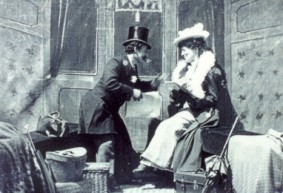
G.A. Smith (the filmmaker) and his wife Laura Bayley in A Kiss in the Tunnel (1899)

The huge growth in geneaology on the web in the past few years has also provided a wealth of resources for the film historian. This post is based on a talk I gave a couple of years ago at the British Silent Cinema festival, and provides a guide to the sorts of resources available (particularly but not exclusively British sources) and what the film historian may gain from them.

1901 census
There have been ten-yearly censuses in Britain since 1801, though until 1841 they did not record details of individuals. It was the launch of the 1901 census online in 2002 that helped generate the explosion of interest in family history, though the National Archives were not expecting the millions who tried to access the site on its publication, which led to its immediate crash and an awkward gap of several months before it was resilient enough to be published again.

The census is available at www.1901census.nationalarchives.gov.uk [update: the link is now www.1901censusonline.com]. The records will provide you with the name, age, place of birth, the county and parish where the census was taken, and the person’s occupation. Hence, type in ‘Cecil Hepworth’ and you will get two results:

Cecil Hepworth / 9 / Lancs Manchester / Chester / Macclesfield /
Cecil Hepworth / 27 / Lewisham / London / Streatham / Cinematographer

One is clearly a British film pioneer, the other a blameless child. You can then view the census record (image of the original form plus a transcription), which will give you all of those resident in Cecil Hepworth’s houshold on the day of the census. For this you need to pay, for which they have a credits system. 500 credits cost £5.00 and are valid for seven days. Viewing a single image takes up 75 credits.

If you are looking for an individual with an unusual name, locating them is easy. A more common name will require a bit more preparation – an idea of age, location etc. Typing in Alfred Hitchcock gets you 66 records (he’s the one aged 1, born in Leytonstone), while Charles Chaplin yields 151 records (he’s the one aged 12, living in Lambeth, occupation ‘Music Hall Artiste’). The full census record will tell you so much about who they lived with, their occupation, social status, and ultimately their ancestry.

Using the Advanced Search option is potentially very interesting, but also frustrating. It ought to be possible to search for everyone in 1901 who was working as a cinematographer, but to do so you have to enter at least two letters with wildcard (e.g. AB*) into the name field at the same time, so to trace everyone who might be a cinematographer in the 1901 census in theory would take 650 individual searches (in practice a lot of letter combinations could be rejected of course). Someone with the patience to do that is the film historian Stephen Bottomore, who conducted a search for profession beginning ‘cine*’, and found a remarkable list of names, most of whom are unknown to film history as yet. Here’s a selection (with transcription errors):

Name / Age / Where Born / Administrative County & Civil Parish / Occupation
Alvey, Harry / 19 / Notts Nottingham / Lancaster West Derby / Cinematograph Operater
Banford, George / 20 / London Hornsey / London Islington / Cinematic Image Maker
Barton, Benjamine / 40 / Warwick Birmingham / Birkenhead Birkenhead / Cinematographer Ethil
Bayliss, Thomas / 51 / Staffs Bradley / Leicestershire Measham / Cinematographic Artist
Brecksapp, Thomas / 27 / Brixton London / Sussex Hove / Cinematographer
Bromhead, Alfred / 24 / Hampshire Southsea / Surrey Kent / Penge London / Cinematograph Agent
Catlin, Edwin / 43 / London St Pancras / London Islington / Cinematograph Operator
Chadwick, Julia / 25 / Lanc Rochdale / Lancaster Rochdale / Cinematograph Operator
Clarke, Herbert / 27 / London St Pancras / London St Pancras / Cinematograph Proprietor
Cramer, Horace / 23 / Sussex Hastings / London Paddington / Cinematograph Operator
Croft, Emelina / 27 / Weybridge Surrey / Surrey Weybridge / Cinemelographer
Davey, Frederick / 20 / Surrey Croydon / Borough Of Oxford Cowley St John / Cinematsgraph Operator

Just the one well-known name there – Alfred Bromhead, who went on to run the Gaumont company in Britain. And astonishing to see two women cinematograph operators (which could be camera operators or projectionists or both). Stephen has kindly made his whole list available as a PDF. Do note that film people got described under a variety of terms – bioscope operator, photographer etc. – so Stephen’s list is just a start. The census gets released to the public one hundred years after it was made – 2011 is going to be quite a year for British film history research.

Update (January 2009): The 1911 census is now available online, published ahead of its centenary owing to an anomaly in the 1920 Census Act. Information on using it for film history research here.
Ancestry

http://www.ancestry.co.uk

Ancestry and FreeBMD

The 1901 census is a good place to start, but for a proper study of British, and international, records, you need FreeBMD and Ancestry. FreeBMD is one of those marvellous resources which the web has encouraged and pure human goodwill has sustained. It is a transcription of the Civil Registration index of births, marriages and deaths in the UK from 1837 to around 1900, and will eventually be complemented by free resources for census and parish register data. It’s all put together by volunteers, and though not quite finished yet it is an indispensible resource, which allows you to search across British births, marriages, deaths, or all three, assorted combinations of name, dates ranges, location etc. It won’t lead you to the documents themselves, and it helps to know a little about how civil registration data is organised to get the best out of it, but it is first-rate research tool.

And then there is Ancestry. Ancestry.co.uk and Ancestry.com are the big players in worldwide genealogy online. Here you will find births, marriages and deaths records for the UK 1837-c.1900, all UK census records 1841-1901 with digitised images of the census forms, local directories (including phone directories), US federal census data going back to 1820, some individual American states’ birth, marriage, divorce, death, military and census records, and much much more. Ancestry is continually adding new resources, and also links name searches to online family trees.

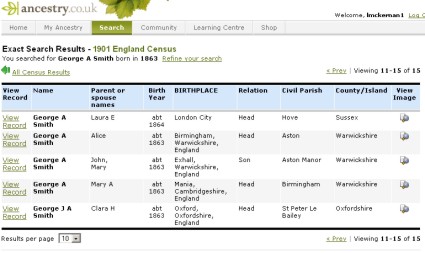
Most of this is not free. There is a variety of subscription options, on a pay-per-view basis, monthly, or annually, and either worldwide or restricted to your country. But for a few pounds a month (a monthly UK membership is £9.95) you can have access to every census record 1841-1901, and there are such marvellous things you can find. So, for example, I can trace Charles Urban – a particular interest of mine – aged 13, living in Cincinnati, in the 1880 US Federal census (freely available), through to the 1901 British census, where he is in London, aged 34, and described as ‘Manager Animated Pictures’. But beware! Ancestry’s transcriptions of census data are notoriously riddled with errors, and you have to be prepared to think laterally and to search under mispellings and the like. You won’t find Charles Urban in 1901 by searching on his name – it’s been mis-transcribed as Verban. As ever, it’s harder looking for common names. The frame grab from Ancestry above is the 1901 record for George Albert Smith, who I eventually found under George A. Smith, identifiable by his age, wife’s name (Laura) and location, Hove.

Other resources

Many people start out looking for family history information with the International Genealogical Index (IGI) or FamilySearch.org. This is the mind-boggling attempt by the Church of Jesus Christ of Latter-Day Saints (i.e. the Mormons) to create a register of all births, marriages and deaths, worldwide, as far as they possibly can, with the underlying intention of baptising anyone who might be their ancestors into their faith. The result is a directory of millions of names, taken from parish registers, census records, social sectority death records etc, plus information supplied by individual researchers. It is not primary source information, it is riddled with errors or dubious interpretations, and should only be used with caution, a pointer as to where to look next. For the film historian, it should not be the first point of call.

These are some other key genealogy resources not yet mentioned:

Genuki – a reference library of genealogical information for the UK and Ireland.

RootsWeb – a worldwide genealogical ‘community’ – a good place for posting questions about family names you may be researching.

Genes Reunited – family history based on the Friends Reunited principle, where the more people who join in and add data, the more comprehensive the resource.

ScotlandsPeople – the official source for Scottish genealogical information, including births/marriages/deaths, census records, parish registers and wills.

Findmypast.com – previously known as 1837online, this is a commercial site which as well census and civil registration records has migration and military records, and offers access to the index of birth, marriage and death records up to the 2002, including overseas records. This is less wonderful than it sounds, as they offer you page records, or groups of page records only, rather than individual name records, and searching for an individual takes ages, and becomes expensive.

General Register Office – from here you can order copies of birth, marriage and death certificates in the UK. There are national equivalents around the world, a growing number of which provide online ordering of certificates.

Ellis Island Records

http://www.ellisislandrecords.org

Passenger lists
And there’s more. Passenger list records are a key source for tracing film people sailing to different countries. Findmypast.com has co-operated with the National Archives to provide ancestorsonboard.com. This is a database of outward passenger lists for long-distance voyages leaving the British Isles from 1890 onwards. Eventually the resource will go up to 1960, and data up to the end of the 1930s has just been added. Name searching is free, but there is a charge for looking at the ships’ transcripts. As ever, it helps to be looking for a unusual name.

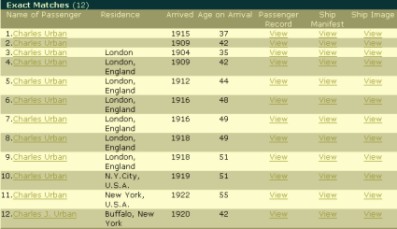
But the champion in this area is Ellis Island Records. This is a free resource free offering records of all those arriving at New York’s Ellis Island 1892-1924. This will give you the passenger details, where they came from and when they arrived in New York, plus the ship’s manifest (i.e. the full record of everyone travelling on that ship) as image or transcribed text. So you can not only get someone’s personal details, but who they were travelling with (family, friends, business associates), in what style (first class? steerage?), plus of course how often they travelled between Britain and America.

There is a whole lot more out there, and it can be a bit bewildering for the newcomer. As a guide through the maze of internet genealogy sources, the essential starting point is Cyndi’s List, which is the widely recognised leading sources of family history links, which is helpfully categorised by theme and country.

For reading, I recommend Peter Christian’s The Geneaologist’s Internet as a thorough and helpful guide through the thicket of online resources, what to expect from each one, their particular advantages and pitfalls.

There is a great deal that can be found in family history sources to benefit the film historian. Obviously if you are looking into the personal history of someone you are interested, these will be essential resources. But you can also learn about the social position of people in the film industry, their locality, mobility, business links, associates and self-image (Charles Urban calls himself ‘manager’ on some sources, on others he describes himself as ‘scientist’). Information from the records of one person will send you off researching other names that you hadn’t considered, and lateral use of the resources will open up new ways in which to examine film history. Who was Julia Chadwick, cinematograph operator from Rochdale, and Emelina Croft, cinematographer in Weybridge, Surrey? How did they get into the business? Who did they work with? What happened to them? The clues are there.

New York Times

New York Times

http://www.nytimes.com

Here on The Bioscope we’ve had several items on the digitised newspaper collections that are available online, both for free and via assorted subscription options. The latest news on this front promises to be the most significant such resource yet, especially for those of us interested in researching the history of early film.

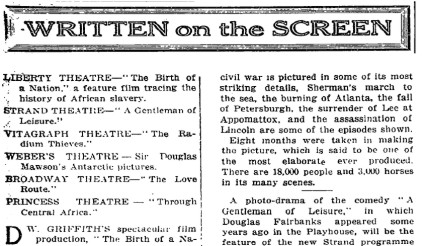
The New York Times has been available in digitial form back to 1851 for some time now, under subscription. Two things have just occured. Firstly, the NYT has dropped its subscription scheme, and now offers free access to its archives back to 1987, and for articles between 1923 and 1980 articles are available for purchase at $3.95 a time, or a ten-article pack of $15.95 (over a period of thirty days). But the sensational change as far as we’re concerned is that everything before 1923 is now held to be in the Public Domain, and hence is being made available for free.

The documents are available in PDF format only, though keyword searches operate across the whole texct, not just headlines. To access the service, go to the New York Times front page at www.nytimes.com and type in your search term in the search box, then select the option NYT Archive 1851-1980. If you are searching for a phrase, put this in inverted commas. You can sort the search results by closest match or date – newest or oldest first. Each result gives you the opening lines of the article, then the option to view the whole piece in PDF format. Articles from 1923 onwards give you a free preview of the opening lines. The first few searches are uninterrupted, but then it seems you have to register (for free), for which for some reason they want to know what you earn, your profession, and the number of people employed in your company. You may deal with such hurdles as you see fit.

It is amazing, and I can’t begin to tell the gems and discoveries I’ve made already in just a couple of hours’ searching. I’m still in shock at coming across a letter from 8 October 1905 which seems in all seriousness to recommend filming lynchings so they can reach a wider audience through the Kinetoscope. I’ve comes across Kinemacolor films I’ve never heard of before. And I’ve found such useful things on when terms first became common (I’d no idea before now that the word nickelodeon was in use before there were motion pictures). Though I suspect the first reference to the word ‘television’ in 1853 may be an OCR error… (but take a look at the article ‘Sending Photographs by Telegraph’ from 24 February 1907)

With this, the Chronicling America resource, and other newspaper collections covered in the Times Past and More Times Past posts, the research opportunities are just huge. How lucky we all are.

(My thanks to David Pierce for alerting me to this and other newspaper resources)