The Bioscope Man

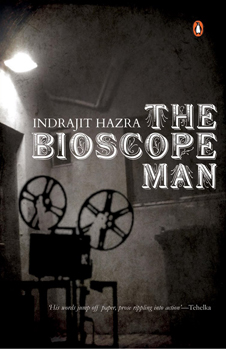
Just recently published in paperback, The Bioscope Man is a novel by Indrajit Hazra, which has its background the days of silent cinema in Calcutta. It tell of the rise and tragic fall of Abani Chatterjee in the 1920s Indian bioscope business, starting as projectionist’s assistant and ending up a star performer, only for ignominy and failure to follow. Other fiction and reality interestingly combine – among the characters in the book are Adela Quested (from E.M. Forster’s A Passage to India) and Fritz Lang, who comes to India to make a film starring Chatterjee but ends up producing Metropolis instead. As with many aspects of Hazra’s book, this has some some grounding in historical reality, as in 1921 Lang and wife Thea von Harbou scripted the two-part Das Indische Grabmal, directed by Joe May and set (but not filmed) in India, and Lang had a lifelong fascination with India. The word ‘bioscope’ was – and remains – a common term for cinema in India, and Hazra notes that the name came from Charles Urban, whose Bioscope cameras and projectors were used by the first Indian filmmakers and exhibitors.

I’ve not read the book yet, but reviews from the Indian press, though mixed, give an interesting flavour of its contents. The Hindustan Times points out the care taken over making the background film history convincing:

The Bioscope Man is set in the Calcutta of early 20th century However, echoes of what is happening on the other coast in Bombay keep intruding into the margins of the story of the rise and fall of his protagonist.

Two years after Dadasaheb Phalke made the first full length feature film in India, Raja Harishchandra, in 1917, a Bengali film, Bilwamangal, produced under the banner of Madan Theatres, was screened in Calcutta. Harishchandra S. Bharvadekhar, a still photographer and dealer in equipment in Bombay was the first to make a film (two, brief films, in fact) in India in the late 19th century. And not too long after, in 1901, Hiralal Sen set up Royal Bioscope in Calcutta to make films: he photographed dance sequences and scenes from plays being staged at Classic Theatres. (‘Bioscope’ is the name of an early film projector for splashing moving images on a screen. It became the generic name for cinema after the American Charles Urban – producer of the world’s first successful natural colour motion picture system, Kinemacolor, as Hazra mentions in his book – popularised it.)

Hazra, a journalist who happens to be a novelist (perhaps it is the other way round), uses his ferreting skills to take the reader behind the silent parde ke peeche, into the fairly cut-throat world of the early pioneers of silent movies in Calcutta.

He also situates his story against a vividly portrayed background of a city whose confidence is being undermined by the decision of the British to shift their capital to Delhi. In the background as well, but palpably present, are the repercussions of the first partition of Bengal – usually through the fringe characters who keep popping up in the novel and the stray remarks tossed occasionally.

While the author has woven many themes into the novel – a critique of Orientalism, a portrait of the Bengali bhadralok in Victorian India, self-deception, the birth and infancy of silent movies – it is the marvellously drawn portrait of the actor whose rapid rise and fall marks him. The actor’s reflections upon his life and work are riveting.

The review in The Newindpress on Sunday shows how the hero’s experiences in the Indian film industry resonate with wider concerns, while describing how Chatterjee meets his downfall:

He starts as a projectionist’s assistant at the Alochhaya Theatre, graduates into being a prompter, and by a lucky twist of fate ends up playing the title-character of Prahalad Parameshwar. He subsequently essays the roles of Othello, Ram, Parasuram and Shivaji, and his silent movies lead to resounding success. He starts getting recognised in street corners and quaint cafes, and is nothing short of being a star.

Hazra successfully experiments with technique, so we find three interludes interspersing the narrative like the titles of the silent films: the stylised stories of Prahalad, Anandhamath and the Black Hole of Calcutta. These bioscopes starring Abani are instant hits with the masses because of their daring portrayal of intimacy and undercurrents of nationalist chic. Yet, he views freedom fighters as “criminals with ambition” and maintains his nonchalance towards nationalism even as various upheavals rock the subcontinent.

Here, brown men (teeming with Bengali pride) share a love-hate relationship with mems: Abani chooses corrosive satire to attack the shape-shifting Annie Besant, though he initially finds her “American” and desirable; Shombu Mama is infatuated with bioscope diva Faith Cooper; and Abani labours under the weight of his undeclared, one-sided love for his onscreen sweetheart Felicia Miller.

On hearing the news of Felicia being shipped to Australia by her disapproving father, Abani enters a trajectory towards ruin when he mistakenly enters a ladies’ restroom. The man with the “bioscope in his bones” falls from grace and spends a decade playing minor roles.

A tart review from The Hindu also focusses on the wider historical background, indicating how the novel may end up being viewed quite differently by audiences within and outside India:

What is it with Indrajit Hazra? Why is he so hung up on the English? A good deal of the novel is a diatribe about the partition of Bengal in 1905 and the shifting of the capital from Calcutta to Delhi in 1911. He tells us about how disastrous it all was for the cultural life of the city and how everything went to seed after that. Curzon, Minto and Hardinge come in for a lot of stick, which is bad enough, but then he goes after old Winston. During a discussion about whether Charlie Chaplin should be called English or American, one of the animated Bengalis inhabiting this novel comes up with this argument: “No, no Shombhu-babu. That doesn’t make him American. Does the British Minister of Munitions become an American just because his mother is American? No, Lahiri babu, Churchill is English.”

There are references galore to period socio-economic gloom, period costume, period food, period politics. Which is all very well but the fact of the matter is that all this does not push the plot forward at all. The author has done huge research, pushed the story into the canopy , then tucked in the ends.

The Bioscope Man is a well-written book in the sense that there is no doubt about Hazra’s command over the language. It is the content one is worried about. Sometimes one wonders which nation he is writing for. In the beginning of the novel he talks about the eating of shingaras and jilipis. Shingaras are, of course, the samosas of Calcutta but take a look at his description of jilipis — “bearing a resemblance to miniature French horns fit for an orchestra of midgets.” No doubt Hazra’s European translators will have a lot of fun with that.

They will also have a lot of fun with the last quarter of the book in which Fritz Lang, German expressionist film maker, turns up in Calcutta to make a film starring Abani Chatterjee. The film is titled: “The Pandit and the Englishman” and is about Pandit Ramlochan Sharma, the Sanskrit tutor of the Orientatlist Sir William Jones. The film is made with great fanfare, but in 1927 the film that is released by the UFA Studio in Berlin is not Abani Chatterjee’s film, but Lang’s Metropolis.

The Bioscope Man is published in India, the UK and the USA. It is Indrajit Hazra’s third novel. Curiously, it is not the only novel set in the early Indian film business to be out at the moment. Tabish Khair’s much-praised Filming: A Love Story, just out in the UK in paperback, centres on 1940s Bombay cinema at the time of partition, but looks back to earlier modes of filmmaking (while echoing these in the novel’s style and framework).

Silent cinema in India has attracted increated critical interest in recent years. There was a major retrospective at the Pordenone Silent Film Festival in 1994, out of which came Suresh Chabria’s book, Light of Asia: Indian Silent Cinema 1912-1934, which includes a lenghty filmography. The major reference source in English is Ashish Rajadhyaksha and Paul Willemen’s monumental Encyclopedia of Indian Cinema. A leading Indian authority is historian P.K. Nair, who writes about the origins of Indian cinema on the Phalke Factory wiki (D.G. Phalke being the creator of India’s first feature film, as noted in The Bioscope Man).

Indian silent films on DVD remain a rarity, but the BFI has issued Franz Osten’s A Throw of Dice (1929), with music by Nitin Sawhney, which strictly speaking is an Anglo-German production, but was filmed in India and has been understandably claimed as an Indian film.

Finally, there was an article recently in The Hindustan Times on preserving India’s film heritage which sadly notes that only twenty-four of the many hundreds of films made in India during the silent era are known to have survived (three of them being films made by Franz Osten).

The Silent Film Bookshelf

The Silent Film Bookshelf was started by David Pierce in October 1996 with the noble intention of providing a monthly curated selection of original documents on the silent era (predominantly American cinema), each on a particular theme. It ended in June 1999, much to the regret to all who had come to treasure its monthly offerings of knowledgeably selected and intelligently presented transcripts. The effort was clearly a Herculean one, and could not be sustained forever, but happily Pierce chose to keep the site active, and there it still stands nine years later, undeniably a web design relic but an exceptional reference resource. Its dedication to reproducing key documents helped inspire the Library section of this site, and it is a lesson to us all in supporting and respecting the Web as an information resource.

Below is a guide to the monthly releases (as I guess you’d call them), with short descriptions.

October 1996 – Orchestral Accompaniment in the 1920s
Informative pieces from Hugo Riesenfeld, musical director of the Rialto, Rivoli and Critierion Theaters in Manhattan, and Erno Rapee, conductor at the Capitol Theater, Manhattan.

November 1996 – Salaries of Silent Film Actors
Articles with plenty of multi-nought figures from 1915, 1916 and 1923.

December 1996 – An Atypical 1920s Theatre
The operations of the Eastman Theatre in Rochester, N.Y.

January 1997 – “Blazing the Trail” – The Autobiography of Gene Gauntier
The eight-part autobiography (still awaiting part eight) of the Kalem actress, serialised over 1928/1929 in the Women’s Home Companion.

February 1997 – On the set in 1915
Photoplay magazine proiles of D.W. Griffith, Mack Sennett and Siegmund Lubin.

March 1997 – Music in Motion Picture Theaters
Three articles on the progress of musical accompaniment to motion pictures, 1917-1929.

April 1997 – The Top Grossing Silent Films
Fascinating articles in Photoplay and Variety on production finance and the biggest money-makers of the silent era.

May 1997 – Geraldine Farrar
The opera singer who became one of the least likely of silent film stars, including an extract from her autobiography.

June 1997 – Federal Trade Commission Suit Against Famous Players-Lasky
Abuses of monopoly power among the Hollywood studios.

July 1997 – Cecil B. DeMille Filmmaker
Three articles from the 1920s and two more analytical articles from the 1990s.

August 1997 – Unusual Locations and Production Experiences
Selection of pieces on filmmaking in distant locations, from Robert Flaherty, Tom Terriss, Frederick Burlingham, James Cruze, Bert Van Tuyle, Fred Leroy Granville, H.A. Snow and Henry MacRae.

September 1997 – D.W. Griffith – Father of Film
Rich selection of texts from across Griffith’s career on the experience of working with the great director, from Gene Gauntier, his life Linda Arvidson, Mae Marsh, Lillian Gish and others.

October 1997 – Roxy – Showman of the Silent Era
S.L. Rothapfel, premiere theatre manager of the 1920s.

November 1997 – Wall Street Discovers the Movies
The Wall Street Journal looks with starry eyes at the movie business in 1924.

December 1997 – Sunrise: Artistic Success, Commercial Flop?
Several articles documenting the marketing of a prestige picture, in this case F.W. Murnau’s Sunrise.

January 1998 – What the Picture Did For Me
Trade publication advice to exhibitors on what films of the 1928-1929 season were likely to go down best with audiences.

February 1998 – Nickelodeons in New York City
The emergence of the poor man’s theatre, 1907-1911.

March 1998 – Projection Speeds in the Silent Film Era
An amazing range of articles on the vexed issue of film speeds in the silent era. There are trade paper accouncts from 1908 onwards, technical papers from the Transactions of Society of Moving Picture Engineers, a comparative piece on the situation in Britain, and overview articles from archivist James Card and, most importantly, Kevin Brownlow’s key 1980 article for Sight and Sound, ‘Silent Films: What was the right speed?’

April 1998 – Camera Speeds in the Silent Film Era
The protests of cameramen against projectionsts.

May 1998 – “Lost” Films
Robert E. Sherwood’s reviews of Hollywood, Driven and The Eternal Flame, all now lost films (the latter, says Pierce, exists but is ‘incomplete and unavailable’).

June 1998 – J.S. Zamecnik & Moving Picture Music
Sheet music for general film accompaniment in 1913, plus MIDI files.

July 1998 – Classics Revised Based on Audience Previews
Sharp-eyed reviews of preview screenings by Wilfred Beaton, editor of The Film Spectator, including accounts of the preview of Erich Von Stroheim’s The Wedding March and King Vidor’s The Crowd, each quite different to the release films we know now.

August 1998 – Robert Flaherty and Nanook of the North
Articles on the creator of the staged documentary film genre.

September 1998 – “Fade Out and Fade In” – Victor Milner, Cameraman
The memoirs of cinematographer Victor Milner.

October 1998 – no publication

November 1998 – Baring the Heart of Hollywood
Somewhat controversially, a series of articles from Henry Ford Snr.’s anti-Semitic The Dearborn Independent, looking at the Jewish presence in Hollywood. Pierce writes: ‘I have reprinted this series with some apprehension. That many of the founders of the film industry were Jews is a historical fact, and “Baring the Heart of Hollywood” is mild compared to “The International Jew.” [Another Ford series] Nonetheless, sections are offensive. As a result, I have marked excisions of several paragraphs and a few words from this account.’

December 1998 – Universal Show-at-Home Libraries
Universal Show-At-Home Movie Library, Inc. offered complete features in 16mm for rental through camera stores and non-theatrical film libraries.

January 1999 – The Making of The Covered Wagon
Various articles on the making of James Cruze’s classic 1923 Western.

February 1999 – From Pigs to Pictures: The Story of David Horsley
The career of independent producer David Horsley, who started the first motion picture studio in Hollywood, by his brother William.

March 1999 – Confessions of a Motion Picture Press Agent
An anonymous memoir from 1915, looking in particular at the success of The Birth of a Nation.

April 1999 – Road Shows
Several articles on the practive of touring the most popular silent epics as ‘Road Shows,’ booked into legitimate theatres in large cities for extended runs with special music scores performed by large orchestras. With two Harvard Business School analyses from the practice in 1928/29.

May 1999 – Investing in the Movies
A series of articles 1915/16 in Photoplay Magazine examining the risks (and occasional rewards) of investing in the movies.

June 1999 – The Fabulous Tom Mix
A 1957 memoir in twelve chapters by his wife of the leading screen cowboy of the 1920s.

And there it ended. An astonishing bit of work all round, with the texts transcribed (they are not facsimiles) and meticulously edited. Use it as a reference source, and as an inspiration for your own investigations.

John Barnes RIP

It is with sadness that I have to report the death of John Barnes, film historian, collector, curator and filmmaker. John is best known for the five volume series The Beginnings of Cinema in England, 1894-1901, his unparalled study of the earliest years of English cinema. Begun in 1976, completed in 1998, it is as much a work of archaeology as historiography. John’s real passion was for the technology of film in the 1890s, and he was prodigious and exhaustive in tracking down every kind of motion picture machine from the period, explaining its distinctive qualities, tracing its use and recording its ownership.

Around this deep understanding of the technology of the era, he weaved stories of the personalities of the time (his great hero was Robert Paul, whose battles with fellow pioneer and rival Birt Acres he recorded with journalistic fervour), the modes of exhibition, and especially the films – each volume of his history contained filmographies of the whole of British film production for one year, information gleaned from catalogues, journals, posters, flyers, and a host of other sources. Details of hundreds of films from this era have been identified from Barnes’ work alone, a huge benefit to scholars and film archivists alike. An era of cinema that previously had been idly documented and frequently misinterpreted was enriched by an exhaustive study that has inspired a huge range of subsequent studies. No one has been able to write about this period of cinema history without reference to the works of John Barnes. He found the material, provided the signposts, and his work remains the sure foundations on which all other research in the field must be built.

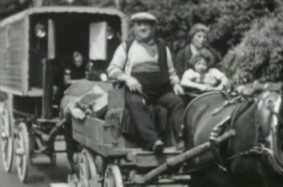
With the Gypsies in Kent (c.1938), film by John and Bill Barnes, from Screen Search

John and his twin brother William (who survives him) were born in 1920 and discovered film during the 1930s, becoming enthusiastic amateur filmmakers while still at school. Two of their films, Gems of the Cornish Riviera (1936) and Cornish Nets (1938) featured at the Pordenone silent film festival in 1997, the year in which both were awarded the prestigious Prix Jean Mitry for services to silent film scholarship. Eighteen of their silent films are now held by Screen Archive South East in Brighton, including The Wheat Harvest (c.1935), In the Garden of England (c.1938) and With the Gypsies in Kent (c.1938), clips from which can be seen on the Archive’s Screen Search site.

On leaving school the brothers studied film design and technique at Edward Carrick’s AAT film school, at which time they began collecting Victorian optical toys and associated literature, often frequenting the bookshops of London’s Cecil Court which three decades before had been ‘Flicker Alley’, home to the nascent British film industry. They hatched a plan to collect artefacts and documents that would trace the history of motion pictures from the 17th to the 20th centuries, an ambition put on hold while they served in the Royal Navy during the Second World War.

After the war, the brothers moved to St Ives in Cornwall, where Bill opened a second-hand bookshop. It was in rooms above this shop in 1951, during the Festival of Britain, that the brothers put on the first exhibition of their film history artefacts, the success of which encouraged them to collect all the more. This was at a time when relatively little was appreciated about pre-cinema tchnologies, and John’s great work was not simply to collect such objects but to understand them, explain them and to be able to contextualise them. Eventually the bookshop was closed and the brothers sold by catalogue alone, supplying books and artefacts to scholars and film museums around the world.

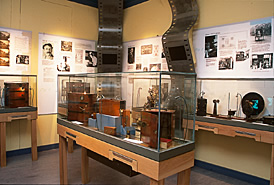
Objects collected by John and Bill Barnes now in Hove Museum

In the 1960s, while Bill went filming overseas, John and his wife Carmen (who also survives him) opened the Barnes Museum of Cinematography in St Ives. This famous collection attracted film scholars from around the world, and its catalogues became treasured documentary sources as serious interest grew in the roots of cinema. Collecting continued, and many objects were lent to museums around the world or formed the subject of illustrations in numerous text books. The Museum never found a London home, as John had hoped, and closed in 1986, its pre-cinema holdings going to the Museo Nazionale del Cinema in Turin, while much of the remainder is now housed in Hove Museum, near Brighton.

But John’s greatest monument is The Beginnings of the Cinema in England. The series began in 1976 with the book of that title, which documented the arrival of film in England, 1894-1896. Establishing his style, the book traced the history through the machinery, out of which followed the personalities involved, the modes of exhibition, and a thorough filmography for the period. It would be hard to underestimate the value this book (which was revised and republished in 1998) to the early cinema specialist. It simply defined a period. Subsequent research has built on his work, and occasionally challenged its findings (Barnes’ arguments around the so-called ‘Paul-Acres camera’), but those solid foundations remain. It was followed by volumes doggedly documenting the cinema in Britain (he wavered between England and Britain in his descriptions) for 1897 (perhaps his best work), 1898, 1899 and 1900, the whole series eventually being republished in a uniform edition by University of Exeter Press in 1998. While the original volumes are quite rare, the re-issued set can be found relatively easily and cheaply and is strongly recommended to any serious student of early film. In the historiography of British film, only Denis Gifford and Rachael Low can match John Barnes’ achievements.

John Barnes devoted his life to the history of cinema. He was as much a pioneer in his field as were those whose lives and technologies he championed in theirs. He faced innumerable battles with publishers and institutions, but that all goes with the part played in being an independent scholar-collector. His knowledge, unfailing help and sturdy friendship were valued by scholars and enthusiasts around the world, and his parting (he died on June 1st) will be recognised as a huge loss. But few of us who work in this field will be able to leave behind so much of such solid and lasting value: objects rescued, identified and their importance recognised; documents saved, preserved and republished; films identified and treasured; and books written that preserve the knowledge of a lifetime and which will benefit research for many years to come.

I’ll finish with a section from a review I made of The Beginnings of Cinema in England when the series was republished, as it rather sums things up for me:

Enthusiasm is the key to John Barnes’ history. Perhaps the chief reason why this area of film studies is so vital, is that in the hearts of its enthusiasts it is as if it were happening now. While other areas of academic cinema history seem doomed to atrophy, as films that were once entertaining no longer entertain, Victorian cinema is alive with debate and discovery … This is perhaps Barnes’ greatest achievement, to have achieved the trick that film has always claimed to do, to abolish time. Thanks to the finest work of empirical early film history that there is, the cinema of the 1890s is very much with us still.

Thank you John.

Cartoon capers

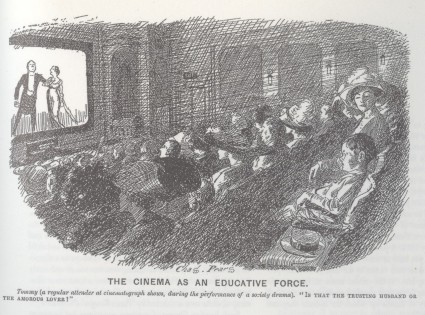
‘The Cinema as an Educative Force. Tommy (a regular attender at cinematograph shows, during the performance of a society drama). “Is that the trusting husband or the amorous lover?”‘ Charles Pears cartoon in Punch, 7 August 1912, from I Want to See This Annie Mattygraph

One of the most interesting ways to examine contemporary perceptions of the silent cinema is through cartoons – newspaper cartoons, that is, rather than animated cartoons. Cartoons in the popular newspapers, comics and magazines of the day provide a marvellous measure of how the new phenomenon of cinema was commonly understood, since cartoons had to tap into a general feeling about the subject. Everyone had to be in on the joke for it to work. And more than simply recording popular sensibility, cartoons of the era pick up on changes in such aspects as technology and film-going habits, providing a valuable documentary record as well as a social history one.

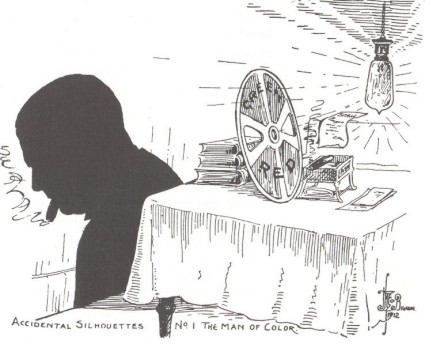
‘Accidental Silhouettes no. 1: The Man of Color’, a cartoon of Charles Urban by Theodore Brown, from The Bioscope 22 February 1912

The film trade papers of the day are another source of cartoons and caricatures, not always so polished or so funny, but often picking up on minutiae of film business concerns which are of value to the specialists, or simply providing the only portraits we have of some of the film personalities (i.e. those behind the camera) that we have. Theodore Brown, editor of the British journal The Kinematograph and Lantern Weekly, unusually was also an occasional cartoonist (and a filmmaker, and an inventor), and provided the above cartoon of film producer Charles Urban, shown silhouetted via a Kinemacolor filter, which regulars will recognise provides my avatar in the comments to posts on this blog.

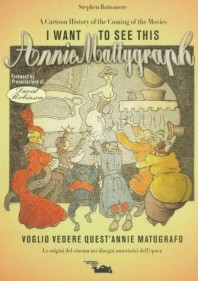
Cartoons on silent cinema are scattered all over the place, and tracking them down can be a laborious business – more often than not the research stumbles across them by chance, or else works their way through the well-thumbed pages of Punch, which never fails to come up with the goods of some sort. There is, however, one book – and a very good book – on the subject, Stephen Bottomore’s I Want to See This Annie Mattygraph: A Cartoon History of the Coming of the Movies (1995). It must be said that the mixture of ungainly title and bi-lingual text (English/Italian) has not helped the book’s acceptance outside the hardy band of early film buffs. (The phrase that gives the book its title comes from a cartoon where a man asks at a box office if he can see what he assumes is an actress but of course the Animatograph projector – how they laughed in 1897). But within lies a rich selection of contemporary cartoons from across Europe and America, arranged around such themes as ‘Going to the Pictures’, ‘Opposition and Rgulation’ and ‘Film Genres’, providing a history of the cinema to 1915 through the pictures that made people at the time laugh about it. It is scholarly, observant and great to look at. I particularly value it for the cartoons of cinema-going, where you find evidence of exhibition practice and audience habits that really aren’t recorded elsewhere. Its opening essay also provides a valuable history of the cartoon over and above its relationship to film history.

But what can you find online? Not a lot, unfortunately, but one worthwhile source to direct you to is the British Cartoon Archive. This is based at the University of Kent at Canterbury, and is effectively the national collection of cartoons. Navigation on the site is a little unclear, but persevere and you’ll eventually find its database, which provides access to 120,000 cartoons, each illustrated with thumbnail image (click on the image for a larger view) and accompanied by exemplary cataloguing information, including an exhaustive array of thesaurus terms, the names of all real people featured in the cartoon, and transcriptions of the text.

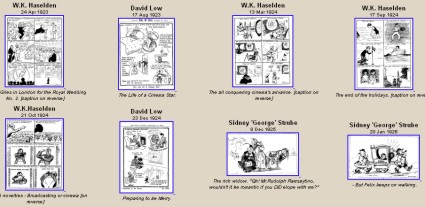
Sample database search result with cartoons by W.K. Haselden, Sidney ‘George’ Strube and David Low

The Archive is rightly particular about protecting copyright images, so no reproductions here bar the web page picture grab above. But type in terms like ‘film’, ‘cinema’ etc and you’ll find such telling cartoons as W.K. Haselden’s ‘The all-conquering cinema’s advance’ (1924), where cinema screens crop up everywhere you look (even at Stonehenge), or David Low’s ‘Continuous show now on’ (1926) which comments on the beleaguered state of the mediocre British film industry, unable to compete against the block-booking Americans, while the overpowering attractions of an American vamp obscure those of the ‘pure but dull British film heroine’.

There are only so many cartoons there on the silent era, but more than enough to pick up on the social perceptions of the time. Look out too for David Low’s ‘Topical Budget’, a cartoon news commentary series which took its name from a popular newsreel of the silent era. There’s a lot more to explore on the British Cartoon Archive site, in particular a collection of biographies of the cartoonists.

There are other, far smaller sites out there marketing mostly Punch cartoons, but nothing that I can see that provides the opportunity to look at early cinema subjects. The various newspapers that have been digitised tend to be of the broadsheet variety, which did not stoop to such things at this time. The British Library provides a useful overview of comics from the era, such as Ally Sloper’s Half-Holiday and Comic Cuts, as well as titles like Film Fun, which began in 1920 and was entirely given over to comic strips featuring popular film stars. Other sites and databases offer just an image or two, provide descriptive lists of what they have but no images, or else a subscription is required. Or they don’t cover early cinema, of course. For a good listing of sites worldwide, go to the Intute: Art and Humanities site (an excellent UK academic service describing online scholarly resources) and type in ‘cartoons’.

Finally, it’s worth noting that a number of cartoonists of the era went on to become filmmakers. Among the best-known are Emile Cohl, Winsor McCay (‘Little Nemo’) and Harry Furniss. Cartoonists were filmed by the early filmmakers, often doing ‘lightning sketches’ (speedy drawings over a preparatory sketch), such as Tom Merry, J. Stuart Blackton and several British artists who contributed political sketches to proto-cartoon films during the First World War. The Library of Congress’ American Memory site includes Origins of American Animation, which demonstrates the interrelationship between paper and screen cartoons 1900-1921.

If anyone knows of other online sources for newspaper and comic journal cartoons which cover our period, do say.

Laws and cases

It’s high time we had a new addition to the Bioscope Library. Fresh in, and just being stamped and having its classification number assigned is The Law of the Motion Picture Industry (1916), by Gustavus A. Rogers. This is the text of a lecture given by a New York lawyer to the College of the City of New York on 28 November 1916. The legal side of early film may not seem to have that much appeal, but it is a crucial subject to grasp. Laws existing and laws which had to be devised for the purpose not only governed but helped define the new medium.

Gustavus A. Rogers proves to be a helpful guide, with a clear-sighted view of his subject and much case law that he is able to cite as milestones in the development of cinema as a social entity. There is a particularly helpful section on patent law (“Ask the average person who is the inventor of motion pictures and the answer will be, Thomas A. Edison. Mr. Edison himself would probably agree that he is the inventor, but the courts have held otherwise”.) and the formation of the Motion Picture Patents Company, which sought to restrict trade to those businesses which recognised Edison’s film patents. Out of this history Rogers draws some fascinating and helpful definitions of what motion pictures actually were (in law), what the technology was there to achieve, and how a motion picture production was to be defined. He cites in the important case of the Kalem Company v Harper Brothers, which determined that the Kalem 1907 film Ben Hur infringed the copyright of the Lew Wallace book on which it was based. Rogers’ interest is in what the ruling meant for the definition of a motion picture in other legal proceedings. He says that the the case had not “definitely determined as to whether a photo-play is really ‘a commodity’ or whether as such it comes under the jurisdiction of the Federal Anti-Monopoly Law”. Rogers’ inference from this is interesting:

I am, however, of the opinion that whenever it will become important to effectually dispose of the question, that it will be found that there is no difference between the photo-play and the celluloid record which is used upon the phonograph, or the picture postal-card. For, after all, what is sent in commerce is a strip, or strips, of film, contained in rolls of approximately a thousand feet each. On these are still photographs that are commercially useful when put into a projecting machine and ground out to portray the story on the screen, in the same manner as the phonograph record is put upon the machine for the purpose of reproducing the musical sounds or matter contained on the record.

This short document (sixty pages) is therefore useful not just as a survey of the law’s engagement with motion pictures to 1916, but as a thoughtful disquistion on what a motion picture actually is. There is useful discussion of trade marks, copyright law, censorship (with comparisons of the state of things in America, Britain and France), Sunday legislation, and an overview of the laws regarding motion pictures in various European countries. It’s available from the Internet Archive in DjVu (1.6MB), PDF (5MB), b/w PDF (1.5MB) and TXT (122KB) formats.

Fight pictures

I wrote a post a while ago on two new books on boxing and modern culture. I’ve just started reading Kasia Boddy’s Boxing: A Cultural History, which is a real treasure trove, so more on that in due course.

I’ve not yet laid eyes on Dan Streible’s Fight Pictures: A History of Boxing and Early Cinema, which is going to be a real treat, but anyone who’s in New York might like to know about an illustrated lecture the author will be giving at Light Industry, a new venue for film and electronic art in Brooklyn. The event takes place on 6 May at 8.00pm, and costs $6.

Here’s the blurb:

Between 1894 and 1915, the first generation of filmmakers produced more than 250 motion pictures with boxing and prizefighting as their subject. Fight pictures were among the most conspicuous, profitable and controversial productions of early cinema. From 1912 until 1940, U.S. law banned the interstate distribution of film recordings of prizefights. Congress enacted the law to suppress the celebrity of the first black heavyweight champion, Jack Johnson, titleholder from 1908 to 1915. Yet, only a few years after the start of the ban, fight pictures flourished again. Throughout the 1920s and 30s these supposedly criminal records were nearly ubiquitous in movie houses and other venues. In conjunction with his newly released book Fight Pictures: A History of Boxing and Early Cinema, Dan Streible presents glimpses of some of these ephemeral films, most of which no longer survive or exist only in fragments. Also on screen will be much of the ephemera – posters, photographs, cartoons, advertisements and the like – that accompanied these “moving fight pictures.”

See the likes of:
Corbett and Courtney Before the Kinetograph (1894)
Corbett-Fitzsimmons Fight (1897)
A Scrap in Black and White (1903)
Squires vs. Burns, Ocean View, Cal., July 4th, 1907 (1907)
Jack Johnson: Der Meister Boxer der Welt (1911)

It’s a compelling history, one well worth telling and telling again. More from the ring in the near future.

Albert Kahn and his wonderful world

http://www.albertkahn.co.uk

Enthusiasts for Albert Kahn, autochrome photography and the BBC series The Wonderful World of Albert Kahn will be delighted to learn that there is now a BBC website devoted to Kahn. Its prime purpose is to promote the new book The Wonderful World of Albert Kahn: Colour Photographs from a Lost Age, by David Okuefuna (published 24 April), but it also has a selection of autochrome images, linked to a map of the world (courtesy of Flickr), a biography of Kahn and information on the Musée Albert-Kahn in Paris. The latter section refers to DVDs, implying that these come out of the BBC/ Musée Albert-Kahn collaboration. There is no further information given. My understanding has been is that there were no plans for a DVD release of the series, but that the museum might be releasing its own DVDs. I’ll try to find out more.

Further information on Albert Kahn, including a more extensive set of links with information on autochromes in general and the films taken as part of his ‘Archives of Planet’ project can be found on the Searching for Albert Kahn post on this site.

The Birth of a Nation

I think it’s true to say that, if film historians could go alter film history just that little bit, they would not have D.W. Griffith’s The Birth of a Nation as the cornerstone of their subject. The most sensational film of its age, one which ushered in the feature and a host of cinematic methods, one which drew in audiences in their millions, one which helped establish the cinema once and for all, one which made a huge amount of money – but also a film of blatant, poisonous racism. Why, oh, why, does such an important film in our field have to be a paean to the Ku Klux Klan?

The embarassment, if not downright offence, that the film tends to arouse in performance nowadays, does not, however, negate its importance to film history – for all the reasons listed above and more. And the film has been given an exhaustive and what looks on initial inspection to be very impressive historical treatment in this new book by Melvyn Stokes, D.W. Griffith’s The Birth of a Nation: A History of “The Most Controversial Motion Picture of All Time”.

Stokes covers the origins, production, reception and subsequent history of The Birth of a Nation, working from a huge range of sources, including the D.W. Griffith papers and the papers of the National Association for the Advancement of Colored People. The book is weighty (408 pages), though not handsomely illustrated. There are substantial chapters on Thomas Dixon, whose novel The Clansman inspired the film; on Griffith’s personal history and outlook; on the film’s production; on its dramatic impact on the cinema and audiences; on the protests and actions made against the film, particularly from the black community in America; an analysis of Griffith’s view of history as expressed through the film; and the subsequent history of the film, both its exhibition (the front cover shows a protest against the film held in 1947) and its uneasy elevation into cinema’s canon.

The Birth of a Nation

Mevyn Stokes has produced some excellent work in the past on film audiences, and the book looks particularly strong on the film’s reception, its powerful effect on cinema as a social force, as a way of life for people. It attracted a huge middle-class audience most of which had not visited the cinema before 1915, widening cinema’s range, increasing its social acceptability, and of course bringing in much money from a wealthier clientele able to pay more for their tickets. Stokes makes it clear how little upset the film caused among the white majority audience, for whom the attitudes that it expressed regarding race were unexceptional. Plenty has been written on The Birth of a Nation‘s importance for film aesthetics and narrative, and on its racial politics. Stokes covers this ground too, but it is by being equally strong on the exhibition, promotion and response from different kinds of audience, and on the film’s relation to American social and cultural history, that makes the book so usefully multi-contextual, if you will.

It looks set fair to become a standard text, not least just as a reference work for the subject, since every name, company or interest group involved seems to be cited somewhere. It’s not a radical re-reading of the film, but simply a methodical, thorough and palpably useful one. Perhaps we do not want to see a re-invented The Birth of a Nation in any case. It stands as a relic of cultural attitudes now overturned, “a reminder”, as Stokes says, “of just how much has changed since 1915”. It will always be an important film in history, but film history changes just as cultural attitudes change, and the film’s narrative skills now seem of far less moment than its significant place in the social and economic history of cinema that is starting to get written all the more.

The Haunted Gallery

The Haunted Gallery

http://www.amazon.co.uk

What fabulous book cover this is. I’d buy the book purely on the strength of the picture – in fact I just have. The image is a 1901 poster for the British Mutoscope and Biograph Company, taken from the copyright collection of The National Archives. Biograph’s 70mm films were a special feature of the Palace Theatre in London (still active today, currently showing Spamalot), and Biograph programmes generally featured news items – hence the full slogan on the screen (which is obscured on the book cover), ‘The Biograph Reproduces the Latest Events from All Parts of the World’.

But the book within is no less of a treasure. The subject of The Haunted Gallery: Painting, Photography, Film c.1900 is how the moving picture changed visual culture at the end of nineteenth century. Lynda Nead is an art and cultural historian, whose first foray into film history this is. Although the subtitle implies equal coverage of painting and photography, the motion picture takes centre stage, but is set into new and exciting contexts by demonstrating its effects alongside the whole range of contemporary visual media, including painting, photography, stage magic, the magic lantern, posters and even astronomy.

The result is a giddyingly rich brew of evidence and analysis, all expounding a shift in visual culture from stasis to motion, which in turn altered modes of perception and ushered in our modern world. The book’s title comes from a characteristic Nead use of the visual as metaphor: an illustration of the Haunted Gallery at Hampton Gallery, which she describes thus:

A space for pictures and for ghosts, the gallery is also for endless pacing watched by portraits of generations of the dead. It is a place of presences but not life, of likenesses which seem real but which are merely representations or figments of the imagination. The picture gallery is also a place of alternating light and darkness; it is a narrow apartment illuminated by shifts of light cast by unseen objects obliterating the light … How apt that the shadows cast on the ceiling by the windows and tapestried walls look like a strip of film, with intermittent, spaced-out picture frames, separated by short intervals of blank darkness. Set this sequence in motion and the enchantment begins; the pictures come to life and the ghosts haunt the gallery.

Nead finds in the haunted gallery a powerful metaphor for the ‘uncanny magic’ of early film. Typically she finds multiple analogues for this concept, from Edison and Biograph advertising films of ancestors climbing down from portraits on the wall to drink Dewar’s Whisky, to similar Scottish ancestors doing much the same in Gilbert and Sullivan’s comic opera Ruddigore, to Georges Méliès’ films The Living Playing Cards and The Mysterious Portrait, to tableaux vivant, to the myth of Pygmalion and Galatea (the statue that came to life). It all interconnects.

It certainly helps if you can see the pictures, and the book is richly illustrated throughout, sometimes enthralling so. Themes covered include the wheel and movement, representation of the everyday and the detective camera, the vision of mobility generated by the new-fangled motor car, the strip (the film strip, the cartoon strip and the striptease), and the astronomical imagination. This latter section looks at visions of the heavens (by way of serpentine dances, G.F. Watts, electricity and the Paris 1900 Exhibition), including some startling examples of astronomical photography spilling over into the imaginative world, represented in particular by Camille Flammarion, the French astronomer, author and astronomical filmmaker, whose 1872 novel Lumen describes all-seeing beings who view the passing of a time as a ray of light, in a constant relay of images. Metaphors, metaphors everywhere.

The best image comes last – a map of the procession through London taken to mark Queen Victoria’s Diamond Jubilee on 22 June 1897 (filmed by many cameramen), marked with bright yellow explosion symbols to mark where Martian explosions occur as recorded in H.G. Wells’ The War of the Worlds, published in the same year. However, it’s not all image and metaphor, and there’s a good deal of practical understanding of the production of images (still and moving) underpinning the theoretical stuff. The moving images make sense on a practical level as well as an imaginative one.

As with Jonathan Auerbach’s Body Shots, covered in a recent post, here is someone from outside the usual early film studies coterie, looking on the subject with fresh eyes and leading it into a broader cultural world, demonstrating bold analogies and connections, inviting in those from other disciplines to see how film was integral to a change in consciousness in the late-Victorian/early-Edwardian era. Both publications have enriched our field. I feel that the Bioscope may have to expand, to become just that little bit more metaphorical, if it is properly to represent its subject in its contexts. We’ll see.

Silent cinema in Tamil

I’ve just seen notice of this publication, a history of world silent cinema written in Tamil, reported on by The Hindu newspaper. It seems worth noting, for the record. Here’s the review:

ULAGA CINEMA VARALAARU — Mouna Yugam (Silent Period): Ajayan Bala; KK Books Pvt. Ltd.,

19, Srinivas Reddy Street, T. Nagar, Chennai-600017. Rs. 150.

A WELCOME publication in Tamil, most likely the first of its kind, narrating the interesting history of world cinema during the period December 1895 to October 1927 being the silent age when many purists and diehard conservatives sincerely felt that the medium would not last long. Ajayan Bala who is involved in many a capacity in cinema has narrated interestingly the fascinating true story of the founding, growth and development of silent film around the world, including India. Today there is great awareness about film history in this part of the country and this book will go a long way in filling the virtual vacuum that exists.

The book is well illustrated with thumbnail photographs, which adds to its attraction and utility.

The author is currently working on more volumes to continue his in-depth study and writing of the later exciting periods of world cinema. Economically priced, this book is a must read for Tamil readers who wish to know the fascinating tale of international cinema. The publishers also deserve to be congratulated besides the author for planning and publishing such a book.