Sunnyside up

sunnyside

Ah me, too much happening – if only any of it was of any consequence. Anyway, apologies for the service from the Bioscope being a bit on the intermittent side of late, but there’s just time to note the publication this month of Glen David Gold’s novel, Sunnyside. Gold gained fame a few years back with his fantastical novel of warring magicians in the 1920s, Carter Beats the Devil, and he seems to have pulled off a similar trick with Sunnyside, this time by taking as his subject the cinema of roughly the same period.

Sunnyside is, of course, the title of a 1919 Charlie Chaplin film (a minor film where Chaplin experimented with rural comedy but lost his comic touch). The novel sounds like a rich feast, using Chaplin and the American movie industry as the means to illuminate a wildly variegated decade and the encroachment of modernity. Amid multiple storylines (there are three main plot lines, covering Chaplin in Hollywood, another character in the battlefields of France, and a third caught up in the little-known Allied invasion of Russia), real-life and imaginary characters intermingle – among the former, readers will find Mary Pickford, Douglas Fairbanks, Adolph Zukor, film theorist Hugo Munsterberg, Rin Tin Tin, and of course Chaplin. There’s an enticing review of the book from the LA Times which describes Chaplin’s portrayal thus:

Scores of novels have tried and failed to depict movie stars and stardom or genius. Yet here Gold conjures a nuanced character who springs to life. Chaplin comes across as witty, charming, insecure. He dresses with a dandy’s care, suffers depressions and wears a perfume that smells like citrus with “base notes of money.” He woos women and conducts a book-length joust with Pickford, whose air of certainty and business smarts confuses and almost terrifies him. Chaplin’s doubts center on his sense of being not good enough, an uncertainty that he knows he must somehow allow to filter through his art.

“He had the easy capacity for seeing kinetic actions first, then creating character and emotion to fill them up, like ladling sand into a sack. This was too easy — everyone did it,” Gold writes. “Where was the small moment, the flirtatious smile not returned, the cuckold discovering a cuff link and saying nothing, the smile of a baby that somehow chills the bones? That was the hardest way to make things.”

Gold places the center of Chaplin’s ache in his longing for love — and his fear of the same — in his relationships with women. Chaplin’s mother, Hannah, was a music hall singer whose career was ruined and who went mad, leaving the young Chaplin destitute, and the whole Chaplin-arc of “Sunnyside” is aimed at the moment, dreaded and longed-for, when Hannah arrives in Los Angeles. “He could meet her eyes, but only as though they were tapping his fingers against a hot stove. They were still a deep hazel, cloudy and merry, for now,” Gold writes. “It’s okay if you don’t love your mother,” Hannah says, as “Sunnyside” speeds at last toward its conclusion with a sequence of scenes that amaze, startle and move.

As someone who found Carter Beats the Devil hugely disappointing, I shall reserve judgement until I read Sunnyside. But I will have to read it (all 559 pages of it), and the book is certain to do well, and to draw people anew to Chaplin and the richly metaphoric world of silent cinema.

An excellent dumb discourse

ruggero

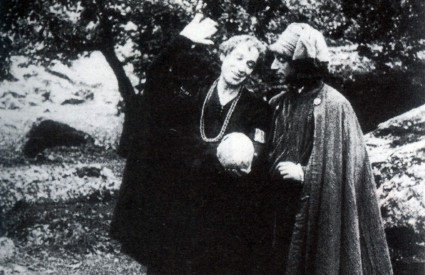
Ruggero Ruggeri as Hamlet in Amleto (1917)

It was the fervent belief of many in the early years of cinema that justification for the medium lay in how it interpeted stage drama. At a time when censorious authorities looked down upon the dubious cinema (with its low class audiences) and cinema was reaching out for respectability (and properties that were out of copyright), Pathé with its Film d’Art and Film d’Arte Italiana companies, and Adolph Zukor’s policy of ‘Famous Players in Famous Plays’ showed that there was financial good sense in bringing high-class drama to the cinema screen, however mutely.

The pinnacle of stage drama was, of course, William Shakespeare, and film companies in the silent film era took on the Bard with enthusiasm. The numbers are extraordinary. Some two hundred films, most of them one-reelers of the pre-war period, were produced that closely or loosely owed something to one or other of Shakespeare’s plays. Some film companies showed a particular interest: Vitagraph filmed Antony and Cleopatra, Julius Caesar, Macbeth, Othello, Richard III, Romeo and Juliet (all 1908), King Lear, A Midsummer Night’s Dream (1909), Twelfth Night (1910) and As You Like It (1912). Thanhouser made A Winter’s Tale (1910), The Tempest (1911), The Merchant of Venice (1912), Cymbeline (1913) and King Lear (1916). Cines, Kalem, Biograph, Ambrosio, Gaumont, Eclair, Nordisk, Milano and several others filmed the plays.

This was more than enthusiasm for high culture; it was good business. Shakespeare films appealed to an audience which found costume dramas in general to be a treat, and which was accustomed to boiled-down Bard from school texts and stage productions which concentrated on the highlights from the plays (such as the Crummles’ hectic production of Romeo and Juliet portrayed in Charles Dickens’ Nicholas Nickelby). Of course, not everyone wanted to see high culture quite as much as the cinema sometimes wanted to be associated with such culture (see the cartoon at the end of this post), but more than enough were impressed, and entranced.

Once films became longer – ironically as the cinema became closer in form to the theatre – the number of Shakespeare films fell, because longer productions were more of a challenge to audiences. But even then there was a burst of activity in 1916 (the tercentenary of Shakespeare’s death), with half-a-dozen or more productions in that year alone, and versions of the plays continued in silent form throughout the 1920s, with four key titles coming from Germany – Hamlet (1920, with Asta Nielsen as the Dane), Othello (1922, with Emil Jannings and Werner Krauss), Der Kaufman von Venedig (The Merchant of Venice) (1923, with Henny Porten) and Ein Sommernachtstraum (A Midsummer Night’s Dream) (1925, Werner Krauss again).

thetempest

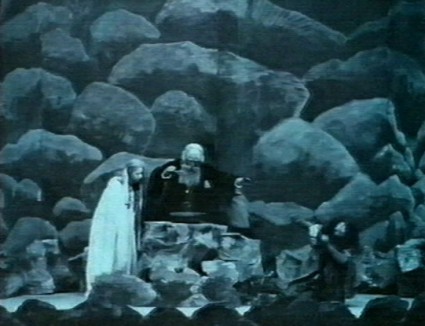
Prospero in his cave, from The Tempest (Clarendon 1908)

So where is the literature to back up this self-evidently significant corner of silent film history? Sadly, until recently, there has been very little. The silent film enthusiasts and film scholars have shied away from Shakespeare as being falsely worthy and far too uncinematic, while the Shakespeareans looked down on cinema per se, while finding the very notion of silent Shakespeare an absurdity. Jack J. Jorgens, a noted scholar, went so far as to write these dreadful words in his Shakespeare on Film (1977):

First came scores of silent Shakespeare films,one- and two-reelers struggling to render great poetic drama in dumb-show. Mercifully, most of them are lost.

Oh dear, oh dear. However, there was one work which almost eccentrically fought against the tide. Robert Hamilton Ball’s Shakespeare on Silent Film: A Strange Eventual History (1968) is one of the most remarkable books ever produced on silent cinema. It is a passionately-pursued archaeological investigation into every kind of Shakespeare film made during the silent era, encomapssing parodies, allusions, plot borrowing as well as ‘conventional’ adaptations, with Ball diggedly tracking down every obscure reference, every hidden print, every list of intertitles, with abundant fervour and an infectious interest in the people involved. This magnum opus has been cherished by the dedicated few for four decades, and for most of that time its discoveries and assertions have been taken as gospel. Yet even Ball ended his investigations with these disappointing words:

Silent Shakespeare film could not be art, a new art. The aesthetic problem is how to make good film which is good Shakespeare. It could not be good Shakespeare because too much was missing.

It is has been the task of a few of us (and I’ve been involved) to prove those words wrong. Silent Shakespeare was good Shakespeare, not because of what was missing, but because of what was there to be seen – a new medium expressing itself imaginatively while asserting its social worthiness and cultural relevance. To study silent Shakespeare films is to see films discovering what they could do. Yes there are histrionics at times, and yes there is some aburdity involved when complex plots are crammed into a ten-minute reel, but equally there is artistry, feeling and subtlety of interpretation. Have you ever seen a ballet of Romeo and Juliet and complained that the words were missing? Of course not. Shakespeare without the words is not a lesser form, but simply a form that requires its own special understanding. It expresses the significance of its subject within its specific constraints – which is precisely what art is.

The tide started to turn with the release of the British Film Institute’s video compilation Silent Shakespeare (1999), a work that was a revelation to many. Even hardened theatricals could see the special virtues in the Clarendon Film Company’s delightful reworking of The Tempest (1908) or the elemental passion evident in Ermete Novelli’s stunning performance in Re Lear (1910). The DVD has found its way onto many a university library shelf, while a number of scholars have begun to take on the silent Shakespeare film with fresh eyes – among them Jon Burrows, Roberta Pearson, Anthony Guneratne and Kenneth Rothwell.

buchanan

The leading champion, however, has been Judith Buchanan, whose quite marvellous Shakespeare on Silent Film: An Excellent Dumb Discourse is published this month by Cambridge University Press. This is the sympathetic, understanding account of a phenomenon that we have been waiting for. It is not a comprehensive history of the silent Shakespeare film – Buchanan defers to Ball in that respect – instead it concentrates on exemplary films and on uncovering the social, cultural and economic contexts. So it is that an opening chapter details a nineteenth-century legacy of performance, with particular attention to Shakespeare and the magic lantern, showing that the silent Shakespeare film was part of an established tradition. Chapters then follow on the first Shakespeare film, King John (1899), featuring Herbert Beerbohm Tree (also on the BFI DVD); Shakespeare films of the ‘transitional era’ between the early and late 1900s, with close, engrossing readings of Clarendon’s The Tempest and Film d’Arte Italiana’s Othello (1909); the ‘corporate authorship’ of Vitagraph’s productions; the contrasting interpretations of Hamlet by Hepworth (a renowned British 1913 production with theatrical great Sir Johnston Forbes Robertson) and Amleto, a 1917 Italian film starring Ruggero Ruggeri, little-known but perhaps the most accomplished extant realisation on Shakespeare on silent film (it’s crying out for the two Hamlets to be released jointly on DVD); the several films of the tercentary year, including the rival Romeo and Juliets starring Francis X. Bushman/Beverley Bayne and Theda Bara/Harry Hilliard, both films alas lost; the German productions of the 1920s; and wordless Shakespeare today (there are some stage productions experimenting with silence, notably Paata Tsikurishvili’s Synetic Theatre).

It’s written for a literary studies audience, but it is grounded in exemplary original research (Buchanan has toured the world to track down the relevant prints) and it is a pleasure to read. There is much here to detain anyone keen to extend their knowledge of film history. She knows her films as well as her plays – a rare and most welcome combination. Above all, Buchanan opens up the subject in all its richness of theme, inviting others to explore further, illuminating the films that we are so fortunate have survived. We will still turn to Robert Hamilton Ball for his extensive documentary evidence, but to Buchanan for her sophisticated understanding.


romeocartoon

A 1913 cartoon from London Opinion, speaking for anyone resistant to the cinema’s occasional urge to impress Shakespeare upon us. Taken from Stephen Bottomore, I Want to See this Annie Mattygraph: A Cartoon History of the Coming of the Movies

If you are keen to seek out silent Shakespeare films for yourself (and you should, you really should) this is what’s currently available on DVD:

  • Silent Shakespeare: includes King John (Biograph 1899), The Tempest (Clarendon 1908), A Midsummer Night’s Dream (Vitagraph 1909), Re Lear (Film d’Arte Italiana 1910), Twelfth Night (Vitagraph 1910), Il Mercante di Venezia (Film d’Arte Italiana 1910), Richard III (Co-operative 1911) [BFI] [Milestone]
  • Thanhouser Presents Shakespeare [Thanhouser series vol.7]: includes The Winter’s Tale (1910), Cymbeline (1913), King Lear (1916) [Thanhouser]
  • Richard III (Shakespeare Film Company 1912) [Kino]
  • Othello (Wörner-Filmgesellschaft 1922): also includes Duel Scene from Macbeth (Biograph 1905), The Taming of the Shrew (Biograph 1908), Roméo se fait bandit (Pathé 1910), Desdemona (Nordisk 1911) [Kino]

The International Database of Shakespeare on Film, Radio and Television, an online filmographic database not yet officially released but available in a test version, hopes to be comprehensive for the silent Shakespeare film. Buchanan herself provides a filmography (restricted to films mentioned in her text), including the location of archive prints. Around forty silent Shakespeare films survive today, mercifully.

The Stage

thestage

New (at least to me) among the digitised historical journals now available online by subscription is The Stage. This is well worth taking note of. The Stage Directory (A London and Provincial Theatrical Advertiser) was founded in February 1880 as a monthly newspaper, and continues (as a weekly) to this day. Its entire archive 1880-2007 has been digitised and put online, covering over 6,500 issues or above 170,000 individual pages reporting on the goings on of the British stage and beyond.

The importance for us is that The Stage has always kept an eye on the motion picture business, and for the silent era it was assiduous in recording the activities of this new strand of showbusiness. A series of articles from 1907 entitled “Cinematograph Notes” records new businesses, film releases, licensing issues and so forth, “Latest Films” is very handy in giving titles of new releases, and another series “Film Facts & Fancies” starting in 1919, written by ‘Figaro’, reports on the cinema world with a knowing eye.

The Stage documented the engagements of actors, and one can trace their travels across the British provincial theatres, seeing also where the variety shows were starting to introduce the cinematograph. Here one can spot names that were later to be famous: in a notice from 30 July 1903 of a performance of Sherlock Holmes at the London Pavilion, the writer notes:

A faithful portrait of Billy is given by Master Charles Chaplin, who shows considerable ability, and bids fair to develop into a clever and capable actor.

Once can follow Chaplin many performances as Billy, and then later with the Karno troupe, up and down the country, before he found his fortune on the screen.

The Stage Archive is available by subscription. There is a timed pass system, with twenty-four hours’ access costing £5, one week £15, one month £30, three months £60, six months £100 and one year £150. Once you have subscribed, you have options to browse by date, so you can scroll through an entire issue (I recommend this to start with, as it gives you an idea of layout and the contents of the regular sections), or you can search by word (or phrase in quotation marks) across all types of ‘clippings’ (i.e. sections), or by article, picture or advertisement. You can search by the time periods 1880-1900, 1901-1950 or 1914-1918 (and later periods, of course), and can order search results chronologically or by relevance.

Those familiar with digitised newspaper collections will soon recognise that The Stage Archive has been produced by Olive Software‘s ActivePaper system. Search results give you the date and page number of the issue and a snippet of the article itself (usually a headline), which you click on to open up the full article. This can be a little frustrating when you have many search results, as there is little way of telling one article from another (many of the Chaplin notices are simply titled ‘Provinces’, for instance), so it may be a little laborious investigating the more popular subjects. You get the full article in facsimile form, with your search term highlighted, and you can print these or file them away in a ‘My Collection’ facility, but there is no way to get at the underlying OCR text, unfortunately.

If you don’t subscribe, you can still use The Stage Archive to search material, you just won’t have access to the articles themselves. But there is more from The Stage that you can access without paying any subscription. The Stage produced an annual yearbook which for the silent era is another rich source of information, particularly for its directory listing of film associations, its advertisements, and especially its reports on legal cases, always fascinating for the realism they provide behind the tinsel of so much cinema reportage. The Internet Archive has the volumes for 1908-1919. The PDFs are a large size (30-50MB), but don’t forget that they are word-searchable. Look out in particular for Arthur Coles Armstrong’s long article in the 1914 volume, “My Lady Kinema – The Eleventh Muse”. And from the 1916 volume, this report on a court case caught my eye:

ELINOR GLYN v. WESTERN FEATURE FILM CO. AND G. BLACK.- ALLEGED CINEMATOGRAPHIC INFRINGEMENT OF NOVEL.

In the Chancery Division, before Mr. Justice Younger, Mrs. Elinor Glyn, the author of and owner of the copyright in “Three Weeks,” brought an action against the defendants for an injunction restraining the defendants from making or authorising the public exhibition of kinematograph films under the title of Pimple’s Three Weeks (without the option).

The defendants pleaded that their film Pimple’s Three Weeks (without the option) was an original dramatic work within the meaning of the Copyright Act, 1911, and that they were entitled to use their film.

The action against the defendant George Black was settled before the case came into Court.

And the reason it was settled is that the judge decided that Three Weeks was an immoral work, and so did not merit any copyright protection, irrespective of whether a parody could be seen as infringing in the first case.

Plenty to discover, whether paid for or free (and acknowledgments to Bioscope regular Penfold for bringing The Stage Archive to my attention).

Who’s Who on the Screen

whoswho

Top row (L-R) June Mathis, Albert Capellani, Ruth Stonehouse; bottom row (L-R) Sessue Hayakawa, Teddy Sampson, Buster Keaton, from Who’s Who on the Screen (1920)

As some may know, while in the small hours I run The Bioscope, in the daylight hours I take occasional care over Screen Research, a social network/information source on moving image research. The latter is mostly devoted to current activity in the online video world, but the photograph section concentrates on older material, simply on acount of rights issues.

So this is just to let Bioscopists know that there is a growing collection of silent film images to be found there. In particular, I have just finished working my way through the Internet Archive copy of Charles Donald Fox and Milton L. Silver’s Who’s Who on the Screen (1920). This is a 400-page biographical guide to Hollywood in 1920, with a photograph and mini-biograph per person per page. I have published each individual on their individual page in four ‘albums’, with actors in Part 1, Part 2, and Part 3, and directors, executives etc. in Part 4. I find the parade of images haunting (the quality of the photography is outstanding, even if the image resolution is low – the photographers are credited in an acknowledgments page on Part 4) and the biographies intriguing for the emphasis placed on how healthy every one was. All the actors stress the sports they follow and their love of the outdoors. The executives feel less need to do so.

There is more silent material to be found under the Photos section. Film historian Deac Rossell has added some gems from his personal collection, including lobby cards, programmes, contemporary collectors’ scrapbooks, and some rare examples of movie star pennants from 1915. Do take a browse.

With new eyes

bakker

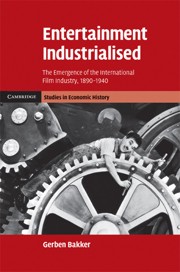
Gerben Bakker’s Entertainment Industrialised: The Emergence of the International Film Industry, 1890-1940 (Cambridge University Press, 2008) opens with a quotation from Marcel Proust:

The real voyage of discovery consists not of finding new lands, but of seeing the territory with new eyes.

A bold claim indeed for any book seeking to make its mark in a territory so exhaustively documented (or so it would seem) as film history. Of course, read the blurb of almost any new film monograph and it will confidently tell you that what lies within is certain to set a new standard for the field or to overturn preconceptions. Open those books and one tends to find exactly as one has found before in countless other monographs, with just a few of the arguments rearranged for novelty’s sake. Open Entertainment Industrialised on any page, and the sense of real discovery is instant. This is history with new eyes.

Gerben Bakker is based at the London School of Economics. His studies into the rise of the international film industry have been exciting a small number of us in the past few years, but they have not made much of a crossover as yet to the wider world of film history. The publication of this magnum opus ought to change things, though it has been issued as part of the Cambridge Studies in Economics History strand (at a hefty price), and is aimed primarily at economics historians. Though some of the language is specialist, the general tone will be clear to all, and the writing is lucid and inviting. It is a book that demands to be read.

His subject is the rise of the film entertainment industry in France, Britain and the United States between 1890 and 1940. That cross-national sweep immediately takes us away from the parochialism of so many film studies, while illuminating the national picture. Its contention is that cinema’s great innovation was not technological, but economic. In a helpful prologue, Bakker set out his theme by reference to the life experience of Charlie Chaplin:

When Charlie Chaplin was nineteen years old he appeared in three music halls a night. On one fine day he started in the late afternoon at the half-empty Streatham Empire in London. Directly after the show he and his company were rushed by private bus to the Canterbury Music Hall and then on to the Tivoli. This constituted the maximum number of venues an entertainer could visit on an evening, and thus the inherent limit to a performer’s productivity.

Yet, barely five years had passed before Chaplin would appear in thousands of venues across the world at the same time. His productivity had increased almost unimaginably. Most of this efficiency jump translated into lower prices, far lower than prices for music hall. Chaplin himself, therefore, was able to capture only a small percentage of revenues. Yet this tiny cut made him the world’s highest-paid performer.

There is the matter in a nutshell. The modern technologies that went with what the author calls the second industrial revolution (bringing with it the almost universal adoption of electricity, synthetic chemicals and the combustion engine) led to a huge leap in productivity. We are now in a world where we expect, without thinking, to have instant access to entertainments from around the world, at any time, wherever we might be located, cheaply or freely, and across multiple platforms. How did we get here? That is what Bakker sets out to describe, not by anecdote or easy assumption, but by thorough powerful analysis of the economic evidence using models established by business history.

bakker_chart

‘Total released film negative length and cinema seats, US, Britain, France and Italy, in metres, 1893-1922’, originally from ‘The evolution of entertainment consumption and the emergence of cinema 1890-1940’ (available at http://eprints.lse.ac.uk/5937)

His method is common to other kinds of economic enquiry, one based on understanding of essential principles tested against factual evidence which can be gleaned from contemporary studies or deduced by subsequent analysis. It is a book full of graphs and tables with titles such as ‘Total released film negative length and cinema seats, US, Britain, France and Italy, in metres, 1893-1922’, ‘Management as percentage of all non-creatives in the French entertainment industry, 1901-1936’, ‘Prices, capacity, sales potential, price elasticity and consumer surplus for various types of specator entertainment venues, Boston, 1909’ or ‘Indicators of sectoral shift in the entertainment industry, US, Britain and France, 1900-1938’. It is daunting but exhilarating stuff. All the time that we were enjoying ourselves, this is what was really going on underneath.

Bakker says that his book has three main themes running through it: how motion pictures industrialised spectator entertainment, how a quality race between firms changed the structure of the international entertainment market, and what effect this had on economic and productivity growth. He explores the rise of entertainment generally, the rise of the international film industry as a part of this movement, and then the notion, mechanisms and consequences of industrialised entertainment. Out this investigation he makes seven main claims (though there are many other interrelated findings):

  • Cinema industrialised live entertainment by automating it, standardising it and making it tradeable.
  • This industrialisation was largely demand-led.
  • It was the index case for the industrialisation of other services that would follow.
  • In a process of dynamic product differentiation old formats were not competed away, but often reinvented themselves when new formats arrived: theatre changed after vaudeville, vaudeville changed after cinema, and motion pictures changed after television.
  • The tradeability of motion pictures integrated national entertainment markets into an international one.
  • A quality race in which firms escalated their costs sunk into film production and marketing, triggered in the 1910s, led to the emergence of feature films as we know them now.
  • Although the Hollywood studios have won the race, American consumers lost it. Their European counterparts enjoyed a far greater variety of both live and filmed entertaiment, and consumed lots of exotic pictures next to the standard Hollywood fare.

Some of this may seem obvious, but that is because we are familiar with the outcomes. The important point is that the success of cinema in the particular form that it took was not a completely foregone conclusion. With only small variables in pricing (of raw stock, of theatre prices), discoveries in technology, competing entertainments or other socio-economic factors, cinema might never have arisen in the form that it did. He gives the example of cinema’s “major fellow traveller” the Phonograph, which remained “a premium product for a limited elite”. Contra such arguments, cinema can be seen almost inevitably to have filled a gap. Increased wages, falling hours of work, the rapid growth in urbanisation, a consequent demand for leisure, the opportunities provided by mass electrification, all can be said have created cinema – or the gap that cinema filled – because they had to.

Many studies have explored this area with this general thesis in mind. Bakker gives us the figures, and the hard reasoning. We may recognise the names and the general territory, but are encouraged to do so with such notions as deregulated entertainment markets, age elasticity of demand, industrial organisation theory and sunk costs – the latter a key concept for Bakker: costs incurred which can’t be reversed, essentially. Bakker’s argument is that the increase in sunk costs exercised by American film businesses in the period up to and throughout the First World War was their source of strength (crudely speaking, they spent more on production and promotion, and audiences responded to the quality on offer). He writes:

The First World War did matter, but in a different way than previously thought: not primarily because of the disruption of European markets, but because the war prevented the European film industry from taking part in the escalation of quality.

Now there’s a thesis you might like to argue over – but make sure you understand what endogenous sunk costs are first.

So he is right in his bold contention that this is a history with new eyes. Of course film historians have considered the economics of their subject before now, and he acknowledges the work done by David Bordwell, Richard Brown, John Sedgwick, Kristin Thompson and a few others. Yet for the most part film history has been written from a film studies perspective, focussing on style and content, in a form that may please its own community and which has interest to some in art and cultural studies, but which means little to other disciplines. Consequently what looks like an over-analysed subject is one which, rather, has been analysed too greatly in one direction, and far too slightly in others. Why were films made? Why did cinema succeed? Why do we have the entertainment industry that we do? Looking at the money doesn’t answer every question, but it helps answer a fair number of them, and we should have been asking these question (or asking them in a better way) long before now.

Bakker knows that he has produced something truly groundbreaking here. It deserves to have the same impact on film history as Peter Bailey’s Music Hall: The Business of Pleasure has had for music hall or Wray Vamplew’s Pay Up and Play the Game has had for the study of sports history – works that simply open our eyes to the economic realities underpinning their subjects, changing understanding.

There is a gentle mocking tone to some of the book, knocking those of us who have produced film histories which have concentrated on technical innovations, inventors or entrepreneurs, as if they alone made things happen. Of course they didn’t, and of course we have always known that there were greater forces that drove the real take-off of the film industry. What we have needed for so long is a guide to those forces, lighting up the territory for all. Now we have it.

(While you are persuading your local library to invest in a copy of Entertainment Industrialised, you might like to visit Bakker’s research papers site, where there are downloadable copies of several of the papers he has produced leading up to his book.)

Taking flight

taube

German aviator Otto Linnekogel with camera operator on a Rumpler Taube, from Flight 15 May 1914

While the growth in digitised historic newspaper collections has proved a huge boon for the silent film researcher, there are specialist journals now being digitised and made available online which hold valuable material that one might not immediately suspect was there. A model example has recently been made available, Flight.

Flightglobal has put up the entirety of Flight magazine, from 1909 to 2005. Every issue has been scanned and is fully searchable in PDF format. There are save and print options, and you can copy and paste the uncorrected OCR text from the PDFs. Searching is by keyword or you can browse by year, and with each search result it is easy to browse back and forth from page to page, handily visible in thumbnail form. The term you have search for is highlighted on the PDF. Search can be limited by date range, so it is easy to narrow things down to our era. It’s a model service, and it’s all free.

And there is plenty there on motion pictures. Film and flight grew up together, with some of the pioneers of sequence photography being closely allied to those experimenting with powered flight towards the end of the nineteenth century, and as each made its appearance on the public stage they fed off each other (an essay I wrote on this subject is available from my personal site, here). For many people, the first sight they had of an aeroplane was not in the sky but on a cinema screen, when newsfilms such as those of the influential Rheims airshow of 1909 (the first gathering of the world’s aviators) amazed audiences everywhere. Films recorded the great aviators of those heroic times, they promoted air races and air meetings, they created exciting dramas in which aviators and their machines served as natural heroes. In return, aviation revelled in the attention the cinema brought to the field, used the cinematograph as demonstration of the feats aviators could achieve, equipped planes with cameras, and planes were used as speedy means of transporting films.

All of this can be traced through the pages of Flight. Useful search terms to use include ‘cinematograph’, ‘cinemato’ (often the fuller word is broken up), ‘bioscope’, ‘kinematograph’, ‘cinema’, ‘films’ and ‘Pathe’. For example, searching under ‘bioscope’ gives you this report from 25 April 1914 of aviator B.C. Hucks and unnamed newsreel operator filming the Royal Yacht in the English channel:

On Tuesday morning after a trial flight with the operator to get him used to his peculiar position—he faced towards the tail—I started off across the Channel at exactly 11 a.m. in brilliant sunshine and very little wind, exactly half an hour after the departure of the Royal Yacht from Dover. It took me some time to pick up the Royal Yacht as there was a considerable mist on the surface of the sea, but after about fifteen minutes’ flying, I noticed a haze of smoke and as this was the only sign of activity in the neighbourhood I made for it and discovered my quarry. The French cruisers had already joined the escort, and to give my operator every facility I dived down to about 400 ft. and enabled him to get a fine picture of the mid-Channel scene.

I circled the fleet completely on three occasions, being then right out of sight of land. As we were nearing Calais I hovered about and flew over Calais Harbour at the precise moment of the entry of Their Majesties’ Yacht, when my photographer obtained what turned out to be a most magnificent and novel film. I then made direct for the Calais Aerodrome, flying over the town at 800 ft, I landed at 12 noon, when I was presented with a bouquet from the Mayor of Calais and also learnt that I was the first English airman to land at Calais.

The operator then extracted the exposed film which I fixed in the passenger seat of my machine together with the bouquet, and at 1.45 I started off for Hendon. I struck the English coast at the exact point of my departure, followed the railway line to Ashford, and on reaching the outskirts of London, I took last year’s Aerial Derby course to Hendon, where I arrived at 2.35. I had covered the 125 miles in 110 minutes. The journey overland was a very bumpy one, there being a terrible lot of remous owing to the extreme heat of the sun.

On landing, the film was handed to a representative of the Warwick Bioscope Chronicle Film, and rushed off to Charing Cross Road, where it was developed, a print made, and a complete record of the King’s journey from London to Calais was shown at the matinee performance at the Coliseum at 5.20. Actually, the film was delivered to the Coliseum at 4.45.

Flight and film were both equated with speed and modernity – the one recorded the instant moment, the other could deliver it to you before it had lost any freshness. Aviation clearly revelled in its association with film. It enjoyed asserting its superiority by telling tales of nervous cameramen filming stunts while on board, but also emphasised the cinematograph’s value as documentary record. There was commercial sense involved as well, as some of the long-distance flights such as those undertaken by Alan Cobham in the 1920s were part-financed by the filming rights. There is also interest in aviation as the subject of film drama, as in this report from 18 December 1914, which concerns British aviator Claude Grahame-White:

I was greatly interested in a “trial run” of a new Imp cinematograph drama produced for the Trans-Atlantic Film Co. Ltd., entitled, “The Secret of the Air.” It will be “released” on January 21st, 1915, and should appeal to a number of FLIGHT readers, since it shows, incidentally to the “story,” several scenes from Hendon at its best in bright sunlight as we all like to remember it. It would not be fair to reveal the plot, but it is sufficient to state that the airman’s part is played by Claude Grahame-White, who, in those days, before the war claimed his services in a more serious capacity, revealed himself as an amateur film actor of no mean order. Among the other scenes witnessed on this film, and only indirectly connected with the “story,” is a very exciting start by the late Gustav Hamel on his 50 h.p. Bleriot in a nasty side wind, and an equally fine landing showing Hamel in his best form. As a reminiscence of Hendon’s great days, “The Secret of the Air” is well worth seeing, apart from the interest attached to the “plot.”

There is much to be discovered, though little that I have found so far in the way of handy illustration – just the one photograph, reproduced above, of a camera on board a plane, plus several images from the air taken from films. Anyway, a very welcome new resource, and my thanks to Nick Hiley for drawing it to my attention. Go explore.

Ghosts

ghosts

Every film is an archive. The actuality to which it is witness is embedded in every frame. All we need is are the eyes to see it and the intelligence to express it. A model example that will hopefully become an inspiration to others is Alastair H. Fraser, Andrew Robertshaw and Steve Roberts’ Ghosts on the Somme, an archaeological study of the 1916 documentary The Battle of the Somme. It is as revelatory a piece of film scholarship as you are likely to find, and this has been achieved by the simple expedient of experts from another field examining the film with the same methodological principles as they would apply to any other historial artefact.

The story behind The Battle of the Somme was covered by a recent post on The Bioscope, coinciding with its release on DVD in a digital restoration by the Imperial War Museum with both original score and new orchestral score from Laura Rossi. In short, it is a feature-length documentary recording the build up to the opening day (1 July 1916) of the Battle of the Somme, the day itself, and its immediate aftermath (all from the British perspective).It was produced by the British Topical Committee for War Films, a film trade body working at the behest of the War Office. The two cameramen were Geoffrey Malins and J.B. McDowell.

Most histories which discuss the film have chiefly considered its production and reception. The authors of Ghosts on the Somme, all military historians, have instead viewed the film itself as a piece of hisorical evidence, examining it frame by frame (in some cases literally so) to determine precisely what it shows. There has long been controversy over the authenticity of parts of The Battle of the Somme. One of the book’s major accomplishments is to confirm that the greater part of the film is quite genuine – indeed, that some scenes previously believed to be faked, or rather shot away from the front line, are not so.

In analysing the film, the authors considered seven major elements of evidence:

  • The film itself, and not just for its photographic evidence – a lip reader helped identify some conversations;
  • The Imperial War Museum’s collection of stills, many of them taken by Ernest ‘Baby’ Brooks, who worked alongside Malins (though the captions are frequently inaccurate);
  • Malins’ autobiographical book How I Filmed the War, a somewhat boastful account whose evidence needs treating with care;
  • A ‘tie-in’ book, Sir Douglas Haig’s Great Push:The Battle of the Somme (1916/17) which has photographs taken from the original film, including sequences which no longer exist;
  • The ‘dope sheet’, compiled between 1918 and 1922, a record of each of the shots from the film in caption order – now known to be highly inaccurate;
  • Assorted war diaries for the identification of men and units, plus other original documents in The National Archives;
  • The present-day landscape of the Somme battlefield.

The result is extraordinary. The authors identify not only locations, units and dates, but people. The grey figures whose faces point at the camera as they march cheerily to war and return shaken are, in a few, precious cases, given names, ages, a past history and – for some of those who survived – a subsequent history. There is such power in being able to put a name to a face. Previously, perhaps we have been guilty at times of sentimentalizing the film when we see those ghostly faces; this book humanizes it.

somme5

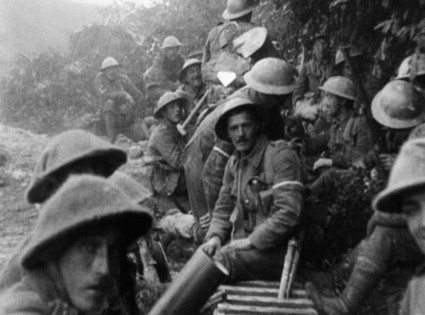
Men of B Company, 1 Lancashire Fusiliers, in a sunken lane in front of Beaumont Hamel, filmed by Geoffrey Malins, 1 July 1916 (frame grab from DVD)

This is a book chiefly for the military history enthusiast. The film historian will welcome the attention paid to the practicalities of the film’s production (there is a chapter on the cameras used and the limitations of orthochromatic film stock, which was not sensitive to the full spectrum, though more could have been said about lenses), while expressing surprise that the book refrains from saying anything about the film’s history once it had been released to an astonished British public (more than half the population saw it). It is pedantic in its dogged desire to identify and list every place, every unit, leaving no scene of the film unturned – a tabulation at the end of the book lists each shot (extant and lost) in order, with timing, date, camera operator, location, subject, date and caption. It is not a history for those who crave narrative.

So it may not find a place on any film studies shelf, but for the factual historian, it opens up a medium for study. As Roger Smither, Keeper of the Film and Photograph Archives at the IWM, says in his foreword, “Ghosts on the Somme sets a new standard for the examination of archive documentary film”. The convention has always been to distrust the record the actuality film provides, to emphasise film’s propensity for lying. Ghosts on the Somme shows that, ultimately, film records reality, and that we can uncover that reality, if we have eyes to see. Perhaps it really should be on a few film studies shelves.

Moving Pictures: How They are Made and Worked

edison_studio

Edison studio with battery of lights and electrically-driven camera, from Moving Pictures: How They are Made and Worked

There has been a rush of newly-available e-books on the Internet Archive following expansion of digitisation activity on Google Books, and we’ll be pointing out some of the key titles in coming weeks and placing them in the Bioscope Library. First up is one of the classic early texts on film, a reference work still cited today, F.A. Talbot’s Moving Pictures: How They are Made and Worked.

Frederick A. Talbot was a British writer of popular works on science and engineering subjects, but had a special interest in motion pictures, producing both Moving Pictures (1912) and Practical Cinematography and its Applications (previously written about here) in 1913. Moving Pictures: How They are Made and Worked was originally published in Britain in 1912, in a revised edition in America in Britain in 1914, and a second, completely re-written edition in 1923. The copy in the Internet Archive is the 1914 revision, though it seems to be largely the same as the 1912 original.

Talbot’s task was to explain the phenomenon of the new age. “A vast industry has been established”, he writes, “of which the great majority of picture-palace patrons have no idea, and he moment appears timely to describe the many branches of the art”. Talbot’s focus is on technology and industry, rather than art or entertainment, and his chief interest is in the motion picture as a medium of discovery. But unlike the many dry works from this period which explain the mechanics of motion picture production and exhibition for the benefit of the technician, Talbot’s book bubbles over with enthusiasm. Some of his judgements need to be challenged, but his keen eye and thorough research (including contact with many of the leading figures in the industry) have kept the book fresh and valuable to this day. It is easy to read, and a easy source for good quotations.

He begins by explaining how we are able to see “animated photography”, and it is this section that has probably had the most influence, as Talbot’s somewhat muddled explanation of the “persistence of vision” has been taken as lightly read by many writers. We now know that the persistence of vision is not the reason why we are able to perceive motion (whether motion pictures or any other kind of motion, which is the real matter in hand – see an earlier post on this for an attempt at an explanation). Michael Chanan’s The Dream that Kicks is recommended for its sympathetic analysis of what Talbot got wrong yet how he struggled for the right answer at a time when science (optics etc.) had not properly supplied the information needed.

automobile

Talbot find more solid ground when he traces the history of the medium, through experiments in sequence photography of Marey and Muybridge, the discovery of celluloid, the construction of the Edison Kinetoscope and other machines, before moving on to perforations, celluloid manufacture, the taking, developing and printing of films, and their exhibition. He covers the staging of fiction films, though his interest is more in the mechanics than the aesthetics, while his real passion is revealed to be the trick film. Talbot devotes a remarkable six chapters to the trick film, revealing an almost childish enthusiasm for the simple transposition, substitution and distortion effects which characterised early trick films (and which were mostly well out-of-date by the time he wrote the book). The photograph comes from The Automobile Accident (man is driven over by a car, severing his legs, which are then repaired by a passing doctor) which he illustrates and explains in minute detail.

Talbot’s other great enthusiasm is for the motion picture as a medium of education and science. There is some fascinating, well-observed material on microcinematography, electric cinematography and chronophotography, with information (and fine illustrations) gleaned from experimenters such as Percy Smith, Jean Comandon, E.J. Marey and Lucien Bull. Finally, Talbot speculates most interestingly on the possibility of the motion picture as a news medium (“the animated newspaper”, or newsreel, was in its infancy), films in colour (he is an observant Kinemacolor sceptic) and motion pictures in the home.

Though care needs to be taken over some of the evidence and its presentation, Moving Pictures: How They are Made and Worked still stands up as a fine illustration of what possibilities lay before a young medium whose rules had not yet been firmly established. In the 1923 edition Talbot expresses some disappointment that progress in the fields of education and science “has been less spectacular than in that devoted to pure entertainment”. In 1912 motion pictures might yet do anything.

Moving Pictures is available from the Internet Archive in Flip Book (25MB), PDF (6.9MB), full text (702KB) and DjVu (8MB) formats). Note that the PDF link takes you to a Google page which seem only to have sections of the book available – the full PDF version can be found by clicking on the Internet Archive’s “All files: http” link.

A tramp’s odyssey

simonlouvish

Having dispatched W.C. Fields, Mack Sennett, Cecil B. De Mille, Laurel and Hardy, and Mae West Simon Louvish has turned his attention to Charlie Chaplin. His latest book, just published, is Chaplin: The Tramp’s Odyssey is a socio-cultural biography of Chaplin, who as the years retreat becomes not so much an entertainer as the story of an entertainer, a twentieth-century everyman. So Louvish gives us Chaplin’s biography though the context of his times, and as metaphor through which to view those times. His interesting device is to name each of the chapters after one of Chaplin’s films, emphasising their biographical quality – The Immigrant, A Film Johnnie, The Adventurer, The Bond, The Gold Rush, City Lights, Limelight, and so on (Carl Davis’ programme of Chaplin films in 2007 arranged the Mutual films with similar biographical purpose). On quick inspection the conceit works well. It’s not a detailed biography (there are many, many nods to David Robinson’s towering Chaplin), but it’s subject is rather the film persona than the man himself. It encourages us to look again at the films for what they say about the man who was so key to his times, and that can only be a good thing.

Bioscope Newsreel nos. 8 and 9

newbooks

In a special double issue of the all too infrequently published Bioscope Newsreel, we bring you news of some of the books on silent cinema recently published or due for publication soon (publication dates are for the UK, please note). Some of these titles I’ll be writing on in greater detail later.

United Artists 1919-1950
Tino Balio’s United Artists: 1919-1950 – The Company Built by the Stars, to be published in April, recounts the history of the studio founded by Charlie Chaplin, Mary Pickford, Douglas Fairbanks and D.W. Griffith.

Shakespeare on Silent Film
At last a work to challenge Robert Hamilton Ball’s Shakespeare on Silent Film (1968), Judith Buchanan’s Shakespeare on Silent Film: An Excellent Dumb Discourse shows how the early cinema went about tackling high culture. It is published in May.

Weimar Cinema
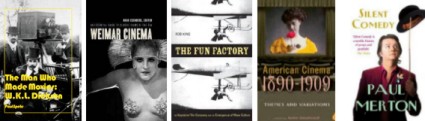
In Weimar Cinema: An Essential Guide to Classic Films of the Era Noah Eisenberg discusses sixteen iconic German films, silent and sound, made between the two world wars.

American Cinema
The Screen Decades is a series from Rutgers University Press, designed for course use and scholarly research. The first three volumes under American Cinema are André Gaudreault, American Cinema 1890-1909: Themes and Variations (yes, it does say 1890 as a start date); Charlie Kiel and Ben Singer, American Cinema of the 1910s: Themes and Variations; and Lucy Fisher, American Cinema of the 1920s: Themes and Variations.

Ghosts on the Somme
Alistair H. Fraser, Andrew Robertshaw and Steve Roberts have produced an intensive analysis of the classic 1916 documentary, The Battle of the Somme, investigating it in unprecedented depth and with many exciting discoveries. Ghosts on the Somme: Filming the Battle, June-July 1916 is published in March.

The Fun Factory
Academia takes on Keystone in Rob King’s The Fun Factory: The Keystone Film Company and the Emergence of Mass Culture, described as viewing “the changing politics of early film culture through the sociology of laughter”.

Film 1900
Klaus Kreimeier and Annemone Ligensa are the editors of Film 1900: Technology, Perception, Culture, a collection of essays which look at early cinema as media history, comparing its impact to that of the current digital revolution.

Stagestruck Filmmaker
The important connection between Griffith’s film career and his stage inheritace is dealt with in David Mayer’s Stagestruck Filmmaker: D.W. Griffith and the American Theatre, which explores early cinema’s theatrical roots. Published in March.

Silent Comedy
Paul Merton, the British comedian who is dedicated to introducing classic silent comedy to new audiences, has his book Silent Comedy published in paperbackin May to coincide with his new Silent Clowns tour.

The Man Who Made Movies
Paul Spehr’s magnum opus, The Man Who Made Movies: W.K.L. Dickson, is a enjoyable biography of the man who deserves more than anyone else the accolade of the inventor of cinema, and an exceptional technological history.

Picturing American Modernity
In Picturing American Modernity: Traffic, Technology, and the Silent Cinema Kristen Whissel takes an innovative look at early cinema in the context of turn-of-the-century American culture.

The Silent Cinema in Song
Ken Wlaschin’s The Silent Cinema in Song, 1896-1929: An Illustrated History and Catalog of Songs Inspired by the Movies and Stars, with a List of Recordings brings together songs about movies and moviegoing created between 1896 and 1929, biographies of the stars with the songs that were dedicated to them, and a discography with availability information.

‘Til next time!