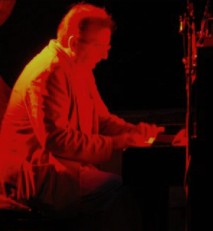
The original Neil Brand

Neil Brand is a silent film pianist. That much is known by most enthusiasts for silent film in the UK, and by a good many around the world as well. It may not always be realised that Neil is also a writer, composer, actor and scholar, one whose prodigious energies and superabundant talent make him not far short of a national treasure. Hmm, why that note of qualification? – he is a national treasure. And now, as if accompanying silents live and on DVD, writing radio scripts and musical comedies, acting on film and TV, writing books and educating students were not enough, now he has turned online archivist with his latest venture, The Originals.

The Originals is a new section of Neil’s personal site which brings together original materials relating to the performance of music to film in the silent era. For some while now Neil has been collecting articles, scores, interviews, memoirs and eye-witness accounts which document the experience of seeing or performing to films in the 1910s and 1920s. He has now started to put some of this material online.

http://originals.neilbrand.com

The site is in three sections: Interviews, Archive and Memories. Interviews features a small collection (so far) of interviews and articles which give the point of view of musicians who were employed in cinemas during the silent era. These include a transcription of a 1988 interview with the 94–year-old Ella Mallett, former silent movie musician (carried out as part of the BECTU History Project which records interviews with veterans of the British film and television industries); an extract from Maurice Lindsay’s memoir of Glasgow life, As I Remember; an extract from New Zealander Henry Shirley’s memoir Just a Bloody Piano Player; and a highly evocative piece from novelist Ursula Bloom about her experiences as a teenage silent film pianist in St Albans (contributed by yours truly).

Archive is the section that is going to attract the most interest. This offers PDF copies of various original documents relating to silent film music, including extracts from original music that would have been performed with various films. The jewel here is selected pages from the score for The Flag Lieutenant, compiled by Albert Cazabon, and the only surviving full score for a British silent fiction film in existence. You’ll also find music for the Douglas Fairbanks picture The Black Pirate, an eyebrow-raisingly dismissive article on the profession of silent film pianist, cue sheets for Hell’s Heroes and The Hound of the Baskervilles, and more.

The third section, Memories, presents extracts from the 1927-1930 diaries of Gwen Berry, who played ‘cello in the orchestra pit of the Grand Cinema, Alum Rock Road, Saltley. The extracts, from 1929, show Gwen’s apprehension at the arrival of the “terrible talkie pictures” which were going to throw so many musicians such as her out of work. The diary is presented in a elegant turn-the-pages digital form, which does require that you install a plug-in for DNL ebook software.

All in all, The Originals is an excellent idea, and one that The Bioscope hopes will grow and grow, not least if those interested are able to send relevant materials to Neil so that they might be shared by all.

Meanwhile, here’s a handy survey of other things NeilBrandian…

Bravo, Neil.

Alla ricerca di Chaplin e Keaton

http://www.cinetecadibologna.it

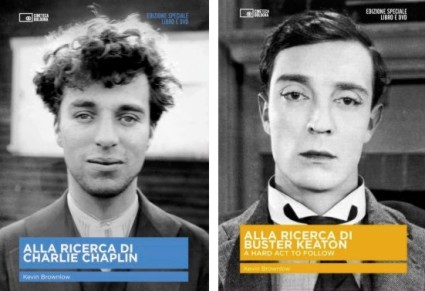
The Cineteca di Bologna has just issued two handsomely-produced book and DVD sets, All ricera di Charlie Chaplin – Unknown Chaplin (The Search for Charlie Chaplin) and Alla ricera di Buster Keaton – A Hard Act to Follow.

The two sets bring together the classic documentary series together with accompanying texts written by Brownlow. The three-part television series Unknown Chaplin was produced by Brownlow and David Gill in 1983, and showcased the previously-unseen collection of Chaplin out-takes that so richly illuminated his working methods. The text, originally written by Brownlow in 1983, was published for the first time by the Cineteca in 2005 in a dual-language edition with DVD. This re-issue has the Italian text only (163 pages), while the DVD is the English-language series (with Italian subtitles). It includes the extras How Unknown Chaplin was Made (on the making of the TV series), The Making of The Count (historian Frank Scheide examines the process of making the Mutual film) and Chaplin meets Harry Lauder (1918). These are available on the UK and American DVD releases.

Frank Scheide viewing The Count

Buster Keaton – A Hard Act to Follow is a three-part television series made by Brownlow and Gill in 1987. It documents the story of Keaton’s working life, with close examination of his working method through the films (though without the revelation of a hidden archive of film this time round). The accompanying book (250 pages) has been written for this publication, which makes it particularly important, but again, the text is in Italian only (there are hopes of an English publication eventually). The DVD is of the English-language television series, but the release has Brownlow’s approval, as opposed to the UK version which lacks many explanatory titles. There are no extras.

The sets are available for 15.00 € each or 27.00 € for the two, from the Cineteca di Bologna site.

A call to war

Film historian Stephen Bottomore has got in touch to ask if The Bioscope can publish a call for papers for an upcoming special issue of Film History which Stephen is editing, on the subject of film and the First World War. More than happy to do so:

Call for papers: World War I and cinema

Film History is planning a special issue about film and the First World War, and we are in the early stages of soliciting material on this theme. We are looking for articles, preferably with good illustrations, on any aspect of the relationship between World War I and cinema during wartime: from production (both non-fiction and fiction) to exhibition and distribution, and any combination thereof. Themes might include film propaganda, war cameramen, the international film trade, the effect of the war on the world’s film industries, etc etc. We might also be interested in articles which explore issues outside the 1914-1918 time-frame, including about film and other conflicts in the silent era, or about the representation of World War I in later (or earlier?) films. Other, related themes might also be considered.

We will mainly be interested in articles from more established scholars, but will also consider pieces from less experienced writers if sufficiently interesting in content, and well-written.

The editor of this issue will be Stephen Bottomore, and the commissioning process will go through four stages:

1) Author e-mails SB a summary of, or rough idea for, the article by end of January 2010.
2) If we agree to go ahead, author sends SB a first draft by Summer 2010.
3) After SB’s comments and further discussion, author sends in final draft (with citations correctly formatted) along with other materials including illustrations – by October 2010, about the time of the Pordenone festival.
4) All the materials will then be forwarded to the editor in chief, Richard Koszarski, who might have his own queries or amendments.

Please feel free to pass on this call for papers to anyone qualified to contribute to this special issue.

Stephen Bottomore
December 2009
warnjai2 [at] fastmail.fm

We’ve not had calls for papers for publications on The Bioscope before now, but if they broadly relate to the subject of silent cinema I’d be glad to include them here.

Ken Wlaschin and the silent opera

kenwlaschin

Sadly the death has been announced of Ken Wlaschin, a major figure in American and British film culture for many years. Born in America, Ken came to prominence as head of the National Film Theatre in London, also serving as the director of the London Film Festival from 1969 to 1984. He returned to the States and revived the Los Angeles International Film Festival, serving also as director of creative affairs at the American Film Institute and vice chairman of the National Center for Film and Video Preservation. He was an author of great distinction, writing not only on film (The Illustrated Encyclopedia of the World’s Great Movie Stars and Their Films, The Faber Book of Movie Verse) but fiction, travel books and poetry.

Obituaries to Ken Wlaschin have been published elsewhere. This post will pay a different kind of tribute by concentrating on one particular area of interest to him. Perhaps Ken’s most notable publication was Encyclopedia on Opera on Screen: A Guide to More Than 100 Years of Opera Films, Video and DVDs (2004). This stupendous publication (all 872 pages of it) is a comprehensive, cultured and engrossing guide to the alliance of opera and the screen, a history that goes back into the silent era, when opera was a remarkably popular subject for filmmakers.

Indeed the alliance is not merely as old as cinema itself, but older. In his caveat of 15 October 1888 Thomas Edison wrote the following famous words about the motion picture device that he was setting out to invent:

I am experimenting upon an instrument which does for the Eye what the phonograph does for the Ear, which is the recording and reproduction of things in motion, and in such a form as to be both cheap practical and convenient. This apparatus I call a Kinetoscope ‘Moving View. In the first production of the actual motions that is to say of a continuous opera the instrument may be called a Kinetograph buts its subsequent reproduction for which it will be of most use to the public it is properly called a Kinetoscope …

Edison repeatedly cited opera as the prime example of what his motion picture invention was meant to achieve, his vision having always been to combine motion pictures with sound. In 1894 he wrote:

The kinetoscope is only a small model illustrating the present stage of progress but with each succeeding month new possibilities are brought into view. I believe that in coming years by my own work and that of Dickson, Muybridge, Marié [i.e. Marey] and others who will doubtless enter the field, that grand opera can be given at the Metropolitan Opera House at New York without any material change from the original, and with artists and musicians long since dead.

So it was that opera was embedded into the consciousness of film from the very outset, and if the precise combination of vocal music and film proved a challenge for three decades (though never an impossibility), filmmakers in the so-called silent era turned to opera again and again – for its stories, its scores, its kudos and its stars.

All of this is documented in fascinating detail in Wlaschin’s Encyclopedia of Opera on Screen. As well as entries on silent cinema and opera and on first opera films, he includes sections on their early film productions of every opera imaginable. How many? Well a quick thumb through the book reveals early film productions of Aida, Un ballo in maschera, Il barbiere di Siviglia, The bartered bride, La boheme, Carmen, Don Giovanni, Faust, Fra Diavolo, Lohengrin, Lucia di Lammermoor, Madama Butterfly, Martha, The Mikado, Le nozze di Figaro, Pagliacci, Parsifal, Rigoletto, Thaïs, Tosca and many more. The exact number is impossible to determine, partly owing to problems of definition, but it undoubtedly runs into hundreds. ‘Silent’ operas films were of various kinds, of which these are the main types:

Synchronised sound
Edison hoped to marry the Kinetoscope to his Phonograph, but the Kinetophone did not have much of a commercial life and never featured any opera. But synchronisation of gramophone recordings with films to give a semblance of the full audio-visual experience began in 1900 with the Phono-Cinéma-Théâtre at the Paris Exposition, for which Clément-Maurice filmed Victor Maurel singing arias from Don Giovanni and Falstaff and Emile Cossira an aria from Roméo et Juliette. A second wave of synchronised (or sound-on-disc) films from around 1907 onwards led to numerous films of scenes or arias from operas, usually with actors miming to the recordings of the genuine opera singers. Systems such as the Cinephone, Cinematophone, Vivaphone, Chronophone, Cinemafono and Biophon were a common feature of cinema programmes for a number of years up to the start of First World War. Although some attempts were made to encompas an entire opera in this way (in 1907 British Gaumont issued a complete Gounod’s Faust in twenty-two separate film/sound recordings), the vast majority of these films were single-reelers of three minutes or so, lasting the length of a single gramophone recording. The greatest exponent of the form was the German producer Oskar Messter, who produced around 500 song, opera and operetta sound shorts using his Biophon system, and even opened a spcialised Berlin cinema dedicated to opera films (one or two other such cinemas opened around Europe at this time).

Georges Mendel’s Lucia di Lammermoor (1908), from the Lobster Films DVD set Discovering Cinema

The most joyous of all synchronised sound opera films is a 1908 production by French producer Georges Mendel of the sestet from Donizzetti’s Lucia di Lammermoor, sung by Enrico Caruso Marcella Sembrich, Antonio Scotti, Marcel Journet, Barbara Severina and Francesco Daddi. The performers who appear on the film are actors miming to the recording, but the spirit in which the music is relayed is truly uplifting (the film – only recently discovered and not correctly identified in Wlaschin’s encyclopedia – can be found on the Discovering Cinema 2-DVD set, for which see below).

Filmed performance
Among the most prestigious, though controversial, of early cinema productions was Edison’s Parsifal (1904), a near-literal recording of the Metropolitan Opera production filmed by Edwin S. Porter, whose exhibition was hampered by a lawsuit preventing Edison from screening the film alongside Wagner’s recorded music.

Operas as films
Operas conceived of as films are a rare breed. There are two examples from the silent era. Rapsodia Satanica (Italy 1915) was an avante garde work directed by Nino Oxilia, which starred Lyda Borelli and had music that accompanied screenings by Pietro Mascagni (composer of Cavalleria rusticana). The peculiar Jenseits des Stroms (Germany 1922), directed by Ludwig Czerny, has music composed for singers and orchestra by Ferdinand Hummel, which had musical notation running along the bottom of the screen throughout the film. A print is held by the BFI National Archive.

Related to this, one composer among the greats was able to have a say in how a film of one of his operas transfered to the silent screen. Richard Strauss’s Der Rosenkavalier, written in 1911, was filmed in 1926 in Austria by Robert Weine. Strauss provided new music and arranged the film’s live score, while his librettist Hugo von Hofmannsthal wrote the screenplay, with new scenes added for the film.

Biopics
Another way of bringing together opera music with silent film was through lives of composers. Examples include opera enthusiast Oskar Messter’s feature-length The Life of Richard Wagner (1913), directed by Carl Froelich, and the 1921 Austrian film Mozarts Leben, Lieben und Leiden, on the life of Mozart, while Verdi was the subject of a 1913 Italian production, Giuseppe Verdi nella vita e nella gloria.

Geraldine Farrar in Carmen, from Flickr

Stars
The leading opera singers of the period were earnestly sought as film actors. Among them were Mary Garden, who appeared in Goldwyn’s Thaïs (1917); Lina Cavalieri, who featured in Italian and American films in the ‘teens (none directly based on operas); and Enrico Caruso, who starred in My Cousin (1918) for Famous Players-Lasky and, less successfully, in The Splendid Romance (1919). The outstanding crossover star was Geraldine Farrar, who had a huge hit with Cecil B. DeMille’s Carmen in 1915 and went on to enjoy a five-year film career with titles (such as the classic Joan the Woman) which owed little to the opera repertoire but demonstrated her powerful cinematic appeal.

Stories
Often the stories from operas were used for silent films that had no allegiance to the music, often because they based themselves on source novels or plays rather than the opera. King Vidor’s La bohème (1926), with Lillian Gish as Mimi, is probably the most notable example (MGM were forbidden by the publishers from using Puccini’s music to accompany the film).

Abbreviations
British producer Harry B. Parkinson was responsible two film series which boiled down opera stories to twenty-minute shorts. Tense Moments with Operas (1922) produced digests of Martha, Rigoletto, La traviata and others. Cameo Operas (1927) did the same, except that these were exhibited with live singers and orchestral accompaniment. Parkinson directed and John E. Blakeley produced. Examples included Carmen, Faust and Der Ring des Nibelungen.

Opera music accompanying silent films
Opera themes were used to accompany silent films, notably Wagner’s ‘Ride of the Valkyries’ which perhaps almost inevitably was used to accompany the ride of the Ku Klux Klan in D.W. Griffith’s The Birth of a Nation.

Silent films about opera
There are numerous examples of silent films set in the world of opera. Best known is the Lon Chaney vehicle, The Phantom of the Opera (1925), but other examples listed by Wlaschin are Clara Kimball Young in The Yellow Passport (1916), Tom Moore in Heartease (1919), Betty Blythe in How Women Love (1922) and Greta Garbo in The Torrent (1926).

Operas based on silent films
Wlaschin records that the first film to be the inspiration for an opera was Cecil B. DeMille’s The Cheat (1915), which served as the basis of French composer Camille Erlanger’s 1921 opera Forfaiture. Eisenstein’s Battleship Potemkin was made into an opera in 1937 by composer Oles Semenovich Chishko, while William Bolcom’s McTeague (1992) is based on both the Erich von Stroheim film and Frank Norris’ original novel.

Operas about silent films
Finally, there could be operatic works about film. Germany composer Walter Kollo came ujp with Filmzauber (Film Magic) in 1912, with libretto by Rudolf Bernauer and Rudolph Schanzer, which was shown in London and New York in 1913 as The Girl on the Film. It told of a film company producing a story about Napoleon in a small village. Other examples include German composer Jean Gilbert’s operetta Die Kinokönigen (1913) and Carlo Lombardo’s La signorina del cinematografo (1914).

Encyclopedia of Opera on Screen (from which much of the information above derives) exists both as a book and as a word-searchable CD-ROM.

I’ve not found any silent opera films or synchronised opera films from the silent era online (at least not legitimately so), but here’s a listing of some of the DVDs available:

Obituaries for Ken Wlaschin have been published by the Guardian and Variety. His silent film intersts extended beyond opera by the way – among his other publications are The Silent Cinema in Song, 1896-1929: An Illustrated History and Catalog of Songs Inspired by the Movies and Stars, with a List of Recordings and Silent Mystery and Detective Movies: A Comprehensive Filmography.

The Rose of Rhodesia

rose-of-rhodesia

Chief Kentani (left) and Prince Yumi in The Rose of Rhodesia, from Screening the Past

A while ago we wrote a piece on the peripatetic American film director Harold Shaw, who – in between periods in America, Britain and Russia – for a short period (1916-1919) produced films in South Africa. Shaw made three films in the country – De Voortrekkers, The Rose of Rhodesia and Thoroughbreds All (a fourth, Symbol of Sacrifice, was started by Shaw but completed by other hands). The first was an Afrikaner nationalist epic of the Battle of Blood River; the third (a lost film) was a racing horse comedy.

The Rose of Rhodesia (1918) has been attracting a lot of interest lately, following its happy rediscovery by the Nederlands Filmmuseum. The process of critical rediscovery has led to a special issue of the always commendable Australian online journal Screening the Past dedicated to the film. There are pieces by the two foremost experts in filmmaking in Africa at this period, Neil Parsons and James Burns, which provide rich detail on the background to the film’s production and personalities, Parson concentrating on the production history and Burns on Bioscope audiences in South Africa at the time (Bioscope was – and I believe remains – the common name for a cinema in South Africa). There are other essays on its racial politics, political and literary perspectives and position in cinema history, and a rich selection of background materials including reproductions of original press notices and advertisements.

rose1

Prince Yumi (Mofti), Edna Flugrath (Rose Randall) and M.A. Wetherell (Jack Morel), exchanging a white rose

But what it is particularly notable is that Screening the Past is delivering the entire restored film itself (streaming only), courtesy of the Filmmuseum [this link no longer works – see note below]. 81 minutes long, with German intertitles (an English translation is supplied) and inventive soundtrack by Matti Bye, the film is a revelation. What commentary the film had received before its rediscovery (chiefly Thelma Gutsche’s 1972 great history The History and Social Significance of Motion Pictures in South Africa 1895-1940) dismissed it as an amateurish failure which was roundly dismissed by local audiences. It is hard to match the recorded disappointment of South African audiences with the remarkable, engrossing film we see now (which is some 20 minutes shorter than the film as originally produced) which more than merits the attention given it by Screening the Past. Indeed, as Shaw had fallen out bitterly with Isidore Schlesinger, film producer and owner of practically all of the South African distribution and exhibition business, one suspects that the film’s reception was sabotaged.

The story concerns, at least initially, the theft of a diamond from a Rhodesian mining concern. The diamond is called ‘the rose of Rhodesia’, but Shaw develop this into a deeper metaphor, as Rose is the name of a gold prospector’s daughter (played by Edna Flugrath, Harold Shaw’s wife), who falls in love with Fred Winter, the overseer who has stolen the diamond, before transferring her affections to a missionary’s son, Jack Morel, played by M.A. Wetherell. Jack is friendly with Mofti, son of the chieftan Ushakapilla, and a white rose is exchanged as a symbol of their friendship. Ushakapilla is planning an uprising against white rule, and expects his reluctant son to adopt the cause, but after Mofti’s accidental death and news that his people’s ancestral lands has been granted to them by the “great white Chief”, Ushakapilla relents. Rose retuns the diamond to the mining corporation (it had been found by one of Ushakapilla’s men), and the reward money enables she and Jack to marry.

mofti

Prince Yumi, as Mofti

The Rose of Rhodesia is distinguished in particular by its portrayal of Africans. The African parts were taken by members of the M’fengu people, with Ushakapilla played by ‘Chief’ Kentani (probably a local headman) and Mofti by ‘Prince’ Yumi (possibly a migrant worker or student). The portrayals are sympathetic and convincing, and the friendship between Mofti and Jack Morel affecting and unforced. The theme of African discontent over loss of lands reflects genuine feelings of the time, and the potential for uprising was one that greatly exercised white authorities at the time (to the degree that the film could never have been made in Rhodesia itself, where the authorities greatly feared cinema’s subversive potential, and was instead filmed at Sea Point studio in Cape Town and by the spectacular Bawa Falls in Eastern Cape – none of the film was made in Rhodesia). It may be felt that the films shies away from what seems to be its initial interest – to depict African versus white tensions – by playing it safe with a story of diamond stealing. Interestingly this was even commented upon at the time by the British trade paper The Kinematograph Weekly:

At the start the impression is given that there is to be strong drama founded on a conflict between the interests of the natives and those of imperialism. But, in reality, the “native question” does not develop. The producers have carefully avoided the danger of giving offence to either partisan side … [and] have left a story rather devoid of “punch”.

But viewing the film now one is struck by how readily the diamond plot is set to one side, and how inter-racial relations become the film’s real interest. Local sensibilities undoubtedly stayed Shaw’s hand, but the theme of the importance of mutual trust and respect demanded of black and white is not diluted at all. Such a progressive view of Africans would not appear again in South African cinema for many years thereafter.

The Rose of Rhodesia was written and directed by Harold Shaw for Harold Shaw Film Productions. It was photographed by the American Ernest G. Palmer and Briton Henry Howse (like Shaw a much-travelled figure whose career included filming for the Salvation Army and in the Arctic). It was first shown on 23 March 1918 in Cape Town, and in Britain on 28 October 1919. It is unclear how widely it may have been seen in Britain (it gained some trade press coverage, reproduced in Screening the Past), while it it a mystery how a print turned up with German titles as no record has been found of its exhibition in any German-speaking territory. Its story is a fascinating one, while its quality as a film is unexpected and most welcome. I warmly recommend seeing the film, and engrossing yourselves in its history.

The Rose of Rhodesia is a late addition to the programme at this year’s Pordenone silent film festival.

Update (March 2017): Screening the Past has changed its website, and the above links to issue 25 of the journal and the film no longer work. These are the changed links:

Film: http://tlweb.latrobe.edu.au/humanities/screeningthepast/25/rose-of-rhodesia/rose-of-rhodesia.html

Issue: http://tlweb.latrobe.edu.au/humanities/screeningthepast/current/issue-25.html

From old Ireland

condon

While sojourning in Dublin last month, I picked up a copy of a new film history which I’d managed to miss up until now. Denis Condon’s Early Irish Cinema 1895-1921, published by Irish Academic Press, describes itself as examining “early and silent cinema and its contexts in Ireland”. It is a history not just of film production in Ireland (at a time when politically it was still a part of the United Kingdom), but its exhibition and its social and cultural contexts as well. Although there have been several histories of Irish film which include accounts of filmmaking in the silent era, so far as I am aware this is the first book dedicated to the early and silent cinema period alone.

Irish film production in the silent era was small-scale (and has attracted little interest among film scholars except those from Ireland) but Condon argues the attention given to these films by Irish commentators suggests that they have “a symbolic significance far out of proportion to their numbers”. The first Irish-produced fiction films did not appear until 1913 – one-reelers made by Irish Film Productions such as Michael Dwyer and Love in a Fix – and did not seriously begin until 1916 with the formation of the Film Company of Ireland, which made O’Neil of the Glen (1916), Knocknagow (1918) and Willy Reilly and his Colleen Bawn (1920), the latter two of which survive. Irish-themed films were made in profusion in America, however, mostly notably by Kalem, which sent a company headed by Sidney Olcott and Gene Gauntier over to Ireland and made such titles as The Lad from Old Ireland (1910), Arrah-na-Pogue (1911), The Shaugraun (1912) and Come Back to Erin (1914) (the latter one of those made by the Gene Gauntier Players, rather than Kalem). On the non-fiction side, there was Irish production from early on with local views produced by exhibitiors such as James T. Jameson, through to Norman Whitten’s General Film Supply, whose most interesting production was the newsreel Irish Events (1917-1920). Again, the greater number of Irish-themed non-fiction films came from outside, particularly British companies such as the Warwick Trading Company and the Charles Urban Trading Company, which produced assorted travelogue series.

This history Condon covers in remarkable detail. There appear to be few documentary sources that he has not examined, and his notes and sources will be plundered by future researchers for years to come. However, though he piles on the detail, he has arranged the book most interestingly. Avoiding too slavish an adherence to chronology, he divides the book into chapter entitled ‘Retrospection and Projection’, ‘Theatre’, ‘Virtual Tourism’, ‘Participation’ and ‘The Great Institution of Kinematography’. These reflect Irish cinema’s roots, its cultural inheritance, the importance of external producers’ work, Irish production itself, and a larger conception of cinema which includes the distribution of films, their exhibition and reception. The construction makes think about how Irish cinema was constructed.

This is a worthwhile, rigorous academic study. It is based on a thesis (and reads like it), with arguments about the institutional and pre-institutional form of early cinema which are designed to appeal to the film studies crowd. But it is also jam-packed full of every sort of detail, fascinating to dig through, and comes with a very helpful filmography that includes both films extant and films lost. My thought on reading it was that, despite the author’s progressive historiographical aims, there is something about the national film history which is a little quaint these days. We’ve done with the histories of this country and that country’s films, or we should have done. If cinema history teaches us anything it is that distribution had to flow over borders, if films were to make money. Condon certainly looks beyond Irish film production, and admirably so, but it is what audiences saw (American films, largely unmentioned except for the Kalem films) and what those audiences were (mostly absent from his book) that is the heart of the matter, not what any one country made.

Eloquent gestures

eloquent_gestures

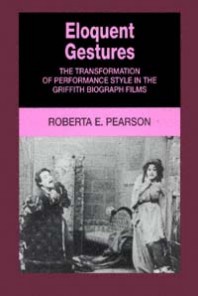
It’s been a while since we added anything new to the Bioscope Library. A new wing has been added to the tottering edifice that is Bioscope Towers, and first on the fresh new set of shelves therein is Roberta E. Pearson’s Eloquent Gestures: The Transformation of Performance Style in the Griffith Biograph Films, published by the University of California Press in 1992. This is one of the titles that the enlightened UCP has made available for free online as one of its eScholarship Editions offerings. It is a model ebook presentation, as well as being one of the most interesting and stimulating books written on the films of David Wark Griffith.

The book’s subject is the changes in the style of the actors’ performances in the films of D.W. Griffith, particularly between 1909 and 1912. Pearson sets this up in a delightful introduction in which she imagines Josiah Evans, “a man with a civic conscience who belongs to several progressive reform organizations”, attending a Broadway storefront picture show in 1909 in which he sees a film entitled The Drunkard’s Reformation, which he rather enjoys because it reminds him of the blood-and-thunder stage melodramas of his youth.

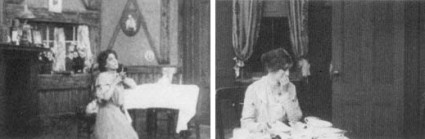
The acting of the young wife as she depicts her misery and desperation particularly affects him. She collapses into her chair and rests her head on her arms, which are extended straight out in front of her on the table. Then, in an agony of despair, she sinks to her knees and prays, her arms fully extended upward at about a forty-five degree angle.

Three years later he visit the Rialto Theatre on 14th Street, a considerably classier venue than that 1909 nickelodeon, and is struck in particular by a film entitled Brutality. It is similar in theme to the earlier film…

… but this moving picture does not remind him of the blood-and-thunder melodramas of his youth. The acting is the equal of Mr. Gillette’s in Sherlock Holmes or even of that in the Belasco play he and Lydia had attended last night. Particularly impressive is the young wife’s despairing reaction to her husband’s harsh treatment and abandonment. After he leaves for the saloon, the wife walks back to the dining-room table covered with the debris of their evening meal. She sits down, bows her head, and begins to collect the dishes. She looks up, compresses her lips, pauses, then begins to gather the dishes once again. Once more she pauses, raises her hand to her mouth, glances down to her side, and slumps a little in her chair. Slumping a little more, she begins to cry. How differently this actress portrays her grief from her counterpart in A Drunkard’s Reformation. A lot has changed in those three-and-a-half years since his first visit to a nickelodeon.

drunkard&brutality

A Drunkard’s Reformation (left) and Brutality, from Eloquent Gestures

How the films of D.W. Griffith moved on from the one style to the next is the subject of Pearson’s book. It traces in meticulous detail the transformation from an acting style inherited from the stage meodramas of an earlier era, to a nuanced style that benefitted from ‘realist’ developments in literature and theatre. It wasn’t there in 1909; it was there in 1912, and by examining closely the films made in that intervening period and being attuned to contemporary cultural developments, the path from the one to the other can be drawn. This is what Pearson does.

It is a very detailed study, one grounded a theoretical language which may not be to everyone’s taste, but the author needs to negotiate the pitfalls that terms such as “naturalism”, “realism” and “melodrama” can lead to. She wants to be precise about the meaning of words which are used all too loosely in general critical discussion (“melodrama” in particular), and to ground what one sees in these films, and what one sees in changing, in a close understanding of what was going on at the time. As she says:

The study of cinematic performance demands that we not depend upon our own aesthetic judgments, which we tacitly deem eternal and unchanging. Rather, we must acknowledge history by attempting to understand the aesthetic standards of another time and place, of a culture very different from our own.

The rest you must read for yourselves, and I warmly recommend that you do so. Though this is very much a thesis turned into a book, with all of the formal argument structures that one recognises (such as having an introduction which rubbishes the opposition), it illuminates understanding – not just of Biograph films, but of any cultural artefact from any period which we may be tempted to interpret from our personal aesthetic experience but which needs to be seen, first and foremost, as the product of its own times.

The ebook presentation is excellent. The book is divided up into hyperlinked chapters, and page breaks are indicated where they occur in the original, which is good for accurate citation. Notes in the text are hyperlinked to a notes section at the end, the index has hyperlinks so you can go directly from term back to the text, and the illustrations are available in small and full size versions. Finally there is a search box enabling to search the entire text of the book. Excellent all round. Into the Bioscope Library it goes.

Film studies is dead… long live film studies

vitagraph_office

Vitagraph’s Manchester office in 1921, from Richard Brown’s article ‘The Missing Link: Film Renters in Manchester, 1910–1920’

OK, not that film studies, but Film Studies the journal, published by Manchester University Press, produced out of the University of Kent, which is no more. This is sad news, because it was handsomely produced and filled with stimulating riches, issue after issue. But, as Catherine Grant on the never less than essential Film Studies for Free reports, Manchester University Press has done the decent thing and made all of the articles in the journal 2004-2007 freely available online in PDF format (earlier content 1999-2004 isn’t available in digital form). Film Studies for Free lists all of the articles that are available; here at the Bioscope we’re selective in our tastes, so here is all the articles which touch on silent cinema:

Volume 10 (Spring 2007)
Luke McKernan, ‘Only the screen was silent …’: Memories of children’s cinema-going in London before the First World War
(pp 1-20)
Full Article in PDF p1 (273 k)

Simon Brown, Flicker Alley: Cecil Court and the Emergence of the British Film Industry
(pp 21-33)
Full Article in PDF p21 (122 k)

Janet McBain, Green’s of Glasgow: `We Want "U" In’
(pp 54-57)
Full Article in PDF p54 (124 k)

Richard Brown, The Missing Link: Renters in Manchester, 1910-1920
(pp 58-63)
Full Article in PDF p58 (157 k)

Frank Gray, Kissing and Killing: A Short History of Brighton on Film
(pp 64-71)
Full Article in PDF p64 (113 k)

Brigitte Flickinger, Cinemas in the City: Berlin’s Public Space in the 1910s and 1920s
(pp 72-86)
Full Article in PDF p72 (173 k)

Kate Bowles, ‘All the evidence is that Cobargo is slipping’: An ecological approach to rural cinema-going
(pp 87-96)
Full Article in PDF p87 (120 k)


Volume 9 (Winter 2006)

David Lavery, ‘No More Undiscovered Countries’: The Early Promise and Disappointing Career of Time-Lapse
Photography
(pp 1-8)
Full Article in PDF p1 (92 k)

Volume 8 (Summer 2006)

Patrick Colm Hogan, Narrative Universals, Nationalism, and Sacrificial Terror: From Nosferatu to Nazism
(pp 93-105)
Full Article in PDF p93 (208 k)

Volume 6 (Summer 2005)

David Trotter, Virginia Woolf and Cinema
(pp 13-26)
Full Article in PDF p13 (152 k)

Elizabeth Lebas, Sadness and Gladness: The Films of Glasgow Corporation, 1922-1938
(pp 27-45)
Full Article in PDF p27 (236 k)

Volume 4 (Summer 2004)

Charles Musser, The Hidden and the Unspeakable: On Theatrical Culture, Oscar Wilde and Ernst Lubitsch’s Lady Windermere’s Fan
(pp 12-47)
Full Article in PDF p12 (478 k) [this PDF is not working at present]

A marvellous selection, including a number from a special issue on Cities and Cinema. I can quite recommend the top article to you – and all the others just as much. For the remaining articles, do visit the relevant MUP web page. If a journal does have to fold, this is a noble way of keeping its contents available, especially for those without easy access to academic libraries, so plaudits to MUP, and hopefully it’s a model that others will follow (though of course we’d rather not have any more film journals fold, of course).

The Brazilian scene

a_scena_muda

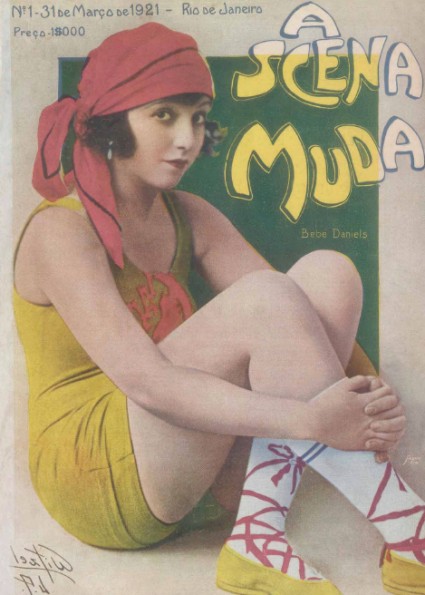
Bebe Daniels on the front cover of A Scena Muda, 1921 no. 1

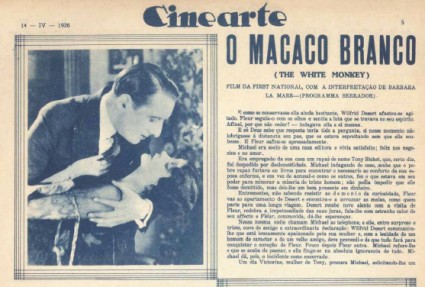
It is frustrating for the silent film researcher that, while there are some excellent online resources which provide with extensive acess to digitised newspaper collections, there are all too few film journals from our period that have digitised. Specialist resources are always going to be that much more difficult to finance. But look beyond the English language, and there are treasures to be found. In the first of two posts covering non-English digitised collections, let me introduce you to Brazil’s Biblioteca Digital das Artes do Espetaculo. This site makes available the runs of two Brazilian film journals, A Scena Muda (1921-1955) and Cinearte (1926-1942), digitised by the Biblioteca Jenny Klabin Segall. While it’s certainly going to help if you know Portuguese, the colour front covers (mostly of Hollywood stars) are a design delight all by themselves. Within you will find news, reviews, photographs, gossip, advertisements, and regular features on the Brazilian feature film.

cinearte

A page from Cinearte, 1926 no. 7

The sites are easy to navigate. From the front page, click on As Revistas. You will then be presented with three drop-down boxes, from which you can choose which of the two journals you want to see, then select whether you want to browse by year or number, and then select from the range offered. Searching by year you get a row of thumbnails of the front covers. The documents themselves are in PDF format, of good quality, though they don’t appear to be word-searchable. However, there is an advanced search option, to be found under Pesquisa, where you can search across both journals for individual words (handy for name searches, for example). So well worth browsing even if Portuguese is one of those languages you’ve never quite grasped fully, and for judging the balance between Hollywood and the native industry in the Brazilian mind.

My thanks to Teresa Antolin for bringing this to my attention. Part two tomorrow.

Update (August 2011): The link for the site has now changed to http://www.bjksdigital.museusegall.org.br/busca_revistas.html

The Biograph in Battle

biographbattle

A few weeks ago, we reported on the marvellous book digitisation project by the Cinémathèque française, the Bibliothèque numérique du cinéma, and said that we would return to the collection to describe some of the highlights (and put them in the Bioscope Library). So we start with one of the truly notable publications of the early cinema period, W.K-L. Dickson’s The Biograph in Battle: Its Story in the South African War (1901). This is both the first account in book form by a motion picture operator describing his work, and the first book about the filming of war. Its subject is the Anglo-Boer War of 1899-1902, often described as the first media war, because film cameras were there to record it.

William Kennedy-Laurie Dickson had already earned his place in motion picture history by being the man who effectively invented motion picture films, when he worked as an engineer in the Edison labs 1883-1895. Dickson left Edison to join the KMCD Syndicate, formed to exploit a 70mm film system used both for screen projection (the Biograph) and for exhibition on a flick-card peepshow (the Mutoscope). The American Mutoscope and Biograph Company, as they became, was the major American rival to Edison in the 1890s, and it pushed its product abroad in an ambitious campaign of proto-motion picture globalization which included the formation of the British Mutoscope and Biograph Company. Dickson went over to his homeland in 1897 to serve as chief camera operator, filming news and travel subjects in the main. The most notable adventure he undertook while with Biograph was to film the Anglo-Boer War.

The Anglo-Boer War (more popularly known as the Boer War) was, like most wars, unclear and unnecessary. It was fought between Britain (specifically the forces of the British Empire) and the two independent Boer republics of the Transvaal and Orange Free State, in southern Africa. The immediate cause of the conflict was the refusal by the Boers (Afrikaners) to grant political rights to a British immigrant workforce, known as Uitlanders, but the real impetus was British imperial ambitions and South African gold and diamonds. The Boers invaded the British colony of Natal on 11 October 1899, and Britain launched an invasion force under Sir Redvers Buller. This force met with several embarassing reverses, and Buller was replaced by Lord Roberts, who took Pretoria on 5 June 1900. Many felt the war was over by this point, but instead it turned into a guerilla campaign for the next two years, characterised by some brutal tactics and the British use of concentration camps to imprison Boer civilians, until victory was gained by Lord Kitchener in May 1902.

The war occured at just the point where the young film industry had the resources, and the eager audience, to make covering the war a most welcome opportunity. Four British companies sent cameramen to the Transvaal: Biograph (Dickson), Paul’s Animatograph Works (Walter Calverley Beevor and Sydney [?] Melsom), the Warwick Trading Company (Joseph Rosenthal, Edgar Hyman, John Benett-Stanford and Sydney Goldman) and Gibbons’ Bio-Tableaux (C. Rider Noble). Goldman and Noble are believed to have filmed the latter stages of the war (post-June 1900), for which no film survivies today. The others filmed the war in its first dramatic months. Other companies, notably Edison, Pathé and Norden Films (Mitchell & Kenyon) fed an audience thirst for images of the war by dramatising heroic actions, but what audiences most wanted to see was war’s actuality.

biograph_battle2

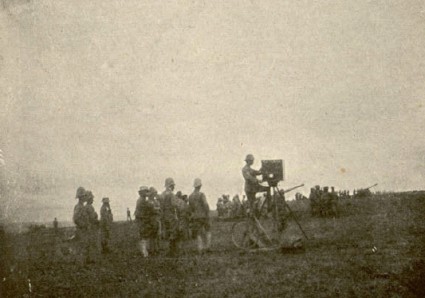
Dickson’s Mutograph camera at Chieveley filming a naval gun battery. Note the bicycle wheel which drove a suction pump that flattened the unperforated film against the aperture plate. From The Biograph in Battle.

Dickson sailed from Southampton on Buller’s ship the Dunottar Castle on 14 October 1899, accompanied by two assistants William Cox and Jonathan Seward, and equipped with a Mutograph camera. He also wrote a diary, originally for newspaper serialisation (Pearson’s Illustrated War News), and then for publication in book form, illustrated with many images from the films that he and his team took between October and June the following year. He started filming immediately upon arrival in Cape Town on 30 October. He travelled to the combat area in late November, and was present at the battles of Colenso (15 December 1899) and Spion Kop (24 January 1900).

It is not difficult to imagine the trials of trying to film a war with camera equipment that literally weighed a tonne. Aside from the bulky Mutograph itself, the tripod weighed 100 pounds, the four boxes of batteries needed to drive its electric motor weighed 1,200 pounds, and the whole caboodle had to be carried around in a Cape cart pulled by two horses. It was equipment hardly designed for the agile filming of war’s actuality, and it made Dickson a less than welcome presence among the troops because the camera made such a good target. Dickson describes some of the problems he operated under:

Getting back to a safer position, we watched the valiant attack of our men as they gradually pushed on. Had we a light camera these movements could have been secured, and many others of a valuable nature, but the enormous bulk of our apparatus which had to be dragged about in a Cape cart with two horses, prevented our getting to the spot. The difficulties were aggravated by the absence of roads, while the huge gullies we had to cross and the enormous boulders we had to get over made the enterprise almost impractical.

It is important to be aware of the limitations Dickson laboured under. He could not go about filming war in the raw. He was constricted by the technology, army officialdom and his independent status. Though not subject to official censorship as he was not a newspaper journalist, his movements were always under the eye of one officer or another, yet because he was not sanctioned by the War Office he could not benefit from army supplies and had considerable battles simply fending for himself and his team. His films are composed documents which record places and activities rather than the heat of battle. Indeed, owing to the range of the Mauser rifles employed by the Boer, the two armies seldom saw much of one another except for occasional assaults or mad cavalry charges. No film was going to get taken showing the fighting itself (Dickson experimented with telephoto lenses but had little success). So we see troops marching, bridges being repaired, signalmen at work, big guns firing, cavalry at the gallop, encampments. The films document the everyday, while at the same time documenting the step-by-step progress of Buller’s army as it progressed from optimism to disaster in its quest to relieve the besieged town of Ladysmith.

spionkop

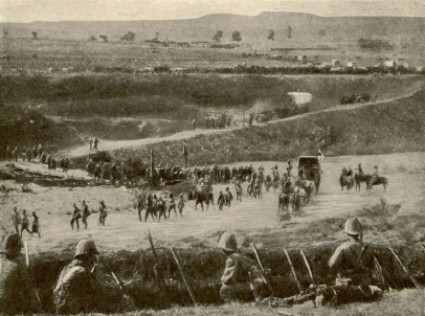
The Battle of Spion Kop, a frame still from The Biograph in Battle.

The Biograph in Battle records Dickson’s experiences on a day-by-day basis, particular attention given to films with which audiences were to become familiar back in Britain, where the latest motion pictures dispatches were avidly followed in the music halls and variety theatres. Most notable of these was Battle of Spion Kop: Ambulance Corps Crossing the Tugela River. This remarkable film records the retreat of British troops following the disastrous assault on the heights of Spion Kop, the culmination of Buller’s ill-fated campaign. Dickson’s film (which exists as three separate shots from the same position,one taken with telephoto lens, in the copy held by the BFI National Archive) shows an ambulance train aspart of a long line of troops passing down a winding path, while in the forground troops in an entrenchment give a palpable sense of conflict which some of these 1890s war actualities lack. Dickson describes the filming thus:

We were not long in following with our Cape cart, and after several hours’ severe work for horse and man succeeded in getting a good picture of the Ambulance Corps crossing the Tugela River over a hurriedly spanned pontoon bridge. In the immediate foreground may be seen trenches filled with our men to guard against any sudden attack should the wounded be fired on by the enemy. A little below the Tugela wends its way through great boulders and a rocky bed, over which our sick and wounded must be driven as they make their way down the opposite side across the pontoon bridge and up the embankment where we now are, the worse cases being carried by innumerable volunteer stretcher-bearers, mostly coolies. On the other side, as far as the eye can reach the Red Cross ambulances are seen waiting their turn to make their perilous descent, nearly all of them having been previously emptied of their worst cases of wounded for fear of an upset, the patients being carried over and replaced after arriving at the other side, when comparatively on safe ground. The picture has an additional value that in the background is part of the battlefield where Warren’s men fought so gallantly as they advanced towards and up Spion Kop to the right.

If only Dickson’s lens had been sharper or the film longer than a minute. Somewhere in that scene was a journalist on the cusp of fame, Winston Churchill, and serving as a stretcher-bearer was the future Mahatma Gandhi.

Following the debacle of Spion Kop, the British army withdrew, regrouped, took Colenso, finally crossed the Tugela river, and raised the siege at Ladysmith, Buller making his formal entrance on 3 March. Dickson had had to deal with both of his assistants falling ill during this period, taking them to a sanatorium in Durban, but with a new assistant (name unknown) he was back in time to record the entry into Ladysmith, arriving in the town ahead of Buller himself. Dickson was exhausted by this time, and having journeyed back to Durban he succumbed to a fever. By mid-April he and his original crew had recovered, but filming priorities had changed with the uncertain progress of the war. Dickson’s next major film would be the annexation of Bloemfontein, the capital of the Orange Free State, which surrended to Lord Roberts on 13 March. The annexation ceremonies took place on 28 May, after which Dickson travelled on to film Roberts’ capture of Pretoria on 5 June. Both films represented the moment of triumph by the raising of a flag in the town square, though Dickson’s film of the latter was a cheeky restaging (he had arrived too late to record the actual event), featuring a larger flag than had been used in the ceremony. This piece of deception was spotted at the time by local audiences and came in for much criticism.

dickson_biograph

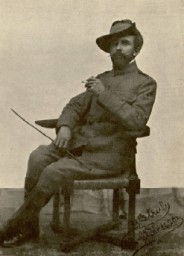
At this point, many believed the war to be over. Dickson (left) and his London employers certainly did so, and he left Cape Town for Southampton on 18 July 1900. His films had been a regular feature at the Palace Theatre (the London showcase for Biograph films) and at theatres around the world equipped for Biograph films. The films generally took three to four weeks to get back to Britain, and did so on such a regular basis that audiences could follow his reportage as a form of news, albeit delayed news. Although attempts had been made to film earlier conflicts (Frederic Villiers was present with a cine camera during the Greco-Turkish War of 1897, John Benett-Stanford filmed at Omdurman in the Sudan in 1898, and Billy Bitzer and Arthur Marvin filmed scenes during the Spanish-American War of 1898 for American Biograph), the films of Dickson and his fellow Anglo-Boer war cameramen – none of whom he mentions in his text, incidentally – were the first successful motion picture records of a war from the battlefront, and the picture that they gave to audiences back at home altered forever what was expected of the motion picture camera, and what audiences could demand to see on their screens.

The Biograph in Battle is an enjoyable, informative read, full of character and sharp-eyed observation. Some of the attitudes expressed, particularly towards the native population, are unfortunately characteristic of their time, but overall this is a remarkably detailed account from the earliest years of motion pictures. In 1894 Dickson had been filming fleeting variety acts for the Edison Kinetoscope peepshow; it is evidence of how rapidly the medium developed in scope and ambition that it could, just five years later, take on the documenting of a war and, incidentally, the demise of an Imperial dream.

There is a catalogue of Anglo-Boer War films held by the BFI National Film Archive, which lists most of the extant films of Dickson and his rivals, which I compiled many moons ago.

The Biograph in Battle is very rare (and very expensive) in its original form. A facsimile publication was produced by Flicks Books in 1995, with a new introduction by Richard Brown. This is now out of print but can be found second-hand. The PDF copy on the Bibliothèque numérique du cinéma (49MB in size) comes from the Will Day collection and is inscribed to collector and historian Day by Dickson himself.

The is a new biography of Dickson by Paul Spehr, which covers the Anglo-Boer War period in detail: The Man Who Made Movies: W.K-L. Dickson. Spehr will be giving an illustrated talk on Dickson and film at the Barbican in London on 5 June, and again at the BFI Southbank on 10 June.

(There are no examples of Dickson’s war films online that I can find, except included in television programmes which have been uploaded without the broadcaster’s permission)