The Moon is yellow

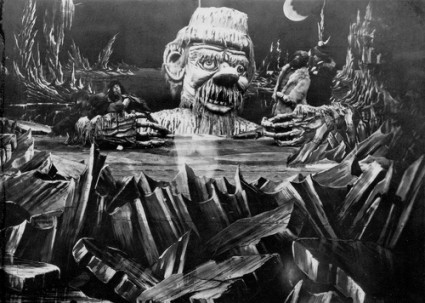
The colour version of Georges Méliès’ Le voyage dans la lune (1902), from http://www.technicolorfilmfoundation.org

May 11 sees the unveiling at the Cannes Film Festival of what may be the film restoration to beat all other film restorations – the colour version of Georges MélièsLe voyage dans la lune (A Trip to the Moon) (1902). Its recovery is little short of miraculous.

The most iconic of all early films is known to so many, if only for the shot of the rocket going into the Moon’s eye, but no-one since 1902 has seen in its hand-painted colour form (see the Bioscope’s 2008 post Painted by hand for a short history of this early method of colouring films). Méliès was able to supply coloured versions of his films, at double the price of black-and-white, but until 1993 no coloured copy of La voyage dans la lune was known to survive. Then a print was discovered by the Filmoteca de Catalunya in Barcelona among a collection of 200 early films, but unfortunately in a state of total decomposition – or so it was thought.

Lobster Films in Paris learned of the print’s existence and arranged an exchange with the Filmoteca for a lost Segundo de Chomón film in their collection. The deal was done, and Lobster examined their purchase:

Inside, there was a 35mm film on which we could distinguish some of the first film images framed by the small perforations characteristic of early films. Unfortunately, our round reel looked more like a ring of wood, such was the extent to which decomposition had transformed the originally supple film into a rigid, compact mass. We decided to consult several specialist laboratories. Their diagnosis was irrevocable: the copy was lost.

http://www.technicolorfilmfoundation.org

But undaunted, and with great patience, they started to unwind the film frame by frame. They discovered that the images were not stuck to one another – only the sides of the images had decomposed and had melded together. There was a glimmer of hope.

We progressed centimetre by centimetre, taking out entire strips of film at a time but often in small fragments. Sometimes the image had disappeared. It took several weeks to uncover the quasi-totality of the images. The reel, now unwound, was still extremely fragile. In its condition, it was unthinkable that we could use wet-gate step printing, the only technique that would enable the images to be copied again onto a new film before they could be restored. We had two options. Either we tried to give the film back its original flexibility so that it could be duplicated, or we photographed each image using an animation stand, but at the risk of breaking the film.

They decided on the first option, which demanded chemical treatment which would render the film pliable for a period, but which would hasten its decomposition thereafter. The work was undertaken by Haghefilm in the Netherlands, who after months of work managed to transfer around a third of the film onto internegative stock. The remainder of the film could not be copied and was now in a highly brittle state. These remaining 5,000 frames (out of a total of 13,375) were photographed individually in 2000 using a 3M pixel digital camera, work which took a year to complete.

Then they had to wait ten years, for technology to catch up with what was required next and for the money to be put in place to complete the restoration. This came about in 2010 thanks support from the Groupama Gan Foundation for Cinema and the Technicolor Foundation for Cinema Heritage. The film now existed in partial internegative form and in different digital file formats at different resolutions, some digitally scanned from the photochemical restoration, some digital images from the 5,000 individual images, many in an incomplete or broken form. It was a huge organisational challenge, as Technicolor’s Tom Burton explains:

Because the digitization took place over a period of years in different physical locations and different technical environments, utilizing dissimilar gear, the resulting data was not natively organized into a sequentially numbered image order. Each digitization session generated its own naming convention and frame numbering protocol … Several versions of some shots had been created as a result of the separate capture sessions. And due to variations in the specific conditions and equipment used in each digitizing session, the files differed greatly from one another in color, density, size, sharpness and position – it was becoming clear that integrating them into a seamless stream of matching images was to be a challenge of extremely large proportions.

Technicolor sorted out the jigsaw puzzle, re-rendered the files as DPX files, then undertook the process of reconstruction the film with reference to an HDCAM version of a black-and-white print of the film provided by the Méliès family, matching it up frame by frame. Much more then followed to clean, stabilise, grade and render the finished film, filling in colours where these were missing with reference to the use of those colours elsewhere in the film, then time-converting it to the original speed of 14fps. The entire restoration project cost 400,000 euros – for a 14-minute film.

http://www.technicolorfilmfoundation.org

And so we come to 2011 (the 150th anniversary of Georges Méliès’ birth) and the restored film’s presentation at Cannes on May 11. It will be presented with a new soundtrack by the vogue-ish French duo Air. The Technicolor Film Foundation has information on the project on its website, including a truly fabulous 192-page PDF book La couleur retrouvée du Voyage dans la Lune / A Trip to the Moon Back in color, in French and English, on Georges Méliès, his career, his methods, the film and its restoration. It is gorgeously illustrated, and serves as a first-rate guide to the special genius of Méliès. I strongly recommend it. It is free to download (the booklet itself is available at Cannes, but apparently it is not going to be on sale generally). A copy has been placed in the Bioscope Library. All illustrations and quotations in this post come from the book.

The Bioscope will pick up on such reports as it can find about the film’s Cannes screening, and any news of screenings thereafter. It will feature at other festivals, but how widely it will get shown further after that (e.g. if there is to be a DVD or Blu-Ray release) has not been said as yet. However, film, digital cinema and HD release versions have been produced.

http://www.technicolorfilmfoundation.org

This is turning out to be the year of Georges Méliès. As well as the colour restoration of Le voyage dans la lune (1902), this month sees the publication of Matthew Solomon’s book on the film, Fantastic Voyages of the Cinematic Imagination. Then at the end of 2011 we will have Martin Scorsese’s Hugo Cabret, his adaptation (in 3D) of Brian Selznick’s children’s book The Invention of Hugo Cabret which features Georges Méliès as a central character. Méliès is played by Ben Kingsley, and the cast includes Sacha Baron Cohen, Jude Law, Asa Butterfield and Chloë Moretz. M. Méliès is about to go global.

Kraszna-Krausz award

Warm congratulations to Matthew Solomon and University of Illinois Press for his book Disappearing Tricks: Silent Film, Houdini, and the New Magic of the Twentieth Century, which has just won the Best Moving Image Book Award at the prestigious Kraszna-Krausz Foundation book awards. The biennial awards, established through a bequest by Andor Kraszna-Krausz, the founder of Focal Press, recognise books on the moving image and photography that have made original and lasting educational, professional, historical and cultural contributions to the field.

Disappearing Tricks, as previously reported on by the Bioscope, revisits the golden age of both theatrical magic and silent film to reveal how professional magicians shaped the early history of cinema. The judges of the 2011 competition, Hugh Hudson, Peter Bradshaw and Sir Christopher Frayling said about Disappearing Tricks:

A fascinating enquiry into the early history of film, especially as it involved magicians and magic tricks. Matthew Solomon explores spiritualism and suspension of disbelief in a compelling investigation of the integration of cinema into mainstream entertainment.

So an important vote for publication on silent film, which joins previous such winners of the award, Writing Himself into History: Oscar Micheaux, His Silent Films and His Audiences by Pearl Bowser and Louise Spence, The World According to Hollywood, 1918-1939 by Ruth Vasey, Hollywood’s Overseas Campaign: The North Atlantic Movie Trade, 1920-1950 by Ian Jarvie, and Walt in Wonderland: The Silent Films of Walt Disney by Russell Merritt and J.B. Kaufman. Ours are the best form of movies and the best books about movies, clearly.

Matthew Solomon’s latest book, Fantastic Voyages of the Cinematic Imagination, on Georges Méliès’ Trip to the Moon, was published recently.

Hot off the presses

We had a previous post where we alerted readers to upcoming publications in the area of silent film, and it seemed to be quite well received, so here’s another look into the crystal ball at some of the books scheduled for 2011:

Fantastic Voyages of the Cinematic Imagination looks highly welcome. It is written by Matthew Solomon, author of the excellent Disappearing Tricks: Silent Film, Houdini, and the New Magic of the Twentieth Century. His new book, published by State University of New York Press, concentrates on Georges Méliès’ Trip to the Moon, the key fantastical film of the silent era (and one of the most important of all science fiction films). It places the film in the context of histories of techology, film history, the avant garde, Méliès’ own history, and more. It’s a great idea for a book and I hope to review here in due course.

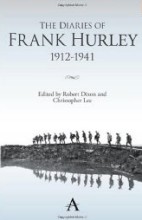
Soon to be published by Anthem Press is The Diaries of Frank Hurley 1912-1941, edited by Robert Dixon and Christopher Lee. Frank Hurley was the photographer and cinematographer for the Antarctic expedition of Douglas Mawson and most famously Ernest Shackleton. He went on to be an official war cameraman on the Western Front and in the Near East, then in the 1920s directed ethnographic dramas such as Pearls and Savages. Onlt short passages of his diaries (which cover all of this period and more) have been published up to now, and this illustrated edition will cast new light on a filmmaker who images alone among the most eloquent (and most arduously achieved) of their time. In October Anthem will publish Robert Dixon’s Photography, Early Cinema and Colonial Modernity: Frank Hurley’s Synchronized Lecture Entertainments which sounds like an important recognition that artists such as Hurley did not produce films so much as multimedia entertainments, combining film, images, music and commentary.

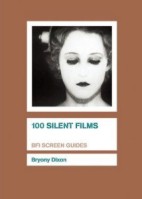
June sees the publication by the BFI of Bryony Dixon’s 100 Silent Films. This is one of a series of BFI books in which 100 essential titles in any given genre (Westerns, Anime, Shakespeare Films, Road Movies etc) are described in pithy, accessible form. The latest is this volume by the BFI’s silent film curator, which will feature one hundred key films of the silent period from a variety of countries, genres and directors, and will doubtless generate much argument as to what should or should not have been included, while being a highly welcome first port of call for anyone discovering silent films. Again, it should be reviewed here in due course.

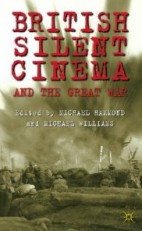
British Silent Cinema and the Great War will be published by Palgrave Macmillan in August. Edited by Michael Hammond and Michael Williams, it is appearing ahead of what is going to be a huge number of texts marking the centenary of the First World War, now just three years away. It covers the complex relationship between British film and the British experience of the war, and is indicative of how confident and sophisticated the discussion of British silent cinema has become in recent years – a far cry from the corner of silent film history that scarcely dared speak its name not so long ago.

The University of California Press is publishing Twilight of the Idols: Hollywood and the Human Sciences in 1920s America by Mark Lynn Anderson. The book looks at the position of silent films stars – particularly Wallace Reid, Rudolph Valentino, and Mabel Normand – and how they shapred ideas of personality and human conduct. As the publishers’ blurb puts it, “Anderson looks at motion picture stars who embodied various forms of deviance – narcotic addiction, criminality, sexual perversion, and racial indeterminacy. He considers how the studios profited from popularizing ideas about deviance, and how the debates generated by the early Hollywood scandals continue to affect our notions of personality, sexuality, and public morals”. So, stuff we’ve heard before, but also stuff that people are going to keep on and keep on reading.

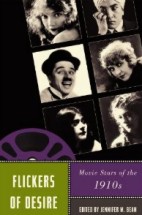
Flickers of Desire: Movie Stars of the 1910s by Jennifer M. Bean is published by Rutgers University Press in August. The blurb states: “The conjunction of the terms “movie” and “star” was inconceivable prior to the 1910s. Flickers of Desire explores the emergence of this mass cultural phenomenon, asking how and why a cinema that did not even run screen credits developed so quickly into a venue in which performers became the American film industry’s most lucrative mode of product individuation. Contributors chart the rise of American cinema’s first galaxy of stars through a variety of archival sources – newspaper columns, popular journals, fan magazines, cartoons, dolls, postcards, scrapbooks, personal letters, limericks, and dances.” Perfomers covered include Charlie Chaplin, Mary Pickford, Pearl White, Sessue Hayakawa, Theda Bara, George Beban and G. M. Anderson.

Nina Baburina’s The Silent Film Poster 1908-1934 is published in July by Art-Rodnik. The book is a little more specific that the title might suggest, being an illustrated study of the Russian film poster. It traces the history from a 1908 poster from Stenka Razin designed by Paul Assaturov in the style of “ancient naive Russian imagery” to an advertisement for a silent movie by Yuri Pimenov from 1934, through 161 full-page repductions. The artists featured include Alexandro Rodchenko, the Stenberg Brothers, Jacob Ruklevski, Nikolai Prusakov and Alexander Naumov, and naturally enough it covers the pre-Soviet as well as the Soviet era, and both Russian/Soviet and foreign films.

If you know of more that are coming up, do add them to the comments.

The place of the past

Venice, California today and inset the same location as featured in Kid Auto Races at Venice, Cal. (1914), from a PowerPoint presentation of famous Chaplin filming locations on http://silentlocations.wordpress.com

John Bengtson is the author of Silent Traces, Silent Echoes, and Silent Visions, three books which take a fresh look at classic silent comedy films by revisting their locations today. Traces covers the films of Charlie Chaplin; Echoes covers Buster Keaton; and Visions (published May 2011) covers Harold Lloyd. The publications have gained much praise for their novel, illuminating approach to film history and simply because they are such a delight to look at.

Bengtson has now gone online with Silent Locations, a blog that promises to cover ‘Chaplin-Keaton-Lloyd film locations (and more)’. It’s early days for the site as yet, but already there are some fascinating then-and-now photographs for films of each of the three stars, with instructive background information on location and production, plus the promise of other kinds of content to follow. For example, there is a downloadable PowerPoint presentation on classic Chaplin locations, with a frame still from the film inset within a photograph of the location today, which is as beautiful as it is informative. It’s going to be a site to keep an eye on.

We can be so engrossed in what we see on the screen that we can forget that there is more to the movies than stars and stories. Every film made is a time capsule. The way people look, dress, talk, interact with one another, the social assumptions that are made, the places they live in, visit, work in, the functions and histories of those places, the transport they use, their hopes, fears, loves and hatreds. Few history books are able to pack in as much as a film does, if we are prepared to look.

This was the great theme of the late Colin Sorensen, museum curator and cultural historian. In building up the modern collection at the Museum of London, he became fascinated by film’s capacity to impart the history of London. By this he didn’t just mean documentaries, but more particularly fiction films, because of their frequently deeper resonances. Films show both a literal and an imaginary past. There are actual locations and buildings still standing or now lost, of course, and Sorensen was very good at pointing out buildings shown standing in films that exist no more, so that the film becomes a precious record of a place’s appearance and social functions. But film is also a dream of how people imagined the city was, and embeds a rich set of associations with other histories. As he wrote in his book London on Film (1996):

This unique accumulation of insight and information, of fact and fantasy, has created a vast resource for the study and appreciation of London. It offers us a largely unprobed field for a new kind of urban archaeology: the archaeology of recorded action rather than of surviving artefact.

It was Colin’s great frustration that he could mostly only present his ideas through still images, and that even when a film was running he could not find the means to fix associations between what was on the screen and the links he detected with other histories that lay in his head (he might have been able to do so much more with today’s computer software). It isn’t that films belong in the museum so much as films are a museum – it’s just that we so seldom take the time to look at them in that way.

London (1926), from London on Film

See, for example, this still from the lost British film London, directed by Herbert Wilcox in 1926, which comes from London on Film. It’s a studio setting, but a precisely recreated one of a part of London life that once was. He writes:

The ebb and flow of city life continues throughout the day and night. Paths cross and the diverge as people go their different ways … [T]he coffee stall, now a vanishing feature of London life, once provided a unique meeting place where people of all types and classes rubbed shoulders for a few moments, refreshing themselves with a drink and a sandwich.

So the setting has a historical, symbolic and practical function – the latter being that it makes for a good point at which to bring together disparate characters, and one with strong character recognition. Of course, there is much more. There are the dowdly, well-worn clothes of the Londoners. Everyone wears hats, all the man have buttoned-up shirts with ties. There is the stall itself (evidently horse-drawn even though this is the 1920s), its pavement location, its wares and its advertisements. But also running through the image is a history of British filmmaking, from the assertive Britishness of the film’s title, to the contrary fact that the lead performer is an American (Dorothy Gish, on the left), typical of many an American star with a career on the wane being snapped up on the cheap by a British studio. But she is a Gish sister, so embedded in her image is a whole history of narrative cinema that comes out of D.W. Griffith. And London was based on the London stories of Thomas Burke, another of whose novels inspired Broken Blossoms). Or we can just look at the coffee cups and think that, apart from the size of the cups, maybe there’s not that much about London life that has changed after all.

John Bengtson has done an excellent job showing how traces of the past exist in the locations of today, and by showing past and present side by side he makes us think historically. But it’s not just the stills but the films themselves that we need to annotate in a far richer form than we have achieved so far. Film’s special capacity for encapsulating times past and creating associations between where we are now and where we once were needs not just to be acknowledged but to be documented. Otherwise the history will be lost.

Bioscope Newsreel no. 19

http://gawker.com

The Bioscope Newsreel failed to hit your screens last Friday, as the entire editorial team was in Spain. But we have returned, with items curious and diverting for your delectation and instruction.

100 Years of YouTube
In case you missed it, one of Google’s contribution to April Fools’ Day was to add a “1911” button to YouTube that allowed users to convert videos into faux silent films, complete with sepia tone, scratches (naturally) and tinkly piano (of course). Unfortunately the joke fell somewhat flat for some, as many videos of serious note (9/11, the Japanese tsunami etc.) hardly lended themselves to facetious treatment. Read more.

We have an app for that
More on faux silents, as we now have Silent Film Director, a new app made by MacPhun for iPhone, iPod Touch, and iPad and available on the iTunes App Store. It allows you to convert your videos into “classic silent movies”. There are six themed filters: an “old and grainy 20s-era movie filter”, 60s home video, 70s-era home video, standard black-and-white, sepia-toned, and “Vintage Sepia” with extra graininess and signs of wear and tear. There are soundtracks you can add, then upload your video to YouTube, share it on Facebook, or enter the developers’ “International Silent Film” content. Read more.

Silent Naruse
Eclipse has issued a three-disc set that brings together the five surviving silent films of Japanese master Mikio Naruse, pre-eminent in studies of women’s lives. They are the short film Flunky, Work Hard (1931), No Blood Relation (1932), Apart From You (1933), Every-Night Dreams (1933) and Street Without End (1934). The films are presented silent, with optional soundtracks, and come with English subtitles. Read more.

The Garbo note
Greta Garbo is going to be on a banknote. She is one of six prominent Swedes (including Ingmar Bergman) whose faces have been selected to appear on Swedish bills scheduled to come into circulation around 2014-15. Is she the first film person (and of course she was a silent film person) to be so honoured? Read more.

Fascinating Chomón
One of the items we brought with us from Spain was the English version of Joan M. Minguet Batllori’s Segundo de Chomón: The Cinema of Fascination. It’s a pleasing critical biography of the leading Spanish of the early cinema period, someone whose reputation as a master of the fantastical continues to grow. See for instance Chris Edwards’ detailed appreciation of Sculpteur moderne (1908) over at the fine Silent Volume blog. Read more.

The Seven Lively Arts

‘The Custodians of the Keystone’ by Ralph Barton, frontispiece illustration to Gilbert Seldes, The Seven Lively Arts

In a recent post on the cinema novel, I mentioned Gilbert Seldes’ advocacy of this hybrid cultural form, and said that a follow-up post was needed, because his book The Seven Lively Arts was available online. Indeed it is, and here is the promised post.

Gilbert Seldes (1893-1970) was an American cultural critic, one the pioneering champions of the popular arts in the age of mass media. His made his name, and established his life-long theme, with his 1924 book, The Seven Lively Arts. The seven are the movies, musical comedy, vaudeville, radio, comic strips, popular music and dance. Seldes championed what was excellent in what was popular. As his biographer Michael Kammen puts it:

Seldes … is conspicuous among his contemporaries because of his abiding commitment to the democratization of culture … Seldes genuinely believed that the taste level of ordinary Americans was not inevtably contemptible, and that, in any case, taste levels could be elevated.

Several decades’ worth of cultural criticism since the 1920s have rather dulled the revolutionary nature of Seldes’ stance. Elitism has become an ugly word; there is no high art or low art; and we seek to understand the components of a culture and how artefacts embody these rather than to say that one work of ‘art’ is better than another. Seldes didn’t think like a present-day cultural critic, but he did work to overturn preconceptions about supposedly low cultural forms. Of these the form that interested him the most, and to which he devoted most attention in his book, was film.

The opening chapter, ‘The Keystone the Builders Rejected’, sets out his agenda:

For fifteen years there has existed in the United States, and in the United States alone, a form of entertainment which, seemingly without sources in the past, restored to us a kind of laughter almost unheard in modern times. It came into being by accident – it had no pretensions to art. For ten years or more it added an element of cheerful madness to the lives of millions and was despised and rejected by people of culture and intelligence. Suddenly – suddenly as it appeared to them – a great genius arose and the people of culture conceded that in his case, but in his case alone, art existed in slap-stick comedy; they did not remove their non expedit from the form itself.

The great genius is of course Chaplin, but while some critics acknowledged that genius (particularly after The Kid, about which he is ambiguous), Seldes argues for the importance of not separating the man from the form in which his greatness was made manifest. The art was not in the man was in slapstick itself. For Seldes, ‘everything in slap-stick is cinematographic’: the slapstick comedy of Mack Sennett and Keystone was pure cinema because it was achieving results which could be acomplished by no other medium, and which were perfectly suited to that medium,; whereas D.W. Griffith, despite all the ways in which he advanced the art of the motion picture, still had half a mind in another medium (the stage, or the novel).

Seldes goes on the champion the slapstick form, taking pot-shots at his fellow critics for dismissing it without reasons. He writes illuminatingly about Ben Turpin, Harold Lloyd, Buster Keaton and lesser lights such as Chester Conklin. He cherishes slapstick for its absence of pretension and consequently its lack of vulgarity:

I consider vulgar the thing which offends against the canons of taste accepted by honest people, not by imitative people, not by snobs. It is equally bad taste, presumably, to throw custard pies and to commit adultery; but it is not bad taste to speak of these things. What is intolerable only is the pretense, and it was against pretentiousness that the slap-stick comedy had its hardest fight. It showed a man sitting down on a lighted gas stove, and it did not hesitate to disclose the underwear charred at the buttocks which were the logical consequence of the action.

There is a touch of paradox for paradox’s sake, but it is an engrossing set of arguments for all that. Every line makes you think again about what you have seen. Seldes goes on to tackle different aspects of his seven lively arts, with an entertaining variety of approaches to the different chapters. A chapter on D.W. Griffith is in the form of a duologue outside an Ancient Greek theatre. There is a mocking open letter to movie magnates (‘I am trying to trace for you the development of the serious moving picture as a bogus art, and I can’t do better than assure you that it was best before it was an “art” at all’). His chapter on Chaplin reveals a deep appreciation of the ebbs and flows of his work which reads like a critic commenting on a display of paintings in gallery. He is alert to the aesthetic experience of Chaplin’s overall output: ‘The flow of his line always corresponds to the character and tempo; there is a definite relation between the melody and the orchestration he gives it’. As noted, he also champions the cinema novel (it is almost the only section of the book not devoted to American culture), because it shows literary people thinking cinematically rather than people of the cinema losing faith in the essential value of their medium and weakly copying literature or the theatre. Other chapters cover jazz, comic strips, Al Jolson and Fanny Brice, Krazy Kat, clowns, Pablo Picasso and more.

The Seven Lively Arts is available in online as one of the hypertext series from American Studies at the University of Virginia. The online version incudes all appendices and illustrations. The digitisation isn’t perfect, with some slips in the OCR (there are problems with split words, accents and some punctuation). In places words are missing. But it is helpfully divided up into chapters and shows page breaks and page numbers. Into the Bioscope Library it goes.

La photographie animée

The De Bedts Kinetograph (1896), from La photographie animée

The latest publication to enter the Bioscope Library of early film texts freely available online is Eugène Trutat’s La photographie animée. Trutat was the director of the museum of natural history at Toulouse, a naturalist, mountaineer and photographer. He wrote a number of books on photography and discovery, and in 1899 he produced one of the first books to document the new technology of cinematography, in La photographie animée.

It is a book known to the specialist but not as widely cited as say its British counterpart, Henry V. Hopwood’s Living Pictures which was published the same year (and can be found in the Bioscope Library and on the Internet Archive, in its 1915 edition). That may simply be on account of its comparative rarity, and because it is in French. The Internet Archive has triumphantly overcome the rarity hurdle; whether the language remains a challenge is down to the individual. In any case one of the book’s particular riches is its copious illustrations of film technologies, which need no translation.

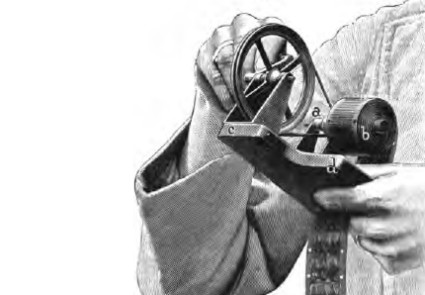
A film winder, from La photographie animée

The main part of the book is a survey of moving image technologies up to 1899, with a particular emphasis on French machines. There is the usual opening thesis on the principles of animated photography and its antecedents found in the ‘pre-cinema’ work of Muybridge, Marey, Londe, Janssen and others. Trutat had a particular interest in multiple-lens cameras, and includes his own invention among those discussed. He then describes the principles and the mechanics of the film devices of Thomas Edison, Georges Demeny, Georges de Bedts, the Lumière brothers and Henri Joly, along with many minor names and technologies now mostly forgotten. For those who have a grasp of such things, Trutat is much given to marking his many illustrations with letters to point out particular mechanical points. It is very much a technician’s book.

He concludes with some practical advice on the production and presentation of films, finishing with a handy list of French patents. So, not a book for everyone, but an invaluable text for the specialist and a fine resource for the iconography of late nineteenth-century motion pictures for the rest of us.

Looking back on 2010

Lillian Gish knows just what it’s like in north Kent, from Way Down East

The snows of winter are piling up in fantastic drifts about the portals of Bioscope Towers. Icy blasts find their way through every crack and cranny. Outside, civilization grinds to a glacial halt, and the end of the year now beckons. In the relative warmth of the Bioscope scriptorium, I’ve been thinking it would be a good idea to look back on what happened in the world of silent film over 2010. So here’s a recap of highlights from the past twelve months, as reported on the Bioscope (and in a few other places) – silent memories to warm us all.

There were three really big stories in 2010. For many of us, the most welcome news story of this or any other year was the honorary Oscar that went to Kevin Brownlow for a lifetime dedicated to the cause of silent films. The restored Metropolis had its premiere in a wintry Berlin in February. It has now been screened acround the world and issued on DVD and Blu-Ray. And there was the sensational discovery by Paul E. Gierucki of A Thief Catcher, a previously unknown appearance by Chaplin in a 1914 Keystone film, which was premiered at Slapsticon in June.

It was an important year for digitised documents in our field. David Pierce’s innovative Media History Digital Library project promises to digitise many key journals, having made a good start with some issues of Photoplay. The Bioscope marked this firstly by a post rounding up silent film journals online and then by creating a new section which documents all silent film journals now available in this way. A large number of film and equipment catalogues were made available on the Cinémathèque française’s Bibliothèque numérique du cinéma. Among the books which became newly-available for free online we had Kristin Thompson’s Exporting Entertainment, and the invaluable Kinematograph Year Book for 1914.

Among the year’s restorations, particularly notable were Bolivia’s only surviving silent drama, Wara Wara, in September, while in October the UK’s major silent restoration was The Great White Silence, documenting the doomed Scott Antarctic expedition.

We said goodbye to a number of silent film enthusiasts and performers. Particularly mourned in Britain was Dave Berry, the great historian of Welsh cinema and a friend to many. Those who also left us included Dorothy Janis (who starred in The Pagan opposite Ramon Novarro); film restorer and silent film technology expert Karl Malkames; the uncategorisable F. Gwynplaine Macintyre; and film archivist Sam Kula. One whose passing the Bioscope neglected to note was child star Baby Marie Osborne, who made her film debut aged three, saw her starring career end at the age of eight, then had a further ninety-one years to look back on it all.

Arctic conditions in Rochester uncannily replicated in Georges Méliès’ A la Conquête du Pôle (1912)

On the DVD and Blu-Ray front, Flicker Alley followed up its 2008 5-disc DVD set of Georges Méliès with a sixth disc, Georges Méliès Encore, which added 26 titles not on the main set (plus two by Segundo de Chomón in the Méliès style). It then gave us the 4-DVD set Chaplin at Keystone. Criterion excelled itself by issuing a three-film set of Von Sternberg films: Underworld (1927), The Last Command (1928) and The Docks of New York (1928). Other notable releases (aside from Metropolis, already mentioned) were Flicker Alley’s Chicago (1927) and An Italian Straw Hat (1927), Kino’s Talmadge sisters set (Constance and Norma), the Norwegian Film Institute’s Roald Amundsen’s South Pole Expedition (1910-1912) and Il Cinema Ritrovato’s Cento anni fa: Attrici comiche e suffragette 1910-1914 / Comic Actresses and Suffragettes 1910-1914, while the Bioscope’s pick of the growing number of Blu-Ray releases is F.W. Murnau’s City Girl (1930), released by Eureka. But possibly the disc release of the year was the BFI’s Secrets of Nature, revealing the hypnotic marvels of natural history filmmaking in the 1920s and 30s – a bold and eye-opening release.

New websites turned up in 2010 that have enriched our understanding of the field. The Danish Film Institute at long last published its Carl Th. Dreyer site, which turned out to be well worth the wait. Pianist and film historian Neil Brand published archival materials relating to silent film music on his site The Originals; the Pordenone silent film festival produced a database of films shown in past festivals; the daughters of Naldi gave us the fine Nita Naldi, Silent Vamp site; while Kevin Brownlow’s Photoplay Productions finally took the plunge and published its first ever website.

The crew for Alfred Hitchcock’s The Mountain Eagle, ready for anything the elements can throw at them

Among film discoveries, in March we learned of the discovery of Australia’s earliest surviving film, the Lumière film Patineur Grotesque (possibly October 1896); in June we heard about a major collection of American silents discovered in New Zealand; and digital copies of ten American silents held in the Russian film archive were donated to the Library of Congress in October. That same month the Pordenone silent film festival unveiled the tantalising surviving frgament of F.W. Murnau’s Marizza, Genannt die Schmuggler-Madonna (1921-22). There was also time for films not yet discovered, as the BFI issued its Most Wanted list of lost films, most of them silents, while it also launched an appeal to ‘save the Hitchcock 9” (i.e. his nine surviving silents).

The online silent video hit of the year was quite unexpected: Cecil Hepworth’s Alice in Wonderland (1903) went viral after the release of the Tim Burton film of Lewis Carroll’s story. It has had nearly a million views since February and generated a fascinating discussion on this site. Notable online video publications included UCLA’s Silent Animation site; three Mexican feature films: Tepeyac (1917), El tren fantasma (1927) and El puño de hierro (1927); and the eye-opening Colonial Films, with dramas made in Africa, contentious documentaries and precious news footage.

2010 was undoubtedly the year of Eadweard Muybridge. There was a major exhibition of the photographer’s work at Tate Britain and another at Kingston Museum (both still running), publications including a new biography by Marta Braun, while Kingston produced a website dedicated to him. He also featured in the British Library’s Points of View photography exhibition. There was also controversy about the authorship of some of Muybridge’s earliest photographs, and a somewhat disappointing BBC documentary. In 2010 there was no avoiding Eadweard Muybridge. Now will the proposed feature film of his life get made?

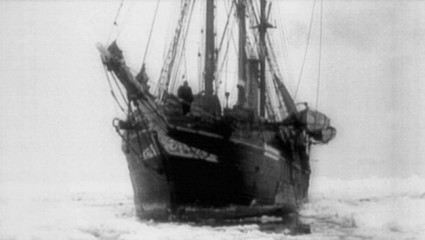
Ernest Shackleton’s ship Endurance trapped in the Medway ice, from South (1919)

It was an interesting year for novel musical accompaniment to silents: we had silent film with guitars at the New York Guitar Festival; and with accordions at Vienna’s Akkordeon festival. But musical event of the year had to be Neil Brand’s symphonic score for Alfred Hitchcock’s Blackmail (1929), given its UK premiere in November.

Noteworthy festivals (beyond the hardy annuals of Pordenone, Bologna, Cinecon etc) included the huge programme of early ‘short’ films at the International Short Film Festival at Oberhausen in April/May; and an equally epic survey of Suffragette films in Berlin in September; while the British Silent Film Festival soldierly on bravely despite the unexpected intervention of an Icelandic volcano.

On the conference side of things, major events were the Domitor conference, Beyond the Screen: Institutions, Networks and Publics of Early Cinema, held in Toronto in June; the Sixth International Women and Film History Conference, held in Bologna also in June; and Charlie in the Heartland: An International Charlie Chaplin Conference, held in Zanesville, Ohio in October.

It wasn’t a great year for silent films on British TV (when is it ever?), but the eccentric Paul Merton’s Weird and Wonderful World of Early Cinema at least generated a lot of debate, while in the US sound pioneer Eugene Lauste was the subject of PBS’s History Detectives. Paul Merton was also involved in an unfortunate spat with the Slapstick festival in Bristol in January over who did or did not invite Merton to headline the festival.

The art of the silent film carried on into today with the feature film Louis (about Louis Armstrong’s childhood), and the silent documentary feature How I Filmed the War. Of the various online modern silent shorts featured over the year, the Bioscope’s favourite was Aardman Animation’s microscopic stop-frame animation film Dot.

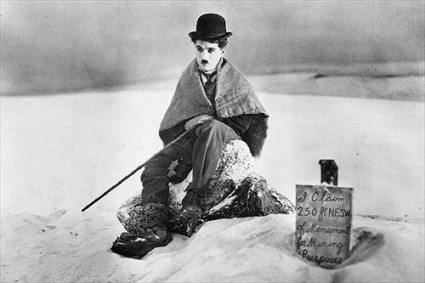
Charlie Chaplin contemplates the sad collapse of Southeastern railways, after just a few flakes of snow, from The Gold Rush

What else happened? Oscar Micheaux made it onto a stamp. We marked the centenary of the British newsreel in June. In October Louise Brooks’ journals were opened by George Eastman House, after twenty-five years under lock and key. Lobster Films discovered that it is possible to view some Georges Méliès films in 3D.

And, finally, there have been a few favourite Bioscope posts (i.e. favourites of mine) that I’ll give you the opportunity to visit again: a survey of lost films; an exhaustively researched three-part post on Alfred Dreyfus and film; the history of the first Japanese dramatic film told through a postcard; and Derek Mahon’s poetic tribute to Robert Flaherty.

It’s been quite a year, but what I haven’t covered here is books, largely because the Bioscope has been a bit neglectful when it comes to noting new publications. So that can be the subject of another post, timed for when you’ll be looking for just the right thing on which to spend those Christmas book tokens. Just as soon as we can clear the snow from our front doors.

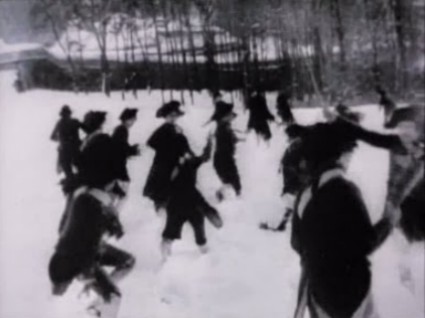
And one more snowy silent – Abel Gance’s Napoléon recreates the current scene outside Rochester castle, from http://annhardingstreasures.blogspot.com

Roll away the reel world

And roll away the reel world, the reel world, the reel world!

So says James Joyce in Finnegans Wake, thereby giving a handy headline for anyone producing anything relating to Joyce and film, something which has grown as a subject of scholarly interest in recent years. Its most recent expression is Roll Away the Reel World: James Joyce and Cinema, a collection of essays edited by John McCourt and published this month by Cork University Press.

The book brings together talks given at last year’s conference, exhibition and film festival on James Joyce held at Trieste in Italy, which the Bioscope reported on at the time. The book includes an essay by myself on James Joyce’s management of the Volta cinema in Dublin December 1909-January 1910 (Ireland’s future literary giant was looking for a get-rich-quick scheme and thought that cinema management was the answer. It wasn’t). I’ve also contributed a filmography of all the film shown at the Volta from December 1909 to mid-April 1910, previously published in an obscure Irish journal and now updated and now a lot more accessible for the assorted Joyceans who have been emailing me for years now in pursuit of a copy of the original list.

There is more on silent cinema in the book, which makes it worth seeking out for anyone interested in the relationships between early film and literature. Indeed it is exciting to see how very well the current generation of literary scholars engage with both media. Erik Schneider writes on the history of the Volta from the Trieste angle (Joyce teamed up with some Triestine businessmen to launch the Volta initiative); Katherine Mullin writes on “Joyce, Early Cinema and the Erotics of Everyday Life” (on Edison, Biograph and peephole movies); Maria DiBattista and Philip Sicker each write on Georges Méliès in “The Ghost Walks: Joyce and the Spectres of Silent Cinema” and “Mirages in the Lampglow: Joyce’s ‘Circe’ and Méliès’ Dream Cinema” respectively; Carla Marengo Vaglio looks at a joint music hall and cinema relationship in “Futurist Music Hall and Cinema” while Marco Camerani explores the stage performer-turned-film perfomer angle further with “Circe’s Costume Changes: Bloom, Fregoli and Early Cinema”. And other writers carry on the argument into the sound era, from John Huston to Jean-Luc Godard to Mel Brooks.

A Glass of Goat’s Milk, from BFI National Archive

And if all that wasn’t enough, and if in particular you want to see the films shown at the Volta, then do take note of the December 1910 Centenary Conference being held in Glasgow, 10-12 December 2010, which takes as its theme Virginia Woolf’s notorious pronouncement that “on or about December 1910 human character changed”. As part of this event, on 10 December at 20:30 at the Glasgow Film Theatre I will be presenting “At the Volta with James Joyce” – an introductory talk followed by a screening of thse films, shown at the Volta during Joyce’s period of involvement with the cinema:

Une Pouponnière à Paris (France 1909, p.c. Éclair)
A Glass of Goat’s Milk (Great Britain 1909, d. Percy Stow p.c. Clarendon)
The Way of the Cross (USA 1909, p.c. Vitagraph)
Aviation Week at Rheims (Great Britain 1909, p.c. Pathé
Come Cretinetti paga i debiti (Italy 1909, d. André Deed p.c. Itala)
Bianca Capello (Italy 1909, d. Mario Caserini p.c. Cines)
Pêche aux Crocodiles (France 1909, p.c. Pathé)
Une Conquête (France 1909, d. Georges Monca p.c. Pathé)

The BFI National Archive has put together a compilation of the Volta films it holds (the BFI holds the majority of the surviving films known to have been programmed at the Volta). This is available to researchers able to get to its central London site (do book ahead, as with all BFI viewings). If you want live music accompanying the films and me burbling on about the history, then come to Glasgow.

Lulu’s journals

Still catching up on the silent news, and probably the biggest story from last week was the announcement from George Eastman House about the journals of Louise Brooks. Before her death in 1985, the star of Pandora’s Box and Diary of a Lost Girl bequeathed her private journals to the New York film and photography museum, on the understanding that they remained under lock and key for twenty-five years. That time elapsed in August, and George Eastman House is now examining the journals.

We have good reason to expect a real treat should they be published (GEH has not announced any plans as yet). Brooks’ acerbic, observant 1982 memoir Lulu in Hollywood is a classic, and she wrote a number of well-regarded articles towards the end of her life. Brooks writes keenly and illuminatingly on a Hollywood stripped of its glamour, with intelligent observations on her films, her peers, and the industry in which she was such a contrary figure. What we have learned so far is that Brooks kept a private journal from 1956 onwards, and that she writes about Greta Garbo, Marlene Dietrich, Humphrey Bogart, Lauren Bacall and her own film roles. There are twenty-nine volumes, which range in size and content, amounting to some 2,000 pages.

More information on the journals from The Examiner, Variety and the Huffington Post.