Journal of the Society of Motion Picture Engineers

The latest set of motion picture-related documents to be added to the Internet Archive by the Prelinger Library is the Journal of the Society of Motion Picture Engineers. The SMPE (later the SMPTE i.e. Television was added to the name) was founded in 1916, and continues to this day as the “leading technical society for the motion imaging industry”. The Society’s journal, known know as SMPTE Motion Imaging Journal, also goes back to 1916, and the Prelinger team have so far digitised the annual volumes 1930-1954, plus a volumes of synopses of papers published 1916-1930. They will carry on up to 1962 (also they won’t be digitising the pre-1930 volumes as they don’t have a complete set).

There are numerous classic papers relating to the silent cinema period, and not just those published before 1930. The various volumes come with indexes to aid searching, but here are some noteworthy papers:

  • Merritt Crawford, ‘Pioneer Experiment of Eugene Lauste in Recording Sound’, October 1931, Volume 17
  • Oscar B. Depue, ‘My First Fifty Years in Motion Pictures’, December 1947, Volume 49
  • W.K. Laurie Dickson, ‘A Brief History of the Kinetograph, the Kinetoscope and the Kineto-phonograph’, December 1933, Volume 21
  • Carl Gregory, ‘Early History of Motion Picture Cameras for Film Wider than 35-mm’, January 1930, Volume 14
  • Louis Lumière, ‘The Lumière cinematograph’, December 1936, Volume 27
  • Robert W. Paul, ‘Kinematographic Experiences’, November 1936, Volume 27
  • E. Kilburn Scott, ‘Career of L.A.A. LePrince’, July 1931, Volume 17

As usual, the individual volumes can be downloaded in DjVu, PDF and TXT formats.

Now Playing

Now Playing

Now Playing is the title of a book and an exhibition on the hand-painted movie poster. The book is by Anthony Slide, Jane Burman Powell and Lori Goldman Berthelsen, and its full title is Now Playing: Hand-Painted Poster Art from the 1910s through the 1950s. The beautifully illustrated book cover the history of posters which were commissioned by individual cinema theatres and theatre chains, and celebrates the work of artists most of us have never heard of, such as Batiste Madalena, Ike Checketts, O.M. Wise and R.J. Rogers. There’s a really interesting interview with Slide, one of the most prolific and knowledgeable of silent film historians, on the Alternative Film Guide. Some amazing research has clearly gone into recovering a lost history of promotion and extraordinary artistic vision.

Now Playing at the Dunn

The book is complemented by an exhibition of original hand-painted movie posters at the Linwood Dunn Theater, at the Academy of Motion Picture Arts and Sciences’ Pickford Center for Motion Picture Study in Hollywood. The exhibition is entitled Now Playing at the Dunn, and it looks gorgeous.

The Silent Treatment

The Silent Treatment

The Silent Treatment is an online newsletter isued in PDF format with news on silent cinema. Vol. 1 issue 3 is out now, for the August/September period, and includes news on screenings, festivals and discoveries, as well as reviews and other small items. Some stories you’ll have read in The Bioscope, many others are new, and each helpfully has its source cited. There’s no website for the four-page newsletter, which is a two-person operation, though one is planned. If you are interested in subscribing (it’s free), e-mail the editors at: tstnews – at – yahoo.com.

Update (March 2008):
There is now a website for The Silent Treatment, though to obtain the PDFs you still have to email them to join the subscription list.

Writing the Photoplay

Lasky Studios

There’s growing interest in the study of silent film screenplays, particularly at the moment in Britain where so few silent film screenplays have survived, which only adds to the challenge. Charles Barr’s work on Eliot Stannard, Hitchcock’s scenarist in the silent era, has been followed by the ongoing research of Ian McDonald at University of Leeds, who is conducting a survey of extant British silent film scripts.

All of which preamble introduces the latest addition to the Bioscope Library, J. Berg Esenwein and Arthur Leeds’ Writing the Photoplay, first published 1913 and then in a revised version in 1919. It is the latter that is available from Project Gutenberg.

It is a standard ‘how to’ guide, published by the Home Corresspondence School of Springfield, Mass. (odd how Springfields keep turning up these days), so presumably it ended up being read by those more optimistic than talented. Nevertheless, it says all the right things (“Action is the most important word in the vocabulary of the photoplaywright”), and it goes into great detail about the process of producing a screenplay, covering its component parts, how a script should look, the mechanical production of a film script, devising a scenario, delineating characters, the use and misuse of titles, and how to market a screenplay. There is an example of a completed screenplay, Everybody’s Girl (adapted from an O. Henry story and released by Vitagraph in 1918). There is also some amusing advice on what not to try and include in your screenplay (expensive scenes like the sinking of ships, ‘trick animals’, special costumes), and advice on what not to include in your screenplay owing to the attentions of the censor (“Write as your conscience and a sense of decency as an individual and as a good citizen dictate”).

It’s all sensible stuff, with interesting insights throughout and plenty of incidental comments on the routine of film production that is useful to the researcher now. There are some good photographs on studio production, and Gutenberg have most helpfully provided hyperlinks not only for chapters and illustrations, but for the index at the back. E-books just get better and better. It’s available from Project Gutenberg in HTML (747KB) and plain TXT (624KB).

Times past

There are several large-scale digitisation progammes going on world wide which are starting to make substantial numbers of historic newspapers available online, a God-send for anyone engaged in research into early film. Some are freely available, some restricted to universities, some are commercial operations. There are various ways of getting at all of them, and in any case one shouldn’t shy away from paying a little for access to such treasures, given the huge efforts made to digitise them (something I know a little about).

This survey covers some of the major historic newspaper resources available. For each, I’ve tested them out with the word ‘Kinetoscope’ (i.e. Thomas Edison’s peepshow viewer which first exhiited motion picture films to the public, and which was most commercially active in the 1894-1896 period, but carried on as a common term for a few years after that).

Chronicling America

The Library of Congress is co-ordinating a huge newspaper digitisation programme, entitled Chronicling America. The project is sponsored jointly by the National Endowment for the Humanities and the Library of Congress as part of the National Digital Newspaper Program. So far it has digitised selected newspapers for the period 1900-1910, covering California, District of Columbia, Florida, Kentucky, New York, Utah, and Virginia. That’s thirty-six newspapers, including such key titles as The San Francisco Call, The New York Sun, The Washington Times, The Colored American, and The New York Evening Times.
Chronicling America

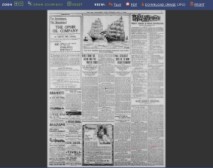
Searching across all papers and all dates for the word ‘kinetoscope’ got me 71 hits. Clicking on a result gives me a picture of the full page, then options to view the OCR text (i.e. text derived throgh scanning using Optical Character Recognition, which may bring up some small errors), PDF, or I can download the image as a jp2 file. The term I searched for is highlighted on the image, and I can zoom in or out. Each hits gives you the title of the newspaper, the date of the issue, and the page number. On a quick survey of the texts, I saw the Kinetoscope was being commonly used as a generic term for motion pictures, rather than the Edison machine specifically.

Chronicling America is free to all, easy to use, and is certain to grow as the phased digitisation programme develops. The site has background information, including technical details for those entranced by TIFFs and JPEGs.

Times Digital Archive

Probably the most outstanding of the newspaper digitisation programmes, and the one that has had a great impact on research across any number of disciplines, is the Times Digital Archive. This is a commercial operation, managed by Thomson Gale. It offers every page from the London Times 1785-1985. It is possible to search for a term or phrase across all dates, a specific date or a date range, and across all types of section, or restricted to Advertising, Business, Editorial and Commentary, Featurees, News, People and Picture Gallery – this is a very useful feature for narrowing down searches.

Searching on ‘kinetoscope’ across all fields got me 60 hits. As it covers the 1890s period, the rsults were excellent, tracing the Kinetoscope’s appearance in London, from a first mention on 8 March 1894 of Edison’s latest invention, to the surprise discovery that in 1897 there as a racehorse called Kinetoscope (not a very successful racehorse, it seems). Search results cite the date, page, issue number and page column of the relevant article, with the search term highlighted on the page. You can view the relevant article or page as PNG images, or view the page as PDF.

Times Digital Archive

Such a wonderful resource comes at a price. It isn’t freely available, and instead it is made available to institutions in a variety of subscription packages. In the UK, most universities subscribe to it, under the Athens password system (which restricts online resources to UK academic users), but it can also be found in many public libraries. It is also available through subscribing international institutions as well.

Google News Archive

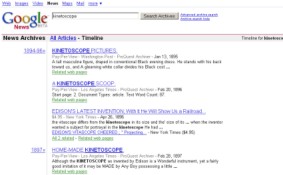
And then there’s the Google News Archive search. Naturally enough Google has provided us with a search engine which browses historic news resources, both free and subscription-based, so you are offered tantalising glimpses of news stories that can be yours if only you’ll pay. Typing in ‘kinetoscope’ yields 2,210 results. The results seem all over the place, but it is possible to narrow down the search by date or newspaper, as Google assesses which areas are likely to yield the most results from your broad search query. It can also arrange results in a handy ‘timeline’ fashion.
Google News Archive

It’s worth noting that many of the subscription sites, such New York Times, give you at least the first few lines of the requested article. Speaking of the NYT, you can pay $4.95 to view a single page, $7.95 a month (up to 100 articles) or $49.95 per year (up to 1,200 articles). Find out more from its TimesSelect service.

The Google News Archive is a wonderful research tool, not least for showing the sheer range of digitised newspaper collections out there, and as a quick spot-check method of seeing when a subject was being discussed, in what way, and by whom. I certainly want to read more of the Los Angeles Times article of 31 March 1897 entitled ‘Kill the Kinetoscope and its Kindred’, with the tantalising opening lines, “The Senate Judiciary Committee did well in reporting favorably the bill to prohibit the exhibition of prize-fight pictures by means of the kinetoscope and kindred devices in the District of Columbia or the Territories of the…”

British Library Newspapers

The British Library maintains the national collection of newspapers (still housed in quaint conditions at Colindale in North London). It has had had for some while a test online historic newspaper service, using Olive Software, which offers some year-long slices from four sample papers: News of the World, Manchester Guardian, Daily News and The Weekly Dispatch, from which only the News of the World gives a Kinetoscope story – on the racehorse, in 1900.

But now the British Library is engaged on a massive British newspaper digitisation programme, with higher education funding money (the JISC Digitisation Programme). The first stage of this, recently completed, has digitised 2 million pages of 19th century newspapers. Stage two, just begun, will add a further 1.1 million pages from 1690-1900. The results, however, will be accessible to UK higher and further education users only.

The lessons to be learned are simply that, if you want serious access to knowledge, you need to pay or to be a student. The number of precious resources being made available only to universities is a problem for the outside researcher, though that’s where the money is coming from, and in many cases it’s the only way of getting round licensing restrictions.

What else is out there?

There are commercial sites, such as ProQuest, which is a world leader in providing access to digitised resources to institutions, including historic newspapers. Like a number of these services, it offers free trials – but only to institutions. The massive NewspaperARCHIVE.com welcomes individuals. It boasts over 68 million pages, and lets you know your search results for free, so Kinetoscope yielded a tantalising 2,923 hits. Annual membership starts at $8.95 per month.

But there are many smaller initiatives to look out for. A while back, I wrote a post on The Silent Worker, a newspaper for the deaf, which had many articles on the deaf and silent films. I found the information on that from the British Columbia Digital Library, which has a very useful listing of digitised newspaper collections around the world. And if you are frustrated at not being able to get hold of subscription-based collections, I recommend the Godfrey Memorial Library, an American library specialising in genealogy resources which for a very cheap annual subscription (from $35.00) offers access to a large number of newspaper libraries, including the Times Digital Archive.

There’s so much out there. If you know of other collections, or directories of information, do let me know.

The West in Early Cinema

The West in Early Cinema

Amazon.co.uk

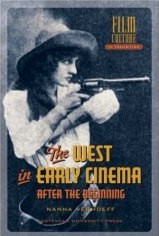
The Bioscope returns from Amsterdam, and will regale you with a report on the Iamhist conference tomorrow. Meanwhile, thinking of that city, there’s a new publication from Amsterdam University Press which looks interesting. Nanna Verheoff’s The West in Early Cinema: After the Beginning is an investigation of the emergence of the Western as a genre in the first two decades of cinema (i.e. to 1915). The author analyses Western films, many of them little known, from archives across the world, tracing the relationships between films about the American West, and other popular media such as photography, painting, popular literature, Wild West shows and popular ethnography, as well as other popular films. Great cover too. As Jean-Luc Godard said, “All you need for a movie is a girl and a gun”.

A Camera Actress in the Wilds of Togoland

The White Goddess of the Wangora

There was a curious sub-genre of silent films which combined exploration with drama. The enthusiasm that there was at the time for exploration films from Africa, South America, Australasia etc, led a number of these ‘explorer’s to make dramatic films, often with ‘native’ performers, which sought to sugar the pill of discovery and anthropology with human interest for the general cinema audience.

Frank Hurley, peerless cinematographer of the Douglas Mawson and Ernest Shackleton expeditions to Antarctica, in the 1920s made dramatised films of life in the Southern seas, The Hound of the Deep aka Pearl of the South Seas (1926) and The Jungle Woman (1926), set in New Guinea. British director M.A. Wetherell made Livingstone (1923) in Africa and Robinson Crusoe (1927) in Tobago. Geofrey Barkas made Palaver (1926) in Nigeria. And of course the Americans Merian C. Cooper and Ernest B. Shoedsack made Chang (1927) in Siam and Robert Flaherty made Moana (1925) in Samoa. All were curious mixes of idealism and colonialism, documentary and drama.

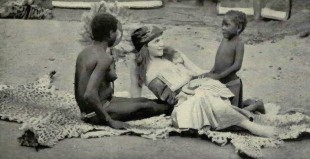
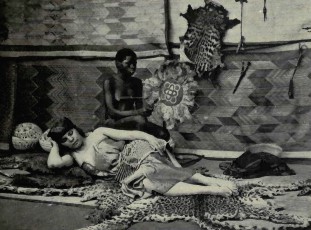
One of the earliest such examples must be The White Goddess of the Wangora (Die weiße Göttin der Wangora). This was made in Togo in 1913/14 by the German explorer and sometime big game hunter Major Hans Schomburgk, and starred his future wife, Meg Gehrts. The reason for this post is that her book on the experience of making this film, along with other dramas and a number of documentaries, is available from the Internet Archive. It has the grand title, A Camera Actress in the Wilds of Togoland (1915).

The White Goddess of the Wangora

Schomburgk, famed for having discovered and captured the pygmy hippopotamus, had made an earlier filming trip to Liberia and Togo, where his negative stock was ruined and the cameraman let him down. A little wiser the second time around, he returned with the intention of making a series of dramas and documentaries of life in Togo, with a white actress in tow to act as the main draw for Western audiences. Obviously he hoped for profits which would offset the expense of the expedition. The White Goddess of Wangora told of a white child washed up on the shore of Togoland, and brought up by the local peoples as a kind of goddess. Years pass. A white hunter (Schomburgk) is captured by the tribe and sentenced to be put to death, but she has fallen in love with him. They escape, an exciting chase ensues, they get away, they live happily ever after.

The book is fascinating in detail, patronising towards the ‘savages’ they work with, but also filled with sympathetic observations, particularly on the drudgery experienced by the Togo women. It also tells us much about the indignities and privations the filmmakers suffered. Four dramatic films were produced in all: The White Goddess of the Wangora, Odd Man Out, The Outlaw of the Sudu Mountains and The Heroes of Paratau. They also made travel and industrial films. All, so far as I am aware, are now lost. It is an observant text, with plenty of interest if you can steer around the period attitudes, and it is well illustrated.

You can find a list of film credits for Hans Schomburgk on the excellent German film encyclopedia www.filmportal.de and, unexpectedly, on Stanford University’s Infolab.

The British cameraman who went with them was James S. Hodgson, who went on to enjoy a long and notable career in newsreels, eventually ending up working for The March of Time in the 1930s. You can read his biography on the British Universities Newsreel Database.

Before the Nickelodeon

Before the Nickelodeon

The latest addition to the Bioscope Library is evidence of a growing trend among academic publishers to make some of their books available electronically, both by subscription, and for some older titles, for free.

That’s what’s happened with University of California Press, which has made some 2,000 books available online via e-Scholarship Editions. Most of these are available only the university staff and students, but a handful have been made freely available for the public. Among them is one of the key early film studies texts, and is strongly recommended, not just for its own sake but for the very user-friendly way in which it has been made accessible.

Charles Musser’s Before the Nickelodeon: Edwin S. Porter and the Edison Manufacturing Company (1991) is a biography of Edwin S. Porter, but also very much more than a biography. He places the story of the Edison filmmaker, producer of The Great Train Robbery (1903) and Life of an American Fireman (1903), within the context of film production and exhibition at the end of nineteenth century and into the twentieth, and within broader socio-cultural contexts. The result is a rich, multilayered account of the birth of American film with Porter as the key with which to unlock the history. This modern classic has been hugely influential on modern early film studies. It is also handsomely illustrated and very readable. It is freely available as chapterised web pages, complete with illustrations, notes, appendices and hyperlinked index i.e. find the term, and the link takes you to that page in the ‘book’.

With thanks to David Pierce for pointing this out to me. I’m going to be on the look out for more.

The Silent Worker

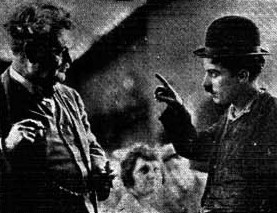
Granville Redmond and Charlies Chaplin

Granville Redmond and Charlie Chaplin

While preparing a post on the digitisation of newspaper collections (which you’ll receive some other time), I came across one journal of such particular interest that it had to have a post to itself.

The Silent Worker was a popular American journal for the deaf, published between 1888 and 1929. Most of the articles were written by hearing-impaired authors. The entire run of the journal has been digitised by Gallaudet University Library. If you go to the search options, and click on subjects, you will find 70 articles on ‘Movies and Deaf’.

I don’t know if there has been much in the way of studies made of the relationship between deafness and silent cinema, though the Chicago Institute for the Moving Image has a Festival for Cinema of the Deaf which has included silent films, and in 1891 the pre-cinema pioneer Georges Demenÿ famously used a proto-moving image camera to show someone mouthing the words ‘Je vous aime’ as a demonstration of how moving images might aid deaf mutes in learning to speak. And there are many anecdotes of deaf lip-readers discovering the fruity language spoken in films like What Price Glory? which had escaped the eye of the censors. And it has been argued that Lon Chaney’s particular acting gifts came in part through both his parents being deaf.

The Silent Worker reveals a rich world where deaf audiences, and deaf creative talents, engage with the silent picture. For example, an article entitled ‘Cinema and “Signs”‘ (October 1916) compares the art of pantomime with that of the silent screen, with particular reference to Billy Merson and Charlie Chaplin. Chaplin gets many mentions, and there is an engrossing piece, ‘Moving Pictures and the Deaf’ (June 1918) by Alice T. Terry (not the actress Alice Terry), who describes a visit to Hollywood and the Chaplin Studios, where she encounters Granville Redmond (illustrated above with Chaplin), a painter and deaf-mute, who acted in A Dog’s Life and The Kid. Chaplin is revealed to have been notably accommodating towards the deaf (has anyone written on this?). Her opinions are full of interest:

Unlike the spoken drama, the deaf can enjoy moving pictures as much as the hearing do. Some may say that the deaf lose, as they do not hear the music that acompanies the pictures. But I do not think we lose; there are various ways in which we are compensated but the hearing would hardly understand if we tried to explain. For myself I hate the noisy show, that is where some struggle or a battle is going on with its accompanying loud imitation battle din. To me the vibrations are a continuous, growling thunder – or worse than that – which sickens me soul and body. In fact most all musical vibrations irritate me. But by many of the deaf I know that the vibrations are enjoyed, especially by those with some remnant of hearing.

She also has trenchant opinions on D.W. Griffith, whose The Birth of a Nation “worked a great injury to the colored race”. Elsewhere, there are reports on the production of films for the deaf, including a Professor G.W. Jones who filmed speeches from Shakespeare.

One article, ‘Preserving a Famous Film’ sounds remarkably archival for April 1912, though its subject is actually the preservation on film of notable practitioners of sign language. The are also reports on Helen Keller, who starred as herself in a dramatised film of her life in 1919, entitled Deliverance (her teacher Annie Sullivan also appeared in the film).

That’s what I’ve gleaned through a quick inspection, and clearly there much more that could be unearthed. Here’s some last words, written by Alexander L. Pach, for the October 1919 issue:

We deaf people must thank the screen-art for the one biggest offset to our infirmity. Good pictures and by good pictures I mean the kind that educate and elevate, are the levers that lift us from the deadly dullness and monotony of total deafness, to the highest pinnacles of delight. They restore our hearing as nothing else does. We know every word that is spoken as well as the hearing do, for they are all projected on the screen. We only miss the music, and this is such a slight loss it doesn’t count … All the best plays of the spoken stage that have delighted millions of hearing people find their way to “Screenland”, and such big hits as “Common Clay”, “Daddy Long-legs”, “The Thirteenth Chair”, “Secret Service” etc. etc., are ours through this media. An evening at a good picture house now means one of those hits of the drama; a News-Weekly that has the whole world for its field … a more or less “funny” picture that makes us laugh whether we want to or not and then Burton Holmes shows us the people, the customs and the homes of some far away denizens of the other side of the earth. After an evening of delightful entertainment of this order one may go home utterly forgetful of the fact that an important sense is missing. He has come away refreshed. The tedium of the every day work of store, office of factory has been relieved in great measure, and we feel it’s a bully good little world after all …

There are such treasures to be found on the web. Let’s all keep on looking.

Behind the Motion-Picture Screen

cakesofice.jpg

The latest addition to The Bioscope Library is Austin C. Lescarboura’s Behind the Motion-Picture Screen, published by Scientific American in 1921. I know nothing about the author and I’d not even come across the book before. It’s a voluminous history and guide to the production of motion pictures. As the subtitle puts it, it covers ‘how the scenario writer, director, cameraman, scene painter and carpenter, laboratory man, art director, property man, electrician, projector operator and others contribute their share of work toward the realization of the wonderful photoplays of today; and how the motion picture is rapidly extending into many fields aside from that of entertainment’. With some rather fanciful chapter titles it cover the work of the director (‘The Artist Who Paints the Film Subjects’), producer (‘The Generals of Shadowland’), actors, cinematographers, screenplays, camera technology, special effects, newsfilming, scientific cinema, animation, colour, and and a prescient chapter on the coming of sound. There is a huge amount of interesting material in there.

But perhaps the real appeal lies in its illustrations. There are superb photographs of the production process, and though frustratingly the captions do not name the participants, the images are a rich source of information in themselves, and an indication of how useful these Internet Archive copies are as a source of pictures – as demonstrated by the picture above, which comes with the caption, ‘Scenario writers are notoriously cruel. Without a moment’s hesitation they call for a hero struggling with death among cakes of floating ice – and the actor must do it’. It’s available in DjVu (24MB), PDF (62MB), b/w PDF (39MB) and TXT (529KB) formats.