Muy Blog

Eadweard Muybridge

It is a disappointment that there is no single good source on the web for Eadweard Muybridge, the founding father of the moving image. There are interesting sites offering animations of his photographic sequences, but nothing comprehensive or in-depth about the man.

This looks likely to change with some of the work being put up in test fashion by Stephen Herbert. The Bioscope has already reported on the Muybridge Chronology that he has created. He has now followed this with a proto-blog of discoveries in Muybridge research, Muy Blog. It’s just a basic web page at the moment, though with gorgeous illustrations, but will undoubtedly develop further. He has also published a Muybridge Timeline, which puts the man’s achievements alongside technological and photographic events of the day, as well as world events. Finally, there’s a page of Muybridge Links. It’s all work-in-progress, but important work, and more is promised.

The Persistence of Vision

The Eye

http://www.amazon.co.uk

I’m currently reading The Eye: A Natural History (2007) by Simon Ings. It’s the story of the eye, of how we see, what we think we see, and how the eye fits into human history and the history of evolution.

This might not seem hugely relevant to the study of silent cinema, but it is. The study of motion pictures needs to take in the practialities (biological as well as psychological) of visual reception, and the study of early cinema is especially relevant because it embraces that extraordinary shift in perception when we were first offered seemingly wholly realistic images in motion as means both to be entertained and to learn about our world. It’s about the apprehension of truth and reality, and a basic grounding in optics wouldn’t go amiss.

The one thing most people know about film and optics is “the persistence of vision”: the visual trick by which we are supposed to be able to “see” motion pictures. This wholly fallacious explanation for why we can see films has been accepted as gospel for decades, and can be found in any number of film text books, yet it is quite wrong. There is certainly a phenomenon which is the persistence of vision, but it does not explain how cinema gives its impression of motion, or continuity. As Ings succinctly puts it:

…’persistence of vision’… is simply the eye’s inability to tell a steady light from one that flickers faster than fifty times a second…

Optical toys such as the Phenakistiscope and the Zoetrope exploited this propensity of the eye to be fooled by a rapid, intermittent procession of images, but the persistence of vision would in fact prevent our seeing motion on film, were it not for other forces at work: fusion, and something called the phi phenomenon, which also explain how we are able to see real movement. Again, as Ings explains it:

Humans are foragers; we take a more than usual interest in what things are. But even our eyes are tuned, first and foremost, to motion. In 1875 the Viennese physiologist Sigmund Exner showed that two brief, stationary flashes, provided they are not too far away from each other, are seen as a single object in motion. This habit of fusing stationary dots into moving objects makes a great deal of sense in nature, where prey and predators disappear and reppear constantly, as they move through grass, run behind trees, and peer around rocks. But the power of the phenomenon (called the phi phenomenon) will perhaps best be demonstrated the moment you set this book down and turn on the television. Every film and television programme ever made depends on phi. Both display images quickly enough for our eyes to read them as a single moving image.

It is not because one image persists and then is replaced by another, but because we cannot see that there is a space between those images that explains why we see ‘motion pictures’. And we can appreciate movies because, evolutionarily speaking, we’re all hunters or hunted.

Sigmund Exner I’ve not come across in any history of our understanding of how we see films, but he sounds to have been a remarkable person. As well as a major figure in our understanding of optics, he was the founding father of the world’s first sound archive, the Phonogrammarchiv in Vienna, founded in 1899 and still going strong.

Not all film histories have got it wrong over the persistence of vision. There are sensible accounts in Jacques Aumont’s The Image, Brian Winston’s Technologies of Seeing, and Michael Chanan’s The Dream that Kicks. There’s a helpful explanation of why the persistence of vision notion is a fallacy, written by Stephen Herbert, on the excellent Grand Illusions site.

Ings’ book is a first-rate work of popular science, made all the more readable by someone who is a novelist as well as a scientist. It also has good stuff on how we see colour, which has relevance for early films as well, but I haven’t got to that chapter yet. A further post will follow when I have…

Brilliance

Brilliance

http://www.amazon.co.uk

Romantic fiction and early cinema seldom mix, but they’re about to now. Romantic novelist Rosalind Laker has written Brilliance, published this month, which is set in 1890s Paris, and features both a magic lanternist hero and the Lumière brothers. Here’s the blurb from Amazon to tempt you:

This story is set in Paris, 1894. In a moment of impulse that she will never regret, Lisette Decourt flees her home and family on the eve of marriage to a man who has betrayed her. She attaches herself to a travelling ‘lanternist’, Daniel Shaw, whose ‘Magic Lantern’ show is a phenomenally popular precursor of silent movies. Lisette is fascinated by Daniel’s art and – though adamant that she will never fall in love again – irresistibly attracted to the magnetic Englishman. Though Fate intervenes to separate them, Lisette cannot forget Daniel. She builds a new life for herself as an independent, self-sufficient career woman, yet she remains fascinated by the vibrant new film-making industry whose French proponents are the famous Lumiere Brothers. When a chance encounter reunites Lisette with Daniel, by now a successful film-maker himself, he realizes that she has the magic, elusive quality that will make her a star…

The first edited motion picture?

chase001.jpg

Hot news from the Who’s Who of Victorian Cinema site. The researches of Eadweard Muybridge scholar Stephen Herbert have come up with evidence for Muybridge to have been the first person to present an edited motion picture, in 1881. This is long before ‘film’ as we know it, but Muybridge’s Zoopraxiscope machine projected silhouette images taken from his sequence photographs, painted around the edge of a glass disk. Anyway, here’s the news report:

It now seems confirmed that there was a screening of some newly-produced Zoopraxiscope glass plates in San Francisco in the Spring of 1881, one of which features sequential actions: perhaps the first ‘edited’ motion picture informed by the camera – meticulously painted images based closely on photographic sequences to create a succession of different ‘shots’; and for dramatic effect. A May 1881 report in the San Francisco Post described this as: “a deerhunt, where a deer, followed successfully [successively?] by dogs and horsemen, traverses over the illuminated screen”. The report says these new subjects “can now be illustrated”. Stephen Herbert thinks it is reasonable to suppose they were all shown at this time, though it is just possible that the report is taken from a written submission by Muybridge. But even if it was, it is quite likely that he started using them in his shows. Most of the subjects described in the report survive, including the little-known ‘three-shot’ motion picture Deerhunt. More details can be found on the Eadweard Muybridge Chronology (1881, May 16 entry).

So maybe the first ‘movie’ was an animated scene of a deer hunt made in 1881, when the Lumiere brothers were still in short trousers (practically). Or perhaps we need to be very careful about our terminology and not describe such a phenomenon with the language of a later medium. ‘Pre-cinema’ (unfortunate term) was not about anticipating cinema, as such, but existed of itself. Nevertheless, it is fun to make the comparison…

Remembrance of bioscopes past

Every now and again I trace the etymology and use of the word ‘bioscope‘. Here ‘s a passage from Marcel Proust’s A la recherche du temps perdu, from the Overture to the first book, Swann’s Way:

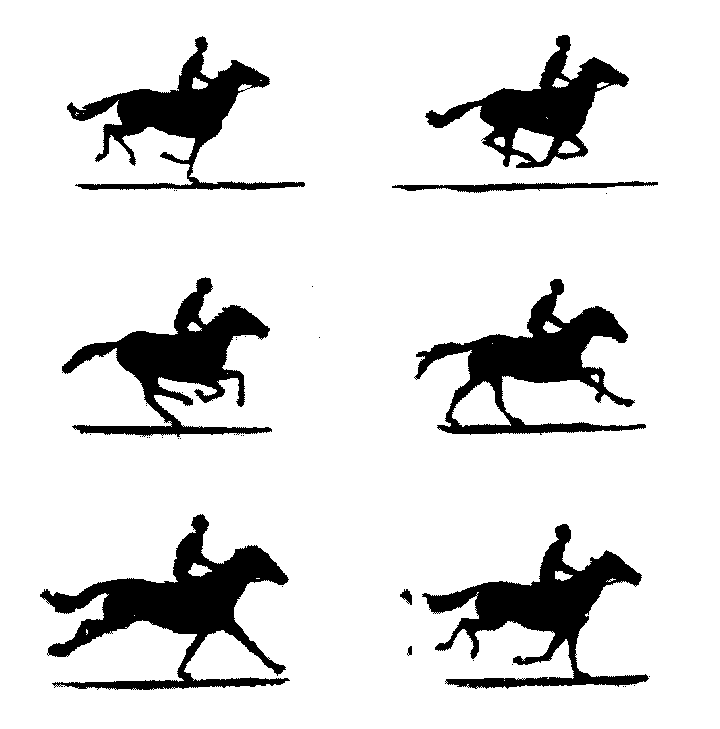
These shifting and confused gusts of memory never lasted for more than a few seconds; it often happened that, in my spell of uncertainty as to where I was, I did not distinguish the successive theories of which that uncertainty was composed any more than, when we watch a horse running, we isolate the successive positions of its body as they appear upon a bioscope.

That’s the C.K. Scott Moncrieff translation, though the Terence Kilmartin one is much the same. It’s interesting to view this with knowledge of Muybridge‘s sequence photographs of a horse galloping (which Proust must have known about) which broke up motion into isolated images, whereas Proust sees the way that film captures motion as now hiding the same mystery. Has anyone written about Muybridge and Proust?

While we’re here, just a little further down the chapter, there is this renowned passage on the magic lantern, a little lengthy, but worth quoting in full (again, from the Scott Moncrieff translation):

At Combray, as every afternoon ended, long before the time when I should have to go up to bed, and to lie there, unsleeping, far from my mother and grandmother, my bedroom became the fixed point on which my melancholy and anxious thoughts were centred. Some one had had the happy idea of giving me, to distract me on evenings when I seemed abnormally wretched, a magic lantern, which used to be set on top of my lamp while we waited for dinner-time to come: in the manner of the master-builders and glass-painters of gothic days it substituted for the opaqueness of my walls an impalpable iridescence, supernatural phenomena of many colours, in which legends were depicted, as on a shifting and transitory window. But my sorrows were only increased, because this change of lighting destroyed, as nothing else could have done, the customary impression I had formed of my room, thanks to which the room itself, but for the torture of having to go to bed in it, had become quite endurable. For now I no longer recognised it, and I became uneasy, as though I were in a room in some hotel or furnished lodging, in a place where I had just arrived, by train, for the first time.

Riding at a jerky trot, Golo, his mind filled with an infamous design, issued from the little three-cornered forest which dyed dark-green the slope of a convenient hill, and advanced by leaps and bounds towards the castle of poor Geneviève de Brabant. This castle was cut off short by a curved line which was in fact the circumference of one of the transparent ovals in the slides which were pushed into position through a slot in the lantern. It was only the wing of a castle, and in front of it stretched a moor on which Geneviève stood, lost in contemplation, wearing a blue girdle. The castle and the moor were yellow, but I could tell their colour without waiting to see them, for before the slides made their appearance the old-gold sonorous name of Brabant had given me an unmistakable clue. Golo stopped for a moment and listened sadly to the little speech read aloud by my great-aunt, which he seemed perfectly to understand, for he modified his attitude with a docility not devoid of a degree of majesty, so as to conform to the indications given in the text; then he rode away at the same jerky trot. And nothing could arrest his slow progress. If the lantern were moved I could still distinguish Golo’s horse advancing across the window-curtains, swelling out with their curves and diving into their folds. The body of Golo himself, being of the same supernatural substance as his steed’s, overcame all material obstacles—everything that seemed to bar his way—by taking each as it might be a skeleton and embodying it in himself: the door-handle, for instance, over which, adapting itself at once, would float invincibly his red cloak or his pale face, never losing its nobility or its melancholy, never shewing any sign of trouble at such a transubstantiation.

And, indeed, I found plenty of charm in these bright projections, which seemed to have come straight out of a Merovingian past, and to shed around me the reflections of such ancient history. But I cannot express the discomfort I felt at such an intrusion of mystery and beauty into a room which I had succeeded in filling with my own personality until I thought no more of the room than of myself. The anaesthetic effect of custom being destroyed, I would begin to think and to feel very melancholy things. The door-handle of my room, which was different to me from all the other doorhandles in the world, inasmuch as it seemed to open of its own accord and without my having to turn it, so unconscious had its manipulation become; lo and behold, it was now an astral body for Golo. And as soon as the dinner-bell rang I would run down to the dining-room, where the big hanging lamp, ignorant of Golo and Bluebeard but well acquainted with my family and the dish of stewed beef, shed the same light as on every other evening; and I would fall into the arms of my mother, whom the misfortunes of Geneviève de Brabant had made all the dearer to me, just as the crimes of Golo had driven me to a more than ordinarily scrupulous examination of my own conscience.

I know much has been written about Proust and the magic lantern, but does anyone know if he is writing about a specific set of lantern slides, and do these survive?

Eadweard Muybridge chronology

zoop3.gif

Stephen Herbert has published an online chronology of the life and work of Eadweard Muybridge (1830-1904), whose sequence photography in the 1870s and 1880s led the way to motion pictures as we understand them. The chronology covers events in his life, and his whereabouts; Muybridge’s published photographs, books, articles, and letters; Muybridge’s unpublished correspondence; correspondence (by others) that mentions Muybridge, where this is useful; books, articles, newspaper reports, advertisements, published during Muybridge’s lifetime, that refer to his life or work. The chronology is still being developed, corrected and expanded. Muybridge’s full achievement is still being avidly researched, and new discoveries are still being made. This is an important new resource from one of the leading Muybridge authorities, who is also promising a Muybridge ‘blog’ in the near future.

Further information:

The Written Word

Today I was looking over an article I located from the Illustrated London News dated August 19, 1922. The title of the piece is “The Birth of the Cinematograph: From Still to Moving Pictures”. This particular article was written by Will Day. Day was an enthusiastic collector of many things, among them some of the early apparatus of pre-cinema and moving pictures. The article is a very interesting document in that it relates much of the pre-cinema history as opposed to traditional moving images. It also has me reflecting on another group of individuals in motion picture history. People such as Day, Merritt Crawford, Earl Thiesen and countless others spent an inordinate amount of time and energy in the attempt to document moving image history. When you think about it, if not for these men, much sole source data such as first person interviews and correspondence might not exist. In many cases actual footage, and equipment is no longer available, so this turns out to be our only method of providing a sense of the history of the Industry. I have found it fascinating in the course of my own research; be it by design or by accident to locate and find written histories left by many more people who played a part in the development of the film industry.

Pre-Cinema Project

hats.jpg

I just came across this section from the George Eastman House web site. GEH is one of the world’s leading media archives, and has a rich selection of images online, chiefly from its photography collections. My eye was caught by the Pre-Cinema Project, which presents a collection of magic lantern images, including photographs of lanterns, magic lantern slides, toy lantern slides, a Muybridge Zoopraxiscope disk, slip slides, and a lovely selection of slides relating to motion pictures – audience notices (such as the slide above), slides that were part of multimedia presentations, and film advertisements.