Laterna Magica – Magic Lantern

Porcelain figures

Porcelain figures of 18th/19th century magic lanternists, from http://www.fuesslin.de

A major new book on the magic lantern has just been published. Laterna Magica – Magic Lantern (vol. 1), by Deac Rossell, is the first in a two-part history which, as the publisher’s blurb indicates, looks at the subject not simply as a precursor of the cinema but as a phenomenon with a rich cultural history of its own:

This first volume covers the 17th and 18th centuries, plus the travelling lanternists – often Savoyards – who brought projected entertainment across Europe through the turn of the Nineteenth century. “Laterna Magica / Magic Lantern” is an attempt to bring together into a single narrative parts of lantern history that have previously been treated separately. It follows the central theme of the projected image in depth while simultaneously recognising the diverse and multifaceted offshoots produced by magic lantern culture.

We often think of the magic lantern today as the “precursor” of the movies and modern digital media; this it undoubtedly was. But at the same time, the magic lantern in its day was not a precursor of anything, but was a sophisticated instrument through which news, entertainment, and visual delight was projected for families, informal groups, and, ultimately, public audiences at fixed shows who enjoyed the elaborate and extraordinary visual rhetoric produced by highly skilled showmen.

The book is published by Füsslin Verlag in a bilingual (German/English) edition (the publisher’s website is bilingual too), and looks set to become a standard work. It also has 113 illustrations, most of them in colour. Deac Rossell is one of the world’s leading historians of the popular optical media of the nineteenth century and before, as well as having been at one time head of the National Film Theatre in London.

Buy one, and have your friends look upon you in awe at your erudition and taste…

Brian Coe 1930-2007

Brian Coe

Brian Coe

It is sad to have to report the death of Brian Coe on 18 October 2007. To anyone with an interest in the history of the technologies of cinematography or photography his work over four decades has been, and remains, indispensible. He joined Kodak in 1952, where he helped found its education service. He made a particular impact with his writings in the early 1960s which forensically overturned the romantic myths which had seen William Friese-Greene chauvinistically championed as a pioneer of cinematography.

He was Curator of the Kodak Museum from 1969 to 1984, building up the collection to be one of international renown, and curating many pioneering exhibitions. When the collection moved to the National Museum of Photography Film and Television in Bradford, Brian became Curator at the Royal Photographic Society’s collection in Bath. In 1989 he joined the Museum of the Moving Image as special events co-ordinator, organising shows, events and organisations on an extraordinary range of topics, all underpinned by exemplary research and presented with enthusiasm, finding a perfect balance between scholarship and entertainment.

At Kodak he built up not only a great collection but considerable personal expertise, which found lasting expression in his many publications. The remarkable thing about his books is that they have not dated. Twenty or thirty years on they are still relied upon as standard reference works, notable as much for their clarity of exposition as their steadfastly reliable content. They include The Birth of Photography (1976), Colour Photography (1978), Cameras: From daguerrotypes to instant pictures (1978), and the incomparable The History of Movie Photography (1981). This is still the best book on cinema technology that exists, and it is hard to see how it could be bettered. It is particularly strong on early cinema technologies – magic lanterns, the optical toys and chronophotographic experiments of the so-called ‘pre-cinema’ era, the first cameras and projectors, the development of colour cinematography, early widescreen systems, the birth of home movies. Its illustrations have been plundered by countless other sources. Film archivists swear by the book – it used to be (and I hope it still is) standard reading for anyone working at the National Film and Television Archive’s preservation centre. Another gem is Muybridge and the Chronophotographers (1992), a small exhibition book reportedly thrown together in a great hurry, but a handy reference guide that I turn back to again and again.

Sadly Brian suffered a serious stroke in 1995, and took no further active part in the worlds of film and photography to which he had contributed such invaluable knowledge. It was a sad curtailment to a varied and richly productive career, recognised through such honours as his Fellowship of the Royal Society Arts, but leaving him little known to the general film enthusiast. Check out one of his books – they’ll be in the local library or second-hand book store. They look beautiful, and they wisely and reliably inform. Thank you, Brian.

Visual archaeology

A couple of items on magic lanterns in America. Firstly, the Museum of Modern Art in New York is currently hosting an exhibition, Panoramas of the Moving Image: Mechanical Slides and Dissolving Views from Nineteenth-Century Magic Lantern Shows. This is a combination of modern and traditional takes on ‘pre-cinema’ technology. At the heart of the exhibition is experimental media artist Ernie Gehr’s Panoramas of the Moving Image (2005), a synchronized five-channel video installation that uses eighty-seven original slides and views selected from Gehr’s personal collection and that of film archivist and magic lantern collector David Francis. This is accompanied by a display of paper Zoetrope strips and Phenakistiscope discs, complementary nineteenth-century moving image technologies. The exhibition runs until 25 February 2008.

Herman Bollaert

Herman Bollaert uses all three lenses of his 19th-century magic lantern to give the “Warehouse in Flames” image added smoke-and-fire effects, from http://www.washingtonpost.com

Meanwhile, in Washington, we have the Belgian Herman Bollaert and his troupe of musicians putting on the The Lanterna Magica Galantee Show at the French embassy. There’s a fine review by Philip Kennicott of this recreation of a nineteenth-century magic lantern show in The Washington Post, which places the lantern within a wider history of visual technologies, following its inheritance through to PowerPoint and the Xbox:

Watching Herman Bollaert and his crew of projectionists manipulate his 19th-century magic lantern is a bit like watching a very old and finicky sailboat being steered into the wind. There is a lot of fussing and fiddling, turning and cranking, all in the service of a charmingly antiquated technology. If you would rather take a powerboat than sail, or watch “The Matrix” on DVD than spend an evening with hand-painted slides of country cottages and windmills, there’s really no point in showing up this evening at the French Embassy, where Bollaert and his Belgian troupe of musicians and lanternists are performing a bit of visual archaeology.

Bollaert’s contraption, a three-lens wooden box from 1880, was made during the great era of magic-lantern shows. Its basic technology was in use during the 17th century, and quite possibly much, much earlier. But in the 19th century, with the growth of all forms of popular entertainment, lanterns became the precursors of the cinema. Slides with moving parts created special effects. Popular novels were presented in narrated slide shows, and science was taught to professionals and amateurs alike through projected images. Musicians often accompanied such popular entertainments, which could include a survey of historic places, short parables and stories, religious spectacles and Gothic horror shows.

The technology was basic – limelight (made by superheated limestone) or kerosene flames were used to project the images onto screens – but its impact was long-lasting. The magic lantern enjoyed popularity well into the 20th century, fading only as cinema took over. It persisted in the form of school slide shows and filmstrips, and is still the animating spirit behind projected PowerPoint presentations. Whole generations of Americans got their first glimpse of human sex organs in health class through a filmstrip projector – a descendant of Bollaert’s machine – which cast lurid pictures into the semi-darkness, into a room of tittering, blushing and sometimes salivating adolescents.

You can read the rest of the article, which brings in Arthur Schopenhauer and Marcel Proust, on the Washington Post site. But here’s the thoughtful final paragraph:

It’s difficult to coax the contemporary mind into the position of someone of two or three centuries ago, who found the basic images projected by lanterns to be amazingly lifelike (aesthetically), emotionally powerful (artistically) and profoundly troubling (philosophically). But like the water wheel set turning by Bollaert’s expert hand, things will come full circle. With the rise of ever more complex virtual realities, once again the philosophical mind is set puzzling over the nature of the real. But now, in our world of Xboxes and Wii consoles, one is hardly aware of the machine that creates the representation, there is no tactile connection between the image and its master, and the boat of illusions sails forth with no hands on deck.

The so-called optical toys of the nineteenth-century, such as the Phenakistiscope, the Zoetrope and the Thaumatrope, were sometimes referred to as philosophical toys. We should always bring a philosophical mind to the moving images placed before us. It is what they are there for.

Animals in motion

These are heady times for the Bioscope, with hundreds of visitors all in pursuit of information on Paul Merton, following the mention of his new book and Silent Clowns tour on Have I Got News for You. So, what can we do to catch the eyes of these passing visitors and maybe entice them to find out more about the worlds of early and silent cinema? Well, what about some nineteenth-century studies of animal motion?

Mohammed running

Mohammed Running, from The Horse in Motion

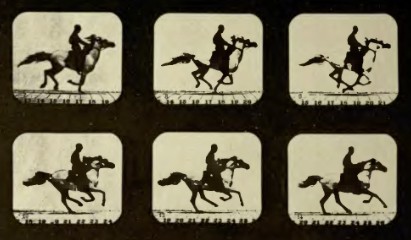
So, we have two new additions to the Bioscope Library, the first of which is The Horse in Motion, by J.D.B. Stillman, published in 1882. Who he? Well therein lies a tale, because the true author of this work should have been the rather better-known Eadweard Muybridge. The book, commissioned by Muybridge’s patron, the railroad baron Leland Stanford, was based on Muybridge’s now famous photographic studies of a horse galloping. But master and reluctant servant had fallen out, and the book was published under Stillman’s name, giving Muybridge negligible credit. The book contains detailed description of the studies into the motion of the horse (and other quadrupeds), with five of Muybridge’s photographs and ninety-one lithographs based on his photographs, plus line drawings. The book’s publication caused considerable embarrassment to Muybridge at the time, as his contribution to the scientific studies was now questioned by several authorities, but it is an important publication nonetheless in the history which took us from sequence photography (or chronophotography) to the successful creation of cinema. It’s available from the Internet Archive in DjVU (6MB), PDF (67MB) and TXT (279KB) formats.

Marey runner

‘Runner provided with the apparatus intended to register his different paces’, from Animal Mechanism

It’s a happier tale to tell with our other, complementary, addition to the Library, Etienne-Jules Marey‘s Animal Mechanism, or La machine animale, first published in 1873. This was the published expression of Marey’s ‘methode graphique’, where, by a variety of graphical devices devised for the measurement of animal motion, Marey was able to demonstrate diagrammatically the walking motion of humans and horses, and the the flight of birds and insects. By this publication, Marey opened up a world of study not previously imagined, and inspired Muybridge and Stanford to undertake their own investigations. Marey did not use photography for Animal Mechanism, but, inspired in turn by Muybridge’s work, would go on to experiment extensively with sequence photographs, developing the science of chronophotography, and through it the mechanism for cinematography. The Internet Archive has both the 1879 American edition, in DjVu (9.9MB), PDF (20MB), b/w PDF (12MB) and TXT (582KB) formats, and the English third edition (not so well scanned), in DjVu only (33MB).

Screen heritage survey

Magic lantern slide from National Media Museum

Magic lantern slide from the National Media Museum, http://www.nationalmediamuseum.org.uk

A online survey was launched today, to uncover collections in the UK with moving image and screen-related artefacts. It is organised by a body called the Screen Heritage Network (of which the organisation I work for, the British Universities Film & Video Council, is a member). The survey is open to any UK collection with artefacts relating to the moving image and screen-related media which may be accessible to the public or researchers. There are ten categories of artefact being sought:

1. Film production equipment
2. Television and video equipment
3. Animation and special effects
4. Sound
5. Sets and costumes
6. Cinema and projection
7. Magic lanterns, slide projectors and viewers
8. Toys and games
9. Installations
10. Documentation

The information gathered will be used to create the first-ever online database of moving image and screen-related objects in UK collections.

Behind this activity lies a definition of ‘screen heritage’ which goes beyond moving picture to encompass the machinery that produces and exhibits them, the culture that supports them, and a notion of ‘screen’ that extends beyond cinema and television back to magic lanterns and forward to video games, consoles and the handheld technologies of today.

So the survey, in looking at artefacts, is concentrating on just a part of this vision of what ‘screen heritage’ comprises. It’s all most appropriate to the study of silent cinema, and where silent cinema fits in within the broader scheme of things. Do take a look at the project site, and if you know of a museum or other heritage organisation within the UK that ought to be taking part, and which we may have missed, let us know.

Friendly shadows

Teleshadow

The Teleshadow, from http://www.bbc.co.uk/news

Shadow puppets were an ancient precursor of our motion pictures on a screen, The Chinese word for cinema, ‘Dianying’, translates as ‘Electric Shadows’, and the word ‘shadows’ is common as a metaphor for film.

So there is something rather pleasing and appropriate about the BBC News Online report on the Teleshadow, a Japanese invention which sends video images of your friends to you in shadow form, so you can keep up with what they are doing in a ‘non-intrusive’ way. The idea is based both on the paper walls that once characterised Japanese interiors, and the lamp with rotating shadows which can be found in Western stores.

There is a projector at the base of the lamp which takes in a feed from a projector, which is trained on the person with whom you wish to stay in visual contact. It is also stressed that the Teleshadow preserves privacy by keeping details of whatever the subject may be doing on the indistinct side.

Hard to say if might catch on, but it is a charming creation, and a step back from the world of social networking through video to the graceful creations of a pre-cinema age.

Iamhist conference report

Amsterdam

Iamhist (International Association for Media and History) is an organisation of filmmakers, broadcasters, archivists and scholars dedicated to historical inquiry into film, radio, television, and related media. It publishes the widely-respected Historical Journal of Film, Radio and Television, and organises biennial conferences. This year’s was held in Amsterdam 18-21 July, on the theme Media and Imperialism: Press, Photography, Film, Radio and Television in the Era of Modern Imperialism. There were several papers given on silent film subjects, and the Bioscope was there with pen and notebook.

A number of the best papers were given on media outside Iamhist’s usual frame of reference. Pascal Lefèvre spoke lucidly and informatively on Imperialist images in French and Belgian children’s broadsheets of the late nineteenth/early twentieth centuries, finding arguably positive or some downright critical images that differed from the usual Western view of African peoples at this time. Andrew Francis was equally entertaining and observant in talking about the use of pro-Empire imagery in New Zealand newspaper advertising during the First World War.

On silent films themselves, James Burns spoke on the distribution (or lack of distribution) of the films of the Jack Johnson-Jim Jeffries boxing match in 1910 and D.W. Griffith’s Birth of a Nation in 1914 to black audiences in Africa and the Caribbean. The Johnson-Jeffries film (the black Johnson defeated ‘white hope’ Jeffries for the world heavyweight title) is well-known for how its images of a black victory alarmed many in America, though Burns pointed out that films of Johnson’s earlier victories over white opponents had not aroused anything like the same rabid reaction. He also pointed out that Birth of a Nation was not exhibited in Africa (until 1931), yet no evidence has yet been found to show why it was withheld. Burns’ has done excellent work on film and black African audiences (see his Flickering Shadows: Cinema and Identity in Colonial Zimbabwe), and his new research promises much, even if evidence of black audience reactions (outside the USA) remain elusive.

Simon Popple spoke on films of the Anglo-Boer War, focussing on the dramatised scenes of the conflict produced by the Mitchell and Kenyon company. M&K are now renowed for their actuality films of life in Northern England in the Edwardian era, after the successful BBC series The Lost World of Mitchell and Kenyon, but they also made dramas, recreating melodramatic scenes from the South African war to feed a public appetite for moving picture scenes of the war which had been disappointed by undramatic newsfilms of the conflict. These crudely histrionic dramas, with titles such as Shelling the Red Cross, A Sneaky Boer, and Hands Off the Flag, raise a laugh now, but presumably had them cheering in the aisles in 1900.

With the unavoidable but unfortunate practice of parallel sessions so that as many speakers as possible can be crammed in, no one could attend everything, and I missed some relevant papers, including Teresa Castro on ‘Imperialism and Early Cinema’s Mapping Impulse’ and Yvonne Zimmermann on ‘Swiss Corporate films 1910-1960’. Too few witnessed Guido Convents‘ excellent presentation on the huge production of Belgian colonial films, from the early years of the century onwards, all designed to remind the world and audiences at home that Belgian had a presence in Africa and an Imperial role to play. He also showed a heartbreaking film of the difficulties faced by the Congo film archive, which put into perspective some of the institutional troubles faced by the world’s larger film archives, described by Ray Edmondson in a plenary session. Edmondson nevertheless made an eloquent case for the ways in which some film archives have come under threat through insensitive political fashions and institutional follies. Archives seem hampered by being archives: politicians do not grasp what it is that they are about in the same way that they do with museums, a far more generously funded sector with a considerably greater public profile.

And there was more. Martin Loiperdinger showed magic lantern slides of British Empire subjects from the nineteenth century and considered their impact upon audiences. Kay Gladstone of the Imperial War Museum showed a two-hour selection of films from its amazing archive for the two world wars (and more), including a live action political ‘cartoon’ from the Anglo-Boer War, and images of Colonial troops in the First World War, though what left the audience stunned was silent, colour home movie footage of India at the time of partition in 1947, showing scenes of the misery caused that the newsreels of the time scrupulously avoided. And there was plenty on post-silent subjects, and me thrilling a small audience with a disquisition on databases and the misuse of thesauri and keywording in describing Imperial and Colonial themes. You should have been there…

These conferences are curious affairs. They are an excellent meeting place and a good way to catch up on the latest ideas, but you do also sit through some truly grim presentations – mumbled monotones, heads bowed down reading from indigestible text, oblivious to the needs of an audience. How some people can still continue to draw salaries as lecturers beats me – you do pity their poor students. And then there are the natural entertainers, who know their audience as well as their subject, and can speak wisely and clearly, in whatever time allotted. It was a well-organised event, the sun shone, the pavement cafés were inviting, and the coffee was fine. I’ll be following up some of the themes (especially silent cinema in Africa) in future posts.

It’s all done with mirrors (well, glass actually)


Now here’s an interesting thing. The new pop video for Paul McCartney’s Dance Tonight, just published on YouTube, has been directed by Michel (Eternal Sunshine of the Spotless Mind) Gondry, and stars Mackenzie Crook and Natalie Portman. And it’s quite a jolly tune with a mandolin. So far so inconsequential, but what is of interest here is that the video employs the Pepper’s Ghost trick, which is of great importance in ‘pre-cinema’ history. Pepper’s Ghost was a clever Victorian stage effect (devised by ‘Professor’ John Henry Pepper) employing glass, mirrors (sometimes) and lighting to make objects – usually ‘ghosts’ – seem to appear on stage. It holds an important place between the Phantasmagoria magic lantern show and the cinema. The trick was achieved by placing a figure off stage, and so lighting it that the light-waves bounced of an angled sheet of glass to create the illusion of the figure appearing in ghostly fashion on a stage. Like so:

Pepper’s Ghost

The McCartney video employs glass in much the same way to produce its ghostly effects. One would suspect that it was all done in post-production rather than ‘in the camera’, but production footage on dazeddigital.com would seem to suggest that they did indeed use glass (not mirrors). It could have been done a whole lot more easily with post-production trickery, but it was clearly done for the delight of the filmmakers – and the publicity.

Pepper’s Ghost inspired the appearance of ghostly figures in many early cinema trick films, though the process itself was not employed directly in films – with one exception, an obscure process called Kinoplastikon. More on that another day…

Nineteen (Obscure) Frames that Changed the World

In October 1888 the French-born inventor Louis Aimé Augustin Le Prince recorded what is thought to be the first ‘film’ in the history of cinema. His subject was Leeds Bridge – the ebb and flow of humanity – people going about their daily business unaware that their motions were being inscribed into history. The surviving frames of this footage are owned by the National Media Museum in Bradford where Curator of Cinematography, Michael Harvey, has been working with New York video artist Ken Jacobs for 18 months to provide footage for the unique exhibition Nineteen (Obscure) Frames That Changed the World. As the blurb puts it, “Ken Jacobs probes the magnitude and infinity of the existing frames, using a unique 3D projection system (with 3d glasses) to reveal hidden beauty and unlock great waves of motion. Ken Jacobs’ films, performances and installations inspire a sense of awe and mystery that audiences must have felt when confronted by moving images at the very start of cinema.” The exhibition opens on Thursday 24 May and runs from 25 May–1 June, 11.30am–6.30pm with free entry. Further information here.

Stopping time

The Man Who Stopped Time

http://www.amazon.co.uk

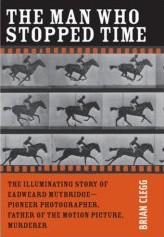
There’s a new book by Brian Clegg, The Man Who Stopped Time: The Illuminating Story of Eadweard Muybridge – Father of the Motion Picture, Pioneer of Photography, Murderer, published by National Academy Press. It’s time we had a good, popular, up-to-date account of Muybridge’s achievements, and Clegg’s book seems to fit the bill. Read the positive review by Stephen Herbert on his Muybridge site, or hear from the author himself via the Popular Science site:

And what a story it is! A passionately-driven man struggling against the odds; dire treachery and shocking betrayal; a cast of larger-than-life characters set against a backdrop of San Francisco and the Far West in its most turbulent and dangerous era; a profusion of technical and artistic advances and discoveries, one hotly following on another; the nervous intensity of two spectacular courtroom dramas (one pitting Muybridge against the richest man in the West and staring ruin in the face, the other sees him fighting for his life) … and for the opening act, a foul murder on a dark and stormy night …

It’s all true.