Marie Glory

marieglory

Marie Glory in L’argent, from Eureka Video

One of the very last silent film actresses pased away on 24 January. French actress Marie Glory (1905-2009) was born Raymonde Louise Marcelle Toully and took the name Arlette Genny when she first appeared on film in 1924, for a small part in Raymond Bernard’s classic Le miracle de loups. Her most notable silent work was in Marcel L’Herbier’s L’argent (1928), arguably one of the greatest – certainly one of the most expensive – of French silent films, where she had the lead female role, starring alongside Pierre Alcover and Brigitte Helm.

Thereafter she changed her name to Marie Glory, and made a successful transfer to sound films, in such titles as Leo Mittler’s Le Roi de Paris (1930) and E.A. Dupont’s Les Deux mondes (1930). Gradually she slipped from lead roles to midway down the cast, to small parts, but she did not make her last film until 1960, and last appeared on television as an actress in 1964. Silent film fans probably best recognise her from the interview she gave to Kevin Brownlow for his television series Cinema Europe: The Other Hollywood in 1995.

There’s a handy short biography for her on the Alternative Film Guide.

And who is still with us among performers who appeared on silent films? Barbara Kent (appeared in Flesh and the Devil), Mickey Rooney (debut as ‘a midget’ in Not to be Trusted in 1926), Diana Serra Cary (Baby Peggy), Daisy D’Ora (Pandora’s Box), June Havoc (perhaps the last person left who appeared in a film before 1920 – her debut was in 1918, aged five), Carla Laemmle (The Phantom of the Opera), Virginia Davis (Disney’s Alice in Cartoonland), and a few more.

A modern musketeer

modernmusketeer

Released next month is the latest mouth-watering, connoisseur-pleasing release from Flicker Alley, Douglas Fairbanks: A Modern Musketeer. This is a five-DVD set covering Fairbanks’ career 1916-1921, as he worked his way through the genres and ever-increasing stardom, before the series of great costume dramas that marked the peak of his fame in the 1920s. It’s officially released on 2 December, with a discount offer for advance orders.

The eleven titles featured on the set are:

  • His Picture in the Papers (1916)
  • The Mystery of the Leaping Fish (1916)
  • Flirting With Fate (1916)
  • The Matrimaniac (1916)
  • Wild and Woolly (1917)
  • Reaching for the Moon (1917)
  • A Modern Musketeer (1918)
  • When the Clouds Roll By (1919)
  • The Mollycoddle (1920)
  • The Mark of Zorro (1920)
  • The Nut (1921)

vance_fairbanks

It’s a sensational package, not just for the instrinc value of the films, but for the portrait it provides of the ‘all-American’ character leaping out of a pre-war world into post-war opportunity. The release of the set is complemented by the publication of Jeffrey Vance’s new biography, Douglas Fairbanks. This, we are told, is

the first critical analysis of Fairbanks’s body of work in over twenty-five years as well as the first full scale biography in over a half century. This extensively researched, engagingly written and sumptuously designed book goes behind Fairbanks’s public persona to thoroughly explore his art and far-reaching influence. Utilizing access to Fairbanks’s personal and professional papers, Douglas Fairbanks is a superb portrait of a true pioneer, critically important to the creation of cinema as the defining art form of the 20th-century.

The DVD set takes its apposite name from the title of the recently rediscovered 1917 A Modern Musketeer, which the curmudgeonly Bioscope didn’t much care for when it was shown this year at Pordenone. For a more generous view, within an illuminating critique of the Fairbanks persona, read David Bordwell’s latest post.

First film dogs

beggar

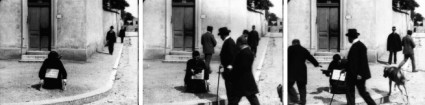
The Lumières’ Le Faux cul-de-jatte (1897), from http://www.davidbordwell.net/blog

David Bordwell recently posted yet another jaw-droppingly good piece on his Observations on film art and Film Art blog, whose consistently high quality makes the rest of us look like mere gossip-mongers. This post, entitled Gradations of emphasis, starring Glenn Ford, examines widescreen cinema (you’ll have to read it to find out what the title means). But there was one aspect of it that caught my eye, something captured drifting across the screen, that reminded me of one of the odder corners of early film down which I like to wander sometimes.

In his survey of lateral staging in film (i.e. action happening within the frame, literally coming in from the sides), Bordwell looks at early film strategies, and reproduces frames from the Lumières’ Le Faux cul-de-jatte (1897), in which a fake amputee begs in the street. He describes the action, until one frame (on the right, above), where a stray dog enters the action from the right. He writes, “The cop comes to the beggar, partially blocking the dog, who takes care of other business. (Not everything in this movie is staged.)” What interests Bordwell is the staged action. What interests me is the dog. Let me explain…

Cinema’s first dog, appearing in Edison’s Athlete with Wand (filmed February 1894) is noticeably at a remove from action and camera (though obedient enough to keep within the frame)

It was when I was presenting a series of programmes at the National Film Theatre on Victorian cinema (i.e. films made before 1901), in 1994, that I first noticed a peculiar phenomenon. As I introduced each short film in the compilation, and pointed out those points of central interest which I had recorded in my notes, I started to notice that the audience’s attention was being frequently been drawn away from the supposed subject and centre of the film’s attention, and instead they were detecting action to the edge of the frame, or crossing the frame, interrupting the action or courageously ignoring it, creating a vital counter-narrative. In short, their attention was irresistibly drawn to stray dogs.

This was a surprising phenomenon, which I exploited at the time for some simple humour, but on mature reflection it seemed that here was a hitherto wholly ignored yet clearly important facet of early cinema, a theme overlooked yet superabundantly obvious once pointed out to the idle observer. The number of stray dogs in early films is considerable, as anyone familiar with the period will readily acknowledge, and their distracting and engrossing qualities seemed to be in urgent need of analysis. Why were stray dogs accepted in early film dramas? What were they doing there? Where did they come from? Were there more such dogs in British films than others? What could their presence tell us about early film practice? How could one construct an overarching vision of early cinema that encompasses the animal and the accidental? Why are there no stray cats? Why, ultimately, were the audience looking in the wrong direction? Were the original audiences similarly distracted? In what sense could it said that such canine interruptions were directed, and by what agency? I resolved to write a paper that would answer these nagging enquiries. It would be called ‘First Film Dogs’.

washingthesweep

I began first by collating the necessary data, and working on a critical theory which would most usefully and succinctly describe the phenomenon. The examples were easy to find: the exuberant Jack Russell which joins in the punishing of a sweep who wanders into a garden and dirties the laundry in James Williamson’s Washing the Sweep (1898, left); the stray dogs wandering over the parade ground amid the marching soldiers in the Boer War actuality Lord Roberts Hoisting the Union Jack at Pretoria (Warwick, 1900), upsetting the solemnity of the situation; dogs wandering casually onto the studio set of early Pathé films; the dog that takes position centre frame in film of a genuine mining tragedy funeral in the middle of the Pathé mining drama Au Pays Noir (1905); actualities such as Funeral of the World’s Greatest Monarch (1910), where King Edward VII’s own dog takes part in the procession, and is then accompanied by a passing stray (such thematic complexity!); the efforts of ‘Monarch’ the Lifeboat Dog to contribute to a life-saving re-enactment performed on the beach in Launch of the Worthing Lifeboat (Biograph, 1899).

comstock

Monarch’s contribution to an actuality which in fact incorporates a dramatic element illustrated the next stage of the theme, where the cinema progressively encroached upon the freedom of the dog, containing the dog within the frame, from Edison’s Laura Comstock’s Bag-Punching Dog (1901, right, though watch the film and see how the dog, Mannie, keeps trying to leap out of the frame only to be drawn back into it); to the passing dogs that enthusiatically take part in early chase films; to the triumph/defeat of Hepworth’s Rescued by Rover (1905), where the dog’s natural motion is contained entirely within the cinematic narrative. Did the sequel to that film, The Dog Outwits the Kidnapper (1905), where Rover gets to drive a car, indicate canine empowerment or slavery? What price the freedom of early cinematic form, when all that results from it in the end is Rin Tin Tin and Lassie?

The critical theory at this stage consisted mostly of a series of such questions, without a key, but I began to work on the concept of ‘canine space’. There was more going on in these early films than first appeared. There was a central performance, or news event, which the original catalogues declared to be the subject matter, but this could not necessarily be what the audience saw, nor was such a dictate bound to be obeyed by those appearing in these films. Anyone familiar with early films will know of the puzzled glances from passers-by that characterise street scenes, of the distracting matter which suggests that the camera operator was not in full command of the subject. In such circumstances, dogs run free. What adds to the fascination, reinforcing one’s belief in the essentially liberated nature of early films, is that stray dogs can be found in studio films of the period. The drama is enacted, the comedy routine performed, and in the background a dog watches, or wanders past, or joins in if it so desires, and this is accepted as part of the total action. ‘Canine space’ is therefore that other space, that world onto which the camera has intruded.

rescuedbyrover

Rover (played by Blair) and Cecil Hepworth in Rescued by Rover (1905)

I never did write the paper. It was intended as a spoof of early film studies, but I couldn’t quite get the humour right. I was scheduled to give the paper at a British silent film festival some years ago, but in the end got up and apologised to the audience and said that the paper was beyond me. But I gave them enough of the argument that it probably affected the rest of the festival, as people starting spotting stray animals in every film, and ever since I’ve had people send me images or information on roving animals which they’ve spotted in some silent or other. A chord was touched.

It’s not a phenomenon entirely restricted to the early cinema (there a renowned stray dog in Joseph Losey’s Accident for instance), but it is a noticeable characteristic of early film which could make one think about the special free nature of film at that time. A cinema where dogs run free is a cinema that has not yet been pinned down, one that lets us look at the edges. You could call it the cinema of distractions. You could theorise about it seriously – there is perhaps some parallel with Roland Barthes’ concept of the ‘punctum’, the oddity in a photograph that shouldn’t really be there but which draws your attention away from what the photograph is ostensibly trying to convey.

Maybe I’ll write the paper one day. Maybe it’s the sort of paper that’s not meant to be written. Maybe we’re always going to be looking at the centre, while at the edges, or wandering across the frame, another kind of story passes by, always eluding us even though it may for a moment catch our eye. I don’t know. Try asking a dog.

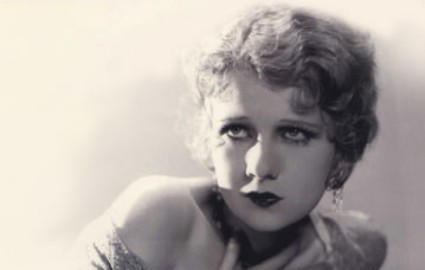
Anita Page RIP

http://www.anitapage.com

Little by little, the human connection with the original silent era slips away. Yesterday, Anita Page, who started in films in 1924 and first gained fame starring alongside Joan Crawford in Our Dancing Daughters (1928), died aged ninety-eight. Here’s a report from Associated Press:

LOS ANGELES (AP) — Anita Page, an MGM actress who appeared in films with Lon Chaney, Joan Crawford and Buster Keaton during the transition from silent movies to talkies, has died. She was 98.

Page died in her sleep early Saturday morning at her home in Los Angeles, said actor Randal Malone, her longtime friend and companion.

Page’s career, which spanned 84 years, began in 1924 when she started as an extra.

Her big break came in 1928 when she won a major role — as the doomed bad girl — in “Our Dancing Daughters,” a film that featured a wild Charleston by Crawford and propelled them both to stardom. It spawned two sequels, “Our Modern Maidens” and “Our Blushing Brides.” Page and Crawford were in all three films.

Page’s daughter Linda Sterne said her mother had been good friends with Marion Davies and Jean Harlow, and for about six months in the 1930s lived as a guest in William Hearst’s massive castle on the Southern California coast.

“She was the best mother I could have,” Sterne said. “She was wonderful.”

In 1928, the New York-born Page starred opposite Chaney in “While the City Sleeps.”

The following year, she was co-star of “The Broadway Melody,” the 1929 backstage tale of two sisters who love the same man. The film made history as the first talkie to win the best-picture Oscar and was arguably the first true film musical.

In his 1995 book “A Song in the Dark: The Birth of the Musical Film,” author Richard Barrios reserved much of his praise for Bessie Love, the veteran actress who played the other sister. But he called Page “intensely likable — sincere, well-meaning, endearing, in much the same fashion as Ruby Keeler several years later — and, of course, quite beautiful.”

Variety wrote in 1929 that Page “is also apt to bowl the trade over with a contribution that’s natural all the way, plus her percentage on appearance. … She can’t dance, (but) the remainder of her performance is easily sufficient to make this impediment distinctly negligible.”

Among Page’s other films were two of Keaton’s sound films, “Free and Easy” in 1930, and “Sidewalks of New York” in 1931; “Night Court,” with Walter Huston in 1932; and “The Easiest Way” in 1931, in which Clark Gable had a small role.

For a short time Page was married to composer Nacio Herb Brown, who wrote songs for “The Broadway Melody,” but the marriage was annulled within a year, Sterne said.

Page stopped acting in 1936 when she fell in love with Herschel House, a Navy aviator. The couple married six weeks later and Page happily adapted to life as an officer’s wife, hosting many parties at their home in Coronado, a city peninsula in the San Diego Bay, Sterne said.

The couple had two daughters, Linda and Sandra.

After House died in 1991, Page went on to return to films. In 1994, she appeared in the suspense thriller “Sunset After Dark.”

Most recently, she had a cameo in the horror film “Frankenstein Rising,” due out later this year.

There is an Anita Page website, The Anita Page (of course), with general biographical information, photos etc. The silent films she appeared in are A Kiss For Cinderella (1925), Love ‘Em and Leave ‘Em (1926), Beach Nuts (1926), Telling The World (1928), Our Dancing Daughters (1928), While the City Sleeps (1928), Our Modern Maidens (1928), The Flying Fleet (1929) and Speedway (1929).

This article by Austin Mutti-Mewse in The Guardian on how Anita Page lived in her latter days makes for fascinating, slightly queasy reading. Benito Mussolini, it appears, was her greatest fan.

She lives the life of Norma Desmond, rising at noon, when one of her assistants gets her dressed for the day ahead. Her wardrobe largely consists of remodelled dresses she wore in the 20s, to which she will add accessories once bought by male suitors. The furs are all a little moth-eaten, her long fingernails look like scarlet talons. The remainder of the day she spends watching herself in old movies. In her own mind, there is only ever one real star. The most famous, the most sought after Anita Page.

Sic transit Anita.

Lost sites

Here at The Bioscope we do our best to alert you to interesting new web resources on the subject of silent cinema, or indeed sites that have been around for a while but aren’t necessarily well known. But what about sites that are no more? We’ve all experienced the frustration of the dead link, discovering that some site or page has been taken down because the domain registration wasn’t kept up, the page was taken down because the owner thought it no longer of interest, or the web links on a site have all been changed. Whatever the reason, the Net is an impermanent place, and many worthwhile sites in our field are around no more.

Happily we have the Internet Archive and its ‘Wayback Machine‘, which has archived a great deal of the Internet (85 billion web pages from 1996 to 2008), taking ‘snapshot’ records of sites periodically (usually every few months). Images are not always retained, and you can’t find movie files, databases or other such complexities in the archive, but you will find the plain HTML. But how do you know what to look for? There is no subject guide or keyword searching (yet). You have to know the web address, and even then that only find you what you knew was there to find. What about those lost sites that you never knew were lost?

Despair not. The Bioscope presents this initial guide to some of the silent cinema sites and web pages which can no longer be found on the Web as such, but do lurk within the Internet Archive. There will be many more than those listed below, of course, but it’s a start (do let me know if you know of any). All links will take you to the Internet Archive record.

The Silents Majority
Old hands will have recognise the gentleman at the top of this post as ‘Merton of the Movies’, the silent town crier who featured on Diane MacIntyre and Spike Lewis’ The Silents Majority, the essential silents information site before it disappeared in 2003 and Silent Era took its place. Here you can still find biographies, reproductions of articles, featured books and videos, photo gallery, guest articles and Cooking with the Stars. Not everything remains (some images and the QuickTime movies won’t be found there), but it’s still a treasure trove. Check also for the final year of its existence when it changed its URL and became www.silentsmajority.com.

A Trip to the Moon
A simple but engaging site dedicated to Georges Méliès’ Voyage Dans La Lune, with an essay on the film, Méliés’ own outline and commentary for the film, film stills (not of terribly high quality, unfortunately), and extracts from the associated imaginative literature of Wells, Verne, Poe and others.

Questions Regarding the Genesis of Nonfiction Film
A stimulating essay on early non-fiction filmmaking, its essence, problems of definition, and neglect by film scholars, by renowned Japanese scholar Komatsu Hiroshi. It does exist elsewhere in print in the journal Documentary Box, but a key text like this ought not to be lost to the online research community.

The Human Motor
This stems from a scientific project to map the human body by the University of Colorado, and was part of a larger site, Building Better Humans. It has sound information on the chronophotography of Etienne-Jules Marey and Eadweard Muybridge, complete with a fine selection of images.

Les Frères Lumière et le Japon 1895-1995
This site accompanied a touring exhibition of films shot in Japan in the 1890s by the Lumière cameramen François-Constant Girel and Gabriel Veyre. It comprises an excellent essay (in French) on the first films and filmmaking in Japan by Hiroshi Komatsu.

Eadweard Muybridge: Father of Motion Pictures
An imaginative, beautifully-designed site on the master photographer who captured motion. Some of the photographs no longer appear, but there some animated gifs of Muybridge sequences, and the whole thing is just done with such style.

Dive cinema muto
Italian site (in Italian) devoted to silent film actresses, especially the Italian ‘divas’ such as Lyda Borelli and Francesca Bertini, plus other femme fatales such as Asta Nielsen and Theda Bara. With biographies, essays and illustrations.

Archiving the Internet is becoming a subject of increasing concern. The Internet Archive leads the field, of course, but the UK Web Archiving Consortium is building up to the day when every UK website will be archived as a matter of legal deposit. For those intrigued by dead sites in general, take a look at Ghost Sites of the Web (these are sites that still exist on the Web, but which have been abandoned).

Please let me know of any lost sites (as opposed to dead ones that just aren’t updated any more) on silent cinema, and I’ll update this list. Note also that not every lost site may necessarily be found on the Internet Archive – the website whose passing I most regret, Charl Lucassen’s beautiful Anima site on chronophotography and other optical delights, once one of the genuine treasures of the Web, is nowhere to be found at all. Such a loss.

Early Chaplin

A Film Johnnie, from http://www.bfi.org.uk/southbank

Opening tomorrow at the BFI South Bank is the first month in a planned six-month retrospective of the work of Charlie Chaplin. The BFI National Archive, in partnership with the Cineteca di Bologna and Lobster Films, is restoring all of Chaplin’s films made for the Keystone company in 1914, as a follow-up to its earlier work on the Chaplin Mutuals. All of the surviving Keystones (Her Friend the Bandit remains lost) are being shown over August and September in nine programmes, as follows.

Here’s the blurb from the BFI site (and programme booklet):

The life of Charles Chaplin is the cinema’s greatest ‘rags-to-riches’ story. Bryony Dixon of the BFI National Archive presents a season of his early films showing how Chaplin became the world’s first movie megastar.

From the Victorian workhouse and the south London slums to the heights of Hollywood and movie stardom, the life of Charles Chaplin is cinema’s greatest ‘rags-to-riches’ story. It is less well known that the 20th Century’s greatest screen star was already a celebrity on this side of the Atlantic before he ever made a film. The fact is that we would never really have known the degree of Chaplin’s genius if he had not gone into films and if they had not survived.

The BFI National Archive, together with the Cineteca di Bologna and Lobster Films, is restoring all of Chaplin’s earliest films made for the Keystone company in 1914. These fascinating films document Chaplin’s rapid progress as a screen performer and director as well as furthering our acquaintance with a host of great comedians such as Mabel Normand, Roscoe Arbuckle, Edgar Kennedy, Ford Sterling, Al St John and Mack Sennett himself. The films – which have previously been seen only in mutilated copies – are brought back to life by painstaking restoration.

After acting in several Keystone films, Chaplin took control and directed most of his films thereafter. After 35 films for Keystone, Chaplin negotiated a better deal for himself with the Essanay Company and had a high degree of control over his comedies. He began to refine his character and further developed the ‘little tramp’ persona during his stay with the Mutual Company in 1916/17. It is during this period that many of his best-loved films were made. Chaplin described those years as the happiest of his life. In the following years Chaplin produced fewer but longer films for First National and in 1921 directed his first feature, The Kid.

This film more than any other laid the ghosts of his London childhood. Shortly after its release and after seven years of solid hard work and 72 films, Chaplin decided to go home for a visit. His reception on arrival in England was astounding.

Chaplin continues to be an important figure for us in Britain. His early films can illuminate our irretrievably lost comic traditions – they are an important part of our cultural heritage despite being made in the US. His life and works tell us about the development of screen comedy, about his adaptation of the music hall comedy of 19th century Britain to the 20th century American film, as well as recording the development of an individual artist and performer of genius.

As David Robinson, Chaplin’s biographer says, “The clothes he wears may have come from American sweat-shops; the streets in which he moves are at once no city and every city, but the origins of that hat and cane, boots and baggy pants, and shabby tenement streets, are unmistakably to be sought in his boyhood London.”

And here’s a list of the Chaplin Keystones being shown over August and September:

Programme 1: 9 & 13 August
Making a Living
Kid Auto Races in Venice, Cal.
Mabel’s Strange Predicament
Between Showers
A Film Johnnie

Programme 2: 16 & 20 August
Tango Tangles
His Favourite Pastime
Cruel, Cruel Love
The Star Boarder

Programme 3: 23 & 26 August
Mabel at the Wheel
Twenty Minutes of Love
Caught in a Cabaret
Caught in the Rain

Programme 4: 28 & 30 August
A Busy Day
The Fatal Mallet
The Knockout
Mabel’s Busy Day

Programme 5: 6 & 10 September
Mabel’s Married Life
Laughing Gas
The Property Man
The Face on the Bar Room Floor

Programme 6: 11 & 13 September
Recreation [fragment only]
The Masquerader
His New Profession
The Rounders
The New Janitor

Programme 7: 14 & 16 September
Those Love Pangs [incomplete]
Dough and Dynamite
Gentlemen of Nerve
His Music Career

Programme 8: 20 & 22 September
His Trysting Place
Getting Acquainted
His Prehistoric Past

Tillie Punctured Romance 21 & 24 September

The Silent Film Bookshelf

The Silent Film Bookshelf was started by David Pierce in October 1996 with the noble intention of providing a monthly curated selection of original documents on the silent era (predominantly American cinema), each on a particular theme. It ended in June 1999, much to the regret to all who had come to treasure its monthly offerings of knowledgeably selected and intelligently presented transcripts. The effort was clearly a Herculean one, and could not be sustained forever, but happily Pierce chose to keep the site active, and there it still stands nine years later, undeniably a web design relic but an exceptional reference resource. Its dedication to reproducing key documents helped inspire the Library section of this site, and it is a lesson to us all in supporting and respecting the Web as an information resource.

Below is a guide to the monthly releases (as I guess you’d call them), with short descriptions.

October 1996 – Orchestral Accompaniment in the 1920s
Informative pieces from Hugo Riesenfeld, musical director of the Rialto, Rivoli and Critierion Theaters in Manhattan, and Erno Rapee, conductor at the Capitol Theater, Manhattan.

November 1996 – Salaries of Silent Film Actors
Articles with plenty of multi-nought figures from 1915, 1916 and 1923.

December 1996 – An Atypical 1920s Theatre
The operations of the Eastman Theatre in Rochester, N.Y.

January 1997 – “Blazing the Trail” – The Autobiography of Gene Gauntier
The eight-part autobiography (still awaiting part eight) of the Kalem actress, serialised over 1928/1929 in the Women’s Home Companion.

February 1997 – On the set in 1915
Photoplay magazine proiles of D.W. Griffith, Mack Sennett and Siegmund Lubin.

March 1997 – Music in Motion Picture Theaters
Three articles on the progress of musical accompaniment to motion pictures, 1917-1929.

April 1997 – The Top Grossing Silent Films
Fascinating articles in Photoplay and Variety on production finance and the biggest money-makers of the silent era.

May 1997 – Geraldine Farrar
The opera singer who became one of the least likely of silent film stars, including an extract from her autobiography.

June 1997 – Federal Trade Commission Suit Against Famous Players-Lasky
Abuses of monopoly power among the Hollywood studios.

July 1997 – Cecil B. DeMille Filmmaker
Three articles from the 1920s and two more analytical articles from the 1990s.

August 1997 – Unusual Locations and Production Experiences
Selection of pieces on filmmaking in distant locations, from Robert Flaherty, Tom Terriss, Frederick Burlingham, James Cruze, Bert Van Tuyle, Fred Leroy Granville, H.A. Snow and Henry MacRae.

September 1997 – D.W. Griffith – Father of Film
Rich selection of texts from across Griffith’s career on the experience of working with the great director, from Gene Gauntier, his life Linda Arvidson, Mae Marsh, Lillian Gish and others.

October 1997 – Roxy – Showman of the Silent Era
S.L. Rothapfel, premiere theatre manager of the 1920s.

November 1997 – Wall Street Discovers the Movies
The Wall Street Journal looks with starry eyes at the movie business in 1924.

December 1997 – Sunrise: Artistic Success, Commercial Flop?
Several articles documenting the marketing of a prestige picture, in this case F.W. Murnau’s Sunrise.

January 1998 – What the Picture Did For Me
Trade publication advice to exhibitors on what films of the 1928-1929 season were likely to go down best with audiences.

February 1998 – Nickelodeons in New York City
The emergence of the poor man’s theatre, 1907-1911.

March 1998 – Projection Speeds in the Silent Film Era
An amazing range of articles on the vexed issue of film speeds in the silent era. There are trade paper accouncts from 1908 onwards, technical papers from the Transactions of Society of Moving Picture Engineers, a comparative piece on the situation in Britain, and overview articles from archivist James Card and, most importantly, Kevin Brownlow’s key 1980 article for Sight and Sound, ‘Silent Films: What was the right speed?’

April 1998 – Camera Speeds in the Silent Film Era
The protests of cameramen against projectionsts.

May 1998 – “Lost” Films
Robert E. Sherwood’s reviews of Hollywood, Driven and The Eternal Flame, all now lost films (the latter, says Pierce, exists but is ‘incomplete and unavailable’).

June 1998 – J.S. Zamecnik & Moving Picture Music
Sheet music for general film accompaniment in 1913, plus MIDI files.

July 1998 – Classics Revised Based on Audience Previews
Sharp-eyed reviews of preview screenings by Wilfred Beaton, editor of The Film Spectator, including accounts of the preview of Erich Von Stroheim’s The Wedding March and King Vidor’s The Crowd, each quite different to the release films we know now.

August 1998 – Robert Flaherty and Nanook of the North
Articles on the creator of the staged documentary film genre.

September 1998 – “Fade Out and Fade In” – Victor Milner, Cameraman
The memoirs of cinematographer Victor Milner.

October 1998 – no publication

November 1998 – Baring the Heart of Hollywood
Somewhat controversially, a series of articles from Henry Ford Snr.’s anti-Semitic The Dearborn Independent, looking at the Jewish presence in Hollywood. Pierce writes: ‘I have reprinted this series with some apprehension. That many of the founders of the film industry were Jews is a historical fact, and “Baring the Heart of Hollywood” is mild compared to “The International Jew.” [Another Ford series] Nonetheless, sections are offensive. As a result, I have marked excisions of several paragraphs and a few words from this account.’

December 1998 – Universal Show-at-Home Libraries
Universal Show-At-Home Movie Library, Inc. offered complete features in 16mm for rental through camera stores and non-theatrical film libraries.

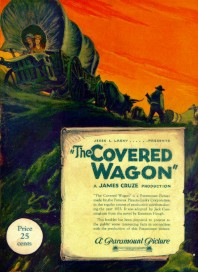
January 1999 – The Making of The Covered Wagon
Various articles on the making of James Cruze’s classic 1923 Western.

February 1999 – From Pigs to Pictures: The Story of David Horsley
The career of independent producer David Horsley, who started the first motion picture studio in Hollywood, by his brother William.

March 1999 – Confessions of a Motion Picture Press Agent
An anonymous memoir from 1915, looking in particular at the success of The Birth of a Nation.

April 1999 – Road Shows
Several articles on the practive of touring the most popular silent epics as ‘Road Shows,’ booked into legitimate theatres in large cities for extended runs with special music scores performed by large orchestras. With two Harvard Business School analyses from the practice in 1928/29.

May 1999 – Investing in the Movies
A series of articles 1915/16 in Photoplay Magazine examining the risks (and occasional rewards) of investing in the movies.

June 1999 – The Fabulous Tom Mix
A 1957 memoir in twelve chapters by his wife of the leading screen cowboy of the 1920s.

And there it ended. An astonishing bit of work all round, with the texts transcribed (they are not facsimiles) and meticulously edited. Use it as a reference source, and as an inspiration for your own investigations.

Forgotten faces

http://www.filmmuseum.nl

One of the sad, or at least frustrating aspects of archival work on early films is trying to identify reels where there is no convenient main title to identify the film for you, and you can’t tell who the performers are. For every Pickford or Chaplin, there were hundreds of second and third tier players, probably not much known about at the time, and recognised by only a dedicated few now. And below they came those whose names were probably never known, who hoped for a little fame and never found it. If you can’t recognise them, or you can’t name the film in which they appear, film and performers remain in limbo, orphaned, acting for no one. Who are you, you ask, peering ever more closely at the screen in the hope of some subliminal clue. You take frame stills and show them to colleagues, leaf through the reference books, scroll through endless lists of film titles looking for some hopeful match between the action on the film fragment you have seen, trying to imagine these things with the mind of a 1910s film producer. Find the right title, or find a name, and you’re restoring someone back to some sort of a life. It’s a precious responsibility.

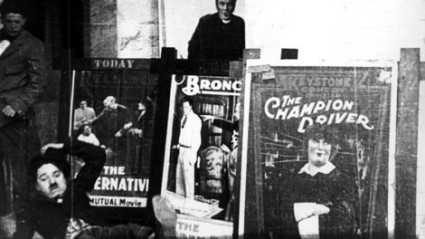
So it is that the Nederlands Filmmuseum, which has made something of a speciality of curating unidentified films, has put together a PowerPoint slide show of actresses from the silent era that either they are unable to identify, or of whom they know frustratingly little. They’ve done this to coincide with the upcoming Women and the Silent Screen Conference, being held in Stockholm 11-13 June, and they are inviting anyone who can to help identify the names. So, visit the conference site to download the PowerPoint, or take a look at the faces here. From the faces above, who is it on the left who appears in a British Lupino Lane film of the 1910s? Who is the actress (centre) who was found in a fragment of a mid 1920s comedy for Fox or Universal with Fred Spencer and Billy Bletcher? And can anyone name the actress (right) in a 1910s film which features Austrian and British officers going on a hunting party, who end up shooting a lion?

http://www.filmmuseum.nl

Or what of these? The actress on the left played the character of Cunegonde in a popular series of comedies 1911-1913 for the French company Lux, but no one knows her name. In the centre, this unidentified player appears in a Universal Century comedy fragment, dating around 1922, with Jimmy Adams and Jack Earle. And who on the right plays the title character in a Powers Company film of 1910 entitled The Lady Doctor?

If you have any idea, the Filmmuseum would love to hear from you. And, from the grave, the women would doubtless thank you too.

Putting up statues to Charlie

This intriguing news report just turned up on a Kazakhstan news site:

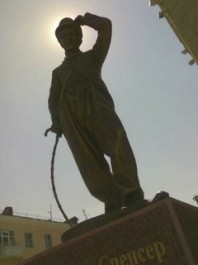
A monument to Charlie Chaplin has appeared in Kostanai last week. As reported, it is the 12th in the world. The very fact of a sculpture to the cinematographe idol being installed in our city is quite weird for the town’s standards, especially taking into account that the only movie theatre in Kostanai was recently demolished. In any case, now we have Charlie and a bench near charlie. And as Farid writes in the local newspaper, “the bench is good enough to sleep on it — that’s practical, because we have as much vagabonds in town as in NYC in early 1900s”.

What intrigues me is where the other eleven statues are. I wasn’t able to find a helpful source for this, and so I set out to track them down for myself – though it all depends on how you define ‘statue’. Anyway, I thought I’d share this information with you; certainly it’s pleasing to see how admiration for silent cinema’s most celebrated practitioner is marked worldwide in bronze. So to start with (left) we have the twelfth and most recent statue, that which has gone up in Kostanai.

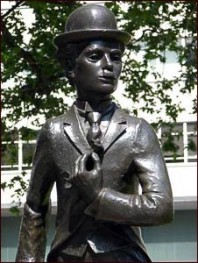
Next, there’s the renowned statue of Chaplin in London’s Leicester Square. He is located in the heart of London’s movieland, with cinemas all about him, while his fellow statues in the Square are Isaac Newton, William Shakespeare, Sir Joshua Reynolds, John Hunter (a pioneer of surgery), and William Hogarth. The Chaplin statue is by John Doubleday, and was created in 1981.

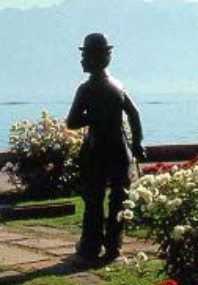
On to Chaplin’s final home, Vevey in Switzerland. In the Square Chaplin, Quai Perdonnet is you’ll find the double of John Doubleday’s statue, showing the little tramp looking out over his favourite view of Lake Geneva and the Alps. It is said to be the subject of pilgrimage, and certainly there are plenty of blogs out there showing people photographed next to Chaplin, leaving flowers there, or even kissing the statue. It was erected in 1982, and is a copy of the Leicester Square statue.

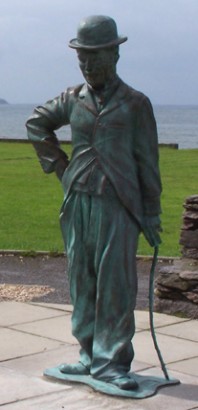
Our next statue is in the seaside town of Waterville, Co. Kerry, Ireland. Waterville was a favourite holiday destination of the Chaplin family. The legend on a stone nearby reads, “For the man who made the movies speak in the hearts of millions. Charlie spent many years in our midst as a welcome and humble guest and friend to many. This image was created by sculptor Alan Ryan Hall. It was funded by the generosity of Josephine Chaplin and by the EU Leader Programme”. It was unveiled in 1998.

And on to Norway. In Oslo, near the Frognerpark, in front of the Coliseum cinema there is a bronze statue of Charlie Chaplin by the renowned Norwegian sculptor (well, renowned to Norwegians, anyway) Nils Aas, dated 1976. Frustratingly, I haven’t been able to track down an image of this in situ [see comments], but here at least is a studio copy. There doesn’t seem to have been any special association of Chaplin with Norway, unlike most of the other statues on view here.

Now let’s away to China, no less. This statue is located outside the ‘Old Film Cafe’. Duolan Road, Hongkou District, Shanghai. The personal connection is that Chaplin secretly honeymooned in Shanghai with Paulette Goddard in 1936. No information as to sculptor or date, but much like most of the statues on display here, you have to say it looks nothing like him. It’s so easy to capture the outline figure, so difficult to capture the man.

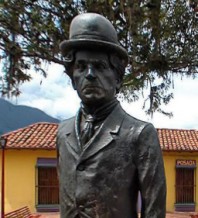
I’m not quite sure why there should be a statue on Charlie Chaplin in Venezuela, but there is. It is located in the city of Mérida, where it is to be found in the Plazoleta Charles Chaplin. No information that I can find as to artist or reason. So on to Disneyland Paris, where a statue of Charlie Chaplin welcomes visitors to the Production Courtyard, but I’ve not yet found a picture of this one.

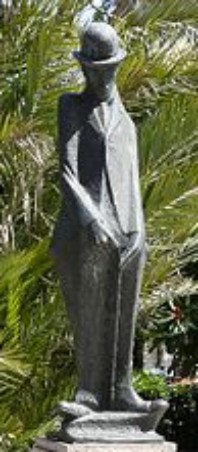
And now we travel to Alassio in Italy. This sheltered spot on the Ligurian coast (the Italian Riviera) is another place where Chaplin often stayed on holiday. The legend on the base of the elongated and not terribly Chaplin-like statue simply reads ‘Charlot’. No information as yet on sculptor or date.

The statue on the left is located in Gabrovo, a small mountain town in Bulgaria. Gabrovo and Gabrovians are apparently the butt of Bulgarian national jokes, but they have responded ingeniously by creating a museum of humour and satire. So it is an appropriate location for a statue of Chaplin. The statue was created by Georgi Chapkanov, and is situated next to Don Quixote and Sancho Panza. It also wins some marks for being a little different.

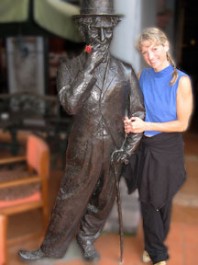
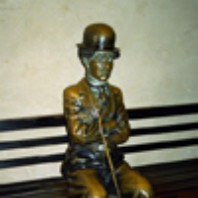
This sitting statue of Chaplin is to be found in the foyer to the Roosevelt Hotel, along Hollywood Boulevard, Los Angeles. It common with most of the statues, there is particular reason for its location. It was at the Roosevelt Hotel where Chaplin received his Academy Award for The Circus in 1929. Another favourite subject for a host of tourist photos.

Well, that makes eleven. Where’s the twelfth? I don’t think the twelve-foot statue of Kermit the Frog as Chaplin outside the Jim Henson Studios (the former Chaplin Studios) really counts. Nor do assorted figures of Chaplin outside restaurants. I think I’ll go with the statue of him outside the Hollywood Entertainment Museum in Los Angeles, which is pleasingly dynamic (pictured left). If anyone knows of any others, or has more information about those described, do say.

Update (16 March 2009): For the news story about the attempt to build a giant statue of Chaplin in India, which have aroused religious protests, see The 13th Statue.

Presenting Keaton and Rogers

Buster Keaton

Here’s news of a novel competition from the Annual Buster Keaton Celebration:

The 16th Annual Buster Keaton Celebration, to be held September 26th & 27th, 2008 in Iola, Kansas, would like to announce its first annual Student Presentation Competition. The winner will receive a spot on the schedule of respected film and cultural authorities who are asked to
take part in the celebration each year and will receive a travel grant of $500 to facilitate his/her attendance. The student presenter will be expected to present a 30- to 40-minute presentation to the Celebration audience in PowerPoint format (with images either still or moving) and so
must be able to attend the conference as scheduled.

Eligibility: Full-time matriculated Undergraduate and Masters students at any point in their academic career, not affiliated with any employee or volunteer of the Buster Keaton Celebration, the Kansas Humanities Council or the Bowlus Fine Arts Center.

Required:
1. Applicants must complete an application to Frank Scheide or by sending a letter to Susan Raines, Bowlus Fine Arts Center, 205 East Madison, Iola, KS 66749-0705). Proof of current matriculation will be required as part of this application.

2. Applicants must submit their complete 30- to 40- minute presentation script for committee review, along with the above application, by the due date of May 1, 2008 along with images to be used in the final PowerPoint document. The applicant must also present evidence that images he or she wishes to use are available and in the applicant’s possession. Scripts must be typed and double-spaced (they may be in essay format, marked with indications as to what images will be utilized where in the presentation). Please do not submit the final PowerPoint demonstration.

To learn more about this year’s topic, please read the essay “Buster Keaton and Will Rogers: American Comic Heroes”, which can be found by visiting the Buster Keaton Celebration web site at http://iolakeatoncelebration.org. Committee members will be looking for original approaches to this topic and are especially interested in papers linking the two performers in some manner.

The Celebration Student Presenter committee will choose one winner and one runner-up, who will serve as an alternate. An announcement of the winner will be made by June 1st. The winner will have until June 30th to accept or decline the award. He or she will then have until July 31st to make his/her travel arrangements (assistance with this task will be provided by a committee volunteer). The winner will receive a spot on the schedule and a stipend of $200 and travel expenses up to $300 (airfare or mileage) to facilitate his/her attendance. Lodging and a daily food allowance will be provided by the Buster Keaton Celebration from Thursday evening, September 25th, through breakfast on Sunday, September 28th.

The chosen Student Presenter will be assigned a Celebration volunteer to assist with any and all parts of the actual presentation process, during the two days of the festival, in order to make the experience a successful and rewarding one for the studentand for the Celebration attendees!

Now how about a festival of PowerPoint one day? It’s the magic lantern de nos jours.