Charlie Chaplin in Zepped

zepped

All frames from Zepped in this post come from http://www.independent.co.uk

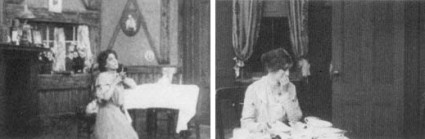
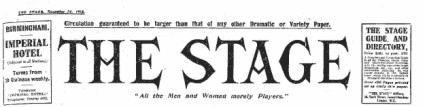
Last week there was much publicity about the discovery of an apparently lost Charlie Chaplin film. Morace Park, of Henham in Essex, purchased a nitrate film from eBay for the princely sum of £3.20 ($5), though he was more interested in the can. When he opened the can he found a reel of nitrate film bearing the title Charlie Chaplin in Zepped. Park could find no record of the film in any Chaplin filmography or biography. The film was a mixture of live action film of Chaplin and animation. Park’s neighbour just happened to be John Dyer, a former member of the British Board of Film Classification, and together they began investigating the history of the film.

They have been thorough in their studies so far, and have determined that the film features unused footage from the Chaplin films The Tramp, His New Profession and A Jitney Elopement. The Independent newspaper, which carries the fullest account of the discovery (including several frame illustrations), describes the film thus:

The unearthed film, called Charlie Chaplin in Zepped, features footage of Zeppelins flying over England during the First World War, as well as some very early stop-motion animation, and unknown outtakes of Chaplin films from three Essanay pictures including The Tramp. These have all been cut together into a six-minute movie that Mr Park describes as “in support of the British First World War effort”. It begins with a logo from Keystone studios, which first signed Chaplin, and there follows a certification from the Egyptian censors dating the projection as being in December 1916. There are outtakes, longer shots and new angles from the films The Tramp, His New Profession and A Jitney Elopement.

The main, animated sequence of the film starts with Chaplin wishing that he could return to England from America and fight with the boys. He is taken on a flight through clouds before landing on a spire in England. The sequence also features a German sausage, from which pops the Kaiser. During the First World War there was some consternation that the actor did not join the war effort.

At first it seemed to those who thought they knew their Chaplin history, and the habits of film collectors, that this was some cobbled-together item by someone who had edited together Chaplin clips with a separate animation film of the 1914-18 period, Chaplin being a regular subject for animators at this time. But then evidence turned up that there had indeed been a film called Zepped, exhibited in Britain in 1916. In 2006 British film historian Mike Hammond had uncovered a reference to the film in a Manchester journal (probably Film Renter), as an article in a Russian online journal reveals (scroll down to note 43 and get an English translation through Babelfish).

zepped_blighty

So what is this peculiar hybrid? The six-minute film is a mixture of Keystone and Essanay titles, plus the animation. Chaplin left Keystone in 1914 to join Essanay, leaving the latter to join Mutual in 1916. Essanay is known to have tried to make the best out of its loss by issuing Triple Trouble (1918), a mish-mash of Chaplin outtakes, but Zepped contains Keystone and Essanay titles, suggesting a still more irregular arrangement. The existence of an Egyptian censors’ certificate only adds to the peculiarity of the whole affair. There seems to be a connection with the accusations made at the time that Chaplin was avoiding his military duty by residing in the United States, though clearly this was an unofficial film and Chaplin had nothing to do with its production.

Chaplin biographer Simon Louvish speculates (in the Independent article) that the film was compiled in Egypt, which was under British occupation at the time. However, no one was making animated films in Egypt in 1916. The access to the outtakes suggests an American source, yet the theme and reference to ‘Blighty’ in the title cards hints at a British source. The frames showing some of the animation (below) look like the crude semi-animated films that British artists such as Lancelot Speed or Dudley Buxton were making at this time. The reference to ‘Made in Germany’ is a British allusion (there were protests at the import of German goods into Britain long before the War), and America was scarcely indulging in anti-German propaganda at this time. I’d point the finger at a British film distributor.

zepped_frames

The film has been transferred to DVD, and Park and Dwyer have been showing it to assorted Chaplin experts. They have also started making a documentary film in America about their voyage of discovery, and you can follow their ‘Lost Film Project’ through Twitter and through a project blog. They seem to be making a good job not only of exploiting the discovery but of seeking to understand it. If it’s not quite ‘THE cinematic find of the last 100 years’ that the blog claims, it’s a real coup – not least for how it has left the experts baffled. We now await anxiously for the results of their researches.

Update (20 November 2009):
The people behind the Zepped discovery have kindly sent me two advertisements for the film plus a press notice, all from the journal Film Renter. Now we learn that the film was made by Screen Plays Co. of Manchester, that it was 1,000 feet long, and that there was some sensitivity over its relationship with Chaplin because the first version of the advert pointedly neglects to mention his name. He is mentioned in the second, however:

Original advertisment from Film Renter, 23 December 1916

Revised advertisement from Film Renter 30 December 1916
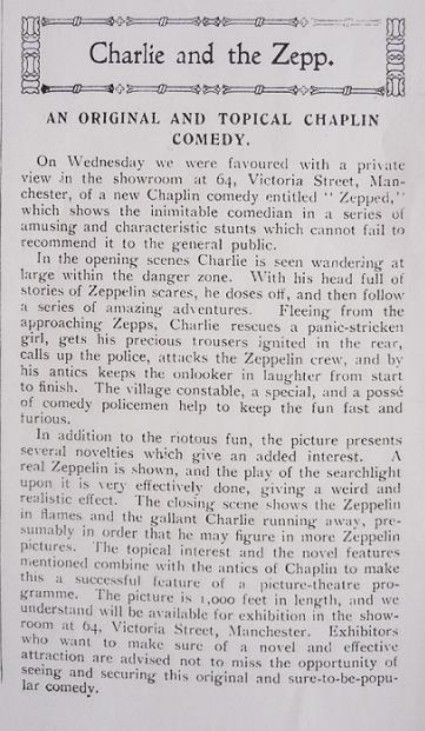
Press notice from Film Renter (date not given)

You can see the documents on the website for the company producing the documentary about Zepped, Clear Champion Ltd.

Another update (11 July 2011):
The latest extraordinary twist in the Zepped saga is that another print of the film has turned up, this time in a second-hand shop in South Shields, UK. This second Zepped is slightly incomplete (opening shots of a Zeppelin are missing, apparently) but otherwise looks to be the same film. It was discovered by one Brian Hann. More information (though with a muddled idea of the film’s history and value) is given in The Shields Gazette and in the comments below.

Brian Hann with the second Zepped, discovered in a South Shields second-hand shop
Keaton and the war

BusterWWI

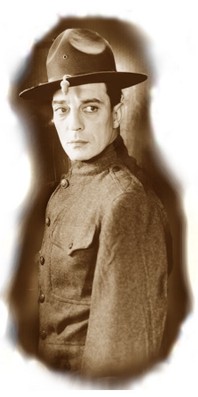
The 17th Annual Buster Keaton Celebration takes place 25-26 September, at Iola, Kansas. Each festival takes an aspect of Keaton’s life or career and explores its contexts, through talks, screenings and special presentations. This year the theme is the First World War, and this is the programme:

Buster Keaton and Company

WWI, Dark Comedy, and Film
The 17th Annual Buster Keaton Celebration

Sept 25-26, 2009, Iola, KS

All activities are held at the Bowlus Fine Arts Center in Iola, Kansas. Free. (donations are very much appreciated– especially this year)

Program subject to change.

Friday, Sept 25, 2009

9:30 am Registration

9:50 am Welcome and Remarks by Susan Raines, Executive Director, Bowlus Fine Arts Center

Emcee Frank Scheide, Prof of Communication, University of Arkansas, Fayetteville

10:00 am — The National WWI Museum, a video segment from the series Sunflower Journeys, produced by KTWU Ch 11, Topeka

10:10 am — Dave Murray
World War I: Causes and Effects

11:00 am — Break

11:10 am — Doran Cart, Curator WWI Museum, Kansas City, MO
Lights, Camera, and Real Action: The U.S. Army Signal Corps Motion Picture and Still Photographers’ Work, 1917-1919

12:00 am — Lunch Break

1:30 pm — John Tibbetts, Ph.D., Professor of Film, University of Kansas
The Worm’s Eye View: A Presentation Concerning the 1919 Film, Yankee Doodle in Berlin

2:20 pm — Lisa K. Stein, Ph.D., Ohio University-Zanesville
Tommy’s New Tune: Warner Brothers’ The Better ‘Ole (1926) and Redefining American Patriotism

3:10 pm — Break

3:25 pm — Screening of The Moving Picture Boys in the Great War (1975), produced by David Shepard
War Story (2001)
Introduced by David Shepard

5:30 pm — Dinner Break

7:30 pm — Evening program
It Happened to You
Shoulder Arms (1918) starring Charlie Chaplin
The Bond (1918) starring Charlie Chaplin
All Night Long (1924) starring Harry Langdon
The Bellboy (1918) starring Fatty Arbuckle and Buster Keaton
Back Stage (1919) starring Fatty Arbuckle and Buster Keaton
with live musical accompaniment by Marvin Faulwell

Saturday, Sept 26, 2009

8:30 am — Registration

9:00 am — Welcome and Remarks by Susan Raines, Executive director, Bowlus Fine Arts Center

Emcee Bill Shaffer, KTWU Ch 11, Topeka

9:20 am — Jim Barkley, Educational Coordinator, WW I Museum, Kansas City, MO
Educational Opportunities at the National WWI Museum

9:40 am — Screening of My Career at the Rear, a documentary by Matha Jett on Buster Keaton’s WWI career

10:00 am — David Macleod, Keaton historian and founder of Blinking Buzzards Society (UK)
Buster and War

10:50 am — Break

11:00 am — Robert Arkus, Film Historian and Archivist
The Liberty Loan Drive, Newsreels and Slapstick
Comics Go to War: Screening of seldom seen footage
plus rare Keaton on video

12:00 — Lunch Break

1:00 pm — Welcome and Introductions

1:10 pm — Leslie Midkiff Debauche, Ph,D., University of Wisconsin — Stevens Point
Buster Keaton Fights the Great War

2:00 pm — Frank Scheide, Ph.D., University of Arkansas, Fayetteville
Charles and Penny Chilton’s Oh What a Lovely War

2:50 pm — Break

3:00 pm — Screening of Yankee Doodle in Berlin (1919), Mack Sennett, with live musical accompaniment by Marvin Faulwell
Introduced by David Shepard

4:00 pm — Break

4:10 pm — Screening of Doughboys (1933) — Buster Keaton Sound Feature

5:35 pm — Dinner Break

7:30 pm — An Evening of Screenings
General Nuisance (1941), Buster Keaton Columbia sound short.
plus short clips and tributes.
Special Presentation, The Last American Surviving WWI Veteran, a 2008 interview with Mr. Frank Buckles by Martha Jett, Documentary Filmmaker and Keaton Biographer.
The Better ‘Ole (1926), starring Syd Chaplin, with live musical accompaniment by Marvin Fauwell

And for those who want to learn more about what Keaton called ‘My Career in the Rear’, Martha R. Jett has written about his personal war experience in ‘Buster Keaton in World War I‘ for http://www.worldwar1.com.

Eloquent gestures

eloquent_gestures

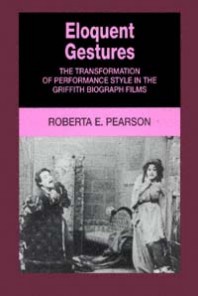
It’s been a while since we added anything new to the Bioscope Library. A new wing has been added to the tottering edifice that is Bioscope Towers, and first on the fresh new set of shelves therein is Roberta E. Pearson’s Eloquent Gestures: The Transformation of Performance Style in the Griffith Biograph Films, published by the University of California Press in 1992. This is one of the titles that the enlightened UCP has made available for free online as one of its eScholarship Editions offerings. It is a model ebook presentation, as well as being one of the most interesting and stimulating books written on the films of David Wark Griffith.

The book’s subject is the changes in the style of the actors’ performances in the films of D.W. Griffith, particularly between 1909 and 1912. Pearson sets this up in a delightful introduction in which she imagines Josiah Evans, “a man with a civic conscience who belongs to several progressive reform organizations”, attending a Broadway storefront picture show in 1909 in which he sees a film entitled The Drunkard’s Reformation, which he rather enjoys because it reminds him of the blood-and-thunder stage melodramas of his youth.

The acting of the young wife as she depicts her misery and desperation particularly affects him. She collapses into her chair and rests her head on her arms, which are extended straight out in front of her on the table. Then, in an agony of despair, she sinks to her knees and prays, her arms fully extended upward at about a forty-five degree angle.

Three years later he visit the Rialto Theatre on 14th Street, a considerably classier venue than that 1909 nickelodeon, and is struck in particular by a film entitled Brutality. It is similar in theme to the earlier film…

… but this moving picture does not remind him of the blood-and-thunder melodramas of his youth. The acting is the equal of Mr. Gillette’s in Sherlock Holmes or even of that in the Belasco play he and Lydia had attended last night. Particularly impressive is the young wife’s despairing reaction to her husband’s harsh treatment and abandonment. After he leaves for the saloon, the wife walks back to the dining-room table covered with the debris of their evening meal. She sits down, bows her head, and begins to collect the dishes. She looks up, compresses her lips, pauses, then begins to gather the dishes once again. Once more she pauses, raises her hand to her mouth, glances down to her side, and slumps a little in her chair. Slumping a little more, she begins to cry. How differently this actress portrays her grief from her counterpart in A Drunkard’s Reformation. A lot has changed in those three-and-a-half years since his first visit to a nickelodeon.

drunkard&brutality

A Drunkard’s Reformation (left) and Brutality, from Eloquent Gestures

How the films of D.W. Griffith moved on from the one style to the next is the subject of Pearson’s book. It traces in meticulous detail the transformation from an acting style inherited from the stage meodramas of an earlier era, to a nuanced style that benefitted from ‘realist’ developments in literature and theatre. It wasn’t there in 1909; it was there in 1912, and by examining closely the films made in that intervening period and being attuned to contemporary cultural developments, the path from the one to the other can be drawn. This is what Pearson does.

It is a very detailed study, one grounded a theoretical language which may not be to everyone’s taste, but the author needs to negotiate the pitfalls that terms such as “naturalism”, “realism” and “melodrama” can lead to. She wants to be precise about the meaning of words which are used all too loosely in general critical discussion (“melodrama” in particular), and to ground what one sees in these films, and what one sees in changing, in a close understanding of what was going on at the time. As she says:

The study of cinematic performance demands that we not depend upon our own aesthetic judgments, which we tacitly deem eternal and unchanging. Rather, we must acknowledge history by attempting to understand the aesthetic standards of another time and place, of a culture very different from our own.

The rest you must read for yourselves, and I warmly recommend that you do so. Though this is very much a thesis turned into a book, with all of the formal argument structures that one recognises (such as having an introduction which rubbishes the opposition), it illuminates understanding – not just of Biograph films, but of any cultural artefact from any period which we may be tempted to interpret from our personal aesthetic experience but which needs to be seen, first and foremost, as the product of its own times.

The ebook presentation is excellent. The book is divided up into hyperlinked chapters, and page breaks are indicated where they occur in the original, which is good for accurate citation. Notes in the text are hyperlinked to a notes section at the end, the index has hyperlinks so you can go directly from term back to the text, and the illustrations are available in small and full size versions. Finally there is a search box enabling to search the entire text of the book. Excellent all round. Into the Bioscope Library it goes.

Strade del cinema 2009

chaplin_strade

http://www.stradedelcinema.it

Apologies for being a little in the day with news of Strade del Cinema, Italy’s less-heralded international festival of silent cinema and music. The festival takes place in Aosta (near Turin), at the Aosta Roman Theatre, and this year runs 6-13 August. The festival is organized by the Strade del Cinema Cultural Association and the City of Aosta, in collaboration with the Turin National Museum of Cinema/Fondazione Maria Adriana Prolo and the support of the UNESCO Italian National Commission. This year’s festival is dedicated to Charlie Chaplin, and is free to all. Its distinctive feature is the emphasis on music by young musicians, participants in the festival’s Young European Musicians Contest.

Here’s the festival programme:

AUGUST 6
ROMAN THEATRE – 21h30
Opening Event in collaboration with AOSTACLASSICA
Tribute to Stanley Kubrick through Gyorgy Ligeti’s music
Orchestra Laboratorio SFOM diected by Mauro Gino

AUGUST 7
ROMAN THEATRE – 21h30
YOUNG EUROPEAN MUSICIANS CONTEST

Retrospective Charlie Chaplin 2

The Fireman, music by Chirichiello e i casi a parte
producer: Charles Chaplin for Lone Star Mutual; director: Charles Chaplin; photography: Frank D. Williams and Roland Totheroh; with: Charles Chaplin, Edna Purviance, Eric Campbell, Lloyd Bacon, Albert Austin; release date: 12 June 1916.

The Vagabond, music by Yati Durant Ensemble
producer: Charles Chaplin for Lone Star Mutual; director: Charles Chaplin; photography: Frank D. Williams; photography assistant: Roland Totheroh; with: Charles Chaplin, Edna Purviance, Eric Campbell, Lloyd Bacon, Albert Austin; release date: 10 July 1916.

AUGUST 8
ROMAN THEATRE – 21h30
YOUNG EUROPEAN MUSICIANS CONTEST

Retrospective Charlie Chaplin 2

The Adventurer, music by Parallelo Dramma
producer: Charles Chaplin for Lone Star Mutual; director: Charles Chaplin; photography: Roland Totheroh; with: Charles Chaplin, Henri Bergman, Edna Purviance, Martha Golden, Eric Campbell; release date: 22 October 1917

The Floorwalker, music by Simone Maggio
producer: Charles Chaplin for Lone Star Mutual; director: Charles Chaplin; photography: Frank D. Williams; photography assistant: Roland Totheroh; with: Charles Chaplin, Eric Campbell, Edna Purviance, Lloyd Bacon, Albert Austin; release date: 15 May 1916

AUGUST 9
ROMAN THEATRE – 19h00
YOUNG EUROPEAN MUSICIANS CONTEST

Retrospective Charlie Chaplin 2

The Tramp, music by Lili Refrain
producer: Jess Robbins for The Essanay Films; director: Charles Chaplin; photography: Henri Ensign; with: Charles Chaplin, Edna Purviance, Fred Goodwins, Lloyd Bacon; release date: 11 April 1915

Shangaied, music by Magus
producer: Jess Robbins for The Essanay Films; director: Charles Chaplin; photography: Henri Ensign; with: Charles Chaplin, Edna Purviance, Wesley Ruggles, Lawrence A. Bowes; release date: 21 June 1915

AUGUST 10
ROMAN THEATRE – 21h30
YOUNG EUROPEAN MUSICIANS CONTEST

Retrospective Charlie Chaplin 2

Easy Street, music by Illya Amar
producer: Charles Chaplin for Lone Star Mutual; director: Charles Chaplin; photography: Roland Totheroh; with: Charles Chaplin, Henri Bergman, Edna Purviance, Albert Austin; release date: 5 February 1917

Work, music by Elia Casu/Antonio Pinna Duo
producer: Jess Robbins for The Essanay Films; director: Charles Chaplin; photography: Henri Ensign; with: Charles Chaplin, Billy Armstrong, Edna Purviance; release date: 21 June 1915

AUGUST 11
ROMAN THEATRE – 21h30
YOUNG EUROPEAN MUSICIANS CONTEST

Retrospective Charlie Chaplin 2

The Pawnshop, music by PanGea Orchestra
producer: Charles Chaplin for Lone Star Mutual; director: Charles Chaplin; photography: Roland Totheroh; with: Charles Chaplin, Henri Bergman, Edna Purviance, John Rand; release date: 2 October 1916

The Rink, music by Federico Missio Movie Kit
producer: Charles Chaplin pour Lone Star Mutual; director: Charles Chaplin; photography: Roland Totheroh; with: Charles Chaplin, Edna Purviance, Eric Campbell, Lloyd Bacon, Albert Austin; release date: 2 October 1916

AUGUST 12
ROMAN THEATRE – 21h30 – EVENTS
IN COLLABORATION WITH THE TURIN NATIONAL MUSEUM OF CINEMA
Events: Tigre Reale (Italy, 1916)

Music by Paolo Angeli, Gavino Murgia and Antonello Salis

Tigre Reale (ITALY, 1916)
director: Giovanni Pastrone; writer : Giovanni Vergada (1873); photography: Giovanni Tomatis, Segundo de Chomón; producer: Itala Film, Turin; original length: 1742 m; copy length: 1600 m ; titles: italian; censor certificate: 11662 du 20/6/1916; release date in Rome: 9/11/1916; preview: Turin, “Salone Ghersi”, July 1916; Rome, 9 november 1916 With: Pina Menichelli (Countess Natka), Alberto Nipoti (Giorgio la Ferita), Febo Mari (Dolsi), Valentina Frascaroli (Erminia), Gabriel Moreau (Count De Rancy), Ernesto Vaser, Enrico Gemelli;
restored copy: 35mm bn col, 1592 mt., 69′ a 20 ft/s

AUGUST 13
ROMAN THEATRE – 21h30 – EVENTS
Events: Safety Last (USA, 1923)

Music by Neil Brand

Safety Last (USA, 1923)
production: Hal Roach pour Hal Roach Studios; director: Fred Newmeyer and Sam Taylor; writers: Hal Roach, Sam Taylor, Tim Whelan; photography: Walter Lundin; artistic direction: Fred Guiol; with: Harold Lloyd, Mildred Davis, Bill Strother, Noah Young, Westcott B. Clarke; release date : 1 April 1923.

More information on the festival website (which seems to tell you a lot about the music but not much about how to get there, where to stay, and so forth).

Sunnyside up

sunnyside

Ah me, too much happening – if only any of it was of any consequence. Anyway, apologies for the service from the Bioscope being a bit on the intermittent side of late, but there’s just time to note the publication this month of Glen David Gold’s novel, Sunnyside. Gold gained fame a few years back with his fantastical novel of warring magicians in the 1920s, Carter Beats the Devil, and he seems to have pulled off a similar trick with Sunnyside, this time by taking as his subject the cinema of roughly the same period.

Sunnyside is, of course, the title of a 1919 Charlie Chaplin film (a minor film where Chaplin experimented with rural comedy but lost his comic touch). The novel sounds like a rich feast, using Chaplin and the American movie industry as the means to illuminate a wildly variegated decade and the encroachment of modernity. Amid multiple storylines (there are three main plot lines, covering Chaplin in Hollywood, another character in the battlefields of France, and a third caught up in the little-known Allied invasion of Russia), real-life and imaginary characters intermingle – among the former, readers will find Mary Pickford, Douglas Fairbanks, Adolph Zukor, film theorist Hugo Munsterberg, Rin Tin Tin, and of course Chaplin. There’s an enticing review of the book from the LA Times which describes Chaplin’s portrayal thus:

Scores of novels have tried and failed to depict movie stars and stardom or genius. Yet here Gold conjures a nuanced character who springs to life. Chaplin comes across as witty, charming, insecure. He dresses with a dandy’s care, suffers depressions and wears a perfume that smells like citrus with “base notes of money.” He woos women and conducts a book-length joust with Pickford, whose air of certainty and business smarts confuses and almost terrifies him. Chaplin’s doubts center on his sense of being not good enough, an uncertainty that he knows he must somehow allow to filter through his art.

“He had the easy capacity for seeing kinetic actions first, then creating character and emotion to fill them up, like ladling sand into a sack. This was too easy — everyone did it,” Gold writes. “Where was the small moment, the flirtatious smile not returned, the cuckold discovering a cuff link and saying nothing, the smile of a baby that somehow chills the bones? That was the hardest way to make things.”

Gold places the center of Chaplin’s ache in his longing for love — and his fear of the same — in his relationships with women. Chaplin’s mother, Hannah, was a music hall singer whose career was ruined and who went mad, leaving the young Chaplin destitute, and the whole Chaplin-arc of “Sunnyside” is aimed at the moment, dreaded and longed-for, when Hannah arrives in Los Angeles. “He could meet her eyes, but only as though they were tapping his fingers against a hot stove. They were still a deep hazel, cloudy and merry, for now,” Gold writes. “It’s okay if you don’t love your mother,” Hannah says, as “Sunnyside” speeds at last toward its conclusion with a sequence of scenes that amaze, startle and move.

As someone who found Carter Beats the Devil hugely disappointing, I shall reserve judgement until I read Sunnyside. But I will have to read it (all 559 pages of it), and the book is certain to do well, and to draw people anew to Chaplin and the richly metaphoric world of silent cinema.

The Stage

thestage

New (at least to me) among the digitised historical journals now available online by subscription is The Stage. This is well worth taking note of. The Stage Directory (A London and Provincial Theatrical Advertiser) was founded in February 1880 as a monthly newspaper, and continues (as a weekly) to this day. Its entire archive 1880-2007 has been digitised and put online, covering over 6,500 issues or above 170,000 individual pages reporting on the goings on of the British stage and beyond.

The importance for us is that The Stage has always kept an eye on the motion picture business, and for the silent era it was assiduous in recording the activities of this new strand of showbusiness. A series of articles from 1907 entitled “Cinematograph Notes” records new businesses, film releases, licensing issues and so forth, “Latest Films” is very handy in giving titles of new releases, and another series “Film Facts & Fancies” starting in 1919, written by ‘Figaro’, reports on the cinema world with a knowing eye.

The Stage documented the engagements of actors, and one can trace their travels across the British provincial theatres, seeing also where the variety shows were starting to introduce the cinematograph. Here one can spot names that were later to be famous: in a notice from 30 July 1903 of a performance of Sherlock Holmes at the London Pavilion, the writer notes:

A faithful portrait of Billy is given by Master Charles Chaplin, who shows considerable ability, and bids fair to develop into a clever and capable actor.

Once can follow Chaplin many performances as Billy, and then later with the Karno troupe, up and down the country, before he found his fortune on the screen.

The Stage Archive is available by subscription. There is a timed pass system, with twenty-four hours’ access costing £5, one week £15, one month £30, three months £60, six months £100 and one year £150. Once you have subscribed, you have options to browse by date, so you can scroll through an entire issue (I recommend this to start with, as it gives you an idea of layout and the contents of the regular sections), or you can search by word (or phrase in quotation marks) across all types of ‘clippings’ (i.e. sections), or by article, picture or advertisement. You can search by the time periods 1880-1900, 1901-1950 or 1914-1918 (and later periods, of course), and can order search results chronologically or by relevance.

Those familiar with digitised newspaper collections will soon recognise that The Stage Archive has been produced by Olive Software‘s ActivePaper system. Search results give you the date and page number of the issue and a snippet of the article itself (usually a headline), which you click on to open up the full article. This can be a little frustrating when you have many search results, as there is little way of telling one article from another (many of the Chaplin notices are simply titled ‘Provinces’, for instance), so it may be a little laborious investigating the more popular subjects. You get the full article in facsimile form, with your search term highlighted, and you can print these or file them away in a ‘My Collection’ facility, but there is no way to get at the underlying OCR text, unfortunately.

If you don’t subscribe, you can still use The Stage Archive to search material, you just won’t have access to the articles themselves. But there is more from The Stage that you can access without paying any subscription. The Stage produced an annual yearbook which for the silent era is another rich source of information, particularly for its directory listing of film associations, its advertisements, and especially its reports on legal cases, always fascinating for the realism they provide behind the tinsel of so much cinema reportage. The Internet Archive has the volumes for 1908-1919. The PDFs are a large size (30-50MB), but don’t forget that they are word-searchable. Look out in particular for Arthur Coles Armstrong’s long article in the 1914 volume, “My Lady Kinema – The Eleventh Muse”. And from the 1916 volume, this report on a court case caught my eye:

ELINOR GLYN v. WESTERN FEATURE FILM CO. AND G. BLACK.- ALLEGED CINEMATOGRAPHIC INFRINGEMENT OF NOVEL.

In the Chancery Division, before Mr. Justice Younger, Mrs. Elinor Glyn, the author of and owner of the copyright in “Three Weeks,” brought an action against the defendants for an injunction restraining the defendants from making or authorising the public exhibition of kinematograph films under the title of Pimple’s Three Weeks (without the option).

The defendants pleaded that their film Pimple’s Three Weeks (without the option) was an original dramatic work within the meaning of the Copyright Act, 1911, and that they were entitled to use their film.

The action against the defendant George Black was settled before the case came into Court.

And the reason it was settled is that the judge decided that Three Weeks was an immoral work, and so did not merit any copyright protection, irrespective of whether a parody could be seen as infringing in the first case.

Plenty to discover, whether paid for or free (and acknowledgments to Bioscope regular Penfold for bringing The Stage Archive to my attention).

Music while they worked

In The Parade’s Gone By, Kevin Brownlow has a short chapter on that intriguing aspect of studio practice in the silent era, the use of musicians on set to help the actors get into the right mood. Not all directors used it, and not all actors needed it, but Conrad Nagel recalled

Every set would have musicians. Mickey Neilan had an orchestra of four, so there was always fun on his set … These musicians would know a hundred to a hundred fifty pieces of music, and they’d have a piece to go with whatever happened on the set. For hundreds of years, when you went to war, the regiment would take a band along. The music would give a great lift to the soldiers. And it was the same on a silent-picture set; the music kept you buoyed up.

Marshall Neilan, King Vidor, William Wellman all approved of the practice; Charlie Chaplin and Edward Sloman never used it. It is such a familiar part of silent film history, and yet how much do we actually know about it, beyond the anecdotal? I received an enquiry from researcher Polly Goodwin the other day about the use of musicians on set, and I realised I knew next to nothing. So, with her permission, I am reproducing her request here, in the hope that readers will be able to suggest texts, films, photographs or whatever. Here’s her email:

I am a researcher into silent film acting and I am currently investigating the phenomenon of on-set music during the filming of (many) silent films. So far, whilst I can find a few mentions of the frequency with which musicians (I believe sometimes called ‘sideliners’?) were invited onto the set, to play whilst the cameras were rolling, accounts tend to be brief and sporadic. There are a few photographs showing them at work, and the odd anecdote from actors and other on-set workers and in contemporary articles, but that is as far as I have been able to go. I wondered if anyone could give me any advice about where I might find more information on this (if, indeed, there is much information to find?) As yet, I have not found any accounts by the musicians themselves, for instance, or (which would be most interesting) by actors/directors etc. really addressing the impact (positive or negative) that this music and those who played it had. I find it such an intriguing situation – acting with the presence of music, and also of the director’s ‘direction’, in many cases, and would love to really get a fuller picture of what this unique acting environment would be like to perform in.

Has anyone come across any information about this, or any evidence in the form of photos, or, even more pie-in-the-sky-optimistically, in any snippets of on-set ‘behind the camera’ footage?

Any advice or suggestions would be more than appreciated.

Well, the Brownlow book is a start – chapter 30 covers the practice, and has two photographs, one of William de Mille with Efrem Zimbalist Jr on set, the other showing Pauline Starke and Conrad Nagel in Edmund Goulding’s Sun-up, with violinist on location. But what else is there?

The legendary intransigence of Mrs Helen Hubbard

fatty_arbuckle

Roscoe ‘Fatty’ Arbuckle, from http://www.time.com

In 1921, after three trials, Roscoe ‘Fatty’ Arbuckle, popular film comedian, was acquitted of the manslaughter of Virginia Rappe at an archetypal wild Hollywood party. The Arbuckle case, because of its lurid features, continues to attract prurient interest, while solid information on what actually happened in what was undoubtedly a key moment in Hollywood history becomes ever harder to find, such is our thirst for conspiracy and lowering tales of human fallibility.

A one-woman mission to unpick fact from fiction is being conducted by Joan Myers (aka Frederica Merrivale), whose investigations into the Arbuckle case and the background of the little-known Rappe, have been highlighted here before. Now she has published a lengthy piece on the New Research in Feminist Media Art/Theory/History blog. Entitled The Case of the Vanishing Juror, it traces the the story behind the first Arbuckle trial (there were three – the first two ended in hung juries, at the third he was acquitted) and the legend that grew up that there was a hung jury at the first trial owing to the intransigence of one stubborn female juror, Mrs Helen Hubbard.

I won’t recount the details here – you should read Joan’s article instead – but essentially she re-examines in depth the newspaper record to recover Mrs Hubbard’s reputation (see this account for an example of how she has been described in the past, supposedly with fingers in her ears during the defence’s case) and to go in pursuit of the ‘missing’ juror (Thomas Kilkenny), because the first trial was hung by a vote of ten to two. Kilkenny was similarly convinced of Arbuckle’s guilt, but he was not subjected to the insinuations about his motives as was Mrs Hubbard. It’s an exemplary piece of work, well grounded in in an understanding of legal procedure (women had only begun serving on juries in California in 1911, and their presence was still controversial for some). Its primary achievement is to make us reject the muddle of myth and innuendo that surrounds the case and makes us yearn for a historiographically rigorous account of the trial (Myers is scathing in her assessment of David Yallop’s The Day the Laughter Stopped, which is considered the standard work on the Arbuckle story). The method has been convincingly displayed – now let’s have the history.

The 13th statue

chaplin_gandhi

Charlie Chaplin meeting Mahatma Gandhi in Britain in 1931

A while ago you may remember there was a news story about a statue being erected to Charlie Chaplin in Kazakhstan. The news reports said that it was the twelfth such statue of Chaplin worldwide, and so the Bioscope put on its reporter’s hat and sought out the other eleven – in London, Vevey, Waterville, Oslo, Shanghai, Mérida, Alassio, Gabrovo, Paris and Los Angeles (two statues). You can read that report and see photographs of eleven of the twelve, but now news emerges of plans for a thirteenth statue – plans that, however, seem fated to come to dust.

It was last week that the Indian press reported that film director Hemanth Hegde was planning to build a 62-feet high statue of Chaplin at Maravanthe beach, Karnataka, some 400km away from Bangalore. The statue was to be built as a backdrop to Hegde’s film House Full, starring Hegde himself, Diganth, Vishaka Singh and Girija Oak. The director was quoted as saying:

We are shooting a song sequence in Maravanthe Beach where this 62-feet statue of Charlie Chaplin is being shown. It will remain a tourist attraction after we finish the film’s shoot …We have applied for recognition from the Guinness Book of World Records. David Brown from the Guinness Book is expected to arrive in India to scrutinise our claim.

The statue was to be built by the film’s art director, Chethan Mundadi, at a cost of 3.5 million rupees, subject to permission from the Karnataka government. Installation was expected to take place on 28 March, and the BBC was reportedly going to film the event.

That was last week. Not long after Hegde has announced his plans, furious objection was made by proestors, said to be members of the radical Hindu Jagarna Vedike group, arguing that the statue of Chaplin should not be built because he was a Christian. The existence of some important Hindu temples near to the proposed site had compounded the sense of insult. They have demanded that the filmmakers instead erect a statue of the 19th-century Hindu missionary Swami Vivekananda.

The row is growing, and has wider political ramifications. Protests have been made by the film and theatre communities, while Hegde has expressed his bemusement and says he is now looking for another site. But, as The Times of London reports, the Hindu Jagarna Vedike protest is part of a wider revolt from ‘extremists’ opposed to Western cultural imports, raning from Valentine’s Day celebrations to cheerleaders and Indian Premier League cricket matches.

Chaplin, an avowed agnostic, would undoubtedly have been very surprised to find himself held up as a symbol of Christianity – indeed, probably no less surpised to learn of a giant statue of himself featuring in a light Bollywood comedy about “two happy-go-lucky youngsters who are always stumbling into new ideas to please their girlfriends”. The Times of India, which puts the blame for the protests on BJP activists, has this to say on the row:

Hindutva brigands attacking a statue of Charlie Chaplin on the grounds that he was a Christian and having his statue close to a temple was offensive to Hindu sentiments may appear too bizzare to be taken seriously. It is indeed ludicrous. But unless such groups are dealt with summarily and the nuisance nipped in the bud, what seems farcical today could become tragically real tomorrow. The state government must show that it will not allow such lumpen activity to go unpunished. It must crack down hard to deter potential imitators of such trends.

Maybe Hegde will be able to build his statue elsewhere, free from local offence. We will keep an eye on developments. Meanwhile, a final word from Jayamala, actress and president of the Karnataka Film Chamber of Commerce:

How can anyone discriminate against an artist on the basis of religion or caste? Chaplin belongs to all.

Indeed.

A tramp’s odyssey

simonlouvish

Having dispatched W.C. Fields, Mack Sennett, Cecil B. De Mille, Laurel and Hardy, and Mae West Simon Louvish has turned his attention to Charlie Chaplin. His latest book, just published, is Chaplin: The Tramp’s Odyssey is a socio-cultural biography of Chaplin, who as the years retreat becomes not so much an entertainer as the story of an entertainer, a twentieth-century everyman. So Louvish gives us Chaplin’s biography though the context of his times, and as metaphor through which to view those times. His interesting device is to name each of the chapters after one of Chaplin’s films, emphasising their biographical quality – The Immigrant, A Film Johnnie, The Adventurer, The Bond, The Gold Rush, City Lights, Limelight, and so on (Carl Davis’ programme of Chaplin films in 2007 arranged the Mutual films with similar biographical purpose). On quick inspection the conceit works well. It’s not a detailed biography (there are many, many nods to David Robinson’s towering Chaplin), but it’s subject is rather the film persona than the man himself. It encourages us to look again at the films for what they say about the man who was so key to his times, and that can only be a good thing.