When the Movies Began…

Kinetoscope

The latest feature to be added to the Who’s Who of Victorian Cinema web site is When the Movies Began. This is a chronology of the world’s film productions and film shows before May 1896. It was originally compiled by Stephen Herbert and published as a booklet by The Projection Box in 1994. This updated and redesigned version incorporates new research, in particular the work of Deac Rossell, and it will be regularly revised and updated. There is also a full introduction and list of references.

Who’s Who of Victorian Cinema is a biographical reference guide to 300 or so people involved in the production of motion pictures before 1901, both behind and in front of the camera. It includes a wealth of supporting resources on the subject of Victorian film (i.e. film during the time of Queen Victoria’s reign), with a growing number of special features, such as When the Movies Began.

The Edison Motion Picture Myth

Thomas Edison W.K-L. Dickson

The latest addition to the Bioscope Library is something of a surprise, since it is a comparatively recent publication to be found on the Internet Archive. It’s Gordon Hendricks’ The Edison Motion Picture Myth (1961), a notable if idiosyncratic contribution to early film history.

Gordon Hendricks was a determinedly independent film historian who was driven to investigate the history of Edison’s development of the motion picture to overturn the “morass of well-embroidered legend” which existed at that time for the beginnings of American film, especially in the biographies of Thomas Edison. Hendricks wanted also to champion his own hero, William Kennedy-Laurie Dickson, Edison’s chief technician on the motion picture project.

The book is a meticulous exploration of the history of the Edison experiments 1888-1894 which led to the Kinetoscope peepshow viewer, the Kineotgraph camera, and the world’s first successful motion picture films. Hendricks made an intensive trawl through the archives at the Edison National Historical Site, overturning myth after myth, and producing solid information which has been gratefully turned to by succeeding film historians, but it has to be said the book is not an easy read. Hendricks aranges his information in tortuous fashion, swamping the reader with bewildering detail. As Charles Musser puts it, “the caustic historiography … verged on the impenetrable”. But Hendricks achieved his aim, and Dickson’s pre-eminent role as the inventor of motion pictures is widely accepted by historians (though some challenge the focus on personalities in considering the business of ‘invention’).

If that description of the book doesn’t quite whet the appetite of the non-specialist, there are several good sources online for finding out more about Edison, Dickson, and the invention of American film.

The Who’s Who of Victorian Cinema site has biographies of Thomas Edison and W.K-L. Dickson as well as a wealth of associated information.

The Edison National Historic Site has extensive information on all parts of Edison career. The Edisonia section has information on the archives, sound clips, Kinetoscope films, a large number of photographs, and a listing of all 1,093 of Edison’s patents.

The Library of Congress’ American Memory site has a section, Inventing Entertainment, with a large number of early Edison films and sound recordings all freely available for viewing and downloading. See such classics as Dickson Greeting (1891, arguably the first film ever made, illustrated below), Edison Kinetoscopic Record of a Sneeze (1894), Corbett and Courtney Before the Kinetograph (1894) and The Execution of Mary, Queen of Scots (1895).

Dickson Greeting

The Thomas A. Edison Papers is one of the great research resources on the net. The project they are undertaking is to edit over five million documents. The online edition has 180,000 document images and a searchable database of 121,000 documents and 19,250 names. The seaching mechanism is a bit on the elaborate side, but it’s more than worth it – for example, take a look at over 300 letters written between Edison and Dickson.

And if you don’t like all this revisionist stuff, why not visit the Edison Birthplace Museum, and be reassured that Edison invented it all.

Finally, the book to read is Charles Musser’s filmography de luxe, Edison Motion Pictures, 1890-1900 (1997).

Gordon Hendricks also wrote Beginnings of the Biograph (1964) The Kinetoscope (1966) and Eadweard Muybridge (1975), all of them rich in reliable, painstakingly uncovered evidence. The Edison Motion Picture Myth is available to download from the Internet Archive (note the mispelling of ‘Edison’ in the title, by the way) in DjVu (13MB), PDF (16MB) and TXT (589KB) formats.

Doug and Buster

The programme for the 15th Annual Buster Keaton Celebration has been announced, held as always at Iola, Kansas, 28-29 September. This year the theme is Buster Keaton & Douglas Fairbanks: “Disciples” of Teddy Rooseveldt’s Philosophy for Pursuing the Physically Strenuous Life, which sounds bracing. The full programme is on the festival site, but the main features are Keaton’s The Love Nest (1923), The Saphead (1920, which happens to be a remake of Fairbanks’ first film, The Lamb), Mooching through Georgia (1939, a Keaton sound short) and Fairbanks’ The Mystery of the Leaping Fish (1916), Down to Earth (1917), The Black Pirate (1926), and When the Clouds Roll By (1919). Music accompaniment will be by the Mont Alto Motion Picture Orchestra.

Buster Keaton

Buster Keaton

There are numerous websites out there dedicated to the leading stars of the silent era, but probably none is better than www.busterkeaton.com, the site of the Damfinos, the International Buster Keaton Society (The ‘Damfino’ is the name of Buster’s vessel in his 1921 short The Boat).

It is a beautifully-designed site, which is not only richly informative but filled with the look and spirit of Keaton’s work. There is news, a detailed biography, a filmography with thorough credits and synopses, a guide to books on Keaton, memorabilia for sale, and a discussion forum. There are also articles, both commissioned and reprints, again gorgeously designed (by Victoria Saint-Claire), which show the richness of Keaton studies. There is much to discover, not only about his films, but about his background in vaudeville, his family life, and in the lives of those who worked with him. And there’s a ‘step back in time’ feature which tells you what Keaton and his family were doing 100 years ago.

Of all the great comedians of the silent era, it is Keaton’s reputation that is currently at the highest. He is sometimes unfairly compared to Chaplin, to the latter’s detriment, when each worked to significantly different ends. Chaplin was the great symbol of his times, the downtrodden everyman who spoke (silently) to anyone in the cinema audience, done down by the system but aware of his individuality and the power that that represented. Keaton was the supreme ironist, in gesture, action and theme. We see our modern selves in him, battling against the indignities of an absurd world. In Chaplin we see what is past; in Keaton what endures.

Borderline

Borderline

http://www.bfi.org.uk

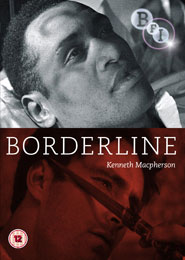
Those good people at the British Film Institute have just released a DVD of Borderline (1930). This little-known British avant garde silent (now’s there’s an unusual combination of words) was made by the POOL collective of intellectuals, including Kenneth Macpherson (the film’s director), Winifred Bryher, the poet H.D. (Hilda Doolittle), and Robert Herring, who were also behind the influential film journal Close-up. But what is most interesting to us now about Borderline is that it stars Paul Robeson, who had just moved to Britain and would later star in several British films in the 1930s. The story revolves around an inter-racial love triangle, made up Robeson’s wife Eslanda, Gavin Arthur and H.D., but it is experimental method attempting to denote states of mind which is so distinctive. As Michael Brooke says in Sight and Sound:

Much of the film is invested with an often inexplicable tension, with regular explosions into rapidly cut torrents of images that reach a frenzy during the more emotionally charged scenes. But it also has quiter, lyrical moments, mostly invoving Robeson, shot from below against Swiss skies and lit as though sculpted in bronze. Whether the film ultimately ‘works’ depends on one’s individual perception, but it’s certainly a unique historical oddity.

Which is sort of how I remember it from a viewing many years ago now. The BFI release has a score by Courtney Pine, background documentaries on Macpherson and co., and booklet.

Borderline also turns up on a four-disc Robeson set from Criterion, released in America. Paul Robeson: Portraits of the Artist features Oscar Micheaux’s Body and Soul (1924), Borderline (which uses the BFI print and Courtney Pine score), The Emperor Jones (1933), Sanders of the River (1935), Jericho (1937), my great favourite among his films The Proud Valley (1940), and Native Land (1942). There are also clips from Big Fella, King Solomon’s Mines and Song of Freedom.

Searching for Albert Kahn

Albert Kahn

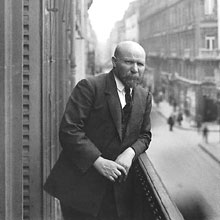
Albert Kahn, from http://www.ejumpcut.org © Albert Kahn Museum – Département of Hauts-de-Seine

A lot of people are coming to this blog in search of information on Albert Kahn, following the BBC4 series The Wonderful World of Albert Kahn. The Kahn collection is best known for its still photographs, which largely lie outside the concerns of The Bioscope, but he did employ motion picture cameramen too (as well as acquiring film from other collections), so here’s a short account of his Archives de la Planète, and some pointers on where to find out more.

Albert Kahn was a millionaire Parisian banker and philanthropist who decided to use his fortune to document the world in photographs. Between 1908 and 1931 he sent out still photographers and motion picture cameramen to create a photographic record of the globe. The project was supervised by geographer Jean Brunhes, who employed around eleven cameramen who visited forty-eight countries and brought back 72,000 Autochrome colour plates, 4,000 steroscopic views, and 600,000 feet of film. They also acquired film from commercial companies, including newsreels and scientific films. Kahn called the project the Archives de la Planète. Kahn lost his money in the Depression, bringing an end to the project, but the collection survived. It has remained remarkably little known, particularly the film component, but a steady trickle of academic interest in recent years has now been followed by the success of the BBC4 series, which has rightly startled people with the beauty of the images and the sheer extent of what they recorded.

Most of the film collection is in the form of unedited rushes of actuality subjects: everything from film taken in Mongolia in 1912-13, to the signing of the Briand-Kellogg Pact in 1928, A.J. Balfour visiting Zionist colonies in Palestine in 1925, fisheries in Newfoundland in 1922, and dancers in Cambodia in 1921. Kahn’s cameramen included Stephane Passet, Lucien Le Saint, Léon Busy, Frédéric Gadmer, Camille Sauvageot and Roger Dumas.

There is an informative and thoughtful article by Teresa Castro, ‘Les Archives de la Planète: A cinematographic atlas’, which is a good place to start, and has some beautiful Autochrome illustrations.

There is no Les Archives de la Planète or Albert Kahn website with a collection of the images on show (update: the BBC has now created www.albertkahn.co.uk). The Hauts-de-Seine.net site has some pages on the Musée Albert Kahn giving basic information and access details, in French. [Another update: the link is now www.albert-kahn.fr]

The Museum is located in the Paris suburb of Boulogne-Billancourt, and is renowned for its beautiful gardens. There is a plain official web page describing these, but you are better off reading the evocative New York Times article, ‘Philosophy in Bloom’, by Jacqueline McGrath, which describes a visit to the gardens (which are apparently not to easy to find).

World War I autochrome

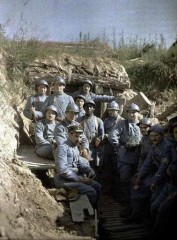
Autochrome of French troops during First World War, from http://www.worldwaronecolorphotos.com

If you are entranced by Autochromes, there are several good sites to visit. This year (2007) sees the centenary of the Autochrome, recognised by www.autochrome.com [link now dead]. The highly recommended Luminous Lint photography site has an explanation of the ingenious Autochrome photographic process, involving the use of dyed potato starch grains acting as colour filters, which helped give them their particular ‘impressionist’ effect.

The site World War I Color Photos has some astonishing images from a conflict we generally only imagine in monochrome. Australian and French First World War Autochromes are reproduced on the Captured in Colour site (which also displays the Paget plate colour system). And there are more First World War Autochromes on the Heritage of the Great War site (though do note this site mixes these up with other coloured images, including artifically-coloured postcards).

The Library of Congress has a page on the restoration of Autochromes. There is an exhibition of the expressive Autochrome work of Gabriel Veyre at www.gabrielveyre-collection.org (Veyre did not work for Kahn but was previously a film cameraman with the Lumière brothers, inventors of the Autochrome). George Eastman House has an online exhibit of eighty Autochromes from the Charles Zoller collection, reproduced in high resolution. The Galerie-Photo site has an exhibition of Autochromes (originally stereoscopic i.e. 3D), with some interesting technical observations.

American academic Paula Amad has written “Cinema’s ‘sanctuary’: From pre-documentary to documentary film in Albert Kahn’s Archives de la Planète (1908-1931)” for the journal Film History, the best single source for information on Kahn’s project, and is writing a book on the collection.

The site www.autochrome.org [link now dead] doesn’t have that much information, but it does tell you in detail how to make your own Autochromes the original way (it’s not easy). If you don’t want to try the original potato starch method, why not use Photoshop? PhotoshopSupport.com will show you how.

Pioneering scientific filmmaker Dr Jean Comandon was one of those who worked for Kahn, late on in the project, as the Institut Pasteur explains (in French).

Definitely the book on Autochromes to buy is John Wood’s The Art of the Autochrome. There will be no more beautiful title on your bookshelves.

Lastly, look out for the National Media Museum’s forthcoming exhibition The Dawn of Colour: Celebrating the Centenary of the Autochrome, which opens on May 25th.

Update (April 2008): The BBC has now produced an Albert Kahn website, www.albertkahn.co.uk, which has information on Kahn, the autochromes and the Albert Kahn museum, as well as promoting the new BBC book The Wonderful World of Albert Kahn: Colour Photographs from a Lost Age. No plans have been announced for a DVD release of the BBC series, presumably owing to licensing issues. However, the Kahn museum section of the new BBC site refers to some DVDs, without going into further details. It has been rumoured that the museum was planning to produce some DVDs of its own, showcasing its Autochrome colour photographs (and its films?). This may be a reference to these, which do not seem to have been published as yet.

Another update (March 2009): There are faint rumours of a possible DVD release, in some form. However, the original The Wonderful World of Albert Kahn series is now available on DVD from the BBC, but only from its educational service, BBC Active, where it is priced at an eye-watering £1,125 for 9x50mins DVDs – the intended market is institutions only. This existence (and price) of this would suggest that any subsequent commercial release to the public will be highlights in some form.

And another update (September 2009): There is now a proper website for the Musée Albert Kahn, at www.albert-kahn.fr. It’s all in French, but includes several examples of the autochromes, photographs of the museum and gardens, a biography of Kahn, and news of exhibitions etc.

Final (?) update (September 2009)
Good news – the BBC has brought out the series on DVD. The Wonderful World of Albert Kahn is a 3-disc set (PAL, region 2), divided into nine parts, running 462mins. It’s released by 2 entertain, which is part-owned by BBC Worldwide.

More Ancestors on Board

Ancestors on Board

As reported in an earlier post, an important new research resource was published this year by the UK’s National Archives and findmypast.com. Ancestors on Board will eventually become a record of everyone who sailed out of a British port (including all Ireland to 1921) on long-distance voyages from 1890 to 1960, taken from the records of the Board of Trade. The first tranche of data released covered 1890-1899; now the site covers 1900-1919 as well. So now there are even more opportunities for historians of silent cinema to track the to and from of actors, filmmakers and executives going to America from Britain. You can find young hopefuls Charles Chaplin and Stanley Jefferson (soon to be Stan Laurel) sailing out in 1912 with the Fred Karno troupe, future Hollywood mogul Samuel Goldfish (later Goldwyn) hoping to find his fortune in 1899, and D.W. Griffith and Billy Bitzer returning to America in 1917 after filming scenes for Hearts of the World in Britain. The name search is free, but there is a charge for viewing images of the ships’ lists or transcripts.

Visiting the Volta

Volta then and now

I’m back from few days in Dublin, and naturally I paid a visit to 45 Mary Street. Why so? Because it was here in December 1909 that Dublin’s, indeed Ireland’s, first cinema was situated, manager one James Joyce. The author of Ulysses‘s contribution to literature is rather more considerable than his contribution to cinema history, but it is nevertheless a diverting tale.

Joyce was living in Trieste, Italy, and ever on the look-out for money-making schemes, when he fell in with a group of businessmen who ran a group of cinemas in Trieste and Bucharest, and teasingly told them that he knew of a city of half a million inhabitants without a single cinema. This was Dublin, of course, which had had plenty of film exhibitions before 1909, but no dedicated venue for film up to that date. A contract was signed between them in October 1909, and Joyce was sent over to Dublin to prepare things. He found a suitable venue at 45 Mary Street, off Sackville Street, and spent the next two months preparing what was named the Volta Cinematograph. He hired the staff, oversaw the fitting out of the venue, and heavily promoted the coming attraction with sandwich board men, press notices and the like.

The Volta opened on 20 December 1909, with this programme (correct original language titles and credits in brackets):

  • The Bewitched Castle (possibly Le Chateau Hanté, Pathé 1909)
  • The First Paris Orphanage (possibly La Première Pierre d’un Asile pour Orphelins, Pathé 1908)
  • Beatrice Cenci (probably Beatrice Cenci, Cines 1909)
  • Devilled Crab (possibly Cretinetti ha ingoiato un gambero, Itala 1909)
  • La Pouponnière (Une Pouponnière à Paris, Éclair 1909)

The Volta seated about 600-700 (200 kitchen chairs were at the front for those paying the top prices). It was a simple shop conversion i.e. no racking, and only the plainest of comforts. Doors opened at 5.00 pm and there were continuous 35 to 40-minute programmes every hour up to 10.00 pm. One extraordinary feature was that the titles of the films were all in Italian – Joyce received the films direct from the Trieste source rather than through English film exchanges, and so handbills were given out with English translations. Music was supplied by a small string orchestra, led by Reginald Morgan. Tickets were 2d, 4d and 6d, children half price.

Joyce did not stick around for long, leaving the cinema in the hands of one Francesco Novak, while he went back to Trieste on 2 January 1910. So his involvement in the actual running, and programming, of the cinema was minimal, though he did remain in touch with the business for a few months as it staggered along, hampered by poor presentation, competing attractions, and undoubtedly a paucity of American films. The business was sold at a loss to the British company Pronvincial Cinema Theatres in June 1910, and continued as a cinema (known for a while as the Lyceum, before it became the Volta once more) until 1948.

There has been quite a bit of interest among some academics in Joyce’s association with the Volta, as reported in an earlier post. This centres on the degree to which Joyce’s “choice” of films might be reflected in his writings (unlikely – he had little to do with the selection of films, which were simply the titles generally available at the time) and how much the idea of cinema itself can be found in his art (a stronger line of enquiry – he was always an enthusiastic filmgoer). As you will see from the photographs, the Volta has not fared as well as some of Dublin buildings associated with Joyce. The site is now part of Penney’s department store, and is not recognisable as having once been a cinema with a unique literary association.

There is a new book, An A to Zed of All Old Dublin Cinemas, collated and self-published by George Kearns and Patrick Maguire. It is mostly a collection of contemporay clippings and photographs, and has useful information on the Volta, including two photographs that I’ve not seen before, both from the 1940s, as is the left-hand image above. Sadly, no photograph of the Volta from the time when Joyce was there is known to survive.

But why not go along for yourself this June? Bloomsday (16th June, the day on which Ulysses is set) is always celebrated with a range of events, and this year these include a tour of Dublin cinema sites, including the Volta, led by Marc Zimmerman, author of another (forthcoming) book on Dublin cinemas. Here the blurb from the James Joyce Centre site:

JOYCE’S VOLTA CINEMA & BEYOND – A GUIDED WALKING TOUR

Start: James Joyce Centre, 35 North Great George’s Street
Duration: ca. 90 minutes
Finish: Irish Film Institute/Cinema, 6 Eustace Street

Tour: This tour visits James Joyce’s Volta cinema (opened 1909 as Ireland’s very first dedicated picture house) as well as a further 15 historic cinemas in Dublin’s city centre ranging from early conversions of Georgian buildings to lavish Art Deco venues, giving a detailed account of their cultural history, architecture and significance. The tour will be illustrated with numerous historic and interior photographs.

Guide: Marc Zimmermann is a building conservation engineer and the author of The History of Dublin Cinemas (book out in May and avail. during the tour). He founded the Cinema Heritage Group in 2006 and issues a free e-newsletter, The Cinematograph [subscribe from: NOSPAMheritage_events@yahoo.com]

Date: 14th June 2007 & 17th June 2007
Time: 7.00pm (14/6) & 2.00pm (17/6)
Venue: James Joyce Centre, 35 North Great George’s Street
Tickets: €10 / €8conc.
Advanced booking advised

There are other Joycean film-related events taking place.

Muy Blog

Eadweard Muybridge

It is a disappointment that there is no single good source on the web for Eadweard Muybridge, the founding father of the moving image. There are interesting sites offering animations of his photographic sequences, but nothing comprehensive or in-depth about the man.

This looks likely to change with some of the work being put up in test fashion by Stephen Herbert. The Bioscope has already reported on the Muybridge Chronology that he has created. He has now followed this with a proto-blog of discoveries in Muybridge research, Muy Blog. It’s just a basic web page at the moment, though with gorgeous illustrations, but will undoubtedly develop further. He has also published a Muybridge Timeline, which puts the man’s achievements alongside technological and photographic events of the day, as well as world events. Finally, there’s a page of Muybridge Links. It’s all work-in-progress, but important work, and more is promised.