Pen and pictures no. 5 – John Buchan

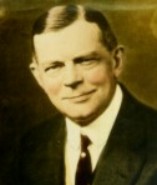
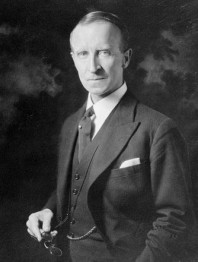
For the next in our series of literary figures who became involved in their various ways with silent films, we turn to John Buchan, 1st Baron Tweedsmuir (1875-1940). Assorted films and television programmes have of course been made of Buchan’s popular novels, in particular The Thirty-Nine Steps, but it is not the adaptation of Buchan’s work that interest us here (almost all of which come after the silent era), but rather his probably unique contribution to film production – unique, that is, for a novelist. For during the First World War Buchan served as the head of the Department of Information, with responsibility for British propaganda, and consequently was the person ultimately responsible, at least for a time, for British official films of the war.

Though these things are partly a question of much contested definition, it is generally held that the arts of state propaganda, through use of the mass media, were established during the First World War, and that the British were the masters of those arts. Certainly the British were quick off the mark, seting up the covert War Propaganda Bureau under MP Charles Masterman within days of the outbreak of war. One of Masterman’s first acts was to invite a number of Britain’s leading authors to Wellington House (the Bureau’s London headquarters) to discuss how they could use their arts secretly (i.e. without anyone knowing that they were being guided by the government) to promote British interests. Those invited to the meeting on 2 September 1914 included Thomas Hardy, Arnold Bennett, G.K. Chesterton, Arthur Conan Doyle, Rudyard Kipling (who was unable to attend), H.G. Wells, John Galsworthy and J.M. Barrie.

The War Propaganda Bureau wanted to use the literary intelligensia for all the influence on hearts and minds that they could command, but Masterman was also interested in using film to target other audiences, and commissioned Charles Urban to produce a documentary feature, Britain Prepared (1915), which was exhibited around the world.

John Buchan was not yet of sufficient literary eminence to be named among Masterman’s greats, but he had political experience, having served as private secretary to Alfred Milner, the High Commissioner for South Africa. His African adventure novel, Prester John (1910), enjoyed great popularity, and The Thirty Nine Steps in 1915 made him famous. Buchan was increasingly courted by the British authorities, leading delegations and delivering lectures on behalf of the Foreign Office and the War Office. Meanwhile, the somewhat elitist approach of the War Propaganda Bureau was coming under increasing internal criticism (the public knew nothing of its existence). Buchan’s former mentor recommended Buchan to the new Prime Minister, David Lloyd George, and after Buchan had written a memorandum on propaganda for the cabinet in January 1917, a new Department of Information (DOI) was set up, with Buchan as its head.

British propaganda policy had originally targeted neutral nations, particularly America, with the hope that America might join Britain as combatant. Not long after Buchan took over, America did indeed join the war, but the need for a propaganda policy was felt all the more, now to persuade America of Britain’s contribution to the fighting, while seeking to keep a war-weary home audience convinced of the necessity of the struggle. Film had become an increasingly important aspect of this work, particularly as the emphasis shifted from convincing influential elites to persuading the masses.

Buchan was therefore in charge when an official newsreel was established, the War Office Official Topical Budget, a wide variety of actuality, documentary and instructional films were produced and distributed around the world (including the feature-length documentaries The Battle of the Ancre and The Battle of Arras), and production started on the fiction epic Hearts of the World, directed by D.W. Griffith. This was bold and committed policy, a world away from the general suspicion – if not contempt – that most of those in authority felt towards film (and its lowly audiences) at the start of the war. However, the DOI Cinematograph department battled throughout 1917 with the War Office Cinematograph Committee (WOCC), which produced most of the films, for overall control. The WOCC was run by Max Aitken, soon to be Lord Beaverbrook, who ultimately had greater political clout than Buchan. He took charge of British propaganda when he became head of a new Ministry of Information early in 1918, for the first time unifying the various conflicting strands of British war information policy (including film). Buchan became Director of Intelligence under him.

Buchan therefore had a strategic eye over film as a part of propaganda policy in 1917, but Beaverbrook (later to be a notorious newspaper magnate) was closer to the actual production of films, and ultimately did more with them. Nevertheless Buchan recognised the necessity and the potential effectiveness of film as a medium of persuasion. But, like most of his class, he found the medium had its ridiculous side. This sense of the absurd comes out in the Richard Hannay novel (Hannay is the hero of The Thirty-Nine Steps) that Buchan published in 1919, Mr Standfast.

In the novel, Hannay is being pursued and is running across Yorkshire moorlands when he stumbles across a peculiar scene, which gives us some insight into Buchan’s view of the industry with which he had to tangle:

Suddenly from just in front of me came a familiar sound. It was the roar of guns – the slam of field-batteries and the boom of small howitzers. I wondered if I had gone off my head. As I plodded on the rattle of machine-guns was added, and over the ridge before me I saw the dust and fumes of bursting shells. I concluded that I was not mad, and that therefore the Germans must have landed. I crawled up the last slope, quite forgetting the pursuit behind me.

And then I’m blessed if I did not look down on a veritable battle.

There were two sets of trenches with barbed wire and all the fixings, one set filled with troops and the other empty. On these latter shells were bursting, but there was no sign of life in them. In the other lines there seemed the better part of two brigades, and the first trench was stiff with bayonets. My first thought was that Home Forces had gone dotty, for this kind of show could have no sort of training value. And then I saw other things – cameras and camera-men on platforms on the flanks, and men with megaphones behind them on wooden scaffoldings. One of the megaphones was going full blast all the time.

I saw the meaning of the performance at last. Some movie-merchant had got a graft with the Government, and troops had been turned out to make a war film. It occurred to me that if I were mixed up in that push I might get the cover I was looking for. I scurried down the hill to the nearest camera-man.

As I ran, the first wave of troops went over the top. They did it uncommon well, for they entered into the spirit of the thing, and went over with grim faces and that slow, purposeful lope that I had seen in my own fellows at Arras. Smoke grenades burst among them, and now and then some resourceful mountebank would roll over. Altogether it was about the best show I have ever seen. The cameras clicked, the guns banged, a background of boy scouts applauded, and the dust rose in billows to the sky.

But all the same something was wrong. I could imagine that this kind of business took a good deal of planning from the point of view of the movie-merchant, for his purpose was not the same as that of the officer in command. You know how a photographer finicks about and is dissatisfied with a pose that seems all right to his sitter. I should have thought the spectacle enough to get any cinema audience off their feet, but the man on the scaffolding near me judged differently. He made his megaphone like the swan-song of a dying buffalo. He wanted to change something and didn’t know how to do it. He hopped on one leg; he took the megaphone from his mouth to curse; he waved it like a banner and yelled at some opposite number on the other flank. And then his patience forsook him and he skipped down the ladder, dropping his megaphone, past the camera-men, on to the battlefield.

That was his undoing. He got in the way of the second wave and was swallowed up like a leaf in a torrent. For a moment I saw a red face and a loud-checked suit, and the rest was silence. He was carried on over the hill, or rolled into an enemy trench, but anyhow he was lost to my ken.

I bagged his megaphone and hopped up the steps to the platform. At last I saw a chance of first-class cover, for with Archie’s coat and cap I made a very good appearance as a movie-merchant. Two waves had gone over the top, and the cinema-men, working like beavers, had filmed the lot. But there was still a fair amount of troops to play with, and I determined to tangle up that outfit so that the fellows who were after me would have better things to think about.

My advantage was that I knew how to command men. I could see that my opposite number with the megaphone was helpless, for the mistake which had swept my man into a shell-hole had reduced him to impotence. The troops seemed to be mainly in charge of N.C.O.s (I could imagine that the officers would try to shirk this business), and an N.C.O. is the most literal creature on earth. So with my megaphone I proceeded to change the battle order.

I brought up the third wave to the front trenches. In about three minutes the men had recognized the professional touch and were moving smartly to my orders. They thought it was part of the show, and the obedient cameras clicked at everything that came into their orbit. My aim was to deploy the troops on too narrow a front so that they were bound to fan outward, and I had to be quick about it, for I didn’t know when the hapless movie-merchant might be retrieved from the battle-field and dispute my authority.

It takes a long time to straighten a thing out, but it does not take long to tangle it, especially when the thing is so delicate as disciplined troops. In about eight minutes I had produced chaos. The flanks spread out, in spite of all the shepherding of the N.C.O.s, and the fringe engulfed the photographers. The cameras on their platforms went down like ninepins. It was solemn to see the startled face of a photographer, taken unawares, supplicating the purposeful infantry, before he was swept off his feet into speechlessness.

It was no place for me to linger in, so I chucked away the megaphone and got mixed up with the tail of the third wave. I was swept on and came to anchor in the enemy trenches, where I found, as I expected, my profane and breathless predecessor, the movie-merchant. I had nothing to say to him, so I stuck to the trench till it ended against the slope of the hill.

It is gentle mockery, and there’s a degree of sympathy for the filmmaking process, in that Hannay thinks that the scenes will impress their target audience, but also a touch of naivety in how he believes the director could so easily lose control of his own film. Was Buchan thinking of any director in particular? Griffith hardly seems to be the target, but maybe there is an element of Herbert Brenon, who late in 1917 (during Buchan’s time with the DOI) began filming another officially-backed but ill-fated feature-length fiction film, which was to have been called Victory and Peace (it was unfinished at the end of the war and was never exhibited). It was filmed in Chester with British troops used to portray Germans (the scenario was provided by Hall Caine, a once famous and now unreadable author, who was one of those invited to Masterman’s meeting on 2 September 1914). But I doubt that Brenon ever wore a loud-checked suit.

Buchan had some connection with the film business after the war, joining the board of British Instructional Films in 1925, and contributing to the script of one of the company’s acclaimed semi-documentary recreations of events from the war, The Battles of the Coronel and Falkland Islands (1927), directed by Walter Summers. His novel Huntingtower was filmed by George Pearson in 1928 (Prester John had been filmed in South Africa by African Film Productions in 1920).

Buchan could be argued to have had the greatest influence over film production of any author during the silent era, albeit for a year only. His political role in overseeing British official film production as an integral part of British propaganda policy had little connection with his fiction, but he treated the medium with greater respect than the comedy of the Mr Standfast scene might suggest. Nevertheless, the passage shows how Buchan intellectually remained at a remove from this popular, peculiar new medium, and it was Beaverbrook who showed the greater instinctive feeling for film, its audiences, and for the political arts of propaganda in general.

BFI on YouTube

The Bioscope has reported on the BFI’s You Tube channel before now, but this just to alert you to the fact that they have been adding many more videos to the site, a good number of them silent. There are currently 177 videos, and there isn’t time or space enough to point out all of the gems that lie therein. So I’m just going to point you to three, and then urge you to go explore for yourselves.

To start with, here’s an odd little newsreel story from 1921 which I first showed at the National Film Theatre in 1992 (ah, memories):

The peculiar event on show is the Eton Wall Game, filmed by the Topical Budget newsreel. This sport, which only the British public school system could have produced, involves the schoolboys piling up into a scrum and trying to push a ball along the wall. If they get it to the end of a wall it’s a goal, but in the traditional St Andrew’s Day game there hasn’t been a goal scored since 1909. What is of interest here is that one of the boys taking part was Eric Blair – yes, the future George Orwell is somewhere in the pile of boys, and despite many people having stared very closely at the film over the past sixteen years, no one has spotted him as yet. So now it’s your turn.

This next gem is called Old London Street Scenes. That’s what we call a supplied title in the trade. It wasn’t called that originally, someone gave it the quaint title later:

This is a piece of footage which has been shown countless times on television because of its spectacular closing shots of London traffic. It demonstrates how a fixed camera single shot of ordinary human life can nevertheless astonish. Look out in particular for the epoch-making moment when a motor car appears among the horse-drawn carriages. It dates from 1903 (we know this because of some of the London shows seen advertised on posters on the passing vehicles). The likely production company is Walturdaw.

Finally, some more sport:

This is part of the extraordinary Mitchell & Kenyon collection of Edwardian era films. Having presumably sold all of the DVDs that they are probably likely to sell of this collection, the BFI has put up quite a selection on the YouTube site. This cricket film has been given the supplied title Arthur Mold Bowling to A.N. Hornby, and was made in 1901. As the DVD commentary (courtesy of Adrian Chiles) explains, there had been a huge controversy at the time when Lancashire’s Arthur Mold was accused of having a dodgy bowling action; that is, throwing (apologies for American readers who may not appreciate how profoundly shocking this to any cricket follower). So he appeared before the cameras demonstrating his bowling style, so that viewers could judge for themselves how legitimate he was. Compared to, say Muttiah Mulitharan, you may wonder what the fuss was about (a bit sideways on, maybe, but hardly chucking). Or, for poetry lovers among you, note simply that the batsman in the nets with Mold is A.N. Hornby, subject of a famous set of lines by Francis Thompson (the poem is called ‘At Lord’s’), recalling the cricket of his youth (when, of course, the game was always better):

For the field is full of shades as I near a shadowy coast,
And a ghostly batsman plays to the bowling of a ghost,
And I look through my tears on a soundless-clapping host
As the run stealers flicker to and fro,
To and fro:
O my Hornby and my Barlow long ago!

On which wistful note, let me just recommend once again the BFI’s YouTube site (not all silents, not all non-fiction, by the way), and look out for further posts on the stories behind one or two of the videos to be found there, in due course.

The Silent Film Bookshelf

The Silent Film Bookshelf was started by David Pierce in October 1996 with the noble intention of providing a monthly curated selection of original documents on the silent era (predominantly American cinema), each on a particular theme. It ended in June 1999, much to the regret to all who had come to treasure its monthly offerings of knowledgeably selected and intelligently presented transcripts. The effort was clearly a Herculean one, and could not be sustained forever, but happily Pierce chose to keep the site active, and there it still stands nine years later, undeniably a web design relic but an exceptional reference resource. Its dedication to reproducing key documents helped inspire the Library section of this site, and it is a lesson to us all in supporting and respecting the Web as an information resource.

Below is a guide to the monthly releases (as I guess you’d call them), with short descriptions.

October 1996 – Orchestral Accompaniment in the 1920s
Informative pieces from Hugo Riesenfeld, musical director of the Rialto, Rivoli and Critierion Theaters in Manhattan, and Erno Rapee, conductor at the Capitol Theater, Manhattan.

November 1996 – Salaries of Silent Film Actors
Articles with plenty of multi-nought figures from 1915, 1916 and 1923.

December 1996 – An Atypical 1920s Theatre
The operations of the Eastman Theatre in Rochester, N.Y.

January 1997 – “Blazing the Trail” – The Autobiography of Gene Gauntier
The eight-part autobiography (still awaiting part eight) of the Kalem actress, serialised over 1928/1929 in the Women’s Home Companion.

February 1997 – On the set in 1915
Photoplay magazine proiles of D.W. Griffith, Mack Sennett and Siegmund Lubin.

March 1997 – Music in Motion Picture Theaters
Three articles on the progress of musical accompaniment to motion pictures, 1917-1929.

April 1997 – The Top Grossing Silent Films
Fascinating articles in Photoplay and Variety on production finance and the biggest money-makers of the silent era.

May 1997 – Geraldine Farrar
The opera singer who became one of the least likely of silent film stars, including an extract from her autobiography.

June 1997 – Federal Trade Commission Suit Against Famous Players-Lasky
Abuses of monopoly power among the Hollywood studios.

July 1997 – Cecil B. DeMille Filmmaker
Three articles from the 1920s and two more analytical articles from the 1990s.

August 1997 – Unusual Locations and Production Experiences
Selection of pieces on filmmaking in distant locations, from Robert Flaherty, Tom Terriss, Frederick Burlingham, James Cruze, Bert Van Tuyle, Fred Leroy Granville, H.A. Snow and Henry MacRae.

September 1997 – D.W. Griffith – Father of Film
Rich selection of texts from across Griffith’s career on the experience of working with the great director, from Gene Gauntier, his life Linda Arvidson, Mae Marsh, Lillian Gish and others.

October 1997 – Roxy – Showman of the Silent Era
S.L. Rothapfel, premiere theatre manager of the 1920s.

November 1997 – Wall Street Discovers the Movies
The Wall Street Journal looks with starry eyes at the movie business in 1924.

December 1997 – Sunrise: Artistic Success, Commercial Flop?
Several articles documenting the marketing of a prestige picture, in this case F.W. Murnau’s Sunrise.

January 1998 – What the Picture Did For Me
Trade publication advice to exhibitors on what films of the 1928-1929 season were likely to go down best with audiences.

February 1998 – Nickelodeons in New York City
The emergence of the poor man’s theatre, 1907-1911.

March 1998 – Projection Speeds in the Silent Film Era
An amazing range of articles on the vexed issue of film speeds in the silent era. There are trade paper accouncts from 1908 onwards, technical papers from the Transactions of Society of Moving Picture Engineers, a comparative piece on the situation in Britain, and overview articles from archivist James Card and, most importantly, Kevin Brownlow’s key 1980 article for Sight and Sound, ‘Silent Films: What was the right speed?’

April 1998 – Camera Speeds in the Silent Film Era
The protests of cameramen against projectionsts.

May 1998 – “Lost” Films
Robert E. Sherwood’s reviews of Hollywood, Driven and The Eternal Flame, all now lost films (the latter, says Pierce, exists but is ‘incomplete and unavailable’).

June 1998 – J.S. Zamecnik & Moving Picture Music
Sheet music for general film accompaniment in 1913, plus MIDI files.

July 1998 – Classics Revised Based on Audience Previews
Sharp-eyed reviews of preview screenings by Wilfred Beaton, editor of The Film Spectator, including accounts of the preview of Erich Von Stroheim’s The Wedding March and King Vidor’s The Crowd, each quite different to the release films we know now.

August 1998 – Robert Flaherty and Nanook of the North
Articles on the creator of the staged documentary film genre.

September 1998 – “Fade Out and Fade In” – Victor Milner, Cameraman
The memoirs of cinematographer Victor Milner.

October 1998 – no publication

November 1998 – Baring the Heart of Hollywood
Somewhat controversially, a series of articles from Henry Ford Snr.’s anti-Semitic The Dearborn Independent, looking at the Jewish presence in Hollywood. Pierce writes: ‘I have reprinted this series with some apprehension. That many of the founders of the film industry were Jews is a historical fact, and “Baring the Heart of Hollywood” is mild compared to “The International Jew.” [Another Ford series] Nonetheless, sections are offensive. As a result, I have marked excisions of several paragraphs and a few words from this account.’

December 1998 – Universal Show-at-Home Libraries
Universal Show-At-Home Movie Library, Inc. offered complete features in 16mm for rental through camera stores and non-theatrical film libraries.

January 1999 – The Making of The Covered Wagon
Various articles on the making of James Cruze’s classic 1923 Western.

February 1999 – From Pigs to Pictures: The Story of David Horsley
The career of independent producer David Horsley, who started the first motion picture studio in Hollywood, by his brother William.

March 1999 – Confessions of a Motion Picture Press Agent
An anonymous memoir from 1915, looking in particular at the success of The Birth of a Nation.

April 1999 – Road Shows
Several articles on the practive of touring the most popular silent epics as ‘Road Shows,’ booked into legitimate theatres in large cities for extended runs with special music scores performed by large orchestras. With two Harvard Business School analyses from the practice in 1928/29.

May 1999 – Investing in the Movies
A series of articles 1915/16 in Photoplay Magazine examining the risks (and occasional rewards) of investing in the movies.

June 1999 – The Fabulous Tom Mix
A 1957 memoir in twelve chapters by his wife of the leading screen cowboy of the 1920s.

And there it ended. An astonishing bit of work all round, with the texts transcribed (they are not facsimiles) and meticulously edited. Use it as a reference source, and as an inspiration for your own investigations.

John Barnes RIP

It is with sadness that I have to report the death of John Barnes, film historian, collector, curator and filmmaker. John is best known for the five volume series The Beginnings of Cinema in England, 1894-1901, his unparalled study of the earliest years of English cinema. Begun in 1976, completed in 1998, it is as much a work of archaeology as historiography. John’s real passion was for the technology of film in the 1890s, and he was prodigious and exhaustive in tracking down every kind of motion picture machine from the period, explaining its distinctive qualities, tracing its use and recording its ownership.

Around this deep understanding of the technology of the era, he weaved stories of the personalities of the time (his great hero was Robert Paul, whose battles with fellow pioneer and rival Birt Acres he recorded with journalistic fervour), the modes of exhibition, and especially the films – each volume of his history contained filmographies of the whole of British film production for one year, information gleaned from catalogues, journals, posters, flyers, and a host of other sources. Details of hundreds of films from this era have been identified from Barnes’ work alone, a huge benefit to scholars and film archivists alike. An era of cinema that previously had been idly documented and frequently misinterpreted was enriched by an exhaustive study that has inspired a huge range of subsequent studies. No one has been able to write about this period of cinema history without reference to the works of John Barnes. He found the material, provided the signposts, and his work remains the sure foundations on which all other research in the field must be built.

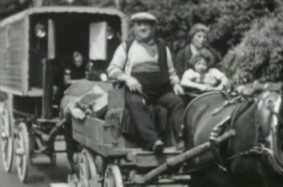
With the Gypsies in Kent (c.1938), film by John and Bill Barnes, from Screen Search

John and his twin brother William (who survives him) were born in 1920 and discovered film during the 1930s, becoming enthusiastic amateur filmmakers while still at school. Two of their films, Gems of the Cornish Riviera (1936) and Cornish Nets (1938) featured at the Pordenone silent film festival in 1997, the year in which both were awarded the prestigious Prix Jean Mitry for services to silent film scholarship. Eighteen of their silent films are now held by Screen Archive South East in Brighton, including The Wheat Harvest (c.1935), In the Garden of England (c.1938) and With the Gypsies in Kent (c.1938), clips from which can be seen on the Archive’s Screen Search site.

On leaving school the brothers studied film design and technique at Edward Carrick’s AAT film school, at which time they began collecting Victorian optical toys and associated literature, often frequenting the bookshops of London’s Cecil Court which three decades before had been ‘Flicker Alley’, home to the nascent British film industry. They hatched a plan to collect artefacts and documents that would trace the history of motion pictures from the 17th to the 20th centuries, an ambition put on hold while they served in the Royal Navy during the Second World War.

After the war, the brothers moved to St Ives in Cornwall, where Bill opened a second-hand bookshop. It was in rooms above this shop in 1951, during the Festival of Britain, that the brothers put on the first exhibition of their film history artefacts, the success of which encouraged them to collect all the more. This was at a time when relatively little was appreciated about pre-cinema tchnologies, and John’s great work was not simply to collect such objects but to understand them, explain them and to be able to contextualise them. Eventually the bookshop was closed and the brothers sold by catalogue alone, supplying books and artefacts to scholars and film museums around the world.

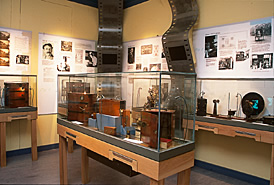
Objects collected by John and Bill Barnes now in Hove Museum

In the 1960s, while Bill went filming overseas, John and his wife Carmen (who also survives him) opened the Barnes Museum of Cinematography in St Ives. This famous collection attracted film scholars from around the world, and its catalogues became treasured documentary sources as serious interest grew in the roots of cinema. Collecting continued, and many objects were lent to museums around the world or formed the subject of illustrations in numerous text books. The Museum never found a London home, as John had hoped, and closed in 1986, its pre-cinema holdings going to the Museo Nazionale del Cinema in Turin, while much of the remainder is now housed in Hove Museum, near Brighton.

But John’s greatest monument is The Beginnings of the Cinema in England. The series began in 1976 with the book of that title, which documented the arrival of film in England, 1894-1896. Establishing his style, the book traced the history through the machinery, out of which followed the personalities involved, the modes of exhibition, and a thorough filmography for the period. It would be hard to underestimate the value this book (which was revised and republished in 1998) to the early cinema specialist. It simply defined a period. Subsequent research has built on his work, and occasionally challenged its findings (Barnes’ arguments around the so-called ‘Paul-Acres camera’), but those solid foundations remain. It was followed by volumes doggedly documenting the cinema in Britain (he wavered between England and Britain in his descriptions) for 1897 (perhaps his best work), 1898, 1899 and 1900, the whole series eventually being republished in a uniform edition by University of Exeter Press in 1998. While the original volumes are quite rare, the re-issued set can be found relatively easily and cheaply and is strongly recommended to any serious student of early film. In the historiography of British film, only Denis Gifford and Rachael Low can match John Barnes’ achievements.

John Barnes devoted his life to the history of cinema. He was as much a pioneer in his field as were those whose lives and technologies he championed in theirs. He faced innumerable battles with publishers and institutions, but that all goes with the part played in being an independent scholar-collector. His knowledge, unfailing help and sturdy friendship were valued by scholars and enthusiasts around the world, and his parting (he died on June 1st) will be recognised as a huge loss. But few of us who work in this field will be able to leave behind so much of such solid and lasting value: objects rescued, identified and their importance recognised; documents saved, preserved and republished; films identified and treasured; and books written that preserve the knowledge of a lifetime and which will benefit research for many years to come.

I’ll finish with a section from a review I made of The Beginnings of Cinema in England when the series was republished, as it rather sums things up for me:

Enthusiasm is the key to John Barnes’ history. Perhaps the chief reason why this area of film studies is so vital, is that in the hearts of its enthusiasts it is as if it were happening now. While other areas of academic cinema history seem doomed to atrophy, as films that were once entertaining no longer entertain, Victorian cinema is alive with debate and discovery … This is perhaps Barnes’ greatest achievement, to have achieved the trick that film has always claimed to do, to abolish time. Thanks to the finest work of empirical early film history that there is, the cinema of the 1890s is very much with us still.

Thank you John.

Pen and pictures no. 1: Thomas Hardy

Tess of the D’Urbervilles (1913), from http://www.thomashardyfilms.com

Time for a new series, I think. And its theme is the crossover between literature and film, looking at how the silent cinema tackled the works of assorted authors – and how authors came to terms with this strange new medium, which challenged their claims upon the popular imagination, frequently mangled their works as screen entertainments, yet also offered riches, either through selling the rights or through contributing their own screenplays. It’s an engrossing history, where every author’s experience is just that little different to anyone else’s. And we’ll start with Thomas Hardy.

Hardy seems so much a Victorian (if late Victorian) author, that it comes as a bit of surprise to release that he lived long into the era of film – long enough to see, somewhat to his bemusement, his novels adapted as films. There were four silent films made of Hardy’s work: Tess of the D’Urbervilles (US 1913), Far from the Madding Crowd (UK 1916), The Mayor of Casterbridge (UK 1921) and Tess of the D’Urbervilles (US 1924). Details of each can be found in the ‘Lost Hardy Adaptations’ section of the website Thomas Hardy: The Films Page.

The entertaining story of Hardy’s personal engagement with film is told in Matthew Sweet’s book Inventing the Victorians. Hardy was first approached by a film company in 1911. The Warwick Trading Company, a British business, wanted to film Tess of the D’Urbervilles, offering Hardy ten per cent of the gross turnover. Hardy told his agent:

I should imagine that an exhibition of successive scenes from Tess (which is, I suppose, what is meant), could do no harm to the book, & might possibly advertise it among a new class.

Scarcely overwhelming enthusiasm at the prospect of seeing his work filmed, though Hardy did sign the contract (the film did not get made). He also accepted money from Hubert von Herkomer, the artist turned filmmaker, who wanted to film Far from the Madding Crowd and The Mayor of Castebridge. Neither was produced, and Hardy was onto a nice little earner without a film having made it to the screen.

It was the Americans who first put Hardy on the screen. Adolph Zukor’s Famous Players produced Tess of the D’Urbervilles in 1913, with Broadway actress Minnie Maddern Fiske as a somewhat mature Tess – she had first played the role on stage in 1895 – David Torrence as Alec and Raymond Bond as Angel Clare. The film was shot in New England, and generally given an American look throughout, as well as having a softened ending (Tess goes to prison rather than being hanged). Hardy attended a press screening of the film at Pyke’s Cinematograph Theatre in London’s Cambridge Circus (today a fashionable bar named after its former cinema owner, the Montagu Pyke) on 21 October 1913. Matthew Sweet records Hardy’s bemused reaction:

It was a curious production, & I was interested in it as a scientific toy; but I can say nothing as to its relation to, or rendering of, the story.

In other words, the movies had produced some kind of bewildering aberation (at least as far as his work was concerned), but it was hard to complain about the money.

The clash between old arts world and new continued with Far from the Madding Crowd, made in 1916 as a five-reel feature by the British company Turner Films, whose great star was the American actress Florence Turner. Turner played Bathsheba Everdene, and her regular co-star Henry Edwards was Gabriel Oak. As with all other Hardy silents, the film is lost, and all we can glean from reviews is that the film did not look like it was filmed in Wessex. This was undoubtedly true, but films of literary properties needed to be true to their own medium first, not to the printed page, a lesson that was starting to be learned as films grew longer and the movie industry grew more assertive, and became richer.

Such riches, and such attitudes, were evidenced by Metro Pictures, which optioned Tess for an astonishing $50,000, but the next Hardy film came from a far humbler source, the Progress Film Company of Shoreham-by-Sea on England’s south coast. The tale of the artist/theatrical community in what was affectionately known as ‘Bungalow Town’ is charmingly told on the Bungalow Town website. The Mayor of Casterbidge was made there in 1921, directed by Sidney Morgan and starring Fred Groves as Michael Henchard. Hardy was receiving more and more offers from film companies, and seems to have selected according to the degree to which the treatment indicated a sympathetic understanding of his original. For the Progress proposal he wrote:

The general arrangement seems as good as is compatible with presentation with cinemas.

Hardy was invited to see the film in production (it was filmed in Dorset, which may have helped secure his approval), and so enjoyed the peculiar experience of seeing his characters come to life, as it were, writing in a letter:

This morning we have had an odd experience. The film-makers are here doing scenes for “The Mayor of C” and they asked us to come as see the process. The result is that I have been talking to the Mayor, Mrs Henchard, Eliz. Jane, & the rest, in the flesh … It is a strange business to be engaged in.

The last film to be made of his work while Hardy was still alive was Metro-Goldwyn-Mayer’s Tess of the D’Urbervilles, in 1924. This was a top-notch Hollywood effort (evidenced by that $50,000 payment for the rights), with Blanche Sweet as Tess, Conrad Nagel as Angel Clare and Stuart Holmes as Alec. Scenes were filmed in Dorechester, but Hardy never saw the film. Given that the film updated much of the action to the 1920s, with motor cars and nightclubs, it is perhaps best that he did not. Interestingly, it seems to have been made with two endings, exhibitors being given the option whether to choose Tess being hanged or Tess escaping the gallows.

And that’s Thomas Hardy and film. He displayed an intriguing tension in his letters between keenness to profit from the film rights and concern over how his work was represented. In Hardy’s personal engagement with the motion picture industry we see films move from being a peculiar distraction which might help book sales, to a medium which challenged the author’s hold upon the work of his imagination. Meeting the Mayor of Casterbridge in the flesh must have been an unsettling experience – evidence that the creative work had a life outside the printed page on which it first appeared.

None of the Hardy silent films are known to exist (there are rumours of a surviving fragment of the Progress Mayor of Casterbridge). Apart from Matthew Sweet’s book and www.thomashardyfilms.com, check out T.R. Wright’s Thomas Hardy on Screen or Paul J. Neimeyer’s Seeing Hardy: Film and Television Adaptations of the Fiction of Thomas Hardy, each of which tells much the same story about the silent films.

Despite having lived until 1928, Hardy does not seem to have been filmed himself. The nearest we get is film of his funeral, which you can see on www.britishpathe.com.

Vittorio Martinelli RIP

Vittorio Martinelli

Vittorio Martinelli

Anyone who has attended one of the marvellous festivals of archive or silent film that the Italians have in such profusion will recognise Vittorio Martinelli (1926-2008). Even if you don’t know his many books of film history, he was a regular sight at Pordenone and Bologna. His death was announced recently, and there are fulsome tributes (in Italian and English) on the Pordenone website, include a fine tribute on PDF from film historian Ivo Blom. Martinelli is best-known for the multi-volume filmography of Italian silent cinema, Il cinema muto italiano, that he co-edited with Aldo Bernardini. He also wrote extensively on other national cinemas. Every nation seems to have produced these dedicated, principled documenters of our silent heritage (John Barnes, Denis Gifford, Einar Lauritzen, Henri Bousquet, Herbert Birett), believers all in the value of the accurate, comprehensive list. Will we see their like again in the next generations, or have we now the filmographies for silent film history that will sustain our subject for the future?

Now with added movies

Film medical realizat de profesor G. Marinescu (1898-1901)

Some you will know that as well as keeping the Bioscope bubbling along I manage other sites, including Who’s Who of Victorian Cinema, which I co-edit with Stephen Herbert. The site is based on our 1996 BFI book, Who’s Who of Victorian Cinema: A Worldwide Survey, and documents the lives of 200 or more people who were active in motion pictures before 1901. We keep the information up-to-date, add new names and resources, and the reason for this notice is that we’ve just added a new feature: links to Victorian films online. We haven’t got into hosting our own films (yet), but where there are freely available films, on YouTube, American Memory and such like, we’ve added links to the relevant individual’s entry on the Who’s Who.

We’ve also created a Films Online page in our Resources section, which offers a selection of films (all from YouTube so far), demonstrating the great variety of the form. For example, not everyone considering films of the late nineteenth century would think to include the works of the Romanian Gheorge Marinescu, whose studies of the movements of patients suffering from severe nervous diseases you can see included in the above compilation film (itself clearly post-1901).

We’ve tried to keep to legitmately available titles only, so there’s nothing from the Lumières (all still in copyright) or Georges Méliès (the only stuff available online has all been ripped from commercial DVDs). But we’ll add more where we can. One last point – all of the films that we show or link to relate to the individuals’ career pre-1901, so we don’t show anyone’s work from a later period. Do take a look.

Colourful stories no. 5 – The Brighton School

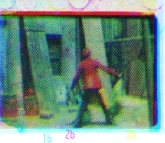
Davidson-Jumeaux two-colour system

Davidson-Jumeaux two-colour system from 1904, blue-green image on the left, orange image on the right

We might note, in passing, that almost all these pioneers were living in Brighton and that they were all in their individualistic and several ways certain that they, and they alone, had inventions worth a fortune. Why did they not collaborate? Were they mutually acquainted? We shall probably never know.

So wrote Adrian Klein, author of the exceptional history and technological survey, Colour Cinematography, first published in 1936. For it is an intriguing fact that most of the pioneers of colour cinematography in what we can call the pre-Kinemacolor era were located in and around the Brighton area, 1898-1906. And in answer to Klein, yes, they were mutually acquainted, some did collaborate, and this is their story.

It was the French film historian Georges Sadoul who first coined the phrase ‘Brighton School’ in the 1940s, to describe a small group of experimenters in motion picture form, among them Esmé Collings, G.A. Smith and James Williamson, who were based in the Brighton and Hove area. The notion of a ‘school’ is a misleading one, though it has proved an enduring term in early film studies, but there was undoubtedly a grouping of like-minded filmmakers, photographers and technicians, larger in composition than Sadoul realised, and dedicated mostly not to innovations in film form to please future film historians, but in a holy grail for the new film industry, colour cinematography. The chief ‘members’ were Alfred Darling, William Norman Lascelles Davidson, Benjamin Jumeaux, Edward Grün, Otto Pfenninger, William Friese-Greene, Charles Urban and George Albert Smith.

Alfred Darling

Alfred Darling, from http://www.victorian-cinema.net

Alfred Darling (1862-1931) was not an experimenter in colour cinematography himself, but he was a technician of genius, whose presence in the area (he lived at 25 Ditchling Rise, Hove) gave huge impetus to the local cinematography industry. His engineering business supplied cinematographic equipment for the Warwick Trading Company, the major British film business of the late 1890s/early 1900s era. It was he who constructed Bioscope cameras and projectors for Warwick, and who supplied much of the equipment used by his experimenting neighbours.

Kammatograph

The Kammatograph, from http://www.victorian-cinema.net

Captain William Norman Lascelles Davidson (c.1871-c.1944), formerly of the 4th Battalion The Kings (Liverpool) Regiment, was an enthusiastic amateur inventor, pursuing the goal of both colour photography and colou cinematography. He claimed to have spent £3,000 in his quest (multiply figures from the early 1900s by 100 to have an idea of equivalent costs today). His first patent for a putative three-colour cinematography system was issued in 1898, which he followed by with a patent for a three-colour still photography method the following year. No working model emerged from either, but in 1901 he teamed up with his neighbour Dr Benjamin Jumeaux to work on the Kammatograph, a filmless device which recorded motion pictures in a spiral on a disc, invented by Leo Kamm. They experimented with two colour filters, instead of three, an inspiration that may have come from the man who probably processed their films – or else he was to take the idea from them – their near neighbour G.A. Smith. Other experiments followed in 1903 and particularly 1904, with their invention (B.P. 7,179 of 1904) which employed twin prisms creating a blue-green and orange record with the pictures side by side, exposed simultaneously (see illustration at top of this post). But the results demonstrated were criticised for poor definition and unnatural colour effects. Davidson then took on William Friese-Greene as his employee, and other demonstrations would follow in 1906, with similar lack of practical success. Davidson then fades out of the picture, still something of a mystery figure.

Davidson-Jumeaux (?) three-colour experiment

Mystery three-colour experiment (c.1903) believed to be by Davidson and Jumeaux, part of the Will Day collection, Cinémathèque française

Three-colour composite

Computerised synthesis of what the above colour record might have looked like

Dr Benjamin Jumeaux (c.1852-?) is still more of a mystery. He lived in Southwick, just outside Brighton, as did Davidson and Smith. He was born in Ceylon (Sir Lanka), of Anglo-French parentage. In the 1901 census he is described as a physician, surgeon and artist. He is named on patents alongside Davidson, but also had patents issued under his own name, demonstrating that he was not simply a financier to the experiments. Included in the Will Day collection at the Cinémathèque française is an extraordinary piece of film, 82mm wide, with three parallel black-and-white images, each registering a red, green and blue image. The Cinémathèque has identified this as Davidson-Jumeaux, apparently through evidence suplied by a perforator, but I have come across no evidence of such a film featuring in their public demonstrations.

Dr Edward F. Grün, or Grune, also lived in Southwick, and was close friends with G.A. Smith. His hobby was inventions in colour photography, and he became briefly celebrated in 1902 for his invention of a ‘fluid’ lens, with coloured fluids within the camera lens itself. Ingenious but pointless, the idea did not catch on. Grün’s would feature as a key witness in a 1913 court case between Kinemacolor and a rival colour system, Biocolour, where his muddled testimony revealed his uncertain grasp of technology as well as events. More on that story in a later post.

Otto Pfenniger

Otto Pfenninger colour photograph of Brighton beach, 1906, from Royal Photographic Society

Otto Pfenninger (1855-?) was Swiss-born, but living in Brighton by the 1890s, where he ran a photography business. He became closely associated with the other Brighton experimenters, especially Davidson and Jumeaux, whom he assisted in some form, but his prime interest was always still photography. He wrote on his experiences in a book, Byepaths of Colour Photography (1921) published under the pseudonym O. Reg, from which the rare (unique?) frames of a Davidson-Jumeaux two-colour experiment in 1904 at the top of this post derives. He devised his own three-colour still photography system, demonstrated by the photograph above of Brighton beach in July 1906.

William Friese-Greene

William Friese-Greene, from http://www.victorian-cinema.net

William Friese-Greene (1855-1921) had had a long association with Brighton through his business partnership with Esmé Collings before he moved from Essex to 203 Western Road, Brighton in 1905. Here he became the paid employee of Captain Davidson, whose experiments were conducted at 20 Middle Street, Brighton. Friese-Greene already had a patent for a three-colour cinematography system in his name from 1898, and issued another with Davidson in April 1905 (B.P. 9,465 – it employed a beam-splitting prism), which he would subsequently boast was the ‘master patent’ for colour cinematography. It was of no such thing, but the full story behind Friese-Greene’s vainglorious efforts to invent colour cinematography must receive full treatment later in this series.

Charles Urban

Charles Urban

Charles Urban (1867-1942) was not an inventor nor a resident of Brighton, but he was a major figure on the scene, and the most important person in colour cinematography in the period up to the First World War, for his championing of Kinemacolor. Urban had first become interested in colour cinematogaphy when Edward Turner and Frederick Lee (subjects of an earlier post) came to his Warwick Trading Company in 1901 looking for financial support for their three-colour system. When Warwick the company lost interest, Urban took on the financing of the project himself. Turner died in 1903, but, undeterred, Urban passed on the development work to his close associate G.A. Smith. Urban came down to Brighton every weekend (or so he claimed) as Smith’s experiments progressed, making himself an honorary ‘Brighton School’ member. Much more on his history is to follow.

George Albert Smith

George Albert Smith, from http://www.victorian-cinema.net

And then there is George Albert Smith (1864-1959), long-lived enough that he might have corrected Adrian Klein, had he a mind to. He lived in Brighton and Southwick, and had already enjoyed a colourful career as mesmerist, showman, filmmaker and film processor for the Warwick Trading Company. He had worked with Lee and Turner, he knew all about the two-colour experiments of Davidson and Jumeaux, he knew all the others, knew what they had done right and all the more importantly what they had done wrong. In particular, he had taken note of the two-colour experiments of Davidson and Jumeaux, and thought he knew how he could make such an idea work, not least by application of his superior knowledge of sensitising photographic materials.

So tune in next week, for the invention of Kinemacolor.

Recommended reading:
Luke McKernan, ‘The Brighton School and the Quest for Natural Colour’, in Vanessa Toulmin and Simon Popple (eds.), Visual Delights – two: Exhibition and Reception (Eastleigh: John Libbey, 2005)

The Anima lodge

Too many topics and too little time. There are so many subjects I have tucked away for research at some time, but many of them I will never get round to tackling. So the best thing to do is to offer them up in their raw state here on The Bioscope, in the hope that they may interest someone else sufficiently to take up challenge.

A case in point is the Anima lodge. I’m unlikely ever to get to the Library and Museum of Freemasonry, and indeed I would hardly know where to start, freemasonry being an entirely closed book to me. But the intriguing story nevertheless is that there was a British freemasonry lodge for those in the film business, and it was established in 1912. I have, from I know not where, a list of the subscribing members of the Lodge 1912-1920, and a fascinating document it is too.

These were the founder members (links are to the Who’s Who of Victorian Cinema and London Project websites):

  • Edward Thomas Heron [publisher of the Kinematograph Weekly]
  • J. Brooke Wilkinson [secretary of the Kinematograph Manufacturers’ Association and later of the British Board of Film Censors]
  • Edwin Houghton Rockett [inventor and general jack-of-all-trades]
  • Frederick Arton [managing director]
  • Francis William Baker [managing director of Butcher’s Film Service]
  • Will Day [film equipment supplier and later film historian]
  • Matt Raymond [Lumière operator, exhibitor, and future master of the Anima lodge]
  • W. Firth [not known]
  • George Henry Smith [British representative for Vitagraph Company of America]
  • James Charles Squier [can’t remember, involved in production]
  • Charles Urban [producer, particularly of Kinemacolor]
  • A. Pearl Cross [executive]
  • John Frank Brockliss [film distributor]

That’s a notable list of a few of the major figures in the British film business at that time. More joined in subsequent years – I’ll identify them where I can:

  • 1913 – Edward Henry Montagu [executive]
  • 1913 – Alexander Liddle
  • 1913 – E.H. Bishop [managing director]
  • 1913 – Walter Northam [executive with Provincial Cinematograph Theatres]
  • 1914 – H.S. Chambers
  • 1915 – Harold John Fisher
  • 1915 – Paul Kimberley [executive]
  • 1915 – Albert Simmons
  • 1915 – George Henry Saffell
  • 1916 – Reginald Charles Bromhead [executive with Gaumont company]
  • 1916 – Sidney Thornton Smurthwaite
  • 1917 – Thomas Arthur Welsh [producer]
  • 1917 – John Pearson
  • 1918 – John Charles Ernest Mason [cameraman]
  • 1918 – Solomon Gabriel Newman
  • 1919 – Robert Chetham
  • 1920 – Alfred G. Challis
  • 1920 – Edward Maxwell Heron
  • 1920 – Samuel Woolf Smith
  • 1920 – Ernest Edgar Blake [executive]
  • 1920 – E.W. Fredman
  • 1920 – Victor Sheridan
  • 1920 – Frederick Holmes Cooper [cameraman]
  • 1920 – George William Pearson [director]
  • 1920 – Chas. J. Miller
  • 1920 – Ernest Peall [executive]
  • 1920 – Lionel Phillips [distributor]

Well, there’s a fascinating line-up of the famous (in their small world, in their day) and the unknown. Figures like Urban, Wilkinson, Welsh, Kimberley, Pearson, Raymond and Heron were leading figures in the early British film business; many of the others were minor figures then, and are undoubtedly obscure now. What did the Anima lodge do? What advantages might it have brought to those who joined? How did the grand and the less-than-grand figures rub together? What alternative history of British silent cinema might some ingenious researcher draw from this line-up? Sadly, I cannot even tell you when the Anima lodge closed – if it ever closed. Perhaps it lingers somewhere. Someone will know.

Anyone who can identify the roles of the names I haven’t been able to identify, please let me know.

The silent pianist speaks again

Neil Brand

Neil Brand

Neil Brand is taking his show The Silent Pianist Speaks – first shown at the Edinburgh Festival – to London. He is appearing for two nights at the Pleasance Theatre, Islington, 22-23 December. What better way to welcome in Christmas. Here’s the press release:

“ASSISTED BY THE TRILLING WIT AND POLISH OF BRAND’S LIGHTNING-FINGERED ACCOMPANIMENT, THE SHEER FINESSE OF EACH SUCCESSIVE SLAPSTICK SELECTION WORKS ITS MAGIC ON THE AUDIENCE AND THE LAUGHTER FLOWS MORE AND MORE FREELY” Telegraph 2007

Fresh from co-starring with Paul Merton in the UK tour of Paul Merton’s Silent Clowns, Neil Brand, one of the world’s foremost silent movie accompanists is proud to present his own critically acclaimed show at The Pleasance Theatre, London for two nights only. The Silent Pianist Speaks is one of most unique and memorable shows you will see. It left both audiences and critics at this year’s Edinburgh Festival Fringe in far from silent awe of the great filmmakers of the Silent Era and the magic of the accompanists who breathed life and sound into their work.

Neil uses clips from some of the greatest moments in silent cinema to illustrate his 25 year career and the special place of music with silent film.

“A RICHLY DIVERTING HOUR OF ENTERTAINMENT – BRAND SHOULD BREAK HIS SILENCE MORE OFTEN” Metro 2007

From the earliest, earthiest comedies and thrillers, through a silent cine-verité classic shot by a young Billy Wilder, which the audience gets to score, to the glories of Hollywood glamour and the sublime Laurel and Hardy, Neil provides improv accompaniment and laconic commentary on everything from deep focus to his own live cinema disasters.

The show culminates in a performance of a film he hasn’t seen, talking through the scoring process as he plays and struggles to make some sense of the film.

“BRAND’S IMPROVISED PIANO PLAYING ELEVATES SILENT MOVIES FROM CRUDE SLAPSTICK TO SUBTLE BALLET” Guardian 2007

Having trained originally as an actor, Neil has been accompanying silent films for over 25 years performing regularly at the NFT on London’s south bank and film festivals and special events throughout the UK and the world. He is considered one of the finest exponents of improvised silent film accompaniment in the world.

He has written the title music and scores for many TV documentaries including Paul Merton’s Silent Clowns, Silent Britain and Great Britons and scores for over 50 Radio 4 dramas including War and Peace, The Box of Delights, several of the BBC audio Shakespeare Collection plays and Sony award winner A Town Like Alice. Neil is also highly regarded as a writer of radio plays including the Sony-nominated Stan, which he adapted last year to great acclaim for BBC4 TV.

He has appeared with Paul Merton across the UK in Paul’s show, Paul Merton’s Silent Clowns and also across the UK and US with his first show, Where Does the Music Come From? This year he has appeared at Finland’s ‘Midnight Sun’ Festival, Padua Opera House and Kilkenny Comedy Festival.

More details and online booking from the Pleasance website.