Kevin Brownlow at Killruddery Silent Film Festival 2009
Two interviews from the recent Killruddery Silent Film Festival, made by Irish company DOCUMENTAVi, have appeared online. The first is with Kevin Brownlow, an engaging twenty-minute film in which Kevin ranges widely over a lifetime promoting the silent film. He discusses discovering silent film while at school, the first films he collected, befriending silent directors (Al Parker in particular) and the task he took on of interviewing those who made the silent film. He covers film festivals, the Thames Silents series, Ireland and silent film, the power of silents experienced live as opposed to online or on TV, and the importance of live, ‘authentic’ (he is amusingly scathing of the taste for modern rock groups to dabble with silents). It’s a delightful encounter.
Stephen Horne at Killruddery Silent Film Festival 2009
Then, looking somewhat bleary-eyed, as anyone might who had just accompanied three silents in a row at the festival, pianist Stephen Horne talks about how he got into providing music for silent films, how this combines with the work he does accompanying dance, and his recent experiences performing the ‘original’ score for The Battle of the Somme. It’s an eloquent, informative seven-minute piece.
Talking of the estimable Mr Horne, he can be heard this Sunday at the Barbican in London, accompanying Guiseppe di Liguoro’s L’Inferno (1911), together with percussionist Martin Pyne and a smattering of electronic samples amid the piano accompaniment. Stephen assures me that it will be nothing like Tangerine Dream (whose DVD score for the film has pained many – doubtless Kevin Brownlow among them), so there’s every reason to go along and catch the Dante-inspired film which caused such a sensation in its time (chiefly on account of copious nudity among the damned). Fragments from a second 1911 L’Inferno, directed by Giuseppe Berardi, will also be shown, apparently for the first time in the UK.
The young David Lloyd George’s dream of David and Goliath. All images in this post are frame grabs from the DVD of The Life Story of David Lloyd George
How do we judge a film that no one saw? The audience gives a film meaning, or at least historical specificity. There are many examples of films that have never been seen (quite a few from recent British cinema history) because they were deemed uncommercial, and other grand projects that were never completed, such as Sergei Eisenstein’s Que Viva Mexico or Orson Welles’ Don Quixote. But the completed film that stands up as an exceptional work of art, that was a strong commercial possibility in its time, and whose exhibition could have changed film history (in a modest way) – such examples are rare.
One such example has just found its way to a DVD release after a remarkable history of idealism, political intrigue, slander, subterfuge, disappearance, rediscovery and restoration. The Life Story of David Lloyd George was made in 1918, vanished before any cinema audience had a chance to see it, and re-emerged to astonished acclaim in 1994. Its place must be in virtual history rather than actual film history, because its story is one of if onlys and maybes. But what a story it is.
Norman Page as David Lloyd George, Alma Reville as his daughter Megan
The story begins with the Ideal Film Company, formed by the brothers Harry and Simon Rowson in 1911 to distribute films, before moving into production in 1915. Excited by the interest shown by the public in official films of the war, the Rowsons decided to make an epic drama about the origins and purpose of the war, employing none other than Winston Churchill – then in the political wilderness following the Dardanelles disaster – to furnish ideas which would be turned into a scenario by Eliot Stannard. When Churchill returned to the cabinet in summer 1916 the original project was dropped, only to transmogrify into a biography of the new Liberal prime minister, David Lloyd George (the Rowsons were strong supporters of the Liberal party). Conceived as an epic story of a man who from humble beginnings rises to lead his country through to victory in the greatest war known to man, it was an undertaking unlike anything attempted in cinema to that date, nor would it have any subsequent parallel until the American and Soviet biopics of the 1930s onwards (Young Mr Lincoln, Wilson, Lenin in October etc.). But those conform to the classical dramatic conventions of their time, and their subjects were long dead – Lloyd George was, and remains, unique in subject and form.
The script was written by a noted historian (though without film experience) Sidney Low. The director was Maurice Elvey, gradually rising to the top of his profession, at least in British film terms. The cast were a mixture of Ideal stalwarts and lookalikes, most notably in the latter case the stage actor Norman Page, whose uncanny performance as Lloyd George carries the film (Page watched Lloyd George in full flow in the House of Commons and gives us what is probably a highly accurate record of his mannerisms). Alma Reville, later to marry Alfred Hitchcock, plays Lloyd George’s daughter Megan, and Ernest Thesiger can be spotted as Joseph Chamberlain. Helen Haye (not credited on the DVD but recently identified) plays Lloyd George’s mother.
The Birmingham Town Hall riot scenes
The film’s production was announced to the trade press in February 1918, under the title The Man Who Saved the Empire. It was not the only propagandist feature film epic to be made in Britain at this time, with American directors brought in by British official film interests to make Hearts of the World (D.W. Griffith) and Victory and Peace (Herbert Brenon), but it was the only one made on such a scale with private money only. Filming proper began towards the end of August and astonishingly was completed by the end of September. It took place in several of the historical locations, including the north Wales of Lloyd George’s childhood, Birmingham and London. Shaping up to be two-and-a-half hours long, there were suggestions that the film could be released as a serial, but excitement was high at what promised to be the outstanding British film release of the year.
In October the trouble started. Horatio Bottomley, the rabble-rousing, influential owner of the nationalistic journal John Bull, began a campaign against the film. Essentially his line was that the film was a disgrace because it was being made by Germans. The Rowsons were Jews, real name Rosenbaum, and in Bottomley’s nakedly bigoted mind, Jews were equated with Germans. Bottomley’s campaign against the film (Ideal won a libel suit against him) brought a lot of unwelcome publicity, and may have added to a sense of awkwardness felt by some in the government at the production of a film lauding the achievements of the prime minister at the time of an impending general election (one took place in December 1918, just after the war ended).
In the end, none of the evidence that we have really explains what happened next. The Ideal company were paid off, to the sum of £20,000 (around half a million pounds in today’s money), which was the cost of the film’s production – though no recompense for the anticipated returns. Lawyers for the government turned up, paid Ideal in twenty one thousand pound notes, took the negative away with them in a taxi – and that was the last that anyone saw of it, publicly at least. Someone in power thought it worth a lot of money to prevent the film from being shown, but to this day no one can really say why, and the documentary record (including a memoir written by Harry Rowson) is tantalisingly vague.
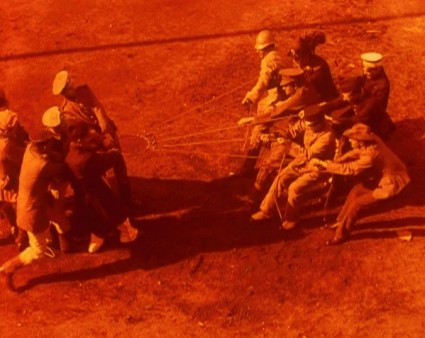
Symbolic illustration of a theme from one of Lloyd George’s speeches, showing the Allies learning to pull together
The only evidence we have for the film after this date is a reference in the diary of Frances Stevenson – Lloyd George’s secretary and mistress – over a year later. On 24 February 1920 she wrote:
Last night went to see a film of D’s life which Captain Guest had put on the screen in No 12 [Downing Street] – a perfectly appalling thing. The idea was all right but the man who was supposed to be D. was simply a caricature. I begged D. not to let it be shown. Mrs Ll. G. very angry with D. because she said I had put D. against it because I had objected to the domestic scenes in it!
Were there plans to show the film in 1920? Is Stevenson referring to this time, or 1918, when she says “I begged D. not to let it be shown”? Might she be speaking of a different film entirely? We do not know. The Life Story of David Lloyd George was no more, unseen by anyone, little more than a footnote in a history or two. British film historian Denis Gifford interviewed Maurice Elvey in 1967, shortly before he died, when Elvey said (with remarkable sang froid in the circumstances):
This I suppose must have been one of the best films I ever made or ever shall make … It is such a shame it has disappeared.
In 1994 the film was discovered. It was in a barn at the home of Viscount Tenby, David Lloyd George’s grandson. It was in pristine condition, though in an unassembled form. Considerable effort and ingenuity effort was required from the only recently-formed Wales Film and Television Archive to piece the film together. As the first sequences were constructed and shown to film historians and Lloyd George experts, the general reaction was astonishment. Instead of the quaint drama that, to be honest, we had been expecting, here was a film of skill and power, possessed of a fervour and a commitment to the issues of the day that were electrifying. The film had its premiere – literally so – on 5 May 1996 (precided by a showing on 27 April for an invited audience) at the MGM cinema, Cardiff, accompanied by the Cardiff Olympia Orchestra playing a score by Welsh composer John Hardy. Since that time it has had screenings around the world, usually with Neil Brand accompanying on piano, and it gained recognition as a unique classic. But there has been a huge struggle on the part of the National Screen and Sound Archive of Wales (as they are now called) to get the film issued on DVD. Now, at last, with pseudo-orchestral score by Brand, it is available for all to see – and it is a film that demands to be seen.
Elderly inhabitants of the workhouse, freed by Lloyd George’s introduction of an old age pension scheme, materialise outside the workhouse walls
The Life Story of David Lloyd George tells the story of its subject from childhood to wartime victory (the film was completed before the war was won), relayed in key scenes selected to demonstrate a calling to national duty and a desire to overturn injustice. The early scenes, showing Lloyd George’s upbringing in Wales, have not been given the praise that should be their due. They capture an atmosphere of modesty, devoutness and dedication towards one’s fellow man which is moving in its general effect, and deeply touching in its detail, grounded as it is in an affectionate portrait of late Victorian Welsh society.
Lloyd George is shown triumphing in the law and local politics through his oratory and commitment to noble causes. He gains notoriety through his anti-Boer War (1899-1902) stance, illustrated by a speech he gave at Birmingham Town Hall which occasioned a near riot in the streets, which the film recreates with truly extraordinary newsreel-style realism, helped by many hundreds of extras. If these scenes impress by their documentary quality, the film’s greater power comes in how it illustrates the revolutionary effect of Lloyd George’s time as Chancellor of the Exchequer, introducing old age pensions and and the National Insurance Act (1911). The very rightness of the actions moves us now, and surely must have had – or would have had – an overpowering effect on a contemporary audience, for whom these great changes were recent occurrences.
While most celebrate the homecoming of loved ones after the war, one woman represents those mourning the dead
Other vigorous tableaux follow, clearly inspired by the newsreels (Lloyd George himself was a consumate performer for the news cameras), notably the Queen’s Hall suffragette riots. The film makes much use of an impressive House of Commons interior set, peopled by lookalikes, shot and perfomed with an easy realism that could fool some into thinking they were watching actuality. The film dips somewhat in its second half when the First World War begins. Lloyd George served brilliantly as minister of munitions before becoming prime minister in 1916, but there is paradoxically less drama on show once the film has arrived at the climactic stage to which its first half has been building. The battle scenes are convincing, likewise Lloyd George’s visit to the Front, and there is a prolonged sequence inside a munitions factory which may lack dramatic interest but as a seemingly documentary record is superbly shot. But our emotions are not re-engaged until the film’s final scenes, when the war comes to an end. Troops line up on the parade ground in their hundreds, fall out, then run to their waiting loved ones, at which point they materialise into civilian clothes. Amid all the happiness, one woman turning her head and weeping stands for all those whose loved ones were not returning home. Shown live, it catches the audience’s breath every time.
It is not a film for every one. Those hoping for either a more conventional human interest story, or a political drama, may be disappointed. Its newsreel-style – a deliberate aesthetic choice to reflect the way in which many of the audience were most familiar with Lloyd Geoge as a public figure – lessens the emotion while it heightens the sense of living history. It is unlike any other silent film in intent and form. But watch The Life Story of David Lloyd George, and then try and take seriously one of the conventional dramas of the war made duing the war – Hearts of the World for example – and they come across as pitiable, not so much in their execution or use of dramatic convention as in their absence of real social and political feeling. The Life Story of David Lloyd George is not realistic as such, despite its newsreel inspiration. It is pure hagiography. But more than any other film of the period it manages to articulate what people were fighting for. Which is what the Rowsons had wanted for their epic war film, right from the beginning.
Lloyd George addresses the camera in the film’s final scene: ‘There must be no “next time”‘
The film runs for 152 minutes. Viewers will see from time to time sequences which clearly do not quite fit. Titles referring to Moses are followed by film of Boadicea (the film has several such emblematic sequences); Lloyd George’s vision of his prime ministerial predecessors has obvious re-take shots; longueurs in the latter half would undoubtedly have been edited down had the film been completed for release. The film had to be pieced together without a running order, and a place found for every extant shot, somehow. Tinting records came with the film, the colour richly but sensitively reproduced by the Wales archive.
On the DVD you get 47 mins of extras, including an interview with composer Neil Brand which goes beyond the thinking behind his sumptuous score to consider the value of silent film generally. It is a tour de force from Neil which I would recommend showing to anyone wanting to understand what the silent film means for us today. Kevin Brownlow is interviewed, stating that the film would have changed film history (particularly in Britain) had it been shown – Britain’s The Birth of a Nation. Would it have been a huge financial success though? I think Ideal may have ended up with a problem on their hands – a long film, without stars, partisan in politics, perhaps too reliant on the patriotic uplift occasioned by the war. But we’ll never know.
The DVD is available for purchase online from the National Library of Wales’ shop, price £18.99, or if you are passing through Aberystwyth, visit the shop in person. Those intrigued by the history should certainly check out David Berry and Simon Horrocks’ book David Lloyd George: The Movie Mystery (1998), which includes Harry Rowson’s memoir, and essays from Lloyd George’s biographer John Grigg, Nicholas Hiley, Sarah Street, Roberta Pearson, John Reed (who restored the film) and others. Information on the film, the archive that restored it, and a short video clips can be found on the Moving History website. Finally, on my personal site, there the text of a talk I gave on the British epic film of the silent era which puts The Life Story of David Lloyd George in that particular context.
The Life Story of David Lloyd George will never fit easily into film history, because it was never seen, and because there has never been anything else like it. But it is a major work irrespective of film history, and the National Screen and Sound Archive of Wales have done us a great service in making available to all.
Our series on literary figures and silent film has seen each confront the upstart medium of moving pictures in their own particular way. Thomas Hardy saw his works strangely adapted for the screen, yet welcomed the royalty cheques. J.M. Barrie and Evelyn Waugh, at different ends of their literary careers, both dabbled in filmmaking, one to challenge ideas of theatrical realism, the other as a testing bed for his brand of mocking satire. John Buchan unexpectedly found himself in charge of British film propaganda during the First World War and incorporated the experience in his fiction. Bernard Shaw critiqued the new medium, intrigued yet wary of letting his own works be filmed for fear of losing control of them. Now we turn to Leo Tolstoy, to see the man of letters pursued by cameras anxious to capture something of his fame.
Count Lev Nikolayevich Tolstoy (1828-1910) enjoyed a reputation as an author and thinker unmatched in his time, and perhaps at any other time. Known worldwide as the great man of Russian literature, chiefly on the basis of his monumental novels War and Peace (1869) and Anna Karenina (1877), he was revered (or feared) just as much as a political thinker. His advocacy of a form of Christian anarchism, of pacifism and non-interventionism disturbed the Russian authorities but encouraged fanatical belief among some and helped inspire the later actions of Gandhi and Martin Luther King.
The peak of Tolstoy’s fame coincided with the emergence of the modern media. Newspapers, photographs and motion pictures could capture one’s essence and distribute it to the masses, across the world. Tolstoy was plagued by enthusiasts, advocates, disciples, fanatics, hangers-on, mendicants, lunatics, artists, reporters and photographers, all anxious to gain something from the great man. As the end of his life came near, there was an immense urge to record something of the great man while he was still breathing – and to take one’s own place alongside him in that record.
Motion pictures had come to Russia in 1896, and Tolstoy certainly knew of them by 1903, because he mentioned his adversion to them when a friend V.V. Stasov tried to organise the recording of Tolstoy in sound and motion pictures, an act which received this angry response by letter, dated 9 October 1903:
I have just read your letter to Sofya Andreyevna (she is in Moscow) and was horrified. For the same of our friendship, drop the business and save me from these phonographs and cinematography. I find them very unpleasant, and I most certainly do not agree to pose and speak.
Sofya Andreyevana was Tolstoy’s wife, and as many biographies have recounted, Tolstoy’s private life in his latter years was tumultuous and unhappy, chiefly on account of his deteriorating relations with his wife, a situation exacerbated by the malign influence of his chief disciple, Vladimir Chertkov, who drove apart the idealist husband from his supposedly materialist wife, sending the latter into a kind of madness. Sofya Andreyevana was the victim of Tolstoy’s complete failure to maintain his principles of pacifism and non-authoritarianism into his private life. She battled to maintain control, not least of her reputation come Tolstoy’s death, partly because of what her husband said about her in his all too frank diaries. Some of this personal battle involved her working with the press, and particularly the motion picture cameramen, to manage the image of Tolstoy and his family.
And so into the Tolstoy’s life in 1908 came Aleksandr Osipovich Drankov (left). The founding father of Russian cinema was the former owner of a dancing school and then a successful photographer with a network of studios. In 1907 he took up cinematography, shooting numerous topicals on Russian life and events but also some of Russia’s first dramatic films, starting with an abortive Boris Godunov (1907) but then success with Sten’ka Razin in October 1908. As films grew in popularity in Russia, there was increased competition among production companies, both native (chiefly Drankov and Khanzhonkov) and foreign companies eyeing the huge Russian market, among them Pathé, Cines, Urban and Gaumont. Rashit Yangirov, in Silent Witnesses, gives us this less than flattering picture of Drankov, culled from impressions provided by his contemporaries:
… a repellent caricature of a plump but extraordinarily familiar and restless character with red hair, always dressed in pretentious lack of taste, a vainglorious man of considerable ambition always invovled in various dubious schemes.
The Russian film industry was viewed with great suspicion by the authorities (the Russian authorities viewed practically everything with great suspicion). A smart move would be for the industry to ally itself with Russia’s literary greatness. Many films culled for the classics would soon follow, but the same impetus led Drankov (with the connivance of Sofya Andreyevana) to join the throng of reporters and still photographers trying to capture something of the great man on the occasion of Tolstoy’s eightieth birthday, 28 August 1908. Tolstoy’s daughter Alexandra (in The Tragedy of Tolstoy, published 1933) describes the scene:
The precursors of every memorable event – the photographers – began to make their appearance at our house. I remember father sitting, exhausted, on the porch with his ailing leg stretched out, and mother coming in to ask him to consent to being photographed for the moving pictures. He made a grimace of pain and started to refuse, but the camera men swore that they were not going to disturb him and would not ask him to pose. They tried to photograph him from the lawn and from the verandah, while father sat motionless, looking before him with a melancholy stare.
Drankov captured only few feet of film of Tolstoy, seated in a chair on a balcony at his Yasnaya Polyana home, staring like some trapped creature at the camera trained upon him. The brief footage needed much padding out with footage of the family and grounds, but it made Drankov’s reputation. Happily, it survives today.
Drankov’s 1908 film of Tolstoy. The film shows relatives and friends in a carriage, then Sofya Andreyevna picking flowers. Vladimir Chertkov distributes alms at the “tree of the poor”. Chertkov and Tolstoy’s sons leave the main house. The camera looks up at a first-floor balcony where Tolstoy can just be glimpsed, sitting. He is then seen in medium close shot on the balcony, seated in a wicker chair, with Sofya Andreyevna standing beside him. Information from Andrew D. Kaufman’s Tolstoy site, which has better quality versions of the film available, in Windows Media Player and QuickTime versions.
This was not the end of the motion pictures camera’s pursuit of Tolstoy, nor the last time that Drankov would film him. Jay Leyda, in his authoritative Kino: A History of the Russia and Soviet Film (1960), provides the fullest account. With the further support of Sofya Andreyevna, anxious to control the family image, more films were taken of him, in a series of events recalled again by Alexandra Tolstoy:
On September 3, 1909, father, Dushan Petrovich, Ilya Vasiliyevich, and I went to visit the Chertkovs at the estate of their relatives, the Pashkov family, at Krekshino. Father wanted to see Vladimir Grigoriyevich and to rest awhile from the life at Yasnaya Polyana. But people dogged his every step. Several days before our departure, a moving picture company requested permission to photograph his departure from Yasnaya Polyana. Mother liked being photographed and made no objections, but for father it was annoying.
“What for?” he said. “It’s so disagreeable, so embarrassing! Couldn’t we arrange it so that they would not come?”
“Let’s send them a telegram, very simply,” I said. “Why should we have any compunctions about them?”
“That would not be right at all,” mother argued. “Why should we hurt people’s feelings? They will come and photograph, and it won’t be any trouble whatever.”
But Aunt Marya Nikolayevna, who was visiting us just then, supported father so energetically that mother had to give in. I sent a telegram in father’s name asking them not to come. But to our amazement and indignation, on the eve of our departure, the camera men nevertheless made their appearance.
“You are asking my consent to be photographed,” father said to them, making an effort to control his irritation. “I cannot give this consent. and if you do it without permission.”
“Our firm would never permit itself to do that!” one of the men replied.
Next morning, as we drove to the station, the photographers were waiting for us at the gates of the estate. We reached the station just ahead of them. The railroad gendarme forbade their photographing on the railway premises, but they telephoned to the authorities at Tula and received the necessary permit. Again their cameras buzzed.
The cameraman on this occasion was Joseph Mundviller, Pathé’s chief operator in Russia at this time. The Tolstoys were going to see relatives at Kriokshino, and having learned of Pathé’s coup, Drankov followed after. With inside information provided by Tolstoy’s driver, he learned that the author could be found walking alone in morning before breakfast at five o’clock. According to Drankov (as reported by Leyda), Drankov cornered Tolstoy, who was not unwilling to be filmed, but then Drankov tripped over his camera equipment, ruining the film which spilled out of the magazine. He returned to the fray a day or so later, at first chased off by Chertkov, but then capturing film of the Tolstoys at the railway station, even filming the party in their railway carriage.
This film also exists. Parts of it can be found in footage libraries around the world, and happily what looks to be most of the film can be seen (though not embedded here) on the ITN Source site, as part of its remarkable Trinity Bridge collection of Russian and Soviet film. The relevant film is called Russian 1900-1949 Compilation (clip 34), and we see Tolstoy and Sofya Andreyevna at the railway station, Tolstoy with family friends out in woodland, the party getting onto a train, Tolstoy walking alone with walking stick, Tolstoy and Sofya walking in the garden at Yasnoya Polyana, and most remarkably Tolstoy and another man sawing wood (the latter scenes come from September 1910, when Drankov was shooting Krestyanskaya Svadba – see below). The high degree of co-operation with the camera operator is obvious.
Alexandra’s version of these encounters shows her mother’s point of view, imagining that the motion picture record might confirm her status as Tolstoy’s confidant which rumours and her enemies were assiduously undermining.
To comfort father, I volunteered to accompany mother. We stayed a few days at Yasnaya Polyana. Without father, mother was much more calm. But as soon as we returned to Kochety her nervousness returned. A photographer from the Drankov moving-picture firm came and pressed us for a chance to photograph father. This was enough to upset mother. At any cost, she wished to be photographed with him, and she put as much emotion into the situation as if it were a question of life and death. “They printed in some paper,” she said, “that Tolstoy has divorced his wife! Let them all see now that it is not true!” During the photographing, she begged father several times to look at her.
Tolstoy had been to the cinema at least once, before he had the experience of witnessing himself on film when Drankov gave a screening at Yasnaya Polyana on 6 January 1910. He showed Tolstoy and an audience of local peasants all of the film of Tolstoy he had taken to that point. Tolstoy apparently expressed some interest in the potential of the cinema for recording Russian life, and this inspired Drankov to take a number of scenes of the Tolstoy family’s peasants, in national costume, including a village wedding, with the co-operation of Tolstoy family members. Cheekily, Drankov would issue this film in 1911 (shortly after the writer’s death) under the title Krestyanskaya Svadba (A Peasant Wedding), advertised as having been written and directed by Tolstoy himself.
Tolstoy’s last days have been much written about (practically everyone in the building was writing a diary). The poisonous atmosphere at Yasnaya Polyana, centered upon Sofya Andreyevna’s disturbed behaviour, led Tolstoy to flee his own home. First joining his sister in a convent, he journeyed on (with entourage) by train, being forced to stop at the railway station of Astopovo by ill-health. Housed in the station master’s cottage, Tolstoy’s health worsened, while the media flocked to the scene. His family joined him, but cruelly his wife was kept outside. Alexandra records the scene:
While we were engrossed in taking care of father, following his slightest ups and downs, now losing heart, now cheering up again, reporters milled around the walls of the house, catching every word. The telegraphers could not dispatch all the messages; there were so many that urgent telegrams went as ordinary ones. Every minute camera men were taking photographs of persons and places: my mother, brothers, our little house, the station. an old monk, Father Varsonofi, asked all the family to let him in to see father or order “to restore him, before his death, to the fold of the Orthodox Church.”
I heard of all this only from the conversations of those around me, but one time I nearly got into a movie film. Goldenweiser, who stood watch in the anteroom, called me saying that mother was on the steps and asked me to come out for a minute so that she could inquire about father’s condition. I stepped out and began to answer her questions, but she asked me to let her into the anteroom, swearing that she would not enter the rooms. I was on the point of opening the door when I heard a buzz and, turning around, saw two photographers grinding away. I waved my hands and shouted to them to stop photographing and then turned to mother and asked her to leave at once.
“You are keeping me from him,” she replied to my reproaches, “then at least let people believe that I have been with him!”
Leo Tolstoy died on 20 November 1910. Part of the battle between Tolstoy, his wife and Chertkov had been over the copyright in his writings, which Chertkov wanted him to hand over to the Russian nation and Sofya wanted to support their home and large family. She won that battle, Tolstoy only renouncing copyright in his recent writings, and it was the family that benefitted from the numerous screen adaptations of Tolstoy’s works that followed (a filmography of Tolstoyan adaptations from the silent era will appear in a follow-up post). However, she and Chertkov joined forces in their disgust at Yakov Protazanov and Elizaveta Thiman’s Ukhod velikovo startza (The Departure of a Great Man) (1912, illustrated above, from http://www.kinokultura.com), a dramatisation of Tolstoy’s last days which made so bold as to show how tormented Tolstoy was, and even showed his wife’s attempted suicide by drowning (an event which occured). Banned from Russia, the film was only seen abroad – and survives to this day (it can be found on the Early Russian Cinema video series.
As noted above, the 1908 film taken by Drankov on Tolstoy’s eightieth birthday can be found on YouTube and Andrew Kaufman’s site, and the 1909/1910 films at ITN Source. Kaufman also has a 1909 sound recordings of Tolstoy’s voice (Tolstoy had his own phonograph, a gift of Thomas Edison, and would make recordings of interesting visitors).
The Tolstoy Studies Journal site has the 1908 film, a Tolstoy filmography, and an article supposedly giving Tolstoy’s views on the cinema in 1908 which probably had considerable embellisment from its source, one I. Teneromo.
Aleksandr Drankov left Russia after the 1917 revolution, moved to America, failed to find any foothold in the film world, ran a Viennese cafe for a while, then slipped back into the photography business. He died in California in 1948 or 1949.
Coming up soon is Flatpack Festival, an inventive film extravaganza organised by 7 Inch Cinema, taking place in Birmingham (UK) 11-16 March. Most of the festival is devoted to present day cinema, but it’s worth out taking note of because its dedicatee is Waller Jeffs (1861-1941). His is a name that you won’t find in many film histories, because he was a showman rather than a producer, but he was one of the major figures bringing films to British audiences (alongside a whole panoply of variety acts that he also handled) in the era before cinemas arrived, particularly in the Midlands region. As the festival blog puts it:
Between 1901 and 1912 Mr Jeffs introduced hundreds of thousands of Brummies to the delights of cinema through his annual seasons at the Curzon Hall, Suffolk Street, with light opera, military bands, live sound effects and intriguing novelty acts like ‘Unthan the Armless Wonder’ presented alongside the films. Towards the end of this period the first proper cinemas started to arrive in the city – including the Electric – and Jeffs’ audience rapidly disappeared. He ended up in slightly less elevated circumstances, managing the Picturehouse in Stratford-on-Avon.
There’s a little-known history of British film, John H. Bird’s Cinema Parade, which is centred upon Waller Jeffs, showing us the development of film in Britain from the showman’s point of view, and with a salutory change of emphasis from the usual London bias.
As well as naming Jeffs its ‘patron saint’, on March 11th the festival is putting on Curzonora, an evening of early film in the spirit of Waller Jeff’s programmes, with “fifteen-piece ‘musical whirlwind’ The Destroyers” who will be “exploring the full spectrum of 1900s filmmaking ingenuity from actualities and travelogue to sci-fi and melodrama”. And on March 12th it is hosting ‘The Amazing Mr Jeffs: Birmingham’s premier film exhibitor‘, an illustrated talk by the practically ubiquitous Professor Vanessa Toulmin,covering Jeff’s working relationship the famed producers Mitchell and Kenyon.
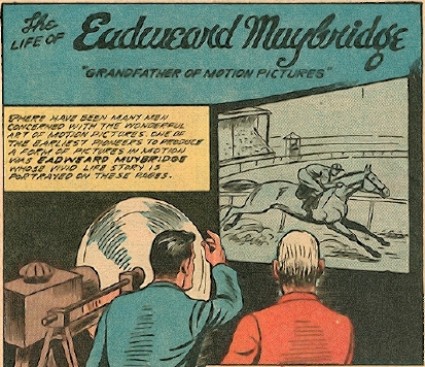
Some artistic licence employed for ‘The Life of Eadweard Muybridge “Grandfather of Motion Pictures”‘, Camera Comics No. 4, Spring 1945, from The Compleat Muybridge
The Bioscope has complained before now that the Web lacks a definitive resource for the ‘Father of the Movies’ Eadweard Muybridge. At last it looks like we have one. Over the past couple of years Stephen Herbert has been building up two essential Muybridge research tools – a blog (Muy Blog) and a detailed chronology. Gradually extra bits of essential information have been tacked on to these, and now he has brought the two resources together with a whole range of new information, and created – The Compleat Muybridge.
It’s a great title, and ideal for one such as Muybridge who appreciated the effect of a grand word. And though the author pleads that the title is ironic, since there never will be a complete life of the protean and often mysterious Mr Muybridge, there is more than enough here to satisfy the most demanding expert in the field of nineteenth century proto-motion photography.
Eadweard Muybridge, Sallie Gardner at a Gallop (1878)
There is, to begin with, a short biography with all the salient details. There is the chronology 1830-1904, available in both detailed (and annotated) and ‘lite’ versions. There is the blog (more a set of news alerts), with much valuable information on new discoveries, publications and events (note that the blog is in three parts: 2007, 2008 and 2009 now underway).
And then comes the new material. The Compleat Muybridge offers a comparative timeline of events in the life and work of Eadweard Muybridge, and his world, in photography, chronophotography and motion pictures, science and technology, and world events. The texts section provides transcriptions or scans of various original texts and articles from the author’s own or private collections, plus links to downloadable documents from the Internet Archive and the University of Pennsylvania Archives.
Kingston in a New Light, a projection project held over two nights in September 2008 using new film and Muybridge images shown on buildings in the centre of Muybridge’s home town of Kingston
The references section complements the chronology, but the citations come with illuminating personal comments on the key texts. And then there are animations of Muybridge photographic sequences (i.e. links to these on other resources) with links to YouTube videos which either animate Muybridge or which are inspired by him in one form or another, as in the Kingston video above.
Added to all that there is a bibliography (a work in progress), a colourful section on modern exhibitions of Muybridge’s work, links, and finally a section on the Zoopraxiscope, the machine by which Muybridge was able to project animated versions of his sequences in silhouette form, on glass discs. Happily there’s a search option to bind it all together.
It’s a fabulous resource already, but the author warns us to revisit regularly as new material is certain to be added (weekly, we’re promised). Muybridge scholarship is evolving all the time, and Herbert would argue that we still haven’t really understood Eadweard Muybridge as yet. His achievement has been so often obscured by an insistence that he should be seen as inventor of motion pictures(when he was working to other ends), and latterly that he was a pure artist, with none of the scientific rigour that he claimed for himself (which is to misunderstand what ‘science’ means). He has time and time again served as a reflection of the concerns of others, rather than being understood for what he achieved, or dreamed of achieving.
It is a complex story, but as Herbert points out, with Muybridge nothing is easy. Go explore.
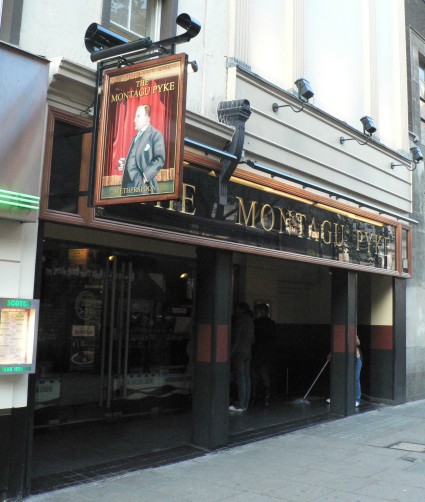
Should you find yourself in London’s Charing Cross Road, on the right-hand side looking south, halfway between the Palace Theatre and Foyles book store, you will find a bar. It bears the extraordinary name of The Montagu Pyke. It is part of the Wetherspoons chain, and is apparently a popular and fashionable spot. A sign outside bears the picture of an assured Edwardian gentleman in an immaculate suit, sporting a monocle, cigar in hand. He is Montagu Pyke, and for a time he was most renowned person in British film. For Monty Pyke was the cinema king.
A huge onrush of cinema building occured in London following the passing of the Cinematograph Act (the first UK legislation devoted to the new industry) at the end of 1909. Fortunes were to be made in this new business so attractive to a mass audience which, though it didn’t pay much for its pleasures, was prepared to turn up once or twice a week, every week, to the cinema. For a new breed of speculators, it looked like a licence to print money. That’s certainly how it must have appeared to Montagu A. Pyke, a former commercial traveller, gold miner and bankrupted stock market gambler. Pyke had seen crowds lined up in Oxford Street to see Hale’s Tours (films of journeys shown inside a rocking rail carriage) and decided this was the business for him.
Obtaining a £100 loan from a City business friend, Pyke formed Recreations Ltd in 1908, with nominal capital of £10,000, but no assets of his own. He identified a property in Edgware Road:
… firstly because it is a very thickly populated neighbourhood, and secondly, it appeared to me from the class of people one sees daily on the streets that they would make an appreciative audience if you gave them good value and the prices were right.
Pyke found two shop properties at 164-166 Edgware Road, and recalled that they were next door to Funland, a shop show which operated for a short period in 1908/09 and undoubtedly played its part in influencing the choice of location, as a proven film-going attraction. He raised money by exploiting society connections and spinning tales of vertiginous profits, including £1,000 from Lady Battersea, sister of Lord Rothschild. Pyke placed his first cinema in a populous neighbourhood with good passing trade, and offered a continuous show between twelve noon and midnight, with prices at 3d, 6d and a shilling. Programmes lasted between an hour and an hour and fifteen minutes. Takings, he recalled, were £400 a week, against outgoings of just £80, and Pyke embarked on a rapid programme of expansion, with investors queuing up to join him.
Initially Pyke’s cinemas were shop conversions, but his policy soon turned to larger venues in prestige locations. Each building was given the generic title of Cinematograph Theatre. Each cinema was also a limited company in itself (a common feature of cinema capitalisation at this time), but he established an umbrella company Amalgamated Cinematograph Theatres Ltd in 1910, with £150,000 capital, by which point he was managing five cinemas. At its peak, the ‘Pyke Circuit’ included fourteen cinemas in central London.
The Pyke Circuit
Recreations Theatre – 164/166 Edgware Road – opened 19 March 1909
Finsbury Park Cinematograph Theatre – 367-369 Seven Sisters Road – 1 October 1909
Walham Green Cinematograph Theatre – 583 Fulham Road – 29 December 1909
Pyke’s business methods were highly dubious, and soon exposed. A committee of investigation formed in 1912 uncovered numerous business irregularities, including dividends being paid out that had not been earned. Pyke was the most notorious exploiter of investors’ eagerness to profit from the cinema craze. His strategy was based on the assumption that the boom would be short-lived, tempting avaricious investors with quick-term profits from a pyramid of flotations. He certainly profited handsomely himself. From a salary of £25 a week in 1908 he had risen in 1911 to paying himself £10,000 a year. As the cinema business only established itself all the more, and competition from larger and more competently managed rivals grew, Pyke’s business necessarily collapsed. He had only two cinemas in operation by the end of 1913 (Piccadilly Circus and Cambridge Circus), and was made bankrupt in 1915, the same year in which he was accused of manslaughter following the death of an employee in a nitrate film fire at the Cambridge Circus venue. Pyke’s ambitions to expand into the provinces were never realised. Amalgamated itself was reconstituted as a company in December 1916 and continued to manage five theatres (Edgware Road, Finsbury Park, Oxford Street, Walham Green and Shepherd’s Bush) to the end of the war.
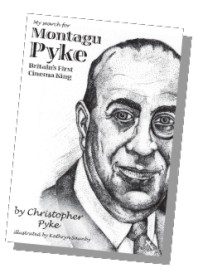
Pyke had been the most prominent figure in the British film business for a short while, but he disappeared into obscurity. Few cinema histories mention him, and it was only with the growth of interest in a social history of British cinema that researchers started to recover his story. Their task was helped by the publication of a chapter of Pyke’s otherwise unpublished autobiography, When I Was the Cinema King, in an edition of Picture House, the Cinema Theatre Association journal (no. 10, 1987). The text was made available by his grandson, Christopher Pyke, who has now produced a website devoted to Pyke and to selling a book, a self-published combination of biography of Pyke, using his memoir, and an account of Pyke’s own investigation into his grandfather’s history. The book, My Search for Montagu Pyke: Britain’s First Cinema King, can only be ordered online from CPI Book Delivery. It was launched last month at the Montagu Pyke bar.
I’ve long had a fondness for Monty Pyke. He was a rogue of sorts, and an employee did die in a fire at one of his premises, even if he was acquitted of manslaughter. But he had his philosophical side, and I’m fond of quoting lines from a 1910 pamphlet of his, Focussing the Universe (also reproduced in that issue of The Picture House). In an earlier post I gave you his use of the words of Isaac Walton to suggest the profound sense of cinema as a diversion. In this passage, he recognises its universal appeal:
Not least of the charms of the Picture Theatre for me is the fact that it is, in the real sense of the word, catholic, appealing not only to men and women of every class and degree, but to men, women and children of all ages. Before its advent, the process of amusing or interesting the child at a public entertainment was a somewhat difficult one, while the possibility of instructing him or her thereat, was never considered at all … The Picture Theatre, if it has done nothing else, has brought delight to the minds and souls of thousands upon thousands of mites in this great Metropolis, some of whom look upon it as the one oasis in the desert of their dull and sordid lives.
The signboard outside the former Cambridge Circus Cinematograph Theatre (where the fire took place) depicts Pyke in his pomp, adapted from the 1911 Vanity Fair portrait of him at the top of this post. He would be proud.
The Montagu Pyke, 105-107 Charing Cross Road, London
Harold Brown, on left in the 1940s (from the British Film Institute), on the right in 2008 (courtesy of Eve Watson)
You will not find the name of Harold Brown in many film history books, but there are quite a number of film histories that could not have been written without him. Harold, who died on Friday 14 November, essentially invented the art and science of film preservation. Countless films have been preserved either by his hands, or by the hands of those he tutored, or those archives around the world who adopted his methods.
It was in 1935 that Harold Brown (born 1919) started as office boy at the newly-formed British Film Institute, where Ernest Lindgren was setting up the National Film Library. Brown was subsequently to become its first preservation officer. In the early 1930s there were no film archives, or almost none. In that decade the four great national archives that were to become pillars of the film archiving movement were established: the Museum of Modern Art Film Library (New York), the Reichsfilmarchiv (Berlin) and the National Film Library (London) in 1935, the Cinémathèque Française (Paris) in 1936. These archives were established by a dedicated band of pioneer archivists with a passion for the film as art. They were driven in particular by the passing of the silent film era, and the imminent loss of the films of that first period of cinema history, films which were being dumped by the studios who saw no value in a heritage that they could no longer sell to anyone.
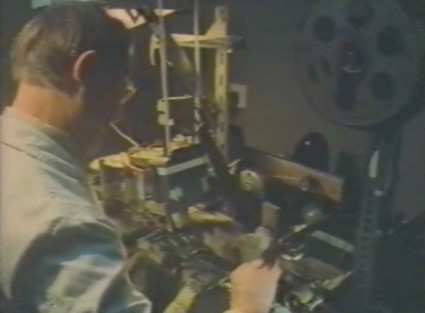
Harold Brown printing a film using the Mark IV
Ernest Lindgren, as Curator of the National Film Library (later the National Film Archive and now the BFI National Archive), laid down principles and Harold Brown came up with the working methods which formed the basis for film preservation. The original film was, as far as possible, inviolate. It needed to be copied, in a form as faithful to the original as possible. Films needed to be treated not only according to their importance but to the extent of, or their potential for, chemical decay. One of Harold’s most notable achievements was the artificial ageing test, which enabled archivists to determine when a film was likely to start deteriorating, and at what time it should be copied. This allowed archives to plan sensibly for the future. A noticeable legacy of Harold’s is the punch holes that you will see occasionally in National Film Archive prints, created so that a circle of film could be put through the ageing test. Another famous Brown creation was the Mark IV, a step printer for dealing with shrunken and non-standard perforation film, built out of bits of toy Meccano, string, rubber bands and parts from a 1905 Gaumont projector.
Harold was a self-taught pioneer. His investigations established basic methods for the identification of early film formats, the repair of damaged film, the storage of film, and the treatment of colour film (his work on Douglas Fairbanks’ 1926 film The Black Pirate, in two-colour Technicolor, was an early classic of film restoration). Awarded an MBE in 1967, he carried working at the National Film Archive until 1984, though he continued as a mentor and consultant to film archives internationally, well into retirement. He passed on his knowledge not only in person, but through some key publications. His Basic Film Handling (1985) and Physical Characteristics of Early Films as Aids to Identification (1990) are standard reference guide to the film archiving profession, and the latter is still available from the site of the Federation of International Film Archives (FIAF). Nor was he solely a nitrate era or early film specialist. He stayed abreast of issues in film archiving throughout, and it was he who gave the name ‘vinegar syndrome’ to the phenomenon of the degredation of acetate film which film archives discovered, to their alarm, in the 1980s.
You can see Harold at work in his prime in a 1963 Pathe Pictorial report on the work of the National Film Archive, available from the British Pathe site (just type in ‘film archive’, or click here for the same film from ITN Source). He features towards the end, delicately handling four frames of film, then seen operating the Mark IV. If you can, check out his modest four-page memoir in the FIAF publication This Film is Dangerous: A Celebration of Nitrate Film, edited by Roger Smither. Or you can read about how Brown and Lindgren went about creating a film archive in Penelope Houston’s Keepers of the Frames: The Film Archives (1994). Or read this text by David Francis (Lindgren’s successor as Curator of the National Film Archive) for this year’s Pordenone Silent Film Festival catalogue on Brown’s role overseeing the projection of the 548 films dating 1900-1906 shown at the seminal 1978 FIAF symposium on early film. Or get a copy of the BFI compilation DVD, Early Cinema: Primitives and Pioneers, most of the examples of which are films that Harold took in, preserved, and made available for future generations.
Harold was a wise, methodical, determined and kindly man. I was lucky enough to know him and to exchange information with him on early film formats at my time at the BFI, in the mid-1990s. I was rather awe-struck just to be holding conversations with him, but I found him to be every inch a gentleman. He has been held in reverence by generations of budding film archivists, and even as his pioneering methods have been superseded by more sophisticated technology, and as the film archiving profession now encounters the digital frontier, his understanding of the life – and the after-life – of a film underpins all that a film archive stands for. Gladly would he learn and gladly teach. Thank you, Harold.
As promised, the Bioscope is starting up a new occasional series, to be called 100 Years Ago, which will reproduce texts from the original British film trade journal The Bioscope, from exactly 100 years ago.
The Bioscope included reports on film and film exhibition around the world, and this piece reported on a strike of nickelodeon projectionists and singers (songs were a common part of early cinema shows) in Chicago.
Artistes and Operators Strike
A somewhat humourous situation recently arose in Chicago, where the ladies and gentlemen who warble such sweet music at the five-cent picture shows joined forces with the bioscope operators and “struck.” There are now over 400 picture shows, employing about 900 people, and they have formed an Operators’ Union. The strikers complain that some of them have been forced to work twelve hours a day. One of the leaders say [sic] “I have known several instances where they did not have time to stop for their meals. I saw a performer bite into a sandwich, leave it on a chair until his act was done, and then finish it.
“If we cannot secure eight-hour days and the pay we ask, this army of employees will stand at the doors of these amusement places Monday and persuade patrons not to enter until the union demands are met.”
On the following Monday, Miss Leonora Drake stood in front of a five-cent theatre on the West Side, and warbled the latest illustrated song. Actors and actresses stop [sic] beside her, and when the crowd paused to listen they called out to them:
“Stay where you are. Don’t go in that theatre. It’s unfair. We’re on a strike, and if you’re with us stay on the outside. She’ll sing. Don’t you think that’s worth a decent salary?”
And while Leonora sang, theatre patrons stood outside and listened.
All over the city striking five-cent theatre artists adopted similar tactics to compel theatre owners to agree to union demands. Vaudeville performers did their turns for nothing out in the middle of the street; teams danced and sang, and moving picture operators, with no machines to operate, explained to the crowds what the strike was for, and declared that five-cent theatre artists were being driven like slaves for the entertainment of the public.
Latest advices [sic] from the scene of war do not tell us if the strike is ended yet.
Frame still of Mavis and Margaret Passmore (holding a piece of 35mm film), from the Passmore family films, c.1903, held by the BFI National Archive
So says John Waters, and while we’ve probably all sat through some relative’s earnest document of their holiday abroad and wished that some of the panning shots of scenery could have been a little shorter, he has a point. Home movies aren’t to be judged by the usual film rules. They are made for an interior purpose; every frame speaks to a select family audience which alone can decode the film’s particular references. And yet, as time passes, and such films turn up in archives, they then speak in a different way to us all, as we see the manners, the customs, the backgrounds, the clothing, the choice of subjects, that make these films such rich social historical documents. Moreover, in other people’s home lives, we see our own. In all these respects, there can be no such thing as a bad home movie.
Image from a Kinora portrait record of the polar explorer Ernest Shackleton and his son Edward, c. 1912, from http://www.jates.co.uk
Home movies are as old as cinema. They were produced throughout what was the silent era in commercial cinema, and continued to be shot silent for several decades thereafter. Some have argued for the scenes of their family life filmed by the Lumière brothers in 1895-96 to be the first home movies, but these were studied compositions for commercial consumption. However, cameras and projectors were soon aimed at the amateur market – indeed, in those first years of cinema some believed that the real money would be made by targeting the home. After all, the Kodak camera had shown where the business lay for still photography. Probably the first motion picture device for amateur use was the Birtac, a camera-printer-projector utilising 17.5mm film, introduced by Birt Acres (hence the name) in 1898. The Biokam, developed by Alfred Darling and Alfred Wrench followed in 1899. Gaumont in France came up with the Chrono de Poche, using 15mm film, in 1900. The Lumières themselves were behind the Kinora, a hand-held, flick-card viewer for which you could either have films made of your family as a ‘portrait’ in a studio, or film them yourself with camera using paper negatives (it was patented in 1896 but the first Kinora camera for amateur use appeared in 1907).
Other such systems followed, employing narrow gauges which were cheaper and easier to handle. Initially the film used was flammable nitrate, but in 1912 there came the Edison Home Kinetoscope using 22mm safety film, and in the same year the Pathéscope, or Pathé Kok, using 28mm safety film. However, these were mostly for showing commercial films in the home, and it was 9.5mm film (introduced 1922) that was the format taken up most avidly by amateurs seeking to shoot their own films, though 16mm (introduced 1923) was used by the wealthy, and some of the first home movies in archives are those shot by the well-to-do upper middle class in the 1920s. A rival to 9.5mm that would soon overtake it in popularity was 8mm, introduced in 1932, and Super 8 appeared in 1965.
35mm was rarely used for home movies, such was the expense (and the fire hazard), but some examples exist, including what I think must be the earliest surviving home movies, those of the Passmore family of Streatham, filmed 1902-1908 and held in the BFI National Archive. They are a delight (they were shown at the Pordenone silent film festival in 1995). Home movies have grown in importance for film archives, or rather film archives have grown up which value such productions highly because of the way they record people and place. The smaller, or regional film archives around the world, are preserving a picture of our private selves which is likely to be rather more highly valued by future generations than the progressively quaint commercial entertainment films that still dominate moving image archiving philosophy generally.
All of which leads us to Home Movie Day. This is an international event, now in its sixth year, and for 2008 it falls on 18 October. Home Movie Day celebrates amateur film and amateur filmmaking through a wide number of events held locally at venues across the world. The events provide ordinary people with the opportunity to see home movies, show their home movies to others, to discover about home movie heritage, and to learn how best to care for such films. This year there are events taking place in Argentina, Australia, Canada, Germany, Italy, Japan, Mexico, the Netherlands, Slovenia, the United Kingdom, and at many points across the USA. The Home Movie Day site provides information on all the events and the home movie day ethos. In the UK, there will be events in Manchester and London. This is the blurb for the London event:
On Saturday October 18, archivists and film lovers around the world will take time out of the vaults to help the public learn about, enjoy, and rescue films forgotten with the advent of home video. Home Movie Day shows how home movies on 8mm, Super8 and 16mm film offer a unique view of decades past, and are an essential part of personal, community, and cultural history.
Home Movie Day returns to London this year at the Curzon Soho cinema bar. It’s a free event and open to everyone. There will be a Film Clinic, offering free film examinations by volunteer film archivists from the British Film Institute, Wellcome Library and BBC, who will check the film for any damage and deterioration, and offer advice about how to store film in the home.
After examination, the films can be passed to one of the projectionists, who will be continuously screening home movies throughout the day.
You don’t need to bring a film to attend and enjoy the event; everyone has a chance to win prizes generously donated by the BFI and Wellcome Collectionjust by viewing any of the films on the day. Prizes include BFI DVDs and tickets to the IMAX.
The archivists can also offer advice about preserving films in film archives around the UK and transferring films to other formats such as DVD so they’remore easily watchable in the home.
Don’t throw your films away; bring them to Home Movie Day!
The London event takes place at 12-5pm at the Curzon Soho, 99 Shaftesbury Avenue, London W1D 5DY. For more information, contact Lucy Smee, at Dearoldsmee [at] gmail.com. The Manchester event takes place at the North West Film Archive.
To find out about the work of regional film archives in the UK, visit the Film Archive Forum website. Film Forever is a good online guide to the preservation of films at home. Our history is in your hands.
I was introduced to this website a while ago (by its author), and thought you ought to know about it. The subject of Filmarchiv Leuzinger is a small town family cinema business from Rapperswil, Switzerland. It was founded by restaurant owner Willy Leuzinger, who began organising film screenings in his restaurant in 1909, going on to open two cinemas in the Lake Zurich district. In 1919 he began a touring cinema business, the Wanderkino Leuzinger, which dominated film exhibition in north-eastern Switzerland from the mid-1920s to 1943. Leuzinger was also a filmmaker, shooting many local topicals (local newsfilms) throughout the 1920s, around eighty of which survive. After Willy Leuzinger’s death in 1935, his eldest daughter took over, and today his granddaughter Marianne Hegi still runs three cinemas, in Rapperswil and Altdorf.
The Wanderkino Leuzinger in 1923
All of this is a charming story, but in the hands of Mariann Lewinsky Sträuli it has been turned into an eye-catching and evocative website. Filmarchiv Leuzinger (click on the Übersicht link to find the main ‘archive’ page) arranges an archive of family memorabilia – biographies, photographs, documents, music, background information and film clips in thematic columns to create an innovative and enticingly explorable site that opens up the Leuzinger’s world. The film clips (in QuickTime format, with MPEG-4, DVD-quality downloadable versions also available) show local festivals, parades, fairs, gynmatic events, and so on, each meticulously described. Every clip, image, audio file or other link leads to a page of information (with larger versions of the images), progressively building up a resonant picture of time, place and occupation.
It is a delightful site, quite an inspiration in conception and design. Unfortunately for the linguistically-challenged English speaker, it is in German. But don’t let that deter – it’s clear enough just from looking that it is a fine piece of social and cinema history (the numerous photographs of cinemas in the 1920s and 30s will delight many), put together with a loving archivst’s care. Mariann Lewinsky Sträuli prrogrammes section of Il Cinema Ritrovato in Bologna, teaches film history at the University of Zurich and directs restoration projects at Memoriav, the Swiss audiovisual heritage organisation.









 The Bioscope