Kevin, Roger and Metropolis

Kevin’s wineglass

Well, it’s been quite a day. As all the silent world knows by now, the Academy of Motion Picture Arts and Sciences has decided to award an honorary Oscar to Kevin Brownlow. Together with Francis Ford Coppola (who is receiving the Irving G. Thalberg Memorial Award), Jean-Luc Godard and Eli Wallach, he will be receiving his Academy Award at the Academy’s 2nd Annual Governors Awards dinner on Saturday, November 13, at the Grand Ballroom at Hollywood & Highland Center. To quote from the Academy’s press release:

Brownlow is widely regarded as the preeminent historian of the silent film era as well as a preservationist. Among his many silent film restoration projects are Abel Gance’s 1927 epic “Napoleon,” Rex Ingram’s “The Four Horsemen of the Apocalypse” (1921) and “The Thief of Bagdad” (1924), starring Douglas Fairbanks. Brownlow has authored, among others, The Parade’s Gone By; The War, the West, and the Wilderness; Hollywood: The Pioneers; Behind the Mask of Innocence; David Lean; and Mary Pickford Rediscovered. His documentaries include “Hollywood,” “Unknown Chaplin,” “Buster Keaton: A Hard Act to Follow,” “Harold Lloyd: The Third Genius” and “D.W. Griffith: Father of Film,” all with David Gill; Brownlow also directed “Cecil B. DeMille: American Epic” and “Garbo,” the latter with Christopher Bird.

Never was an Academy Award more richly deserved, nor – so far as I know – has such an award ever gone to a film historian [correction – he’s the third – see comments]. Brownlow is far more than a historian, of course, being a filmmaker, film preservationist and programme maker, but it is his principled and dedicated investigation into silent film history (out of which has come preservation, exhibition, writing and programmes) that stands out. He made silent films special once again.

By happy chance I met Kevin today, being warmly congratulated by all. I asked if I could take a photo of him for the Bioscope – he said I could take the photo, but not publish it online (there have been too many photos, he said), so I have acceded to this request and instead have published a quick snap made of the wineglass he was holding. Cheers to you Kevin.

The event we were both at was a retirement party for Roger Smither, held at the Imperial War Museum in London. Now while Kevin Brownlow is famed among all who revere silent films, Roger will only be known by a few, but his contribution to film history and film culture has been no less important. He retires as Keeper of the IWM’s Film and Video Archive, arguably the world’s oldest film archive (it was founded in 1919), and has presided over the British official film record of the First and Second World Wars, including hundreds of classic titles, and for the First World War a marvellously rich collection of silent film material documenting evey aspect of the war, including the home front experience. He was instrumental in the restoration of The Battle of the Somme (1916) and its inscription on the UNESCO Memory of the World register. He has written knowledgeably on the Somme and other war films in many publications, and he edited the weighty classic This Film is Dangerous, a history of nitrate film, published by FIAF – a body of which he was Secretary-General for some years. He has been an exceptional servant to film archives and the Bioscope warmly wishes him a happy retirement.

Metropolis

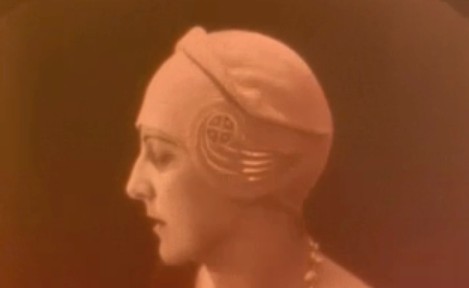
And then I left the party to go and see another filmed inscribed on the UNESCO Memory of the World, Metropolis – specifically the 2010 restored version receiving its UK premiere at the BFI Southbank. It’s interesting speaking to some film archivists to pick up on a bit of a backlash against the Metropolis restoration, which is perhaps a reaction to all the hype. Some are saying that the 16mm inserts don’t add anything, that the film was better the way that it was, and that the whole business is being oversold. Well, seeing the film at last for myself I was hugely impressed by the restoration. It seemed to me to be a model presentation of the material, with the 16mm material clearly of a substandard quality but giving a special thrill to the audience whever it turned up, as you picked up on what had been cut and why, so that you ended up with the sense of watching two films – the one we’ve known before, and the one we have now. It was an engrossing lesson in film restoration and the mutability of cultural artefacts.

The film itself I have never much loved, aside from the exceptional robot transformation sequence, and it seems even more ridiculous than ever. The additional sequences make the filmmakers’ intentions clearer, but they also expose what a muddled plot the film has (and why the cuts were made in the first place). It is muddled not only in narrative, but in conception, dramatic motive, politics and morals. It is a stupendous folly, packed full of glorious, iconic images, but without a single credible idea to hold them together.

I don’t know if the comparison has been made before, but I kept on thinking of Cabiria (1914). It wasn’t just that both films have Moloch scenes, or the histronics of Metropolis that hark back to an earlier age (the film critic Geoff Brown once memorably said of Alfred Abel’s performance that he played someone who, if you asked him what the time was, would mime the operations of a sundial). Metropolis and Cabiria were each epic European productions of the kind that (in the immortal words of Sam Goldwyn) starts out with an earthquake and works its way up to a climax, with buildings tumbling down and flood waters threatening to drown all. The humans are mere ciphers; chaos is all. The spectacle was designed to overawe audiences and to outdo what could be done on the American screen. In a way, Metropolis was a very old-fashioned sort of film for 1927.

Mad folly it may be, but it’s a film that has to be seen, and then argued over. There are ample opportunities to do so now that it has reached the UK – see the list of screenings provided by Eureka Entertainment. The DVD will follow shortly, but it’s a film for the cinema screen if you can.

Lives in film no. 4: Jack Johnson

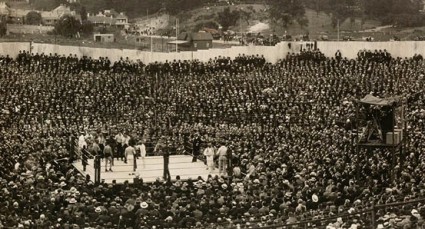
Jack Johnson knocks Jim Jeffries out of the ring at the climax of their world heavyweight bout at Reno, Nevada, on 4 July 1910. The referee is the fight’s promoter, Tex Rickard. Frame still from Sights and Scenes from the Johnson-Jeffries Fight (BFI National Archive)

I’m Jack Johnson. Heavyweight champion of the world.
I’m black. They never let me forget it.
I’m black all right. I’ll never let them forget it.

100 years ago, on 4 July 1910, two men met to contest the world heavyweight championship. One was James Jeffries, a former world champion brought back out of retirement to answer the call made by many in America to defend the white race. The other was the Afro-American Jack Johnson, the most iconic sportsman of the era, a man feared inside the ring for his tremendous power and outside it for the threat he seemed to pose to white society. The contest at Reno, Nevada was perhaps the most socially significant sporting event of the twentieth century. And of course the motion picture cameras were there.

Johnson lived much of his life in front of the camera. By the time he began fighting, sales of motion picture rights were a major source of revenue for those in the fight business, and every bout of significance was filmed, generally in its entirety, albeit semi-illegally given that prize fighting was prohibited in most American states. Films of Johnson’s fights were among the most significant of their age, to the point where legislation was created to contain them. Above all, Johnson was the first black person to be a leading film attraction – Dan Streible calls him “the first black movie star”. He helped change how America saw itself.

Arthur John Johnson, or Jack Johnson (1878-1946), was born in Galveston, Texas, the son of a former slave, and began his fighting career in 1897. He emerged as a major contender in the early 1900s, but the leading white boxers of the period mostly declined to fight against him, such was the racism endemic in the sport and American society generally. In particular he was effectively barred from any world heavyweight championship fight. There were other talented black boxers in Johnson’s time, notably Joe Jeannette, Sam McVey and Sam Langford, but they were mostly forced to fight among themselves for black-only championships. Johnson was unusual in his thirsting for the very top, avoiding the likes of Langford as much as possible in his search for the heavyweight crown.

Following the retirement of James J. Jeffries as world heavyweight champion in 1905, the championship and boxing in general went into decline. Two inadequate champions followed, Marvin Hart and Tommy Burns. Johnson became the beneficiary of the impoverished heavyweight scene, for the lacklustre Tommy Burns had failed to attract the crowds and money, and a new black champion, it was suggested, would attract controversy and a challenger to regain white supremacy. Johnson eventually hunted down Burns to Australia, and defeated him in Australia on 26 December 1908, becoming the first black world heavyweight champion. The fourteen-round fight was filmed by the British branch of Gaumont, though the Sydney police dramatically halted the filming and the fight in the final round to prevent the live and future audiences from witnessing any further humiliation for Burns. The film’s distribution around the world greatly helped revitalise interest in heavyweight boxing, while making the idea of a search for a white challenger to retake the crown something of an obsession for white American society. It also made Johnson a considerable film attraction.

The Johnson-Burns fight, Sydney, Australia, 26 December 1908, with the booth housing the motion picture cameras to the right. From Wikimedia Commons.

At first it was believed that a challenger would soon dispose of Johnson, but his easy defeats of such challengers as Stanley Ketchel (filmed for the Motion Picture Patents Company), ‘Philadelphia’ Jack O’Brien, Al Kaufman, and even the future film actor Victor McLaglen (not a title fight), created an atmosphere of panic and the very real search for a ‘white hope’ who would crush the disturbingly confident and powerful Johnson. Eventually former champion Jeffries was persuaded to come out of retirement to face him.

The build up to the fight of the century was tremendous, and the cinema was greatly involved. Films of both boxers in training were released, including one of a bulky and seemingly invincible Jeffries working on his ranch (Jeffries on his Ranch, made by the Yankee Film Co.). The fight itself took place on 4 July 1910 at Reno, Nevada, promoted by the larger-than-life Tex Rickard. Three film companies, Selig, Vitagraph and Lubin, representing the Motion Picture Patents Company, combined to organise the production and distribution of the fight film, under the one-off name of the J. & J. Company, with J. Stuart Blackton of Vitagraph supervising overall production and distribution. The cameras were set up in pride of place on a stand overlooking the ring, with no attempt at closer shots or other viewpoints, but with plenty of material shot prior to the event – enthusiastic crowds filling the street of Reno, both boxers in training, star fighters of times past and present (Abe Attell, ‘Philadelphia’ Jack O’Brien, Sam Langford, Jake Kilrain), and unique film of a portly John L. Sullivan, champion from another era, mock sparring with the first official world heavyweight champion, Jim Corbett (who made racial taunts at Johnson throughout the fight).

The fight lasted fifteen rounds, but was a foregone conclusion from round one, as Johnson humiliated a patently inferior Jeffries. That the fight lasted so long was no indication of Jeffries’ staying power; more likely it was an indication of Johnson’s awareness of the value of a full-length fight film. A film of a fifteen-round fight would command bigger audiences and greater revenue than a one-round knockout. It was commonly felt that Johnson had spun out the fight to increase its revenue (Rickard had promised $101,000 for the boxers, with 75% for the winner, and two-thirds of the movie rights), and this seems borne out by the evidence of the film itself. Johnson patently extends the contest beyond what was necessary, and can be seen taunting the hapless Jeffries during their numerous clinches. However, on the eve of the fight both Johnson and Jeffries had agreed to take lump sums for the movie profits rather than a percentage, so one might judge that Johnson’s motives were as much vengefulness as good business.

Jim Jeffries and Jack Johnson, from American Memory

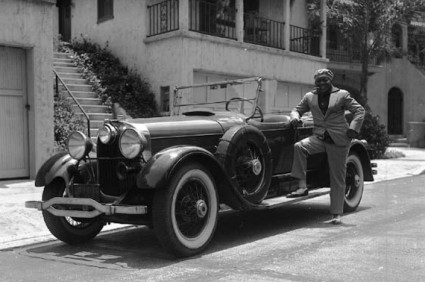
But the most significant effect of the Johnson-Jeffries fight on the world of film came afterwards. The shock of Johnson’s victory terrified white America and thrilled the black community. Immediately the result was known there were racial conflicts throughout the country, resulting in many deaths and injuries. It was not only Johnson’s defeat of a white man, but his very public cockiness, his fondness for fast cars, fancy talk and fancy clothes, and above all his taste for white women (his various white wives were always prominent in newsreel footage of Johnson) compounded the fears. The existence of the film greatly added to the shock. Not only was one forced to read about the unspeakable Johnson becoming champion over the whites, but he could be appearing in your very own neighbourhood. The film of the fight had to be banned. With the racial violence that followed the fight as the primary excuse, and following heavy lobbying by such interest groups as the United Society of Christian Endeavor, the film was soon barred from many individual cities, and fifteen states went further by banning all prize fight films – it was assumed there would be other Johnson fights and other Johnson films, and so the states legislated against all boxing films rather than the specific cases of the Johnson-Jeffries film.

However, no immediate federal law was passed. Such legislation only arose when another Johnson fight film, that of his contest against ‘Fireman’ Jim Flynn on 4 July 1912, threatened further social unrest. Bills had already been introduced by the grossly racist Congressmen Representative Seaborn A. Rodenberry and Senator Furnifold Simmons to prohibit the interstate transportation of fight films, and on 31 July 1912 the legislation was passed. It was now a federal offence to transport fight films over State lines. This naturally had a severe effect on the production and distribution of boxing films, though it by no means stopped them. The ambiguous legislation, which was much challenged as it seemed directly to contradict reasonable commerce, did not necessarily prevent such films’ exhibition, and there was still a large audience keen to see such films, especially the Johnson-Willard contest of 1915 where the victorious Jess Willard finally proved to be the ‘white hope’ so many had been looking for.

One of the most striking attempts to by-pass the ban on interstate transportation occurred in 1916. The film in question was that of the Johnson-Willard fight; the company involved the Pantomimic Corporation (created by L. Lawrence Weber, the producer of the Johnson-Willard film). A motion picture camera was placed eight inches from the New York-Canada border, pointing north. On the Canadian side was placed a tent containing a box with an electric light. Past this was then run a positive of the Johnson-Willard film, which by means of a synchronising device was then photographed on the American side, and thus a duplicate negative (of doubtful quality) was produced. The whole extraordinary process was deliberately given wide publicity, but Pantomimic lost the ensuing court case, for having violated the spirit if not the letter of the law.

The law was a preposterous one, contrary to the basic rules of commerce and unashamedly racist in intent. It was widely violated throughout the 1920s, as the continued production of fight films indicates, and the Johnson ‘threat’ was in any case over. However, it was not until the late 1930s that calls for the legislation to be repealed were heard. Boxing was now seen to be popular among all classes, with a clear following among women, and the new, unthreatening black champion Joe Louis, modesty and courtesy personified, was the very model of what white America hoped to see. The Senate finally passed a bill permitting the interstate shipment of prize fight films on 13 June 1939.

Jack Johnson with one of his fast cars, from the Henry E. Winkler Collection of Boxing Photographs, University of Notre Dame

After the Willard fight, Johnson’s life went into decline. He had been sentenced to a year’s imprisonment in 1913 for violation of the anti-‘white slavery’ Mann Act (“transporting women across state lines for immoral purposes”) but skipped bail and fled to France, where he successfully defended his title against Frank Moran, the film of which was widely derided for its obvious spinning out of the fight to make a more commercial film offering. The Willard fight took place in Havana, Cuba, and he only returned to the USA to serve out his sentence in 1921, after spending time in Spain and Mexico. He carried on fighting in prison and following his release, and continued to appear before the motion picture cameras, though now in dramatic films, albeit very obscure titles made for the Afro-American community: As the World Rolls On (1921) and For His Mother’s Sake (1921) (Johnson had made at least one fiction film during his time in Spain).

Johnson kept on fighting until 1938, as well appearing on stage, refereeing fights, giving talks and making personal appearances. Always fond of fast cars and speeding, he died in a car crash in 1946.

From having been probably the most reviled man of his age, posthumously Johnson has undergone a considerable change in reputation. Always honoured by most fight fans for his boxing ability and his historical importance, he was increasingly held up as an example of black empowerment, starting with Howard Sackler’s 1967 play The Great White Hope, filmed in 1970 with James Earl Jones as the Johnson-like character Jack Jefferson. There then followed Bill Cayton’s Academy Award-nominated documentary Jack Johnson (1970) with its superb Miles Davis jazz score, which ends with the imposing words (spoken by Brock Peters) cited at the top of this post. Sympathetic biographies followed, notably Randy Roberts’ Papa Jack: Jack Johnson and the Era of White Hopes, and recently Geoffrey C. Ward’s book Unforgivable Blackness: The Rise and Fall of Jack Johnson, which was turned into a documentary by Ken Burns with another jazz soundtrack, this time by Wynton Marsalis. There is now a strong move in the US for Johnson’s 1913 conviction to be overturned, with Congress recommending in 2008 that he be granted a presidential pardon, a motion that received the unexpected support of Senator John McCain.

Finding out more
The PBS Unforgiveable Blackness website has extensive information on Jack Johnson and his times, including a special Flash feature on the Jeffries fight.

As noted above, the key biographies are Randy Roberts, Papa Jack: Jack Johnson and the Era of White Hopes, and Geoffrey C. Ward, Unforgivable Blackness: The Rise and Fall of Jack Johnson. On the Johnson-Jeffries fight in particular, see Robert Greenwood, Jack Johnson vs. James Jeffries: The Prize Fight of the Century; Reno, Nevada, July 4, 1910.

For the history of fight films in the silent era, with extensive information on Jack Johnson, there is the excellent Fight Pictures: A History of Boxing and Early Cinema, by Dan Streible, to which this post in much indebted, particularly the filmography. Acknowledgments also to Larry Richards, African American Films Through 1959: A Comprehensive, Illustrated Filmography.

Two essays cover the legislative back ground to the Johnson films: Barak Y. Orbach, ‘The Johnson-Jeffries Fight and Censorship of Black Supremacy‘, and Lee Grieveson, ‘Fighting Films: Race, morality and the governing of cinemas, 1912-1915’, in The Silent Cinema Reader, edited by Grieveson and Peter Kramer.

The Chronicling America site of digitised historic newspapers has a special section on the Johnson-Jeffries fight.

For celebratory centenary events, see www.johnsonjeffries2010.com.

In 2005 Jeffries-Johnson World’s Championship Boxing Contest (1910) was added to the National Film Registry as a work of “enduring significance to American culture”.

Parts of this post are taken from a long essay I wrote for Griffithiana in 1998 entitled ‘Sport and the Silent Screen’.

Filmography

1. Fight films
(Note: Fight films tend to be recorded under a variety of titles, but US copyright titles are given where available. Dates are the dates of the fights)

  • [Jack Johnson v Ben Taylor] (GB, 31 July 1908, producer unknown)
  • World’s Heavyweight Championship Pictures between Tommy Burns and Jack Johnson aka The Burns-Johnson Boxing Contest (GB/Australia, 26 December 1908, Gaumont)
  • World Championship, Jack Johnson vs. Stanley Ketchell [sic] (USA, 16 October 1909, J.W. Coffroth)
  • Jeffries-Johnson World’s Championship Boxing Contest, held at Reno, Nevada, July 4, 1910 (USA, 4 July 1910, J&J Company) [The cut down version held by the BFI is entitled Sights and Scenes from the Johnson-Jeffries Fight. There were also a number of re-enactment films made of the fight – see Streible, Fight Pictures]
  • Jack Johnson vs. Jim Flynn Contest for Heavyweight Championship of the World (USA, 4 July 1912, Jack Curley/Miles Bros.)
  • Johnson-Moran Fight / The Grand Boxing Match for the Heavyweight Championship of the World between Frank Moran and Jack Johnson (France? 27 June 1914)
  • Willard-Johnson Boxing Match (USA, 5 April 1915, Pantomimic/L. Lawrence Weber) [Streible records a pirated version of the fight as well]
  • Note: Denis Gifford’s British Film Catalogue lists a Jack Johnson v Bombardier Billy Wells fight film made in 1911 by Will Barker, but though the film was advertised the fight itself was abandoned and the film never made.

2. Fiction films

  • Une aventure de Jack Johnson, champion de boxe toutes catégories du monde (France 1913)
  • Fuerza y nobleza (Spain 1917-18, four-part serial)
  • Black Thunderbolt (Spain 1917-18, released in USA in 1921 by A.A. Millman, 7 reels) [it is possible that this is the same film as Fuerza y nobleza]
  • The Man in Ebony (USA 1918, T.H.B. Walker’s Colored Pictures, 3 reels) [uncertain credit, because Johnson did not live in the USA 1913-1919]
  • As the World Rolls On (USA 1921, Andlauer Production Company, 7 reels)
  • For His Mother’s Sake (USA 1922, Blackburn Velde Productions, 5-6 reels)
  • Madison Sq. Garden (USA 1932, Paramount) [guest appearance]

3. Other films
(Note: Some of these titles probably reproduce material from earlier releases, such as the Kineto films of Johnson in training)

  • Burns and Johnson Training (GB? 1909) [given by Streible, not by Gifford]
  • Jack Johnson in Training/How Jack Johnson Trains (GB? 1909, Kineto) [given by Streible and BFI database, not by Gifford]
  • Jack Johnson Training Pictures/Jack Johnson Training (GB? 1910, Kineto) [given by Streible, not by Gifford]
  • Johnson Training for his Fight with Jeffries (USA 1910, Chicago Film Picture Co.)
  • Mr Johnson Talks (USA 1910, American Cinephone Co.) [gramophone recording synchronised to film]
  • How the Champion of the World Trains, Jack Johnson in Defence and Attack (GB 1911, Kineto) [given by Streible, not by Gifford. The title of the copy in the Nederlands Filmmuseum is Jack Johnson: Der Meister Boxer der Welt]
  • Jack Johnson, Champion du Monde de Boxe (Poids Lourds) (France 1911) [newsreel]
  • Jack Johnson Paying a Visit to the Manchester Docks (GB 1911) [newsreel]
  • Jack Johnson and Jim Flynn Up-to-date (USA 1912, Johnson-Flynn Feature Film Co.)

Lives in Film no. 2: T.E. Lawrence

I am currently working on a project with Neil Brand to recreate, at least in part, a multimedia show of considerable importance to the popular understanding of one theatre of the First World War, and one man in particular. With Allenby in Palestine and Lawrence in Arabia was the creation of the American journalist Lowell Thomas, who journeyed to Europe on a propaganda mission to uncover stories that would encourage American support for the war. Not satisfied with what he found on the Western front, Thomas moved to Palestine, where General Allenby’s war against the Turks promised a less sullied, more symbolic conflict. And it was there, in Jerusalem in March 1918 that Thomas met the man who was to make his fortune, and whose own fame he was to play a major part in securing.

Thomas famously said of Thomas Edward Lawrence (1888-1935) that he had “a genius for backing into the limelight”. The shy archaeologist working for British intelligence who was instrumental in organising the Arab revolt was simultaneously repelled by and fascinated by fame. This post will not attempt to tell the story of T.E. Lawrence, which is amply documented elsewhere, but it will cover the handful of occasions on which the man who shied away from publicity, to the point where he took on an assumed name and a humble occupation after the war, nevertheless appeared before motion picture cameras. By my calculation he was filmed on five occasions, each for a brief moment only, yet each iconic in its own way. Unlike the many photographs of Lawrence that exist, which seem filled with mystery and contradiction, the films of him capture his ordinariness in extraordinary circumstances.

General Allenby’s Entry into Jerusalem
The first two films of Lawrence to be made were two shots from the same newsreel film taken on 11 December 1917. On 9 December Jerusalem fell to the Allied forces led by General Edmund Allenby, the great hero of the hour. There was obviously huge symbolic significance for Western audiences in seeing Jerusalem being freed from centuries of occupation by the Ottoman Empire. Two days after the city’s capture, Allenby organised a march on foot into the city (intended as a humble gesture to contrast with the Kaiser’s earlier choice to drive into the city). A proclamation was then read out promising respect for all religions.

Taking part in the ceremonies was T.E. Lawrence. He was dressed in British uniform, and appears twice in the official film of the events. The film was made by Harold Jeapes, cameramen for the War Office Official Topical Budget – which changed its names to Pictorial News (Official) when the newsreel was released on 23 February 1918. Jeapes was assisted by a second cameraman, probably the official photographer George Westmoreland. Lawrence was, of course, quite unknown to the outside world at this point, and marches past anonymously as part of the column following Allenby into the city. (Unfortunately I’m not able to illustrate this)

Allenby and Lawrence shown in the newsreel film General Allenby’s Entry into Jerusalem; frame still taken from a compilation film British WWI Film on the Mideast and other Naval Operations, from www.realmilitaryflix.com/public/481.cfm

But the second shot of him in the film is more mysterious. It shows Allenby in conversation with someone, but the figures standing around part, and the small figure of Lawrence emerges, glancing coyly at the camera, almost as if to say you don’t know who I am – but one day you will do. So far as I have been able to tell (and it’s a film I have studied over many years), Lawrence does not appear in that part of the film where the proclamation is read, though it is very likely that he is somewhere among the crowd listening to Allenby’s significant words being read out.

With Allenby in Palestine and Lawrence in Arabia
It was just over two months later, in March 1918, when Lowell Thomas turned up in Jerusalem and asked to see the young officer whose exploits were the subject of marvelled rumour. Thomas was accompanied by Harry Chase, a seasoned photographer also equipped with a motion picture camera, with whom he had been recording Allenby’s campaign, mostly in retrospect.

Lawrence recognised Thomas as the journalist in search of a good story that he was, but also as a reasonable man. He saw that Thomas’ mission could be used to help promote the little-known Arab revolt, but also that he would need to keep Thomas at arms’ length to protect his much-valued privacy. This is borne out in the photographic and cinematographic record. Lawrence permitted Chase to take a number of photographs of himself in Arab dress, both in Jerusalem and outside his tent in Aqaba. Thomas had persuaded Lawrence of the need to have several photographs, on account of the illustrated show that he had in mind. But Thomas only spent a couple of days close to Lawrence, and the film record bears this out.

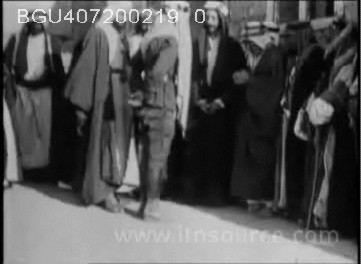
Emir Faisal (bearded) in centre, with Lowell Thomas to his right and a hunched Lawrence (in Arab dress) to his left, translating Thomas’ words. Filmed by Harry Chase. From www.itnsource.com/shotlist//BHC_RTV/1935/05/23/BGU407200219

Lawrence turns up just twice in the films that Chase took. In the first sequence, he is seen in Arab dress amongst a group of Bedouin warriors in an urban setting. Emir Faisal, the future King Faisal I of Iraq (the Alec Guinness character in David Lean’s film) is the central figure. Lawrence is barely visible to the side until Thomas himself walks and speaks to Faisal, at which point Lawrence comes forward to act as interpreter. In the second sequence, Lawrence and Faisal drives past the camera in an army truck, neither distinguishable unless one has prior knowledge. [Doubt has been cast on whether it is Lawrence and Faisal in this shot – see comments]

It is not much of a documentary record, but Lawrence could not have imagined how Thomas’ genius would turn his relatively slender material into a show that would be viewed by millions. Putting together all that he gathered from the various war fronts into a series of shows which he put on in New York in March 1919, Thomas found that his Arabia and Palestine material was easily the most popular. A British impresario, Percy Burton, saw the show, and brought Thomas and Chase (who served as projectionist) over to London, where With Allenby in Palestine opened at the Royal Opera House in the unpromising month of August.

Within days the show – which Thomas labelled a ‘travelogue’ – had become With Allenby in Palestine and Lawrence in Arabia and was the talk of the town. Londoners were charmed by Thomas’ easy-going narrative style (he presented every screening, two a day of a two-hour show) and enthralled by the romance of Lawrence’s exploits. As Thomas told them, here was “one of the most picturesque personalities of modern times, a man who will be blazoned on the romantic pages of history with Raleigh, Drake, Clive and Gordon”.

Lawrence (left) and Faisal in army truck, filmed by Harry Chase. From www.itnsource.com/shotlist//BHC_RTV/1935/05/23/BGU407200219 [See comments – this is not thought to show Lawrence]

It wasn’t exactly historical truth, but it was exactly what audiences wanted. An estimated one million people saw it during its London run (it also played at the Royal Albert Hall, the Philharmonic Hall and the Queen’s Hall) and four million world-wide. The show was a combination of prologue, musical interludes (organ music and the band of the Welsh guards), Thomas’ narration, photographic slides (many of them hand-coloured) and films. It established the romantic legend of Lawrence of Arabia, enshrined in Thomas’ book of that name published in 1924, in the short documentary film of the same title in 1927, and on to the David Lean feature film, which builds on the image of Lawrence created by Lowell Thomas (who is portrayed in the film as Jackson Bentley, played by Arthur Kennedy).

Versailles peace treaty
This is a speculative one. Lawrence attended the Versailles peace conference negotiations as part of Faisal’s delegation between January and May 1919. Some twenty years ago I was watching a television programme on the First World War when an archive film sequence was shown of the Versailles conference. A group of men walked past the camera in the palace grounds, and one of them – I swear – was T.E. Lawrence. I’ve searched high and low for this sequence ever since and never found it (and I can’t remember what the programme was) but I’m certain I saw him. Perhaps someone out there could confirm this or otherwise for me.

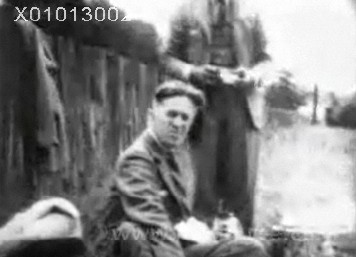
Lawrence at a picnic with publisher Frank N. Doubleday, at some point in the late-1920s/early-30s. From www.itnsource.com/shotlist//BHC_FoxMovietone/1930/01/01/X01013002

The Doubleday ‘home movie’
Following Versailles and a short period serving as an advisor to the Colonial Office, Lawrence turned his back on his growing fame by enlisting in the RAF under the name of John Hume Ross. This attempt as disguised was soon rumbled, but he changed name once more, enlisting in the Tank Corps as Private T.E. Shaw, later rejoining the RAF under this name. But while he was hiding from those who pursued him because of his fame, he was also worked to increase that fame by publishing an account of his experiences as The Seven Pillars of Wisdom (1922). The US publisher of this was Frank N. Doubleday, and the next film of Lawrence is a film taken at some point in the late 1920s (or possibly early 1930s) at a picnic and for a photo shoot outside Doubleday’s home (the first sequence feels like a home movie, but the latter looks professional). A somewhat world-weary-looking Lawrence eyes the camera with something that comes half-way between caution and amusement.

Lawrence (shown arrowed) when Aircraftsman Shaw, disembarking from a ship off Plymouth, from Gaumont Graphic newsreel. From www.itnsource.com/shotlist//BHC_RTV/1929/01/01/BGT407140571

Aircraftsman Shaw
Our final film of Lawrence is pure paparazzi. He was pursued by photographers and cameramen throughout the last years of his life, and finally in February 1929 one newsreel cameraman got lucky. There is a Gaumont Graphic newsreel which shows some wobbly, long-distance shot of the then Aircraftsman Shaw disembarking at Plymouth from India, where he had been on a supposedly secret mission. “Despite all precautions Gaumont Graphic cameraman secures exclusive pictures of ‘elusive Lawrence'” boast the intertitles.

T.E. Lawrence died in a motorcycle accident in May 1935, and the several newsreel films on his funeral lauded his achievements and his legend with what little footage they could muster. The Doubleday picnic film, the Shaw footage and the Thomas footage were used (the latter without anyone pointing out which shots showed Lawrence), but not Lawrence’s appearance in the Jerusalem film. This was not spotted until many years later.

Lawrence’s experience with the motion picture camera says a lot about the progress of twentieth-century fame. Lawrence’s time in the limelight came at just that point where cameras were becoming inescapable and the celebrated had to learn not to avoid them but how to live with them. Television made the game of escape impossible, but the newsreel camera was a little more cumbersome, and those who wanted to flee its gaze could do so for a while, or at least be caught only on the sly. Lawrence mastered photography (and still portraiture in general) because he could control the conditions under which still images of him were taken, but the motion picture camera was more dangerous. It showed more than the myth – it could capture the real man, which above all is what Lawrence wanted to hide.

Our partial recreation of With Allenby in Palestine and Lawrence in Arabia features at the British Silent Film Festival at the Leicester Phoenix or Friday 16 April, at 11.15am. It’s being presented as a work in progress, and depending on how well it goes we’ll see if we can take the project further and devise a fuller recreation of Lowell Thomas’ travelogue.

General Allenby’s Entry into Jerusalem (the short newsreel versions – a longer, ten-minute version also exists) can be seen on the BFI’s Screenonline site, accessible to UK libraries, schools and colleges only. The film is held both by the BFI National Archive and the Imperial War Museum.

Shortened versions of the Lawrence sequences filmed by Harry Chase in 1918 can be seen in a 1935 Gaumont-British News item available on the ITN Source site.

The Doubleday picnic film can be seen on ITN Source and used in a 1935 Fox Movietone memorial item with commentary by Lowell Thomas, included in the same clip.

The various Lowell Thomas films of Allenby and Lawrence, in unedited and edited form, are held by the Imperial War Museum.

An almost complete version of Lowell Thomas’ script for With Allenby in Palestine and Lawrence in Arabia is available on the web archives website of Marist College, USA, which holds the Lowell Thomas papers. The script comes from a presentation of the show in Ireland and has several local references. The Marist site also has a selection of Harry Chase’s photographs and a digitised copy of Thomas’ diary.

Lawrence’s official biographer Jeremy Wilson has an excellent blog on Lawrence, which includes this recent post on Lowell Thomas’ 1919-1920 shows. There is also a fascinating thread from the T.E. Lawrence Studies list, managed by Wilson, discussing the relationship between Lowell Thomas and Lawrence.

Lives in film no. 1: Alfred Dreyfus – part 3

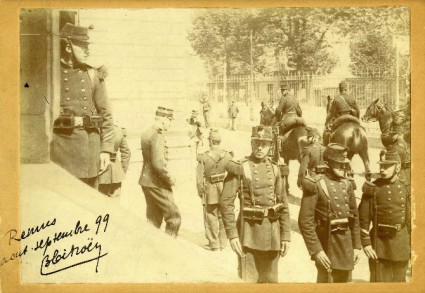
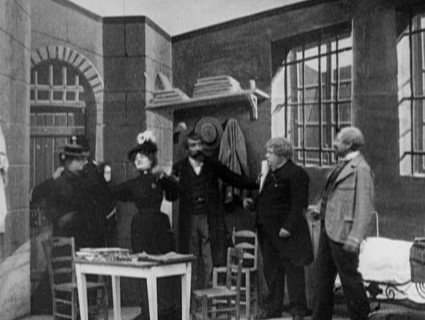
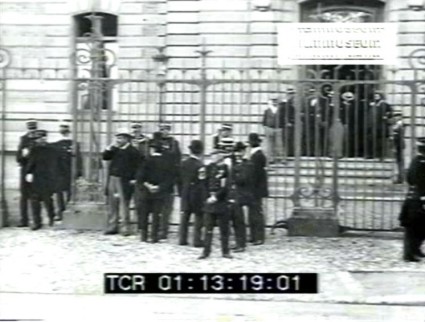
Scene outside the court room at Rennes, probably showing chief prosecution witness General Mercier on the left, from the Société Française de Mutoscope et Biographe Dreyfus trial scene film, courtesy of Filmmuseum, Amsterdam.

Part one of this series covered the early films of the Dreyfus affair made by Georges Méliès; part two completed the picture with the early films made by Biograph and Pathé. This final post supplies a plain filmography, for reference purposes. It includes a film by Lubin which was overlooked for the first two posts. It is arranged by film company. It does not include post-silent era productions.

American Mutoscope and Biograph Company

Dreyfus Receiving His Sentence (USA 1899)
Cast: Lafayette [Sigmund Neuberger] (Alfred Dreyfus)
68mm bw st ??ft
Archive: none
Impersonation. “Lafayette, the mimic, showing Capt. Dreyfus reading the verdict of the court-martial in his prison, and meeting with Madame Dreyfus. This picture is very dramatic, and true to the details of the actual scene.” (American Mutoscope and Biograph Company, Picture Catalogue, 1902)

Trial of Captain Dreyfus (USA 1899)
Cast: Lafayette [Sigmund Neuberger] (Alfred Dreyfus)
68mm bw st ??ft
Archive: none
Impersonation. “An impressive character impersonation by Lafayette, the great mimetic comedian. The scene is from the famous court-martial at Rennes, ending with the prisoner’s dramatic declaration, ‘I am innocent’.” (American Mutoscope and Biograph Company, Picture Catalogue, 1902)

British Mutoscope and Biograph Company

The Zola-Rochefort Duel (UK 1898)
ph. W.K.-L. Dickson
68mm bw st 45″ (30fps)
Archive: Filmmuseum (Amsterdam)
Dramatic sketch. “This is a replica of the famous duel with rapiers between Emile Zola, the novelist, and Henri Rochefort, the statesman. The duel takes place on the identical ground where the original fighting occurred, seconds and doctors being present as in the original combat. The picture gives a good idea of how a French affair of honor is conducted.” (American Mutoscope and Biograph Company, Picture Catalogue, 1902)

Amann, the Great Impersonator (UK c.1899)
Cast: Ludwig Amann (Emile Zola/Alfred Dreyfus)
68mm bw st 30″ (30fps)
Archive: BFI National Archive (London)
Impersonation. Quick-change artist Amann impersonates first Emile Zola and then Alfred Dreyfus.

[American Biograph at the Palace] (UK 1899)
68mm bw st 35″ (30fps)
Archive: Filmmuseum (Amsterdam)
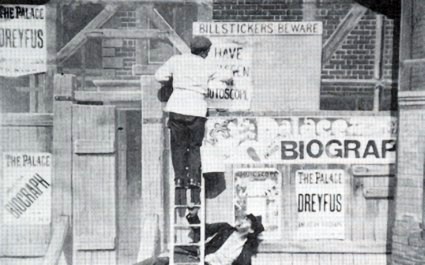
Comic sketch/advertisement. A tramp and a billsticker come to blows while the latter puts up a notice saying ‘Have You Seen the Mutoscope’. There are several posters advertising the Palace Theatre and the Biograph/Mutoscope, two of which mention the Dreyfus films.

Lubin

The Trial of Captain Dreyfuss at Rennes, France (USA 1899)
p. Siegmund Lubin
35mm st bw ??ft
Archive: none
Listed in Library of Congress Motion Pictures Catalog 1894-1912, copyrighted 28 September 1899

Pathé Frères

L’affaire Dreyfus (France 1899)
Jean Liezer (Dreyfus)
35mm bw st 155m
Catalogue nos. 516-523
Archive: BFI National Archive (one, possibly two, episodes only of eight, Entrée au conseil de guerre and maybe Dreyfus dans sa cellule à Rennes)
Description: French descriptions taken from Pathé Frères 1897-1899 catalogue; English versions taken from The Era, 21 September 1899.

No. 516/515: Arrestation, aveux du colonel Henry (20m)
“M. Cavaignac, ministre de la guerre, discute avec son chef de cabinet. Il mande un planton et lui ordonne de faire introduire le colonel. Le ministre interroge l’inculpé et lui présente le faux; le colonel se trouble et nie l’authenticité de la note. Mais, confronté avec le général accusateur, le colonel fait ses aveux. Le ministre le fait arrêter.”

No. 517/516: Au mont Valérien: suicide du Colonel Henry (20m)
“Aspect de la cellule. On aperçoit le colonel très agité. Le prisonnier envoie son gardien porter un message. Pendant ce temps, un général lui rend visite, le prie d’espérer et se retire. Mais le colonel, découragé, saisit son rasoir et, d’un élan énergique, il se coupe la gorge et tombe inanimé sur le sol.”

No. 518/517: Dreyfus dans sa cellule à Rennes / Dreyfus in the Military Prison at Rennes (20m)
“Assis à côté de sa femme, il veut la convaincre de son innocence et la prie d’espérer. Embrassades et pleurs. Un capitaine de gendarmerie entre et prévient Mme Dreyfus que l’heure de sa visite est écoulée.Les époux s’embrassent et Dreyfus reconduit sa femme jusqu’à la porte. Entrent les deux défenseurs: Mes Demange et Labori. Dreyfus les fait asseoir; ils se mettent ensemble à compulser le dossier.” / “Showing the cell in the prison in which Dreyfus, the accused, is confined during the time of his wife’s daily visit. Embraces and tears. A sergeant enters to tell Madame Dreyfus her visiting time is up. The parting of husband and wife is most pathetic and emotional. Dreyfus conducts his wife to the door. The two counsels for the defence, Maîtres Demange and Labori, then enter. The latter with his usual smile on his face full of good nature. Dreyfus asks them to be seated, and the three examine some documents together connected with the case.”

No. 519/518: Entrée au conseil de guerre / Entering the Lycee, 6.0 am (20m)
“Dreyfus traverse la rue et entre au Conseil. Mes Demange et Labori suivent en causant avec animation. Viennent ensuite les officiers témoins: général Mercier et autres, puis le colonel Jouaust, président du Conseil.” / “Streets lined with soldiers with fixed bayonets. Dreyfus with the Captain of Gendarmerie, crosses the street and enters the Lycee. Maître Demange and Labori, who appear very excited, then enter, followed by Officer-witnesses, General Mercier and other well-known personages are easily recognisable. Then comes Colonel Jouaust, the President of the Court.”

No. 520/519: Audience au conseil de guerre / Court Martial at Rennes (20m)
“Les avocats se concertent. Le colonel Jouaust les avertit que la séance va commencer: la cour entre, on introduit l’accusé. Le président donne la parole au général Mercier qui dépose.” / “A scene at the Lycee at Rennes, showing the military Court Matial of Captain Dreyfus. The only occupants of the room at this time are maîtres Demange and Labori, who are holding an animated conversation. The judges begin to arrive, and take their seats, Colonel Jouaust declares the court open, and orders the Sergeant to bring in the accused. Dreyfus enters, saluting the court, followed by the Captain of Gendarmerie, who is constantly with him. They take their appointed seats in front of the judges. Colonel Jouaust asks Adjutant Coupols to call the first witness, and General Mercier arives, and proceeds with his deposition. The scene which is a most faithful portrayal of the Court-Martial at Rennes, shows the absolute portraits of the principal personaes in the famous trial.”

No. 521/520: Sortie du conseil de guerre / Leaving the Lycee (20m)
“Officiers témoins, général Mercier en tête. Puis Dreyfus, accompagné d’un capitaine de gendarmerie. Viennent ensuite Mes Demange et Labori.” / “After the sitting witnesses go out, General Mercier first, followed by a number of others. Then Dreyfus, accompanied by Captain of Gendarmerie. Then Counsels for the Defence, Maîtres Demange and Labori, who seem pleased with their morning’s labours, and glad of the fresh air.”

No. 522: Prison militaire de Rennes, rue Duhamel (20m)
“Arrivée de l’officier d’infanterie assistant à l’entrevue dans la cellule. Arrivée de Mme Havet, tante de Mme Dreyfus et de M, son père. Sortie de Mme Dreyfus; Mme Havet et M l’accompagnent. Sortie de l’officier.”

No. 523: Avenue de la Gare à Rennes (15m)
“Sortie de Dreyfus du lycée. Aussitôt le barrage fermé, deux gendarmes sortent du lycée en traversant l’avenue pour aller ouvrir la porte de la manutention. Vient ensuite Dreyfus, suivi du capitaine de gendarmerie préposé à sa garde.”

L’affaire Dreyfus (France 1908)
d. Lucien Nonguet
p. Ferdinand Zecca
35mm bw st 370m
Catalogue no. 2237
Archive: Archives du Film (?)
Description: “L’Affaire Dreyfus – Cette intéressante vue nous donne une vivante idée des principaux incidents de l’affaire Dreyfus qui troubla si violemment les milieux militaires français en 1894. Alfred-Henri Dreyfus, officier au Ministère de la Guerre, était accusé d’avoir vendu des secrets militaires à une puissance étrangère. Il fut jugé et reconnu coupable, d’après des preuves insuffisantes, puis condamné à la détention à l’île du Diable où il resta huit ans. Jusqu’au moment où l’influence de ses partisans démontra qu’il était victime d’un complot . Finalement, il fut gracié par le président Loubet et reprit sa place dans l’armée. Dans la première scène, on voit Estherazy s’emparer d’un papier sur le bureau d’Henry pour l’envoyer à Swartzkoppen. Henry le voit le prendre, mais n’en laisse rien savoir, parce que c’est lui qui a forgé le document et l’a mis juste à l’endroit où on pouvait s’en emparer. Un garçon du baron découvrit le document sur son bureau et le fit tenir au Ministre de la Guerre – qui soupçonne Dreyfus. Il fait venir ce dernier et le prie de signer son nom. Cela fait, il compare l’écriture avec celle du document et accuse Dreyfus de trahison. Il appelle des agents de la sûreté et Dreyfus est arrêté. Nous le voyons ensuite dans sa cellule où vient le voir sa fidèle femme convaincue de son innocence. Il est traîné devant le conseil de guerre et, après un rapide procès, condamné à une terrible sentence. Alors, il est dégradé en place publique et voit son sabre brisé sur le genou d’un officier, son supérieur. On l’emmène en prison, marqué comme un traître, et c’est une pathétique scène que celle de son départ pour l’île du Diable. On le voit dans sa solitude, alors qu’il passe son temps à regarder l’horizon, rêvant de sa famille dans la patrie lointaine. Enfin, après des années de souffrance, pendant lesquelles ses amis luttèrent pour sa justification, Henry avoue son faux et se suicide. L’heureuse nouvelle de la grâce arrive au prisonnier dans sa case et nous le voyons rentrer en France où il est replacé dans le grade qu’il avait précédemment dans l’armée” Et voilà justement comme on écrit l’histoire au cinématographe-monopole ! Ne croirait-on pas voir quelque vieille image d’Épinal dont se réjouissait notre enfance ? Un tel document au lieu de relever la faveur du cinéma est de nature à l’abaisser … mais quoi ? tout le monde n’est pas Michelet !” [This is a French translation of part of a review in Moving Picture World, 4 July 1908, reproduced at http://filmographie.fondation-jeromeseydoux-pathe.com]

Société Française de Mutoscope et Biographe

[Dreyfus Trial Scenes] (France 1899)
68mm bw st c.4mins (30fps)
Archive: Filmmuseum (Amsterdam)
Actuality. Several scenes filmed at Rennes during the time of the Dreyfus re-trial, including fleeting views of Dreyfus himself and several of the major participants in the drama.

[Trial scene 1]
Scenes at Rennes in front of Lycée court building. Carrying out evidence in a basket? Various presumably notable figures exit the main gates.

[Trial scene 2]
Carriage arrives outside the Lycée for woman, presumably Lucie Dreyfus. Large gathering of military officers.

[Trial scene 3]
Guards on foot and on horseback lined up outside Lycée with their backs to a figure who comes out of the building (presumably Dreyfus) and passes by (view obscured) to left, with rapid panning shot.

[Trial scene 4]
Possibly General Mercier standing by the main gate to the Elysée. Dreyfus’ lawyer Fernand Labori may be in this scene as there are reports of British audiences cheering Labori and booing Mercier.

[Trial scene 5]
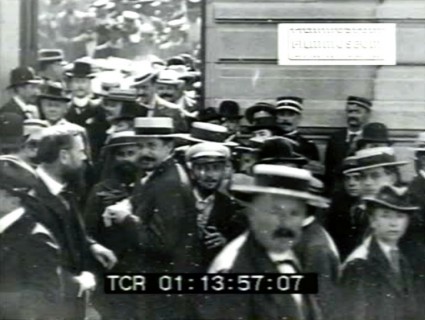
Large crowd (probably journalists) coming out of a doorway during the trial, some of whom recognise the camera.

Dreyfus in Prison
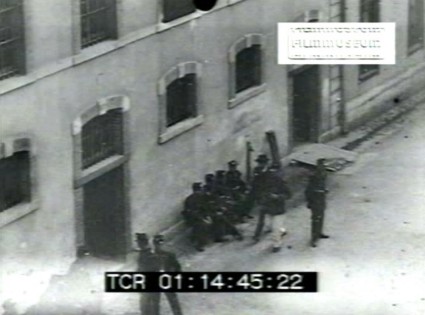
View from above of the prison courtyard showing Dreyfus and an accompanying officer walking out of one door and in through another. Sequence repeated. Title from London Palace Theatre of Varieties programme, 21 August 1899.

Madam Dreyfus Leaving the Prison
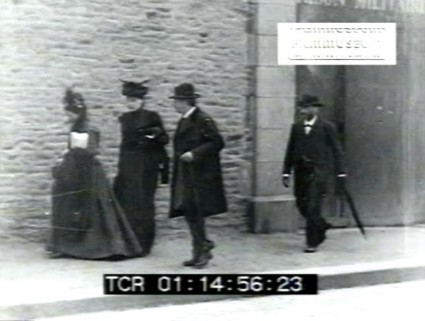
Lucie Dreyfus and her brother-in-law Mathieu Dreyfus walking along street, with panning shot. Title from London Palace Theatre of Varieties programme, 21 August 1899.

Dreyfus Walking from the Lycée to the Prison
Figures leave court room including Dreyfus (only half-visible) past the guards on foot and on horseback all with their backs turned. Dreyfus followed as he passes to the left by panning shot. Guards then disperse. Title from Manchester Palace Theatre of Varieties programme, 4 December 1899.

Star-Film

L’affaire Dreyfus (France 1899)
d. Georges Méliès
Cast: Georges Méliès (Fernand Labori)
35mm bw st 240m c.15mins
Catalogue nos. 206-217
Archive: BFI National Archive (London) [nine episodes from original eleven; nos. 216 and 217 are missing]
Descriptions taken from the Warwick Trading Company catalogue (November 1899):

No. 206: La dictée du bordereau / Arrest of Dreyfus, 1894 (20m)
“Du Paty de Clam requests Captain Dreyfus to write as he dictates for the purpose of ascertaining whether his handwriting conforms to that of the Bordereau. He notices the nervousness of Dreyfus, and accuses him of being the author of the Bordereau. Paty du Clam offers Dreyfus a revolver, with advice to commit suicide. The revolver is scornfully rejected, Dreyfus stating that he had no need for such cowardly methods, proclaiming his innocence.”

No. 216: La dégradation / The Degredation of Dreyfus in 1894 (20m)
[note that the catalogue number is not correct in terms of historical chronology]
“Shows the troops ranging in a quadrant inside the yard of the Military School in Paris. The Adjutant, who conducts the degredation, reads the sentence and proceeds to tear off in succession all of the buttons, laces, and ornaments from the uniform of Captain Dreyfus, who is compelled to pass in disgrace before the troops. A most visual representation of this first act of injustice to Dreyfus.”

No. 207: L’Ile du diable / Dreyfus at Devil’s Island – Within the Palisade (20m)
“The scene opens within the Palisades, showing Dreyfus seated on a block meditating. The guard enters bearing a letter from his wife, which he hands to Captain Dreyfus. The latter reads it and endeavours to talk to the Guard, who, however, refuses to reply, according to strict orders from his Government, causing Dreyfus to become very despondent.”

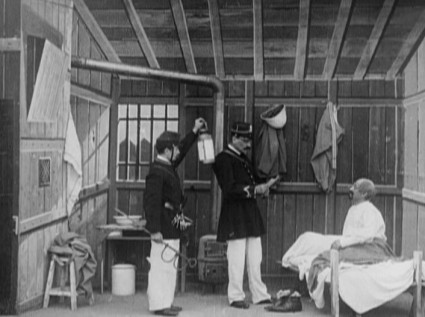
No. 208: Mise aux fers de Dreyfus / Dreyfus Put in Irons – Inside Cell at Devil’s Island (20m)
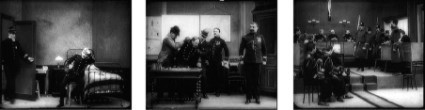
“Showing the interior view of the hut in which Dreyfus is confined. Two guards stealthily approach the cot upon which Dreyfus is sleeping. They awake him and read to him the order from the French minister – M. Lebon – to put him into irons, which they proceed at once to accomplish. Dreyfus vigorously protests against this treatment, which protests, however, fall on deaf ears. The chief sergeant and guards before leaving the hut, inspect the four corners of same by means of a lantern.”

No. 209: Suicide du Colonel Henry / Suicide of Colonel Henry (20m)
“Shows the interior of the cell of the Prison Militaire du Cherche-Midi, Paris, where Colonel Henry is confined. He is seated at a table writing a letter on completion of which he rises and takes a razor out he had concealed in his porte-manteau, with which he cuts his throat. The suicide is discovered by the sergeant of the guard and officers.”

No. 210: Débarquement à Quiberon / Landing of Dreyfus from Devil’s Island (20m)
“A section of the port Quiberon, Bretagne, at night where Dreyfus was landed by French marines, and officers after his transport from Devil’s Island. He is received by the French authorities, officers, and gendarmes, and conducted to the station for his departure to Rennes. This little scene was enacted on a dark rainy night, which is clearly shown in the film. The effects are further heightened by vivid flashes of lightning which are certainly new in cinematography.”

No. 211: Entrevue de Dreyfus et de sa femme à Rennes / Dreyfus in Prison of Rennes (20m)
“Showing room at the military prison at Rennes in which Dreyfus the accused is confined. He is visited by his counsel, Maître Labori and Demange, with whom he is seen in animated conversation. A visit from his wife is announced, who enters. The meeting of the husband and wife is most pathetic and emotional.”

No. 212: Attentat contre Me Labori / The Attempt Against Maître Labori (20m)
“Maître Labori is seen approaching the bridge of Rennes in company with Colonel Picquart and M. Gast, Mayor of Rennes. They notice that they are followed by another man to whom Colonel Picquart calls Labori’s attention. They, however, consider his proximity of no importance, and continue to speak together. As soon as their backs are turned, the man draws a revolver and fires twice at Maître Labori, who is seen to fall to the ground. The culprit makes his escape, pursued by Colonel Picquart and M. Gast.”

No. 213: Bagarre entre journalistes / The Fight of the Journalists at the Lycée (20m)
“During an interval in the proceedings of the court martial, the journalists enter into an animated discussion, resulting in a dispute between Arthur Myer of the `Gaulois’, and Mme Severine of the `Fonde’, resulting in a fight between Dreyfusards and Anti-Dreyfusards, in which canes and chairs are brought down upon the heads of many. The room is finally cleared by the gendarmes.”

Nos: 214-15: Le conseil de guerre en séance à Rennes / The Court Martial at Rennes (40m)
“A scene in the Lycée at Rennes, showing the military court-martial of Captain Dreyfus. The only occupants of the room at this time are Maître Demange and secretary. Other advocates and the stenographers now begin to arrive and the sergeant is seen announcing the arrival of Colonel Jouaust and other officers comprising the seven judges of the court-martial. The five duty judges are also seen in the background. On the left of the picture are seen Commander Cordier and Adjutant Coupois, with their stenographers and gendarmes. On the right are seen Maître Demange, Labori, and their secretaries. Colonel Jouaust orders the Sergeant of the Police to bring in Dreyfus. Dreyfus enters, saluting the court, followed by the Captain of the Gendarmerie, who is constantly with him. They take their appointed seats in front of the judges. Colonel Jouaust puts several questions to Dreyfus, to which he replies in a standing position. He then asks Adjutant Coupois to call the first witness, and General Mercier arrives. He states that his deposition is a lengthy one, and requests a chair, which is passed to him by a gendarme. In a sitting position he proceeds with his deposition. Animated discussion and cross-questioning is exchanged between Colonel Jouaust, General Mercier, and Maître Demange. Captain Dreyfus much excited gets up and vigorously protests against these proceedings. This scene, which is a most faithful portrayal of this proceeding, shows the absolute portraits of over thirty of the principal personages in this famous trial.”

No. 217: Dreyfus allant du lycée à la prison / Officers and Dreyfus Leaving the Lycee (20m)
“The exterior of the Lycee de Rennes, where the famous Dreyfus Court-Martial was conducted, showing hte French staff leaving the building after the sitting, and crossing the yard between the French soldiers forming a double line. Maîtres Demange and Labori also make their appearance, walking towards the foreground of the picture, and at length Captain Dreyfus is seen approaching, being accompanied by the Captain of Gendarmes, who is conducting him back to prison.”

Lives in film no. 1: Alfred Dreyfus – part 2

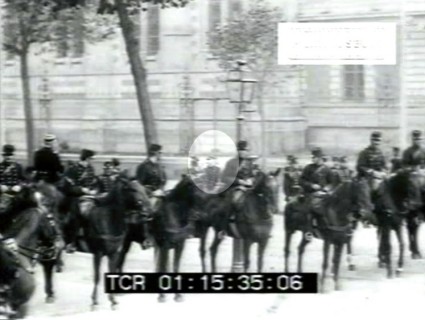
Alfred Dreyfus (inset) walks from the courtroom at Rennes, with the military guard lined up with their backs against him because of the disgrace that he represented. This and other frame grabs taken from the Biograph series of Dreyfus trial scene films, with kind permission of the Filmmuseum, Amsterdam.

This series looks at the ways in which the early motion picture recorded and influenced the lives of some significant individuals. We have started with Alfred Dreyfus, and in part one we saw how Georges Méliès documented the ‘Dreyfus affair’ by creating a multi-part drama that demonstrated great fidelity to genuine incident and appearance. For part two, we look at the responses of other film companies to Dreyfus, which ranged from dramatic sketches to on-the-spot news coverage. Firstly, a recap of the Dreyfus story itself.

The Dreyfus affair
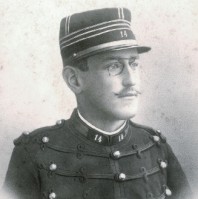
Alfred Dreyfus, a Jewish French officer, was arrested in October 1894 on suspicion of spying for Germany. A military court suspended him from the Army and on highly dubious evidence he was sentenced to life imprisonment on Devil’s Island. In 1896 one Colonel Picquart found documents which seemed to offer convincing evidence of Dreyfus’ innocence and it became apparent that the guilty party was another French officer, Ferdinand Walsin Esterhazy. The military authorities under General Auguste Mercier ordered the matter hushed up, and Picquart was transfered to Tunis. But Dreyfus’ family continued to plead his cause, and a campaign led by the author Emile Zola (who wrote an open letter to the French president Émile Loubet famously entitled ‘J’accuse’) resulted in a fresh trial in 1899, which became a mockery through the Army’s refusal to admit that it could be in the wrong and the general anti-Jewish hysteria that abounded. Dreyfus was found guilty again (to the shock and disgust of world opinion), but President Loubet swiftly pardoned him. The case was reviewed in 1906 and Dreyfus found innocent. The whole affair saw France bitterly divided between Dreyfusards (generally liberals, Socialists, anti-clericals and intellectuals) and anti-Dreyfusards (generally Roman Catholics, monarchists, anti-Semites and nationalists). It became the major political crisis of the Third Republic, and seriously weakened the world view of France as a champion of liberal values.

Francis Doublier
It’s not certain whether Lumière cameraman Francis Doublier‘s tale of exhibiting films of the Dreyfus affair while he was touring Russia in 1898 is apocryphal or not, but it is such a good story – recounted several times in histories of documentary – that has to be included for the record. He told the story several times – this version comes from a lecture that he gave in 1941 at New York University, which was reproduced in 1956 in Image magazine:

The Dreyfus affair was still a source of great interest in those days, and out of it I worked up a little film-story which made me quite a bit of money. Piecing together a shot of some soldiers, one of a battleship, one of the Palais de Justice, and one of a tall gray-haired man, I called it “L’affaire Dreyfus.” People actually believed that this was a filming of the famous case, but one time after a showing a little old man came backstage and inquired of me whether it was an authentic filming of the case. I assured him that it was. The little old man then pointed out that the case had taken place in 1894, just one year before cameras were available. I then confessed my deception, and told him I had shown the pictures because business had been poor and we needed the money. Suffice to say, I never showed “L’affaire Dreyfus” again.
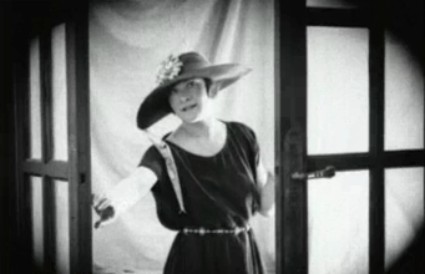
Whatever the precise truth, Doublier’s story reveals two fundamental truths about film – one, that it doesn’t matter what the image literally shows but what you say that it shows that counts; two, that audiences aren’t always quite a dumb as filmmakers like to believe that they are. Or at least some of them aren’t.

Biograph
Biograph is a name associated with D.W. Griffith, but the original company was the American Mutoscope and Biograph Company and it made use of a 68mm filmstock which produced films of startling size and image quality. In term of product, it produced both comic sketches, often of a midly salacious nature for viewing through the peepshow Mutoscope, and films of actuality which tended to feature at prestige theatre screenings. It gained a high reputation for films of news, sport, travel and famous personages, particularly when one of its founders, William Kennedy-Laurie Dickson, moved to Britain in 1897 to become filmmaker for the British Mutoscope and Biograph Company. Biograph diversified further, and the Société Française de Mutoscope et Biographe was formed in 1898. These two companies, and the American parent company, each produced Dreyfus-related films.

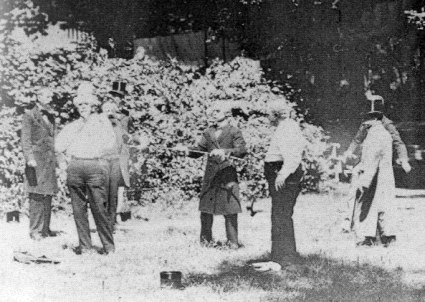
The Zola-Rochefort Duel, from The Wonders of the Biograph (1999/2000).

The first Biograph film related to the Dreyfus affair was the British Mutoscope and Biograph Company’s The Zola-Rochefort Duel, made around June/July 1898. This was the year of Emile Zola’s polemical open letter ‘J’accuse’ which brought the Dreyfus injustice out into the open. Henri Rochefort was a journalist and a rabid anti-Dreyfusard. The film dramatises a duel with swords between the two men in a park. A Biograph catalogue record describes it this:

This is a replica of the famous duel with rapiers between Emile Zola, the novelist, and Henri Rochefort, the statesman. The duel takes place on the identical ground where the original fighting occurred, seconds and doctors being present as in the original combat. The picture gives a good idea of how a French affair of honor is conducted.

However, there was no duel fought between Zola and Rochefort in reality, so either the film is meant to be symbolic or it is based on a false news report.

The American Biograph at the Palace – an advertising film for Biograph films (which were billed in the UK as American Biograph) at the Palace Theatre, London, highlighting films of the Dreyfus trial. From Richard Brown and Barry Anthony, A Victorian Film Enterprise. (1999).

The following year, at the time of the trial, Biograph used all of its publishing muscle (the British company was managed by newspaper and magazine interests) to promote itself as the company with all that anyone needed to see relating to the story of the hour. It produced an advertising film in which a billsticker puts up posters advertising Dreyfus films to be seen at the Palace Theatre in London (Biograph’s showcase theatre). The British company also produced Amann, the Great Impersonator, in which quick-change artist Ludwig Amann poses before the camera as Zola and Dreyfus, while the American branch made two films staring Lafayette, ‘the great mimetic comedian’, entitled The Trial of Captain Dreyfus and Dreyfus Receiving His Sentence (these latter two films do not appear to exist, but the three British films do).

Crowds pouring out of the courtroom at Rennes, filmed by Biograph. Dreyfus trial scenes, Filmmuseum.

However, Biograph’s major contribution to the Dreyfus affair was made by its French branch. The Société Française de Mutoscope et Biographe produced a series of what are effectively news reports filmed outside the courtroom at Rennes during Dreyfus’ second trial over August-September 1899. Here we are taken away from the comic sketches and dramatic reconstructions to the startling reality. The series of films (which are held by the Filmmuseum in Amsterdam) are extraordinary to witness, not just because they document the actuality, but because they do so with a camera style that comes across as all too modern. This is the inquisitive news camera, eagerly gazing on history in the making, making us news voyeurs, as we urge the camera to give us whatever glimpse it can of the personalities involved.

Alfred Dreyfus, in hat and dark civilian clothes, accompanied by an official (with white trousers), walks in the prison yard at Rennes, filmed by the Biograph camera from a high vantage point. Dreyfus trial scenes, Filmmuseum.

The camera operator certainly tried his best (we don’t know his name; some sources credit Julius W. Orde, but he was a director of the French company, not a cameraman). The most remarkable achievement was to capture a few seconds of of Dreyfus exercising in his prison yard, filmed from a platform built on a overlooking roof. It is pure paparazzi, except that the operator was working with a camera which with all its batteries and accoutrements weighed over half a ton. The fleeting sight of the man of the hour became a huge coup for Biograph, its brevity only enhancing the sense of a precious image snatched by the ingenuity of the operator. This film captured the headlines, but a second film of Dreyfus – illustrated at the top of the post – was also obtained, just managing to show him (via a frantic panning shot) walking from the court room across the street with a guard all standing with their backs to him because of the dishonour he represented (there was supposed to be a practical side to it as well, because the guard would be looking out for assassination attempts rather than looking at Dreyfus). A third film in the Filmmuseum set has a similar line-up of guards but it is unclear whether Dreyfus passes through them.

Lucie Dreyfus (second left) and Mathieu (second right) leaving the prison at Rennes, filmed by the Biograph cameraman tracking left. Dreyfus trial scenes, Filmmuseum.

The other film among the Dreyfus set that attracted much interest was filmed of Dreyfus’s wife Lucie and his brother Mathieu walking from the prison, with the camera tracking left to follow them as they turn a corner. The camera feels invasive, but we are also struck by the ordinariness of the scene, as the subjects recede in to the distance and the indifferent passers-by drift past or glance at the oddness of the Biograph camera. The remaining surviving films from this set include shots outside the court, with notable figures coming and going – one appears to be General Mercier, the lead prosecution witness. The films really should receive careful analysis from experts in the field, because none of the footage is accidental; the cameraman was trying as far as he could to capture something of all of the notable names. Another shot shows someones leaving the courtoom and entering a carriage (possibly Lucie Dreyfus), while another shows people pouring out of the courtroom into the open air in such a clear and animated image that the years fall away and we are back there in Rennes in 1899.

The other valuable thing about the Biograph films of the trial is that we know something of their reception. Of the court yard scene, a British theatre reviewer (from an unidentified journal clipping) wrote:

Out … comes Captain Dreyfus in civilian attire escorted by an official. Before the pair have walked five yards towards us the official espies the camera [it is not clear if this is the case], and at once hurries his charge out of sight again through the nearer door. Captain Dreyfus, who has come out for daily exercise, does not get much, for he is not in our sight for more than five seconds. The Biograph kindly repeats the view, not as an encore, but in consideration of its brevity. Without being an artistic success, it is likely to remain for some time the view that will excite the most interest. Last night it was received in ominous silence, but was heralded and succeeded by loud cheers.

This account (part of a longer review) shows how such films could be viewed both ironically and straightforwardly, while exciting a range of emotions in the general audience. Other reports reveal the sympathies of the British audience – film of Dreyfus’ lawyer Labori was cheered, while film of General Mercier was roundly booed (this also indicates that the films had live commentary from someone explaining who was to be seen going in or out of the courtroom).

Pathé
While Georges Méliès’s L’affaire Dreyfus (discussed in part one) is relatively well-known, the L’affaire Dreyfus series produced by Pathé is less-discussed, chiefly because only one part of an original eight items survives. However it was quite similar in method to Méliès’s films, using dramatisation to document the reality and breaking up the the story into dramatic tableaux which could either be viewed singly or as a complete set. In this case we know the name of the actor who played Dreyfus – Jean Liezer. These are the titles of the individual episodes:

  • Arrestation, aveux du colonel Henry
  • Au mont Valérien: suicide du Colonel Henry
  • Dreyfus dans sa cellule à Rennes
  • Entrée au conseil de guerre
  • Audience au conseil de guerre
  • Sortie du conseil de guerre
  • Prison militaire de Rennes, rue Duhamel
  • Avenue de la Gare à Rennes

Each episode was 20 metres in length. To judge from the one episode that survives (at the BFI National Archive), Dreyfus dans sa cellule à Rennes, the style was more restrained than that adopted by Méliès (though Pathé like Méliès showed the bloody suicide of Colonel Henry). It place emphasis on producing a pseudo-realistic of the personalities and places involved, with a greater concentration on the events surrounding the second trial (conseil de guerre). The extant film (no still available to illustrate, unfortunately) shows the guards with their backs to those entering the courtroom. Were the whole series to survive, one suspects that it would be a comparable work to that of Méliès, in its keen attention to detail if not in dramatic verve.

Frames from L’affaire Dreyfus (1908), directed by Lucien Nonguet, from Dreyfus à l’écran film programme, Musée d’art et d’histoire du Judaïsme, 2008

What does survive, however, is a second Pathé film, made nine years after the trial and two years after Dreyfus was finally found innocent. This is a longer work (370 metres) and a single, multi-scene film, directed by Lucien Nonguet and produced by Ferdinand Zecca. However, from the frame stills (I’ve not seen the film myself) the mise-en-scène seems remarkably similar to the 1899 films, the emphasis still being on documenting the look of key incidents through close replication of people and locations (compare the trial scene, to the right of the above frames, with the trial scene filmed by Méliès, illustrated in part one). The major difference comes through an additional character – this L’affaire Dreyfus features Esterhazy, the man who produced the document betraying French miitary secrets to the Germans that Dreyfus was accused of having written. His guilt is made clear from the opening scene, turning a series of unfortunate incidents in something with tragic impetus.

Photograph of Dreyfus leaving the courtroom at Rennes, showing the guard with their backs turned. Taken from the Dreyfus Rehabilitated site, http://www.dreyfus.culture.fr

Envoi
The 1909 film was the last to be made of the Dreyfus case until 1930. In 1915 the French banned any dramatic representation of the Dreyfus case from being made, and when Richard Oswald’s 1930 feature film Dreyfus was made, France still refused to allow it to be screened. But for the silent period, it was documenting history in the making that was important. The young medium used every means at its disposal to record the news story of 1899 (for some, the news story of the century) and to turn it into profitable entertainment. It employed both dramatic reconstruction and actuality, pushing the boundaries of the medium’s expression in each case, and demonstrating the power of motion pictures to capture the moment in a form that no other medium could quite emulate. Cinema brought you face to face with life itself.

Though it may be something of an inappropriate speculation, given Dreyfus’s Jewish faith, there is something of the Christian Stations of the Cross in the early Dreyfus films. Each illustrates the key stages in the victim’s noble passage to the point where false justice is executed through a series of tableaux. In each the victim is noble, passive, and wronged. The narrative does not develop in a form that is understandable to anyone new to the story, but instead represents passages of suffering told through tableaux that the faithful will recognise as having special meaning. It is interesting that the main multi-scene film narratives made in the 1890s are the two L’affaire Dreyfus films, assorted lives of Christ (by Lumière, Pathé and others), and Méliès’ Cendrillion (1899), or Cinderella – another episodic tale of suffering and redemption.

But what of Alfred Dreyfus himself? He is not recorded as being aware of the films that were made of him, and of course they were only a trivial distraction in the context of the issues that raged around him, issues of patriotism, religion, race and social order. Dreyfus was pardoned soon after the farce of the second trial, and was finally pronounced innocent in 1906. Despite the way it had treated him, he rejoined the Army, but retired on grounds of ill-health in 1907. However, he joined the Army once more in 1914 and rose to the rank of lieutenant colonel (he had had hopes of eventually becoming a general before the catastrophe of 1894). He was awarded the Légion d’honneur in 1918, and died in 1935.

Information on Biograph, including the filming and exhibiting of Biograph films, can be found in two sources in particular: Richard Brown and Barry Anthony, A Victorian Film Enterprise: The History of the British Mutoscope and Biograph Company, 1897-1915 (1999) and Mark van den Tempel and Luke McKernan (eds.), The Wonders of the Biograph, special issue of Griffithiana, nos. 66/70, 1999/2000). Although more has been discovered since it was written (not least the Biograph trial films), Stephen Bottomore’s article ‘Dreyfus and Documentary’, Sight and Sound (Autumn 1984) is still the best source for learning about the relationship between the Dreyfus affair and early film. Stephen also covers still photography, making it clear just what a media scramble the whole Affair was.

For extensive background information on the Dreyfus affair, the personalities and the issues involved, see the generally excellent Dreyfus Rehabiliated website. Unfortunately its section on the films of the affair is muddled. For a concise and informative book acount, see Eric Cahm, The Dreyfus Affair in French Society and Politics. For an atmospheric eye-witness account of the second trial itself, read G.W. Steevens’ The Tragedy of Dreyfus (1899), available from the Internet Archive.

The Biograph and Pathé films are not available online or on DVD.

The third and final part of this account will be a filmography.

Lives in film no. 1: Alfred Dreyfus – part 1

L’affaire Dreyfus: la dictée du bordereau – the first part of Georges Méliès’ 1899 film series. October 1894 – Dreyfus (seated) gives a sample of his handwriting and is accused by Colonel Du Paty de Clam (left) of being the author of the Bordereau

I’m starting up a new series here at the Bioscope. It is going to document the ways in which the early motion picture recorded and influenced the lives of some significant individuals. Public lives from 1896 onwards started to be different to a significant degree because they began to be led in front of motion picture cameras, which could record them in reality or reconstitute them dramatically as entertainment. Each post in the series will investigate an individual of significance to social, cultural or political history and try to see them particularly in the light of the cinema. Each post will include a filmography including both non-fiction and fiction films. I don’t know whether any of the subjects will be actors or filmmakers – maybe so. But the series starts with a French soldier, victim of one of the most notorious cases of miscarriage of justice in history, Alfred Dreyfus.

The Dreyfus affair
Alfred Dreyfus (1859-1935), a Jewish French officer, was arrested in October 1894 on suspicion of spying for Germany. A military court suspended him from the Army and on highly dubious evidence he was sentenced to life imprisonment on Devil’s Island. In 1896 one Colonel Picquart found documents which seemed to offer convincing evidence of Dreyfus’ innocence and it became apparent that the guilty party was another French officer, Ferdinand Walsin Esterhazy. The military authorities under General Auguste Mercier ordered the matter hushed up, and Picquart was transfered to Tunis. But Dreyfus’ family continued to plead his cause, and a campaign led by the author Emile Zola (who wrote an open letter to the French president Émile Loubet famously entitled ‘J’accuse’) resulted in a fresh trial in 1899, which became a mockery through the Army’s refusal to admit that it could be in the wrong and the general anti-Jewish hysteria that abounded. Dreyfus was found guilty again (to the shock and disgust of world opinion), but President Loubet swiftly pardoned him. The case was reviewed in 1906 and Dreyfus found innocent. The whole affair saw France bitterly divided between Dreyfusards (generally liberals, Socialists, anti-clericals and intellectuals) and anti-Dreyfusards (generally Roman Catholics, monarchists, anti-Semites and nationalists). It became the major political crisis of the Third Republic, and seriously weakened the world view of France as a champion of liberal values.

L’affaire Dreyfus: L’île du diable. April 1895 – Dreyfus (seated) within the palisade on Devil’s Island, where a guard brings him a letter from his wife but is forbidden to speak to him. Dreyfus was imprisoned on the island for over four years.

The Dreyfus affair was debated across the world. It filled the newspapers, and the second trial at Rennes in 1899 witnessed a media frenzy of a kind we are all too familiar with today. Eager to participate in that frenzy and take advantage of one of the first news stories of worldwide interest to come into its view was the motion picture camera. Films were made of the Dreyfus affair because they were excellent business, but also – in one significant case – because they enabled the filmmaker to express his dedication to the Dreyfus cause. The motion picture industry responded with newsfilm, dramatic reconstructions and sketches, so that the Affair served as a demonstration of everything that the young medium could do to capture the semblance of reality.

L’affaire Dreyfus: Mise aux fers de Dreyfus. 6 September 1896 – Dreyfus is placed in irons inside his cell on Devil’s Island. He was shackled to his bed for a period between September-October 1896 after a false report of an escape attempt.

Four companies produced films on the Affair while it was ongoing: Star-Film (i.e. Georges Méliès), Pathé Frères, the British Mutoscope and Biograph Company and its sister company the Biograph and Mutoscope Company for France. There’s a lot to cover so the latter three will be covered in a second post, with a full filmography in a third post. Here we will tackle the contribution by Georges Méliès.

Star-Film
George Méliès is said to have picked up his strong Dreyfusard feelings from discussions with his cousin Adolphe. It is heartening to know that France’s great creative filmmaker in the early years of cinema chose the right side. He set about making his Dreyfus films with an eye to commercial opportunity but also as a means to express his personal sympathies – probably the first time that film had ever been used in this way. His approach was radical – he would make a multi-part news narrative, tracing the Dreyfus story from his original imprisonment in 1894 to the second trial in 1899. At a time when films were almost entirely single-shot narratives of less than a minute in length, Méliès produced a 15-minute, eleven-part chronological series of documentary fidelity and great cinematic invention (strictly speaking it was twelve parts, as one scene covers two catalogue numbers in the Star-Film catalogue). Filming took place August-September 1899, while the trial was taking place, at his studios at Montreuil, Paris.

L’affaire Dreyfus: Suicide du Colonel Henry. 31 August 1898 – Colonel Joseph Henry, who discovered the ‘bordereau’ that incriminated Dreyfus but who later forged documents in an attempt to compromise the Dreyfus-supporting Colonel Picquard, cuts his throat with a razor while in prison in Paris.

Méliès did not consider filming actuality – he got nearer to his idea of the truth through dramatic recreation. He took great care to replicate locations, using newspaper illustrations and photographs as reference, and employing performers who looked like the leading players in the real-life drama. An unnamed blacksmith played Dreyfus because of a physical similarity, while Méliès himself played Dreyfus’ bearded lawyer, Fernand Labori. The choice of tableaux indicate Méliès’s sympathies while showing both his commercial sense and artistic imagination. The series (nine parts of the original eleven survive today at the BFI National Archive and are illustrated throughout this post) starts with Dreyfus being accused of writing the Bordereau, the notorious document that betrayed French military secrets to the Germans. The scene in which Dreyfus was dishonourably discharged from the French army by having his sword symbolically broken is lost, so next comes Dreyfus imprisoned on Devil’s Island, followed by a scene in his cell in which he is placed in leg-irons, punishment for a supposed escape attempt. Méliès’s Dreyfusard sympathies are already made clear. The scene then switches to France to show Colonel Henry in prison, the man whose zealous loyalty led him to forge documents intended to compromise Dreyfus supporter Colonel Picquard, spectacularly cutting his throat with a razor blade. It’s the point where Méliès meets Tarantino; probably the first blood to be seen shed in cinema history.

L’affaire Dreyfus: Débarquement à Quiberon. 30 June 1899 – Dreyfus (the figure in civilian clothes in the centre) returns to France at Quiberon (where a storm rages) to face his second trial.

With the next scene the news realism takes over. Dreyfus is shown returning to France at the port of Quiberon, at night, in the middle of a storm. Lightning flashes, the performers are soaked in water, sailors on the boat bob up and down on the waters – it is as far as possible the scene as it had occured only a few weeks before Méliès started filming. We then see Dreyfus in jail, where he converses with his lawyers (including Méliès as Labori, giving himself the heroic defender role – was this series the first set of films in which named living people were portrayed by actors?) before meeting with his wife Lucie in a calculatedly pathetic scene.

L’affaire Dreyfus: Entrevue de Dreyfus et de sa femme à Rennes. 1 July 1899 – Dreyfus (furthest right) in prison at Rennes meets his wife Lucie for the first time in four years. Georges Méliès, playing the lawyer Labori, is the figure in the centre, with another Dreyfus lawyer, Edgar Demange, portrayed to the right.

Next follows what was an assassination attempt on Labori, Méliès going to the trouble of replicating the locale, next to a bridge crossing the river Vilaine at Rennes. Labori survived a shot in the back and is seen in the next scene in which Dreyfusard and anti-Dreyfusard journalists come to blows. The scene appears symbolic, but reflects actual uproar that occurred at the court-house in Rennes on 14 August 1899 when news of the attack on Labori was reported, with a confrontation occuring between anti-Dreyfusard Arthur Myer of the Gaulois and Dreyfusard ‘Séverine’ (Caroline Rémy) of the Fonde, as the Star-Film catalogue relates. A New York Times report makes clear the connection between the two incidents. For film form enthusiasts the scene is most remarkable for the way the journalists all run at and past the camera, breaking the cinema screen’s fourth wall in revolutionary style. However there is some dramatic licence, because the injured Labori did not return to the trial for a week after the shooting.

L’affaire Dreyfus: Attentat contre M. Labori. 14 August 1899 – In the company of Colonel Picquart and M. Gast, Mayor of Rennes, Dreyfus’s lawyer Labori is shot in the back by a would-be assassin beside the river Vilaine at Rennes.

L’affaire Dreyfus: Bagarre entre journalistes. 14 August 1899 – rival news reporters fight one another during the court martial proceedings upon hearing the news of the attempted assassination of Labori.

The double-length court room scene is where Méliès took the greatest trouble in depicting the news as it was more or less happening. The catalogue description makes clear the minute attention to detail regarding personality, action and appearance (text from the English language version in the Warwick Trading Company catalogue):

A scene in the Lycée at Rennes, showing the military court-martial of Captain Dreyfus. The only occupants of the room at this time are Maître Demange and secretary. Other advocates and the stenographers now begin to arrive and the sergeant is seen announcing the arrival of Colonel Jouaust and other officers comprising the seven judges of the court-martial. The five duty judges are also seen in the background. On the left of the picture are seen Commander Cordier and Adjutant Coupois, with their stenographers and gendarmes. On the right are seen Maître Demange, Labori, and their secretaries. Colonel Jouaust orders the Sergeant of the Police to bring in Dreyfus. Dreyfus enters, saluting the court, followed by the Captain of the Gendarmerie, who is constantly with him. They take their appointed seats in front of the judges. Colonel Jouaust puts several questions to Dreyfus, to which he replies in a standing position. He then asks Adjutant Coupois to call the first witness, and General Mercier arrives. He states that his deposition is a lengthy one, and requests a chair, which is passed to him by a gendarme. In a sitting position he proceeds with his deposition. Animated discussion and cross-questioning is exchanged between Colonel Jouaust, General Mercier, and Maître Demange. Captain Dreyfus much excited gets up and vigorously protests against these proceedings. This scene, which is a most faithful portrayal of this proceeding, shows the absolute portraits of over thirty of the principal personages in this famous trial.

L’affaire Dreyfus: Le conseil de guerre en séance à Rennes. 12 August 1899 – The court room at Rennes, with the lead prosecution witness General Mercier (centre) making a showy entrance. Dreyfus, dressed in military uniform, is seated on the raised dais to the right.

L’affaire Dreyfus concluded with a now-lost scene showing Dreyfus being led away to prison once more. The set of films was produced with the intention of capturing audience attention immediately following the trial (which ended on 9 September 1899). The films could be bought as a complete set (lasting some 15 minutes) or individually, according to taste and pocket. Méliès’ granddaughter much later wrote that there were pitched battles in the theatres where the films were shown. Police had to separate Dreyfusards from anti-Dreyfusards, which supposedly led to the film being banned by the French government and that consequently no film was allowed to be shown about the Dreyfus affair until 1930. However, there is no concrete documentary evidence that I’m aware of for the film being banned, or even for the scuffles in theatres, and in any case the French ban on accounts of the Dreyfus affair was not made until 1915 (so, for example, Pathé made a film about Dreyfus in 1908). However, there must have been great uncertainty among some exhibitors about showing the film, as film historian Stephen Bottomore suggests that some British theatres chose not to screen the films because of the unseemly passions they might arouse, so one can hardly expect less of a reaction that this in France. Nevertheless the films were never removed from the Star-Film catalogue, and by remaining on sale one has to deduce that they were never banned, not in France or anywhere else.

In truth we don’t know much about the reception of Méliès’ films. We have commentaries, and we have concerns raised in some quarters about the dramatisation of actuality. “Where is this new kind of photo-faking to stop?” asked Photographic News, wringing its hands in mock despair. What we can gather from watching what survives today is that the news story gave the filmmaker the opportunity to produce a documentary (there can be no other word for it) using every valid filmic device at his disposal while expressing through the mise-en-scène his sympathy for Dreyfus the victim.

Unsurprisingly the films do not give us much of an idea of Dreyfus the man, but it is remarkable that they give us anything of him at all. Throughout the affair, and in all acounts that were made of it, Alfred Dreyfus was a cipher, a figure upon who one could unload one’s prejudices or sympathies. Dreyfus (shown left, in 1895) was not an unremarkable man. He had had a notable military career, and was recognised for his keen intelligence. He seems to have been something of an unpopular figure, however, standing out from his fellow officers by being neither one of the humbler sort (he was wealthier than most of them) nor an aristocrat. A perceived aloofness stood against him. During both trials he refused to play the pity card and put his faith in reason – a stubborn policy when surrounded by such rabid anti-Semitism and blind refusal from many to accept that the French military could do any wrong. But there was nobility in such a stance, and Méliès’ Dreyfus does at least give us some sense of his principled forebearance, and this at a time when films had not yet advanced to giving much sense of individual character in dramatic representations. Among the many ‘firsts’ that can be ascribed to L’affaire Dreyfus is surely the first human portrayal of someone on screen.

The Méliès L’affaire Dreyfus is available to view online on the Europa Film Treasures site and as part of the 5-DVD set issued by Flicker Alley, Georges Méliès: First Wizard of Cinema (1896-1913) (also the source of the frame grabs used here). For a filmic analysis, see Michael Brooke’s Georges Méliès blog.

For extensive background information on the Dreyfus affair, the personalities and the issues involved, see the excellent Dreyfus Rehabiliated website. Unfortunately its section on the films of the affair is muddled. For a concise and informative book acount, see Eric Cahm, The Dreyfus Affair in French Society and Politics.

The essential account of the Dreyfus Affair and early film is Stephen Bottomore’s essay ‘Dreyfus and Documentary’, Sight and Sound, Autumn 1984, to which these posts are much indebted.

Part two will explore the dramatic records made by Pathé, at the time of the trial and later, and the extraordinary actuality films of the trial made by Biograph. Part three will be a Dreyfus filmography.

The great Londoner

Yesterday an exhibition opened at the London Film Museum, Charlie Chaplin – The Great Londoner. The exhibition promises “insights into the life and career of Charles Chaplin, the boy from the London slums who won universal fame with his screen character of the Tramp, and went on to become a Knight of the British Empire”. Produced by Jonathan Sands and devised by Leslie Hardcastle in collaboration with David Robinson, Chaplin’s biographer, the exhibition is in six sections, described thus:

A London Boyhood
Charles Chaplin was born in 1889 in East Street, Lambeth, and his early years were spent, often in acute poverty, in this square mile to the South and East of the present London Film Museum. This section evokes the life of the poor in late Victorian Lambeth, and the escape provided by the light, colour and fun of the music halls, in which his parents were performers.

A Child of the Theatre
At the age of 10 the young Chaplin found work in a juvenile music hall troupe, and his future was decided. As a boy actor he made his mark as the comic page-boy in Sherlock Holmes, and even played the role in the West End. But his greatest success came in the music hall, and at 20 he was already a star of the Karno comedy companies. This section sets out to recall the atmosphere and the stars of the music halls, with memorabilia relating to Chaplin’s own stage career.

America and the movies
Between 1910 and 1913 Chaplin twice toured the American vaudeville circuits as a star of the Karno company, and was greatly excited by his encounter with the New World. At the end of 1913 he yielded to an offer from the Keystone Comedy Company, ruled by Mack Sennett and arrived in Hollywood. At first disoriented by the new medium, he learned rapidly, and within weeks was directing his own films. The exhibition evokes the buccaneering atmosphere of early Hollywood, its primitive studios, and its rapid evolution towards an international industry.

The Tramp
Searching for a character for his second film, Chaplin put together a costume from elements found in the Keystone wardrobe shed. The result – the Tramp – achieved instant popularity and within a year or two was known and loved across the world. Chaplin’s creation remains to this day the screen’s iconic and most universally recognised character.

Citizen of the World
When Chaplin finally took a rest and visited Europe in 1921, he was astonished to find himself a world celebrity, mobbed by crowds everywhere he went, and sought out by the great men of the day. Increasingly he used his comedy to comment on the fundamental problems of humanity. Modern Times is a broad-ranging social critique; and in The Great Dictator, having finally abandoned his character of the Tramp, he pillories Adolf Hitler, fascinated by the physical resemblance between the best-loved man in the world and the most hated.

The Happy Exile
In the paranoia of the Cold War years, Chaplin became an object of suspicion to the Communist-obsessed American political right. His anti-war statements in Monsieur Verdoux and his friendships with liberal intellectuals led to increasingly virulent attacks and accusations of Communist sympathies. In 1952 he came to England for the premiere of his last American film, Limelight (a recollection of the London music halls of his youth) never permanently to return to the United States. His final years were spent contentedly in Switzerland, surrounded by his growing family and still planning films, two of which, A King In New York and A Countess from Hong Kong, were made in Britain.

This is good news, and the exhibition will also become part of the permanent museum display. But what’s the London Film Museum, eh? Last time I looked there wasn’t one. The Museum of the Moving Image (MOMI) sadly closed in 1999, and in 2008 an odd and seemingly short-term attraction with the ungainly title of The Movieum appeared on the South Bank as part of the popular attractions based in the former County Hall complex. It didn’t look like it would last long or offer much.

Bu the Movieum has turned out to have more staying power and ambition towards being a genuine commemoration and repository for moving image heritage than one might have supposed. It has been rebranded as the London Film Museum (strictly speaking, the London Film Museum now incorporates the Movieum), at the same location, and the first expression of its new status is the Chaplin exhibition. And, as some will know, Leslie Hardcastle was one of the presiding geniuses behind MOMI, so to have his approval of the new venture is significant indeed. We shall watch these developments with interest.

Catwalks and pavements

Paris fashions displayed through stencil colouring, from the Discovering Cinema DVD, www.flickeralley.com

A subject I’ve long meant to cover on the Bioscope is fashion in silent film. It’s a subject of great importance, because of the strong relationship between what was worn on the screen and what the audience in the cinema then dreamt of wearing. That relationship was exploited commercially, by fashion firms whose products featured in films and by those stars who were used to promote fashions (on and off-screen). Moreover, there is an equally important, if less recognised connection between fashion and film, which is the record that film can provide of what ordinary people in the street were wearing. Fashion is found not just on the catwalk or the movie screen, but on the pavement as well.

However, I am no expert in fashion (as anyone who has seen how I dress would be quick to affirm). But I can produce a guide to some sources, particularly online video sources, to help those who might like to explore this area further for themselves.

Let’s start with films of the fashion houses. Short films showcasing the latest fashions from the Paris houses were a staple of film programmes of the 1910s and 20s. Films showing mannequins parading gowns, hats and shoes beyond the hopes of most in the cinema audience were seen in individual films and occasional special film series, but more commonly as part of newsreels and cinemagazines. Beyond the hopes of most they may have been, but not all. There was commercial sense in it because coturier fashions were starting to move from appealing to the exclusively rich and were starting to appear in department stores, just at the time when cinema was doing it best to attract a more middle class and monied audience. Fashion films were part of the general aspirational trend of the cinema, and they were there in particular to attract women to the cinema.

French film companies became the natural specialists in the field, not least because Pathé and Gamuont had factories dedicated to producing artificially coloured films employing a stencilling process (and many women workers painting the individual frames using those stencils). Fashion films in which the models moved slowly displaying gorgeously coloured gowns were ideal subjects for a colour process that struggled to capture objects moving at speed. Colour was naturally attractive for the fashion film, and fashions were a fine means of showing off colour processes. One of the earliest of all magazine film series was Kinemacolor Fashion Gazette (1913), edited by British fashion journalist Abby Meehan, which showcased the pioneering natual colour process and combined its exhibition with a live fashion revue organised by the Evening News newspaper at the West End Cinema in London.

An exquisite example of a stencil colour fashion film can be found on the Flicker Alley site, in its Screening Room – a 1926 Unie Film Revue from the Netherlands showing fashions from Maison Redfern, Maison Blanche Lebouvier and Maison Tolmann (click on the Discovering Cinema option – the clip comes from their Discovering Cinema 2-DVD set, or you can find the same film on Europa Film Treasures). There’s a frame grab at the head of this post. And below is a c.1927 colour tinted film from Australian Screen, here showing off a Le Mennier headpiece:

Scene from Camp-Berlei Foundation Garments: Physiological Support (c.1927), from Australian Screen, http://aso.gov.au/titles/ads/camp-berlei-foundation/clip1/

Colour fashion films from the silent era are hard to find online, but there are monochrome examples a-plenty. The British branch of Pathé featured many fashion items, particularly in its women’s magazine series Eve’s Film Review, and numerous examples (including Fashions à la Parisienne, illustrated below) can be found at www.britishpathe.com (type in ‘fashions’, ‘maison’ or ‘paris fashions’ for the best results.

A black and blue hat with ribbon cockade and flowers from Maison Mimoso, from Fashions à la Parisienne, Eve’s Film Review (c.1921), www.britishpathe.com

The sheer extent of fashion films in British newsreels can best be judge by applying the same search terms to the BUFVC’s News on Screen database of all British newsreels, though there are no clips (there are links across to the Pathé site, however). Or search under such fashion houses as Lucile’s (i.e. Lady Duff-Gordon, sister of Elinor Glyn), Maison Lewis, Marco’s, Joseph Paquin, Maison Worth and Paul Poiret. British Gaumont films (which as with Pathé include many international films which happened to be released through the British reels) can be seen on the ITN Source site – go to Advanced Search, click Deselect All under Partners then click on New Classics, select 1920s as a decade, then put in your search term. There are numerous fashion clips there, such as this interesting example of Chinese fashions (actually from the American International News):

New Fashions for Chinese Flappers, International News (1926), www.itnsource.com/shotlist//BHC_RTV/1926/03/15/BGT407111003

Gaumont’s early 1920s Around the Town cinemagazine had many fashion-related items, though only a few examples of the series exist today, and none online (many of the lost films can nevertheless be found described on News on Screen). Examples from French Gaumont and Pathé can be found on www.gaumontpathearchives.com, though that requires registration and it’s not easy to obtain permission unless you are a production company.

But as said, there was more to fashion than Paris. One of the overlooked virtues of archive films is what they are able to show us of what we wore. There is nothing quite like film for showing what was worn by people day-to-day, how those clothes fitted in motion, and how popular fashions changed. Again the newsreels provide an excellent source, but a still more useful one has just emerged from Brighton. It was Brighton professor Lou Taylor whose 1980s television series Through the Looking Glass first alerted me to the value of using archive actuality film to study what ordinary people were wearing, and it is the University of Brighton’s Screen Archive South East which is the source of Screen Search Fashion, a thematic guide to fashion and dress in films of the 1920s and 30s held in the Archive’s collection.

Group of people standing outside the Heath cinema in Haywards Heath, c.1928, from the Screen Archive South East collection

This wonderful resource employs selected themes (1920s fashion, 1930s fashion, work, sport, leisure, travel etc) to guide users through the collections, using stills and clips from the Archive. There are overviews of types of fashion and periods, descriptions of the clothing to be seen in the clips, and even modern photographs of particular clothes for comparison (or else links to external collections). As an example of the descriptive text, here is part of what’s written about the Heath cinema film above:

A group of young people stand outside a cinema in Burgess Hill. The men wear three-piece suits. One man wears the fashionable ‘plus fours’ style popularised by the Prince of Wales rather than full-length trousers. The women follow the fashionable androgynous silhouette of the period with knee-length hemlines. They wear interchangeable separates including sweaters, skirts, dresses and coats. One woman sports a necktie reinforcing the boyish look. Their clothing is probably ready-to-wear rather than made by a dressmaker. All the women have bobbed hair and none wear hats.

This is just what film archives should be doing – making us look at films anew. Amateur films, home movies, newsreels and magazine films are filled with sociological detail, but it needs someone with an intelligent understanding of the films’ milieu and contents to open our eyes to hat these films contain. This Screen Search Fashion does so well, illuminating men’s and women’s clothing, and for both adults and children. It is such a sensible and well-executed idea to have had, and I warmly recommend it.

Turning to the feature film, there was a close connection between the couture houses and some film producers from the mid-1910s onwards. The already-mentioned Lucile, or Lady Duff-Gordon (shown left, from www.ladyduffgordon.com), was the great pioneer, dressing a number of films from the mid-teens onwards (Lillian Gish tell us that Lucile supplied the models for the ball scene in Way Down East) as well as ensuring that her fashions appeared regularly in magazine films.

Elizabeth Leese, author of the essential Costume Design in the Movies (1991), writes:

Couture houses have always supplied dresses for feature films, particularly from New York, as quite a lot of filming was done in the East Coast studios. The couture houses did not, as a general rule, get any kind of screen credit, although news items often appeared in trade and fan magazines telling film-goers that a star would be getting her dresses from a particular fashion house. Many actresses who were rather short on acting talent relied on the lavishness of the wardrobes, because the ability to wear clothes well was just about all they had to offer. Roberta Hickman (who was working around 1915) wore clothes from Lucille [sic] and Poiret, Irene Castle used Lucille Ltd. Alice Joyce and Corinne Griffith were faithful to Madame Frances. Many actresses used Hattie Carnegie, but she was smart enough to get a screen credit for the films she did with Constance Bennett.

Then were were people from the couture houses who went to work in films – but that takes us into the world of the costume designer as a profession in the silent era, and that will have to be the subject of another post, at another time.

For some further reading (aside from Elizabeth Leese), Jenny Hammerton’s For Ladies Only? Eve’s Film Review: Pathe Cinemagazine 1921-33 is very informative on the fashion films in this key series, while Emily Crosby’s essay ‘The Colour Supplement of the Cinema: The British Cinemagazine, 1918-1938’, in Projecting Britain: The Guide to British Cinemagazines illuminatingly links the cinemagazines’ use of fashion to the place of fashion in 1920s culture as a whole. The book also contains some interesting examples of letters written by Pathé’s editor to some fashion houses.

The last bioscopewallah

salim

Mohammad Salim with his 100-year-old projector, from http://www.littleindia.com

We have written here before on the tradition of the travelling bioscope in India, film shows put on by men journeying from town to town with projector in a hand cart, some of whom work with equipment dating back to the early cinema period.

The subject has interested a number of filmmakers. There is K.M. Madhusudhanan’s feature film Bioscope, The Bioscopewallah by Prashant Kadam, Megha B. Lakhani’s Prakash Travelling Cinema (available in two parts on YouTube), Andrej Fidyk’s Battu’s Bioscope, Vrinda Kapoor and Nitesh Bhatia’s Baarah Mann Ki Dhoban and Salim Baba by Americans Tim Sternberg and Francisco Bello, which was nominated for an Oscar in 2008.

An article by Nilanjana Bhowmick on the man featured in that last film has turned up on Little India (an Indian newspaper published in the USA). Entitled ‘The last bioscopewallah’, its subject is Mohammed Salim, who tours Kolkata with his 100-year-old projector (apparently Japanese in origin) on a cart, accompanied by his reluctant son. It’s an evocative piece of writing, depicting a decades-old form of street entertainment that just about hangs on in the age of the iPod and the DVD, sustained by the belief of the bioscopewallah in the magic of literally bringing cinema to the people. These are a few choice paragraphs:

Bioscopewallah……bioscopewallah ayah….aao, dekho,nai purani filme sirf ek rupiya. (Here comes the Bioscopewallah, come and watch new and old films for just Re 1).

The throw-back cry from the 1960s and 1970s of Indian street vendors trying to lure children and adults to the magic of movies in a box still reverberates in the serpentine bylanes of Kolkata, mingled with the smell of moss and decay. The cry might not have the same verve, nor perhaps does it elicit the earlier enthusiasm. But it still attracts curious onlookers who crowd around as the last bioscopewallah of Kolkata sets up his shop near a school or a movie theater.

Children rush to his cart, clutching a rupee coin in their hands. Some older people might still remember the voyeuristic feeling of peek-a-boo cinema under the shade of the ominously grave-looking black cloth, but most have either forgotten or never experienced the charm of the movie in the wooden box.

Mohammad Salim, with his 100-year-old projector, is a relic from a forgotten era. He roams the streets of Kolkata, letting people experience in short bursts the often surreal world of the bioscope.

Salim’s voice has become weaker with age, but the enthusiasm remains undimmed. He is the thin string that binds Kolkata with its glorious past to the beginning of cinema — the Royal Bioscope Company, India’s first bioscope company. Salim is not only oblivious to the legacy he has carried on his shoulders for decades now, but he is equally nonchalant about his brush with international fame, which includes an Oscar nominated documentary on his life. He only understands his bioscope and beyond it everything else pales.

Salim’s journey on the Kolkata streets with his bioscope began more than 40 years ago. In his late fifties, he laboriously pushes along his archaic projector on a hand driven cart. These days often he is accompanied by one of his unwilling sons, for whom the bioscope holds no magic. Sometimes he is mistaken for an ice cream vendor, most times he is ignored. In this digital age, the wooden bioscope holds no attraction and Salim cuts a lone figure as he wanders from one street to another. However, as he sets shop and Bollywood music and dialogs burst forth from his bioscope, a small crowd gathers around him; a crowd that wants to lose itself in the garish, colorful, melodramatic and musical world of Bollywood movies. The glamour, thrill, drama and dreams of Bollywood are packed into three-four minutes of trailers that transport the viewer into a makeshift world of the movies — short lived, but an escape from the real world nevertheless …

… In the 1960s and 1970s the call of the bioscopewallah was eagerly awaited in the neighborhoods of Kolkata. However in this age of television and computers, the bioscope is as antiquated as the term itself. Salim recalls the golden days when his father’s bioscope ruled the roost: “When my father used to call out, people used to come rushing out of their houses, especially children and women. They used to stand in the balcony for hours in order to catch the bioscopewallah.”

Salim started with his father when aged just twelve. In those days there were many other bioscopewallahs, all of whom showed only silent films. To keep up with the times, Salim has had to adapt to sound, showing scraps of films that highlight songs, dances and fights.

Salim survives in an age dominated by iPods and DVDs by updating his equipment to keep pace with the modern age. His passion with the bioscope led him to experiment with it and add new features. The original bioscope had no provision for sound so Salim, realizing he will lose his audiences if he failed to add it to his trailers, acquired sound.

“I love my projector and the fact that this small box contains all the wonders of a cinema hall. And I told myself, there must be a way to put sound too! I went to the cinema halls and asked people about how they put the sound on the lip movements. We tried to replicate that in my projector and succeeded. It was because I went with the times that I have been able to keep this alive. If there was no sound, no one would have watched it anymore.” …

… The era of the bioscope will likely end with Salim. His sons are not interested in carrying forward the tradition of their father and grandfather. They are young men who have come of age in the digital era of mobile phones and computer games.

Salim is philosophical about his plight and the future of his craft. He insists he is not driven by money, otherwise he would have sold the projector — an antique piece — by now. “I have had offers from abroad to sell my bioscope, I have said no. It is the heritage of my country, why should I sell it to another country?”

It’s a delightful piece well worth reading in its entirety. Not exactly silent films, but definitely in their spirit.

Sunnyside up

sunnyside

Ah me, too much happening – if only any of it was of any consequence. Anyway, apologies for the service from the Bioscope being a bit on the intermittent side of late, but there’s just time to note the publication this month of Glen David Gold’s novel, Sunnyside. Gold gained fame a few years back with his fantastical novel of warring magicians in the 1920s, Carter Beats the Devil, and he seems to have pulled off a similar trick with Sunnyside, this time by taking as his subject the cinema of roughly the same period.

Sunnyside is, of course, the title of a 1919 Charlie Chaplin film (a minor film where Chaplin experimented with rural comedy but lost his comic touch). The novel sounds like a rich feast, using Chaplin and the American movie industry as the means to illuminate a wildly variegated decade and the encroachment of modernity. Amid multiple storylines (there are three main plot lines, covering Chaplin in Hollywood, another character in the battlefields of France, and a third caught up in the little-known Allied invasion of Russia), real-life and imaginary characters intermingle – among the former, readers will find Mary Pickford, Douglas Fairbanks, Adolph Zukor, film theorist Hugo Munsterberg, Rin Tin Tin, and of course Chaplin. There’s an enticing review of the book from the LA Times which describes Chaplin’s portrayal thus:

Scores of novels have tried and failed to depict movie stars and stardom or genius. Yet here Gold conjures a nuanced character who springs to life. Chaplin comes across as witty, charming, insecure. He dresses with a dandy’s care, suffers depressions and wears a perfume that smells like citrus with “base notes of money.” He woos women and conducts a book-length joust with Pickford, whose air of certainty and business smarts confuses and almost terrifies him. Chaplin’s doubts center on his sense of being not good enough, an uncertainty that he knows he must somehow allow to filter through his art.

“He had the easy capacity for seeing kinetic actions first, then creating character and emotion to fill them up, like ladling sand into a sack. This was too easy — everyone did it,” Gold writes. “Where was the small moment, the flirtatious smile not returned, the cuckold discovering a cuff link and saying nothing, the smile of a baby that somehow chills the bones? That was the hardest way to make things.”

Gold places the center of Chaplin’s ache in his longing for love — and his fear of the same — in his relationships with women. Chaplin’s mother, Hannah, was a music hall singer whose career was ruined and who went mad, leaving the young Chaplin destitute, and the whole Chaplin-arc of “Sunnyside” is aimed at the moment, dreaded and longed-for, when Hannah arrives in Los Angeles. “He could meet her eyes, but only as though they were tapping his fingers against a hot stove. They were still a deep hazel, cloudy and merry, for now,” Gold writes. “It’s okay if you don’t love your mother,” Hannah says, as “Sunnyside” speeds at last toward its conclusion with a sequence of scenes that amaze, startle and move.

As someone who found Carter Beats the Devil hugely disappointing, I shall reserve judgement until I read Sunnyside. But I will have to read it (all 559 pages of it), and the book is certain to do well, and to draw people anew to Chaplin and the richly metaphoric world of silent cinema.