Seconds out

Fight Pictures

http://www.ucpress.edu

The mere mechanical construction of a film projector has been overestimated … it was boxing that created cinema.

So someone once wrote (actually it was me), and even if the statement was done for effect, there’s some truth to it. Cinema was created for a purpose, which was to make money by amusing an audience, and many of the first viewers of motion pictures wanted to see boxing. The Edison peepshow Kinetoscope (first exhibited commercially in 1894) recorded several bouts, albeit specially staged for the camera; the first projected film to be shown commercially was the Lathams‘ Young Griffo v Battling Charles Barnett (first exhibited in New York on 20 May 1895); and films first extended for over an hour when Enoch Rector‘s Veriscope Company filmed the world heavyweight championship of 1897 between Jim Corbett and Bob Fitzsimmons with three camera in parallel, the 63mm film stock being specially designed to frame the full view of the boxing ring – boxing in a very real sense creating cinema.

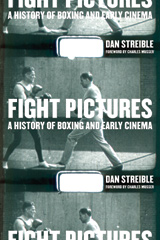
The history of boxing and early cinema is now to be given its first thorough history with the publication of Dan Streible’s long awaited Fight Pictures: A History of Boxing and Early Cinema. Published by the University of California Press next month, the book covers the rich period where the new medium of cinema collided, or colluded, with the ignoble art, as the the former built up its mass appeal and the latter sought to drag itself out of a state of illegality into legimatised entertainment. It’s a story of technical innovation, exploitation, criminality, fakery, brutality, star power, racial tension, and the rise of mass appeal sport and the media in the early twentieth century.

This history has been researched by Streible for many years now, and it seemed for too long that the book would never come out. It ought to be a crossover seller, appealing both to the early film studies community and the sports history afficionados, to go by his previous writings on the subject.
Boxing

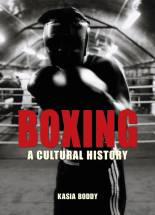
But that’s not all. Because in May the enterprising Reaktion Books publishes Kasia Boddy’s Boxing: A Cultural History. I know nothing of the provenance of this work, but it sounds tempting enough from the blurb:

Throughout this history, potters, sculptors, painters, poets, novelists, cartoonists, song-writers, photographers and film-makers have been there to record and make sense of it all. In her encyclopaedic investigation of the shifting social, political and cultural resonances of this most visceral of sports, Kasia Boddy throws new light on an elemental struggle for dominance whose weapons are nothing more than fists. From Daniel Mendoza to Mike Tyson, boxers have embodied and enacted our anxieties about race, ethnicity, gender and sexuality. Looking afresh at everything from neo-classical sculpture to hip-hop lyrics, Boddy explores the way in which the history of boxing has intersected with the history of mass media, and sheds new light on the work of such diverse figures as Henry Fielding and Spike Lee, Charlie Chaplin and Philip Roth, James Joyce and Mae West, Bertolt Brecht and Charles Dickens. This all-encompassing study tells us just how and why boxing has mattered so much to so many.

It probably isn’t going to go into the practical details of how many arc lights the American Mutoscope and Biograph Company employed to photograph indoor fights in 1900, but it does sound like it will give us an eclectic and entertaining cultural history, outlining boxing’s special resonance and appeal, and placing film’s role within that history.

I’ve never been to a boxing match. I can’t watch televised bouts of today. But the history, the characters, the themes of boxing in the past are just so compelling, and – to be honest – the distancing effect of seeing brutal fights only in black-and-white and silently helps sanitise the subject.

To finsh off, here’s an example of how YouTube can serve as an archive bringing life to films you might never expect to see again. Dan Streible himself brought this to the attention of a film archiving list I subscribe to: the Selig Polyscope Company’s 1900 film McGovern-Gans Fight Pictures. It features the lightweights Terry McGovern and Joe Gans, the first native-born black American to win a world title (in 1900). This bout wasn’t for the world title, and it became controversial (and still is, judging from the comments accompanying the film) for Gans reportedly admitting to taking a dive. See what you think.

The film comes from a 1930s or 40s short produced by Forrest Brown, no longer existing in its original 1900 form, so far as is known. Amazing to be able to see such things still, and there’s many more such early fight pictures on YouTube, generally taken from sports shorts made decades later – see, for example, Joe Gans v Kid Herman in 1907 – though many more are lifted from programmes by ESPN, which has the world’s largest collection of archive boxing films, mostly gathered by Jim Jacobs and Bill Cayton of Big Fights Inc., who when they weren’t amassing an amazing collection of fight films were managing the young Mike Tyson. Tyson has probably seen more archive films of boxing matches than anyone. He’s going to love Streible’s book, I’m sure.
Struggling to keep up with the BFI

Lights and Shades on the Bostock Circus Farm

The British Film Institute employs so many different outlets for its films these days that it’s difficult to keep up. What with the Mediatheque, Creative Archive, Screenonline, European Film Treasures, filmarchives online, its vast website and MySpace page, alongside the traditional outlets of DVD, book publishing and cinema exhibition, it’s becoming hard to escape their mission to inspire us all. Yet it’s still possible to overlook some of their activities, such is their number, as I’d done until now with their YouTube channel.

The BFI has contributed to several other YouTube sites, wittingly (e.g. 10 Downing Street and The Royal Channel) or unwittingly (take your pick), but for a few months now it has also had its own channel. And what gems are there.

There are sixty-four titles at present, and all are films which the BFI owns or for which there is no rights claimant, and so there’s an emphasis on silent shorts. Several of these are available from other BFI outlets, and all are featured in the Mediatheque, so the site serves as a taster, and no harm with that. So, for example, there are numerous clips from The Open Road, Claude Friese-Greene’s two-colour travelogue of 1924/25, which has already seen the recent light of day as a television programme and two DVD releases.

So let’s recommend a few old favourites. None more favoured to my mind than Lights and Shades on the Bostock Circus Farm, featured above, an astonishing 1911 production from the Warwick Trading Company (the print comes from a German source, hence the German titles, but it’s nevertheless a British production). I shan’t spoil the surprise – just to let you now that what looks like a conventional interest film about a touring circus and its animals suddenly turns to heart-rending drama…

Oyster Fishing at Whitstable, England

Or here’s another old favourite, Oyster Fishing in Whitstable, England – apparently an American production from 1921, though actually it’s a repackaging of a pre-First World War British film. An old favourite firstly because I was brought up in the fair town of Whitstable (and it hasn’t changed much), secondly because it’s a harmoniously accomplished example of early non-fiction ‘interest’ film, and thirdly because the subject of much of my research work, Charles Urban, the film’s producer, can be seen towards the end as one of a crowd on the beach sampling oysters (he’s the one crouching down on the right, wearing a hat).

The films all come with knowledgeable background descriptions from one or other of the BFI curators (a marked difference to many YouTube offerings). There are newsreels, magazine films, travels films, phantom rides, actualities, a recreation of Kinemacolor (more on that at another time) and much more. There are also several sound films of course (check out Geoffrey Jones’ glorious Snow, a brilliantly edited 1963 piece from the esteemed British Transport Films)). Fascinatingly, the most popular title so far is An Otter Study, with its underwater photography (the titles comes from the 1920s, but the original film was made by Urban’s Kineto company in 1912). Others are bound to feature in later posts. Go explore.

Where the wild things are

Percy Smith

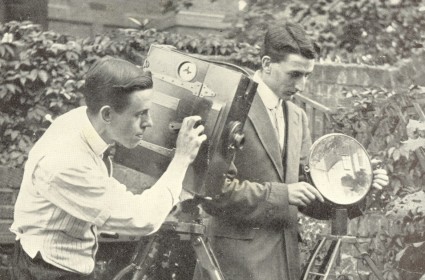
Percy Smith (left), from F.A. Talbot’s Moving Pictures: How They are Made and Worked (1912)

It’s been a long time in coming, but it’s been well worth the wait. Today saw the launch of WildFilmHistory, a site dedicated to recognising 100 years (so they say) of wildlife filmmaking. Produced by the Wildscreen Trust and supported by Lottery funding, this is a multimedia guide to one hundred years of natural history filmmaking, from the pioneering days when stop-motion films of flowers opening wowed them in the music halls to the age of Attenborough and beyond.

The site is biographical in focus, and at its centre are ninety-one (so far) mini-biographies of wildlife filmmakers, twenty-nine of them with accompanying oral history recordings, which very usefully come with PDF transcripts. So you get interviews with the likes of David Attenborough, Hans and Lotte Haas, Desmond Morris, Tony Soper and the late Gerald Thompson, but also the academic Derek Bousé, whose excellent history Wildlife Films investigates our period – more of which below. There’s also a very useful timeline.

But of greatest value for our purposes are the film clips of early wildlife films. There are thirteen of them (many from the British Film Institute collection):

  • Das Boxende Känguruh (1895) – Max Skladanowsky’s film of a boxing kangaroo and its trainer Mr Delaware.
  • Rough Sea at Dover (1895) – Something of a surprise choice, Birt Acres’ self-explanatory film which they argue is “considered by some to be the first natural history orientated film”.
  • Pelicans at the Zoo (1898) – Pelicans at Regent’s Park Zoo, made by the British Mutoscope and Biograph Company, a breathtakingly beautiful film if seen on 35mm (it was originally shot on 70mm), a little more prosiac in Flash.
  • Spiders on a Web (1900) – A new one on me. This was apparently made by G.A. Smith and features two spiders in close-up, viewed through a circular mask (but no web to be seen). Clearly an extract from a longer film.
  • St. Kilda, Its People and Birds (1908) – Made by Oliver Pike, this shows both human and animal life on St kilda, off Scotland, at a time when it was still inhabited by people.
  • The Birth of a Flower (1910) – Exquisite stop-motion photography of flowers opening, complete with stencil colouring, made by the great Percy Smith for Charles Urban.
  • The History of a Butterfly – A Romance of Insect Life (1910) – A fully-fledged natural history film, made by James Williamson, with a fair bit of nitrate damage to remind us of the precious state in which some of these films survive.
  • The Strength and Agility of Insects (1911) – Eye-popping pyrotechnics performed by flies, who juggle corks, twirl matchsticks etc. This is actually a re-issue of an earlier film, The Balancing Bluebottle (1908), filmed by our hero of the era, Percy Smith, for Charles Urban once again. No animals was injured during the making of this film (honest).
  • Secrets of Nature: The Sparrow-Hawk (1922) – One of the famous British Instructional Films series of educational films from the 1920s/30s, this was made by Captain C.W. R. Knight (the site’s synopsis mistakenly says in one place that Percy Smith made the film, though he was associated with many Secrets of Nature productions) (Captain Knight turns up twenty years later as the eagle-tamer in Powell and Pressburger’s I Know Where I’m Going, trivia fans).
  • Secrets of Nature: The Cuckoo’s Secret (1922) – Another title from The Secrets of Nature, this time filmed by Oliver Pike and produced by ornithologist Edgar Chance
  • With Cherry Kearton in the Jungle (1926) – Cherry Kearton was the most celebrated naturalist of the era, and with his brother Richard more or less pioneered the art of wildlife photography and then cinematography. This is a ‘greatest hits’ compilation of some of his African natural history films.
  • Simba (1928) – An African travelogue (extracts only) made by the enterprising American couple Martin and Osa Johnson, blending actuality with staged scenes, and alarmingly also blending shooting with both camera and gun.
  • Dassan: An Adventure in Search of Laughter Featuring Nature’s Greatest Little Comedians (1930) – Cherry Kearton anticipates The March of the Penguins by several decades.

And so it continues up to the present day, with many marvellous clips which both amaze and cause a sigh of happy nostalgia (Zoo Quest, Jacques Cousteau). A little oddly, the site includes pages for films that they haven’t tracked down yet – these include Oliver Pike’s In Birdland (1907), which they argue was the first true wildlife film (hence the centenary), but unfortunately no copy is known to exist.

This is a very well produced site, on which a huge amount of effort has been expended on clearing and producing the clips, esearching the history, and presenting the interviews. The early film clips are wonderful to see, even if I miss one or two titles that I think should have been there (e.g. Herbert Ponting’s fine penguin footage from his films of Captain Scott’s Antarctic expedition). The site opens up the history of wildlife film, demonstrating an interconnected heritage, championing excellence, and encouraging us all to find out more.

Wildlife Films

So, if you are interested in finding out more, where should you go? Well, as mentioned, I strongly recomennd Derek Bousé’s Wildlife Films (2000). This is a first-rate history of wildlife filmmaking and television production, good not only on the plain history but on the mysteries of the genre, which ever since its earliest days has had to adopt assorted entertainment strategies, particularly storytelling, to make its work palatable to a mass public. It is thoughtful and informative. Also recommended is the similarly thought-provoking Animals in Film (2002) by Jonathan Burt. There’s also the recent BBC publication, Michael Bright’s 100 Years of Wildlife (2007), which is aimed at the popular end of the market, but does at least name check people such as Kearton, Smith and Urban.

WildFilmHistory is a wonderful resource, which promises to grow and welcomes any information on new material that they might use. In the spirit of the great filmmakers it champions, go explore.

European film treasures

Daisy Doodad’s Dial

Florence Turner in Daisy Doodad’s Dial (1914), from http://creative.bfi.org.uk

Announced today is a plan by Lobster Films of Paris, with a number of partner organisations, to release up to 500 film titles from thirty-seven European archives, online and for free, with 50% funding from the European MEDIA programme, which is all about expanding markets for films and exposing content to new audiences. The partners include the British Film Institute and the Danish Film Institute. The project, European Film Treasures, launches in April.

Here’s a Reuters press report:

PARIS (Hollywood Reporter) – Where do you go if you want to watch rare archive films such as a 1916 document about life on a German submarine or John Ford’s 53-minute Western “Bucking Broadway” from the following year?

Until now, the answer would have been a trip to one of the film archives that house these prints, respectively London’s Imperial War Museum and the French Film Archive.

But that is about to change with the launch in April of a Europe-wide video-on-demand platform bringing together content from 37 film archives and cinematheques across the continent. And the good news for film buffs is that it’s free.

European Film Treasures, as the site will be known, is the brainchild of Serge Bromberg, founder of Paris-based historic film and restoration specialist Lobster Films. The European Union’s MEDIA Program has pledged to put up half of the approximately 500,000 euros ($725,000) needed to fund the project for its first year.

European Film Treasures is hoping to tap into a chunk of the huge audience for free on-line video sites like YouTube and Bebo. “The difficulty today is not so much to find old films and restore them, it’s finding an audience for them,” Bromberg says. “These are some of the best films shot in Europe over more than 80 years, but it’s often difficult to convince people to see films like these.”

Each partner archive will propose films, and a jury of historic film specialists will decide which to include on the VoD site based on criteria such as historical interest and artistic quality. Footage will be accessible for streaming only, not download, but the site may in the future extend to associated DVD sales.

Films will be available in their original language with translation where needed into English, French, German, Italian and Spanish.

The site is expected to launch with about 100 titles, but the aim is to include as many as 500 films once fully loaded. Lobster is coming up with original music to accompany silent films.

It took two years to convince all the archives to come on board. “They thought it was a good idea but considered it was impossible. The idea is not just to show their films, but also to present the archives and their work,” Bromberg says.

The only major national archive that decided not to be represented was from Belgium. “That is to their great shame,” Bromberg opines.

Bryony Dixon, curator (silent film) at the British Film Institute’s National Archive, says that VoD is a well-adapted platform for these early and short films, which are otherwise difficult to program. “Theatrical, you may get a few thousand viewers. On the Web, you can get hundreds of thousands or even millions. If you put it out there, people will find it. You get that long-tale effect.”

As with the other partner archives, the BFI is not putting in any financing but simply making films available. “We’re in a good position to do that as probably the biggest film archive in Europe,” Dixon says.

Among films the BFI is submitting are “Daisy Doodad’s Dial,” a 1913 British-made comedy starring U.S. actress Florence Turner, and a rare film of a French boxing champion. “We’ll pick things that have appeal, like the boxing film, which will be really interesting for the boxing community because it’s not seen before,” Dixon contends.

For its part, the Danish Film Institute is submitting a 1923 Danish film that is one of the earliest examples of a viable talking film; an animated sausage commercial film from the mid-1930s that uses Dufay Color, a mosaic screen additive system that predates Technicolor; and a raunchy 1910 one-reeler about Copenhagen nightlife.

“These are films that we restored recently. They’re all entertaining films, one about color and cinema, one about sound and cinema. It’s broadening people’s idea of the development of cinema,” said Thomas Christensen, curator of the DFI.

“It’s great that there’s this kind of channel for content that is otherwise sitting fallow in the archive,” said Christensen. “I don’t expect it to become a blockbuster phenomenon. It might never be more than marginal but it’s an interesting channel to be represented on. I think this is very much a transition time, and we have to explore the possibilities.”

This is exciting news, though it doesn’t explain where the other 50% of the money has come from, or what happens after the first year. Also, some of those films may have been already made available online elsewhere (Daisy Doodad’s Dial is being offered by the BFI for free downloading on its Creative Archive site). But the more exposure the better, because it is all about finding those new audiences.

So roll on the 1910 scenes of raunchy Copenhagen nightlife, and shame on Belgium.

Update (June 2008): The site is now available, from www.europafilmtreasures.eu. An initial review of the site fom The Bioscope is here.

Music for experimental film

I missed this excellent-looking DVD release from Kino when it appeared late last year, but no harm in drawing attention to it now.

Music for Experimental Film is a collection of avant garde film classics from the 1920s, with music from former Television guitarist and front man Tom Verlaine plus producer/guitarist Johnny Rip. Originally a live show, the DVD features the original films with the music accompaniment for the most played live from a selection of the concerts.

The films featured are:

L’Étoile de Mer (France 1928 12 mins Man Ray)

The Fall of the House of Usher (USA 1928 13 mins James S. Watson & Melville Webber)

The Life and Death of 9413 A Hollywood Extra (USA 928 11 mins Slavko Vorkapich and Robert Florey)

Emak-Bakia (France 1926 13 mins Man Ray)

Rhythmus 21 (Germany 1921 3 mins Hans Richter)

Brumes d’Automne (France 1929 12 mins Dimitri Kirsanoff)

Ballet Mécanique (France 1924 10 mins Fernand Léger)

To judge from the extracts Kino have provided on the YouTube promo (Emak-Bakia, Rhythmus 21 and Ballet Mécanique) the marriage of delicate post-punk guitar and the visual purity of the films (all the better for the occasional scratches and blemishes earned through age) works particularly well. An apposite and haunting combination.

2008 Man with a Movie Camera

2008 Man with a Movie Camera

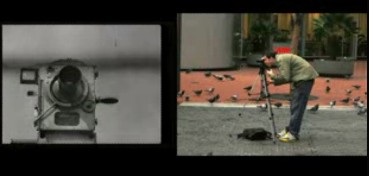
1929 and 2008 Man with a Movie Camera, from http://dziga.perrybard.net

You may remember the posts on video artist Perry Bard’s remarkable project in ‘database cinema’ to create a modern version of Dziga Vertov’s avant garde documentary classic, Man with a Movie Camera, by inviting anyone interested to upload modern equivalent shots to those in the original. You can find all about the ongoing project on Bard’s website, at http://dziga.perrybard.net, but she got in touch to correct an earlier post about the project with this information:

There was an initial deadline which may have led to some confusion however the project is open and ongoing.The reason for the deadline is that people tend to like the excitement of doing things at the zero hour and we wanted as much material as we could get for the launch in Manchester October 11. It continued screening there for two weeks, then screened in Norwich during the Aurora Festival, in Leeds during the Leeds Film Festival. There are links to photos of these events on the site.The site now contains a full length version of the remake which plays as a split screen with the original. We don’t have the server capacity to keep updating the remake but with each screening event it works through a daily download meaning that the film is different each time it screens as more than one person has uploaded entire scenes and shots. The possibilities are infinite. Please participate by logging on to http://dziga.perrybard.net.

There’s also a two-minute trailer available, and the full-length split-screen film (in its current version) is available from Google Video.

A creative Christmas

Santa Claus

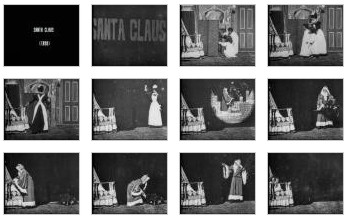
Santa Claus (1898), from http://creative.bfi.org.uk

The Creative Archive Licence Group is a number of organisations (BFI, BBC, Channel 4, Open University, Community Channel, Teachers’ TV, Museums Libraries and Archives Council, ITN Source) dedicated to making video clips available online for free downloading in the UK under a Creative Licence scheme, which essentially means that you can download, keep and re-use the material so long as you do so under the terms of the licence, which means not selling the material, and if you re-publish it (within the UK) to say where it came from and make your creation available under the same licence terms.

All of which sounds impressive, though the amount of material released is very small, with the major partner, the BBC, having withdrawn from the scheme for the time being. But the British Film Institute has a Creative Archive site with a modest selection of mostly silent films there for anyone in the UK to download for free. And, in the spirit of the season, the selection includes three Christmassy titles: G.A. Smith’s Santa Claus (1898), with its innovative superimposition and double-exposure effects (as well as maybe the world’s first opening title); Robert Paul’s Scrooge (1901), condensing Dickens’ classic tale into a taut three minutes; and James Williamson’s heart-rending take on Hans Christian Andersen, The Little Match Seller (1902).

Download and be merry.

Mary Pickford used to eat roses

Of all the subjects that might have been chosen as the theme for a contemporary popular song, the formation of the United Artists film company must come as one of the least expected. But such is the theme of ‘Mary Pickford’, the new single by Katie Melua. I shall not pass judgement on its musical or lyrical merits – simply to say that it is written by Mike Batt, and tell us in simple words that Mary Pickford, her husband Douglas Fairbanks, Charlie Chaplin and D.W. Griffith got together to form the United Artists Corporation, which indeed they did in 1919. It was the first film company to be formed by film artists, rather than businessmen, and was of course intended to produce and distribute the films of the quartet (as well as others) and retain power and profits for themselves. Famously, Richard A. Rowland of Metro Pictures Corporation, on hearing the news, pronounced that “the lunatics have taken over the asylum”.

The video is constructed as a silent film, and features numerous clips, including newsreel footage of the four founders, The Gaucho, The Black Pirate, The Taming of the Shrew, and even Rescued from an Eagle’s Nest, Griffith’s undistinguished 1907 film acting debut. Chaplin film clips are noticeable by their absence. The video features faux silent titles, including (a nice touch) “Guitar solo”.

Cue an upsurge of interest in Mary Pickford, no doubt. Apparently Pickford did indeed use to eat roses (presumably just the petals) to make herself look more beautiful, as the song tells us. Cue an upsurge in visits to garden centres…

Motion Pictures 1894-1912

The latest edition to the Bioscope Library is Motion Pictures 1894-1912. This is the Library of Congress catalogue of copyrighted works identified as motion pictures by Howard Lamarr Walls. The catalogue was published in 1953, two years after Motion Pictures 1912-1939 (already entered in the Bioscope Library). The volume was not considered to be a part of the Library of Congress’ Catalog of Copyright Entries, Cumulative Series, although it complemented it, because before 1913 films were not copyrighted in the USA as motion pictures but instead as photographs. Hence Walls had to determine which of the copyright records for photographs 1894-1912 were actually motion pictures, which was ultimately a question of individual knowledge rather than official designation. He found around 6,000 titles. Walls became Curator of the Motion Picture Collection at the Library of Congress, and then at the Academy of Motion Picture Arts and Sciences, and his pioneering research was of inestimable value in establishing solid information on the early motion picture in America as a subject of study.

The earliest title is Edison Kinetoscopic Record of A Sneeze, January 7, 1894, which was copyrighted on 9 January 1894. This film, taken by William Kennedy-Laurie Dickson, shows Edison worker Fred Ott sneezing. It was a promotional work rather than a commercial release, being used as illustration in a Harper’s Weekly article. It can be found on the Library of Congress’ excellent American Memory site, from where it has been reproduced for this YouTube clip:

The catalogue is available to download from the Internet Archive, in DjVu (4.9MB), PDF (12MB), b/w PDF (5.8MB) and TXT (621KB) formats).

Moonshine

Moonshine

Moonshine CD cover

Dedicated Bioscope watchers will know that I like a little jazz with my silents, and that earlier this year I reported on seeing American trumpeter Dave Douglas and his Keystone band playing music inspired (obliquely) by the work of Fatty Arbuckle at the Bray Jazz festival in Ireland. Well, blow me down if they haven’t produced a CD of the music, but it’s a live recording from the Bray concert itself, so you can hear me applauding in the background.

The CD is entitled Moonshine, which is of course the title of a 1918 film that Arbuckle made with Buster Keaton, probably best known for its much-imitated gag of having a seemingly endless procession of people pour out of a car. Douglas’ music is not really intended as accompaniment to Arbuckle’s films (it certainly doesn’t work in that way), and is more an expression of ideas inspired by Arbuckle’s work. As Douglas says:

But these pieces weren’t written as soundtracks, more as reflections on great forgotten absurdities like ‘Mabel and Fatty’s Married Life’ and ‘The Rough House.’ The bounce and bubble of those characters begged for a beat – shimmering shadows on the screen hinting at hidden crevices of texture and timbre. The songs reflect the atmosphere of those innocent/zany black and white images, refracted through a 21st century jazz sensibility, interpreted by an eclectic collection of gifted musicians.

Those musicians are Douglas (trumpet), Marcus Strickland (saxophone), Adam Benjamin (keyboards), Brad Jones (double bass), Gene Lake (drums) and DJ Olive (turntables and laptop – yep, its modern jazz, folks).

The CD is released on 27 November, but it seems it is available now as MP3 downloads. There’s more information on the Greenleaf Music site.

Douglas and Keystone have released two other CDs, Keystone and Keystone: Live in Sweden.

I’m seated ten rows back on the right, by the way…

Update: Arbuckle and Keaton’s Moonshine has just been posted on YouTube, with Dave Douglas’ ‘score’. Moonshine only survives in a regrettably fragmentary state, hence the gaps in the narrative and the abruptness of several shots. See what you think…