Lego goes silent

As we continue our trawls through YouTube looking for imaginative and legitimate (or at least arguably so) creations relating to silent cinema, our eyes settle on Lego…

Lego films (or brick films) have become an honourable strand of the animation film, though one whose apparent ease of production has attracted far too many amateurish efforts. Parodies of films and film genres are rife, inevitably, and so it is that there are numerous silent Lego films to be found, or Lego films imitating silents. For the most part they are as bad as one might fear, showing only the most hackneyed ideas about silents, and minimal artistry. But, as ever, among the dross we find a few gems a-glistening. Here’s a selection to amuse and maybe instruct a little.

So let’s start with The Birth of a Nation. One may tremble with trepidation at what such an offering might mean, but what we get is a parody of one of those TV Hollywood history programmes, presented as though a previously lost fragment of interview material, with talking heads reminiscing over the experience making the films. Enjoy the insights offered by editor Rose Smith, director, producer and editor D.W. Griffith (“I wanted to push the length of feature film productions, baby”), cameraman Billy Bitzer, actor Ralph Lewis, and music editor Joe Carl Briel, all boastfully talking up the film’s length, technical innovations and undying contribution to film history. Created by Geoff Reimer and C.J. Reisenbigler.

Most Lego film parodies tackle the obvious. Here holstenwall has shown a little more imagination and given us a Lego interpretation of the Berg or mountain films of Arnold Fanck, in which Leni Riefenstahl first made her mark as an actress. Here we see Berg von Alptraumen, or Mountain of Nightmares (part 1), complete with German intertitles (with English subtitles), as our hero scales the snowy heights amid settings of suitably midget epic grandeur. Sadly, the world still awaits part 2…

There are various Lego versions of scenes from Metropolis to choose from. This is the one to see. Considerably classier in look than the average, it also shows greater imagination than simply mimicking parts of the film. Entitled 45 Seconds of Metropolis, it takes the film’s famous tag line – ‘Der Mittler zwischen Hirn und Händen muss das Herz sein’ – ‘The mediator between head and hands must be the heart’ – and illustrates this through three sections (two really), dedicated to the hands, the head and the heart. A subtle miniaturist’s idea, and a fine title sequence too. It was created by Gordon Bühler, a.k.a TrashGordon (great name).

That’s probably more than enough, but how could I resist any Lego film which chooses to demonstrate to us that Thomas Edison invented the Kinetoscope…

(I’m just keeping things ticking over while I work on grander stuff to present to you when it’s ready. Bear with me.)

Mashing it up once again

Third in what looks increasingly like a series of posts on the creative coming together of silent films and music tracks on YouTube takes us to the wilder edge of things. We’re still following the placing of sequences or montages of silent films with pre-existing music, but playing around with the concept rather more.

To start with, here we have Radiohead meets Buster Keaton, courtesy of YouTuber hoverground. It’s a collection clips (mostly very familiar) put to music, but now we have extracts from several songs, interspersed with pauses for a train passing, wind blowing, bridge collapsing etc. It gives us multiple interpretations of Keaton’s art, while the great stoneface shows himself yet again to be an Everyman figure whose eternal crises can be replayed to ideal effect in almost any form. Not so sure about the use of stills at the end, but a memorable tribute for all that.

Now for something rich and strange – strange at any rate. Here we have a clip from Dimitri Buchowetzki’s 1922 Othello, with Emil Jannings as the Moor and Ica von Lenkeffy as Desdemona. Accompanying it we have loops of music from an unnamed ‘garage band’, plus sounds from The Texas Chainsaw Massacre – whether the original or the remake it does not say, and I am not expert enough to judge. The result is peculiar, to say the least, particularly when the chickens start clucking. Its creator, Joe Boyce Burgess, called the video Me vs You, and he has created a number of bizarre juxtapositions of film and alien sound.

Experimental films of the silent era are a favourite subject for adding music tracks. Here Walter Ruttman’s Opus I, II, III and IV are set to music by electronica outfit Digitonal, courtesy of totaldistortion. The marriage (inevitably?) works perfectly, and you can find Ruttman’s works similarly set to the experimental music (of one kind or another) of John Zorn and The Chemical Brothers.

This, however, starts to take us into the field of applying original soundtracks to silents on YouTube, and that will be the subject of another post or two, as inevitably it’s a rich seam to be mined (albeit with a large amount of dross along the way). As before, I’m keen to learn of other examples you may have come across. In particular, I’ve yet to find an example where two different silent films have been mashed up (Eric Campbell ends up chasing Buster Keaton, the Ku Klux Klan from Birth of a Nation end up galloping along the Circus Maximus in Ben Hur, that sort of thing). Anyone come across such a creation?

Filmarchiv Leuzinger

Ben Hur exhibited at Meisterschwanden, Switzerland, May 1930, from http://www.filmarchiv-leuzinger.ch

I was introduced to this website a while ago (by its author), and thought you ought to know about it. The subject of Filmarchiv Leuzinger is a small town family cinema business from Rapperswil, Switzerland. It was founded by restaurant owner Willy Leuzinger, who began organising film screenings in his restaurant in 1909, going on to open two cinemas in the Lake Zurich district. In 1919 he began a touring cinema business, the Wanderkino Leuzinger, which dominated film exhibition in north-eastern Switzerland from the mid-1920s to 1943. Leuzinger was also a filmmaker, shooting many local topicals (local newsfilms) throughout the 1920s, around eighty of which survive. After Willy Leuzinger’s death in 1935, his eldest daughter took over, and today his granddaughter Marianne Hegi still runs three cinemas, in Rapperswil and Altdorf.

The Wanderkino Leuzinger in 1923

All of this is a charming story, but in the hands of Mariann Lewinsky Sträuli it has been turned into an eye-catching and evocative website. Filmarchiv Leuzinger (click on the Übersicht link to find the main ‘archive’ page) arranges an archive of family memorabilia – biographies, photographs, documents, music, background information and film clips in thematic columns to create an innovative and enticingly explorable site that opens up the Leuzinger’s world. The film clips (in QuickTime format, with MPEG-4, DVD-quality downloadable versions also available) show local festivals, parades, fairs, gynmatic events, and so on, each meticulously described. Every clip, image, audio file or other link leads to a page of information (with larger versions of the images), progressively building up a resonant picture of time, place and occupation.

It is a delightful site, quite an inspiration in conception and design. Unfortunately for the linguistically-challenged English speaker, it is in German. But don’t let that deter – it’s clear enough just from looking that it is a fine piece of social and cinema history (the numerous photographs of cinemas in the 1920s and 30s will delight many), put together with a loving archivst’s care. Mariann Lewinsky Sträuli prrogrammes section of Il Cinema Ritrovato in Bologna, teaches film history at the University of Zurich and directs restoration projects at Memoriav, the Swiss audiovisual heritage organisation.

Go explore.

Mashing up some more

Well, it was fun picking out those YouTube clips where silents had been creatively mashed up with modern music tracks, so here are three more examples. These aren’t the same as silents to which modern composers (or would-be composers) have added new tracks – that’s an interesting subject for another time. Instead these are examples of re-edits or montages to modern music tracks which illuminate or heighten the films in interesting ways. To impose some sort of thematic reasoning to all this, the three videos below all derive from classic German 1920s silents.

Louise Brooks is one of the most popular search terms used on this blog, but such researchers have been going away disappointed. Well, no more, because here’s a dynamic and assured mix of scenes from Pandora’s Box (1929), skilfully edited by Adam Armand to the tune of The Killers’ ‘Mr Brightside’. It doesn’t tell us anything more about the film or the image of Brooks than we already know, but what else might the film have to say? The video expresses the quintessence of the iconography of Pabst’s film with a song that resonates with sexual torment and urgency. It may vulgarise Pabst’s artistry by reducing it to MTV-style editing, but it also expresses Brooks’ modernity and lasting appeal.

Paul Wegener’s Der Golem (1920), the classic proto-horror film telling of the creation of a clay creature, the Golem, brought to life to protect the Jews of 16th-century Prague, is accompanied by the death metal music of Fantomas, a band who sound like they know a silent film or two. In this case the band wrote a song inspired either by the legend or the film itself, and a fan (‘Monster Island Media‘) decided to do the decent think and match song to clips – which is why lyrics and imagery go together so well. Not exactly most people’s musical cup of tea, but it undoubtedly places the film within a modern, if crude, sensibility. What pop video director could ever have conjured up so convincing a vision of medieval magic?

Others have had the same idea: see here for a more frantically-edited homage.

After all that sex and musical violence, here’s some a little more surprising, and graceful. Scenes from The Cabinet of Dr Caligari (1920) are accompanied by Françoise Hardy singing ‘La Terre’, seemingly for no other reason than the chanson is a pretty one and it brings out the mystery of Robert Weine’s film. Note how well it fits in with Conrad Veidt’s Cesare slowly opening his eyes, and how delicately it accompanies the way the characters move.

The clip’s creator, Clay, has treated other silents to new scores, including Christus (1914), The Abyss (1910), Alice in Wonderland (1915) and Evgenii Bauer’s After Death (1915).

More examples to follow, as the mood takes me.

Mashing things up

I’m completely against ripping silent films from DVDs and posting them for free online – it’s not just illegal but mean and thoughtless. But taking silent content and doing something with it to create a new work is more of a borderline case. It may all depend what legal system you exist under, but creativity is more of a justification for appropriation.

YouTube and its ilk are full of silent film clips, montages or sequences of stills where fans have added favourite music tracks over the top. The results are usually indifferent, if not glutinous, but just occasionally you get examples done with great skill. Such creative works don’t just make great juxtapositions of film and music, but can illuminate the films in refreshing ways. There are numerous examples, but here are three personal favourites to demonstrate what I mean.

Here were have scenes of black and ‘black’ characters from D.W. Griffith’s The Birth of a Nation set to Public Enemy’s ‘Burn, Hollywood, Burn’. No ambiguity here, or excuses from the defence about the film’s importance to the history of film form. The film is exposed for all its grotesque racism, all the more loathsome for the way the film still has its place in the pantheon. The music and rap lyrics hammer it. The film becomes the perfect vehicle for rage. It’s sharply edited, and the opening and closing titles are a nice touch. Its creator goes under the YouTube name of jewofmalta.

It takes a certain amount of creative inspiration to think of bringing together Buster Keaton and The Pixies. Here the creator (weepingprophet) complained of only ever coming across Keaton clips “set to contemporary music” and wanted to see a tribute to his favourite comedian set to music that made more sense to him. Choosing The Pixies’ ‘Down to the Well’ is a surprise, but how well it works. The montage itself, skilfully put together, is a collection of all the most familiar Keaton gags. With the music you get two different kinds of Americana brought together in strange harmony.

This is inspired. Charlie Chaplin (a favourite subject for the masher-uppers) does his dance of the bread rolls from The Gold Rush to the theme tune from the Spiderman TV series. It starts off feeling silly, then becomes just right. Chaplin as superhero. It comes over as cunningly synchronised, though the brain does a lot to help matters, as placing any film to a piece of music makes us instinctively look out for points of contact between the two. The video was created by Bob Loblaw.

I’ll publish more such examples from time to time, and do let me know if you have any favourites.

Welcome to Newsfilm Online

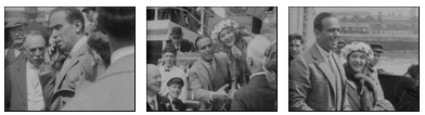
Southampton: Arrival of Mary Pickford & Douglas Fairbanks, Gaumont Graphic, 21 June 1920, from http://www.nfo.ac.uk

Quietly launched this week (with an official launch due in October) is Newsfilm Online. This is 3,000 hours of UK cinema newsreel and television news content, dating 1910s-2000s, all of it taken from the collection of ITN Source. ITN is the UK’s largest commercial footage library, (if you don’t count the BBC as such), and doesn’t just own ITN news programmes, such as News at Ten and Channel 4 News, but most of the UK’s newsreel archives (Pathe, Paramount, Gaumont, Universal). The 3,000 hours (about 2% of the ITN news collection) have been digitised and made available for free downloading and re-use, so long as you are a member of a subscribing UK institution of higher or further education. Sadly that’s going to leave out a lot of you, but the project was funded by the Joint Information Systems Committee, which exists to support UK HE/FE (as we call it in the trade), and the conditions under which the newsfilms were digitised stipulated that they would be available to HE/FE users only.

But despair not, because although you may not be able to see the films, the catalogue records are searchable and browsable by all. And for the silent era, there are 1,241 news stories from the 1910s and 5,091 from the 1920s, making this a marvellously rich resource for historical study, even without the films themselves – not least because you get thumbnail images, like those of Doug and Mary illustrated above. It’s supposed to be every example of the Gaumont Graphic newsreel held by ITN, and shopws how alert the newsreels were to the stories, concerns, fads and personalities of their era. The thumbnails alone excitingly bring the 1910s and 20s back to vivid, varied life.

Remarkably, the publication of Newsfilm Online means that the majority of British newsreels (I’d guess between 80-85%), 1910-1979, are now digitised, encoded and available on the Web in one form or another, albeit with restricted access in some cases (the Paramount and Universal newsreels are the big gaps). That’s a sensational thing to be able to report, achieved in little over five years by a mixture of public money (around £3.5M, at a rough guess, though the £2M that Newsfilm Online cost was for TV news as well as its Gaumont newsreels) and private (no idea how much). The four main sources (with the silent newsreels that they include) are:

  • British Pathe – including Pathe Gazette, Eve’s Film Review, freely available (low resolution)
  • British Movietone News – Movietone itself was a sound newsreel, but the site include a rag-bag collection of silent actualities, freely available (low and middling resolution)
  • Newsfilm Online – includes Gaumont Graphic, movies available to subscribing UK educational institutions only
  • Screenonline – the BFI online ‘encyclopedia’ has many examples of the Topical Budget newsreel, movies available to UK schools, colleges and libraries only

What a fantastic achievement. Having played a small part in making NfO (as we call it in the trade) happen, I’m just a little bit chuffed to see it published at last. For a record of most British newsreel stories in one place, I warmly recommend the British Universities Newsreel Database (still has some gaps to fill for silent newsreels), which also lists other digitised newsreel collections around the world (Australia, France, Germany, Italy, Sweden – America, alas, lags seriously behind).

Let’s have every newsreel around the world available online – it can be done; it would delight and benefit so many if it could be done.

Watching silents online

Harry Langdon, Mabel Normand, Roscoe Arbuckle and Max Linder, from http://slapstick-comedy.com

The recent post on the British Film Institute’s YouTube page made me think it would be useful to provide a round-up of the major online sources where you can legitimately and freely view and sometimes download silent films. It’s important to note that most mainstream silents are not going to be found online (except illicitly) but only on DVD (if at all). Online sources are most likely to have very early and non-fiction films, either because there are no rights issues or, conversely, because it is to someone’s advantage to advertise such content for footage sales (notably the newsreel libraries).

If you follow the Online Videos link in the Categories section on the right-hand column you’ll find all the posts in the past which have discussed such sources, in one form or another, but here’s that handy overview:


American Memory
The Library of Congress’ American Memory digitised materials site remains a world beater. There are several sections on the site which include silent films, such as Edison titles, early animation, variety films and films of New York – see the Bioscope’s guide to the site for more information.

australianscreen
First-rate Australian educational resource, with 100 years of Australian feature films, documentaries, television programmes, newsreels, short films, animations, and home-movies, including much silent material. The guide written here will help locate things.

Black Film Center/Archive
A selection of downloadable early films (QuickTime) showing African-Americans, including Edison’s The Pickanninies (1894) and A Morning Bath (1896). Produced by Indiana University’s Department of Afro-American Studies.

British Film Institute
The BFI has several outlets for online video. Its Screenonline resource is an encyclopedia of British film and television, with extensive silent film materials (with strong emphasis on non-fiction) but licensing issues means that the video content itself is only accessible to schools, colleges and libraries in the UK. Free to all is its YouTube channel, which has a fascinating mix of oddities, including many silents. Its Creative Archive site makes a small number of mostly silent videos available for free download and re-use, under licence.

British Movietone News
Unlike British Pathe (see below), this freely-available British newsreel collection (covering 1929-1979) is little-known outside the commercial footage sector. However, it also contains a fascinating and varied collection of pre-1929 material, much of it the Henderson Collection of early film subjects. The post on this collection supplies a guide to some of the gems to be found there. It’s all freely-available, but prior registration is required.

British Pathe
This British newsreel collection covers the period 1896-1970, though the pre-WWI material is a peculiar mishmash of news and some fiction material, a guide to which is available here, with a guide to the silent newsreel collection itself available here. The films can all be downloaded for free, in somewhat frustratingly low resolution form, for which prior registration is required.

DG
QuickTime extracts from the films of D.W. Griffith – Biograph shorts as well as the feature films – part of the range of interconnected silent film sites maintained by David B. Pearson.

The Early Cinema
A selection of Quick Time movie clips of films made by Biograph and Edison from the 1897-1905 period, which derive from the Library of Congress Paper Print Collection.

Europa Film Treasures
Rich pot pourri of mostly silent films from archives around Europe, bringing together dramas, comedies, tricks films, travel, animation, propaganda and pornography. The Bioscope report on the resource is here. The site owners, Lobster Films, promise an improved service (some have had problems with download times) soon.

Gallaudet University Video Library
Uncovering something of the history of deaf people and silent cinema has been one of the real pleasures since starting the Bioscope; this site includes several films for the deaf made during the silent period. The Bioscope post on the collection explains the history and how to find the relevant titles.

Gaumont Pathé Archives
Database of the French Gaumont, Pathé and Éclair newsreels, from 1896, searchable by keyword and date. It has large number of streamed video copies of the newsreels, for which log-in access is required.

Internet Archive
The Internet Archive’s Movies section offers a huge number of freely available and downloadable movies, which we must assume are all in the public domain (under US law). The silents can mostly be traced through the keywords option under Feature Films, and range from early Chaplin to 1930s Chinese dramas. Key titles available include 20,000 Leagues under the Sea, Man with a Movie Camera, Battleship Potemkin, Nosferatu, Sherlock Jr, The Cabinet of Dr Caligari and The Hunchback of Notre Dame.

Open Video Project
An international repository of digitised video content designed for the research community, which includes nearly 200 early Edison titles, most of which won’t be found on the American Memory site (see above). More information on the contents is in the Bioscope posting on the collection.

Realmilitaryflix
650 freely-available films covering conflicts from the First World War to Afghanistan today. See this report on some of the remarkable First World War documentary and actuality content available on the site.

Scottish Screen Archive
Over sixty films from the silent era are available among the 1,000 or so films included on this exceptional resource from the Scottish Screen Archive, Scotland’s national film collection.

Slapstick
A range of silent comedy clips from David B. Pearson in MPEG4 format: Chaplin, Keaton, Lloyd, Normand, Langdon, Arbuckle, Linder, Semon, Pollard, Lane…

Videos with Bibi
YouTube is awash with silent material, much of it lifted from DVDs. It’s immoral if not criminal for the most part, but it also makes so much available that most would never otherwise see, and some of what’s available is legitimately there (how is the average punter to judge?). This site provides a guide to vintage film content on YouTube, and has a silents section.

WildFilmHistory
Clips from 100 years of filming wildlife, with thirteen (so far) precious titles from the silent era, from filmmakers such as Percy Smith, Oliver Pike and Cherry Kearton. More information here.


There are many other sites with a small number of clips, and some which are only available to university users (e.g. Film and Sound Online, which has many First World War titles from the Imperial War Museum). There are a number of download sites offering public domain (US) titles, but most of these films turn up on the Internet Archive in any case. Undoubtedly others that should be listed above that I’ve forgotten or never knew about in the first place. Do let me know of other such sites and I’ll add them to this post to make it a standard reference guide.

BFI on YouTube

The Bioscope has reported on the BFI’s You Tube channel before now, but this just to alert you to the fact that they have been adding many more videos to the site, a good number of them silent. There are currently 177 videos, and there isn’t time or space enough to point out all of the gems that lie therein. So I’m just going to point you to three, and then urge you to go explore for yourselves.

To start with, here’s an odd little newsreel story from 1921 which I first showed at the National Film Theatre in 1992 (ah, memories):

The peculiar event on show is the Eton Wall Game, filmed by the Topical Budget newsreel. This sport, which only the British public school system could have produced, involves the schoolboys piling up into a scrum and trying to push a ball along the wall. If they get it to the end of a wall it’s a goal, but in the traditional St Andrew’s Day game there hasn’t been a goal scored since 1909. What is of interest here is that one of the boys taking part was Eric Blair – yes, the future George Orwell is somewhere in the pile of boys, and despite many people having stared very closely at the film over the past sixteen years, no one has spotted him as yet. So now it’s your turn.

This next gem is called Old London Street Scenes. That’s what we call a supplied title in the trade. It wasn’t called that originally, someone gave it the quaint title later:

This is a piece of footage which has been shown countless times on television because of its spectacular closing shots of London traffic. It demonstrates how a fixed camera single shot of ordinary human life can nevertheless astonish. Look out in particular for the epoch-making moment when a motor car appears among the horse-drawn carriages. It dates from 1903 (we know this because of some of the London shows seen advertised on posters on the passing vehicles). The likely production company is Walturdaw.

Finally, some more sport:

This is part of the extraordinary Mitchell & Kenyon collection of Edwardian era films. Having presumably sold all of the DVDs that they are probably likely to sell of this collection, the BFI has put up quite a selection on the YouTube site. This cricket film has been given the supplied title Arthur Mold Bowling to A.N. Hornby, and was made in 1901. As the DVD commentary (courtesy of Adrian Chiles) explains, there had been a huge controversy at the time when Lancashire’s Arthur Mold was accused of having a dodgy bowling action; that is, throwing (apologies for American readers who may not appreciate how profoundly shocking this to any cricket follower). So he appeared before the cameras demonstrating his bowling style, so that viewers could judge for themselves how legitimate he was. Compared to, say Muttiah Mulitharan, you may wonder what the fuss was about (a bit sideways on, maybe, but hardly chucking). Or, for poetry lovers among you, note simply that the batsman in the nets with Mold is A.N. Hornby, subject of a famous set of lines by Francis Thompson (the poem is called ‘At Lord’s’), recalling the cricket of his youth (when, of course, the game was always better):

For the field is full of shades as I near a shadowy coast,
And a ghostly batsman plays to the bowling of a ghost,
And I look through my tears on a soundless-clapping host
As the run stealers flicker to and fro,
To and fro:
O my Hornby and my Barlow long ago!

On which wistful note, let me just recommend once again the BFI’s YouTube site (not all silents, not all non-fiction, by the way), and look out for further posts on the stories behind one or two of the videos to be found there, in due course.

Urban dreams

Dundas ‘n’ Bathurst, from http://www.youtube.com/user/TUFFyear1

It’s good news to be able to report the return of TUFF, the Toronto Urban Film Festival. TUFF is an eight-day public film festival held in Toronto, which features urban-themed one-minute films, all of which have to be silent. Last year’s inaugural festival (reported by the Bioscope) produced some remarkably high quality entries – as an example of which, do take a look at 2007’s overall prize winner, the dazzling Dundas n’ Bathurst (an area of Toronto) by Charuvi Agrawal and Jeffrey Tran, or visit the YouTube site which hosted the 2007 entries.

The festival invites entries covering all genres of film, video, and animation from both trained professional, and untrained amateur, artists and filmmakers. National and international submissions are welcomed. Every entry has to fit in with one of the festival’s themes, which this year are:

* Urban Encounters – the moments that make city-living worthwhile
* Urban Fears – the darker side of living in a metropolis
* Urban Growth – from skyscrapers to suburban sprawl
* Urban Imaginary – hopes for the future of municipalities
* Urban Natural – the living city, both nurtured and oppressed
* Urban Secrets – stories about the hidden or forgotten city
* Urban Travels – from taking public transit to practicing Parkour

As stated, all submissions must be silent and exactly 60 seconds in length. The deadline for submissions is 1 July 2008, and the festival itself runs 5-12 September 2008. Films selected by the jurors for each thematic category will play on Toronto’s network of 250 TTC subway platform screens repeatedly during one day of the festival. All selected films will also be eligible to be posted on the festival website, for viewing and voting throughout the festival, as well as for future viewing. Filmmakers can also opt to have their film added to the TUFF YouTube collection.

Finally, not only is it free to submit, but the filmmakers retain rights, and receive $150 per selected film – $75 for taking part in TUFF on the TTC, and $75 for being a part of the website. Full details of how to enter can be found on the festival website.

What an excellent venture, further evidence of the rude health of the silent film today. I’ll publish more on it at the time of the festival itself.