Gary Lucas plays The Golem


Just to show that jazz and rock musicians can come up with effective scores for silent films, here’s another great favourite of mine, jazz/experimental guitarist Gary Lucas, accompanying Der Golem (1920), which tells of a rabbi in medieval Prague creating a clay monster to save the Jews of the ghetto from annihilation. The score is by Lucas and Walter Horn, and Lucas’ interest in Jewish themes clearly informs his intense reading in this five minute extract.

Find out more about the music and the screenings that have taken place from Lucas’ website, which includes further sound extracts.

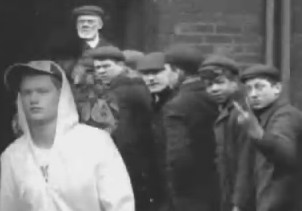
Edwardian hoodies

edwardians.jpg

Anyone watching BBC television at the moment will have seen the trailer for the BBC4 Edwardians season. The trailer uses footage from the now renowned Mitchell and Kenyon collection of mostly actuality films of life in nothern England 1900-1914, digitially treated to mix the people of Edwardian times with such modern figures as a pizza delivery motorbike, a ‘golf sale’ signboard, rock concert fans, a policeman with a gun, and a hoodie. So of course they’re just like us and we’re just like them. You can see the trailer here (click on ‘Watch the season trail’).

Update – For all those who have been looking, the music that accompanies the trailer is Fashion Parade, by Misty’s Big Adventure. More details from the band’s MySpace site.

A Tour of the Cinema Museum with Ronald Grant


I’m a bit wary about adding YouTube clips to The Bioscope. My pernickety film archivist principles will prevent me from posting anything that’s been ripped off illegally from somewhere else, so I’ll try to stick to legitimately posted stuff which is of interest. So, let’s start with this wonderful tour of The Cinema Museum, the treasure trove of film memorabilia held in the former Lambeth workhouse where Chaplin’s mother was incarcerated. It isn’t open to the public alas, but this five-minute tour is a real treat, with programmes, music scores, posters, films, memorabilia, costumes, equipment, journals and stills, all crammed in so that there’s barely room to move.

American Memory

Among the very best resources on the web is the Library of Congress’ American Memory site. The purpose of American memory is to provide “free and open access through the Internet to written and spoken words, sound recordings, still and moving images, prints, maps, and sheet music that document the American experience”. Its Motion Pictures section is a marvellous example of this, offering users access to a wide range of predominantly early cinema subjects, all available for viewing and downloading, in MPEG, QuickTime and RealMedia formats.

Each collection is usefully contextualised and indexed, and there are impeccable cataloguing records. The collections with silent film material (both fiction and non-fiction, but chiefly the latter) are:

Needless to say, this is all non-copyright material, one of the consequences of which being that eBay is full of DVDs of early film materials which are simply repackaged downloads from this site.

British Pathe – part one

British Movietone (see 26 February post) is one British newsreel now available in its entirety online, but the most important British newsreel collection – and one which goes back to the silent era – to be found on the web is British Pathe. Pathé newsreels ran in Britain from 1910 to 1970, while the company also produced cinemagazines like Eve’s Film Review and Pathé Pictorial, as well documentaries and other shorts. 3,500 hours of this collection was made available online in free low resolution download form four years ago, thanks to funding from the Lottery-based New Opportunities Fund.

The British Pathe site is therefore a superb resource for discovering silent non-fiction film, and in future posts I’ll be providing a guide to some of the treasures to be found. However, I’m going to start with the unexpected – fiction films. Pathé somehow picked up assorted pre-First World War films, some though not all made by its French parent company, and these got digitised alongside the newsreels and are available on the site. There is no index to these fiction films, so below is a list of some of the ones that I have been able to find, with descriptions and some attempts at identifying them, as few are given correct titles or dates:

(the first title given is that on the British Pathe database – enter this in the search box to find the film)

THE FATAL SNEEZE = comedy in which a man suffers from an increasingly violent sneeze. This is That Fatal Sneeze (GB Hepworth 1907).

THE RUNAWAY HORSE = comedy in which a runaway horse causes chaos. This is a famous comedy of its time, Le Cheval Emballé (FR Pathé 1907).

FLYPAPER COMEDY = This is a French comedy with Max Linder, in which Max has flypaper sticking to him which he then finds sticks to everything else.

THE FANTASTIC DIVER = early trick film in which a man dives into a river fully clothed then returns by reverse action in a swimsuit.

THE RUNAWAY GLOBE = Italian? comedy in which a giant globe intended for a restaurant runs away down a street and is chased by a group of people before being sucked up by the sun, only to be spat out again.

THE MAGIC SAC [sic] = French trick film in which an old man hits people with a sack and makes them disappear.

MYSTERIOUS WRESTLERS = French trick film where two wrestlers pull one another to bits. This is a brilliant George Méliès trick film, Nouvelle Luttes Extravagantes (FR Star-Film 1900).

ATTEMPTED NOBBLING OF THE DERBY FAVOURITE = section from a British racing drama, made by Cricks and Sharp in 1905.

THE POCKET BOXERS = trick film in which two men place two miniature boxers on a table and watch them fight.

ESCAPED PRISONER RETURNS HOME = guards wait while prisoner bids a tearful farewell to his sick wife. This must be a James Williamson film, perhaps The Deserter (GB 1904).

LETTER TO HER PARENTS = extract from a drama at which elderly parents are upset at a message they receive.

ASKING FATHER FOR DAUGHTER’S HAND = scenes from a film where a fiancée has to prove himself to the father.

HAVING FUN WITH POLICEMEN = British comedy in which two legs stick out of a hole in an ice-covered pond, placed there by boys to trick a policeman.

POINT DUTY = a policeman is run over by a car and put back together again. This is How to Stop a Motor Car (GB Hepworth 1902).

THE MOTOR SKATER = comedy where man buys a pair of motorised skates and causes chaos.

RUNAWAY CYCLIST = comedy where man buys a bicycle and causes chaos (as can be seen, this was a common theme for comedies of the period).

FIRE = mixture of actuality film of a fire brigade and a dramatised fire rescue. This is Fire! (GB Williamson 1901).

HAMLET = scene with Hamlet and his father’s ghost, using trick photography, from Sir Johnston Forbes-Robertson’s production of Hamlet, a feature-length film (GB Hepworth 1913).

THE DECOY LETTER = early, rudimentary Western, where a soldier lures away an innkeeper with a decoy letter and attempts to assault his wife.

THE VILLAGE FIRE = comedy fire brigade film. This is The Village Fire Brigade (GB Williamson 1907).

THE RUNAWAY CAR = French comedy in which three men try to ride a bicycle and then a car.

RESCUED BY ROVER = a dog finds a kidnapped baby. This is of course the famous Rescued by Rover (GB Hepworth 1905).

Anyone who recognises the descriptions where the film has not been identified, or has the time to take a look at the films and identify them, or finds other fiction films on the site, do let me know.
Movietone and Henderson

There are two major British newsreel collections available online. The British Pathe collection is well known, having public money behind it and much publicity. However, the entire British Movietone News library is also available, at www.movietone.com. But for the early film enthusiast, this collection is worth an additional look because, although the newsreel ran 1929-1979, its library includes a substantial amount of pre-1929 material, much of it footage from the early 1890s and early 1900s from the Henderson Collection. George Henderson was a showman in Stockton, in the north of England, in the 1890s, and kept many of the films that he showed, a collection that was added to by his son James. The collection found its way to Movietone, though the nitrate originals ended up at the BFI and copies of the key titles can be found in several collections.

The films include Edison Kinetoscope titles such as Blacksmith Shop, Robert Paul‘s Blackfriars Bridge and The Launch of HMS Albion, the first film of Queen Victoria, taken at Balmoral in September 1896, the Prestwich film of W.G. Grace at Lords celebrating his 50th birthday, the English and Australian cricket teams in 1905, Anglo-Boer War film, and assorted processions and funerals for British royalty. There are early trick films, variety acts, comedies, and a lot of material that simply hasn’t been identified by scholars as yet. To find the films, just select “pre-1929” from the Decade option on the Search page (it is necessary to register with the site first). Do not trust the dates given for the films (most are guesses), nor the titles. The films are available as streams (modem / broadband), but cannot be downloaded. There are around 300 titles in the Henderson collection available here – a hidden treasure trove.