australianscreen

australianscreen is a first-rate educational website created by the Australian Film Comission, with material from the National Sound and Film Archive, the National Archives of Australia and others.

The site features contains information about, and in many cases excerpts from, a wide selection of Australian feature films, documentaries, television programmes, newsreels, short films, animations, and home-movies produced over the last 100 years, all freely available. It is searchable in a variety of forms, but the broad categories are Feature Films, Documentaries, Television programmes, Short films, Home movies, Newsreels, Advertisements, Other historical footage, Sponsored films, and Short features. Frustratingly, there seems to be no way of search on viewable material alone [correection, there’s something viewable for every title – see Comments], but there is plenty on offer, including MP4 files for download (subject to agreeing to their terms and conditions).

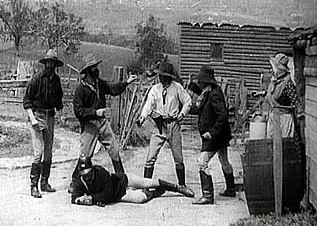
Story of the Kelly Gang

The Story of the kelly Gang, from http://australianscreen.com.au

There is a lot of silent film on view, with helpful contextualising material. Among Feature Films, there are sequences from the world’s first narrative feature film The Story of the Kelly Gang (1906), and two other renowned Australian silents, The Sentimental Bloke (1919) and On Our Selection (1920). Among Documentaries there are such gems as Marvellous Melbourne: Queen City of the South (c.1910) and a Pathé documentary on the making of the newspaper The Sydney Morning Herald (1911). Look out also for Endurance (1933), the sound film version of the film originally shot by Frank Hurley of Ernest Shackleton’s 1914-1916 Trans-Antarctic expedition.

Darwin

Darwin c.1926, from http://australianscreen.com.au

And there’s more. The Newsreels section has extensive material from Australasian Gazette, dating from 1911 onwards. In Other historical footage, look out for Marius Sestier and Walter Barnett’s film of the Melbourne Cup horse race in 1896, one of the first films made in Australia, a parade of Australian troops going off to the Boer War in 1899, filmed by Frederick Wills and Henry Mobsby, and footage of Darwin in 1926 which includes sequences showing the Chinese community.

It’s a marvellous resource, oriented for schools use but of interest to anyone. It’s so clearly laid out and expressed. Go explore.

Focus on Film

Focus on Film

The Learning Curve is a free online teaching and learning resource provided by the UK’s National Archives (formerly, and far better known as, the Public Record Office). It brings together a range of archive materials around key historical themes, and this includes film. Its Onfilm resource has recently been revamped and renamed Focus on Film.

This now comes with 150 film clips, all of them downloadable and re-usable, and the site now has its own online editing tools, in The Editor’s Room. The National Archives does not hold film itself (selected British government films are preserved by the BFI National Archive on its behalf), so it uses film from Screen Archive South East, the BFI, the Imperial War Museum, British Pathe and the BBC.

Focus on Film

There are several silent film clips available. There is an absolutely delightful film of Folkestone in 1904, with people just being themselves, parading up and down the streets, having fun at the beach, fooling before the camera, dressed on their Sunday best. It’s long been one of my desert island films (it has no known producer or title, and goes by the supplied title of Edwardian Folkestone), and I strongly recommend it (how drearily the teaching notes on the site describe it: “The roller coaster ride reminds us of the primary aim of early film-makers, profit via entertainment”). Scarcely less delightful nor more absorbing in its social detail is a 1920 tour through the streets of Canterbury, taken from the back of a moving vehicle.

There are newsreel films of the suffragettes, including the infamous film of the 1913 Epsom Derby in which Emily Davison runs on to the race-course and is killed. There are several film clips for the First World War, including key sequences from the great documentary testament The Battle of the Somme (1916). Somewhat peculiarly, there are also clips of a modern actor telling us about the experience of the Somme, which together with clips elsewhere of actors giving us vox pops on life in the Tudor and Stuart periods may end up confusing a few schoolchildren. There’s also footage from Ireland in 1916 (The Easter Rising) and 1920s.

The quality of the downloads is good (QuickTime Pro is needed if you are going to retain a copy), and the suggested activities (for PC or interactive whiteboard) and editing facilities are fascinating. Note that the site states: Teachers and students are granted a limited, non-exclusive licence to use the film clips for non-commercial educational use only and may not re-publish materials without permission of the copyright holder.

Well worth a look.

Queen Victoria comes to Canterbury

Queen Victoria’s Diamond Jubilee

General bookings opened today for Queen Victoria’s Diamond Jubilee at the Canterbury Festival. This is a show I’ve devised which recreates the tour around London taken by Queen Victoria on 22 June 1897, to mark the sixtieth year of her reign. In taking the audience around London, the show integrates photographs, eye-witness testimony and original films (from the BFI National Archive) of the procession, shown in correct sequence. The eye-witness testimony, including the words of Kier Hardie, Edward Burne-Jones, Molly Hughes, Beatrice Webb, Mark Twain and Queen Victoria herself, is read by Neil Brand (an actor as well as our most celebrated silent film accompanist) and Mo Heard, with Stephen Horne playing the piano. And I’m the presenter.

The show is taking place Friday 19th October, 8.00pm, at the International Study Centre, which is in the precincts of Canterbury Cathedral. Tickets are an entirely reasonable £12, and full details of how to book are on the Festival website.

Downing Street posts silents


Who’d have thought it? Downing Street is posting silent films on YouTube. It’s true. DowningSt is a registered YouTube member and has posted some 50-60 videos on YouTube, including a selection of Topical Budget silent newsreels from the collection held by the British Film Institute. This one shows Conservative PM Andrew Bonar Law (not one of the more celebrated British prime ministers) introducing his new cabinet to the newsreel cameras in 1922 – absolutely fascinating for the differing reactions from the ministers to this unprecedented intrusion from the media. (Adding comments has been disabled, by the way, should you have wished to express your rage – or heartfelt approval – at Bonar Law’s handling of the economy in 1922).

Others available from DowningSt on YouTube include MR BALDWIN AND ‘OLD BERKELEY’ (Stanley Baldwin with a hunt), NOW FOR THE PREMIERSHIP STAKES! (Baldwin electioneering), and LLOYD GEORGE RESIGNS (the fall of the Lloyd George Liberal government in 1922). I’m particularly fond of a 1921 Topical Budget film showing Lloyd George at Chequers in 1921, DOWNING ST IN BUCKINGHAMSHIRE, deftly filmed by Fred Wilson (in the dim and distant past I wrote a book on Topical Budget, and I’m always pleased to see it getting continued screenings). There was a real art to the best of the silent newsreels, as for any other kind of silent film production.

One oddity – all of the Topical Budget items posted by DowningSt are without a soundtrack, yet three of them come from the 1992 BFI Topical Budget video release, which had excellent music by Neil Brand. Shame.

More from Mitchell and Kenyon

IrelandSports

Clearly there are people out there who cannot get enough of Sagar Mitchell and James Kenyon. Firstly there was the discovery of the lost haul of their actuality films of life in northern Edwardian Britain, an astonishing collection of 800 films in pristine condition, which were restored by the British Film Institute, with research undertaken by the National Fairground Archive. Then there came the 2005 BBC series The Lost World of Mitchell and Kenyon, which opened people’s eyes to past lives in a way probably never achieved before by a television programme. That was followed by the DVD of the series, then an accompanying book, then a second DVD Electric Edwardians, and then another book of the same title. And there have been public screenings, and countless newspaper articles.

And now there are two more DVDs, and both look amazing. Mitchell and Kenyon in Ireland, narrated by Fiona Shaw, includes twenty-six films taken by Mitchell and Kenyon 1901-1902, and covers Dublin, Wexford, Cork and Belfast. There’s an eighteen-page booklet, and a score by Neil Brand and Günter Buchwald. The second DVD, Mitchell and Kenyon Sports, is the one for me. Narrated by Adrian Chiles (clever choice), this has scenes of football, rugby, athletics, swimming and cricket. There’s film of Liverpool, Everton, Blackburn and Hull Kingston Rovers. A particular highlight is film of Lancashire bowler Arthur Mold demonstrating his action to prove that he didn’t, as was alleged, throw the ball. The camera never lies… Stephen Horne and Martin Pyne provide the musical accompaniment.

How will these sell, and what else lies in the vaults ready for release? It’s still extraordinary the excitement that has been generated by this collection of films. The ‘local topical’ film of the 1900s, in which Mitchell and Kenyon specialised, has long been well-known to film archivists. They are films with particular charm because of their artless style and the way in which the people in the films address the camera. They have always been seen as having largely regional appeal, the sort of films that few would ever see or appreciate. Then along came 800 in one go, negatives, with an underlying history connecting them with town hall showmen and fairground operators who commissioned the films and exhibited them across the country. And one musn’t forget the drive of Vanessa Toulmin, of the National Fairground Archive, in pulling all of this activity together.

Mitchell and Kenyon weren’t the only producers of local topicals at this period, but they were the most important. It has be stressed that we knew nothing of these films before they were discovered. My reaction, when I first saw a list of the films when I was working at the National Film and Television Archive, was disbelief – such a number of previously unknown films simply couldn’t exist. M&K were know for a handful of ‘fake’ newsreels of the Boer War, but none of the actualities films turned up in filmographies – they are completely absent from Denis Gifford’s British Film Catalogue, while Rachael Low’s The History of the British Film barely mentions the company. We know better now.

Will there ever be such a film discovery again?

Iamhist conference report

Amsterdam

Iamhist (International Association for Media and History) is an organisation of filmmakers, broadcasters, archivists and scholars dedicated to historical inquiry into film, radio, television, and related media. It publishes the widely-respected Historical Journal of Film, Radio and Television, and organises biennial conferences. This year’s was held in Amsterdam 18-21 July, on the theme Media and Imperialism: Press, Photography, Film, Radio and Television in the Era of Modern Imperialism. There were several papers given on silent film subjects, and the Bioscope was there with pen and notebook.

A number of the best papers were given on media outside Iamhist’s usual frame of reference. Pascal Lefèvre spoke lucidly and informatively on Imperialist images in French and Belgian children’s broadsheets of the late nineteenth/early twentieth centuries, finding arguably positive or some downright critical images that differed from the usual Western view of African peoples at this time. Andrew Francis was equally entertaining and observant in talking about the use of pro-Empire imagery in New Zealand newspaper advertising during the First World War.

On silent films themselves, James Burns spoke on the distribution (or lack of distribution) of the films of the Jack Johnson-Jim Jeffries boxing match in 1910 and D.W. Griffith’s Birth of a Nation in 1914 to black audiences in Africa and the Caribbean. The Johnson-Jeffries film (the black Johnson defeated ‘white hope’ Jeffries for the world heavyweight title) is well-known for how its images of a black victory alarmed many in America, though Burns pointed out that films of Johnson’s earlier victories over white opponents had not aroused anything like the same rabid reaction. He also pointed out that Birth of a Nation was not exhibited in Africa (until 1931), yet no evidence has yet been found to show why it was withheld. Burns’ has done excellent work on film and black African audiences (see his Flickering Shadows: Cinema and Identity in Colonial Zimbabwe), and his new research promises much, even if evidence of black audience reactions (outside the USA) remain elusive.

Simon Popple spoke on films of the Anglo-Boer War, focussing on the dramatised scenes of the conflict produced by the Mitchell and Kenyon company. M&K are now renowed for their actuality films of life in Northern England in the Edwardian era, after the successful BBC series The Lost World of Mitchell and Kenyon, but they also made dramas, recreating melodramatic scenes from the South African war to feed a public appetite for moving picture scenes of the war which had been disappointed by undramatic newsfilms of the conflict. These crudely histrionic dramas, with titles such as Shelling the Red Cross, A Sneaky Boer, and Hands Off the Flag, raise a laugh now, but presumably had them cheering in the aisles in 1900.

With the unavoidable but unfortunate practice of parallel sessions so that as many speakers as possible can be crammed in, no one could attend everything, and I missed some relevant papers, including Teresa Castro on ‘Imperialism and Early Cinema’s Mapping Impulse’ and Yvonne Zimmermann on ‘Swiss Corporate films 1910-1960’. Too few witnessed Guido Convents‘ excellent presentation on the huge production of Belgian colonial films, from the early years of the century onwards, all designed to remind the world and audiences at home that Belgian had a presence in Africa and an Imperial role to play. He also showed a heartbreaking film of the difficulties faced by the Congo film archive, which put into perspective some of the institutional troubles faced by the world’s larger film archives, described by Ray Edmondson in a plenary session. Edmondson nevertheless made an eloquent case for the ways in which some film archives have come under threat through insensitive political fashions and institutional follies. Archives seem hampered by being archives: politicians do not grasp what it is that they are about in the same way that they do with museums, a far more generously funded sector with a considerably greater public profile.

And there was more. Martin Loiperdinger showed magic lantern slides of British Empire subjects from the nineteenth century and considered their impact upon audiences. Kay Gladstone of the Imperial War Museum showed a two-hour selection of films from its amazing archive for the two world wars (and more), including a live action political ‘cartoon’ from the Anglo-Boer War, and images of Colonial troops in the First World War, though what left the audience stunned was silent, colour home movie footage of India at the time of partition in 1947, showing scenes of the misery caused that the newsreels of the time scrupulously avoided. And there was plenty on post-silent subjects, and me thrilling a small audience with a disquisition on databases and the misuse of thesauri and keywording in describing Imperial and Colonial themes. You should have been there…

These conferences are curious affairs. They are an excellent meeting place and a good way to catch up on the latest ideas, but you do also sit through some truly grim presentations – mumbled monotones, heads bowed down reading from indigestible text, oblivious to the needs of an audience. How some people can still continue to draw salaries as lecturers beats me – you do pity their poor students. And then there are the natural entertainers, who know their audience as well as their subject, and can speak wisely and clearly, in whatever time allotted. It was a well-organised event, the sun shone, the pavement cafés were inviting, and the coffee was fine. I’ll be following up some of the themes (especially silent cinema in Africa) in future posts.
Worldwide montage

vertov.jpg

Now here’s an extraordinary thing. Video artist Perry Bard is planning a remake of Dziga Vertov’s classic avant garde documentary Man with a Movie Camera, and is inviting the world to join in.

Her plan is to use the web to archive, sequence and deliver submissions for a remake of the 1929 film, which will then be exhibited on the Big Screen Manchester (a BBC initiative to bring big screen pictures to city squares) UK on 11 October 2007, with more public venues visited throughout the UK through 2008.

The project website, http://dziga.perrybard.net, has a scene index with every shot of Vertov’s film recorded in thumbnails and logged in seconds and number of frames. Would-be Vertov’s of today can upload their footage (or still images, or even text), which does not have to match the original shot but should come close to it in length – it’s the rhythmic patterning that counts. Presumably it’s meant to be one shot contributed per person.

Goodness what the results will be like (or how she will select what’s sent, or even how many different potential versions might emerge), but it’s an amazing idea, and certainly has something of the spirit of Vertov’s radical work about it. Here’s the artist’s explanation of how her work connects with that of Vertov:

Vertov’s 1929 film Man With A Movie Camera records the progression of one full day synthesizing footage shot in Moscow, Riga, and Kiev. The film begins with titles that declare it “an experiment in the cinematic communication of visible events without the aid of intertitles, without the aid of a scenario, without the aid of theater.” It is often described as an urban documentary yet the subject of the film is also the film itself – from the role of the cameraman to that of the editor to its projection in a theatre and the response of the audience. It is a film within a film made with a range of inventive effects – dissolves, split screen, slow motion, freeze frame – all of which are now embedded in digital editing software … When the work streams your contribution becomes part of a worldwide montage, in Vertov’s terms the “decoding of life as it is”.

The project site also has the the entire film to view (via Google Video). Uploading starts in August.

Whatever next?

Queen Victoria’s Diamond Jubilee

Mr Hunt

110 years ago, on 22 June 1897, Queen Victoria processed through London to mark sixty years of her reign. Numerous motion picture cameramen were positioned around the route, including Birt Acres, Robert Paul, R.J. Appleton, Dr J.H. Smith, Alexandre Promio (filming for Lumière), Henri Lavanchy-Clarke, Alfred Wrench and John Le Couteur. A number of these short film survives, mostly in the collection of the BFI National Archive. Ten years ago I put together a commemorative show which combined the surviving films with photographs from around the route and actors reading our eye-witness testimony from Mark Twain, Edward Burne-Jones, Molly Hughes, G.W. Steevens and others. Recently I revived the show, and this is just a bit of advance notice that it will be featuring at this year’s Canterbury Festival, on Friday 19 October, with Stephen Horne on the piano, Neil Brand (away from the piano for once) taking the male parts and Mo Heard the female parts, with me as narrator. Booking opens 13 August!

The image above shows a section of the crowd in the stands outside St Paul’s Cathedral, where the main ceremonies took place (the Queen being too infirm to scale the steps and go inside). In the centre of the photograph you can see the camera and tripod of Mr Hunt, one of Robert Paul’s team of cameramen. And you can see footage taken by Paul himself (positioned on the other side of the square, in this QuickTime video clip from the New Zealand Film Archive.

The Birds and the Bees

birdsandbees1.jpg

Why not pop down to the National Film Theatre on London’s South Bank next Tuesday evening to see a programme of some of the less usual kind of silent films? The Birds and the Bees is a special programme of early natural history films, put together by the BFI’s curator of silent film, Bryony Dixon. Early British film history is rich in naturalist filmmakers who, decades before David Attenborough, were combining science with entertainment to prove that the movies could do more than just distract the masses with slapstick and melodrama. Filmmakers such as Oliver Pike, who specialised in recording birds in their habitat in films such as St Kilda, its People and Birds (1908); or the wonderful Percy Smith, who made stop-frame films of plant growth that could take over a year to produce, as well as meticulous studies of animal life with a touch of showmanship about them. Or what about the extraordinary J.C. ‘Bee’ Mason, war cameraman, adventurer and apiarist, whose films of his life-long hobby, such as The Bee’s Eviction (1909), are mad entertainment.

It’s on at 18.15, Tuesday June 16th in NFT2. More details from the BFI Southbank web pages.

Science is Fiction

The new BFI DVD of the surreally beautiful films of scientific filmmaker Jean Painlevé, Science is Fiction, looks marvellous just by itself, but for lovers of early scientific films (there are a handful of us) the DVD also includes Percy Smith‘s The Birth of a Flower (1910) and The Strength and Agility of Insects (1911, though this is actually the retitled The Balancing Bluebottle from 1908), with its cork-juggling flies.