The Silent Film Bookshelf

The Silent Film Bookshelf was started by David Pierce in October 1996 with the noble intention of providing a monthly curated selection of original documents on the silent era (predominantly American cinema), each on a particular theme. It ended in June 1999, much to the regret to all who had come to treasure its monthly offerings of knowledgeably selected and intelligently presented transcripts. The effort was clearly a Herculean one, and could not be sustained forever, but happily Pierce chose to keep the site active, and there it still stands nine years later, undeniably a web design relic but an exceptional reference resource. Its dedication to reproducing key documents helped inspire the Library section of this site, and it is a lesson to us all in supporting and respecting the Web as an information resource.

Below is a guide to the monthly releases (as I guess you’d call them), with short descriptions.

October 1996 – Orchestral Accompaniment in the 1920s
Informative pieces from Hugo Riesenfeld, musical director of the Rialto, Rivoli and Critierion Theaters in Manhattan, and Erno Rapee, conductor at the Capitol Theater, Manhattan.

November 1996 – Salaries of Silent Film Actors
Articles with plenty of multi-nought figures from 1915, 1916 and 1923.

December 1996 – An Atypical 1920s Theatre
The operations of the Eastman Theatre in Rochester, N.Y.

January 1997 – “Blazing the Trail” – The Autobiography of Gene Gauntier
The eight-part autobiography (still awaiting part eight) of the Kalem actress, serialised over 1928/1929 in the Women’s Home Companion.

February 1997 – On the set in 1915
Photoplay magazine proiles of D.W. Griffith, Mack Sennett and Siegmund Lubin.

March 1997 – Music in Motion Picture Theaters
Three articles on the progress of musical accompaniment to motion pictures, 1917-1929.

April 1997 – The Top Grossing Silent Films
Fascinating articles in Photoplay and Variety on production finance and the biggest money-makers of the silent era.

May 1997 – Geraldine Farrar
The opera singer who became one of the least likely of silent film stars, including an extract from her autobiography.

June 1997 – Federal Trade Commission Suit Against Famous Players-Lasky
Abuses of monopoly power among the Hollywood studios.

July 1997 – Cecil B. DeMille Filmmaker
Three articles from the 1920s and two more analytical articles from the 1990s.

August 1997 – Unusual Locations and Production Experiences
Selection of pieces on filmmaking in distant locations, from Robert Flaherty, Tom Terriss, Frederick Burlingham, James Cruze, Bert Van Tuyle, Fred Leroy Granville, H.A. Snow and Henry MacRae.

September 1997 – D.W. Griffith – Father of Film
Rich selection of texts from across Griffith’s career on the experience of working with the great director, from Gene Gauntier, his life Linda Arvidson, Mae Marsh, Lillian Gish and others.

October 1997 – Roxy – Showman of the Silent Era
S.L. Rothapfel, premiere theatre manager of the 1920s.

November 1997 – Wall Street Discovers the Movies
The Wall Street Journal looks with starry eyes at the movie business in 1924.

December 1997 – Sunrise: Artistic Success, Commercial Flop?
Several articles documenting the marketing of a prestige picture, in this case F.W. Murnau’s Sunrise.

January 1998 – What the Picture Did For Me
Trade publication advice to exhibitors on what films of the 1928-1929 season were likely to go down best with audiences.

February 1998 – Nickelodeons in New York City
The emergence of the poor man’s theatre, 1907-1911.

March 1998 – Projection Speeds in the Silent Film Era
An amazing range of articles on the vexed issue of film speeds in the silent era. There are trade paper accouncts from 1908 onwards, technical papers from the Transactions of Society of Moving Picture Engineers, a comparative piece on the situation in Britain, and overview articles from archivist James Card and, most importantly, Kevin Brownlow’s key 1980 article for Sight and Sound, ‘Silent Films: What was the right speed?’

April 1998 – Camera Speeds in the Silent Film Era
The protests of cameramen against projectionsts.

May 1998 – “Lost” Films
Robert E. Sherwood’s reviews of Hollywood, Driven and The Eternal Flame, all now lost films (the latter, says Pierce, exists but is ‘incomplete and unavailable’).

June 1998 – J.S. Zamecnik & Moving Picture Music
Sheet music for general film accompaniment in 1913, plus MIDI files.

July 1998 – Classics Revised Based on Audience Previews
Sharp-eyed reviews of preview screenings by Wilfred Beaton, editor of The Film Spectator, including accounts of the preview of Erich Von Stroheim’s The Wedding March and King Vidor’s The Crowd, each quite different to the release films we know now.

August 1998 – Robert Flaherty and Nanook of the North
Articles on the creator of the staged documentary film genre.

September 1998 – “Fade Out and Fade In” – Victor Milner, Cameraman
The memoirs of cinematographer Victor Milner.

October 1998 – no publication

November 1998 – Baring the Heart of Hollywood
Somewhat controversially, a series of articles from Henry Ford Snr.’s anti-Semitic The Dearborn Independent, looking at the Jewish presence in Hollywood. Pierce writes: ‘I have reprinted this series with some apprehension. That many of the founders of the film industry were Jews is a historical fact, and “Baring the Heart of Hollywood” is mild compared to “The International Jew.” [Another Ford series] Nonetheless, sections are offensive. As a result, I have marked excisions of several paragraphs and a few words from this account.’

December 1998 – Universal Show-at-Home Libraries
Universal Show-At-Home Movie Library, Inc. offered complete features in 16mm for rental through camera stores and non-theatrical film libraries.

January 1999 – The Making of The Covered Wagon
Various articles on the making of James Cruze’s classic 1923 Western.

February 1999 – From Pigs to Pictures: The Story of David Horsley
The career of independent producer David Horsley, who started the first motion picture studio in Hollywood, by his brother William.

March 1999 – Confessions of a Motion Picture Press Agent
An anonymous memoir from 1915, looking in particular at the success of The Birth of a Nation.

April 1999 – Road Shows
Several articles on the practive of touring the most popular silent epics as ‘Road Shows,’ booked into legitimate theatres in large cities for extended runs with special music scores performed by large orchestras. With two Harvard Business School analyses from the practice in 1928/29.

May 1999 – Investing in the Movies
A series of articles 1915/16 in Photoplay Magazine examining the risks (and occasional rewards) of investing in the movies.

June 1999 – The Fabulous Tom Mix
A 1957 memoir in twelve chapters by his wife of the leading screen cowboy of the 1920s.

And there it ended. An astonishing bit of work all round, with the texts transcribed (they are not facsimiles) and meticulously edited. Use it as a reference source, and as an inspiration for your own investigations.
City & country

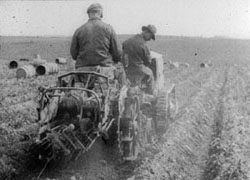
The How and Why of Spuds (1920), National Archives Collection

This year’s Northeast Historic Film’s Summer Symposium takes place 25-26 July, at Bucksport, Maine. Northeast Historic Film collects, preserves, and makes available to the public, film and videotape of interest to the people of northern New England, and holds an annual symposium which focuses on regional film, much of it amateur, and stretching back to the 1920s. This year’s theme is City & Country:

Images and archetypes of the city and the country as seemingly distinct locations and ways of life have remained a potent force in the cultural imagination since the mid 19th century. Even though the transformations of industrial culture and mobility have changed rural and urban landscapes and lifestyles, the ideas and images associated with the City and the Country continues to thrive as traditional poles of modern experience. They are where we anchor the dreams and fears of technology and tradition, and where we are animated by hopes of progress and the comforts of nostalgia. As Raymond Williams noted of this powerful duality, “the contrast of country and city is one of the major forms in which we become conscious of a central part of our experience and of the crises of our society.”

More information as ever from the website.

Shell shocked

War Neuroses: Netley 1917, Seale Hayne Military Hospital 1918, from http://www.britishpathe.com

I’ve been reading (well, skimming through) Philip Hoare’s Spike Island, which is a poetic, not to say rococo history of the Royal Victoria Military Hospital at Netley, Hampshire. This is a building with a rich cultural history centring around its role during the First World War, where it was home to many casualties of the war, including Wilfred Owen, and became well known for treating victims of shell shock.

You’ll find many an account of the experiments and therapies for shellshock at Netley and elsewhere, from the sentimental to the Freudian. What concerns us here is the contemporary film record. One of the most notable films of the First World War, by what ever criteria you care to mention, is War Neuroses: Netley 1917, Seale Hayne Military Hospital 1918, made by Pathé (British branch) in 1918, which Hoare covers in some detail. War Neuroses shows the psychotherapeutic treatment of shell shock victims at Netley and Seale Hayne (Devon) military hospital, featuring the treatments undertaken by Doctors Arthur Hurst and J.L.M. Symns of the Royal Army Medical Corps. The catalogue of the Wellcome Trust Moving Image and Sound Collection describes the film thus:

Shows the symptomatology of “shell-shock” in 18 British “other rankers” and its treatment by two leading R.A.M.C. neurologists in two British military hospitals towards the end of the First World War. Captions tell us the men’s names, rank, medical condition, details of their symptoms and how long it took to complete the cure, which in one case was in two and a half hours. Clinical features shown include a variety of ataxic and “hysterical” gaits; hysterical paralyses, contractures and anaesthesias; facial ties and spasms; loss of knee and ankle-jerk reflexes; paraplegia; “war hyperthyrodism”; amnesia; word-blindness and word-deafness. Although there are no precise details of the kind of treatment given, apart from the description ‘cured and re-educated’ we do see a little physiotherapy and hypnotic suggestion in treatment, and of ‘cured’ men undertaking farm-work, drill and a mock battles entitled ‘Re-enacting the Battle of Seale Hayne / Convalescent war neurosis patients’.

At least three versions of the film exist. There are copies at the Wellcome, the BFI National Archive and the Imperial War Museum, but the ones to draw your attention to here are the versions held by British Pathe (currently managed by ITN). Pathé were the original producers, but not everyone might think to find it in the British Pathe online newsreel library, but there it is – or there they are – available for free download, albeit in low resolution.

Private Ross Smith (above), facial spams, and Private Read, hysterical gait, swaying movement and nose-wiping tic

There are five parts of the films on the British Pathe site: War Neuroses Version A reel 1, War Neuroses Version A reel 2, War Neuroses version B reel 1, War Neuroses version B reel 2 and Wonderful Shell Shock Recovery. For some impenetrable reason only two come up if you type in the words ‘war neuroses’ into the search box; type ‘netley’ instead and you’ll get all five. As indicated, there are two versions available (Wonderful Shell Shock Recovery is a fragment repeating scenes from the other films). The different versions, however, appear to be simply re-edits of the same material, with Version B being the most complete, with opening titles and scenes of some patients that Version A lacks. In its fullest form the film last around 25 mins. It is necessary to download the films (i.e. they won’t play instantly), with the site requiring you to fill out personal details before you do so.

The film demonstrates the symptoms of those suffering from shell shock, and are often quite heartbreaking. Private Preston, aged 19, we are told suffers from ‘Amnesia, word blindess and word deafness, except the the word “Bombs!”‘ He is shown sitting up in bed talking to one of the doctors, the key word is spoken, and immediately hides under the bed, and only reluctantly coming out again. Private Meek, aged 23, suffers ‘complete retrograde amnesia, hysterical paralysis, contractures, mutism and universal anaesthesia’. We see him seated in a wheelchair outside the hospital, legs rigid, leaning sideways, mvoing in awkward jerks and biting his thumb, while a nurse attends to him. It is a characteristic of War Neuroses that we see see before-and-after cases. So, after unseen treatment, we next meet Private Meek walking stiffly towards a group of patients weaving baskets (his peace time job), and later walking completely normally.

There are numerous such examples, the men shown with various forms of uncontrollable nervous spasms, next shown moving more or at less at ease, their return to normality sometimes illustrated by their performing tasks around the hospital as occupational therapy. One of the most distressing sequences is that of an unnamed patient (illustrated at the top of this post) suffering from hysterical pseudo-pseudohypertrophic muscular paralysis. We see the man in a dormitory, dressed only in a loin cloth. He walks with pathetic, angular awkwardness in a circle, before falling down, unable to get up without huge struggle. Next we see him in hospital uniform, walking calmly towards the camera. The reassuring scenes of rehabilitation seem almost as disturbing as the scenes of affliction. How can such mental wounds be healed so easily?

The purpose of the physical and psychotherapeutic treatment was not simply to cure, but to make the men literally fighting fit once more. Four-fifths of men who had been entering hospital suffering from shell shock were unable to return to military duty; the military authorities wanted to reverse this. What happened to the named and nameless soldiers seen in War Neuroses? One hopes fervently that none were returned to the battlefield. So what to make of the final scene from the film, where patients are shown taking part in a re-enacted battle scene: ‘The Battle of Seale Hayne, directed, photographed and acted by convalescent war neurosis patients’? Innovative psychodrama aimed at a final cure, or rehabilitation for war? Have we seen an actuality record, or a dramatisation of recovery to satisfy the wishes of those who chose to commission the film?

I don’t know enough of the history, either of the film (no one knows who the cameraman was, or much at all about the film’s production) or of the treatment of shell shock. It’s a subject that some have written about in great depth, yet it seems a subject where we still have much to learn. The film – which I urge you to see – provides no answers, only asks searching questions. Which is what films are there to do, whether they realise it or not.

Update (April 2009): A higher resolution copy of the film is available from the Wellcome Trust site, at http://catalogue.wellcome.ac.uk/record=b1667864~S8, as complete film and as four segments, plus a detailed catalogue record. Also, British Pathe is no longer managed by ITN Source.

Rockin’ with Nanook

Sumner McKane, right, and bass player Josh Robbins, from http://www.mainetoday.com

This report from Maine Today on some local rock groups taking it turns to provide scores for silents rather appealed:

The members of the Sumner McKane Group composed their latest musical work while watching grainy, black-and-white footage of an Inuit man hunting seals to keep his family alive in the frozen Hudson Bay region of Canada 86 years ago.

Not exactly your typical pop-song fodder.

“There’s sort of a desperate sadness to some of it,” said McKane, guitarist for the Portland instrumental trio.

McKane and his bandmates – Josh Robbins on bass and Todd Richard on drums – have been working for three weeks on creating an original score to the classic 1922 silent documentary “Nanook of the North.”

They’ll perform the music live while the 79-minute film is shown next Wednesday and Thursday at One Longfellow Square in Portland as part of the 200-seat venue’s monthly series, “Local Scores, Silent Films.”

Each month, a different local band picks a silent film and composes a score for live accompaniment. This will be the fourth concert/film showing in the series, following Buster Keaton’s “The General,” scored by Samuel James; Fritz Lang’s “Metropolis,” scored by the Improvisational String Quartet; and the classic German vampire film “Nosferatu,” scored by the jazz group Tempera.

Tom Rota, manager of One Longfellow Square, said he contacts bands to find out if they are interested, then gives them a list of classic silent films from which to choose.

The venue presents a mix of live music, dance, film and other performances and was known as the Center for Cultural Exchange before the current owners bought the building and reopened as One Longfellow Square last July.

In a sense, the venue is recreating the theater experience of the silent film era, when live musicians, usually a pianist, performed onstage or in an orchestra pit while the movie played onscreen. By using modern scores, it’s giving the tradition a modern twist.

McKane said when he was approached about the series, he immediately thought of “Nanook of the North.” He had seen it, was fascinated by it and thought its slow pace and human themes would fit his band’s brand of instrumental music, which includes rock, country and ambient music.

“There are a lot of still shots of the landscape, which allow for some spacious music. That’s better for us than something that’s action-packed,” said McKane, 31.

Considered the first full-length anthropological documentary, the film follows a year in the life of Inuits in Arctic Canada. It was made by Robert Flaherty, who went to Hudson Bay looking for iron ore on behalf of the Canadian Northern railroad. While there, he became intensely interested in capturing Inuit life on film.

In the film, Nanook takes his family on a hunting expedition to try to get enough food to survive another winter. The family travels on dog sled, hunts with spears and sleeps in igloos that have to be made on the spot every night.

Being a documentary, it’s very different from most of the classic silent films that often get shown today with live musical accompaniment. Horror films, epics and slapstick comedies are the usual suspects for this kind of silent film/live music series.

To compose the score, McKane, Robbins and Richard have been gathering in the basement of McKane’s North Deering home. They got a copy of the film from Netflix and watched it on a laptop computer as they composed and played. When they got a piece they liked, they went back to make sure it matched up with a segment of film.

It’s a fairly slow process. At a recent rehearsal, band members estimated it took maybe four hours or more to get about 25 minutes’ worth of music for the film.

During rehearsal, the band focused on part of the movie that takes place in the heart of the Arctic winter, when the family has little food left.

While the family slowly travels over a barren, icy landscape, the band plays music that’s spacey and full of echo, with Mark Knopfler-like guitar work. When Nanook traps a small fox, the music becomes faster and joyous.

Another scene where the music mimics the mood is when the family struggles to get its dogsled through a field of ice boulders. Once the sled goes up and over the last hill and can travel freely, the band explodes into a fast, thumping, rock ’n’ roll passage.

Matching music to scenes is a challenge, as is remembering all 79 minutes of the piece in sequence.

“For us, a long song is maybe 10 minutes,” said Robbins, 33. “And it’s all structured. There’s no jamming in the middle of this.”

The Maine Today report provides a sample of the Nanook music.

War as it really is

German prisoners of war in Donald C. Thompson’s War As It Really Is (1916), from http://www.realmilitaryflix.com

Realmilitaryflix is the ungainly name for a remarkable new source of online video. The site has been put together by US Air Force combat camera veteran John Corry, who began building up a collection of war films while producing a television series in 1991. The site comprises 650 films (with 1,200 more promised by the end of the year), and ranges from the First World War to Iraq and Afghanistan today. Military enthusiasts can scour the decades of conflict; here at the Bioscope we concentrate on the silent material from the 1914-1918 conflict, which is significant enough in itself.

There are some thirty titles so far, most of them American official films of one kind or another, shot by the U.S. Signal Corps or produced by the propaganda outfit, the Committee on Public Information. Care has been taken to give correct titles and to determine dates, locations and regiments. I’ve not yet had the chance to view them all, but here’s a quick guide to some of the highlights:

Actualities of the World War
Realmilitary flix says “If you only watch one WWI film, make it this one”, and it’s not far wrong. This dynamic four-part compilation was made up of American military film after the war, and the material was expertly edited to form a general narrative of American participation in the war 1917-1918. Its correct title appears to be Flashes of Action, and the National Archives and Records Administration’s ARC catalogue identifies it as c.1921 (many of these films of this site are duplicated in NARA, and some of the descriptions come from NARA’s records). It is filled with vivid scenes of the kind we expect to see of the war, leavened with plenty of human detail.

War As It Really Is
This 1916 production is a single person’s effort – the redoubtable Donald C. Thompson, an independent and resourceful American cameraman who filmed British, French, Belgian, Russian and German troops over 1914-1916, speaking volumes for his diplomatic abilities. He was with the French army at Verdun, where he was wounded, and from which conflict much of this film derives. The quality of the footage is evident throughout, while some of it is startling – apparently close shots of trench warfare (one should always be suspicious of footage where the cameraman would have been in peril e.g. being positioned above the trenches), the shooting of a spy (before and after), and shots of corpses and skeletons.

German Film of the WWI Sea Commerce Raider “Moewe”
This, as it says, is a German-produced film, made in 1917, which was captured by the Allies and subsequently released as The Notorious Cruise of the Raider ‘Moewe’. It follows the German raider ship Moewe as it captures Allied shipping, several examples of which are shown sinking. Its breezy tone comes over as all the more startling having the matter-of-fact titles translated into English.

British WWI Film on the Mideast and other Naval Operations
This is British official film taken in Palestine and Mesopotamia 1917-1918. There is some very impressive footage here, including a gunboat firing on the Tigris and striking aerial photography of a British convoy at sea. It ends with famous, iconic footage of General Allenby entering Jerusalem in December 1917, with fleeting glimpses of Lawrence of Arabia (in military uniform), if you know where to look.

T.E. Lawrence and General Allenby, shown in British WWI Film on the Mideast and other Naval Operations, from http://www.realmilitaryflix.com

And there’s much more: demonstrations of gas warfare, the operation of observation balloons, the construction of dummy soldiers as camouflage, radio operations, black troops, and the peace treaty negotations at Versailles in 1919. As indicated, one should always take care assessing the authenticity of war footage from this era – the cameramen were frequently brave, but they were severely limited by both equipment and army officialdom, and of course had to preserve their own lives. Overly dramatic footage (always consider where the cameraman was positioned when the film was taken and then ask why he wasn’t killed) may show genuine action but may equally have been staged. That said, there seems relatively little fakery here, just much startling footage intercut with skilfully-shot scenes of the mundanities of warfare which somehow bring it home all the more to us today.

All of the titles are available in Flash, and look OK blown up to full screen. One notable last point to make – all of the contemporary films of the war are shown silent. Go explore.

The Open Video Project

Edison titles

2 A.M. in the Subway (1905), Japanese Acrobats (1904) and The Boys Think They Have One on Foxy Grandpa, But He Fools Them (1902), from http://www.open-video.org

There are a number of online video collections out there designed for university use which feature lectures, demonstrations, educational documentaries etc. One that has been around for some time is the Open Video Project, which is hosted by Internet2 in America, and aims “to collect and make available a repository of digitized video content for the digital video, multimedia retrieval, digital library, and other research communities.” It comprises a number of collections from around the world such the University of Maryland HCIL Open House Video Reports, Digital Himalaya, NASA K-16 Science Education Programs and the HHMI Holiday Lectures on Science, but for our purposes what is interesting about the site is the Edison Video section.

This features 187 Edison production from the Library of Congress, dating from the 1890s and 1900s. Many early Edison titles are, of course, available from the LoC’s own excellent American Memory site, but the majority of the titles here are not on the better-known site. Among the varied titles only available here are A Ballroom Tragedy (1905), A Nymph of the Waves (1903), A Wake in “Hell’s Kitchen” (1903), Dog Factory (1904), Fights of Nations (1907), Gordon Sisters Boxing (1901), International contest for the heavyweight championship–Squires vs. Burns, Ocean View, Cal., July 4th, 1907 (1907), Princeton and Yale Football Game (1903), a series of films on the United States Post Office, films of the Westinghouse electrical works in 1904, and films from the St. Louis Exposition of 1904. And many more.

Basic cataloguing information is provided, though there are some peculiar errors with dates from time to time, and the presentation is rudimentary apart from some helpful synopses. There is little information available on the collection overall, so nothing to explain the significance of Edison films or why these titles – predominantly actuality – have been chosen. All are available as freely downloadable MPEG-1s, with the same frustratingly small image size as one finds on the American Memory site. But let us not be churlish – here is a wonderful selection of titles, many of them unfamiliar and indicative of the range of Edison production, including comedies, dramas, variety acts, sports films, travel films, and sponsored industrial work. Well worth exploring.

There will be silents

The Story of Petroleum

The Story of Petroleum, from http://www.dvdtalk.com

An intriguing small news piece for you. The forthcoming DVD release (Collector’s Edition) of the Paul Thomas Anderson film There Will Be Blood, on the birth of the American oil industry, will include The Story of Petroleum among its extras.

This 25mins documentary dates from c.1923 and was produced at the behest of the US Bureau of Mines and the Sinclair Oil Company (nothing to do with Upton Sinclair, whose novel Oil! forms the basis on Anderson’s film). It shows operations of the American oil industry at the time (There Will Be Blood is set in the 1890s), and comes with a score from Radiohead’s Jonny Greenwood, who also scored the main feature film. The film was presumably remade or updated from time to time, as the BFI National Archive has copies dating from 1920 and 1928. It is a typical example of the semi-instructional semi-propagandist films produced by industrial concerns for the burgeoning non-theatrical market from the 1920s onwards.

The DVD (Collector’s Edition) of There Will Be Blood is released in the UK on 8 April.

Motion pictures

Execution of Czolgosz

Execution of Czolgosz with Panorama of Auburn Prison (1901)

This gentle, business-like image comes from one of the most discussed and notorious of early films, Edison’s Execution of Czolgosz with Panorama of Auburn Prison (1901). Leon F. Czolgosz was the assassin of President William McKinley, and Edwin S. Porter and James White journeyed to Auburn Prison in upstate New York, reportedly with the hope of filming Czolgosz’s actual execution in the electric chair. Happily they were rebuffed, but they filmed the outside of the prison on the day of the execution, then back at the studio the Edison team dramatised the scene that had taken place inside, and cut the films together.

Should you wish to, you can see the film on the Library of Congress’ American Memory site, which supplies this original catalogue description:

A detailed reproduction of the execution of the assassin of President McKinley faithfully carried out from the description of an eye witness. The picture is in three scenes. First: Panoramic view of Auburn Prison taken the morning of the electrocution. The picture then dissolves into the corridor of murderer’s row. The keepers are seen taking Czolgosz from his cell to the death chamber, and shows State Electrician, Wardens and Doctors making final test of the chair. Czolgosz is then brought in by the guard and is quickly strapped into the chair. The current is turned on at a signal from the Warden, and the assassin heaves heavily as though the straps would break. He drops prone after the current is turned off. The doctors examine the body and report to the Warden that he is dead, and he in turn officially announces the death to the witness. Class B 200 ft. $24.00

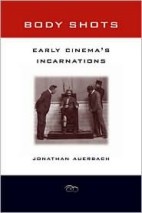
So much that is complex, problematic, mysterious, engrossing and unique about the motion picture is bound up in this short film; in its production, reception and subsequent critical understanding. What exactly does it signify? What is the relationship between the actuality footage and the dramatised? How ‘real’ is it? How do we understand the figure of Czolgosz from what is presented to us? Why did audiences want to see the film, and what exactly did they see in it? It is these mysteries, and in particular the presence of the human body in motion, trailing all kinds of ‘anxieties and preoccupations’ with it, that forms the subject of a new book on early cinema, Jonathan Auerbach’s Body Shots: Early Cinema’s Incarnations, which places the Czolgosz film on its front cover.

Body Shots

It’s an inelegant title, but a compelling work – quite the best book on early film that I’ve read in ages. Its argument is not one you can summarise easily. Auerbach’s interest is in the earliest years of film before narrative took hold, when the signification of these figures in motion is not straightforward. He does not put forward an all-encompassing theory, but rather raises questions and demonstrates the complexity of an audience’s understanding of the figure in motion. In doing so, he rather lays into the dominant theory in this field, the ‘cinema of attractions’, promoted by Tom Gunning and André Gaudreault in the mid-1980s, and cited religiously by countless students and scholars of early cinema ever since. The theory (to use Auerbach’s words) “posits early films and filmmaking as a mode of showing that privileged immediate shock and sensation over narrative continuity and integration”. So, variety acts, exotic scenes, hand-painted colour, magic tricks – spectacle over story.

I doubt that Gunning himself would say that his should be a theory to explain all film before 1906, but it has become an orthodoxy, as Auerbach states, and he’ll have none of it. For him it is too cosy a solution, too tidy an explanation of what should be perplexing, uncertain territory. He finds the evidence provided by specific films, in their specific contexts, and it is close readings of just a handful of actuality (or pseudo-actuality) films that makes the book such an engrossing read.

Perhaps the book’s tour de force is the chapter on McKinley at Home – Canton, O (1896). This brief film shows the Republican candidate for the presidency, William McKinley, walking across his garden and receiving a telegram, before walking with a companion of out frame. Auerbach tell us the history of McKinley’s campaign (he made a virtue of staying at home), the film’s production (McKinley’s brother was on the board of the American Mutoscope and Biograph Company which made the film), its promotion, interpretations of the film at the time (the message he was receiving could be interpreted how you wished), the participatory nature of its reception (audiences reacting vocally to what they saw on the screen), and the film’s enthusiastic reception by a press largely dedicated to the Republican cause. Four years later, he would be assassinated, and the chapter concludes with a more speculative reading of Execution of Czolgosz.

Auerbach demonstrates the range of strategies and meanings that can underlie such a simple seeming actuality as McKinley at Home. Of course, not all films of the 1890s may yield such a rich contextual history, but it is the potential for such contexts that matters – that, and the relationship between film and audience, each operating in their own particular sphere. None of the profusion of ideas that Auerbach brings to his interpretation of McKinley at Home, Execution of Czolgosz, early Edison and Lumière actualities, The May Irwin Kiss, The Big Swallow, Personal or The Life of an American Fireman seems forced or inappropriate. The themes he takes on include the visualisation of sound, the emergence of the chase movie as proto-narrative, and finally a Barthesian meditation on death and early film, when such bodies cease to move.

The great appeal of early cinema is its receptivity to ideas, its status as a period when no one can be certain of what is going on, just as Auerbach says about the early actualities themselves:

… volition and animation are often at odds rather than coterminous, a fact that gives these early moving images a peculiar kind of affect, suggesting neither filmmakers nor viewers nor bodies on-screen quite knew what to make of or do with themselves. Hence their interest for me.

It seems a new generation of theorists is coming to the field (Auerbach’s background is in literary studies) and dragging early cinema forward or back into the many worlds to which it belongs. Body Shots is not an easy read, but then neither is it a difficult one. It makes films that you may not have seen nevertheless visible, and makes you want to look again with sharper eyes at those you do know. I may not have explained it terribly well, but I do recommend it.

Scotland the brave

Scottish Screen Archive

Scottish Screen Archive

The Scottish Screen Archive has released some 1,000 film clips on its impressively-redesigned site. The SSA is Scotland’s national film archive, now part of the National Library of Scotland. It has an excellent record of preserving, contextualising and making accessible a national moving image heritage to a multiplicity of audiences. This latest resource comes courtesy of the Heritage Lottery Fund, and present clips from the 1890s to the 1980s, all integrated into their existing catalogue. The searching and browsing (by place, subject, biography and decade) are all exemplary, and the catalogue descriptions are spot on.

So, what is here for the silent era? Well, sixty-two clips, all of them non-fiction titles, from 1897 onwards, including many classic gems. For instance, look out for Lord and Lady Overtoun’s Visit to Mcindoe’s Show (1906), a rare early film of the outside of a fairground bioscope show; Dr Macintyre’s X-Ray Film (1896/1909), examples of the X-ray cinematography of Dr John Macintyre; several examples of Scotland’s own silent newsreel, Scottish Moving Picture News (later called British Moving Picture News); the civic record, Glasgow’s Housing Problem and its Solution (c.1919); a family holiday home movie from 1927; film of the building of the Ritz Cinema, Edinburgh in 1929; and St Kilda – Britain’s Loneliest Isle (1923/1928), a classic picture of life on the remote island while it was still inhabited by humans.

Social films, city films, newsreels, home movies, charity films, advertising films, interest films, documentaries – this is a marvellous collection, not just of Scottish life but of the multifarious forms of the non-fiction film, demonstrating for our period what an important part it plays in what should be our understanding of the silent film overall – somehing of the people, for the people. Go explore.

Struggling to keep up with the BFI

Lights and Shades on the Bostock Circus Farm

The British Film Institute employs so many different outlets for its films these days that it’s difficult to keep up. What with the Mediatheque, Creative Archive, Screenonline, European Film Treasures, filmarchives online, its vast website and MySpace page, alongside the traditional outlets of DVD, book publishing and cinema exhibition, it’s becoming hard to escape their mission to inspire us all. Yet it’s still possible to overlook some of their activities, such is their number, as I’d done until now with their YouTube channel.

The BFI has contributed to several other YouTube sites, wittingly (e.g. 10 Downing Street and The Royal Channel) or unwittingly (take your pick), but for a few months now it has also had its own channel. And what gems are there.

There are sixty-four titles at present, and all are films which the BFI owns or for which there is no rights claimant, and so there’s an emphasis on silent shorts. Several of these are available from other BFI outlets, and all are featured in the Mediatheque, so the site serves as a taster, and no harm with that. So, for example, there are numerous clips from The Open Road, Claude Friese-Greene’s two-colour travelogue of 1924/25, which has already seen the recent light of day as a television programme and two DVD releases.

So let’s recommend a few old favourites. None more favoured to my mind than Lights and Shades on the Bostock Circus Farm, featured above, an astonishing 1911 production from the Warwick Trading Company (the print comes from a German source, hence the German titles, but it’s nevertheless a British production). I shan’t spoil the surprise – just to let you now that what looks like a conventional interest film about a touring circus and its animals suddenly turns to heart-rending drama…

Oyster Fishing at Whitstable, England

Or here’s another old favourite, Oyster Fishing in Whitstable, England – apparently an American production from 1921, though actually it’s a repackaging of a pre-First World War British film. An old favourite firstly because I was brought up in the fair town of Whitstable (and it hasn’t changed much), secondly because it’s a harmoniously accomplished example of early non-fiction ‘interest’ film, and thirdly because the subject of much of my research work, Charles Urban, the film’s producer, can be seen towards the end as one of a crowd on the beach sampling oysters (he’s the one crouching down on the right, wearing a hat).

The films all come with knowledgeable background descriptions from one or other of the BFI curators (a marked difference to many YouTube offerings). There are newsreels, magazine films, travels films, phantom rides, actualities, a recreation of Kinemacolor (more on that at another time) and much more. There are also several sound films of course (check out Geoffrey Jones’ glorious Snow, a brilliantly edited 1963 piece from the esteemed British Transport Films)). Fascinatingly, the most popular title so far is An Otter Study, with its underwater photography (the titles comes from the 1920s, but the original film was made by Urban’s Kineto company in 1912). Others are bound to feature in later posts. Go explore.