Mark Kermode, the BBC’s amusingly opiniated film critic, has a second life as bassist with retro band the Dodge Brothers (another member is film professor Mike Hammond). At the recent British Silent Film Festival the Dodge Brothers accompanied the William S. Hart western White Oak (1921) and here Kermode talks about the experience. Once we have got past the unfunny silent pastiche at the start, Kermode typically enough has some sharp points to make, comparing the CGI-dominated summer blockbusters to the artistry of the silent film, and arguing that “we have lost the ability to tell stories through facial gestures… we have lost the melody of melodrama, we have lost the tunes that used to make cinema work”. Discuss.
Modern silent films are a mixed bag. Too often the spirit is willing but the inspiration is weak. In particular the modern silent comedy tends towards lame pantomime and fails to learn the first lesson of the original silent comedy films, which is to be funny. That involves more than being in monochrome, aping Chaplinesque movements and throwing in an intertitle or two. It requires the ability to express humour visually. The gag has to be funnier seen than it appears to be written down. The camera reveals the comedy.
So it is a particular pleasure to bring you the video on display here, because I think it is a genuinely funny modern silent comedy. It is a comic sketch set to ‘Largo al Factotum’ from Rossini’s The Barber of Seville, and the story revolves around a humble barber’s assistant who dreams of trichological glory. I won’t give the gag away, but suffice to say that it’s something beyond Rossini’s imagination.
Largo al Factotum is directed by Dougal Wilson (whose background is pop videos), photographed by Alvin H. Kutchler and produced by Matthew Fone for Blink Productions. The hero is played by Mat Baynton. The film is one of a number of ‘Opera Shorts‘ commissioned by Sky Arts for the English National Opera, which were first broadcast in February of this year. The ENO always sings in English, so we get Rossini’s aria in English.
It’s a classy piece of work, from the lateral tracking shots to the astute photography (looking both of the past and of today), with welcome points of detail such as the slightly wobbly intertitles. Mop-haired Mat Baynton is an engaging hero, resourceful as a Keaton or Lloyd would be in the face of the oddities of fate. And the film matches the music perfectly. Enjoy.
Thanks are due to the Bioscope’s continental Europe correspondent, Frank Kessler, for this delightful YouTube clip. It features Maud Nelissen, regular accompanist for silent films at the Nederlands Filmmuseum, playing a Fotoplayer organ at the Utrecht musical museum Van Speelklok tot Pierement. Her explanation is in Dutch, part of which is to announce an upcoming screening in Utrecht, which was on 18 April, so apologies for being a bit late with that, but the Fotoplayer itself plays on.
The photoplayer (the Fotoplayer itself was one make, produced by the American Photoplayer Company) was a form of player piano, electrically-driven, with augmented orchestral effects, including organ pipes, percussion instruments and assorted sound effects (whistles, bird song, thunder etc.). The organ could be played manually, as shown above, but it also took piano rolls as with a conventional player piano, each of which would be designed for particular genres and scenes. An operator (often an usherette, it is said) would therefore have to switch from one roll to another as the action changed.
Photoplayers were first introduced around 1910, and were produced in their thousands in the United States. Generally they were installed in smaller cinemas throughout the silent era, as the amplification was not good enough to larger theatres. Their peak years were the late teens, and production tailed off after 1925. Only a hundred or so exist today. In part they were dumped once the talkies arrived, in part they suffered greatly from the wear-and-tear of all-day operation.
Now would one of those be fun to have at Pordenone? Possibly a little tricky to transport, but even so…
Update (December 2009):
Maud Nelissen has kindly sent me four photographs of the Fotoplayer in action, with these notes on its performance:
First we explained how this great Photoplayer was used in the earlier days. Then we started our programme:
1) First we showed a film with the musicrolls in the piano and the effects (made by us, by pulling, pushing ropes, buttons etc).
2) Then we showed a Chaplin programme: The Cure, The Rink and Easy Street.
The Photoplayer’s piano was played by me, and I had a very valuable assistant (Daphne, musician of my band The Sprockets) who did marvelously all the effects and was running around me like a madwoman to get everything totally synchronised with the Chaplins. It was incredibly funny and the audience loved the films even more through it!
Although it looked very loose and vibrant at the time … we had numerous rehearsals and Daphne practiced the effects at home (she made a “practice” installation, pulling ropes without sound + running around … can you imagine …?)
Our next aim now is to visit all the remaining photoplayers in the world, We have a great show to put on and we adore the photoplayer!! Daphne is thinking about a career switch, leaving The Sprockets to become a fulltime photoplayer-player. Who knows … Luckily there will always be Utrecht!
Kevin Brownlow at Killruddery Silent Film Festival 2009
Two interviews from the recent Killruddery Silent Film Festival, made by Irish company DOCUMENTAVi, have appeared online. The first is with Kevin Brownlow, an engaging twenty-minute film in which Kevin ranges widely over a lifetime promoting the silent film. He discusses discovering silent film while at school, the first films he collected, befriending silent directors (Al Parker in particular) and the task he took on of interviewing those who made the silent film. He covers film festivals, the Thames Silents series, Ireland and silent film, the power of silents experienced live as opposed to online or on TV, and the importance of live, ‘authentic’ (he is amusingly scathing of the taste for modern rock groups to dabble with silents). It’s a delightful encounter.
Stephen Horne at Killruddery Silent Film Festival 2009
Then, looking somewhat bleary-eyed, as anyone might who had just accompanied three silents in a row at the festival, pianist Stephen Horne talks about how he got into providing music for silent films, how this combines with the work he does accompanying dance, and his recent experiences performing the ‘original’ score for The Battle of the Somme. It’s an eloquent, informative seven-minute piece.
Talking of the estimable Mr Horne, he can be heard this Sunday at the Barbican in London, accompanying Guiseppe di Liguoro’s L’Inferno (1911), together with percussionist Martin Pyne and a smattering of electronic samples amid the piano accompaniment. Stephen assures me that it will be nothing like Tangerine Dream (whose DVD score for the film has pained many – doubtless Kevin Brownlow among them), so there’s every reason to go along and catch the Dante-inspired film which caused such a sensation in its time (chiefly on account of copious nudity among the damned). Fragments from a second 1911 L’Inferno, directed by Giuseppe Berardi, will also be shown, apparently for the first time in the UK.
In The Parade’s Gone By, Kevin Brownlow has a short chapter on that intriguing aspect of studio practice in the silent era, the use of musicians on set to help the actors get into the right mood. Not all directors used it, and not all actors needed it, but Conrad Nagel recalled
Every set would have musicians. Mickey Neilan had an orchestra of four, so there was always fun on his set … These musicians would know a hundred to a hundred fifty pieces of music, and they’d have a piece to go with whatever happened on the set. For hundreds of years, when you went to war, the regiment would take a band along. The music would give a great lift to the soldiers. And it was the same on a silent-picture set; the music kept you buoyed up.
Marshall Neilan, King Vidor, William Wellman all approved of the practice; Charlie Chaplin and Edward Sloman never used it. It is such a familiar part of silent film history, and yet how much do we actually know about it, beyond the anecdotal? I received an enquiry from researcher Polly Goodwin the other day about the use of musicians on set, and I realised I knew next to nothing. So, with her permission, I am reproducing her request here, in the hope that readers will be able to suggest texts, films, photographs or whatever. Here’s her email:
I am a researcher into silent film acting and I am currently investigating the phenomenon of on-set music during the filming of (many) silent films. So far, whilst I can find a few mentions of the frequency with which musicians (I believe sometimes called ‘sideliners’?) were invited onto the set, to play whilst the cameras were rolling, accounts tend to be brief and sporadic. There are a few photographs showing them at work, and the odd anecdote from actors and other on-set workers and in contemporary articles, but that is as far as I have been able to go. I wondered if anyone could give me any advice about where I might find more information on this (if, indeed, there is much information to find?) As yet, I have not found any accounts by the musicians themselves, for instance, or (which would be most interesting) by actors/directors etc. really addressing the impact (positive or negative) that this music and those who played it had. I find it such an intriguing situation – acting with the presence of music, and also of the director’s ‘direction’, in many cases, and would love to really get a fuller picture of what this unique acting environment would be like to perform in.
Has anyone come across any information about this, or any evidence in the form of photos, or, even more pie-in-the-sky-optimistically, in any snippets of on-set ‘behind the camera’ footage?
Any advice or suggestions would be more than appreciated.
Well, the Brownlow book is a start – chapter 30 covers the practice, and has two photographs, one of William de Mille with Efrem Zimbalist Jr on set, the other showing Pauline Starke and Conrad Nagel in Edmund Goulding’s Sun-up, with violinist on location. But what else is there?
This is the provisional programme for the conference:
PROGRAMME
Sunday 7 June 2009: Barbican Centre, Cinema 1
3–3.15 Introduction to conference: Julie Brown
Introduction to D.W.Griffith and Way Down East: Professor David Mayer
3.15–6.15 Way Down East: original score by William Frederick Peters and Horace Silvers, reconstructed and conducted by Gillian Anderson (prog. includes short interval)
6.30–7 Gillian Anderson in conversation with Professor Ian Christie
7pm Depart for dinner
Monday 8 June 2009: Institute of Musicological Research
9am Registration
9.15 Welcome
9.30–10.45 Film Lecturers
Film Lecturers in the UK, pre-1907, Dr Joe Kember, University of Exeter
‘Sound’ and silent cinema in Scotland, Dr Trevor Griffiths, University of Edinburgh
Coffee
11.15–1 Early musical practices
’Motivated Music’: the evidence for accompaniment practice in London cinemas, 1896–1913, Prof Ian Christie, Birkbeck College, University of London
Music in Mitchell and Kenyon shows, Dr Vanessa Toulmin, National Fairground Archive, University of Sheffield
Music for A Trip to the Moon? A Probable English Film Score for a French Film Fantasy, Prof Martin Miller Marks, Mass. Institute of Technology
Lunch
2–3.45 The 1910s: UK and US practices
Entertainment licensing in the UK during the ‘silent’ film era, Dr Jon Burrows, University of Warwick
The Sound of the City: Music, The Show, and the Picture Palace, Dr Jim Buhler, University of Texas at Austin
“The efforts of the wretched pianist”: Fiction as Historical Resource, Prof Andrew Higson, University of York
Coffee
4.15–5.15 Resources 1: Film and Documents
Dr Phil Wickham, The Bill Douglas Centre, University of Exeter
Luke McKernan, Curator, Moving Image, British Library
Bryony Dixon, Curator, Silent Film, British Film Institute
Prof David Sanjek, University of Salford
End of day discussion, followed by Buffet (at IMR)
8pm Barbican Centre, Cinema 1 The Flag Lieutenant: original score by Albert Cazabon. Arranged and performed by Philip Carli (pno.) with Gunter Buchwald (vln.) and Paul Clarvis (perc.)
Tuesday 9 June 2009: Institute of Musicological Research
9.30 -10.45 Music and/as transition practice
Another mystery from the pen of Mr. Edgar Wallace? The case of the vanishing part-talkie, The Crimson Circle (British Talking Pictures, 1929), Fiona Ford, University of Nottingham
Live music and the transition to sound in Britain, Dr Julie Brown, Royal Holloway, University of London
Coffee
11.15-12.30 Retrospective Research: Early Sound Films and Silent Practice
Scores in early sound film as sources for silent film accompaniment practices, Dr Ian Gardiner, Goldsmiths College, University of London
The Development of Dialogue Underscoring in Sound Films in the Early 1930s, Prof David Neumeyer, University of Texas at Austin
Lunch
1.30-2.45 Resources 2: Technology and Ephemera
Phil Wickham, Curator, The Bill Douglas Centre, University of Exeter
Dr Mike Allen, Birkbeck College, University of London
Len Rawle, Cinema Organ Society
Other panel members tbc.
Coffee
3.15 – 4.30 Musical Performance on Film
Silent Mancunians: Overcoming Silence in Silent Operas, Dr Chris P. Lee, University of Salford
Variety Performance as Captured in Early Film, Prof Derek B Scott, University of Leeds
The conference closes at 5.30 pm after a short open forum.
The Sounds of Early Cinema in Britain research network is funded by the Arts and Humanities Research Council, under their Beyond Text programme. The research team is Dr Julie Brown (Royal Holloway, University of London), Principal Investigator, and Dr Annette Davison (University of Edinburgh), Co-investigator. They describe the conference aims thus:
The aim of this interdisciplinary conference is to bring together researchers from widely divergent fields to share perspectives on the sonic practices associated with early film exhibition, particularly in Britain. The first decades of film exhibition in the UK were characterized by flux and experimentation. Musical and sonic practices were often improvisatory, but always contingent upon the resources available, their stage of technological development, and the exhibition venue itself, which might have been a music hall, fairground, theatre, or purpose-built venue. Elements of performativity and contingency continued well into the sound era; live musical performance long remained a key part of film exhibition in many cinemas. This conference is the first of four events organised by the AHRC-Funded Beyond Text Network “The Sounds of Early Cinema in Britain” to enable, encourage, and consolidate research and practical activity in this field, and is particularly concerned with the nature, limitations and potentialities of the sources available for studying these practices.
After a prolonged period in the shadows, while dark and pressing operational matters were sorted out, the British Silent Film Festival is back. No longer based in Nottingham, the festival this year moves to the Barbican Cinema, London. It is taking place 4-6 June, and the theme is ‘Music and the British Silent Film’. It will therefore run harmoniously alongside the Sounds of Early Cinema in Britain conference, which is taking place at the Barbican from 7-9 June.
Our theme this year is Music and the British Silent Film which will encompass all aspects of music and sound relating to silent film. The theme will encompass experimental sound systems before 1930, contemporary music and silent film and the visual depiction of sound in film. We have less time for papers this year but if you have specific suggestions for a presentation please email us at director@britishsilentfilm.org.uk.
The Sounds of Early Cinema in Britain conference which runs alongside the British Silent Film Festival is one output of the Sounds of Early Cinema in Britain project, funded by the Arts & Humanities Research Council and based at Royal Holloway, University of London, which is examining “sound’s and music’s roles as practised in the exhibition of early and ‘silent’ cinema in Britain”.
The Dodge Brothers
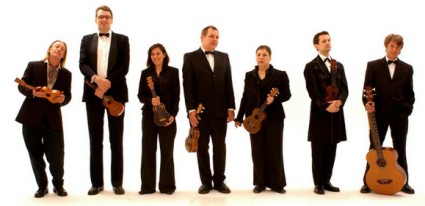
There’s no programme for the festival as yet (clearly, since suggestions for presentations are still invited), but “a very exciting public event” on 4 June is promised, featuring the Dodge Brothers, who include one Mark Kermode – film critic, double bassist, TV personality and defiant haircut; and the universally worshipped Ukulele Orchestra of Great Britain.
More information on the festival as and when we receive it, but at least you can now fill that gap in your diaries.
The latest DVD offering from the creative and painstaking people at Flicker Alley is a rather surprising package, Under Full Sail. Following on from the imaginative packaging of silent film on the immigrant experience as Perils of the New Land, this latest offering brings together a selection of silent films on the theme of sailing ships. The centrepiece is The Yankee Clipper (1927), directed by Rupert Julian and produced by Cecil B. De Mille, a drama of the China tea trade, filmed aboard an 1856 wooden square-rigger, starring William Boyd, Elinor Fair and Frank ‘Junior’ Coghlan. The additional titles are Around the Horn in a Square Rigger (1933), Alan Villiers’ account of the voyage of the barque Parma from Australia to England in the 1933 Grain Race; The Square Rigger (1932), a sound short showing life aboard the schoolship Dar Pomorza; Ship Ahoy (1928), a record of a schooner employed in the North American lumber trade; and a ten-minute sequence from Down to the Sea in Ships (1922), which records a whale hunt on board the 1878 wooden ship Wanderer out of New Bedford, Massachusetts.
All of which looks like an interesting attempt to beef up The Yankee Clipper, which is not that well-known a title, with films which would otherwise have been unlikely to find their way onto DVD, producing a package that ought to reach beyond silent film specialists to a wider market intersted in sailing history. Films don’t just tell stories, they tell histories, so let’s hope the release is a success and that Flicker Alley can provide us with more such socio-historically informed DVDs. For the silent film music buffs, the release is also notable for being (surprisingly) the solo DVD premiere of renowned organist Dennis James, who accompanies The Yankee Clipper on an original-installation 1928 Wurlitzer pipe organ, recorded at Seattle’s Paramount Theatre.
This being my blog and no one else’s, I can go off at a tangent if I feel like it, and every now and then I like to throw in my interest in modern (veering on the experimental side) guitar music. Happily, a number of guitarists on the cutting edge of things have dabbled with accompanying silent films, admittedly with some mixed results.
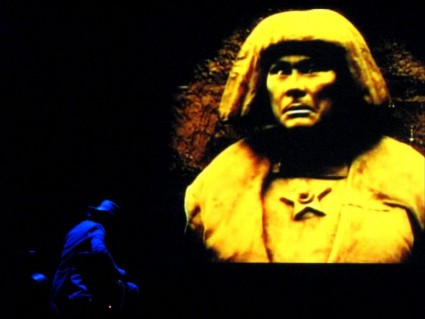
The leading exponent is Gary Lucas, and it is upcoming activity in the field that is the reason for this post. Lucas is best known in rock music circles for playing for Captain Beefheart’s Magic Band in its latter years (the Ice Cream for Crow years) and for his close association with Jeff Buckley. The extent of his musical activity is almost as bewildering as his quick-fingered skills, and this has included two forays into accompanying silent film, with which he has toured extensively. Sounds of the Surreal combines René Clair’s Entr’acte (1924), Fernand Léger’s Ballet mécanique (1924) and Ladislaw Starewicz’s The Cameraman’s Revenge (1912). His splendid score to The Golem has been showcased widely – though not, surprisingly, at any silent film festival, so far as I am aware.
There’s a YouTube extract from his score (which might change a few expectations of what a guitar score can sound like) to the film, and four parts of a 1998 Slovenian documentary (with Lucas interviewed in English) on the film and his interpretation if it, here, here, here and here.
Gary Lucas accompanying Der Golem at the Valladolid Film Festival in 2008, from http://www.garylucas.com
And now there is news of two new silent film scores, accompanied live by Lucas, happening this year. In mid-April his score for the Lon Chaney classic The Unholy Three, commissioned by The Film Society of Lincoln Center, will have its premiere at the Walter Reade Theater in New York City in mid-April. Then the Holland Festival has commissioned a new live solo guitar score by Lucas in collaboration with Dutch-Iranian composer Reza Namavar and ensemble for Abel Gance’s J’Accuse which will have its premiere live mid June in the Amsterdam Stadtsshouwburg.
How well does the guitar (and it’s usually the electric guitar) go with the silent film? The jury’s out on this, as those guitarists who have taken on the task have varied in the degree to which they have accompanied the film or the film has accompanied them. At its best, the electric guitar can bring colours and expressions that illuminate the films without dominating them (with a tendency towards ambient sounds). At its worst you get music inspired by the film that doesn’t connect with the film in a live content in any meaningful way at all, and which sounds too thin to take on the weighty task of accompanying a film drama at its fullest.
Jazz guitarist Bill Frisell, the best-known among these exponents, has taken a haunting, almost doom-laden approach to his scores for the films of Buster Keaton, which can be found on his CDs Go West and The High Sign/One Week. I haven’t seen them played to the films themselves, so I can’t judge their effectiveness. Fred Frith, doyen of the avant garde guitar, and Marc Ribot (known for work with Tom Waits especially) appeared at the 2007 Strade del Cinema festival in Aosta, Italy, playing to Giovanni Pastrone’s Il Fuoco (1916). Henry Kaiser (probably best known for scoring Werner Herzog’s Grizzly Man) accompanied Kinugasa Teinosuke’s A Page of Madness (1926) and guitarist Alex de Grassi took on Yasujiro Ozu’s A Story of Floating Weeds (1934) at the 2006 New York Guitar Festival. And there have been others. Here’s American ambient guitarist Rob Byrd, playing to The Passion of Joan of Arc (1927) in an intriguing twin-screening setting:
Only last month Scottish acoustic guitarist David Allison played to Murnau’s Nosferatu (1922) at the Glasgow Film Festival (see interview with him here). Let me know of other examples, if you can.
Finally, I don’t know if the guitar was ever used to accompany silent films originally (it seems unlikely), but it is a little known fact Max Schreck was a guitarist of considerable ability, shown here in this recently-discovered archive clip, during a break in filming Nosferatu. Well, I believe it anyway…
The programme from the 2009 StummFilmMusikTage (the German festival of silent film and music) has been announced. The theme for this year’s festival, which takes place on 24 January (apparently just the one day – it was a three-day festival last year) at Erlangen, is There’s no Business Like Showbusiness:
16 Uhr / 4 pm Filmens Helte (Pat und Patachon, die Filmhelden / Film Heroes)
Dänemark/Denmark 1928, 68 min
Regie/Director: Lau Lauritzen, Sr.
mit/with: Carl Schenstrøm, Harald Madsen, Holger Reenberg, Eli Lehmann
Musik und Ausführung: Miller the Killer con Conny Corretto
18 Uhr / 6 pm
Lesung: Der ewige Tramp /Reading: The Eternal Tramp
Eintritt frei / free entrance
19 Uhr / 7 pm The Circus (Der Zirkus)
USA 1928, 71 min
Regie/Director: Charles Chaplin
mit/with: Charles Chaplin, Merna Kennedy, Al Ernest Garcia
Musik: Charles Chaplin
Ausführung: Ensemble Kontraste
Leitung: Christian Schumann
21 Uhr / 9 pm
When Silence Sings: Der Filmkomponist Aljoscha Zimmermann im Gespräch/ A Conversation with film composer Aljoscha Zimmermann
Eintritt frei / free entrance
22 Uhr / 10 pm Varieté (Variety)
D 1925, 112 min
Regie/Director: E.A. Dupont
mit/with: Emil Jannings, Maly Delschaft, Lya De Putti, Warwick Ward
Musik und Ausführung: Aljoscha und Sabrina Zimmermann
Pre-sale tickets are now available (the organisers advise that if you are considering acquiring tickets from outside Germany, please to write to asynchron@stummfilmmusiktage.de to check about reserving tickets).






 The Bioscope