Silent film/live guitars

(L-R) Gyan Riley, Steve Kimock and Alex de Grassi, from http://www.newyorkguitarfestival.org

For some while now the Bioscope has been championing the guitar as accompaniment for silent film, with such notable figures as Bill Frisell and Gary Lucas having taken up the challenge. So it is pleasing to see that this year’s New York Guitar Festival includes a strand entitled Silent Film/Live Guitars. The Festival is halfway through, but the first of the combination of silent films with guitar music is on 21 January, with two further concerts on 28 January and 4 February. Here are extracts from the festival schedule:

21 JAN Thu
Charlie Chaplin’s One A.M. and Easy Street + Buster Keaton’s Cops
featuring music by Bon Iver’s Justin Vernon and Steve Kimock

Bon Iver is the nom-de-guerre of musician Justin Vernon. His album For Emma, Forever Ago was a critical and commercial hit, making him one of the most talked-about indie artists of 2008. For his scores to One A.M. & Easy Street, he’s joined by Chris Rosenau, of Collection of Colonies of Bees, whom Justin calls his “guitar mentor.” Steve Kimock is best known as co-founder and guitarist for the San Francisco band Zero. He’s recorded and performed with Bruce Hornsby and members of the Grateful Dead—Jerry Garcia once hailed him as his favorite guitarist. He performs music for Buster Keaton’s Cops.

28 JAN Thu
Charlie Chaplin’s Shoulder Arms and The Fall of the House of Usher (directed by James Sibley Watson and Melville Webber
featuring music by Alex de Grassi + James Blackshaw

One of the top fingerstyle, steel-string guitarists, Grammy nominee Alex de Grassi is renowned for his impeccable technique and compelling compositions. He’s explored a variety of world music influences and drawn acclaim for his 14 recordings on Windham Hill and other labels. He presents his original score for Chaplin’s 1918 masterpiece Shoulder Arms. James Blackshaw is a London-based prodigy who’s released seven albums of mesmerizing 12-string compositions. His style is often described as “American primitive” and incorporates elements of Indian raga, improvisation, and psychedelia.

04 FEB Thu
Charlie Chaplin’s Pay Day & The Idle Class plus short animations from Harry Smith’s Early Abstractions
featuring music by Chicha Libre + Gyan Riley

The Peruvian-influenced psychedelic pop of Chicha Libre mixes Colombian cumbia, dreamy surf guitar, and Andean melodies. They present their scores to Chaplin’s Pay Day (1922) and The Idle Class (1921). Gyan Riley is an equally strong presence in the worlds of classical guitar and contemporary music. He’s performed throughout Europe and the U.S., both as a soloist and in ensembles with Zakir Hussain, the San Francisco Symphony, the Falla Guitar Trio, and his father, the composer/pianist/vocalist Terry Riley.

The concerts take place 8pm at the Merkin Concert Hall, Goodman House, 129 W. 67th Street, New York. The first is sold out.

The original Neil Brand

Neil Brand is a silent film pianist. That much is known by most enthusiasts for silent film in the UK, and by a good many around the world as well. It may not always be realised that Neil is also a writer, composer, actor and scholar, one whose prodigious energies and superabundant talent make him not far short of a national treasure. Hmm, why that note of qualification? – he is a national treasure. And now, as if accompanying silents live and on DVD, writing radio scripts and musical comedies, acting on film and TV, writing books and educating students were not enough, now he has turned online archivist with his latest venture, The Originals.

The Originals is a new section of Neil’s personal site which brings together original materials relating to the performance of music to film in the silent era. For some while now Neil has been collecting articles, scores, interviews, memoirs and eye-witness accounts which document the experience of seeing or performing to films in the 1910s and 1920s. He has now started to put some of this material online.

http://originals.neilbrand.com

The site is in three sections: Interviews, Archive and Memories. Interviews features a small collection (so far) of interviews and articles which give the point of view of musicians who were employed in cinemas during the silent era. These include a transcription of a 1988 interview with the 94–year-old Ella Mallett, former silent movie musician (carried out as part of the BECTU History Project which records interviews with veterans of the British film and television industries); an extract from Maurice Lindsay’s memoir of Glasgow life, As I Remember; an extract from New Zealander Henry Shirley’s memoir Just a Bloody Piano Player; and a highly evocative piece from novelist Ursula Bloom about her experiences as a teenage silent film pianist in St Albans (contributed by yours truly).

Archive is the section that is going to attract the most interest. This offers PDF copies of various original documents relating to silent film music, including extracts from original music that would have been performed with various films. The jewel here is selected pages from the score for The Flag Lieutenant, compiled by Albert Cazabon, and the only surviving full score for a British silent fiction film in existence. You’ll also find music for the Douglas Fairbanks picture The Black Pirate, an eyebrow-raisingly dismissive article on the profession of silent film pianist, cue sheets for Hell’s Heroes and The Hound of the Baskervilles, and more.

The third section, Memories, presents extracts from the 1927-1930 diaries of Gwen Berry, who played ‘cello in the orchestra pit of the Grand Cinema, Alum Rock Road, Saltley. The extracts, from 1929, show Gwen’s apprehension at the arrival of the “terrible talkie pictures” which were going to throw so many musicians such as her out of work. The diary is presented in a elegant turn-the-pages digital form, which does require that you install a plug-in for DNL ebook software.

All in all, The Originals is an excellent idea, and one that The Bioscope hopes will grow and grow, not least if those interested are able to send relevant materials to Neil so that they might be shared by all.

Meanwhile, here’s a handy survey of other things NeilBrandian…

Bravo, Neil.

Silent days at the Barbican

Extract from Yogoto Yo Yume (1933), with Nitin Sawhney score

The Barbican has become London’s home for the silent film, and on 1 March it hosts a screening of revered Japanese director Mikio Naruse’s 1933 Yogoto Yo Yume (Nightly Dreams) with the London Symphony Orchestra playing a new score by boundary-crossing Asian-British composer Nitin Sawhney. Sawhney has already made his mark with his score for the Anglo-Indian production A Throw of Dice (Franz Osten 1929), now available on DVD from the BFI. He is certainly going for the less-obvious when it comes to picking silents to supply scores to, and bringing a new audience with him as well. More details from the Barbican site.

Her Sister from Paris (1925), from http://www.barbican.org.uk

Meanwhile the Barbican’s regular Silent Film & Live Music series held on Sunday afternoons continues as healthily as ever, and there are some real gems and rarities among the offerings between January and March. Here’s the line-up:

The Ghost Train (El tren fantasma) (PG) + live piano accompaniment by Neil Brand
16:00 / An action laden adventure from Mexico’s silent film era
24 Jan 10 / 16:00 / Cinema 1

Adolfo Mariel, a railroad engineer, is sent by his company to the town of Orizaba to investigate a series of robberies on the railway’s ‘El Ferrocarril Mexicano’ line. As he alights, he is welcomed by various officials but is smitten by the stationmaster’s daughter – only to find that another man, Paco Mendoza, has also taken a romantic interest.

As Adolfo tries to solve the railway crimes, the story unfolds as an exciting adventure laden with action sequences and remarkable camera movements – much ahead of its time for many silent films of the era. Together with breath-taking stunts, chases, and fights on the railway line as the train approaches. El tren fantasma is one of just a handful of silent Mexican films that still survive, and to cap it all, the actors performed their own stunts.

Mexico 1927 Dir. Gabriel García Moreno 71 min

Orphans of the Storm (U)
15:00 / A Celebration of Twenty Years of Photoplay Productions beginning with DW Griffith’s epic melodrama
7 Feb 10 / 15:00 / Cinema 1

Accompanied by the symphonic splendour of John Lanchbery’s epic score.

Photoplay Productions is the leading ambassador for silent film presentation in the UK, perhaps the world. We are delighted to mark its twentieth anniversary with three performances, starting with DW Griffith’s epic melodrama. Lillian and Dorothy Gish star as the eponymous orphans thrust into the maelstrom of the French Revolution.

US 1921 Dir. DW Griffith 154 min.

The Kreutzer Sonata (Kreutzerova sonáta) (PG)
16:00 / A rare adaptation of Leo Tolstoy’s story, with live accompaniment by acclaimed Czech percussionist Pavel Fajt
28 Feb 10 / 16:00 / Cinema 1

This rare Czech adaptation of Leo Tolstoy’s story tells the tale of a man driven to rage and revenge when he hears his pianist wife and her lover playing Beethoven’s Kreutzer Sonata.

Czechoslovakia 1927 Dir. Gustav Machatý 95 min.

Presented in association with the Czech Centre, London

Her Sister From Paris (PG)
16:00 / Sidney Franklin’s scintillating comedy with specially commissioned live musical accompaniment from Jane Gardner
7 Mar 10 / 16:00 / Cinema 1

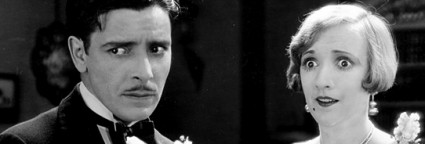
As part of the Birds Eye View film festival’s ‘Blonde Crazy’ strand, we are delighted to present Sidney Franklin’s scintillating comedy starring Constance Talmadge and Ronald Colman.

Dowdy Helen turns to her glamorous twin sister Lola for help in re-igniting romance in her marriage. They trick her husband into believing Helen is Lola – he falls for it, and Helen seduces her own husband. But how far can the dupe go?!

US 1925 Dir. Sidney Franklin 70 min.

South (U)
16:00 / A tribute to Australian director Frank Hurley with live piano accompaniment by Neil Brand
21 Mar 10 / 16:00 / Cinema 1

As part of the London Australian Film Festival we present a celebration of the work of Frank Hurley – Australian filmmaker, photographer, adventurer and writer.

Hurley’s stunningly beautiful and dramatic images of Ernest Shackleton’s ill-fated 1914-16 expedition to Antarctica, and the destruction of the ship Endurance, are amongst the most breathtaking ever captured on silent film, and confirm South as one of the most remarkable exploration films ever made.

UK 1919 Dir. Frank Hurley 88 min.

More details for all screenings, including ticket prices and how to book, from the Barbican site.

Fotoplayer redux

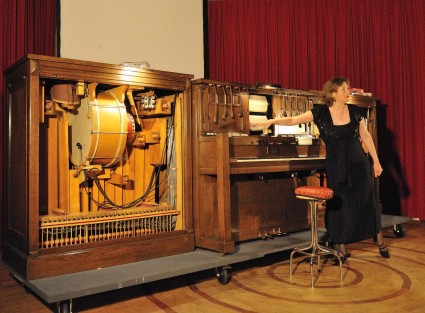
Maud Nelissen introducing the Fotoplayer

A while ago the Bioscope told you about the Fotoplayer, a remarkable form of player piano with added percussion and sound effects used in the silent era to accompany films. I have now added four photographs to the post (one of which is reproduced above), plus an account of performing with the Fotoplayer, all kindly supplied by silent film musician Maud Nelissen (also the source of the previous post on The Three-Must-Get-Theres, so thanks are due doubly to her). The post also contains a mini-history of the Fotoplayer (and other photoplayers of a smiliar kind) and a delightful YouTube video of Maud playing the machine. Do take a look.

The Three Must-Get-Theres, and other pleasures

Max Linder in The Three Must-Get-Theres (1922), from http://www.europafilmtreasures.eu

Welcome news arrives from silent film musician and composer Maud Nelissen. Europa Film Treasures, the free online library of European films put together by Lobster Films, has published the uproarious Max Linder film The Three Must-Get-Theres (1922), with a fine new score by Maud and her band The Sprockets. The film is a cheerful parody of Douglas Fairbanks’ The Three Musketeers (1921), sending up the Fairbanks persona while having with more than a little of the spirit of Alexandre Dumas itself, in between the anachronistic gags and slapstick knockabout. It looks good, and sounds terrific.

We’ve already reported on Europa Film Treasures, an extraordinary collection of fiction and non-fiction titles from across Europe (plus some from the USA), dating from 1898 to 1999, and from archives such as Deutsche Kinemathek, GosFilmoFond, Filmarchiv Austria, the Imperial War Museum Film and Video Archive, and Lobster Films itself. To quote from the earlier report, the films include

early actualities by Danish cinematographer Peter Elfelt, pornography from Austria, Biblical lands film from 1906, dance films, a Russian fish processing factory documentary, comedies (including Max Linder), trick films, science fiction (Walter Booth’s The Airship Destroyer from 1909, listed here under a German title, Der Luftkrieg der Zukunft), Spanish newsfilm, Russian Yiddish drama, one of John Ford’s first Westerns Bucking Broadway (1917) – the only non-European title on view, the extraordinary Der Magische Gürtel (1917) – tracking the trail of destruction wreaked by a German U-Boat, French public health films, abstract animation from Viking Eggling, Soviet puppet animation, and more, much more.

That was a year and a half ago, when there were fifty or so titles, with the promise of 500 eventually. More titles have been added since then – around forty – among which are Twee Zeeuwse Meisjses in Zandvoort (1913), a plotless comedy about two young Dutchwomen visiting the seaside, starring Annie Bos; Rijks-veeartsenijkundige hoogeschool (1918), a visit to the Royal Veterinary School of Utrecht in the Netherlands; Hesanut Builds a Skyscraper (1914), an American animation film about the building of a skyscraper; and Chamber of Forgetfulness (1912), an American drama of jealousy and photography directed by Étienne Arnaud for Eclair, starring Alec B. Francis and Barbara Tennant.

You can keep up with the additions by following the Europa Film Treasures blog, which records each new film as it goes up. Fresh material is promised, including titles by Georges Méliès. Additional features are being added to the site, including documentary resources, including an introduction the history of colour in cinema and an essay on film conservation. A debate section covers issues such as the digital projection of heritage films. The site continues to have its oddities, not least a quaint use of the English language (the site in in English, French, Italian, Spanish and German) that reads in place like they used translation software. You can either view this as having an amusing charm, or you can be disappointed that an excellent site funded out of the European MEDIA programme could not be just that little bit better in its presentation (another quibble is films given under the language title of the print rather than their original title).

Anyway, as always, go explore.

Ken Wlaschin and the silent opera

kenwlaschin

Sadly the death has been announced of Ken Wlaschin, a major figure in American and British film culture for many years. Born in America, Ken came to prominence as head of the National Film Theatre in London, also serving as the director of the London Film Festival from 1969 to 1984. He returned to the States and revived the Los Angeles International Film Festival, serving also as director of creative affairs at the American Film Institute and vice chairman of the National Center for Film and Video Preservation. He was an author of great distinction, writing not only on film (The Illustrated Encyclopedia of the World’s Great Movie Stars and Their Films, The Faber Book of Movie Verse) but fiction, travel books and poetry.

Obituaries to Ken Wlaschin have been published elsewhere. This post will pay a different kind of tribute by concentrating on one particular area of interest to him. Perhaps Ken’s most notable publication was Encyclopedia on Opera on Screen: A Guide to More Than 100 Years of Opera Films, Video and DVDs (2004). This stupendous publication (all 872 pages of it) is a comprehensive, cultured and engrossing guide to the alliance of opera and the screen, a history that goes back into the silent era, when opera was a remarkably popular subject for filmmakers.

Indeed the alliance is not merely as old as cinema itself, but older. In his caveat of 15 October 1888 Thomas Edison wrote the following famous words about the motion picture device that he was setting out to invent:

I am experimenting upon an instrument which does for the Eye what the phonograph does for the Ear, which is the recording and reproduction of things in motion, and in such a form as to be both cheap practical and convenient. This apparatus I call a Kinetoscope ‘Moving View. In the first production of the actual motions that is to say of a continuous opera the instrument may be called a Kinetograph buts its subsequent reproduction for which it will be of most use to the public it is properly called a Kinetoscope …

Edison repeatedly cited opera as the prime example of what his motion picture invention was meant to achieve, his vision having always been to combine motion pictures with sound. In 1894 he wrote:

The kinetoscope is only a small model illustrating the present stage of progress but with each succeeding month new possibilities are brought into view. I believe that in coming years by my own work and that of Dickson, Muybridge, Marié [i.e. Marey] and others who will doubtless enter the field, that grand opera can be given at the Metropolitan Opera House at New York without any material change from the original, and with artists and musicians long since dead.

So it was that opera was embedded into the consciousness of film from the very outset, and if the precise combination of vocal music and film proved a challenge for three decades (though never an impossibility), filmmakers in the so-called silent era turned to opera again and again – for its stories, its scores, its kudos and its stars.

All of this is documented in fascinating detail in Wlaschin’s Encyclopedia of Opera on Screen. As well as entries on silent cinema and opera and on first opera films, he includes sections on their early film productions of every opera imaginable. How many? Well a quick thumb through the book reveals early film productions of Aida, Un ballo in maschera, Il barbiere di Siviglia, The bartered bride, La boheme, Carmen, Don Giovanni, Faust, Fra Diavolo, Lohengrin, Lucia di Lammermoor, Madama Butterfly, Martha, The Mikado, Le nozze di Figaro, Pagliacci, Parsifal, Rigoletto, Thaïs, Tosca and many more. The exact number is impossible to determine, partly owing to problems of definition, but it undoubtedly runs into hundreds. ‘Silent’ operas films were of various kinds, of which these are the main types:

Synchronised sound
Edison hoped to marry the Kinetoscope to his Phonograph, but the Kinetophone did not have much of a commercial life and never featured any opera. But synchronisation of gramophone recordings with films to give a semblance of the full audio-visual experience began in 1900 with the Phono-Cinéma-Théâtre at the Paris Exposition, for which Clément-Maurice filmed Victor Maurel singing arias from Don Giovanni and Falstaff and Emile Cossira an aria from Roméo et Juliette. A second wave of synchronised (or sound-on-disc) films from around 1907 onwards led to numerous films of scenes or arias from operas, usually with actors miming to the recordings of the genuine opera singers. Systems such as the Cinephone, Cinematophone, Vivaphone, Chronophone, Cinemafono and Biophon were a common feature of cinema programmes for a number of years up to the start of First World War. Although some attempts were made to encompas an entire opera in this way (in 1907 British Gaumont issued a complete Gounod’s Faust in twenty-two separate film/sound recordings), the vast majority of these films were single-reelers of three minutes or so, lasting the length of a single gramophone recording. The greatest exponent of the form was the German producer Oskar Messter, who produced around 500 song, opera and operetta sound shorts using his Biophon system, and even opened a spcialised Berlin cinema dedicated to opera films (one or two other such cinemas opened around Europe at this time).

Georges Mendel’s Lucia di Lammermoor (1908), from the Lobster Films DVD set Discovering Cinema

The most joyous of all synchronised sound opera films is a 1908 production by French producer Georges Mendel of the sestet from Donizzetti’s Lucia di Lammermoor, sung by Enrico Caruso Marcella Sembrich, Antonio Scotti, Marcel Journet, Barbara Severina and Francesco Daddi. The performers who appear on the film are actors miming to the recording, but the spirit in which the music is relayed is truly uplifting (the film – only recently discovered and not correctly identified in Wlaschin’s encyclopedia – can be found on the Discovering Cinema 2-DVD set, for which see below).

Filmed performance
Among the most prestigious, though controversial, of early cinema productions was Edison’s Parsifal (1904), a near-literal recording of the Metropolitan Opera production filmed by Edwin S. Porter, whose exhibition was hampered by a lawsuit preventing Edison from screening the film alongside Wagner’s recorded music.

Operas as films
Operas conceived of as films are a rare breed. There are two examples from the silent era. Rapsodia Satanica (Italy 1915) was an avante garde work directed by Nino Oxilia, which starred Lyda Borelli and had music that accompanied screenings by Pietro Mascagni (composer of Cavalleria rusticana). The peculiar Jenseits des Stroms (Germany 1922), directed by Ludwig Czerny, has music composed for singers and orchestra by Ferdinand Hummel, which had musical notation running along the bottom of the screen throughout the film. A print is held by the BFI National Archive.

Related to this, one composer among the greats was able to have a say in how a film of one of his operas transfered to the silent screen. Richard Strauss’s Der Rosenkavalier, written in 1911, was filmed in 1926 in Austria by Robert Weine. Strauss provided new music and arranged the film’s live score, while his librettist Hugo von Hofmannsthal wrote the screenplay, with new scenes added for the film.

Biopics
Another way of bringing together opera music with silent film was through lives of composers. Examples include opera enthusiast Oskar Messter’s feature-length The Life of Richard Wagner (1913), directed by Carl Froelich, and the 1921 Austrian film Mozarts Leben, Lieben und Leiden, on the life of Mozart, while Verdi was the subject of a 1913 Italian production, Giuseppe Verdi nella vita e nella gloria.

Geraldine Farrar in Carmen, from Flickr

Stars
The leading opera singers of the period were earnestly sought as film actors. Among them were Mary Garden, who appeared in Goldwyn’s Thaïs (1917); Lina Cavalieri, who featured in Italian and American films in the ‘teens (none directly based on operas); and Enrico Caruso, who starred in My Cousin (1918) for Famous Players-Lasky and, less successfully, in The Splendid Romance (1919). The outstanding crossover star was Geraldine Farrar, who had a huge hit with Cecil B. DeMille’s Carmen in 1915 and went on to enjoy a five-year film career with titles (such as the classic Joan the Woman) which owed little to the opera repertoire but demonstrated her powerful cinematic appeal.

Stories
Often the stories from operas were used for silent films that had no allegiance to the music, often because they based themselves on source novels or plays rather than the opera. King Vidor’s La bohème (1926), with Lillian Gish as Mimi, is probably the most notable example (MGM were forbidden by the publishers from using Puccini’s music to accompany the film).

Abbreviations
British producer Harry B. Parkinson was responsible two film series which boiled down opera stories to twenty-minute shorts. Tense Moments with Operas (1922) produced digests of Martha, Rigoletto, La traviata and others. Cameo Operas (1927) did the same, except that these were exhibited with live singers and orchestral accompaniment. Parkinson directed and John E. Blakeley produced. Examples included Carmen, Faust and Der Ring des Nibelungen.

Opera music accompanying silent films
Opera themes were used to accompany silent films, notably Wagner’s ‘Ride of the Valkyries’ which perhaps almost inevitably was used to accompany the ride of the Ku Klux Klan in D.W. Griffith’s The Birth of a Nation.

Silent films about opera
There are numerous examples of silent films set in the world of opera. Best known is the Lon Chaney vehicle, The Phantom of the Opera (1925), but other examples listed by Wlaschin are Clara Kimball Young in The Yellow Passport (1916), Tom Moore in Heartease (1919), Betty Blythe in How Women Love (1922) and Greta Garbo in The Torrent (1926).

Operas based on silent films
Wlaschin records that the first film to be the inspiration for an opera was Cecil B. DeMille’s The Cheat (1915), which served as the basis of French composer Camille Erlanger’s 1921 opera Forfaiture. Eisenstein’s Battleship Potemkin was made into an opera in 1937 by composer Oles Semenovich Chishko, while William Bolcom’s McTeague (1992) is based on both the Erich von Stroheim film and Frank Norris’ original novel.

Operas about silent films
Finally, there could be operatic works about film. Germany composer Walter Kollo came ujp with Filmzauber (Film Magic) in 1912, with libretto by Rudolf Bernauer and Rudolph Schanzer, which was shown in London and New York in 1913 as The Girl on the Film. It told of a film company producing a story about Napoleon in a small village. Other examples include German composer Jean Gilbert’s operetta Die Kinokönigen (1913) and Carlo Lombardo’s La signorina del cinematografo (1914).

Encyclopedia of Opera on Screen (from which much of the information above derives) exists both as a book and as a word-searchable CD-ROM.

I’ve not found any silent opera films or synchronised opera films from the silent era online (at least not legitimately so), but here’s a listing of some of the DVDs available:

Obituaries for Ken Wlaschin have been published by the Guardian and Variety. His silent film intersts extended beyond opera by the way – among his other publications are The Silent Cinema in Song, 1896-1929: An Illustrated History and Catalog of Songs Inspired by the Movies and Stars, with a List of Recordings and Silent Mystery and Detective Movies: A Comprehensive Filmography.

The Battle of the Ancre

ancre

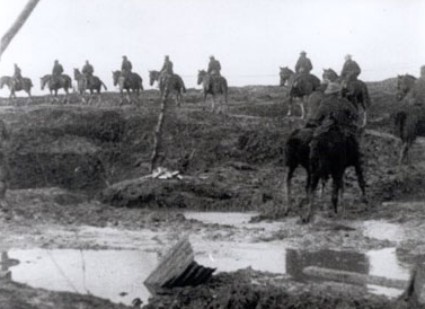
The Battle of the Ancre, from http://www.iwm.org.uk

You will recall, I’m sure, that last year the Imperial War Museum in London undertook a digital restoration of the 1916 documentary The Battle of the Somme, the DVD release of which we reviewed here in detail. The Battle of the Somme was the first of three high profile feature-length documentaries that the British War Office propagandists produced during the First World War, before they changed strategy and turned much of their filmmaking energies towards producing a newsreel. The two films were The Battle of the Ancre and the Advance of the Tanks (1917) and The German Defeat and the Battle of Arras (1917), and while neither could match the seismic social impact of the first film, they remain eloquent testimonies of the conflict.

There is a chance to see The Battle of the Ancre this weekend at the Imperial War Museum, as they start to give it much the same treatment as they did to the Somme film. The DVD release of The Battle of the Somme was distinguished by its twin scores, one of which recreated the original score from contemporary musical suggestions for the film’s exhibition. The same musician, Stephen Horne, is doing the same with The Battle of the Ancre. The ‘new’ score is the result of months of research by Horne and Dr Toby Haggith of the IWM, the reconstituted score is to be played by Stephen this Saturday (7 October) for the first time since the war, which makes the screening a truly special one. The film carries on the story from the first film, as it were, covering the Somme campaign as it dragged on into the winter of 1916. Its major selling point was the tank, the first time audiences had had sight of this startling new weapon. The film also memorably documents the ordeal faced by troops in the sea of mud that was the Western Front that autumn and winter.

The screening takes place 14:00 at the IWM London Cinema – all the details are on the IWM site.

While were on the subject, you might like to take a peek at IWM Film and Video Sales, an online footage sales service from the IWM, still in test mode. The site offers you the chance to view for free some 150 hours of content (a lot of it from the First World War), to download such content for private viewing or commercial scene selection (a charged service), or to look up the details of over 35,000 films. The Bioscope will be producing a review of this major new service very soon.

Larry goes to the market

A current internet sensation is Drunkest Guy Ever Goes for Even More Beer Video, in which a convenience store security camera picks up the the hapless efforts of man so drunk he cannot stand to get yet more beer for himself. As is the way with these things, the video has not only chalked up millions of views itself, but has inspired a mini-industry of remixes, parodies etc.

Among these is the above gem, Larry Goes to the Market, in which Whit Scott has added titles, scratches and music (from pianist Kevin MacLeod) to turn the video into a rather impressive silent movie pastiche. View, enjoy, and learn what lessons you can from it.

Whit Scott writes about the video at http://whitscott.com/2009/10/22/what-no-beer-not-starring-elmer-j-butts (its title a reference to the Buster Keaton 1933 feature What! No Beer?). Kevin MacLeod provides royalty-free music for download from his Incompetech site, include a variety of silent film music styles (which become quite familiar if you’ve ever gone looking for silent film pastiches on YouTube).

Acknowledgment to NewTeeVee, where I picked up the story of the remixes and which links to other examples.

Remixed into silence

This an interesting development. Shown last week at the Edinburgh Festival and this week at London’s Rich Mix arts centre was Mother India – 21st Century Remix, or MI21. DJ Tigerstyle has taken the classic 1957 Indian film Mother India, directed by Mehboob Khan, and reimagined it as a 45-minute silent film. Tigerstyle (“world champion scratch DJ”) is joined by Matt Constantine on keyboards and cello, David Shaw on drums and Josh Ford on visuals. The promo above includes some clips of the performance, alongside interviews, audience reaction and so forth. The film’s website describes it thus:

Presenting the film to a contemporary audience, whilst preserving the power and vitality of the original piece is the key to this work. At 45 minutes in length, MI21 will engage you through the music to understand how dynamic a story the film has to tell.

Setting aside the qualms some may feel at seeing a cinema classic being deconstructed in this way (with the implication that a contemporary audience wouldn’t be able to sit through the original), it is a triumph of some sort for the art of the silent film, reclaiming a sound film through its images as one of its own. What other sound films have been reconstituted as silents? I know of one other recent example, the group British Sea Power adding a music soundtrack to an edited-down version of Robert Flaherty’s Man of Aran (1934), which once had a perfectly serviceable soundtrack of its own:

Interesting that some of the chat about this video has suggested that Flaherty’s film was a silent film originally (its sounds and dialogue may have been post-synched, but there was very much sound there all the same). It seems to be part of a similar urge for the poetics of the silent film. Maybe the sound dies for some films, eventually, but the images live on. Something to ponder, and a trend to look out for.

Meanwhile, Mother India – 21st Century Remix can be experienced at the following venues:

* Sat 05 Sept – Brighton Pavillion Theatre – 01273 709709
* Tue 22 Sept – Bristol Colston Hall – 0117 922 3686
* Sat 10 Oct – Coventry Belgrade Theatre – 024 7655 3055
* Sat 24 Oct – Bridlington Musicport Festival – 0845 3732760

Strade del cinema 2009

chaplin_strade

http://www.stradedelcinema.it

Apologies for being a little in the day with news of Strade del Cinema, Italy’s less-heralded international festival of silent cinema and music. The festival takes place in Aosta (near Turin), at the Aosta Roman Theatre, and this year runs 6-13 August. The festival is organized by the Strade del Cinema Cultural Association and the City of Aosta, in collaboration with the Turin National Museum of Cinema/Fondazione Maria Adriana Prolo and the support of the UNESCO Italian National Commission. This year’s festival is dedicated to Charlie Chaplin, and is free to all. Its distinctive feature is the emphasis on music by young musicians, participants in the festival’s Young European Musicians Contest.

Here’s the festival programme:

AUGUST 6
ROMAN THEATRE – 21h30
Opening Event in collaboration with AOSTACLASSICA
Tribute to Stanley Kubrick through Gyorgy Ligeti’s music
Orchestra Laboratorio SFOM diected by Mauro Gino

AUGUST 7
ROMAN THEATRE – 21h30
YOUNG EUROPEAN MUSICIANS CONTEST

Retrospective Charlie Chaplin 2

The Fireman, music by Chirichiello e i casi a parte
producer: Charles Chaplin for Lone Star Mutual; director: Charles Chaplin; photography: Frank D. Williams and Roland Totheroh; with: Charles Chaplin, Edna Purviance, Eric Campbell, Lloyd Bacon, Albert Austin; release date: 12 June 1916.

The Vagabond, music by Yati Durant Ensemble
producer: Charles Chaplin for Lone Star Mutual; director: Charles Chaplin; photography: Frank D. Williams; photography assistant: Roland Totheroh; with: Charles Chaplin, Edna Purviance, Eric Campbell, Lloyd Bacon, Albert Austin; release date: 10 July 1916.

AUGUST 8
ROMAN THEATRE – 21h30
YOUNG EUROPEAN MUSICIANS CONTEST

Retrospective Charlie Chaplin 2

The Adventurer, music by Parallelo Dramma
producer: Charles Chaplin for Lone Star Mutual; director: Charles Chaplin; photography: Roland Totheroh; with: Charles Chaplin, Henri Bergman, Edna Purviance, Martha Golden, Eric Campbell; release date: 22 October 1917

The Floorwalker, music by Simone Maggio
producer: Charles Chaplin for Lone Star Mutual; director: Charles Chaplin; photography: Frank D. Williams; photography assistant: Roland Totheroh; with: Charles Chaplin, Eric Campbell, Edna Purviance, Lloyd Bacon, Albert Austin; release date: 15 May 1916

AUGUST 9
ROMAN THEATRE – 19h00
YOUNG EUROPEAN MUSICIANS CONTEST

Retrospective Charlie Chaplin 2

The Tramp, music by Lili Refrain
producer: Jess Robbins for The Essanay Films; director: Charles Chaplin; photography: Henri Ensign; with: Charles Chaplin, Edna Purviance, Fred Goodwins, Lloyd Bacon; release date: 11 April 1915

Shangaied, music by Magus
producer: Jess Robbins for The Essanay Films; director: Charles Chaplin; photography: Henri Ensign; with: Charles Chaplin, Edna Purviance, Wesley Ruggles, Lawrence A. Bowes; release date: 21 June 1915

AUGUST 10
ROMAN THEATRE – 21h30
YOUNG EUROPEAN MUSICIANS CONTEST

Retrospective Charlie Chaplin 2

Easy Street, music by Illya Amar
producer: Charles Chaplin for Lone Star Mutual; director: Charles Chaplin; photography: Roland Totheroh; with: Charles Chaplin, Henri Bergman, Edna Purviance, Albert Austin; release date: 5 February 1917

Work, music by Elia Casu/Antonio Pinna Duo
producer: Jess Robbins for The Essanay Films; director: Charles Chaplin; photography: Henri Ensign; with: Charles Chaplin, Billy Armstrong, Edna Purviance; release date: 21 June 1915

AUGUST 11
ROMAN THEATRE – 21h30
YOUNG EUROPEAN MUSICIANS CONTEST

Retrospective Charlie Chaplin 2

The Pawnshop, music by PanGea Orchestra
producer: Charles Chaplin for Lone Star Mutual; director: Charles Chaplin; photography: Roland Totheroh; with: Charles Chaplin, Henri Bergman, Edna Purviance, John Rand; release date: 2 October 1916

The Rink, music by Federico Missio Movie Kit
producer: Charles Chaplin pour Lone Star Mutual; director: Charles Chaplin; photography: Roland Totheroh; with: Charles Chaplin, Edna Purviance, Eric Campbell, Lloyd Bacon, Albert Austin; release date: 2 October 1916

AUGUST 12
ROMAN THEATRE – 21h30 – EVENTS
IN COLLABORATION WITH THE TURIN NATIONAL MUSEUM OF CINEMA
Events: Tigre Reale (Italy, 1916)

Music by Paolo Angeli, Gavino Murgia and Antonello Salis

Tigre Reale (ITALY, 1916)
director: Giovanni Pastrone; writer : Giovanni Vergada (1873); photography: Giovanni Tomatis, Segundo de Chomón; producer: Itala Film, Turin; original length: 1742 m; copy length: 1600 m ; titles: italian; censor certificate: 11662 du 20/6/1916; release date in Rome: 9/11/1916; preview: Turin, “Salone Ghersi”, July 1916; Rome, 9 november 1916 With: Pina Menichelli (Countess Natka), Alberto Nipoti (Giorgio la Ferita), Febo Mari (Dolsi), Valentina Frascaroli (Erminia), Gabriel Moreau (Count De Rancy), Ernesto Vaser, Enrico Gemelli;
restored copy: 35mm bn col, 1592 mt., 69′ a 20 ft/s

AUGUST 13
ROMAN THEATRE – 21h30 – EVENTS
Events: Safety Last (USA, 1923)

Music by Neil Brand

Safety Last (USA, 1923)
production: Hal Roach pour Hal Roach Studios; director: Fred Newmeyer and Sam Taylor; writers: Hal Roach, Sam Taylor, Tim Whelan; photography: Walter Lundin; artistic direction: Fred Guiol; with: Harold Lloyd, Mildred Davis, Bill Strother, Noah Young, Westcott B. Clarke; release date : 1 April 1923.

More information on the festival website (which seems to tell you a lot about the music but not much about how to get there, where to stay, and so forth).