Charleston Symphony Orchestra Silent Film Contest

This is novel. The third annual Charleston Symphony Orchestra Silent Film Contest has just been announced. The concept for this project is to have amateur and professional filmmakers choose a piece from the set repertoire, and make a film based on his/her interpretation of the piece. The completed films are then sent to the Symphony where they will be judged by an independent panel. The selected films will be projected onto a movie screen above the orchestra as the soundtracks are performed live. The winner receives a $1,000 grand prize and may have his/her film presented at a future CSO event.

The concert will be held on Thursday, April 10 at the Charleston Music Hall, Charleston, SC, starting at 9PM. This year the selections are “The Last Spring” from Two Elegaic Melodies by Edvard Grieg, “March of the Sardar” from Caucasian Sketches: Suite by Mikhail Ippolitov-Ivanov, “The Alcotts” from Concert Sonata by Charles Ives, Symphony No. 25 Movement 1 by Wolfgang Amadeus Mozart, the Magic Flute Overture by Wolfgang Amadeus Mozart, The Barber of Seville: Overture by Gioacchino Rossini, and Messages, an original composition by local composer and professor at the College of Charleston, Trevor Weston. All are in the public domain and freely available (“i.e. iTunes”) except for the Weston piece, for which you have to request a Midi file from the organisers.

All entires must be on DVD, must not infringe copyrights, must be world premieres, and must “be intended for a family audience, be non-commercial in nature (e.g., no infomercials or commercials), fall within the equivalent of a G, PG or PG-13 rating as such ratings are determined for theatrical films by the Motion Picture Association of America, and not contain any sexually explicit, disparaging, libelous or other inappropriate content or any nudity”. What fun. Further details are available from the competition site.

Joan in Sheffield

Passion of Joan of Arc

The Passion of Joan of Arc, from http://www.sensoria.org.uk

In the Nursery, the esteemed music duo (twins Klive and Nigel Humberstone) who have produced several scores of silent films, will be premiering their latest score, for Carl Dreyer’s The Passion of Joan of Arc (1928) at the Sensoria festival in Sheffield on 16 April. This is a new festival of film and music, running 12-18 April 2008, though a full programme has not been publishd is yet, so I don’t know if there will be further silent film/music combinations. The venue for The Passion of Joan of Arc will be Sheffield cathedral, and the box office is now open.

The Passion of Joan of Arc is of course one of the landmark films of silent era, indeed of cinema history as a whole. It is one of those superhuman works where you cannot imagine that the mundanities of filmmaking – camera set-ups, lighting, pauses, retakes, breaks for meals – ever took place. Using extensive use of probing, intense close-ups (no make-up was used), the film is like the history of a soul, quite unlike any other movie (what a vulgar term that is) that you will have come across. Information on the film is extensive, but check out Carl Dreyer’s illuminating thoughts on the production process, with its emphasis on staying true to the documents of the period, on the Criterion site. Dreyer, so it is said, wanted the film to be seen in silence.

In the Nursery’s website has information on their previous silent film scores. These have included Electric Edwardians (the Mitchell and Kenyon DVD collection of early actualities), Hindle Wakes, A Page of Madness, Man with a Movie Camera, Asphalt and The Cabinet of Dr Caligari. Sound extracts are available as mp3 files. The Passion of Joan of Arc will subsequently screen at Wave Gotik Treffen in Liepzig somewhere between 9-12 May, and at the Barbican in London on 1 June.

When the Barbican put on Molly

Molly Picon

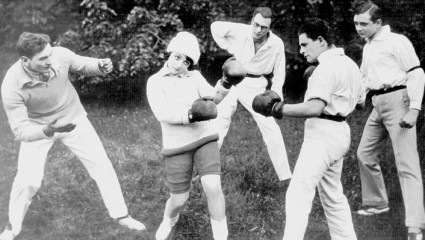
Molly Picon in East and West (Ost und west), from Barbican Film

The home for silent film in London is now the Barbican centre, whose Silent Film and Live Music continues to demonstrate imaginative programming in the titles selected and the music chosen to accompany them.

Apart from highlighting the current series, I wanted to draw particular attention to the film showing on Sunday February 17, Ost und West (East and West) (Austria 1923). This features Molly Picon, the great star of Yiddish stage and screen, and gives me the opportunity of reproducing the splendid still above. The diminutive, round-eyed Molly Picon (1898-1992) was a New York Yiddish theatre star, on the stage from the age of six, and massively popular among Jewish and on-Jewish audiences in the 1920s. She made made a handful of films in the 1920s and 30s, before returning to the screen more regularly in the 1970s (she’s most familiar to general audiences for playing the matchmaker in Fiddler on the Roof). Ost und West is the earliest of her films that survives. I’ve not see the film (yet), so here’s the Barbican’s blurb for it:

Featuring Molly Picon, one of the great stars of Yiddish cinema, it tells the story of streetwise New York flapper Mollie, who travels to her cousin’s wedding in a traditional Polish shtetl. Contrasting sophisticated city values against those of simple village life, the film contains classic scenes of the irrepressible Picon lifting weights, boxing and teaching young villagers to shimmy, and eventually meeting her match in a young yeshiva scholar.

The music comes from Lemez Lovas of Oi Va Voi and guest musicians Moshikop and Rohan Kriwaczek, taking in “traditional klezmer to contemporary electronica, from liturgical melancholy to party pop kitsch and from vaudeville to breakbeat.” Directed by Sidney M. Goldin and Ivan Abramson, the film is screening at 16.00 and runs for 85mins.

Bridge of Light

http://www.amazon.co.uk

For anyone interested in the history of Yiddish film, the essential source is J. Hoberman’s Bridge of Light: Yiddish Film Between Two Wars (1991), which apart from its commendable written content, is just one of the most beautifully-produced books on film history that I know. Check out also Sylvia Plaskin, When Joseph Met Molly: A Reader on Yiddish Film (1999) (Joseph being the Polish director Joseph Green), Judith N. Goldberg, Laughter Through Tears: The Yiddish Cinema (1983), or Eric A. Goldman, Visions, Images and Dreams: Yiddish Film Past and Present (1984).

Other titles being screened in the Barbican series are:

9 MarchOn Our Selection (Australia 1920) – homely, landmark Australian comedy-drama about the pioneering Rudd family. With piano accompaniment by Neil Brand.

3 AprilChang: A Drama of the Wilderness (USA 1927) – King Kong creators Merian C. Cooper and Ernest B Shoedsack’s classic dramatised documentary set in the jungles of Thailand (and producing background footage that went on to pad out a number of Tarzan movies). With live accompaniment by Italian group Yo Yo Mundi.

20 AprilThe St Kilda Tapes – a collection of silent films from the Scottish Screen Archive, including the topical St. Kilda – Britain’s Loneliest Isle (1923-28), Da Makkin O’ A Keshie (1932), and A New Way to a New World (1936), all set to music by acoustic guitarist David Allison.

4 MayNanook of the North (USA 1922) – the so-called first documentary film (if you’ve got a couple of hours I’ll give you chapter and verse on how wrong all the text books are), directed by poet of cinema Robert Flaherty. Music from the Shrine Synchrosystem, featuring Max Reinhardt, DJ Rita Ray, world music kora master Tunde Jegede and Ben Mandelson on guitars, which ought to steer us away from the siren temptations of too much authenticity (like Flaherty?).

17 MayThe Wind (USA 1928) – one of the cast-iron classics of silent cinema, Victor Sjöström’s visual masterpiece stars Lillian Gish living a hard life in dust-bowl Texas, and is guaranteed to convert even the stoniest-hearted sceptic into acclaming silent cinema. With the Carl Davis symphonic score (sadly, not with actual orchestra).

1 JuneThe Passion of Joan of Arc (Denmark 1928) – somehow not convinced even by The Wind? Carl Theodore Dreyer’s astonishing, overpowering work, with Falconetti as Joan, will do the trick. With music by In the Nursery.

15 JuneStella Dallas (USA 1925) – classic weepie from Henry King, starring Ronald Colman, Douglas Fairbanks Jr. and Belle Bennett. Remade with Barbara Stanwyck in 1937, but this is the version to see. With piano accompaniment by Stephen Horne.

Far, far away

Further information has been made about about Stummfilmmusiktage, the German festival of silent film and music, which takes place in the Markgrafentheater, Erlangen, 24-27 January. This email has just been sent out by the festival:

Dear friends of the silent screen,

It’s been a while since you heard from us, but the 2008 programme of StummFilmMusikTage Erlangen is finally rock solid and pre-sale tickets are available (please note: If you are considering acquiring tickets from outside Germany, please write to asynchron@stummfilmmusiktage.de and we will help you reserve the tickets you want). Our main theme for the 2008 festival will be Far, Far Away with films focussing on the rich silent film heritage of Asia, but also on Western conceptions of Asia and the exotic.

Please note that there have been a few changes in our programme since we first published it in October. This year’s films will take you to the South Seas, Japan, Mongolia, Siam, India, Chinatown L.A., the Limehouse district in London, and… to the moon.

The programme now goes like this:

Thursday, January 24, 2008

7 p.m.
Vernissage
Japanese Film Actresses in Silent Era

in cooperation with The National Film Center, Tokyo

Introduction: Mariann Lewinsky
Autor of the book Die verrückte Seite

Venue: SiemensForum Erlangen
Werner-von-Siemens-Str. 50

20:30 p.m.
What Made Her Do It? (Nani ga kanojo o sô saseta ka)
Japan 1930, 83 min
directed by: Shigeyoshi Suzuki
score: Günter Buchwald
performed by: Erlanger Musikinstitut

Venue: Vortragssaal der Siemens AG
Werner-von-Siemens-Str. 50

Friday, January 25, 2008

6 p.m.
Introduction: Storm Over Asia
with Nina Goslar (ZDF/ARTE), Bernd Schultheis (composer), Vera Zvetajeva (Cine-Club, Vladimir)

7 p.m.
Storm Over Asia (Potomok Chengiskhan)
Soviet Union 1925, 130 min
directed by: Wsewolod Pudowkin
score (world premiere): Bernd Schultheis
performed by: Ensemble Kontraste
conductor: Frank Strobel

coporoduction with
ZDF/ARTE and Ensemble Kontraste

9 p.m.
Introduction: Silent Film in Japan
Günter Buchwald

10 p.m.
Express 300 Miles (Tokkyu Sanbyaku Ri)
Japan 1929, 84 min
directed by: Genjiro Saegusa
score and performance: Günter Buchwald

Saturday, January 26, 2008

4 p.m.
Georges Méliès Short Film Programme
France 1896-1911, 60 min
directed by: Georges Méliès
score and performance:
Yogo Pausch

6 p.m.
Introduction Tabu: film and score
Violeta Dinescu (composer)

7 p.m.
Tabu
USA 1925, 84 min
directed by: F.W. Murnau
score: Violeta Dinescu
performed by: Ensemble Kontraste
conductor: Frank Strobel

9 p.m.
Merian C. Cooper – Life as Adventure
A conversation with Kevin Brownlow

10 p.m.
Chang
USA 1927, 69 min
directed by: Merian C. Cooper
score and performance:
Hildegard Pohl (piano), Yogo Pausch (percussion)

Sunday, January 27, 2008

11 p.m.
The Light of Asia
India/D 1925, 97 min
directed by: Franz Osten
score and performance: Om Prakash Pandey (Tabla), Henning Kirmse (Sitar)

13 p.m.
Slapstick-Lunch
Enjoy a delicious three-course Asian lunch. We’ll serve slapstick highlights on the side.
A reduced combi ticket for the screening of The Light of Asia and the three-course lunch is available.

4 p.m.
The Cameraman
USA 1925, 75 min
directed by: Buster Keaton
score and performance: Helmut Nieberle Quartet

6 p.m.
Anna May Wong
A reading by actors Heike Thiem-Schneider and Thomas Lang

7 p.m.
Piccadilly
GB 1928, 110 min
directed by: E.A. Dupont
Score: Frieder Egri, Roman Rothen
performed by: Frieder Egri & Ensemble

I like the idea of a slapstick lunch. Presumably custard pies for dessert. Further details as always from the festival web site.

The silent pianist speaks again

Neil Brand

Neil Brand

Neil Brand is taking his show The Silent Pianist Speaks – first shown at the Edinburgh Festival – to London. He is appearing for two nights at the Pleasance Theatre, Islington, 22-23 December. What better way to welcome in Christmas. Here’s the press release:

“ASSISTED BY THE TRILLING WIT AND POLISH OF BRAND’S LIGHTNING-FINGERED ACCOMPANIMENT, THE SHEER FINESSE OF EACH SUCCESSIVE SLAPSTICK SELECTION WORKS ITS MAGIC ON THE AUDIENCE AND THE LAUGHTER FLOWS MORE AND MORE FREELY” Telegraph 2007

Fresh from co-starring with Paul Merton in the UK tour of Paul Merton’s Silent Clowns, Neil Brand, one of the world’s foremost silent movie accompanists is proud to present his own critically acclaimed show at The Pleasance Theatre, London for two nights only. The Silent Pianist Speaks is one of most unique and memorable shows you will see. It left both audiences and critics at this year’s Edinburgh Festival Fringe in far from silent awe of the great filmmakers of the Silent Era and the magic of the accompanists who breathed life and sound into their work.

Neil uses clips from some of the greatest moments in silent cinema to illustrate his 25 year career and the special place of music with silent film.

“A RICHLY DIVERTING HOUR OF ENTERTAINMENT – BRAND SHOULD BREAK HIS SILENCE MORE OFTEN” Metro 2007

From the earliest, earthiest comedies and thrillers, through a silent cine-verité classic shot by a young Billy Wilder, which the audience gets to score, to the glories of Hollywood glamour and the sublime Laurel and Hardy, Neil provides improv accompaniment and laconic commentary on everything from deep focus to his own live cinema disasters.

The show culminates in a performance of a film he hasn’t seen, talking through the scoring process as he plays and struggles to make some sense of the film.

“BRAND’S IMPROVISED PIANO PLAYING ELEVATES SILENT MOVIES FROM CRUDE SLAPSTICK TO SUBTLE BALLET” Guardian 2007

Having trained originally as an actor, Neil has been accompanying silent films for over 25 years performing regularly at the NFT on London’s south bank and film festivals and special events throughout the UK and the world. He is considered one of the finest exponents of improvised silent film accompaniment in the world.

He has written the title music and scores for many TV documentaries including Paul Merton’s Silent Clowns, Silent Britain and Great Britons and scores for over 50 Radio 4 dramas including War and Peace, The Box of Delights, several of the BBC audio Shakespeare Collection plays and Sony award winner A Town Like Alice. Neil is also highly regarded as a writer of radio plays including the Sony-nominated Stan, which he adapted last year to great acclaim for BBC4 TV.

He has appeared with Paul Merton across the UK in Paul’s show, Paul Merton’s Silent Clowns and also across the UK and US with his first show, Where Does the Music Come From? This year he has appeared at Finland’s ‘Midnight Sun’ Festival, Padua Opera House and Kilkenny Comedy Festival.

More details and online booking from the Pleasance website.

Retour de flamme

This short piece on the remarkable Lobster Films of Paris is doing the rounds. Here it is (taken from www.france24.com):

Frenchman Serge Bromberg, saviour of more than 100,000 reels of old films, this week marked the 15th anniversary of a world-touring show with a difference – where he accompanies rescued silent movies on the piano.

A twice yearly Paris event, Retour de Flamme (Return of the Flame) has played New York’s MoMA and travels to India next February before going to Italy and the US for shows in San Francisco and New York.

“I like to say I ‘restore’ the spectator,” he said in an interview. “I bring old movies up-to-date with a presentation and a specially-written musical score, to bring the films alive.

Bromberg’s company Lobster Films, set up two decades ago with fellow film addict Eric Lange, has saved from destruction movies dating as far back as 1895, including film’s first movie with sound – Charlie Chaplin’s first 1914 movie “Twenty Minutes of Love” – and the first movies shot in Palestine (1897) as well as the only Marx Brothers shot in colour.

In the first 50 years of cinema, films were recorded on nitrate stocks, which is inflammable and decays. As no-one had thought at the time of preserving film, much of movie history was lost.

“I pick up films all year, with 99 percent unviewable but there’s always one which is extraordinary and which I want to share,” said the 46-year-old film buff.

On DVD now is 1912 footage of the Titanic before it went down, and a 1931 burlesque titled Stolen Jools, featuring Laurel and Hardy, Buster Keaton, Joan Crawford, Gary Cooper and Douglas Fairbanks Jr.

“Fifty percent of the films shot before World War II have been lost,” he added.

Among recently saved treasures are 15 hours of rushes from a 1964 drama featuring the late Romy Schneider and directed by Henri-George Clouzot. The film was never completed and the rushes had been kept at home by Clouzot’s widow Ines.

Another of his 2007 finds is “Bardelys the magnificent” (1926) by King Vidor, starring John Gilbert.

So it’s true, Bardelys the Magnificent has been found, and of course it would be Lobster who found it. All power to them, and three cheers to all film archivists able to accompany their restorations of silent films on the piano. It ought to be a compulsory part of the job.

Pop and propaganda

Another day, another silent adopted by a modern pop group. This time it’s the Pet Shop Boys, who will be playing their score to Battleship Potemkin at the Barbican in London on 11 January 2008. The duo will be joined by the BBC Concert Orchestra, conducted by the suite’s arranger, Jonathan Stockhammer. In the breathless words of the Daily Telegraph, the ‘suite’ is “an immaculate match for this extraordinary, groundbreaking piece of Bolshevik propaganda”. Hmm. The Barbican site has three short sound clips (QuickTime files), so you can be the judges.

Mary Pickford used to eat roses

Of all the subjects that might have been chosen as the theme for a contemporary popular song, the formation of the United Artists film company must come as one of the least expected. But such is the theme of ‘Mary Pickford’, the new single by Katie Melua. I shall not pass judgement on its musical or lyrical merits – simply to say that it is written by Mike Batt, and tell us in simple words that Mary Pickford, her husband Douglas Fairbanks, Charlie Chaplin and D.W. Griffith got together to form the United Artists Corporation, which indeed they did in 1919. It was the first film company to be formed by film artists, rather than businessmen, and was of course intended to produce and distribute the films of the quartet (as well as others) and retain power and profits for themselves. Famously, Richard A. Rowland of Metro Pictures Corporation, on hearing the news, pronounced that “the lunatics have taken over the asylum”.

The video is constructed as a silent film, and features numerous clips, including newsreel footage of the four founders, The Gaucho, The Black Pirate, The Taming of the Shrew, and even Rescued from an Eagle’s Nest, Griffith’s undistinguished 1907 film acting debut. Chaplin film clips are noticeable by their absence. The video features faux silent titles, including (a nice touch) “Guitar solo”.

Cue an upsurge of interest in Mary Pickford, no doubt. Apparently Pickford did indeed use to eat roses (presumably just the petals) to make herself look more beautiful, as the song tells us. Cue an upsurge in visits to garden centres…

StummFilmMusikTage

Yogoto No Nume

Yogoto No Nume (1933), from http://www.stummfilmmusiktage.de

StummFilmMusikTage, the German silent film festival which makes a special feature of the musical accompaniments, takes place in the Markgrafentheater, Erlangen, 24-27 January 2008. The festival site is in German and English, but the latter does not have the programme details as yet. So here are the details of the films being shown:

Thursday 24 January

Yogoto No Yume (Every Night Dreams) (Japan 1933, d. Mikio Naruse)
Music and performance: Yogo Pausch

Friday 25 January

Potomok Chingis Khana (Storm over Asia) (USSR 1925, d. Vsevolod Pudovkin)
Music: Bernd Schultheis, performed by the Ensemble Kontraste, conductor Frank Strobel

Nani ga kanojo o sô saseta ka (What Made Her Do It?) (Japan 1930, d. Shigeyoshi Suzuki)
Music: Günter Buchwald, performed by the Erlanger Musikinstitut

Saturday 26 January

Kongen af Pelikanien (Pat and Patachon in Pelikanien) (Denmark 1928, d. Lau Lauritzen)
Music and performance: Yogo Pausch

Tabu (USA 1925, d. F.W. Murnau)
Music: Violeta Dinescu, performed by the Ensemble Kontraste, conductor Frank Strobel

Chang (USA 1927, d. Merian C. Cooper)
Music and performance: Günter Buchwald & Ensemble

Sunday 27 January

The Light of Asia (India/Germany 1925, d. Franz Osten)
Music and performance: Om Prakash Pandey (Tabla), Henning Kirmse (Sitar)

The Cameraman (USA 1925, d. Buster Keaton)
Music and performance: Karsten Gnettner, Helmut Nieberle, Bob Rückert

Piccadilly (GB 1928, d. E.A. Dupont)
Music: Frieder Egri, Roman Rothen, performed by Frieder Egri & Ensemble

A strong line-up indeed, and there are introductory presentations to several of the screenings as well. The Markgrafentheater is an attraction in itself, Germany’s oldest Baroque theatre still in use. It was built in 1719, and provides a stunning setting for the annual silent film festival. Advance booking starts on 15 December (details on both English and German versions of the site).

Update: A revised programme has now been published (January 2008). See this updated post for details.

Moonshine

Moonshine

Moonshine CD cover

Dedicated Bioscope watchers will know that I like a little jazz with my silents, and that earlier this year I reported on seeing American trumpeter Dave Douglas and his Keystone band playing music inspired (obliquely) by the work of Fatty Arbuckle at the Bray Jazz festival in Ireland. Well, blow me down if they haven’t produced a CD of the music, but it’s a live recording from the Bray concert itself, so you can hear me applauding in the background.

The CD is entitled Moonshine, which is of course the title of a 1918 film that Arbuckle made with Buster Keaton, probably best known for its much-imitated gag of having a seemingly endless procession of people pour out of a car. Douglas’ music is not really intended as accompaniment to Arbuckle’s films (it certainly doesn’t work in that way), and is more an expression of ideas inspired by Arbuckle’s work. As Douglas says:

But these pieces weren’t written as soundtracks, more as reflections on great forgotten absurdities like ‘Mabel and Fatty’s Married Life’ and ‘The Rough House.’ The bounce and bubble of those characters begged for a beat – shimmering shadows on the screen hinting at hidden crevices of texture and timbre. The songs reflect the atmosphere of those innocent/zany black and white images, refracted through a 21st century jazz sensibility, interpreted by an eclectic collection of gifted musicians.

Those musicians are Douglas (trumpet), Marcus Strickland (saxophone), Adam Benjamin (keyboards), Brad Jones (double bass), Gene Lake (drums) and DJ Olive (turntables and laptop – yep, its modern jazz, folks).

The CD is released on 27 November, but it seems it is available now as MP3 downloads. There’s more information on the Greenleaf Music site.

Douglas and Keystone have released two other CDs, Keystone and Keystone: Live in Sweden.

I’m seated ten rows back on the right, by the way…

Update: Arbuckle and Keaton’s Moonshine has just been posted on YouTube, with Dave Douglas’ ‘score’. Moonshine only survives in a regrettably fragmentary state, hence the gaps in the narrative and the abruptness of several shots. See what you think…