Urban dreams

Dundas ‘n’ Bathurst, from http://www.youtube.com/user/TUFFyear1

It’s good news to be able to report the return of TUFF, the Toronto Urban Film Festival. TUFF is an eight-day public film festival held in Toronto, which features urban-themed one-minute films, all of which have to be silent. Last year’s inaugural festival (reported by the Bioscope) produced some remarkably high quality entries – as an example of which, do take a look at 2007’s overall prize winner, the dazzling Dundas n’ Bathurst (an area of Toronto) by Charuvi Agrawal and Jeffrey Tran, or visit the YouTube site which hosted the 2007 entries.

The festival invites entries covering all genres of film, video, and animation from both trained professional, and untrained amateur, artists and filmmakers. National and international submissions are welcomed. Every entry has to fit in with one of the festival’s themes, which this year are:

* Urban Encounters – the moments that make city-living worthwhile
* Urban Fears – the darker side of living in a metropolis
* Urban Growth – from skyscrapers to suburban sprawl
* Urban Imaginary – hopes for the future of municipalities
* Urban Natural – the living city, both nurtured and oppressed
* Urban Secrets – stories about the hidden or forgotten city
* Urban Travels – from taking public transit to practicing Parkour

As stated, all submissions must be silent and exactly 60 seconds in length. The deadline for submissions is 1 July 2008, and the festival itself runs 5-12 September 2008. Films selected by the jurors for each thematic category will play on Toronto’s network of 250 TTC subway platform screens repeatedly during one day of the festival. All selected films will also be eligible to be posted on the festival website, for viewing and voting throughout the festival, as well as for future viewing. Filmmakers can also opt to have their film added to the TUFF YouTube collection.

Finally, not only is it free to submit, but the filmmakers retain rights, and receive $150 per selected film – $75 for taking part in TUFF on the TTC, and $75 for being a part of the website. Full details of how to enter can be found on the festival website.

What an excellent venture, further evidence of the rude health of the silent film today. I’ll publish more on it at the time of the festival itself.
Pixar goes silent

http://www.youtube.com/user/WallEMovie

The new Pixar animation film WALL-E is released soon, and there has been much made of how the virtually dialogue-free film, about a lonely robot left alone on an earth that has been vacated by humanity, is like a silent film. Without having seen it, I can’t judge, but its debt to silents is acknowledged by director Andrew Stanton, in this interview with the Baltimore Sun:

Even for Pixar, a company that thrives on new frontiers, WALL-E is a gutsy next move. It’s the first dystopian parable that’s actually ecstatic fun. It’s also the closest Pixar has come to making a full-length silent movie.

The choice of hero is audacious: a beeping, whirring Waste Allocation Load Lifter, Earth class, or WALL-E. For long, unbroken, startlingly seductive stretches, we see him navigate an abandoned American city all by himself. (He does have a pet cockroach.) Thanks to him, towering ziggurats made of trash compacted into cubes have sprouted up among malls and skyscrapers.

WALL-E‘s director, Andrew Stanton says he didn’t let the silence of these sections stymie him.

To Stanton, “WALL-E is not a silent movie that just happens to have sound, it’s a regular movie that just happens to use unconventional dialogue. My methodology, from the script on, was no different than it was approaching any ‘regular’ movie. It’s like I was dealing with a hero who spoke French all the time.”

Squat and scrappy, with binocular-like eyes that are as warm and eloquent as Bambi’s, WALL-E looks like a cross between R2D2 and a Cubist portrait of a geek. He’s the sole and surprisingly spirited survivor of a mammoth cleanup operation.

After Earth grew clogged with trash, the all-consuming Buy N Large corporation sent the human population into outer space and left behind a mechanical janitorial super-service to make the globe inhabitable once again. But these plans went awry (if they ever were sincere at all), and the one trash-compactor left is WALL-E, who has developed curiosity, survival skills and surprising wells of emotion – and expresses them with little more than a crook of his articulated elbows or a shift of his bifurcated head.

Stanton’s love for silent movies gave him confidence. “You just want to make sure the visuals and the acting carry as much information as possible because people’s senses are going to be a little more focused on them without dialogue.”

Stanton wrote the script with Jim Reardon, an old friend and college classmate who directed 35 episodes of The Simpsons.

“We put dialogue in brackets: We knew we would be swapping it out with something else to convey it. … so I wrote what I expected them to ‘say.’ ”

The influence of silent films on Pixar has been pronounced from the beginning. When I interviewed Stanton 13 years ago at Pixar’s old Point Richmond headquarters in the San Francisco Bay Area (the company has since moved to nearby Emeryville), he told me, “Buster Keaton is God.”

Despite Stanton’s devotion to Keaton, Charlie Chaplin’s Tramp may be the silent clown who hovers over the plucky and poignant WALL-E. Stanton agrees that in addition to “hundreds of other films,” WALL-E has a touch of Chaplin’s Modern Times: in content, as “an indirect comment on one possibility of the automation of humanity and losing your soul.” And in style, too – Modern Times (1936) was a silent made in the sound era, with a music track, sound effects, gibberish and only a smattering of English.

And just as Modern Times, despite its mordant view of modern industry, became Chaplin’s cheeriest film because of the Tramp’s romance with “a gamin” (Paulette Goddard), WALL-E became Pixar’s most piquant and satisfying film because of WALL-E’s courtship of EVE, the svelte Extra-terrestrial Vegetation Evaluator sent from the Buy N Large mother ship to see if plants have started growing again on Earth.

EVE helped Stanton locate the core of the movie and also simply added to the pantomimed fun: “I already had one ‘person” who spoke a different language than I did, and now he’d fall in love with someone of a different nationality who spoke another language.”

Read the rest of the article here. And there’s a whole raft of WALL-E promo videos on a YouTube channel if you want to test further the notion of modern silents.

Adventures in silent pictures

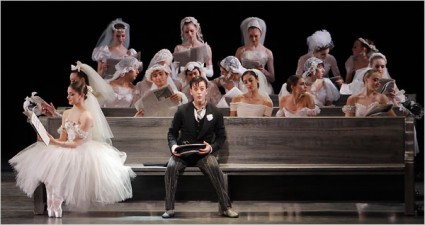
Makin’ Whoopee, part of Susan Stroman’s Double Feature, from http://www.nytimes.com

We haven’t had enough ballet here on The Bioscope. So, just opened at the New York State Theater is Broadway choreographer Susan Stroman’s “Double Feature”, performed by the New York City Ballet. The two parts of the ballet, which was first commissioned in 2004, are “The Blue Necklace” and “Makin’ Whoopee”. Both are inspired by silent movies, blending melodrama with slapstick comedy.

Silent film would seem to be a natural source of inspiration for ballet, and there are examples dotted around. Matthew Bourne’s dance company Adventures in Motion Pictures indicates some of its inspiration by its name, and Bourne has drawn on silent film for sets (Caligari helped inspired his “Cinderella”) as well as dance.

Amy Moore Morton, artistic director of the Appalachian Ballet Company, created and dances the lead in “With Chaplin”, which is none too surprisingly centred on Charlie Chaplin.

In the silent era itself ballet does not seem to have featured that often, but there are some notable exception. René Clair’s sublime Entr’acte (1924) was created as an interlude to feature between the acts of Francis Picabia’s ballet “Relâche”, performed by the Ballets Suédois with music by Erik Satie.

Also from the avant garde, Fernand Léger’s Ballet Mécanique is ballet in cinema form, even if it doesn’t feature dance as such, except the dance of objects and machines (plus a Chaplin figure). It was was created by American composer American composer George Antheil and Léger, though music and film did not come together for many years. So, in that spirit, here’s a clip from the film with music by guitarist Gary Lucas (a Bioscope favourite). Sorry about the faux scratches at the start.

Gary Lucas playing to an extract from Ballet Mécanique

Returning to Chaplin, don’t forget the dance (ballet) of the rolls from The Gold Rush (1925). And indeed you could argue for any number of Chaplin films for their balletic qualities.

Moving to modern silent director, Guy Maddin’s Dracula: Pages from a Virgin’s Diary (2002) is a ballet version of the Dracula story with German Expressionist decor and choreography by ballet director Mark Godden.

A modern oddity is Le Sacre du Printemps (2005), a film by Oliver Hermann which bills itself as a “‘Silent Movie’ to Stravinsky’s ballet score”. Sir Simon Rattle conducts the Berlin Philarmonic on the DVD release, and to judge from reviews it’s something of a challenging experience:

…a pair of albino men in tutus, a godlike black female figure baking tiny people like cookies in her kitchen, nuns, voodoo rituals, walls of neatly-mounted Polaroid snapshots being broken thru with an axe, or people endlessly lost in a giant green maze. Not to mention some very sexual scenes and a roomful of naked figures writhing around which disturbingly hovered between Dante’s Inferno and a Nazi death camp ‘shower’.

Hmm. Let us turn instead to Anna Pavlova, greatest of all ballerinas, who appears in three extant silent films, Lois Weber’s The Dumb Girl of Portici (1916), a feature film drama in which she acts rather than dances; Anna Pavlova (1924), which is a non-fiction film depicting her in various ballet sequences filmed in New York in 1924; plus there is a fragment of film of her dancing ‘Columbine’ on the set of Douglas Fairbanks’ The Thief of Bagdad (1924).

Lastly, it’s worth noting that many of the silent film pianists of today help earn their daily bread by playing for ballet and dance classes. Carl Davis has written for ballet as well as his renowned silent film scores, and it would be interesting to know how silent film musicians view accompanying dance or accompanying the screen, and what the interelationships might be.

Any more examples? Just let me know.

Timon’s Friendship Adventure

Timon’s Friendship Adventure

As regular readers will know, here at The Bioscope we try to keep up with current trends in silent filmmaking, while those who know me may know that I have an interest in that engagingly oddest of genres, the silent Shakespeare film. But who would have suspected that the two interests might come together, and that Timon of Athens would be its subject?

And so I offer you Timon’s Friendship Adventure, which is a modern silent (in modern dress) based on William Shakespeare’s Timon of Athens. It’s few people’s favourite Shakespeare play, and one of his least filmed (let alone performed), but writer Michael Weinreich, producer Lisa Shapiro and director Max Littman have created this oddity, shot in black-and-white, silent, with intertitles, and a familiar-style piano accompaniment (until, unfortunately, electric guitar and drums kick in halfway through). Jason Davids Scott plays Timon.

There’s website dedicated to the film, which was made in 2007, and has been doing the round of festivals. Timon is one of Shakespeare’s more misanthropic characters, but though in the play he holds a feast for friends who turn out to be false friends when he is in need, he doesn’t slaughter everyone, as happens here. The inspiration seems more Titus Andronicus than Timon of Athens. Anyway, it deserves notice for being different, and for showing that the honourable art of compressing Shakespeare into five minutes (and squeezing out his words while you’re at it) is not lost.

Neversink Valley Area Museum

The Neversink Valley Area Museum is in Cuddebackville, NY, an area know to film historians as a popular location for New York film companies in the pre-Hollywood era. In particular it was a favoured location of D.W. Griffith and the Biograph company, which filmed in Cuddebackville six times over the period 1909-1911. The local museum (which takes its name from the optimistically-named Neversink river) has a section on filmmaking in the area (Thanhouser and the Victor Film Company were other visitors). But more than that, it has established competitions for silent filmmaking today and writing scores or silent films. The rules for the silent film competition are as follows:

We will accept any film up to 18 minutes in length, it may be from any country and does not have to premiere at our festival. Films currently in distribution are not eligible.
Film makers to submit entries on DVD (all region compatible, as one judge is UK-based).
Length not to exceed 18 minutes.
No synchronized sound.
Music, if used, must be original or provide proof of licensing.
Intertitles acceptable.
DVD should be marked with Title Only.
Enclose sheet with all credits in submission packet.

And here are the rules for the original film score competition:

Entrant to compose an original score for one of these three films: King Lear, The Vagabonds and The Marvelous Marathoner, all made by Thanhouser Motion Picture Company.
Thanhouser will provide a copy of the film to interested entrants.
The winning entry (i.e. film + winner’s music) will be posted on the Thanhouser web site for viewing the winner can use the film with their music royalty free.

Prizes are to be announced later. All screenings to take place 23 August. Further details and application form on the museum’s website.

Immersive video

42nd Street, from http://www.immersivemedia.com

Here at the Bioscope we try to keep our eye as much on what’s new in silent film as what’s in the past, and there’s not much that’s newer than immersive video. This is 360 degree video which lets the viewer view all points of a motion picture. Many will be familiar with still images on the web where by dragging on the image with the mouse you can have a 360 degree view of a place from a fixed point – it’s used on art gallery websites and other such visitor attractions. Immersive video does the same, except the fixed point is in motion and the images move. Just play the video, then drag on its with the mouse to see left, right, above, below and behind you as the action unfolds. It is astonishing to see.

This is an emerging field, with a variety of solutions being employed. The leaders – or at least those with the best selection of videos to test out on its site – are Immersive Media. Their Telemmersion® System employs eleven cameras positioned in a ball-like device, each camera directed at different angle, the results all blended into a single moving image. There are assorted examples to try out on the Immersive Media site, most of which are street scenes taken from a moving car – see their GeoImmersive Database for a map of US and Canadian cities filmed in this way, or 42nd Street, New York (pictured above) from the main demo section of the site. What intrigues me is the similarity between these pioneering efforts and the phantom rides and street scenes taken from the front of moving vehicles which were common in the earliest years of film – see, for example, Panorama of Ealing from a Moving Tram (1901), on the BFI’s Creative Archive site. There is the same sense of excitement at capturing the real world in motion, the same sense of the innate drama of reality, the same sense of immersion.

And they are, for the most part, silent. All of the street scenes on Immersive Media are so, and most of the other videos on the site – underwater scenes of a coral reef, humpback whales, song and dance in New Guinea, and so on – may have music tracks, but there is no live sound. It is possible for the Immersive Media system to record sound (see the demo of the New Jersey Nets basketball team), but for some reason (is it a synchronisation issue? I don’t quite see why) they are avoiding it.

Immersive video seems to have been produced for the industrial, surveillance and promotional markets so far, but its applications are bound to grow (just wait until the first music video is made in this form). As said, Immersive Media is only one of a number of solutions, which roughly boil down to multiple versus single camera systems. You can read about the competing systems on the Immersive Video site. But go and try out the videos on Immersive Media, and be amazed.

The sound of silent film

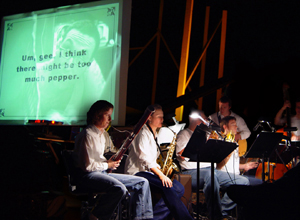
Sound of Silent Film

Sound of Silent Film, from http://www.acmusic.org

Further evidence of the rude health of the modern silent film. The third annual Sound of Silent Film Festival, an evening of modern silent films with music scores performed live, takes place at the Chopin Theatre, 1543 W. Division, Chicago on 26 March. The five films on the bill are Native New Yorker by Steve Bilich, Elastic Stronghold by Justin Heim, Birdcatcher by Chris Hefner, The Purse Belongs to Her by B.J. Moore, and Bajalica by Hurt McDermott. The composers are Natasha Bogojevich, Demetrius Spaneas and William Susman.

There’s a trailer for the festival (QuickTime), or find out more from the Academy of Accessible Music website.

Best silent film

SZABIST

SZABIST Inter-university Film Festival awards

All praise to Syed Paiman Hussain for his film Martey Raho. I’ve no idea what it’s about, but at the Shaheed Zulfikar Ali Bhutto Institute of Science and Technology (SZABIST) Inter-university Film Festival in Pakistan, his film won the award for ‘best silent film’. Other awards went to best sound, best original score, best editing, best documentary, best cinematography, best story, best actor, best director and best film. The partipants in the awards were students from various schools and universities in Pakistan that include film-making as part of their curriculum. Hussain is a student at the Indus Valley School of Arts and Architecture. Let’s hope it’s the start of a brilliant career. There certainly can’t be too many awards for best silent film these days – we should be doing more encouraging of the art form in this way.

More information from the Pakistan Daily Times.

Charleston Symphony Orchestra Silent Film Contest

This is novel. The third annual Charleston Symphony Orchestra Silent Film Contest has just been announced. The concept for this project is to have amateur and professional filmmakers choose a piece from the set repertoire, and make a film based on his/her interpretation of the piece. The completed films are then sent to the Symphony where they will be judged by an independent panel. The selected films will be projected onto a movie screen above the orchestra as the soundtracks are performed live. The winner receives a $1,000 grand prize and may have his/her film presented at a future CSO event.

The concert will be held on Thursday, April 10 at the Charleston Music Hall, Charleston, SC, starting at 9PM. This year the selections are “The Last Spring” from Two Elegaic Melodies by Edvard Grieg, “March of the Sardar” from Caucasian Sketches: Suite by Mikhail Ippolitov-Ivanov, “The Alcotts” from Concert Sonata by Charles Ives, Symphony No. 25 Movement 1 by Wolfgang Amadeus Mozart, the Magic Flute Overture by Wolfgang Amadeus Mozart, The Barber of Seville: Overture by Gioacchino Rossini, and Messages, an original composition by local composer and professor at the College of Charleston, Trevor Weston. All are in the public domain and freely available (“i.e. iTunes”) except for the Weston piece, for which you have to request a Midi file from the organisers.

All entires must be on DVD, must not infringe copyrights, must be world premieres, and must “be intended for a family audience, be non-commercial in nature (e.g., no infomercials or commercials), fall within the equivalent of a G, PG or PG-13 rating as such ratings are determined for theatrical films by the Motion Picture Association of America, and not contain any sexually explicit, disparaging, libelous or other inappropriate content or any nudity”. What fun. Further details are available from the competition site.

2008 Man with a Movie Camera

2008 Man with a Movie Camera

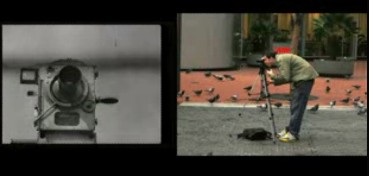
1929 and 2008 Man with a Movie Camera, from http://dziga.perrybard.net

You may remember the posts on video artist Perry Bard’s remarkable project in ‘database cinema’ to create a modern version of Dziga Vertov’s avant garde documentary classic, Man with a Movie Camera, by inviting anyone interested to upload modern equivalent shots to those in the original. You can find all about the ongoing project on Bard’s website, at http://dziga.perrybard.net, but she got in touch to correct an earlier post about the project with this information:

There was an initial deadline which may have led to some confusion however the project is open and ongoing.The reason for the deadline is that people tend to like the excitement of doing things at the zero hour and we wanted as much material as we could get for the launch in Manchester October 11. It continued screening there for two weeks, then screened in Norwich during the Aurora Festival, in Leeds during the Leeds Film Festival. There are links to photos of these events on the site.The site now contains a full length version of the remake which plays as a split screen with the original. We don’t have the server capacity to keep updating the remake but with each screening event it works through a daily download meaning that the film is different each time it screens as more than one person has uploaded entire scenes and shots. The possibilities are infinite. Please participate by logging on to http://dziga.perrybard.net.

There’s also a two-minute trailer available, and the full-length split-screen film (in its current version) is available from Google Video.