And the winner is…

As promised, we bring you the winner of the Vimeo Weekend Project to produce a silent film. Vimeo, the video-hosting site, has these regular weekend competitions inviting new videos to be uploaded on a particular theme, and this time chose silents. The process seems to be a bit confusing, as many just submitted any kind of video in the hope of getting noticed, while others submitted silent but old videos – not surprising, giving the rapid turnaround demanded by the competition.

The winner, above, is Two Knives One Motive by Tyler Capeheart, who says it was written, shot and edited within four hours. It lasts 3mins 19secs. See what you think.

The standard of some of the silents, both those newly produced and some of the older titles submitted, was higher than I’d expected. The video below would probably have got my vote – Guard Duty, by Andrew C, which makes a droll silent comedy pastiche out of the Call of Duty video game (being ignorant of these things I’ve no idea how one makes a new film out of video game software, but clearly this is second nature to some):

And then among the older titles, I was quite struck with Fleeting by Robin Brown, from 2008. It’s longer than usual, just over 15 minutes, and features black-and-white cinematography of a high order. There is engaging use of intertitles early on and some good performances, though I feel the film doesn’t quite know where to go with its theme, and the music is distracting. But it looks so good (the filmmaker says that his influences included F.W. Murnau):

You can find other titles in the Weekend Project section of Vimeo, though there doesn’t seem to be a link I can give you that will only have those films submitted for the competition. Anyway, good to see the several ways in which the art of the silent film continues to inspire.

Silents for the weekend

Those in the know know that the classiest online video site around is Vimeo. It’s home to the work of budding filmmakers, film school graduates, animators and those for whom YouTube is altogether too low grade. It is not particularly a place where one is going to find silent films, but that may change with its recently-announced Weekend Project on silent films. The site organises occasional Weekend Projects where Vimeo members are encouraged to produced films along a particular theme. This time they are being asked to produce silent films. One of the site’s organisers says says:

Last time I suggested a Weekend Project, it was all about making noise. This week, I’m swinging the pendulum to the opposite side and proposing a Silent Film project. And when I say silent, I mean no sound. At all. This means you’re going to have to make actions, edits, and direction speak for you. You are allowed to use those old-timey slides to show what people are saying and to narrate your story. But remember, silence!

Well, not strictly silence, since the filmmakers are allowed to include music (not songs), with the less than encouraging suggestion that “Cheesy piano music is the way to go if you use music.” Winners will be announced next Friday. I’ll let you know. Meanwhile, the above video by Benjamin VanderVeen exploring the School of Art and Design at Northern Michigan University is held up as a model effort. Hmm.

The Legend of the Mountain Man

mountainman

http://aslfilms.com

The Bioscope has an interest in films made for and by the deaf, as old hands may know. Deaf cinema shouldn’t be equated with silent cinema in general, but there is a fascinating history of deaf people’s engagement with film during the silent era, to which I shall certainly return, and it is worthwhile noting from time to time what is going on in the world of deaf film, as a sort of parallel activity to the modern silent film (another activity we’ve also been tracing).

All of which leads us to The Legend of the Mountain Man, a feature film wholly silent yet very much a talking picture, except that the language is ASL, or American Sign Language. It is made by ASL Films, who have set themselves up to produce feature films to professional standards for the deaf community, and have now made three titles: Forget Me Not (2006), Wrong Game (2007) and The Legend of the Mountain Man, which was released late last year. Their films are pure ASL, without captions or voiceover, and so for the hearing viewer offer a purely silent experience as well as a window onto a wholly talkative world.

Mountain Man concerns three children staying at their grandparents’ Montana ranch who encounter a mysterious mountain creature, and through their adventures help bring back together their dysfunctional family. It looks to be heartwarming, family fare, and has been warmly accepted by the deaf community in America (not least for its purist ASL policy). There’s plenty of information to be found on the film, and ASL Films’ mission, on the movie’s official site, which has trailer, cast interviews, showtimes, photos and news.

To find out more about deaf cinema, and deaf art and media in general, visit The Deaf Lens, whose list of links alone is just amazing, not least for what it reveals of the number of deaf film festivals out there.

The Gold Bug

Here at the Bioscope we like to commend all efforts to keep the art of silent filmmaking alive today, and now we learn of The Gold Bug, an 87-minute version of the Edgar Allen Poe short story about a man who becomes obsessed with finding gold after being bitten by a “gold bug”. It’s a home-made effort by former students Spike Carpenter and Andy Tornow, produced at a cost of some $10,000. The film had its premiere last month at the Grand Opera House, Oshkosh, Wisconsin.

These are extracts from an interview with Carpenter in the Oshkosh West Index, which say much about the filmmakers’ enthusiasm and dedication:

Lack of high-quality sound equipment was one major factor in the decision to make The Gold Bug silent, but Carpenter and Tornow also hold a deep respect for the unique art of silent film.

“I just fell in love when I saw my first Charlie Chaplin film; I love the world that it places you in. The way he moved across the screen effortlessly is what I tried to capture in our film,” said Carpenter. “To me, film is most importantly a visual art.”

“It was too difficult to work with a moving camera, so we kept it simple and focused more on the composition of the frame, or the artistic balance of the shot. At one point we put the audience in a cage; because Brand feels trapped in the cottage. We filmed bars with light coming in to represent that feeling.”

In order to successfully see their creativity become a reality in the filming process, the young filmmakers constantly had to work around obstacles using their own innovations.

“The pirate treasure was just one of many cinematic tricks that we used to make this picture. We built a false bottom to the treasure chest to make it look like the entire thing was loaded, when, in reality, we only had to fill a fourth of it,” said Carpenter. “From the beginning, I wanted authentic, time-period coins, so I ordered those online. When I realized that I was still way short in terms of filling the false bottom, I purchased “filler” treasure. In making an independent film, you have to learn to cut corners whenever possible.”

To get the unique nebulous look present in the entirety of The Gold Bug, such as the sepia tone and slow shutter film setting, there was much technical film work to pursue. The crew used a program called Sony Vegas Pro for the editing, which allowed them to maximize the extent of their imaginations.

“[The program] took a while to learn; we finished late October and then were up until actually the morning of the showing to get everything finalized,” said Carpenter. “The effect of the words mysteriously appearing on the parchment is a simple double-exposure. This technique is an old one. It’s very difficult to get this shot just right. You have to stay completely still as someone else makes the necessary changes for the next shot. That is why, if you watch closely, you see that Legrand’s thumb moves a little in the dissolve.”

“Casting actors was terribly difficult, especially since this was my first film and I had zero credibility. Making a film is grueling work, and it takes up your life if you’re serious about it. We went through several different people in the three years it took to make this film. When it came to this summer we had different actors and we had to do all the pirate stuff over again.”

“When we’re old and gray we can look back at ourselves climbing cliffs and riding horses,” said Carpenter. “It’s an amazing reward to see my imagination finally come out in film. It is the toughest and most important project we’ve ever done in our lives. I learned a lot about filmmaking; it takes months and months of hard work.”

Carpenter’s father provided the music score, and copies on DVD are available from his mother – unfortunately, no contact details provided, perhaps on the assumption that the only interest will be local, but the YouTube clip looks quite stylish. The Bioscope suspects that it would merit further exposure elsewhere.

Prometheus Triumphant

Trailer for Prometheus Triumphant, from Mad Monkey Productions

It’s been a while since we had a look at any modern silents – the examples on show at Pordenone last year rather set back the cause of the silent film for today, I thought.

But now we have Prometheus Triumphant, or, to give its full title, Prometheus Triumphant: A Fugue in the Key of Flesh. Reportedly two years in the making, this is a feature-length film shot silent (with intertitles) in German Expressionist mould, as you may judge from the trailer. It was made by Mad Monkey Productions, directed by Jim Towns and Mike McKown, and stars Josh Ebel and Kelly Lynn in a tale of a white-masked young man seeking to raise back to life the dead body of his lover. Mad Monkey’s YouTube section has a number of curious videos about the film’s production.

Much more than that, I cannot tell you, except to say that there’s a plot synopsis on Film Baby, that Cinema Epoch is selling it on DVD, that it runs 79mins, that it reportedly aims to be explicit about the sexuality that the German Expressionists left implicit, and that maybe the German Expressionists knew more of what they were doing than those who have come after them…

Silent Chanel

cocochanel

Brad Koenig and Edita Vilkeviciute in Karl Lagerfeld’s Coco Chanel film

Let’s bring a little glamour to the sometimes rather fusty Bioscope, and take a look at the world of fashion. Because designer Karl Lagerfeld has made a ten-minute silent film about Coco Chanel, which premieres in Paris tomorrow. This article from Women’s Wear Daily Fashion provides us with the essential details:

A glamorous, big-budget short film of the silent variety will premiere in Paris this week, and it’s all due to Chanel and Karl Lagerfeld, who donned a director’s hat and let rip his encyclopedic knowledge of Gabrielle Chanel’s early years.

The 10-minute movie — in all its flapper glory, as these stills illustrate — will be screened at Le Ranelagh theater on Wednesday night, along with a showing of Chanel’s Paris-Moscow, a luxury pre-fall ready-to-wear collection embellished by the couture ateliers Chanel owns.

“Today, people are ready for silent movies again, as they spend time — hours, I would say — looking at text messages and e-mails,” says Lagerfeld. “I always loved silent movies.”

The designer gathered some familiar members of his entourage, including model Brad Koenig and his bodyguard/private secretary Sébastien Jondeau (mustachioed and surly as a Russian nightclub owner), for the cast, along with model Edita Vilkeviciute, her gamine allure, jutting chin and ramrod posture creating a beguiling portrayal of the young Coco from 1913, when the legendary designer first set up shop. As reported in WWD Nov. 17, Tallulah Ormsby-Gore plays a Chanel model who has to sell her real-life mother, Lady Amanda Harlech, a hat in the film. Even the workers in the Chanel atelier got to play parts as workers in the fashion house. “I cannot take extras,” Lagerfeld notes. “They don’t know how to touch the clothes.”

The second part of the film takes place in 1923, when Chanel was already established, and is interspersed with newsreel images from the First World War. The plot, conveyed with title cards, involves a fascinating cast of characters, many tied to Russia, including Chanel’s lover the Grand Duke Dmitri Pavlovich, from whom she borrowed the pea jacket and pelisse, giving them a feminine touch. “It’s a funny movie, unpretentious,” says Lagerfeld. “Chanel was a charming woman, at liberty to seduce men. Everybody this year has decided to make a movie about Chanel, and you know their historical worth is not always too exact.”

Lagerfeld’s mini movie took two days to shoot in a studio on the outskirts of Paris, and was “made like a Hollywood production,” the designer says. “I had every image in my head.” As for the collection he will show, he says it will be “constructed,” incorporating elements of imperial Russia and Russian folklore.

Well, I think we’re all pleased that Karl loves silent movies even if – were one to be cynical – he may not actually have seen one. And I’m impressed by the intellectual leap displayed when he says that people are ready for silent films once more because they dedicate so much of their time to reading texts and emails. If anyone has wise words on that one, I’d be glad to see them.

A title for Lagerfeld’s film does not appear to have been advertised, but no doubt it will generate far more column space than any conventional silent film screening today, and the same hackneyed ideas about what silents looked like and what they represented will persist. The WWD Fashion article includes an eleven-picture slideshow of images from the film, so you may judge for yourselves.

Uncle Max

unclemax

Uncle Max Looks After the Baby

There is a long tradition of British televison comedians honouring the silent comedians of the past. As documented on an earlier post, one strand of this began in the 1960s with Bob Monkhouse and Michael Bentine presenting silent comedy films to new audiences. Another strand that began at the same time was televison comedians producing their own silent, or near-silent comedies, among them Ronnie Barker (A Home of Your Own, Futtock’s End, The Picnic, By the Sea), Eric Sykes (The Plank, Rhubarb, It’s Your Move) and Benny Hill (The Waiters, Eddie in August). In recent times, Paul Merton has taken on the Monkhouse/Bentine mantle by inculcating a new generation attracted by his verbal humour into the purely visual humour of his heroes; while following the line set by Barker, Sykes and Hill, Rowan Atkinson has given us Mr Bean, for which we may or may not be grateful.

Now (and for the past couple of years) children in the UK are enjoying silent comedy courtesy of David Schneider, and the television series Uncle Max. This series, produced by Irish company Little Bird Pictures, started out on ITV in 2006 and then transferred to the BBC’s children’s channel, CBBC. It stars Schneider (best known as Steve Coogan’s unhappy sidekick in Knowing Me Knowing You) as the cheerfully accident-prone Uncle Max, a sort of cross between Michael Crawford in Some Mothers Do ‘Ave ‘Em and Mr Bean (without the undercurrent of malice). Episode titles such as Uncle Max Goes to the Dentist, Uncle Max Walks the Dog and Uncle Max Buys some Shoes give you a rough idea what to expect, and in presentation as well as spirit it has real echoes with the minor comedy series of the silent era. It’s obvious humour, but well enough composed for its target audience. And the nephew who endures Uncle Max’s chaotic approach to life is called Luke, something I heartily approve of.

Uncle Max episodes (10 minutes each) turn up on iPlayer when available, and there are trailers on YouTube. Curiously, for reasons of economy the whole series, while set in England, was filmed in South Africa.

C’est une catastrophe

Jean-Luc Godard’s Une catastrophe

In what is quite a coup for the Viennale, Vienna’s film festival, Jean-Luc Godard came out of semi-retirement to make a trailer for the festival, his first film work since 2006. Entitled Une catastrophe, it runs for just sixty-three seconds, but it is hereby claimed for the silent film community because it makes use of Battleship Potemkin and People on Sunday. The film opens with the over-famous Odessa Steps sequence from Potemkin, accompanied probably for the first time by the sounds of a tennis match.

Then, following a shot of an agonised man with a knife (from what film?) and gaudy colour footage of war, we get a slowed-down, stop-start sequences of two lovers from People on Sunday (Menschen am Sonntag), Edgar G. Ulmer, Fred Zinnemann and Billy Wilder’s exquisite 1930 drama with a Berlin documentary background. Throw in some fractured titles, snatches of Schumann’s “Scenes from Childhood”, and an eighteenth century poem in Low German, and you have a mightily rich concoction for your sixty-three seconds.

Love, death, guns, music, language, iconography, montage. Histoire(s) du cinéma, indeed.

Bioscope Newsreel no. 4

The Sport of the Gods
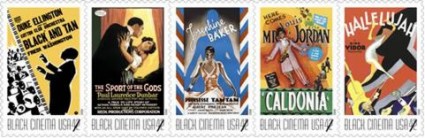
The US Postal Service has issued a series of stamps celebrating African-American performers in early (i.e. pre-1950) films. The titles chosen are each represented by posters and include the 1921 all-black cast The Sport of the Gods, directed by Henry J. Vernot and starring Elizabeth Boyer and Edward R. Abrams. Read more.

Shakespeare goes Hollywood
Director Scott Palmer and the theatrical company Bag & Baggage Productions are putting on a production of A Midsummer Night’s Dream that is set in the world of silent-era Hollywood. Chaplin, Lloyd, Valentino, Theda Bara and Louise Brooks are all referenced, while Puck echoes Murnau’s Nosferatu. The production is being put on for Oregon State University’s Bard in the Quad at Corvallis. Read more.

Telegu silent once more
Telugu comedy actor Brahmanandam, who is recorded in the Guinness Book of Records for having appeared in the most number of films in a single language, is to star in a silent film, which is reckoned will be the first Indian silent commercial feature film since the classic Pushpak. The film, Brahmanandam Drama Company, is a Telegu remake of the 2006 Hindi film Bhagam Bhag. Read more.

‘Til next time!

Time travelling

The Time Travellers of 1908, from http://www.gmfilm.co.uk

I’ve added a new section among the links for Modern Silents, a subject that, as regulars will know, has been covered here from time to time. Modern silents until recently were occasional curiosities (Le Bal), spoofs (Silent Movie), imitations of slapstick (The Plank), eccentricities (Juha) or lacked dialogue merely because they featured dinosaurs (One Million Years B.C.). But the arrival of cheap digital equipment, broadband and YouTube has encouraged experimentation in this field (as it has in so many others). More than that, there seems to be growing interest in the stylistic tropes of silent cinema as an means of expression today among a number of accomplished filmmakers, of whom the Canadian Guy Maddin is the best known.

The Bioscope will continue to pay attention to such work, so let’s kick things off afresh by looking at Martin Pickles. He is a British filmmaker, whose G.M. Film site is named after his 2001 film G.M., which took its title and inspiration from Georges Méliès. Pickles does not produce pure silent films so much as work with the aesthetic and historiography of silent film in creating some of his own work.

Take, for example, Time Travellers of 1908. This short film follows two explorers, using a time-machine shaped like a movie camera, as they visit 21st century London. It was shot entirely on Edwardian hand-cranked cameras with original lenses, and the soundtrack recorded on a 1909 Edison phonograph. There is a real sense of modern London viewed anew (is it accident or ingenuity that makes their first shot of modern London a view of Trafalgar Square taken from much the same spot as Wordsworth Donisthorpe chose for his proto-movie of 1890?)

Or there’s G.M. itself, in which an Edwardian gentleman (looking not unlike Georges Méliès) is tormented by spirits who appear through holes in the wallpaper. In the simple but effective Camera Obscura a man dreams of a ballet dancer but finds himself literally tied to his office desk. And Trafalgar Square makes another appearance in Century’s End, a ‘film-poem’ of London filmed between midday and midnight on 31 December 1999, shot on 16mm at 16fps but telecine-ed at 25 fps, as Pickles says, ‘in order to give it the jerky look of an old Edwardian film’. One would usually protest at the notion of silent films being jerky and run at the wrong speed, but here the choice is knowing and apposite.

All these and more are available as QuickTime movies on the G.M. Film site, with background explanations on their production, rationale and funding. All are short, all are ingeniously creative. Seeing such work makes you realise how silent films will continue to have a creative life because they represent a form of artistic expression which is now set in time. They constitute a vision of things, a discrete way of telling stories, that will always have an appeal to some filmmakers. There was far more to silent films, even (or especially?) early silents, than the relatively simple aesthetic referenced in Pickles’ films, but what matters here is not the pastiche but the acknowledgment from today of a particular way of seeing things. They are an act of time travelling, whether we view the originals or whether we endeavour to imitate them.

I’ll keep on the lookout for more such filmmakers, and would welcome any recommendations.