Momentos

When we champion the modern silents here at the Bioscope, we see them fall into two broad categories. Category one is pastiches of the traditional silent film stle (or what is generally imagined to be silent film style). They are shot in black-and-white, with exaggerated mannersisms, playing with the idea of modern themes dressed up in a silent style.

Then there are modern silents which are a mode of filmmaking that doesn’t look back to the 1920s at all, but rather seeks to strip away dialogue because image is all. It is a form that is starting to flourish with the proliferation of video sites and the chances for filmmakers to make their statements with short films that have the potential to reach thousands more than will ever see them on the festival circuit alone. There is also the strong influence of pop videos underlying such films, where the dumbshow complements the song with telling images that speak volumes by themselves.

All of which is preamble to the above film, Momentos, the latest production on Vimeo from Portguese filmmaker Nuno Rocha. It is sentimental but most expertly done, with a subtle plot twist, and comes equipped with an in-joke since the video we see the lead character laughing at is Rocha’s earlier production, the mesmerising 3 x 3, previously highlighted here on the Bioscope. It is well worth seven minutes of your time, I promise you.

Idiot with a tripod

As you’ll know if you’re a regular in these parts, we’re keen to encourage the silent film of today wherever we can. This effort was made by filmmaker Jamie Stuart in the New York snow, and was shot, edited and then published in just over a day (26-27 December 2010). It has gained praise from Roger Ebert, who compares its technique to Dziga Vertov’s Man with a Movie Camera and says that it ought to be awarded an Oscar.

Well it’s undoubtedly a polished piece of work from someone who who knows what he is doing technically (see Ebert’s interview with Stuart at the end of his post) but personally I think it’s some way off Vertov, not least because it doesn’t actually tell you anything. And it suffers from the curse of too many otherwise elegant pieces of wordless filmmaking to be found all over YouTube and Vimeo in adding a lame electro-music soundtrack which muffles the artistry rather than elevating it. But there’s a good editing rhythm to the video, every shot is telling, and each shot connects well with the next. OK, so it’s quite good. Just not that good.

Looking back on 2010

Lillian Gish knows just what it’s like in north Kent, from Way Down East

The snows of winter are piling up in fantastic drifts about the portals of Bioscope Towers. Icy blasts find their way through every crack and cranny. Outside, civilization grinds to a glacial halt, and the end of the year now beckons. In the relative warmth of the Bioscope scriptorium, I’ve been thinking it would be a good idea to look back on what happened in the world of silent film over 2010. So here’s a recap of highlights from the past twelve months, as reported on the Bioscope (and in a few other places) – silent memories to warm us all.

There were three really big stories in 2010. For many of us, the most welcome news story of this or any other year was the honorary Oscar that went to Kevin Brownlow for a lifetime dedicated to the cause of silent films. The restored Metropolis had its premiere in a wintry Berlin in February. It has now been screened acround the world and issued on DVD and Blu-Ray. And there was the sensational discovery by Paul E. Gierucki of A Thief Catcher, a previously unknown appearance by Chaplin in a 1914 Keystone film, which was premiered at Slapsticon in June.

It was an important year for digitised documents in our field. David Pierce’s innovative Media History Digital Library project promises to digitise many key journals, having made a good start with some issues of Photoplay. The Bioscope marked this firstly by a post rounding up silent film journals online and then by creating a new section which documents all silent film journals now available in this way. A large number of film and equipment catalogues were made available on the Cinémathèque française’s Bibliothèque numérique du cinéma. Among the books which became newly-available for free online we had Kristin Thompson’s Exporting Entertainment, and the invaluable Kinematograph Year Book for 1914.

Among the year’s restorations, particularly notable were Bolivia’s only surviving silent drama, Wara Wara, in September, while in October the UK’s major silent restoration was The Great White Silence, documenting the doomed Scott Antarctic expedition.

We said goodbye to a number of silent film enthusiasts and performers. Particularly mourned in Britain was Dave Berry, the great historian of Welsh cinema and a friend to many. Those who also left us included Dorothy Janis (who starred in The Pagan opposite Ramon Novarro); film restorer and silent film technology expert Karl Malkames; the uncategorisable F. Gwynplaine Macintyre; and film archivist Sam Kula. One whose passing the Bioscope neglected to note was child star Baby Marie Osborne, who made her film debut aged three, saw her starring career end at the age of eight, then had a further ninety-one years to look back on it all.

Arctic conditions in Rochester uncannily replicated in Georges Méliès’ A la Conquête du Pôle (1912)

On the DVD and Blu-Ray front, Flicker Alley followed up its 2008 5-disc DVD set of Georges Méliès with a sixth disc, Georges Méliès Encore, which added 26 titles not on the main set (plus two by Segundo de Chomón in the Méliès style). It then gave us the 4-DVD set Chaplin at Keystone. Criterion excelled itself by issuing a three-film set of Von Sternberg films: Underworld (1927), The Last Command (1928) and The Docks of New York (1928). Other notable releases (aside from Metropolis, already mentioned) were Flicker Alley’s Chicago (1927) and An Italian Straw Hat (1927), Kino’s Talmadge sisters set (Constance and Norma), the Norwegian Film Institute’s Roald Amundsen’s South Pole Expedition (1910-1912) and Il Cinema Ritrovato’s Cento anni fa: Attrici comiche e suffragette 1910-1914 / Comic Actresses and Suffragettes 1910-1914, while the Bioscope’s pick of the growing number of Blu-Ray releases is F.W. Murnau’s City Girl (1930), released by Eureka. But possibly the disc release of the year was the BFI’s Secrets of Nature, revealing the hypnotic marvels of natural history filmmaking in the 1920s and 30s – a bold and eye-opening release.

New websites turned up in 2010 that have enriched our understanding of the field. The Danish Film Institute at long last published its Carl Th. Dreyer site, which turned out to be well worth the wait. Pianist and film historian Neil Brand published archival materials relating to silent film music on his site The Originals; the Pordenone silent film festival produced a database of films shown in past festivals; the daughters of Naldi gave us the fine Nita Naldi, Silent Vamp site; while Kevin Brownlow’s Photoplay Productions finally took the plunge and published its first ever website.

The crew for Alfred Hitchcock’s The Mountain Eagle, ready for anything the elements can throw at them

Among film discoveries, in March we learned of the discovery of Australia’s earliest surviving film, the Lumière film Patineur Grotesque (possibly October 1896); in June we heard about a major collection of American silents discovered in New Zealand; and digital copies of ten American silents held in the Russian film archive were donated to the Library of Congress in October. That same month the Pordenone silent film festival unveiled the tantalising surviving frgament of F.W. Murnau’s Marizza, Genannt die Schmuggler-Madonna (1921-22). There was also time for films not yet discovered, as the BFI issued its Most Wanted list of lost films, most of them silents, while it also launched an appeal to ‘save the Hitchcock 9” (i.e. his nine surviving silents).

The online silent video hit of the year was quite unexpected: Cecil Hepworth’s Alice in Wonderland (1903) went viral after the release of the Tim Burton film of Lewis Carroll’s story. It has had nearly a million views since February and generated a fascinating discussion on this site. Notable online video publications included UCLA’s Silent Animation site; three Mexican feature films: Tepeyac (1917), El tren fantasma (1927) and El puño de hierro (1927); and the eye-opening Colonial Films, with dramas made in Africa, contentious documentaries and precious news footage.

2010 was undoubtedly the year of Eadweard Muybridge. There was a major exhibition of the photographer’s work at Tate Britain and another at Kingston Museum (both still running), publications including a new biography by Marta Braun, while Kingston produced a website dedicated to him. He also featured in the British Library’s Points of View photography exhibition. There was also controversy about the authorship of some of Muybridge’s earliest photographs, and a somewhat disappointing BBC documentary. In 2010 there was no avoiding Eadweard Muybridge. Now will the proposed feature film of his life get made?

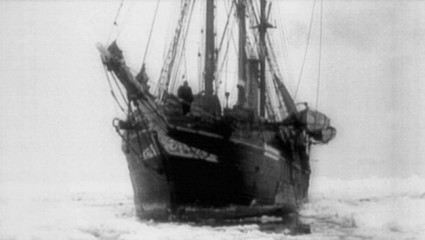
Ernest Shackleton’s ship Endurance trapped in the Medway ice, from South (1919)

It was an interesting year for novel musical accompaniment to silents: we had silent film with guitars at the New York Guitar Festival; and with accordions at Vienna’s Akkordeon festival. But musical event of the year had to be Neil Brand’s symphonic score for Alfred Hitchcock’s Blackmail (1929), given its UK premiere in November.

Noteworthy festivals (beyond the hardy annuals of Pordenone, Bologna, Cinecon etc) included the huge programme of early ‘short’ films at the International Short Film Festival at Oberhausen in April/May; and an equally epic survey of Suffragette films in Berlin in September; while the British Silent Film Festival soldierly on bravely despite the unexpected intervention of an Icelandic volcano.

On the conference side of things, major events were the Domitor conference, Beyond the Screen: Institutions, Networks and Publics of Early Cinema, held in Toronto in June; the Sixth International Women and Film History Conference, held in Bologna also in June; and Charlie in the Heartland: An International Charlie Chaplin Conference, held in Zanesville, Ohio in October.

It wasn’t a great year for silent films on British TV (when is it ever?), but the eccentric Paul Merton’s Weird and Wonderful World of Early Cinema at least generated a lot of debate, while in the US sound pioneer Eugene Lauste was the subject of PBS’s History Detectives. Paul Merton was also involved in an unfortunate spat with the Slapstick festival in Bristol in January over who did or did not invite Merton to headline the festival.

The art of the silent film carried on into today with the feature film Louis (about Louis Armstrong’s childhood), and the silent documentary feature How I Filmed the War. Of the various online modern silent shorts featured over the year, the Bioscope’s favourite was Aardman Animation’s microscopic stop-frame animation film Dot.

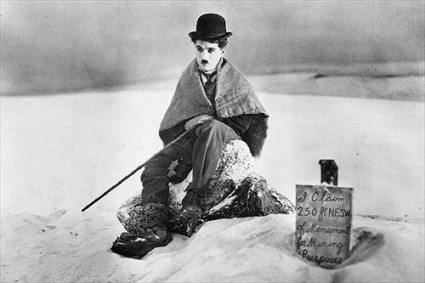
Charlie Chaplin contemplates the sad collapse of Southeastern railways, after just a few flakes of snow, from The Gold Rush

What else happened? Oscar Micheaux made it onto a stamp. We marked the centenary of the British newsreel in June. In October Louise Brooks’ journals were opened by George Eastman House, after twenty-five years under lock and key. Lobster Films discovered that it is possible to view some Georges Méliès films in 3D.

And, finally, there have been a few favourite Bioscope posts (i.e. favourites of mine) that I’ll give you the opportunity to visit again: a survey of lost films; an exhaustively researched three-part post on Alfred Dreyfus and film; the history of the first Japanese dramatic film told through a postcard; and Derek Mahon’s poetic tribute to Robert Flaherty.

It’s been quite a year, but what I haven’t covered here is books, largely because the Bioscope has been a bit neglectful when it comes to noting new publications. So that can be the subject of another post, timed for when you’ll be looking for just the right thing on which to spend those Christmas book tokens. Just as soon as we can clear the snow from our front doors.

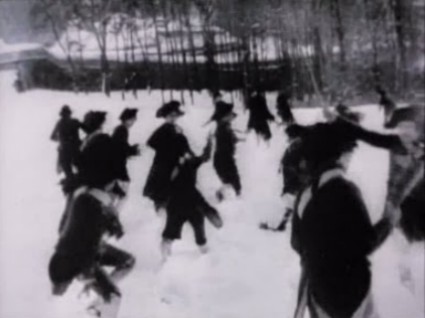
And one more snowy silent – Abel Gance’s Napoléon recreates the current scene outside Rochester castle, from http://annhardingstreasures.blogspot.com

The Tenement Ghost

As regulars will know, here at the Bioscope we like to champion the modern silent film, of which there are growing numbers. The explosion in film production brought about cheap cameras, broadband and online video platforms has led to many experiment with a variety of film forms, silent among them. There are many such home-made or semi-home-made efforts which are of short duration, but the organisation required for a feature length silent means that these are inevitably fewer in number. Nevertheless we’ve been able to champion such titles as How I Filmed the War, Silent, Hannah House, The Gold Bug and Prometheus Triumphant.

Now we can add to their number The Tenement Ghost. This 51-minute film was directed and produced by Thomas Cochrane for his Twisty-Headed Man Company in 2009. Set in Scotland just after the First World War (though costumes seen to veer between 1919 and 2009), the film documents the disintegration of a marriage following the husband’s descent in alcoholism. Physical and emotional violence follow, then spectral occurences are experienced by the bride, as the film’s press handout describes:

Her rapid transition from starry-eyed bride to battered wife is marked by the appearance of a ghostly apparition and, though we are never sure whether this spectre is real or simply a fantasy borne of her brutal situation, its appearances become more frequent as her personality disintegrates. The death of their unborn child pushes her ever closer to the edge of sanity until the ghostly visitor’s promptings finally impel her into a last desperate attempt to free herself from torment, bringing the Tenement Ghost to its ghastly and appalling climax.

The film boasts a busy electronic score by Skirlin Burster and stars Frances Rowan as the wife, Barry Ward as the husband heading a cast and crew of twenty. Apparently it was made in just a week on the thinnest of shoestring budgets. The director writes of his enthusiasm for silent films:

It’s not a unique situation – it’s something you see in the newspapers on a far too regular basis – but it is a situation that, if you look at it through the very charming medium of silent film, becomes, I think, more powerful, more shocking … I love silent films. I love the look of them, the feel, the atmosphere. And in producing one I thought the effect would be… the first effect that came to mind was charming – it would be something pleasant to look at. You’d get a warmth from it.

Trailer for The Tenement Ghost

So what is it like? Up to a point the director knows his silents, with plenty of familiar camera angles, visual motifs, intertitles and appropriately attuned performances. It is also in monochrome with faux scratches (such as they wouldn’t have seen in 1919, of course). However he has gone for an odd stop-motion-style look to people’s movements which doesn’t really add to the film’s attractions. Also alcoholism is seldom a good subject for film drama (just ask D.W. Griffith, whose film career came to an end with the unfortunate The Struggle) and there isn’t much story here. But there are some striking visuals, a good performance from Frances Rowan, and an overall a sense that it was right to shoot the film silent – it’s not simply a sound film shorn of its words. It’s just that over 50 minutes you need a bit more of a story, or just a little more complexity.

The film can be seen in its entirely on Vimeo or on the film’s website, where you are also offered the choice buy it on DVD (£10.00 plus p&p) or download it as a free torrent.

There an interview with Thomas Cochrane on his experience making the film on Eye for Film.

Slapstick is back

http://www.slapstick.org.uk

Here comes 2011, and first off the blocks will be the seventh edition of the annual Slapstick festival, held in Bristol. The festival has developed into a celebration of visual comedy in general by bringing together silent slapstick with British television and radio comedians of today (not that radio excels in visual comedy, but it all fits somehow). This year the presenters include Bill Oddie, Ian Lavender, Barry Cryer, Tim Brooke-Taylor, Neil Innes, Shappi Khorsandi and Chris Serle. Kevin Brownlow turns up presenting ‘Unknown Chaplin’ material, while the silent performers featured include Chaplin, Keaton and Langdon. And there is also a welcome tribute to one of Bristol’s finest, the Aardman Animation studios’ children TV series Shaun the Sheep, which the Bioscope should have championed long before now as a truly great example of the art of silent comedy happily carried on into the 21st century (and who would have guessed that Sir Christopher Frayling was a fan? Good on him).

Here’s the full programme:

THURSDAY 27 JANUARY

5.40pm Watershed
UNKNOWN CHAPLIN with KEVIN BROWNLOW
Academy Award winning film historian Kevin Brownlow introduces a selection of the rarest and least known footage of Charlie Chaplin as the festival opens with the first of four events dedicated to the ‘Little Tramp’.

8.00pm Colston Hall
Neil Innes: A People’s Guide to World Domination
The very welcome return of Slapstick Festival supporter and patron, Rutle and Bonzo front man Neil Innes as he brings his new solo show to Colston Hall for one night only on the opening night of Bristol’s Seventh Slapstick Festival. Neil performs a wry, poignant, humorous and topical one-man show, spiced with anecdotes of his life and times in the worlds of media and show business. Neil’s solo shows tickle the emotions with a potent mix of fine musicianship and enlightened lyricism, packed with sharp observations celebrating the absurdities of modern existence. Join us for a unique musical experience in the company of the self proclaimed ‘Ego Warrior’ and ‘Seventh Python’

FRIDAY 28 JANUARY

2pm Arnolfini
CLARA BOW in MANTRAP (Dir Victor Fleming; USA, 126 mins)
Clara Bow wasn’t just the ‘IT’ girl of a generation, she was also a fine actress and comedienne. Here in one of her funniest films, Bow plays the sexy wife of an old Canadian backwoodsman who becomes attracted to a young, rich and famous divorce lawyer who comes to town on vacation.

4pm Watershed
SLAPSTICK INTERNATIONAL (U) with live piano accompaniment
In a continuation of Slapstick’s tradition of sharing the best new silent comedy finds, three superb films discovered by the Giornate Cinema Muto for Italy’s Pordenone Silent Film Festival: W.C. Fields, making his silent screen debut, in THE POOL SHARKS; the same wise-cracker in the early sound short, THE GOLF SPECIALIST, plus a delightful silent from Russian, CHESS FEVER. Introduced by Pordenone’s director David Robinson, with John Sweeney on piano and Chris Serle as host.

7.30pm Colston Hall
SLAPSTICK SILENT COMEDY GALA
with Bill Oddie, Ian Lavender, Barry Cryer and Neil Innes; the Jazz Train orchestra; the European Silent Screen Virtuosi and Paul McGann

Four living comedy icons introduce a four-film salute to the best-loved past masters of silent humour, showing here on a giant screen with music from the 25-piece jazz combo, Jazz Train, and the European Silent Screen Virtuosi. Plus a ukulele tribute to Chaplin and an appearance by Paul McGann. £20 (£16 conc); £6 under 12s.

SATURDAY 29 JANUARY

9.30am Colston Hall
HOMAGE TO CHAPLIN (U, Germany, 50 mins)
A rare chance to see a fine visual tribute to Charlie Chaplin, made in association with, and performed by students from, a German school for young people who are deaf. Showing here with a live piano accompaniment by Guenter Buchwald.

11am Colston Hall
HARRY LANGDON: BEST COMEDY SHORTS with Graeme Garden
Baby-faced Harry Langdon used a subtler form of visual comedy than that which became known as ‘slapstick’ but his talent made him a worthy rival of those who became better known. Here, Graeme Garden, of The Goodies and the I’M SORRY I HAVEN’T A CLUE panel explains why he’s a Langdon champion and introduces some of the comic’s brightest and funniest shorts. With live music.

2pm Arnolfini
CHAPLIN: THE CIRCUS + a new animation CIRCUS DRAWINGS
Too often overshadowed by his more legendary comedies, THE CIRCUS boasts Chaplin’s most brilliant gags, including a Hall of Mirrors chase and climaxing with a de-trousering by monkeys on the high wire! Showing here with the UK premiere of a new short by the triple Oscar-winning animator, Richard Williams, based on his 1950s drawings of a circus in Spain.

4pm Bristol Old Vic
CELEBRATING BUSTER KEATON with IAN LAVENDER
DAD’S ARMY and EASTENDERS star Ian Lavender makes his first Slapstick visit appearance to share his long-held passion for Buster Keaton – his chosen subject on a recent Celebrity Mastermind – before revealing and screening his all time favourite short by ‘the great stone face’ and then introducing SHERLOCK JUNIOR (PG, 1924, 45 mins) in which Keaton plays an aspiring detective wrongly accused of a crime by the family of the girl he loves. With live accompaniment by the five-piece European Silent Screen Virtuosi.

8pm Bristol Old Vic
BARRY CRYER’S TOP COMEDY MOMENTS with ROB BRYD0N
The man who has probably worked with &/or written for more UK comics than anyone else on the planet shares his favourite moments and memories with another bright star of British comedy, Rob Brydon. Together, they’ll be telling tales and showing clips celebrating almost 100 years of film and tv humour – from Harold Lloyd and Buster Keaton, via Morecambe & Wise and David ‘Del Boy’ Jason to today.

SUNDAY 30 JANUARY

9.30am Colston Hall
REDISCOVERIES & REVELATIONS
Amazingly, 2010 saw the rediscovery of not one but two unknown Chaplin films, a lost Charley Chase, and the recovery of films featuring Laurel & Hardy, Harry Langdon and British stars, Walter Forde and Pimple. Join silent comedy expert David Wyatt as he brings these gems and others to the screen again, concluding with the UK premiere of Stan Laurel’s restored Monty Python-like classic WHEN KNIGHTS WERE COLD (1923).

11am Colston Hall
MARTY! with TIM BROOKE-TAYLOR and CHRIS SERLE
Writer, actor and wit Tim Brooke-Taylor shares his memories of working with the instantly-recognisable but often overlooked bug-eyed funny man Marty Feldman in his pre-Hollywood days. With clips of some of Marty’s best visual gags from shows like the seminal AT LAST THE 1948 SHOW and the BAFTA award-winning MARTY to illustrate and Chris Serle as host.

2pm Arnolfini
LECTURE: SLAPSTICK & THE CITY: Silent Comedy and the Metropolitan Playground plus HEAVEN’S SAKE and music from The Slapstick Boys
Dr Alex Clayton, Lecturer in Screen Studies at the University of Bristol, looks at how early slapstick films used urban architecture – including statues, giant clocks, escalators and industrial machines – to create some of their most vivid and comic sequences. With illustrative clips and, to follow, a Harold Lloyd comedy (U, 1926, 58 mins) set in the ‘Big Apple’, with a live accompaniment.

2pm Watershed
IT’S… SHAUN THE SHEEP
Eighty years on from the end of the silent film era, silent comedy is alive and well and regaining massive new audiences and global success in the guise of the Wallace and Gromit spin-off character Shaun the Sheep’. Here, Aardman Animation’s Creative Director Richard Goleszowski, chats with Sir Christopher Frayling about Shaun’s inspirations, development and popularity, using extracts from the shows and original models.

4pm Bristol Old Vic
CHAPLIN: THE GREAT DICTATOR with SHAPPI KHORSANDI
When comedian and author Shappi Khorsandi was invited to add an item to BBC Radio 4’s THE MUSEUM OF CURIOSITY, she chose Charlie Chaplin and revealed that his THE GREAT DICTATOR is her all-time favourite film. Here, she explains why she is so drawn to this satire on dictatorship, Fascism, and racism before iintroducing the film (PG, 1940, 120 mins) in which Chaplin plays both the Hitleresque Adenoid Hynkel and his look-alike, a poor Jewish barber. £10-£5

8pm Watershed
MARTY: THE YOUNG FRANKENSTEIN with TIM BROOKE-TAYLOR
To close Slapstick 2011, Tim Brooke-Taylor introduces the Frankenstein spoofathon which catapulted his comedy colleague Marty Feldman to international stardom. Here, Feldman plays Eye-Gore in a piece of inspired lunacy which also stars Mel Brooks and Gene Wilder. Dir: Mel Brooks, USA, 1974, 105 mins.

All the necessary information, with booking details and information on past festivals, can be found on the Slapstick site.

Their films, our music

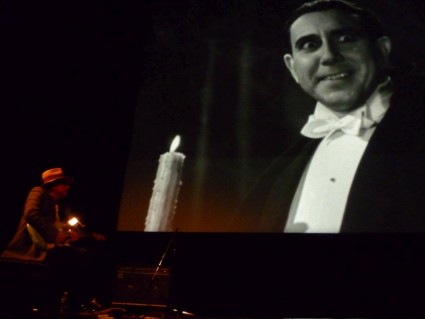
Gary Lucas playing to Dracula at the New York Film Festival, September 2010, with Carlos Villarias was Dracula, from http://www.garylucas.com

Will silent films survive? After the present generation of enthusiasts is gone, and now with almost no one left who remembers silent films the first time round, what impetus will there be in an age of HD, 3D, video games, home cinema, web video and mobile video to attract young audience to a silent, monochrome world filled with quaint manners, outdated narrative conventions and names that no longer hold the magic that once they had?

This issue was debated recently on the silent film discussion forum Nitrateville, and many interesting arguments were given for the survival of silent films. The great availability of silent films on DVD and Blu-Ray, the rude health (general global economic downturn notwithstanding) of some excellent festivals, the sheer fascination of viewing a past that recedes ever further away from us, scholarly investigation, the importance of book publications to inspire and intrigue, and the dedication of archives, all are cited as reasons for optimism.

I would add another, which is the silent film’s need for music. What is distinctive about the silent film as a medium is that it requires accompaniment by us. We have to add something of ourselves – our music, that is – to bring the films back to life. This performance imperative is not unique to silent films. Of course it applies to dramas, operas, indeed the music of the past. The playscript and the sheet music are the preserve of the expert until what they contain is given life through performance, is popularised. But what particularly distinguishes the silent film is that marrying of two forms of artistic expression – the film, and our music alongside it.
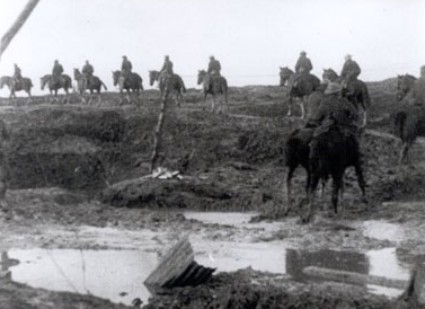
The Battle of the Ancre and the Advance of the Tanks (1917)

I experienced three illustrations of this last Sunday. It is surely strong evidence of the vitality of the medium that I was able to go to three very different screenings of silent films where the music was the real subject of interest in one city (London) on one day. I started off at Imperial War Museum to see The Battle of the Ancre and the Advance of the Tanks (1917). This documentary feature was made by the British goverment’s War Office Cinematograph Committee as the successor to the hugely successful The Battle of the Somme (1916), and the film – made by Geoffrey Malins, J.B. McDowell and Oscar Bovill – documents the later stages of the Somme conflict. While the film does not have the shock value or socio-historical resonances of the first film, it is more elegantly crafted and has shots of striking visual quality, in particular shellfire at night and iconic silhouetted figures against the sky.

The film depicts the routine of war in distinctively poetic terms. No other documentary medium can tell us so much about such engrossingly mundane details as soldiers donning thigh boots to fight off frost-bite, the wounded being given tea and sandwiches, and the ominpresent mud. It also features genuine footage (filmed at a distance with shaky camera) of troops going over the top and crossing no-man’s land. And of course it has tanks, which is what the public particularly came to see and which helped make the film a commercial success.

For the screening Toby Haggith of the IWM and pianist Stephen Horne had constructed the original ‘score’. As with their earlier project of The Battle of the Somme, there wasn’t a score as such, but rather a collection of musical suggestions for the different stages of the film, recommended in 1917 by musical director J. Morton Hutcheson. Horne has put together this pot pourri of popular tunes from the era, which was played by Horne himself (piano, flute and accordion), Geoffrey Lawrence (cornet), Sophie Langdon (violin) and Martin Pyne (percussion). The emphasis was on popular. Hutcheson had picked the pop hits of the day without much thought on their relevance to the film sequences they were to match, except for some association of names, though it was hard to fathom why a tune entitled ‘The Happy Frog’ had been chosen for a scene with a tank. As the film progressed so Hutcheson became more caught in the gravity of what was being shown and the music became of greater moment, but my abiding memory of the screening is of a line of howitzers shown to the sounds of a palm court orchestra with the occasional polite thud of the drum each time of of the guns fired. You did wonder what audiences made of such a musical mélange. Did it seem appropriate? Did it affect their view on what was on the screen? Did they hear differently to ourselves? Did they simply not pay it much attention?

This might seem to be the converse of adding our music to their films, but it is our modern taste to seek out authenticity in this way. Horne’s meticulous musical reconstruction took us that much closer to the past, while at the same time making the past seem all the more like the foreign country where things are done differently.

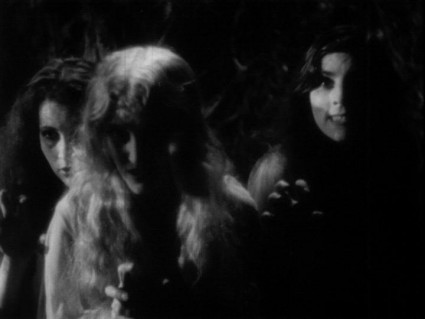
The brides of Dracula from the Spanish version of Dracula (1931), from http://www.garylucas.com

A few hours latter, and I was at the Queen Elizabeth Hall on the South Bank for two film screenings with live music that were part of the London Jazz Festival. This was something of a personal thrill as two of my favourite musicians were on the same bill. First up was guitarist Gary Lucas playing guitar to the Spanish version of Dracula (1931). This is the version of Tod Browning’s film that was shot on the same sets at night with a Spanish cast and director Geoge Melford. So yes it’s a sound film, albeit one with long stretches of silence and no background music except at the beginning and end. So why accompanying it with live music?

The effect certainly was jarring to begin with. Dialogue, translated titles and great swooping washes of electric guitar laden with effects pedals was a bit too much for the ears to take in all at once, but gradually you acommodated yourself to it, and Lucas’ wall of sound has proven itself an effective form of providing musical accompaniment to silents (notably his music for Der Golem) and now quasi-silents. He speaks through his guitar and his music is an expression of his enthusiasm for what is being shown on the screen. That’s the key point. It is not simply a rock musician doing his thing with a silent film (as others have done, often with painfully inapposite results). Enthusiasm for the film comes first, and with that an expression of that enthusiasm through his medium of choice – the electric guitar (two in fact). The result leaves the film still very much a 1931 film, but also one that connects through music with 2010.

The film itself is quaint, but while I wouldn’t say it was hugely superior to Browning’s original (as some have done), it shows invention and the sort of creepiness, except where adherence to the stage production drags it down. Carlos Villarias’s smiling Dracula drew laughter from the audience (I found him off-puttingly similar to Steve Carrell), but Pablo Alvarez Rubio (Renfield) played insanity as well as I’ve ever seen it done, and Lupita Tovar (Eva) was strikingly voluptuous.

Keystone, from http://www.davedouglas.com

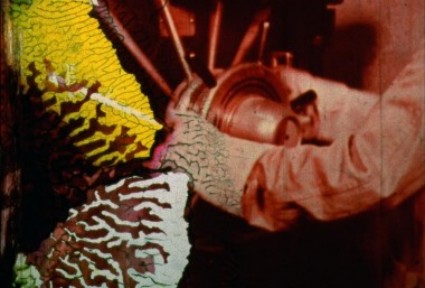
The second film that evening was a silent film of sorts – a new work by experimental filmmaker Bill Morrison, who has enjoyed much acclaim for his work Decasia, composed out of found, distressed footage, which finds an otherworldly beauty in images in the process of decay. Morrison has continued to produced work in a similar vien, his latest effort being Spark of Being, inspired by the Frankenstein story, which he has developed with jazz trumpeter Dave Douglas. Douglas is building up a distinctive track record of silent film-inspired work with his band Keystone, though his modern jazz sound with strong beats behind it is better viewed as being inspired by the silents of Keaton and Arbuckle (subjects of earlier Keystone recordings) than ideal accompaniments to the films themselves.

The band came on stage – trumpet, saxophone, bass, drums, Rhodes and someone off-stage providing electronic noises – and played a punchy overture, then the film began. It was divided up into chapters (“The Captain’s Story”, “The Doctor’s Creation”, “The Creature Confronts His Creator” etc.) with the band accompanying what was shown on the screen. Morrison’s film is a mixture of distressed actuality footage and archive film, all of it silnet (or rather sound-less) including polar exploration (some of it Frank Hurley’s film of the Shackleton expedition), crowds (an amusing short sequence where people glower at the camera to signify public reaction to the Creature), two naked lovers running through woodland (““Observations of Romantic Love”) and a delightful sequence showing a Bavarian wedding projected at a slow speed that gave it a mesmeric quality). However, with the exception of the wedding, the archive film didn’t really convey the symbolic quality that was expected of it, and sometimes jarred with the bolder use of distressed footage. It was these sequences where the band seemed happiest, letting rip against a furious cavalcade of distorted images. On other occasions it seemed constrained by the need to follow the film, and one sensed that the audience would have been content just to have had the band play and never mind the film.

That’s a shame, because it was a bold coming together of experimental film and post-bop jazz, telling a familiar story in an imaginatively oblique fashion. And it was a modern silent film, given its own spark of being by Douglas’ music. I especially admire Douglas’ imaginative vision of the silent film as a springboard for musical invention, which has taken him from Keaton and Arbuckle’s Moonshine to Bill Morrison with the same band, Keystone. Certainly Sunday night would have comes as a surprise to Mack Sennett.

Silent films will survive for many reasons, but one of them is music. They are always going to sound new, to have a connection with our times, so long as we keep on re-imagining how we want to make them sound. It is a key to their enduring appeal to the imagination.
Spark of Being, from http://www.fest21.com

Tied to the tracks

I’m grateful to Bioscope regular Penfold for bringing this delightful short animation by Aidan McAteer to my attention. It is funny, stylish, and will have particular resonance for any weekend train traveller in the UK who has come up against the words ‘engineering works’ …

It’s a mocking idea of a silent film, the kind of silent film that was never made. All those know don’t know silent films know one thing about them – that they featured evil villains who twirled their moustaches then tied a hapless female to the railway track. And all those who do know silent films know that such scenes were hackneyed even before films were invented, and the few films that did show them did so as parody.

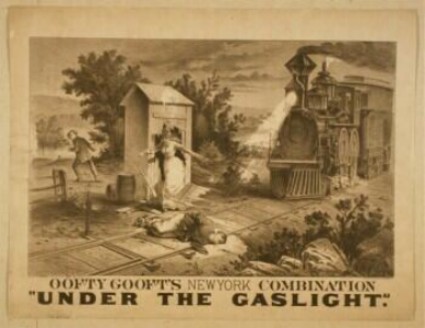
It’s an issue that comes up time and time again, so let’s try and pin down the historical truth. The idea of an entertainment where someone is tied to a railway track and is rescued in the nick of time certainly predates cinema. The entertainment that put the idea into the popular imagination was an 1867 stage melodrama written by American playwright and theatre manager Augustin Daly entitled Under the Gaslight which featured a man tried to railway tracks who was rescued by a woman before he could be run over by the oncoming train (Victorian theatre revelled in such stage spectaculars). An earlier play, The Engineer, had some elements that may have inspired Daly, but he put all the right elements together.

Poster for Under the Gaslight, from http://www.josephhaworth.com. Note the male victim and the female rescuer

When the man in peril was changed to a woman in peril in the popular imagination is unclear, but it is no surprise that the transference was made. The play was wildly popular and was re-produced many times, while Daly complained that his big idea was stolen by other theatrical managers who adapted it for their own entertainments. When films appeared, thirty years later, the mannerisms of stage meldorama that had sent shivers up Victorian spines were out-of-date (so no more twirling of moustaches if you wanted your villain to be taken seriously) while the elaborate stage effects were increasingly supplanted by the realism that cinema could provide by filming on location. So, as dramatic films emerged a major sub-genre emerged of the train thriller (including such notable titles as D.W. Griffith’s The Lonedale Operator and The Girl and Her Trust). But the thrill had transferred from the tracks to the train itself. It is the speed, power and modernity of the train that characterises such films, not the notion of tying someone to the tracks which was too much ingrained in outmoded stage conventions to be taken seriously.

That said, the transference was not immediate, because there were at least two films featuring a woman in peril of being run over by a train that played it straight before anyone played it for laughs. Edwin S. Porter and Wallace McCutcheon’s The Train Wreckers (Edison 1905) features a switchman’s daughter who is pursued by a gang of outlaws, tied to a tree, then when she she escapes (her dog unties the rope) the outlaws knock her unconscious and lay her on the railway track. Happily her boyfriend is a rail engineer who scoops her up from the cow-catcher in the nick of time. So, not exactly tied to the rails, but near enough, and a work very much in the spirit of the Victorian melodrama.

The set-up was still credible in 1911 because it turned up again with Pathé/American Kinema’s The Attempt on the Special, which is very close in action to the earlier film, down the heroine being left unconscious on the rails (rather than tied up) and the assistance from a dog. It is described thus by the BFI National Archive:

Nell, the pointsman’s daughter is tied up by a gang who plan to rob a train. A greyhound, taught to relay messages between herself and her boyfriend comes to her aid and unties her. She sends the dog off with a message for help, but in attempting to escape she is knocked down and left lying on the track. The message is recieved in time to save the girl and the gang is routed.

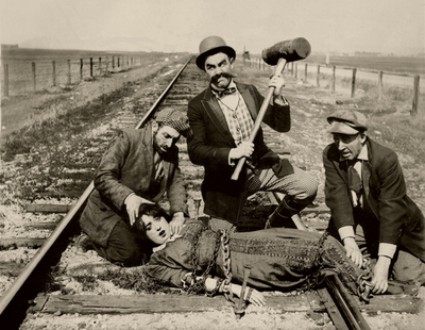
Ford Sterling with the sledgehammer and Mabel Normand tied in the rails in Barney Oldfield’s Race for a Life (1913), from moma.org

The film that established the parodic idea, and which is often used to illustrate it, is Keystone’s Barney Oldfield’s Race for a Life (1913), featuring real-life motor racer Barney Oldfield, Ford Sterling as the moustachioed villain and Mabel Normand as the victim. The film plays it entirely for laughs, and the still above shows you everything you would expect to see. Not only is it not the archetypal silent, but it is unusual for its time in parodying dramatic conventions that someone like D.W. Griffith was still half in thrall to. Perhaps 1913 was some sort of a threshold year of a lack of respect for Victoriana, because stage melodrama is similarly ridiculed by the British film Blood & Bosh, made in the same year by Hepworth. It can be seen as a sign of the growing maturity of the film medium as it outgrew its stage origins, and as the twentieth century increasingly outgrew the nineteenth.

Betty Hutton playing Pearl White in The Perils of Pauline (1947), from http://www.dvdbeaver.com

It is commonly believed that heroines being tied to the tracks was a common element in the adventures serials that appeared around this time, such as The Exploits of Elaine (1914), The Perils of Pauline (1914) or The Hazards of Helen (1914-17). Such serials skilfully married the melodramatic conventions of an earlier age with independent heroines that were a part of the modern world. The heroines were put into perilous situations, but they had the resourcefulness to escape from them. Trains feature frequently in such serials, but the heroine is more likely to be tackling danger on the train rather than being passively threatened by it. The Perils of Pauline, often cited as showing Pauline (Pearl White) being tied to a railway track, contained no such scene. Indeed, the only example from a silent serial I have traced with anything like such a scenario is the Helen Holmes serial, A Lass of the Lumberlands (1916). Here a person was a person tied to the tracks, but it was a man, and it was Helen – in true Under the Gaslight fashion – who rescued him. In the 1947 feature film The Perils of Pauline Betty Hutton (playing Pauline heroine Pearl White) does get tied to the rails, but that just shows what had been forgotten about silents in less than two decades. And it was probably from here – a parody of a parodic idea – that the idea as being archetypally silent film took hold, and has remained.

Helen Holmes to the rescue in A Lass of the Lumberlands

Interestingly Under the Gaslight itself was filmed, in 1914, with Lionel Barrymore and Millicent Evans, though the plot synopses I’ve seen make no mention of any trains at all (and the film is lost). Instead it was Keystone who returned to the comic idea established in Barney Oldfield’s Race for a Life when they made Teddy at the Throttle (1917), in which Gloria Swanson gets tied (strictly speaking, chained) to the tracks, Wallace Beery is the villain, and it is the quick-witted dog (Teddy) who saves Gloria.

So the idea was around in the silent era, but infrequently so. It was played straight on a few occasions, parodied on about as many, and inverted on at least one occasion. It is anything but a major theme.

But the myth goes on. The villain twirls his moustache. The pianist pounds away furiously as the train grows ever closer. The girl, bound with rope, squirms and screams. Will the hero get there in time? Will the idea that this is what silent films were about ever be shaken off? Probably not. It’s what people need to know who don’t need to know. We’ll just have to live with them.

A dot so small

Time to return to the art of silent film today, and this truly remarkable short film made by Ed Patterson and Will Studd at Aardman Animation. Entitled Dot, it tells of the struggles of the 9mm high Dot in her microscopic world. The remarkableness comes in that 9mm. The film was shot using a Nokia N8 12 megapixel camera with Carl Zeiss lens and a microscopic attachment entitled the CellScope, invented by Professor Daniel Fletcher, which is usually used for medical analysis.

The film set was no more than a metre and a half long, and the objects were all painted under a microscope animated using tweezers. Dot herself was converted from drawings to a series of 3D object by use of Rapid Prototyping 3D printing technology that uses a computer-generated model of an object or character and then prints it in full 3D using a plastic resin material.

The film which has been widely acclaimed for its smallest and its ingenuity, but should receive additional praise here for its wordless, impeccably visual storytelling.

And here’s how it was done:

Frankenstein versus Dracula

Sometimes circumstances throw up the perfect title for a blog post, and you just have to run with it. And what if circumstances were then to put a cherry on it by bringing together two of the Bioscope’s favourite musicians in an unexpected coming together of jazz, outré electric guitar and silent film? Well, that’s what we’ve got with the news that trumpeter Dave Douglas and guitarist Gary Lucas will be appearing not alongside one another but in competition at this year’s London Jazz Festival, as they present their respective musical takes on the Frankenstein and Dracula stories. The event is billed as Frankenstein V Dracula: Gary Lucas plays Dracula > Dave Douglas & Keystone re-imagines Frankenstein, and it takes place at the Queen Elizabeth Hall at the South Bank Centre, London, on 21 November 2010.

Dave Douglas (left) and Gary Lucas, from www.londonjazzfestival.org.uk

Dave Douglas‘s adventures in silent film have been documented by the Bioscope on several occasions. One of the many outlets for his musical energies is the group Keystone, which as its name might suggest takes its inspiration from American silent comedy, though the music tends more towards ‘inspired by’ rather than serving as conventional accompaniments to the films of Arbuckle and Keaton that have formed the basis of Keystone forays so far. Douglas’ experimental leanings and use of turntables might not be everyone’s idea of silent film (or jazz, for that matter), but all I can say is that you just have to witness it live when it all makes sense.

Keystone embraces silents overall rather that just the Mack Sennett studio, and Douglas’ latest Keystone project ventures into modern silents, while coinciding with the centenary of notable silent horror film. Spark of Being is a re-imagining of the Frankenstein story that he has devised with experimental filmmaker Bill Morrison (he of the acclaimed Decasia, a haunting art film made out of decaying nitrate clips of silent films). Their project appears in the centenary year of the 1910 Edison Frankenstein film, and they initially considered calling their work Frankenstein: The First 100 Years. The Edison film is a legend in film collecting circles after the one surviving copy was jealously guarded by the late Alois Dettlaff for many years. When Dettlaff finally made the film available to all there was astonishment at how accomplished, indeed horrific it was – a tour de force of the imagination. Charles Ogle plays the monster, the director was J. Searle Dawley, and you can view it on the Internet Archive (ripped from a DVD, so we won’t be embedding it, but it’s there so you are going to find it anyway).

Trailer for the Spark of Being project

Spark of Being started out as an event at Stanford University in April this year. Morrison worked with new, archival, and ‘distressed’ footage, while Douglas and his band supplied the score. The music has now been issued as a single and boxed set CD, and there is the live show with music and film featuring at the London Jazz Festival (and across Europe throughout November).

Gary Lucas is a rock guitarist with avant garde leanings (he started out playing with Captain Beefheart). He has accompanied silent films on several occasions, most notably for The Golem, which he has taken around the world. Other silents given the Lucas treatment (which veers between ambient sounds and dazzling pyrotechnics) are The Unholy Three, J’Accuse and his Sounds of the Surreal set (three films by Clair, Leger and Starewicz). For the London Jazz Festvial his choice isn’t a silent, but it is virtually so. It is the celebrated Spanish version of Tod Browning’s 1931 Dracula, which was discovered in Cuba in the 1980s. Made at night at the same time, on the same set and with the same script as the Bela Lugosi version, the film was directed by George Melford and stars Carlos Villarias as Dracula and Lupita Tovar as Eva.

Gary Lucas accompanies the Spanish-language Dracula (1931) at the Havana Film Festival, 11 December 2009

Though the film has Spanish dialogue, there are long stretches where it is effectively silent, giving Lucas ample space in which to introduce his score, which he has been touring since 2009. The London event will feature Lucas and Dracula first (18:00-19:45), then Douglas and Spark of Being (20:05-21:30). The event is being produced in association with BBC3, so presumably we can look forward to some form of television broadcast as well. At any rate, a gobsmacked Bioscope will be there.

There is more information on both projects at the Dave Douglas and Gary Lucas websites.

Tuff times are here again

“emBodying Toronto” by Joyce Wong and Sonia Hong, 1st Place Winner at TUFF 2009

TUFF is the annuel Toronto Urban Film Festival, which has the noble ambition of showing new silent films to the commuters of Toronto. The festival, which takes place 10-19 September 2010, comprises an urban-themed programme of new one-minute silent films, which run repeatedly on the ONESTOP digital network of over 270 platform screens on fifty subway platforms of the Toronto Transit Commission (TTC) for ten days, reaching 1.3 million daily commuters. The top three films of the festival are chosen by a guest jury and guest judge; this year the judge is director, producer and screenwriter Deepa Mehta. The festival is now in its fourth year.

TUFF films on exhibition on a Toronto subway platform

TUFF is open to Canadian and international submissions by video artists, filmmakers – trained and untrained – animators and ‘urbanites’ with cameras or video-capable mobile devices. Filmmakers are asked to submit one-minute silent videos addressing one of seven themes: Urban Encounters; Urban Diversity; Urban Journeys; Urban Imaginary; Urban Natural; Urban Secrets; and Urban Ideas. Only the leading entrants in each category get to be screened on the TTC, from the hundreds of submissions made each year. The winning videos in each category from 2009 are now available to view on the TUFF site or on the festival’s YouTube channel (including entries from previous years).