Brand upon the Brain

Brand upon the Brain

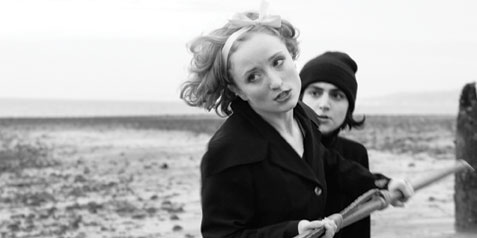
The silent film continues as a valid art form, particularly in the hands of the Canadian Guy Maddin, who has made silent film his natural mode of expression. His latest film is Brand upon the Brain, which is playing (with live music ensemble) at the San Francisco International Film Festival on May 7. The festival site describes it:

The semiautobiographical Brand upon the Brain! mines the rich territories of director Guy Maddin’s youth and spins them into a delirious fantasy of familial discontent. At the edge of the sea stands a lighthouse, once the location of an orphanage. There, some years ago, lived Guy and Sis, a brother and sister under the constant observation of their mother yet entirely ignored by their father, an ingenious inventor. When Wendy Hale, amateur harpist and half of twin detective team the Lightbulb Kids, arrives to investigate a mysterious regenerative nectar harvested from the orphans, things grow ever more complicated. A love triangle becomes a quadrangle when Wendy masquerades as her brother Chance and goes in search of clues. A fever dream of Freudian impulses and horror show theatrics, Maddin devours 100 years of film history whole and, like the ersatz Guy’s painting of the lighthouse, covers the screen with a 12-chapter outpouring of his various obsessions.

There’s a trailer for the film on the festival site which gives a good flavour of Maddin’s distinctive style and take on cinema history.

Silent podcasts

The Bioscope is as dedicated to new technology as it is to old, and is always interested to see what is being done with the silent film form today. So, having brought you information on the Rudolph Valentino podcast site a while back, how about the truly silent podcast? 1st Silent Podcast is just that – a series of podcasts of silence. Visitors, or subscribers to the feed, can sample the sound of one hand clapping, silence recorded in Palau (Micronesia), Shanghai, Denmark, and Las Vegas, silence in a Tuscan vineyard, a memorial rendition of John Cage’s celebrated silent piece 4′ 33”, download silent ring tones, and, yes, of course, experience the world’s first silent video podcast. Presumably because this bills itself as 1st Silent Podcast, there are imitators out there, but I’ll trust to the original.

Passio

On 23 February the Adelaide Film Festival hosted the world premiere of Paolo Cherchi Usai’s film Passio. The film is a compilation of silent found footage from a century of visual culture, taken from archives around the world, put to a score by Arvo Pärt. Cherchi Usai, director of the Australian National Film and Sound Archive, says that the film must only be seen as a live experience in a theatre. To this end he has apparently destroyed all the masters and vowed never to release the film on video. According to the festival blurb, it is “a masterwork of the first order, a stunning and revelatory film of surprising emotional and narrative power, that explores the impending crisis of visual culture and its reflection in politics and society. Its unsettling images, drawn from a century of filmmaking, are woven into a tapestry of mysterious beauty and violence.”

Bird’s Eye View

The Bird’s Eye View film festival “showcases the very best work from women filmmakers” and takes place at London’s NFT, Barbican and ICA from 8th -14th March. Below is the programme description from the festival web site:

SOUND AND SILENTS – LIVE MUSIC AND SILENT FILM

Two programmes of short silent films made by women directors from early pioneers to contemporary artists taking place at the Barbican on Sunday 11th March and NFT as part of the Optronica Festival on Sunday 18th March with specially composed & original soundtracks performed live by cutting-edge women musicians including ERROLLYN WALLEN, SEAMING TO, JOANNA MCGREGOR and RITA RAY. Expect a variety of styles and genres for both ears and eyes: innovative and inspirational.

SOUNDS AND SILENTS 1 Sunday 11th March, 3PM, Barbican 1.

THE SMILING MADAME BEUDET

Made by one of the first female directors, Germaine Dulac, in the 1920’s, The Smiling Madame Beudet is lauded as the first feminist film ever made. It is the story of an intelligent woman trapped in a loveless marriage. Her husband is used to playing a stupid practical joke in which he puts an empty revolver to his head and threatens to shoot himself. One day, while the husband is away, she puts bullets in the revolver. However, she is stricken with remorse and tries to retrieve the bullets the next morning. Her husband gets to the revolver first only this time he points the revolver at her.

Specially commissioned soundtracks performed live by Errolyn Wallen.

MESHES OF THE AFTERNOON

One of the most influential works in American experimental cinema. A non-narrative work, it has been identified as a key example of the “trance film,” in which a protagonist appears in a dreamlike state, and where the camera conveys his or her subjective focus. The central figure in Meshes of the Afternoon, played by Deren, is attuned to her unconscious mind and caught in a web of dream events that spill over into reality. Symbolic objects recur throughout the film; events are open-ended and interrupted. Deren explained that she wanted “to put on film the feeling which a human being experiences about an incident, rather than to record the incident accurately.”

Specially commissioned soundtracks performed live by Seaming To.

SOUND AND SILENTS 2 Sunday 18th March, 5:30PM, NFT OPTRONICA Festival.

Daisy Doodad’s Dial (UK 1914, 6’) – Florence Turner
Brilliantly entertaining British comedy, featuring Turner herself as rubber-faced Daisy.

Jetsam (UK 2002, 2’ 30”) – Sonia Bridge
A fascinating high-speed experimental short celebrating the everyday.

Sap (UK 2002, 8’) – Hyun-Joo Kim
Animation in the style of a Korean folk tale that makes use of delicate oil-on-glass animation techniques.

Suspense (USA 1913, 8’) – Lois Weber and Philip Smalley
Innovative early thriller using groundbreaking split-screen techniques.

Missing People (UK 2003, 6’ 30”) – Kathy Hinde
A hypnotic film from one of Joanna Macgregor’s most frequent collaborators.

The Grasshopper and the Ant (UK 1954, 11’) – Lotte Reiniger
Remarkable shadow-puppet animation from the first filmmaker, male or female, to direct a full-length animated feature film.