Lost and found no. 3 – or is it?

The Four Devils

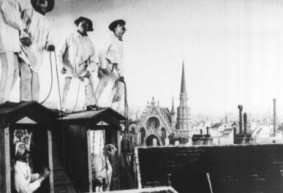
The 4 Devils (1928), from http://www.silentera.com

The web has been buzzling with rumours of two long-lost silent film classics having reportedly been discovered. No physical evidence has been offered for either title.

The first is F.W. Murnau’s circus drama The 4 Devils (1928), starring Janet Gaynor and Charles Morton. It was reported last month, on the Criterion Forum, that a collection of nitrate film has been uncovered in Tacoma, Washington. Its discoverer (apparently based in the UK) was coy at first about revealing the title, then confessed that it was The 4 Devils, the long-lost presumed masterpiece by Murnau, director of Nosferatu, The Last Laugh, Sunrise and all. supposedly the films belong to an engineer in his seventies, who acquired them from the estate of someone who died in the 1960s. The discoverer sounds like he knows what he’s talking about (but then the best scams come from the most knowledgeable), and certainly those on the Criterion Forum are excited by the apparent discovery. But no frame stills have been offered as evidence, no photographs, no proof at all, and now all has gone silent indeed…

Bardelys the Magnificent

Poster for Bardelys the Magnificent, from blog.france3.fr

And then there’s Bardelys the Magnificent (1926), starring John Gilbert and directed by King Vidor. This time the alleged print is said to be in France. A sequence from the film is thought to survive in a private collection, but not the complete film. Again, precise information has not been forthcoming, but here the discoverer claims that the film will be shown on French television next year. The original report in French is available here, and there’s a translation with ensuing discussion on alt.movies.silent. Once again, following the original news alert, all is silent.

In the virtual reality that is the web, anything can be alleged and nothing proven. So the Bioscope remains sceptical, though high-profile lost prints do still turn up, as demonstrated by a discovery a couple of years ago in the Netherlands of Beyond the Rocks (1922), with the piquant teaming of Rudolph Valentino and Gloria Swanson, now available on DVD. It isn’t very good, and for some lost films their very preciousness may even depend on their remaining lost. But the 4 Devils would be a joy to see again…

Lost films

The Deutsche Kinematek has initiated a ‘Lost Films’ project, the main expression of which so far is a Lost Films Wiki. As the site puts it:

We have set it up to bring together titles of films that are presumed to be lost. Furthermore we hope that archivists and film historians will add information about fragments and related documents. The idea is not to build up a comprehensive database but rather to focus on important movies, current restoration work etc. Besides the project we would like to work with this Wiki on a regular basis parallel to it and in the long run.

They invite researchers to look for films on the wiki, to add information if they have any, or to create a new record if the film is not recorded there. The emphasis is on German films, and many titles by Lubitsch, Murnau et al are listed. The site names participating archives in their project to “reconstruct and render visible the invisible legacy of German film”. All of which begs the question how people are supposed to know that is a film is lost for certain, and how many films might be added to the wiki in the belief that they are lost when they are not. Doubtless, in the way of wikis, all will sort itself out in the long run. At the moment there is little beyond a list of titles on the site. A Lost Films project web page is promised for summer 2008.

How curious is the cult of the lost film. Few other media can elicit the same amount of interest, nostalgia and speculation for those creations that are no more. Of course, one is always delighted when a ‘lost’ film re-emerges, even if the actuality frequently fails to match the anticipation, but some films actually seem better lost. Greed and The Magnificent Ambersons always have that extra allure through our sense of the footage that is no longer there. There is some other reality that lost films possess, a history that might have been, a virtual archive. Indeed, the Lost Films Wiki revealingly talks about creating “a collection of lost films”.

So, there are whole books about lost films out there: Harry Waldman’s Missing Reels: Lost Films of American and European Cinema; David Meeker and Allen Eyles’ Missing believed Lost: The Great British Film Search; Frank T. Thompson’s Lost Films: Important Movies that Disappeared (which is rather good on the background history to some elusive silents, liked Saved from the Titanic and A Daughter of the Gods).

And there are other websites dedicated to the theme – Moving Image Collections’ Lost Films list, which gives you updates on films that have been rediscovered, wholly or partially; and Silent Era’s Presumed Lost section, which naturally enough concentrates on silents, and likewise tries to keep things up-to-date by reporting on rediscoveries. Its long, long list of films previously noted as being missing and now locatd in archives across the world shows just how much good work is being done. Indeed, archivists have rather used the label of ‘lost’ to arouse interest in their work, and to encourage interest in key titles with the hope of footage turning up somewhere. Sometimes, in fact, they have been well aware that the so-called lost films are out there, and have used lost film ‘searches’ to tease them out of collectors’ hands. How hard it is too say with any finality that a film is truly lost.

Nevertheless, I’ve created a new category for Lost Films, and will regale you in due course with stories of some of the more fascinating examples, whose legend endures by simple virtue of their unavailability.

Lost and Found no. 2 – Dawson City

Number two in our occasional series of heartening tales about early film collections that have been found against the odds. Lost films have been uncovered in many peculiar places, but none so odd as in a Canadian swimming pool, close to the Arctic Circle.

The now famous Dawson City collection was uncovered in 1978 when a new recreation centre was being built. A bulldozer was working its way through a parking lot when a horde of film cans was dug up. The films had been stored in a disused swimming pool, which had been paved over. The films dated largely from before the First World War, when Dawson City was still a gold rush town, and the final distribution centre for films sent out to the cinemas attended by the ten of thousands of prospectors in the area. Film historian Sam Kula tells us that touring showmen first brought film to Dawson in 1898, while the former Orpheum Theatre re-opeened as the town’s first cinema in 1910, while films could also be seen at the Arctic Brotherhood Hall. Films took a long time to get to Dawson (the newsreels were always hopelessly out of date), but got there they did – but, it seems, they tended not to make the journey back.

Films therefore built up in Dawson, and were eventually stored in the basement of the local library. In 1929, the decision was made dispose of the inflammable nitrate films, which no one wanted to see any longer. It is easier said than done to get rid of nitrate film, and eventually it was decided to place them safely underground. Hence the burial in the swimming pool, where the permafrost ensured their survival in what were, in principal, ideal archival conditions (basically the thing to do with nitrate films is to keep them very cold) until their rediscovery fifty years later.

There were over 500 films in the collection. While none was a most masterpiece as such, they formed a marvellous selection of common cinema fare of the period – titles from studios such as Essanay, Rex, Thanhouser and Selig; obscure titles starring Harold Lloyd, Douglas Fairbanks and Lon Chaney; and many newsreels (including rare Canadian examples). The collection is particularly storng on serials with women heroines: Pearl White in Pearl of the Army (1916-17), Helen Holmes in Hazards of Helen (1915), Marie Walcamp in The Red Ace (1917-18), and Grace Cunard in Lucille Love (1914), The Girl of Mystery (1914) and The Purple Mask (1917), which she also directed.

The Dawson City films have been preserved by Library and Archives Canada and the Library of Congress.

There’s an entertaining essay on their discovery and preservation by Sam Kula, ‘Up from the Permafrost: The Dawson City Collection’, in the excellent book This Film is Dangerous: A Celebration of Nitrate Film (2002), edited by Roger Smither.

Lost and Found no. 1 – Joseph Joye

I wrote a couple of days ago on the Michell and Kenyon film collection of Edwardian actualities, and asked whether such an extraordinary film collection would ever turn up again. Well, not yet, but despite time marching on and nitrate film inevitably decaying, remarkable early film collections do still turn up. While we’re waiting, I’m going to start up a mini-series on previous amazing collections, which should make us hopeful of future such discoveries. To start with, the heartening story of the Abbé Joye…

Joseph Joye

Joseph Joye (1852-1919) was a Swiss Jesuit priest who decided, around 1902-03, to start educating the children in his charge with motion pictures. Like quite a number of clerics around the world, he made the leap from showing scenes on the magic lantern to capturing his young audience’s attention with films. What made Joye different was the scale of his endeavour. He built up a collection of many hundreds of films over the period 1905-1914, purchasing prints on the second-hand market in the German-speaking quarter of Switzerland. It is said that in some cases he smuggled prints across the German-Swiss border by hiding the cans under the folds of his cassock. All were shown to his child and adult audiences, and then retained at his Basle school.

Joye was omnivorous in his tastes, collecting comedies, melodramas, classical adaptations, travelogues, actualities, trick films, histories, science films, fairy tales, industrials, coloured films: the whole rich panoply of early cinema production. His collection remained at the school, until it was discovered by a British filmmaker, David Mingay, in 1975. It was taken in by the National Film Archive in London, which had the best facilities for tackling such a huge collection of nitrate film, in 1976. The collection of 1,200 prints (all with German titles) was eventually restored and extensively catalogued in its entirety, a task completed in the mid-1990s. It was also lovingly researched by Swiss academic Roland Cosandey, who published the book Welcome Home, Joye! Film un 1910 in 1993 (if you find a copy, I took all the frame stills).

Ah! Da fleigt ein Aeroplan

(Ah!… Da fleight ein Aeroplan, a 1910 Gaumont comedy about people’s amazement at seeing aeroplanes, from the Joye collection)

It is one of the richest collections of early films in the world, renowned among the early film studies community but little known outside it. The collection is full of unique gems. Among the star titles are Victor Sjöström’s Havsgamar (Sea Vultures) (1915) and Ranch Life in the Great South-West (1910), which features the first screen appearance of Tom Mix. There is the awe-inspiring S.S. Olympic (1910), a Kineto film about the making of the sister ship to the Titanic (much used in TV documentaries) and L’Inquisition, a surprisingly graphic Pathé film on the Spanish Inquisition, which makes you wonder what was going on in Joye’s mind when he purchased it. There are ravishingly beautiful stencil colour films, and many travel films from around the world providing rare glimpses of peoples probably never filmed before. It is thematically rich in so many ways. And no DVD has ever been published, no catalogue (all of the shotlists can be found on the BFI’s database, though no search will find you all of the Joye titles in one go), no BBC4 television series…

If the BFI is looking for another ‘lost’ film collection to promote to the world, it has one sitting on its shelves.