Drakula halála

Bioscope Festival of Lost Films

Hungary 1921

Director: Lajthay Károly
Production company: Corvin Filmgyár
Cinematographer: Eduard Hoesch
Scenario: Lajthay Károly, Mihály Kertész (Michael Curtiz)
Based on the character created by Bram Stoker

Cast: Paul Askonas (Drakula), Margit Lux (Mary Land), Elemér Thury (Doctor), Lajos Réthey (Fake doctor), Aladár Ihász (Assistant), Karl Götz (Funny man), Dezsö Kertész (George), Lajos Szalkay, Zoltán Dezső, Hatvani Károly, Oszkár Perczel, Károly Hatvani, Anna Marie Hegener, Paula Kende, Lene Myl, Magda Sonja, Béla Tímár

Five reels
Distributor: Jenö Tuchten
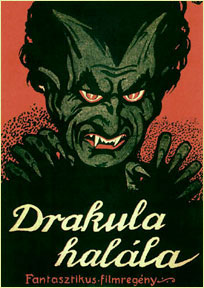
Drakula halála poster

Poster for Drakula halála

Welcome all to the final screening in the inaugural Bioscope Festival of Lost Films. This evening we find ourselves in Leicester Square, in the cinema that has the honour of being the first such venue to have opened in London’s motion picture heartland. It was the 5th June 1909 when it first opened its doors, as the select Bioscopic Team Rooms. Soon it changed its name to the Circle in the Square, which name we rather prefer to its later name of the Palm Court Cinema, still more to its eventual fate – conversion into an Angus Steak House. There is room for 250 of you (if some stand), and the music is provided by the indefatigable and certainly inimitable Ena Baga.

And what a chilling offering we have for you tonight. It is with some pride (and not a little trepidation for fear of the effect it might have on some of the more nervous among you) that we present Drakula halála, a Hungarian tale of horror and fantasy as mysterious in its history as it is in its subject matter. Mystery, for example, surrounds the date of its production, but we are assured that – despite the several claims for it to have been made two years later – Drakula halála was produced in 1921 and was reportedly first shown in Vienna that year, though it was re-exhibited in Budapest in 1923. So the estimable F.W. Murnau in Germany who we hear is planning a film based on the legend of Dracula may have more resources at his disposal, yet he will be second with his subject matter. But finding any certain facts about our film’s production has been difficult (having no one on the Festival staff with a working knowledge of Hungarian has been a handicap).
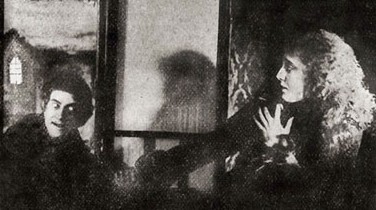
Paul Askonas (Drakula) and Margit Lux (Mary)

Paul Askonas (Drakula) and Margit Lux (Mary)

The title of the film translates as The Death of Dracula, but the story is not that of the novel by Bram Stoker. Instead it tells of the orphaned Mary who is sent against her will to a psychiatric hospital. There one of the inmates claims to be the undead Dracula, and he begins to haunt her dreams. Although she escapes from the hospital and eventually marries a noble forester, visions of Dracula still fill her mind, and she remains unsure whether all that happened to her was some awful dream or horrid reality.

The Hungarian film industry is a modest one, and one that has suffered greatly under the political turmoil in that country. In 1919, the revolutionary Béla Kun established a Communist government, which collapsed after just a few months, to be replaced by the brutal military regime of Miklós Horthy. Kun had nationalised the film industry and an ambitious plan of production was drawn up. But the anti-Semitic Horthy despised the film industry, and persecuted many filmmakers (the unfortunate director Sándor Pallós was tortured to death for having made a film based on a novel by Gorky). Many in the industry fled, such as Sándor László Kellner (Alexander Korda) and Mihály Kertész (Michael Curtiz), who is believed to have contributed to the script of Drakula halála. The industry continues, but in a greatly reduced state, close to the point of bankruptcy.

Paul Askonas as Drakula

Paul Askonas as Drakula

Thus Drakula halála is one of just a handful of films being made in Hungary at this time. Most are based on light popular novels, but this film is very different. Its star, Paul Askonas, has appeared in both Hungarian and Austrian films, usually of a fantastical or horrific nature, such as Labyrinth des Grauens (1921, Labyrinth of Horror). It is tempting to see this vision of dark threats, uncertainty and nightmares as somehow reflecting its troubled land and film industry, a place where reality may be a still greater nightmare than those encountered in one’s dreams. Director Lajthay Károly, a specialist in thrillers and someone praised for his uniquely atmospheric style, never directed another film – why, and whatever happened to him? (There are rumours of a drink problem) So many mysteries, so many more fantasies than certain facts…

Hungary is the land of lost silent films. 600 films made between 1912 and 1930, and just forty-five complete films survive. Drakula halála is not among them – or is it? Are we to believe the claims of a dubious Italian site dealing mostly in adult films, which claims to know of a 16mm print with a thirteen-minute fragment of the film? We choose not to believe it. The internet is awash with such fantasies. Here at the Bioscope Festival of Lost Films we deal only with true loss. Only when a film can no longer be seen does it, for us, become strangely, truly alive. Undead, even.

Life Without Soul

Publicity sheet for Life Without Soul, from http://frankensteinia.blogspot.com

To accompany this film we have broken our rules somewhat and gone for another five-reel feature rather than a short. But what a double-bill, to be able to offer you: Drakula halála and Life Without Soul. This 1915 film, made by the Ocean Film Corporation of New York, is similar to our main feature in that it presents the story of Frankenstein as a dream that explores the borderland between life and death. Frankenstein’s name has become William Frawley, a doctor living in modern times who dreams that he creates a humanoid monster (played by Percy Darrell). Despite acclaim for Mr Darrell’s chilling portrayal of a man without a soul that yet catches the audience’s sympathy, the film has not been a success. We hear that its 1916 re-edited re-issue included extra scenes taken from scientific films about the reproductive habits of fish. It is unclear why.

Do not believe the fantasist who on that modern innovation the Internet Movie Database, writes about this film as though he has seen it. He has not. It is lost, as have been all the films in this Bioscope Festival of Lost Films. We hope that you have enjoyed our selections. Please leave the cinema quietly, and a safe journey home to you all.

Pleasant dreams.

The Mountain Eagle

Bioscope Festival of Lost Films

UK/Germany 1926

Director: Alfred Hitchcock
Production company: Gainsborough Pictures/Münchner Lichtspielkunst AG (Emelka)
Producer: Michael Balcon
Assistant director: Alma Reville
Scenario: Eliot Stannard, Max Ferner
Story: Charles Lapworth
Art direction: Ludwig Reiber, Willy Reiber
Cinematography: Baron Ventimiglia

Cast: Bernard Goetzke (Pettigrew), Nita Naldi (Beatrice Brent), Malcolm Keen (John Fulton, known as Fearogod), John Hamilton (Edward Pettigrew), Ferdinand Martini

7,503 feet
Distributor: W & F

The Mountain Eagle

Bernard Goetzke (Pettigrew), in The Mountain Eagle

Good evening once again, and welcome to the latest screening at the Bioscope Festival of Lost Films. Today we find ourselves in London’s Tottenham Court Road at the Cambridge Circus Cinematograph Theatre (recently renamed the Super, but we prefer the old name), a marvellous venue which seats 1,000 of you, and has room for full orchestra and a pipe organ, which will be played for us by that nonpareil of silent film accompanists, Florence de Jong. Prepared to be stirred!

Our film this evening is the second feature film to be directed by a most promising talent for our British film industry, Mr Alfred Hitchcock. The film is The Mountain Eagle, which follows his The Pleasure Garden of the previous year. Mr Hitchcock has been a little dismissive of his latest work, something that we prefer to ascribe to a commendable modesty.

The film is excitingly set in the Kentucky hills, though you may be surprised to learn that the production was in fact filmed in the Austrian Tyrol, with studio scenes taken in Munich (we understand that some interiors were also filmed in Paris). The film’s producer Mr Michael Balcon has been keen to encourage co-productions with Germany, and many of you will remember that excellent film The Blackguard, made in 1925.

But what story does it tell? We can do no better than to provide you with the synopsis given in The Bioscope (a journal naturally close to our hearts):

Beatrice Brent, school teacher in a small mountain village, incurs the enmity of Pettigrew, the local Justice of the Peace and owner of the village stores, because he believes that she encourages the attentions of his son Edward, a cripple, who takes evening lessons. Pettigrew, while questioning Beatrice, is himself influenced by her charm and attempts liberties which she strongly resents. He is so furious at the rebuff that he proclaims her as a wanton and she is driven from the village by the inhabitants. Beatrice is saved from their fury by a mysterious strange known as Fearogod, who lives a solitary life in a cabin to which he takes her for shelter. To stop all scandal, Fearogod takes Beatrice down to the village and compels Pettigrew to marry them, explaining to her that he will help her to get a divorce. Beatrice, however, is content to leave the situation as it is, but Pettigrew, furious with rage, takes advantage of the fact that his son has left the village and arrests Fearogod for his murder.

In spite of the fact that there is no vestige of evidence that young Pettigrew has been murdered, Fearogod is kept in prison for over a year, whe he decides to escape. He finds that his wife has a baby and he goes off with them to the mountains. When they find that the baby is taken ill, Fearogod goes back to the village for a doctor, where he sees old Pettigrew. Some doubts as to which of them men is going to attack the other first is settled by an onlooker firing off a gun which wounds Pettigrew in the shoulder. The sudden return of his son Edward convinces the old man of the futility of proceeding with his accusation of murder, so he makes the best of matters by shaking hands with the man he has persecuted and all is supposed to end happily.

The Mountain Eagle

Production crew for The Mountain Eagle on location in the Austrian Tyrol

This is a remarkably intense, elemental drama of family passion. Mr Hitchcock has produced a powerful melodrama clearly inspired by its rugged mountain surroundings. Some critics have complained that the direction is a little too slow, and that Mr Hitchcock has perhaps not quite grasped the German style he has aimed for, while others complain that the supposed setting in Kentucky seems more than a little implausible. But if British films are to succeed in America they must tempt that huge potential audience with American subjects. This also explains the presence of that up and coming star Nita Naldi (you will remember her from Blood and Sand), even if she does appear less than comfortable with her role. Praise is due to that talented yet strangely underrated Italian cinematographer, Baron Ventimiglia, who has contributed so much to the film’s brooding expressionism. That thoughtful and sophisticated scenarist Eliot Stannard has a way of binding character and narrative that helps bring out the nascent genius that we suspect lies in Mr Hitchcock – even if some feel that the number of intertitles are excessive. This is the work of a strong team, even if the subject matter has not perhaps quite brought out the best in each of them.

In America, the film is to be known as Fearogod, while in Germany it is Der Bergadler. Here it has become The Mountain Eagle, though we must confess we are unsure who or what the mountain eagle is supposed to be. In truth, this has been a somewhat troubled production, but undoubtedly an essential part of the learning process for the promising Alfred Hitchcock, who now tells us he is working on an adaptation of Mrs Belloc Lowndes’ thrilling novel, The Lodger, which sounds to be a property ideally suited to this young man’s talents. We shall follow his progress with interest.

Number 13

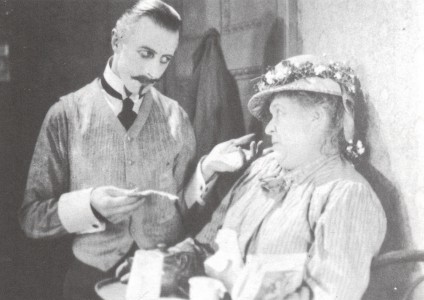
Ernest Thesiger and Clare Greet in Number 13

The lost short that accompanies our main feature is something of a coup. Gainsborough Studios has made available to us the rushes from Alfred Hitchcock’s uncompleted Number 13, which was to have been his first solo film as a director (he had taken over the direction of the two-reel Always Tell You Wife, one reel of which survives). Filmed at Islington Studios in 1922, this drama (also given the name Mrs Peabody), was to have starred Ernest Thesiger and Clare Greet. The shoot was a troubled one, and production on the two-reeler was halted after only a few scenes were shot.

Do join us tomorrow for the final screening of the Bioscope Festival of Lost Films, when we shall be at the Circle in the Square, in Leicester Square. We can promise you something truly sensational with which to round off the festival…

Human Wreckage

Bioscope Festival of Lost Films

USA 1923

Director: John Griffith Wray
Production company: Thomas H. Ince Corporation
Director of photography: Henry Sharp
Script: C. Gardner Sullivan

Cast: Mrs Wallace Reid (Ethel MacFarland), James Kirkwood (Alan MacFarland), Bessie Love (Mary Finnegan), George Hackathorne (Jimmy Brown), Claire McDowell (Mrs Brown), Robert McKim (Dr Hillman), Harry Northrup (Steve Stone), Victory Bateman (Mrs Finnegan), Eric Mayne (Dr Blake), Otto Hoffman (Harris), Philip Sleeman (Dunn), George Clark (The Baby), Lucille Ricksen (Ginger Smith), George E. Cryer (A city official), Dr R.B. von Kleinsmid (An educator), Benjamin Bledsoe (A jurist), Louis D. Oaks (A police official), Martha Nelson McCan (A civic leader), Mrs Chester Ashley (A civic leader), John P. Carter (A civic leader), Mrs Charles F. Gray (A civic leader), Dr L. M. Powers (A health authority), Brig. C. R. Boyd (Salvation Army worker)

7,215 feet
Distributed by Film Booking Offices of America

Human Wreckage

Mrs Wallace Reid and Bessie Love (right), in Human Wreckage

Ladies and gentlemen, good evening, and welcome to the third screening of the Bioscope Festival of Lost Films. Today we find ourselves at the Casino de Paris in London’s Oxford Street. This small but fine building, which first opened its doors on 18 September 1909, seats just 175 of you. The venue has been chosen for its select nature, as only an invited and carefully vetted audience could be allowed in to see this evening’s sensational production which – as you will know – has been banned by the British Board of Film Censors. It is only under special licence from the London County Council that we are able to show it to you at all. The music comes from that legend among silent film pianists, Mr Arthur Dulay (round of applause).

What is also special about this evening’s main film is that it is to be shown in the presence of its principal performer, Dorothy Davenport, previously a popular film actress but now perhaps best known to you all as Mrs Wallace Reid (murmurs of sympathy). For it was the unfortunate death of her husband, the much-loved Wallace Reid, as the result of a wretched morphine addiction, that led her to produce Human Wreckage, and she has been tireless in presenting the film herself at its screenings across America. She is in this country to promote the film’s serious message, and we welcome her (warm and prolonged applause).

The history of Wallace Reid you will know well. The highly popular American star of such popular films as The Affairs of Anatol and Forever, became addicted to morphine, it is said after he suffered injuries in a railroad crash in 1919, while making The Valley of the Giants. What was at first medical expediency became an increasing habit, to the extent that it is believed that Wallace had morphine administered to him by a doctor at Famous Players-Lasky studios, to ensure that he could complete the many motion pictures that were demanded of such a popular star (expressions of shock and dismay). Many among you will recall the apathetic look that Wallace bore in his later pictures – only now do we know why! His death came on 18 January 1923, aged just thirty-one (deathly silence).

Human Wreckage is not the story of Wallace Reid. Instead it is a product of Mrs Wallace Reid’s determination, following her husband’s death, to campaign against the evils of drug pedling and addiction. Of course, its theme of drug addiction runs against the normal American censorship codes, but the picture’s serious intent has seen it gain a special dispensation from Mr Will Hays, and it was made under the guidance of the Los Angeles Anti-Narcotic League. You will have noted the various civic and health figures included in the cast (murmurs of approval).

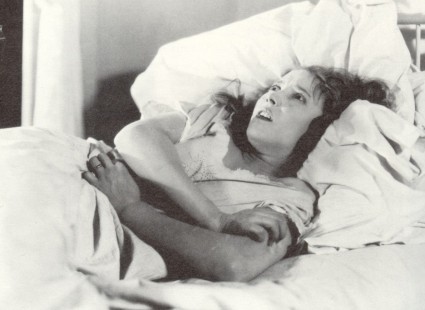
Bessie Love in Human Wreckage

Bessie Love as Mary Finnegan in Human Wreckage

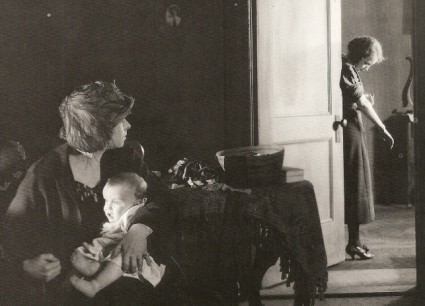
The film tells of the evils of drug addiction as they affect several people. Jimmy Brown, a heroin addict, is arrested by the police but successfully defended in court by attorney Alan MacFarland. Jimmy is sent to hospital (where he endures the pains of withdrawal symptoms), while MacFarland, exhausted by pressure of work, is offered morphine by a friend. He gradually becomes addicted. Meanwhile his wife, Ethel, notices that a young girl, Mary Finnegan, living in the same tenement as Jimmy’s mother, is injecting herself with morphine. She is also putting morphine onto her breast to quieten the baby she is nursing. Mary tries to kill herself, but ends up in hospital and separated from her baby. Alan MacFarland is hired by Steve Stone, who is his own dealer, and manages to keep him out of jail. Ethel is unable to save her husband from his addiction, but then he discovers that despair has apparently led her to her own drug addiction, and this brings him to a shocked realisation of what he has put her through. Her ruse works, and he gives up morphine. Jimmy Brown takes Steve Stone on a mad taxi drive through the city, and both are killed in a crash. The film concludes with a plea from the MacFarlands for stronger laws to confront the evil of drugs.

The film has caused a sensation in the United States. Those uncertain about the film’s motives have been shaken by its sincerity and the power of its telling. Mrs Reid herself has been tireless in promoting the film, often introducing it herself, and using her profits to support the Wallace Reid Foundation Sanatorium, as well as establishing her own film production company (warm applause). It is no cheaply-made exposé; instead it has been handsomely produced by the Thomas Ince Corporation, and boasts some remarkable sets inspired by The Cabinet of Dr Caligari for one fantastical sequence. The producers’ confidence has been rewarded by the film’s noted financial success in America.

Here in Britain, where the American context of the story means less, the censors have been less accommodating. Our BBFC rejected the film in January 1924. Mrs Reid has organised some screenings for private individuals – our screening this evening is one of these – but this seems to have shocked the BBFC still further. The chief censor, Mr J. Brooke Wilkinson, has gone on to say:

There have been few, if any, films submitted to the Board since its inception which the examiners look upon as more dangerous than this film ‘human wreckage,’ and we see no possibility of altering it so as to make it suitable for public exhibition in this country.

And so it remains banned, and unseen (cries of ‘shame’).

The lost short accompanying our main feature is Dorian Gray (1913), also known as The Picture of Dorian Gray. How bitterly ironic it is that the young Wallace Reid should have starred in this film, playing Oscar Wilde’s seemingly unblemished young man, whose true, corrupted nature is revealed through a deteriorating portrait of him. The film was directed by Phillips Smalley and written by his talented wife Lois Weber, both of whom also appear in the film. It was made by the New York Motion Picture Corporation.

This has been a harrowing evening. We thank you all for you attention, and particularly to Mrs Reid for having graced us with her presence (loud applause). Tomorrow we will move around the corner to the Cambridge Circus Cinematograph Theatre, for a compelling Anglo-German production. Do join us.

Ein Sommernachtstraum

Bioscope Festival of Lost Films

Germany 1925

Director: Hans Neumann
Production Company: Neumann-Film-Produktion GmbH (Berlin)
Producer: Hans Neumann
Screenplay: Hand Behrendt, Hans Neumann
Titles: Alfred Henschke
Cinematographer: Guido Seeber
Camera assistant: Reimar Kuntze
Costumes and sets: Ernö Metzner
Original music: Hans May

Cast: Theodor Becker (Theseus), Paul Günther (Egeus), Charlotte Ander (Hermia), André Mattoni (Lysander), Barbara von Annenkoff (Helena), Hans Albers (Demetrius), Bruno Ziener (Milon), Ernst Gronau (Squenz), Werner Krass (Zettel), Wilhelm Bendow (Flaut), Fritz Rasp (Schnauz), Walter Brandt (Schnock), Armand Guerra (Wenzel), Martin Jacob (Schlucker), Tamara (Oberon), Lori Leux (Titania), Valeska Gert (Puck), Alexander Granach (Waldschraff), Rose Veldtkirch, Adolf Klein, Hans Behrendt, Paul Biensfeldt

2,529 metres

Ein Sommernachtstraum

The tragedy of Pyramus and Thisbe, from Ein Sommernachtstraum

Welcome to day two of the Bioscope Festival of Lost Films, and to our special venue this evening, the Court Electric Theatre in London’s Tottenham Court Road. Opened in 1911, this select venue seats 420, and normally its patrons are entertained by an Italian orchestra. For this evening, however, to play the special music composed by Hans May for our lost film, we have Eric Borchard’s American jazz band, brought over at great expense following their acclaimed performances accompanying the film in Berlin.

And what a treat we have for you. Ein Sommernachstraum is a fascinating film, strangely and undeservedly forgotten by the posterity that is to come. It is, of course, based on William Shakespeare’s comedy, A Midsummer Night’s Dream, which is the title it has been given in America, though in Britain it has been rather curiously renamed Wood Love. It is the last silent film to be made of a Shakespeare play, and one of the oddest of that distinctly odd genre.

The plot, as you will know, revolves around two pairs of Athenian lovers, whose fortunes are mixed up with the fairy band of the forest and a group of comic workmen rehearsing a play, whose performance forms the uproarious conclusion to both film and play. However, the film takes numerous liberties with Shakespeare, as you will see. The character Shakespeare calls Bottom is here called Zettel, and is played by the great Werner Krauss (who you will recall played Iago in the 1922 German version of Othello and Shylock in the 1926 Der Kaufmann von Venedig). Oberon is played by a woman, the Russian ballet dancer Tamara. A battle between Greek warriors and the female Amazon army is shown, such as Shakespeare never thought to stage. Theseus is seen using a telephone.

Indeed this is not a conventional, nor respectful interpretation. It satirises the performance of Shakespeare, and the rather confused critics have variously described it as being ribald, charming, stagey, sincere, magical, dull, and grotesque. The Berlin censors pronounced it as being forbidden to juveniles. That this is intentionally a radical production can be seen from the presence of contributors such as the well-known poet and critic Alfred Henschke, writing the titles which slyly parody Shakespeare, while director Hans Neumann has been previously distinguished as a producer of titles such as Robert ‘Caligari’ Weine’s strikingly expressionist Raskolnikov. Yet some critics see it only as being conventionally charming, with such magical features as double exposures for appearing and disappearing fairy folk.

The British critic Oswald Blakeston has had some curious things to say about the film in the journal Close-up:

We all know the respectable whose lives are led in a patch of arid ground shut in by a complicated geometrical pattern of lines. Valeska Gert [playing Puck] steps beyond the lines as a hierophant to show what fun one can get from being released; Krauss steps beyond the lines to show what a great actor he is. The Gert puts out her tongue at the audience in devilment; the Krauss puts out his tongue for the audience to see how well he can act the part of a devil … There are more things in this picture more ineluctably Rabelasian that I have ever discovered in the most boisterous Rabelasian comedy … The heartiness in this picture is not biased, it spreads to the simple pleasure of hacking a man in two with a battle-axe.

We are not entirely sure what Mr Blakeston is on about (and we will leave you the pleasure of seeking out a dictionary to find out what ‘hierophant’ means), but clearly the film is a challenge to the senses.

And let us not forget the music. Hans May’s music, performed by jazz band with strings, has divided opinion, but Variety calls it “a real advance in scores for accompanying comedy pictures”. May playfully combines Wagner with Tin Pan Alley, closely scoring for such comic scenes as the battle with the Amazons, and frequently in performance the audience has burst into applause at the musical flourishes alone. As with the intertitles, the music forms an ironic commentary on Shakespeare’s play.

The film has enjoyed a long run at Berlin’s Nollendorf Platz theatre, where it has appeal for a discerning audience, but doubts must be expressed whether it can enjoy a similar kind of success in America or Britain. We are very pleased to be screening it here this evening, but feel that no film burdened with the title Wood Love will last long in the British cinemas.

Hamlet (1907)

Georges Méliès contemplates Yorick’s skull

The lost short that accompanies Ein Sommernachtstraum is an appropriate one: Hamlet (France 1907). How wonderful to see the great Georges Méliès play the Dane! How wonderful too to have Shakespeare’s greatest, but undoubtedly lengthy play, brought to a far more manageable and agreeable length of ten minutes. All the essential details are there: Hamlet at the graveside, his madness aggravated by the sight of visions, Hamlet meeting his father’s ghost, Hamlet meeting the ghost of his love Ophelia, the duel before King Claudius, and the death of Hamlet. Clearly the film displays a bold use of flashbacks and much of M. Méliès’ favoured use of camera trickery. One great artist putting his distinctive stamp upon the work of another.

So ends our screening for this evening. Be sure to return tomorrow, when we shall be at the Casino de Paris to see a truly sensational American production.

A Study in Scarlet

Bioscope Festival of Lost Films

UK 1914

Director: George Pearson
Production Company: Samuelson Film Company
Producer: G.B. Samuelson
Cinematographer: Walter Buckstone
Assistant to the director: Jack Clair
Script: Harry Engholm
Based on the novel by Arthur Conan Doyle

Cast: James Braginton (Sherlock Holmes), Fred Paul (Jefferson Hope), Agnes Glynne (Lucy Ferrier), Harry Paulo (John Ferrier), James Le Fre (Father), Winifred Pearson (Lucy as a child)

Distributed by Moss
5,749 feet

A Study in Scarlet

James Braginton as Sherlock Holmes

Welcome to the opening screening of the inaugural Bioscope Festival of Lost Films! Over the next five days we will be bringing you five feature films (with accompanying shorts), each of them notable film productions, and each (so far as can be ascertained) a lost film, untraceable in any of the world’s film archives or private collections.

Today we are showing A Study in Scarlet, George Pearson’s lost classic from 1914. The screening is taking place at the magnificent West End Cinema Theatre in London’s Coventry Street, later known as the Rialto. This magnificent venue, built by Hippolyte Blanc at a cost of £31,00 with gorgeously ornamental interior design by Horace Gilbert, opened in March 1913. It seats nearly 700, and boasts the first use of a neon sign in central London. It has been long disused but is still open for dreams. Musical accompaniment comes from that incomparable organist and doyenne of the National Film Theatre, Florence de Jong. Please settle down now. Ask your children to behave, and if possible please avoid reading out the titles on the film to your neighbour. And please avoid throwing orange peel and nutshells at Miss De Jong. This is a high-class venue, and in any case she is only doing her best. So lights down, and we can begin…

A Study in Scarlet is the second feature-length film with the character of Sherlock Holmes. It is not the first film to have been made of Conan Doyle’s detective – that was the American Biograph film of 1903, Sherlock Holmes Baffled (a film which survives) – and it was preceded by several Holmesian films including earlier in 1914 the French four-reeler, Le Chien de Baskerville (also lost), which seems to have been the first Holmes feature film.

This six-reel British production is based on the first Sherlock Holmes story that Conan Doyle wrote, and it has been authorised by the author (unlike an American two-reeler based on the same book made later in the year). This exciting story of murder, love, revenge and detection takes place among the Mormon pioneers of Utah in 1850. Years later, in London, the great detective Sherlock Holmes is called upon to solve a murder, the roots of which lie in a man’s sworn revenge against the Mormons.

The Bioscope spoke to the director Geoge Pearson and asked him about the making of the film:

TB: Mr Pearson, can you tell us how you managed to recreate the Salt Lake plains and the Rockies in England?

GP: The film called for ambitious locations, but much can be suggested camera-angles to hide geographical inaccuracies. We discovered what we needed in the Cheddar Gorge and the Southport sands.

TB: How did you find your Sherlock Holmes, Mr James Braginton?

GP: Sherlock Holmes was a problem; much depended upon his physical appearance, build, height, and mannerisms had to be correct. By a remarkable stroke of fortune Samuelson had an employee in his Birmingham office who absolutely fitted these requirements.

TB: But surely he could not act?

GP: A tactful producer can control every action of an inexperienced actor. I decided to risk his engagement as the shrewd detective. With his long and lean figure, his deer-stalker hat, cape-coat and curved pipe, he looked the part, and played the part excellently.

TB: The scenes of the wagon train are very impressive. What planning was involved?

GP: As Buckstone and I were finishing our last scenes in the gorge on June 25th, we received an urgent message that all was ready at Southport; everything possible had been done to meet the problem of a suitable date for all concerned, and that date was Friday, June 26th, and furthermore, only the morning of the day! There was a little moonlight when we arrived, and since Buckstone and I had not yet seen the actual sport in the sands where it might be possible to stage that long procession of waggons, we spent the anxious hours before dawn in search of a suitably lengthy gully, and with a compass to guide us stuck sticks in the sand to mark the camera position and the line route for the waggons. The long snakelike winding caravan had to appear round a far distant bend in the sand-dunes, and move slowly towards the camera position. We had to get that important scene right first time, for a retake could only result in utter chaos. How we got that long line of wagons with their characteristic hoods, the cattle, the women, children and bearded drivers past the camera without mishap is beyond belief, but get it we did.

A Study in Scarlet

The Mormon trek, recreated on Southport sands

The producer of this great work is the ebullient G.B. ‘Bertie’ Samuelson, who created such a sensation in 1913 with his bold epic of the life of Queen Victoria, Sixty Years a Queen (of which just a one minute fragment survives). Bertie was born in Southport, Lancashire, so this is very much a personal film for him, with many local people turning out to play the Mormon pioneers. It is also the first film to be made at Mr Samuelson’s impressive new studios at Worton Hall, Isleworth, on the outskirts of London. The spectacular production has been acclaimed already by the critics, who have been impressed by its economy of style, its scenic settings, and the intense performance of Mr Fred Paul as the vengeful Jefferson Hope. Some have even gone so far to say that the work improves upon aspects of Conan Doyle’s original novel, by cutting out some of the more wearisome descriptive manner. Enthusiasts of the great Sherlock Holmes may feel that his appearance, only towards the end of the film, is a little too brief, but all are agreed that these scenes are undeniably dramatic.

Owing to the unfortunate outbreak of the Great War, the film’s release was delayed until December 1914, though we understand that Mr Samuelson managed to sell the film to the United States for a handsome four-figure sum. If anyone is going to put the British film on the map (at last!) it will be the indefatigable Samuelson.

The main feature will be preced by a short film, equally lost. The Great European War (UK 1914) is a Samuelson production which he has made in the period between the outbreak of the Great War and the release of A Study in Scarlet at the end of 1914. This startling compilation of actuality film and dramatic inserts is a typically bold, if hurried, flourish from Mr Samuelson. As George Pearson, the director, tell us, Mr Samuelson conceived of the idea of a film about the war on the evening of the day on which hostilities were announced, 4 August 1914. They wrote the script all night and began production on 7 August! Mr Pearson calls the film ‘a fictitious News-Reel brought bang up to date with material provided by the headlines of the daily Press’. Every out-of-work actor in town has been comandeered, along with every concievable kind of military costume. Filled with trenchant symbolism (‘a flag unfolding, a lion rampant, German hands tearing a parchment treaty to pieces…’) this is filmmaking forged in the heat of the historic moment. Posterity may find it all a little on the ridiculous side, but posterity was not there at the time, and in any case posterity does not – we fear – have the chance to see it.

So, a great start to our festival of lost films, we hope you will agree. Please return tomorrow, when we will be at the Court Electric Theatre, Tottenham Court Road, to see a most strange and adventurous 1925 German film…

The Sea Gull

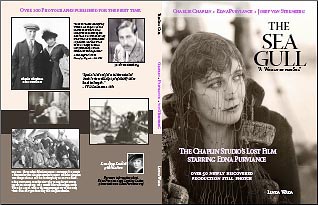
The Sea Gull

http://ednapurviance.com

On the eve of the Bioscope Festival of Lost Films, congratulations go out to Linda Wada of the esteemed Edna’s Place blog and www.ednapurviance.org website, for today publishing her long-awaited book The Sea Gull, on this mysterious lost Chaplin film. The film, originally known as Sea Gulls or The Sea Gull, and later as The Woman of the Sea was produced by Chaplin but written and directed by Joseph von Sternberg, in 1926. The film was a melodrama set among the fishermen on the coast of California, and starred Edna Purviance, Chaplin’s great leading lady. According to von Sternberg, the film had just one screening, before Chaplin withdrew it for reasons that remain unclear, though he did say at one point that it simply wasn’t good enough for release.

The book explores the history of one of the most renowned of lost films, with over 100 photographs published for the first time, including over fifty recently discovered production stills from Purviance’s grand nieces, the Hill family. Here are Kevin Brownlow’s words on the publication:

The Sea Gull is an important contribution to film history, and worth buying for the stills alone. The look of the film, revealed in these marvellous photographs, makes it all the more tragic that it was destroyed. This book provides the nearest experience we will have to seeing it.

Details of how to order the book can be found at http://ednapurviance.com. It is being published as print-on-demand by Leading Ladies, price $39.95 plus shipping, and can be bought using PayPal.

Countdown to the festival

Bioscope Festival of Lost Films

Just eight days remain until we start The Bioscope Festival of Lost Films – a world first, I believe. The festival runs 14-18 January, and all of the films to be shown (one feature and one short per day) will be guaranteed not to exist. Once they did, and one reason why the titles are not being announced in advance, is that exhaustive researches are being undertaken in archives around the world to ensure that the selected films do not still exist somewhere.

However, we can give you some incidental details. The festival will of course be taking place in lost venues. Those selected – a different one each night, all in London – are:

The West End Cinema Theatre, Coventry Street
The Court Electric Theatre, Tottenham Court Road
The Casino de Paris, Oxford Street
The Cambridge Circus Cinematograph Theatre, Charing Cross Road
The Circle in the Square, Leicester Square

All are no longer cinemas. The West End Cinema Theatre, which opened in 1913, later became the Rialto and closed in 1982. It is a Grade II listed building but remains disused. The Court Electric Theatre, which closed in 1928, does not exist as a building, but the space it occupied is now the foyer of the Dominion Theatre. The Casino de Paris (opened 1909) is now a McDonald’s. The Cambridge Circus Cinematograph Theatre (opened 1911) is now the Montagu Pyke bar. And the Circle in the Square (originally called the Bioscopic Tea Rooms, opened 1909) is now an Angus Steak House. But we can dream.

And we have musicians. We have gone for the best, and can promise three names once renowned for their accompaniment of silents at the National Film Theatre: Arthur Dulay, Ena Baga and her sister Florence de Jong playing the organ. You will be transported. Book now!

The Bioscope Festival of Lost Films is dedicated to the anonymous person who visited this blog using the search term “lost films download”. We must all continue to live with such hope.

Retour de flamme

This short piece on the remarkable Lobster Films of Paris is doing the rounds. Here it is (taken from www.france24.com):

Frenchman Serge Bromberg, saviour of more than 100,000 reels of old films, this week marked the 15th anniversary of a world-touring show with a difference – where he accompanies rescued silent movies on the piano.

A twice yearly Paris event, Retour de Flamme (Return of the Flame) has played New York’s MoMA and travels to India next February before going to Italy and the US for shows in San Francisco and New York.

“I like to say I ‘restore’ the spectator,” he said in an interview. “I bring old movies up-to-date with a presentation and a specially-written musical score, to bring the films alive.

Bromberg’s company Lobster Films, set up two decades ago with fellow film addict Eric Lange, has saved from destruction movies dating as far back as 1895, including film’s first movie with sound – Charlie Chaplin’s first 1914 movie “Twenty Minutes of Love” – and the first movies shot in Palestine (1897) as well as the only Marx Brothers shot in colour.

In the first 50 years of cinema, films were recorded on nitrate stocks, which is inflammable and decays. As no-one had thought at the time of preserving film, much of movie history was lost.

“I pick up films all year, with 99 percent unviewable but there’s always one which is extraordinary and which I want to share,” said the 46-year-old film buff.

On DVD now is 1912 footage of the Titanic before it went down, and a 1931 burlesque titled Stolen Jools, featuring Laurel and Hardy, Buster Keaton, Joan Crawford, Gary Cooper and Douglas Fairbanks Jr.

“Fifty percent of the films shot before World War II have been lost,” he added.

Among recently saved treasures are 15 hours of rushes from a 1964 drama featuring the late Romy Schneider and directed by Henri-George Clouzot. The film was never completed and the rushes had been kept at home by Clouzot’s widow Ines.

Another of his 2007 finds is “Bardelys the magnificent” (1926) by King Vidor, starring John Gilbert.

So it’s true, Bardelys the Magnificent has been found, and of course it would be Lobster who found it. All power to them, and three cheers to all film archivists able to accompany their restorations of silent films on the piano. It ought to be a compulsory part of the job.

A Charlie Chaplin Christmas

Charlie Chaplin Christmas

http://www.myspace.com/silenttheatre

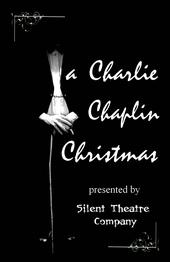
Talking of lost films, as we have been, today sees the opening in Chicago of A Charlie Chaplin Christmas, a play based around an imaginary lost Chaplin film, A Tramp’s Christmas. The play is a production of Chicago’s Silent Theatre Company, which has the brave and notable mission of creating stage productions inspired by silent movies. Its previous production was Lulu, based on G.W. Pabst’s Pandora’s Box.

A Charlie Chaplin Christmas tells of a production company in the silent era desperate to find production funding. It tells potential backers that is has Chaplin signed up to take part in the film, and then have to make good its promise with a convincing lookalike. One of the inspirations behind the production is the old story that Charlie Chaplin himself once entered a Chaplin lookalike content, and came third. As with Lulu, the Silent Theatre Company performs in monochrome. Sets, costumes and make-up all are in black-and-white (or black or white).

The production is running at the Studio Theater in the Chicago Cultural Center, and runs until January 6. More information, visit the Silent Theatre Company’s MySpace page.

The Bioscope Festival of Lost Films

Bioscope Festival of Lost Films

The days are grey, the weather foul, and we need something to lift our spirits. So how about The Bioscope’s very own film festival? We always try to point you to the various silent film festivals around the world, but for its own film festival The Bioscope wants to do something a little different.

So we’re going to have the world’s first festival of lost films. The Bioscope Festival of Lost Films will take place over five days, 14-18 January 2008. It will present five lost silent feature films, each accompanied by a short, with supporting materials, side events, and maybe a celebrity interview or two. So, just like any other festival, except of course that there will be no films to show you. Because all of the films featured will be lost films, not known to exist in any archive anywhere. So a collective act of imagination will be required, as well as a collective sigh at what has been so thoughtlessly cast aside.

What films will be showing? We cannot yet tell you. Just as some festivals have to leave it until the last moment because they cannot be sure of securing the films that they want to show, so The Bioscope Festival of Lost Films will need to be cautious in case the films it hopes to programme turn out to exist somewhere. It seems the story about F.W. Murnau’s The 4 Devils having been found is only an ingenious prank, but there could be some truth to the rumours about King Vidor’s Bardelys the Magnificent having been found. Only at the last minute will it be possible to confirm the final selection. Rest assured that only the best titles will get selected for your delectation.

Therefore, please note down 14-18 January in your diaries, and look out for further announcements about the festival as the time gets nearer.

Postscript (January 2008)

The films featured in the festival were:

Day 1: A Study in Scarlet (1914) and The Great European War (1914)
Day 2: Ein Sommernachtstraum (1925) and Hamlet (1907)
Day 3: Human Wreckage (1923) and Dorian Gray (1913)
Day 4: The Mountain Eagle (1926) and Number 13 (1922)
Day 5: Drakula halála (1921) and Life Without Soul (1915)