Welcoming in 2009

2009

Emil Jannings in The Patriot (1928), from the 2009 Silent Movies Calendar

Want to be able to tell one day from another in 2009, see images from lost silent films, and contribute towards the preservation of silents that happily are not lost? Then purchase the Silent Movies Benefit Calendar for 2009.

This year’s calendar theme is ‘lost films’, and as well as a gorgeous image per month from the silent film of choice, you get a range of significant silent film events noted throughout the year. All proceeds after printing costs go towards a silent preservation project (last year’s calendar helped pay for the video restoration of Bardelys the Magnificent), and the calendars are priced at a modest $15 for a first copy, $12 each for further copies, plus postage.

For ordering information, go to the Mont Alto Motion Picture Orchestra site.

The Bioscope Festival of Lost Films

filmcans

As the bitter winds sweep down direct from the North Pole, and the first Winter snows settle upon the roof of Bioscope Towers, it is time to look to new hopes for the new year, and the return of the Bioscope Festival of Lost Films. Yes, it’s a year since we startled a complacent film world with the very first festival of lost films. Other festivals will show you newly-made films, classic films, obscure films, films you know well and films you’ve never heard of – only the Bioscope Festival of Lost Films will exhibit films that were shown once but can be seen no more.

filmcan

The festival will follow the pattern last year, with some innovations. Over five days, we will feature five silent films that, so far as our researchers are able to determine, no longer exist. Each will come with a programme of extras, such as short films, guest interviews and so on. Each will be shown in a venue that was once a cinema but is now dedicated to other business. There will be appropriate live accompaniment from some noted silent music practitioners of the past. As before, it is not possible to announce what any of the films to be shown will be. Partly this is to maintain the element of surprise, partly because the most stringent efforts need to be taken right up to the last minute to ensure than none of the films on show does, in some far-flung corner of the film archive world, exist.

filmcan1

The festival will take place 5-9 January 2009. Please cancel all other engagements. A year ago we had excellent participation from the Bioscopists, who very much got into the spirit of things, though none quite so much as the person who became so enthused that he asked if his own work could be considered for a future festival. The idea of producing films that are lost before they are even made (the dreams that never made it to celluloid reality) is for another festival, at another time. These are the films that were once, and are no more.

As before, the Bioscope Festival of Lost Films is dedicated to the anonymous person who visited this blog with the search request “lost films download”. We must all continue to live with such hopes.

On not finding London After Midnight

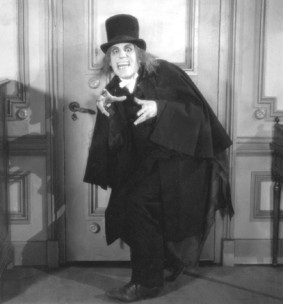
Lon Chaney in London After Midnight

When the news first starting buzzing across the wires that lost scenes from Metropolis has been discovered, many old hands in the film world suspected a hoax. There have been so many such bogus announcements, perpetrated by the naive, the over-optimistic, and – increasingly – the fraudulent. It is so easy to create a narrative, a plausible history bolstered up with links, pictures and air of expert knowledge, and then to have such rumours speed around the world, finding out the credulous.

The amazing thing about Metropolis, and the discovery last year of Bardelys the Magnificent, is that the rumours were true – the lost films had indeed been found. But the lost silent film that is most subject to fantasies of discovery, and which indeed probably comes at the top of many silent film buffs’ wish list of films that they would love to see discover, is London After Midnight. And today the rumours have gone flying around following a rambling but insistent account on a horror film forum that the 1927 Lon Chaney horror film had been found (the argument is that MGM had been hiding it under its alternative release title, The Hypnotist). Of course it hadn’t, as should be obvious to anyone with grain of sense who reads it – it’s riddled with naiveties and fantasies.

The last known print of London After Midnight is believed to have been destroyed in a vault fire at MGM in 1967. Ever since then the rumours have circulated that a print had survived somehow: that a 16mm copy was in secret circulation, that one or other of the renowned collectors was sitting on a print (not daring to announce its existence for fear of losing it to rights-holders MGM), that MGM itself was sitting on material that for assorted mysterious reasons it had chosen to suppress. Or, in the case of this most recent claim, that MGM was somehow unaware of what was lying on its own shelves.

This basic history you can get from Michael Gebert’s London After Midnight Myths pages (though beware that the first few pages do their best to tease the unsuspecting with ‘evidence’ that might indicate the film does exist). It is true that you can find London After Midnight on the TCM schedules every now and then, and on DVD accompanying Chaney’s The Unknown, but this is a 45-minute compilation by Rick Schmidlin of extant stills, recreating therefore what the film looked like. Until a print turns up one day to expose all the so-called experts to ridicule – who knows, as Metropolis has shown, it might be in South America – the Schmidlin recreation is the nearest to this most celebrated of all lost silent films that we have.

For more on lost films, see Moving Image Collections’ Lost Films list, the Deutsche Kinematek’s Lost Films wiki and Silent Era’s Presumed Lost section. And continue to dream.

The Metropolis case

Fritz Rasp as the spy Schmale © Friedrich-Wilhelm-Murnau-Stiftung; Bildbearbeitung: Dennis Neuschäfer-Rube

A day on from all the excitement of the news that a print of the previously ‘lost’, complete Metropolis had been found in Argentina, the dust has settled a little, and more information has filtered through. So here’s a round-up of the film’s history, the discovery of the print, and why the news is so significant.

Let us travel to the year 2026, not so far away now. The giant city of Metropolis is maintained by a slave army which runs the machines which served the pampered ruling class. Freder, son of the city’s ruler, is captivated by a beautiful woman, Maria, and in following her discovers the horrors of the underground life of Metropolis. Maria is a figurehead for the restless workers, and Freder’s father instructs the scientist Rotwang to build a robot in her image so that the workers will follow ‘her’ and be duped into avoiding revolution. But the robot goes beserk and incites a rebellion. Eventually the workers see how they have been misled. They destroy the robot, while Freder, his father and Maria are reunited in happiness, Capital and Labour united at last. So, your typical tale of twenty-first century life.

Such was the vision conjured up by German film director Fritz Lang and his scenarist wife Thea von Harbou for the 1927 film Metropolis, one of the most ambitious, expensive (for the German film industry) and iconic of all silent films. However, at the time it was something of a flop with audiences. The industry reponded as the industry will, and cut the film drastically, to the extent of losing scenes essential to the film’s dramatic logic. Some 950 metres were removed; almost a quarter of its original length. The film at its original length of 4189 metres (147 mins at 25fps, though there is argument over the correct running speed) was therefore only seen for a short while (until May 1927 in Berlin); thereafter a cut version of around 113 mins was all that could be seen, and – so far as posterity aware – all that had survived thereafter, despite various restored versions being produced, most recently that overseen by Enno Patalas in 2001 (which runs at 118 mins).

Move forward to 2008. Paula Félix-Didier, newly installed as curator of the Museo del Cine in Buenos Aires, learns from her ex-huband (director of the film department at the Museum of Latin American Art) of a curiously long screening of a print of Metropolis at a cinema club some years before, a print which was now believed to be in the Museo del Cine. According to ZEITmagazin, which has reconstructed the story, one Adolfo Z. Wilson, who in 1928 ran the Terra film distribution company of Buenos Aires, had secured a copy of the full length version of Metropolis for screening in Argentina. A copy then found its way into the hands of film critic Manuel Peña Rodríguez. In the 1960s he sold the film to Argentina’s National Art Fund, with seemingly neither party to the deal realising the unique value of the film. A print (on 16mm) then came into the hands of the Museo del Cine in 1992. Sixteen years later, Paula Félix-Didier found it.

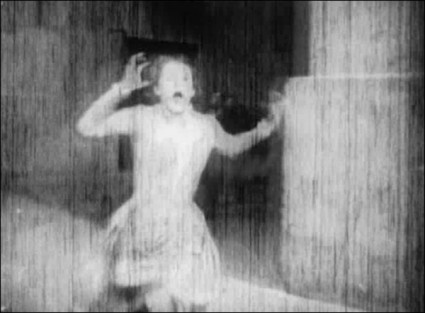
Maria (Brigitte Helm) flees from the mob © Friedrich-Wilhelm-Murnau-Stiftung; Bildbearbeitung: Dennis Neuschäfer-Rube

Félix-Didier then acted with care. Rather than announce the discovery in Argentina (where, apparently, she believed it would not attract so much attention) she chose to have the discovery announced in Germany, where the film had been produced, and where the Friedrich-Wilhelm-Murnau-Stiftung had been responsible for the most recent restored version of the film. She also had a friend who was a journalist for ZEITmagazin, which is how it ended up getting the exclusive and the stills which reveal that the print is indeed a well-worn 16mm copy, but whose very murkiness and lack of sharpness seem only to add to their haunting quality. (Word is that the stills are frame grabs from a DVD copy, so they look a little worse than the print actually is)

So, what is it that we have? What was found was a 16mm dupe neg of virtually the entire original version of Metropolis, minus just one scene, that of a monk in a cathedral, because it happened to be at the end of a reel that was badly torn (this information from Martin Koerber of the Deutsche Kinemathek, via the AMIA-L discussion list). The original 35mm nitrate print is lost. Precise details of the missing scenes (which were cut by the film’s American distributors, Paramount) are unclear, but it is reported that they reveal why the real Maria is mistaken by a rampaging mob for the robot created in her image; the significance of the role of the spy Schmale (played by Fritz Rasp), who pursues Freder, is made clear; and the scene where the workers’ children are saved by Freder and Maria towards the end of the film is revealed to be far more dramatic, and violent (a likely reason for its having been cut in the first place).

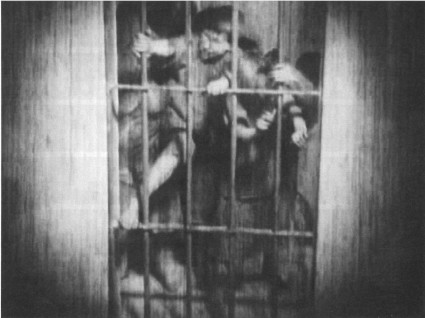
From Ain’t it Cool News, showing the trapped workers’ children trying to escape flood waters

And what will happen now? The above-mentioned restored version was produced in 2001, and has been made available on DVD in deluxe editions by Kino and Eureka. There is also a study or critical edition available from the Filminstitut der Universität der Künste Berlin. Kino recently announced that it would be issuing Metropolis on high-definition Blu-Ray early in 2009 – how will the news affect their plans?. The Friedrich-Wilhelm-Murnau-Stiftung has announced its intention to produce a ‘restored’ version, which would presumably simply mean inserting the relevant ‘lost’ sequences into the existing 35mm restoration. The reports from those who have seen the rediscovered print all indicate how coherent the complete work is, and hence how logically the extra scenes would slot in. Of course, there would be a somewhat brutal shift from pristine 35mm to battle-worn 16mm, but other such attempts at full restorations have shown similar changes in image quality where only inferior material remains, and the effect is not so jarring. Far more important will be the realisation of a story – and of one of the twentieth-century’s masterpieces of art in any form – made whole again. But what will get released, in what form, and when – it’s too soon to say.

© Friedrich-Wilhelm-Murnau-Stiftung; Bildbearbeitung: Dennis Neuschäfer-Rube

Where to find out more:

One last thought. What other lost silents might be lurking in South American film archives, perhaps not as thoroughly investigated as their North American cousins, but a territory where many American prints will inevitably have turned up? After such a tremendous discovery, we can only be greedy for more.

Update (4 July): Today in Argentina journalists were shown extracts from the rediscovered print of Metropolis. Photographs show that they were shown a DVD with brief clips. Reports indicate that the clips they were shown were (i) a worker who has exchanged clothes with Frederer gets in a car and drives to Yoshiwara, Metropolis’ red-light district; (ii) Smale, the spy following Frederer, at a newspaper stand; (iii) the robot Maria is seen in Yoshiwara; (iv) Frederer and the real Maria rescue the workers’ children, including scenes where the children are seen trapped behind bars as the flood water rise.

According to Digital Bits, Kino are intending to include the rediscovered new sequences in their already-announced Blu-Ray release of Metropolis from early next year, though it is surely too early for such confident pronouncements.

Further update (12 February 2010): For a report on the restored film’s premieres and the latest news news, see https://bioscopic.wordpress.com/2010/02/12/the-new-metropolis/.

Lost version of Metropolis discovered

Previously lost scene showing Maria fleeing, from the rediscovered print of Metropolis, from http://www.zeit.de © Friedrich-Wilhelm-Murnau-Stiftung; Bildbearbeitung: Dennis Neuschäfer-Rube

The wires are a-buzzing with the sensational news that a 16mm print of a lost version of Fritz Lang’s Metropolis has surfaced in Argentina, which may well be the original cut – around a quarter of the original film is missing from existing prints. The German newspaper Die Zeit has reported the news and published a gallery of startling images from the previously lost sequences of the film.

Word is that the Friedrich-Wilhelm-Murnau-Stiftung will work with the Museo del Cine Pablo C. Ducros Hicken in Buenos Aires on restoring the lost scenes, but it’s too early for any concrete details. More information is promised is tomorrow’s Die Zeit, meanwhile, here’s a press release (in somewhat quaint English) from the Friedrich-Wilhelm-Murnau-Stiftung:

Sensational discovery in Buenos Aires: Lost scenes from “Metropolis” rediscovered

Staff members of the Museo del Cine Pablo C. Ducros Hicken in Buenos Aires, found the missing scenes which had been considered lost up to now, in a 16mm Negative.

The tale of the concision of “Metropolis” is well-known. The film is renowned for the story of its restoration which began in the 1960s in the national Film archive of the German Democratic Republic, to the source critical reconstruction of the Film museum Munich (E. Patalas) in the 1980s, up until the film was digitally restored through Mr. Martin Koerber on behalf of the Friedrich-Wilhelm-Murnau-Stiftung, Wiesbaden in the year 2001. This restoration, which is based on the version of the Film museum Munich and on materials of the Bundesarchiv-Filmarchiv (Federal Archive / Filmarchive), Berlin, was completed not only with these two institutions but also with other partners of the Deutscher Kinematheksverbund (Association of German Film Archives)

In addition to this, Enno Patalas developed a study version of the film in collaboration with the University of Arts in Berlin. They supplemented the survived fragments in their original relation to the film in written form or with pictures and musical resources.

Because of these survived sources, the hiatuses which weren’t able to be found even after decades of research in national and international Film archives and private converts, were sorely cognizant. Pictures gave us the impression of what was missing – the to a supernumerary reduced figure of Georgy, the man named Slim, Josaphat, the car journey through Metropolis, the observation of Georgy through Slim, Freders delirium of Slim in which he changes into a apocalypse preaching monk. With this discovery in Buenos Aires these scenes will finally come back to life. Even if the quality of the picture is in a deplorable condition, thanks to the Argentinean material, the dream of the completion of “Metropolis” will finally come true.

According to Anke Wilkening, restorer of the Murnau Foundation “Hitherto incomprehensible is now intelligible, the sometimes puzzling relations of the figures among each other now make sense.” The story of the instauration can now come to an end.

Helmut Poßmann, managing director of the Murnau Foundation states that: “In continuance of the restoration from 2001, the Murnau Foundation would very much like to compile a complete version of the film together with the former partners and the Museo del Cine Pablo C. Ducros Hicken in Buenos Aires and to open it to the public, all the more because “Metropolis” is the first film which has been affiliated in this restored version from 2001 – safety lug Nr. 1 – to the Memory of the World register of the UNESCO.”

“This sensational discovery places the Murnau Foundation into a position being able to restore the film to a very large degree. That way it could be achieved to come as close to the masterwork of Fritz Lang as never before possible and present it to the world”, says Eberhard Junkersdorf, head of the board of trustees.

For the past 42 years the Friedrich-Wilhelm-Murnau Foundation has applied itself to save, preserve, restore and reconstruct a bulk of the German cinematic heritage of 2.000 silent films, 1.000 talkies and about 3.000 filmlets (commercials, documentaries, etc.) from the beginning of film up to the 1960s, trying to make these films accessible to the public.

Among films as “Metropolis”, German classics like “Das Cabinet des Dr. Caligari”, “Nibelungen”, “Der blaue Engel”, “Die Drei von der Tankstelle”, “Münchhausen”, “Große Freiheit Nr. 7“ just as a multitude of productions of important German-speaking directors such as Friedrich Wilhelm Murnau, Fritz Lang, Ernst Lubitsch, Detlef Sierck, Helmut Käutner and Wolfgang Liebeneiner.

The current extensive restoration project is Fritz Lang’s monumental film “Die Nibelungen” which is planned to premiere with a new musical score at the Berlin Film Festival in 2010.

Truly wonders will never cease, and lost films will only remain lost until someone finds them. More news here as it emerges.

Update: There’s more news, including a history of the print’s rediscovery and further images, in The Metropolis case follow-up post.

The Silent Film Bookshelf

The Silent Film Bookshelf was started by David Pierce in October 1996 with the noble intention of providing a monthly curated selection of original documents on the silent era (predominantly American cinema), each on a particular theme. It ended in June 1999, much to the regret to all who had come to treasure its monthly offerings of knowledgeably selected and intelligently presented transcripts. The effort was clearly a Herculean one, and could not be sustained forever, but happily Pierce chose to keep the site active, and there it still stands nine years later, undeniably a web design relic but an exceptional reference resource. Its dedication to reproducing key documents helped inspire the Library section of this site, and it is a lesson to us all in supporting and respecting the Web as an information resource.

Below is a guide to the monthly releases (as I guess you’d call them), with short descriptions.

October 1996 – Orchestral Accompaniment in the 1920s
Informative pieces from Hugo Riesenfeld, musical director of the Rialto, Rivoli and Critierion Theaters in Manhattan, and Erno Rapee, conductor at the Capitol Theater, Manhattan.

November 1996 – Salaries of Silent Film Actors
Articles with plenty of multi-nought figures from 1915, 1916 and 1923.

December 1996 – An Atypical 1920s Theatre
The operations of the Eastman Theatre in Rochester, N.Y.

January 1997 – “Blazing the Trail” – The Autobiography of Gene Gauntier
The eight-part autobiography (still awaiting part eight) of the Kalem actress, serialised over 1928/1929 in the Women’s Home Companion.

February 1997 – On the set in 1915
Photoplay magazine proiles of D.W. Griffith, Mack Sennett and Siegmund Lubin.

March 1997 – Music in Motion Picture Theaters
Three articles on the progress of musical accompaniment to motion pictures, 1917-1929.

April 1997 – The Top Grossing Silent Films
Fascinating articles in Photoplay and Variety on production finance and the biggest money-makers of the silent era.

May 1997 – Geraldine Farrar
The opera singer who became one of the least likely of silent film stars, including an extract from her autobiography.

June 1997 – Federal Trade Commission Suit Against Famous Players-Lasky
Abuses of monopoly power among the Hollywood studios.

July 1997 – Cecil B. DeMille Filmmaker
Three articles from the 1920s and two more analytical articles from the 1990s.

August 1997 – Unusual Locations and Production Experiences
Selection of pieces on filmmaking in distant locations, from Robert Flaherty, Tom Terriss, Frederick Burlingham, James Cruze, Bert Van Tuyle, Fred Leroy Granville, H.A. Snow and Henry MacRae.

September 1997 – D.W. Griffith – Father of Film
Rich selection of texts from across Griffith’s career on the experience of working with the great director, from Gene Gauntier, his life Linda Arvidson, Mae Marsh, Lillian Gish and others.

October 1997 – Roxy – Showman of the Silent Era
S.L. Rothapfel, premiere theatre manager of the 1920s.

November 1997 – Wall Street Discovers the Movies
The Wall Street Journal looks with starry eyes at the movie business in 1924.

December 1997 – Sunrise: Artistic Success, Commercial Flop?
Several articles documenting the marketing of a prestige picture, in this case F.W. Murnau’s Sunrise.

January 1998 – What the Picture Did For Me
Trade publication advice to exhibitors on what films of the 1928-1929 season were likely to go down best with audiences.

February 1998 – Nickelodeons in New York City
The emergence of the poor man’s theatre, 1907-1911.

March 1998 – Projection Speeds in the Silent Film Era
An amazing range of articles on the vexed issue of film speeds in the silent era. There are trade paper accouncts from 1908 onwards, technical papers from the Transactions of Society of Moving Picture Engineers, a comparative piece on the situation in Britain, and overview articles from archivist James Card and, most importantly, Kevin Brownlow’s key 1980 article for Sight and Sound, ‘Silent Films: What was the right speed?’

April 1998 – Camera Speeds in the Silent Film Era
The protests of cameramen against projectionsts.

May 1998 – “Lost” Films
Robert E. Sherwood’s reviews of Hollywood, Driven and The Eternal Flame, all now lost films (the latter, says Pierce, exists but is ‘incomplete and unavailable’).

June 1998 – J.S. Zamecnik & Moving Picture Music
Sheet music for general film accompaniment in 1913, plus MIDI files.

July 1998 – Classics Revised Based on Audience Previews
Sharp-eyed reviews of preview screenings by Wilfred Beaton, editor of The Film Spectator, including accounts of the preview of Erich Von Stroheim’s The Wedding March and King Vidor’s The Crowd, each quite different to the release films we know now.

August 1998 – Robert Flaherty and Nanook of the North
Articles on the creator of the staged documentary film genre.

September 1998 – “Fade Out and Fade In” – Victor Milner, Cameraman
The memoirs of cinematographer Victor Milner.

October 1998 – no publication

November 1998 – Baring the Heart of Hollywood
Somewhat controversially, a series of articles from Henry Ford Snr.’s anti-Semitic The Dearborn Independent, looking at the Jewish presence in Hollywood. Pierce writes: ‘I have reprinted this series with some apprehension. That many of the founders of the film industry were Jews is a historical fact, and “Baring the Heart of Hollywood” is mild compared to “The International Jew.” [Another Ford series] Nonetheless, sections are offensive. As a result, I have marked excisions of several paragraphs and a few words from this account.’

December 1998 – Universal Show-at-Home Libraries
Universal Show-At-Home Movie Library, Inc. offered complete features in 16mm for rental through camera stores and non-theatrical film libraries.

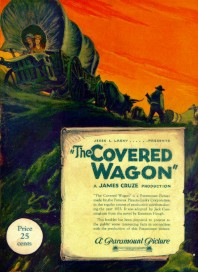
January 1999 – The Making of The Covered Wagon
Various articles on the making of James Cruze’s classic 1923 Western.

February 1999 – From Pigs to Pictures: The Story of David Horsley
The career of independent producer David Horsley, who started the first motion picture studio in Hollywood, by his brother William.

March 1999 – Confessions of a Motion Picture Press Agent
An anonymous memoir from 1915, looking in particular at the success of The Birth of a Nation.

April 1999 – Road Shows
Several articles on the practive of touring the most popular silent epics as ‘Road Shows,’ booked into legitimate theatres in large cities for extended runs with special music scores performed by large orchestras. With two Harvard Business School analyses from the practice in 1928/29.

May 1999 – Investing in the Movies
A series of articles 1915/16 in Photoplay Magazine examining the risks (and occasional rewards) of investing in the movies.

June 1999 – The Fabulous Tom Mix
A 1957 memoir in twelve chapters by his wife of the leading screen cowboy of the 1920s.

And there it ended. An astonishing bit of work all round, with the texts transcribed (they are not facsimiles) and meticulously edited. Use it as a reference source, and as an inspiration for your own investigations.

Lost and found no. 4 – The Henville collection

Yarmouth Fishing Boats Leaving Harbour (1896), from http://www.youtube.com/user/BFIfilms

The appearance of the above film on the BFI’s YouTube site has inspired me to revive the Lost and Found strand on this blog (film collections once lost that have now been recovered), and to tell you something of the remarkable story of the Henville collection.

Cast your minds back to 1995. It was the year of the Oklahoma City bombing, Yitzhak Rabin was assassinated, the Aum Shinrikyo cult relased sarin gas on the Tokyo underground, Jacques Chirac became president of France, Eric Cantona attacked a football fan in the crowd, a new moving image format, the DVD, was announced, and in film archives and cinematheques across the globe those dedicated to film history and numerology sought various ways to mark the centenary of cinema.

It was a busy time for me, as the British Film Institute’s pet early film enthusiast, if not quite expert, with screenings, events, conferences and writing a book on Victorian cinema. And somewhere early on in that manic year, a collection of films turned up. There were some seventeen cans, single reel subjects, non-standard perforations, all readily identifiable as films from the 1890s. Films from the 1890s generally only turn up in dribs and drabs, so seventeen titles in one go was quite a coup. And the archivist who took in the films let me inspect a few (they were in a very fragile state), and one I looked at was clearly filmed at Epsom. ‘Oh no’, I said, ‘it’s another Derby’. We had other early Derby films, all looking very much the same, and it was a pain in the neck trying to tell one from another. I set it to one side…

The collection had come from one Ray Henville, a collector of vintage radios. At an auction he picked up some vintage radios and with them acquired some cans of unidentified films. Henville knew nothing of old film, but one of them featured a sailing boat, so he sent in a photograph to a yachting magazine in the hope that someone might be able to identify it. Happily the photograph was seen by Bill Barnes, film historian and twin brother of John Barnes, author of the esteemed The Beginnings of the Cinema in England series.

Bill alerted that BFI, we took them in, and I ended up trying to identify them. This was a slow process, not least on account of the fragility of the films which meant that for a long period I only had frame stills to go on. But it soon became clear that here was a remarkable collection of films from the 1890s, several of them likely to have been taken by Birt Acres, the first person to take a 35mm cinematograph film in Britain.

Birt Acres filming the 1895 Derby

Birt Acres filming the 1895 Derby

What distinguished these Acres films was an indistinct frameline and a lack of sharpness to the image. These were characteristics of the Derby film, and the more I looked at it the more I felt that it could be the Derby of 1895, which would make it an extraordinary coup in the centenary year. But how to identity it for certain? There were no contemporary frame stills that I could use to compare, but the angle of the camera matched the position known to have been taken by Acres in the above photograph. Then, having checked race reports and horse racing sources, I looked at the colours of the jockeys (albeit in black-and-white), which matched the winner for 1895, and the fact that it showed a close finish between three horses, such as featured in 1895 but not any other Derby 1896-1900.

It wasn’t quite a eureka moment, and there were arguments against the identification. The film had perforations which suggested it was a later production by Acres’ great rival Robert Paul, who was effectively the producer of the 1895 Derby (it turned out to be a reprint), and once a dupe print had been painstakingly created by archivist João Oliveira and we could screen it, we discovered the film ran satisfactorily at 24 fps, when a film shot for the Kinetoscope peepshow (which was the case with the 1895 Derby) ought to have run at 40 fps. There isn’t space here to go into the complexities of this particular argument – suffice to say that one should judge things by what one finds, not what one expects to find, and that though some doubts were raised over the film’s identity I believe I was right, and the discovery recently of further Acres films from this period which similarly run at a speed seemingly too slow for the Kinetoscope tends to verify the original identification.

1895 Derby

What is believed to be the Derby of 1895, filmed by Birt Acres

It took a while to identify all the films in the Henville collection, and in some cases original identifications were overturned, but here’s the list of films, with titles in brackets for those still unidentified (links are to their entries on the BFI database):

Bataille de Neige (France Lumière 1896)
Blackfriars Bridge (UK Paul 1896)
(Blacksmith) (France? 1896?)
(Boy tormenting gardener) (France? 1896?)
Carpenter’s Shop (USA Edison 1896)
(Circulaire Train Arriving at Paris Station) (1896?) and Depart de Jerusalem en Chemin de Fer (France Lumière 1896) [two films on one reel]
Cologne: Sortie de la Cathédral (France Lumière 1896)
A Corner of Barnet Fair (UK Acres 1896)
(Crude Set Drama) (UK 1895?)
The Derby (UK Acres/Paul 1895)
(Military Parade) (UK? Paul? 1896?)
Niagara Falls (UK Acres 1895)
La Prise de Tournavos (France Méliès 1897)
Queen Victoria’s Diamond Jubilee (UK Paul 1896)
(Workers Leaving a Factory) (France Méliès? 1896?)
Yarmouth Fishing Boats Leaving Harbour (UK Acres 1896)

I remember the Yarmouth film in particular because David Cleveland, then head of the East Anglian Film Archive had asked me what the likelihood was of this, the earliest film taken his region, ever turning up. I said it was next to impossible. A few weeks later, we had a copy. Now it’s on YouTube.

But what is also of interest is what happened next. A huge fuss made was made about the collection, especially the Derby film. The BFI went to town on it. We had reams of press coverage, television news reports, even a mention on Barry Norman’s Film 95. But this in turn raised the interest of the donor, who felt that there had to be great commercial value in these films, and eventually he took back the nitrate originals, with the BFI retaining the dupe copies it had made. The films were put up for auction in Germany, where I think one or two titles were sold (including the Georges Méliès dramatisation of a scene from the Greco-Turkish War, La Prise de Tournavos, I think), and then the remainder went up for auction at Sotheby’s in 2000. As I recall, the collection was bought by a London antiquarian bookdealer apparently without any knowledge of film.

And then what? A mystery. Perhaps the films lie crumbling on that same bookseller’s shelves, or maybe they have passed on to other hands, convinced that the great excitement generated by the films’ discovery had to mean that they had a great commercial value. Of course, they did not, except what one might get for them at auction – in all other respects, there was nothing to be made from them. This is a folly which has been repeated again and again, dreaming of treasures when all one is left with is unshowable, inflammable and not even necessarily unique (at least six of the Henville films were duplicated in other collections), fascinating to the specialist but of only passing interest to the general viewer. And arguably of minimal aesthetic interest.

But the duplicate copies remain, and so the 1895 Derby is preserved for posterity, until some bright spark comes along and tells me it was the 1896 Oaks all along…

Update (2019):

In September 2019 theatre and film historian Barry Anthony uncovered an image taken from the Acres Derby film which clearly corresponds with the print held by the BFI. The image, which is heavily retouched and printed the wrong way round, with the background removed, was found in The Field, 21 September 1895, p. 510, submitted by one IMPECUNIOSUS (a horse-racing enthusiast), who writes that it shows the closing stage of that year’s Derby. In a later issue of the same journal (5 October) Acres complains that the image had been used without his permission. The Field is available on the British Newspaper Archive subscription site.

So it was the 1895 Derby all along. Here are the original image, the image flipped, and a still from the film:

Colourful stories no. 7 – Reviving Kinemacolor

David Cleveland

David Cleveland operating a Kinemacolor projector

We continue with our series on the history of early colour cinematography, but take a diversion out of the past to the present day – Monday February 25th, to be precise – for the very best of reasons. Because today, at the British Film Institute’s J. Paul Getty Conservation Centre in Berkhamsted, Hertfordshire, we witnessed a rare recreation of ‘true’ Kinemacolor.

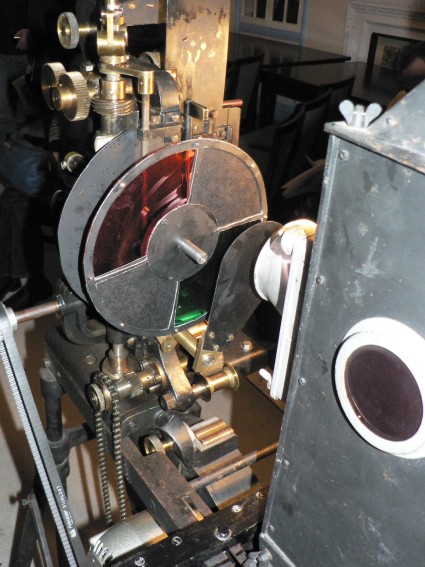
The screening was organised by film archivists David Cleveland and Brian Pritchard, who decided to mark the centenary of Kinemacolor by exhibiting the world’s first natural colour motion picture system in its correct form, using an original Kinemacolor projector. Kinemacolor films have been shown in composite colour or computer synthesized forms, or so customised that they will run at normal speed on a normal projector, but not since 1995 at the Museum of the Moving Image has anyone attempted to show Kinemacolor as it was originally done – black-and-white film run through a projector fitted with a red and green rotating filter, at double speed (thirty or more frames per second). It is rarer still to employ an original projector (the MOMI show used a customised 1920s Ernemann projector).

Kinemacolor projector

Kinemacolor projector no. 19 (rear view showing colour filter)

The projector was generously loaned by Wirral Museum, which also allowed the archivists to replace missing parts and to make the machine operable, so long as it would be returned to its original museum state once they had finished with it. It is Kinemacolor projector no. 19, with original colour filter. Cleveland and Pritchard aimed to be as authentic as possible, with two limitations – they could not show nitrate films, fairly obviously, and for similar health and safety reasons they could not use an arc light (they used a filament blub instead).

We gathered in a small room, with chandelier adding an appropriate touch of class to the proceedings (less so the windows necessarily blacked out with black bags and tape). The small audience comprised archivists from the BFI National Archive, a smattering of academics, and as guests of honour, Kinemacolor’s producer Charles Urban’s step-grandson Bruce Mousell and his two daughters.

David introduced the event and the projector, then we were shown three of the sample Kinemacolor films held in the BFI National Film Archive. Tragically few Kinemacolor films survive today, and all that the UK’s national archive holds are some test films which were never shown publicly. These were retained by the system’s inventor G.A. Smith, who passed them on to Brighton collector Graham Head, whose collection in turn went to the Cinema Museum in London. Two of the prints we saw were therefore struck from original negatives, with a third taken from a dupe neg. This film was shown first, Cat Studies (c.1908), a short single shot of a cat (a black-and-white cat at that), which served to help make adjustments to the filter, since we started off with the wooden board with a hole through which the cat looked appearing green, because the rotating filter had been aligned incorrectly.

Woman Draped in Patterned Handkerchiefs

Projection of Kinemacolor test film Woman Draped in Patterned Handkerchiefs

There then followed Woman Draped in Patterened Handkerchiefs (c.1908), whose action is self-explanatory, a film clearly designed to demonstrate basic colour effects; and Pageant of New Romney, Hythe and Sandwich (1910), an actuality film rejected at the time for being too contrasty. In truth, the sample Kinemacolor films held by the BFI are poor examples of the colour system, showing little in the way of effective colour, and the latter film in particular demonstrating the hazards of fringing (the alternating red/green records meant that the film record could not always keep up with movement, resulting in red or green ‘fringes’).

But, after a pause for reloading and a talk from Brian Pritchard on the customising of the projector and Smith’s ingenious use of sensitizing chemicals (without which Kinemacolor would not have worked at all), we were shown a beautiful Kinemacolor film loaned by the Nederlands Filmmuseum. This was Lake Garda, Italy (1910), a travelogue of the Italian beauty spot, whose picture postcard images showed up the colour to exquisite effect. We saw panoramic views of the lake, buildings, boats with red and yellow sails, and a delightful sequence where three musicians in a small boat serenaded the camera. Being full of gentle motion, the muted, subtle colour was shown to its best effect, being particularly good at rendering white buildings and reflections in the water. Kinemacolor, using as it did red and green filters, could not logically depict blue, yet blue we saw in the sky and water. This is all down to our gullible brains, reconstituting what seems optically logical to us. The sky should be blue, so we see blue.

What was also interesting was the colossal noise. The motorised projector had to rattle through at a speed of thirty frames per second, and the racket drowned out all conversation. The image on the screen had to be kept quite small, to retain as much brightness as possible (Kinemacolor absorbs a great deal of light). We all wondered how on earth they coped projecting Kinemacolor in large theatres, where the throw would have been considerable. We also marvelled at the skill of the original projectionists, who had to cope not only with a double-speed projector, but changing colour effects owing to differences in filters used (the cameramen would change then accoding to the light conditions encountered) and all of the hazards of correct colour synchronisation.

Bruce Mousell

David Cleveland (right) with Charles Urban’s step-grandson Bruce Mousell and his daughters

The demonstration revealed many of the problems, but also several of the beauties of Kinemacolor, and made one wish for more such screenings to be organised. As David Cleveland explained in his notes to the show:

Several archives have a few examples of Kinemacolor films in their collections, and the usual process is to make a composite film copy of the red and green images onto one new Eastman Color inter-negative, and normal colour prints therefrom. Of course this takes on Eastman Color characteristics, and the colour is not the same as originally seen. Scanning is probably the answer, but here again it needs to be carefully done so that the colour is as near to the original filters as possible … and that the result is not a smooth ‘television’ type picture, but an image that resembles the projected picture of a century ago. Only this way can Kinemacolor be put into context with the development of colour films.

It is a great shame that, in its centenary year, Kinemacolor remains so elusive. Cleveland and Pritchard had the greatest difficulty getting films from other archives, and it is to be hoped that there may be greater co-operation over any future events. So few Kinemacolor films survive (maybe thirty or so, out of the hundreds originally produced), and more must be done to preserve them, to make them accessible in original as well as the more convenient composite form, and to uncover more – because there are undoubtedly ‘lost’ Kinemacolor films out there. Kinemacolor appears to be ordinary silent black-and-white film to the untrained eye. Only when you look closely do you see alterations in tonal emphasis from frame to frame. Many archives, I am sure, are sitting on Kinemacolor films and are not aware of the fact. 2008 would be a good year in which to start conducting a search to locate them.

William Haggar’s phantom ride

William Haggar

William Haggar, from http://www.williamhaggar.co.uk

Talking, as we have been, about lost films, here’s an interesting piece from the South Wales Echo (we cast our investigative net widely here at the Bioscope) on a theatre show devised by performance group Good Cop Bad Cop:

Haggar remembered in ‘rough and ready’ show

WILLIAM Haggar was one of the first pioneers of cinema in a silent age where actors ‘spoke’ volumes with just a simple frown or smile.

A travelling entertainer from Essex, he settled in Wales and transformed live entertainment into the cultural industries of the early 20th Century.

Now his work is being resurrected by two-man company Good Cop Bad Cop, which has been commissioned by Chapter for three nights of experimental theatre.

In what has been described as a rough-and-ready production, John Rowley and Richard Morgan, who set up Good Cop Bad Cop in 1995, take to the stage for their performance of Phantom Ride.

Based on a series of lost silent footage, Phantom Ride aims to rejuvenate memories from a selected 32 of Haggar’s films in a creative leap of faith by the theatre group.

The two actors, who met when they worked with Welsh theatre company Brith Gof, have brought on board newcomer Louise Ritchie for the project.

The show will be performed purely through stand-up acting on a stage which has been stripped bare of scenery, props and bright lighting.

Each will give a brief synopsis of Haggar’s work and recount memories of those switched-on enough to have handed down thoughts about his films so that future generations could get an insight into a disappearing film era.

It will then be up to audiences to visualise the rest, albeit prompted by storytelling monologues and a background soundtrack.

John Rowley, co-artistic director of Good Cop Bad Cop, says they are still making changes to the production which is how the pair usually work best.

He said: “We are still working on it.

“Although the show is on Wednesday we’ll piece it together right up until Tuesday night.

“It’s rough and ready in a way. It’s not like going into the theatre seeing bright lights, scenery and costumes. It’s based on a series of lost films which do not exist any more.

“In the silent movie era after the people watched the film they didn’t care what happened to the footage which was combustible, so they went to powder.

“A lot of work has been done to restore them in different parts of the world but a lot have been lost. I think only eight exist at the moment and they are in fragments.”

During the 70-minute show the audience is expected to play its part by using imagination and imagery.

John added: “What we are interested in is the live raw experience of an audience member, and the relationship between the audience and the performer which is often kind of negative in traditional theatre.

“We will be using the same space as the audience as it’s not a built-up stage.

“It could be some of the audience end up standing next to the actor listening to them as if it was a personal conversation.

“That part of the audience is then turned into part of the performance.”

I like the idea of getting the audience to contribute to the imaginative recreation of a lost film. That sort of engagement with the audience is very much in the spirit of Haggar, who toured the fairgrounds with his films and knew that it was those who came to see the show that really made the films what they were. William Haggar is the great pioneer of Welsh cinema, responsible for such lively works as A Desperate Poaching Affray (1903) and The Life of Charles Peace (1905), and the subject of Peter Yorke’s recent biography. Yorke has also produced a website about Haggar and his book, at www.williamhaggar.co.uk.

Good Cop Bad Cop: Phantom Ride can be seen at Chapter, in Cardiff, Wednesday, January 23, to Friday, January 25, at 8pm. Further information from the Chapter website.

Footnotes to the festival

Bioscope Festival of Lost Films

Now that the Bioscope Festival of Lost Films is over, here are a few notes on some of the sources used, credit having to be where credit is due.

For A Study in Scarlet and its partnering short, The Great European War, the chief source is the autobiography of its director George Pearson, Flashback: An Autobiography of a British Film Maker (1957). This is an evocative and at times inspiring account of dedicated creative endeavour amid the general poverty of budgets and imagination that existed in the British film industry in the silent era. There’s more information (which I didn’t have access to) in Harold Dunham and David Samuelson’s voluminous Bertie: the life and times of G. B. Samuelson, an unpublished biography of the film’s producer, a copy of which is held in the BFI Library. I also used contemporary reviews and David Meeker and Allen Eyles’ Missing Believed Lost: The Great British Film Search (1992), which was the source of the main photograph of Sherlock Holmes (the other photo, of the Mormon trek at Southport, comes from Pearson’s book).

For Ein Sommernachtstraum, my chief source was Robert Hamilton Ball’s incomparable Shakespeare on Silent Film: A Strange Eventful History (1968), which was also the source of information on the 1907 Hamlet, and the source of both photographs. Ball is so thorough in citing and quoting from his source (such as the Close-up review) that there wan’t much need to look elsewhere, but I did also used a review of the film in Variety.

The prime source of information on Human Wreckage was Kevin Brownlow’s Behind the Mask of Innocence: Sex, Violence, Crime, Films of Social Conscience in the Silent Era (1992), one of the essential sources on silent film. Images came from here and from Mark A. Viera’s Sin in Soft Focus: Pre-Code Hollywood (2003). Also useful was James C. Robertson, The Hidden Cinema: British Film Censorship in Action, 1913-1972 (1989). I also referred to assorted reviews of the film. I could find very little on Dorian Gray, the 1913 Wallace Reid film, and in the end turned to an Oscar Wilde filmography I’d compiled years ago and trusted that I’d got my facts and figures right then.

There is plenty of information available on The Mountain Eagle, inevitably. The best source is the warmly recommended English Hitchcock, by Charles Barr. Further information came from editions of the renowned Hitchcock journal, MacGuffin and Missing, Believed Lost. Stills from the film are handsomely reproduced in Dan Auiler, Hitchcock’s Secret Notebooks (1999) and can be found on the commendable Hitchcock Wiki’s Hitchcock Gallery. The famous François Truffaut interview book, Hitchcock, was the source of information on Number 13, including the unexpected still.

Drakula halála was the most difficult film to research, as there is so much that is not known about it, so much has been misreported, and such key sources as exist are in Hungarian – and even they make little mention of it. Sources vary over whether it should be 1921 or 1923, but in the end I went for 1921 as it is listed as such in the filmography given in the standard work, István Nemeskürty, Word and Image: History of the Hungarian Cinema (1974). My chief source, however, was www.hitchcock.hu. The main site is – bizarrely – about cats, but click on the Hitchcock.hu link on the front page and it takes you to a enthusiastic site on Hitchcockiana (in Hungarian), with offshoots on subjects such as silent horror, which is where I found a short history of the film, images, and reproductions of original texts – all in Hungarian, of course, and translation software can only do so much with one of the world’s more challenging languages, but I think I extracted the basics. Information on the Hungarian industry came mostly from Filmkultúra (rather good, in English). Christopher Frayling’s Mad, Bad and Dangerous?: The Scientist and the Cinema (2005) had some information on Life Without Soul, while the poster for the film is reproduced on the Frankensteinia blog.

Grateful acknowledgments to all those sources.