Timon’s Friendship Adventure

Timon’s Friendship Adventure

As regular readers will know, here at The Bioscope we try to keep up with current trends in silent filmmaking, while those who know me may know that I have an interest in that engagingly oddest of genres, the silent Shakespeare film. But who would have suspected that the two interests might come together, and that Timon of Athens would be its subject?

And so I offer you Timon’s Friendship Adventure, which is a modern silent (in modern dress) based on William Shakespeare’s Timon of Athens. It’s few people’s favourite Shakespeare play, and one of his least filmed (let alone performed), but writer Michael Weinreich, producer Lisa Shapiro and director Max Littman have created this oddity, shot in black-and-white, silent, with intertitles, and a familiar-style piano accompaniment (until, unfortunately, electric guitar and drums kick in halfway through). Jason Davids Scott plays Timon.

There’s website dedicated to the film, which was made in 2007, and has been doing the round of festivals. Timon is one of Shakespeare’s more misanthropic characters, but though in the play he holds a feast for friends who turn out to be false friends when he is in need, he doesn’t slaughter everyone, as happens here. The inspiration seems more Titus Andronicus than Timon of Athens. Anyway, it deserves notice for being different, and for showing that the honourable art of compressing Shakespeare into five minutes (and squeezing out his words while you’re at it) is not lost.

Pen and pictures no. 2 – The most popular authors

I’ve started up this new series on literary authors and their engagement with motion pictures of the silent era, but which authors were the most popular subjects for adaptation? It’s a difficult subject to research, because of the variable quality of the reference sources to hand. One could go to the IMDB, but it still misses out so much, and there would be no easy way that I know of to isolate all literary source credits and then match these to silent films.

A better route I’ve found is to use Denis Gifford’s Books and Plays in Films 1896-1915. This is a typically thorough and rigorous reference work from the late Mr Gifford. His filmography is arranged by original author, and then gives release date, title, title of original work if different, production company and length. Its measure is films that were released globally, so it omits titles that were probably only shown in Russia or China (to name two obvious gaps), but in most respects it is as near a definitive source as you are going to find. He stops at 1915 just before the age of the feature film, but also to demonstrate the astonishingly varied literary adaptations of the first twenty years of cinema. It is apart from anything else, an excellent guide to popular taste and the cultural ambitions of the early cinema business.

So, who comes out on top out of the 861 authors he lists? No, it’s no who you think it is – he comes second – and no it’s not the other guy – he comes fourth. Below I’ve listed every author who has ten or more film adaptations to his or her name 1896-1915, with the number given in brackets after their name), and an intriguing list it is too:

  • James Curwood (81) [sturdy tales of the Canadian north]
  • William Shakespeare (75)
  • George Ade (70) [American humourist best known for his ‘fables in slang’]
  • Charles Dickens (60)
  • Alexandre Dumas père (28) [Three Musketeers etc]
  • Victor Hugo (28)
  • Alfred, Lord Tennyson (27)
  • Arthur Conan Doyle (26)
  • Frederick Burr Opper (26) [creator of Happy Hooligan cartoon strip]
  • Henry Longfellow (24) [Hiawatha etc]
  • Sir Walter Scott (23)
  • Dion Boucicault (22) [Irish playwright]
  • Richard Harding Davis (22) [journalist and novelist]
  • Washington Irving (22) [Rip van Winkle etc]
  • Edward Bulwer-Lytton (21) [Victorian novelist, The Last Days of Pompeii etc]
  • Johann Wolfgang von Goethe (19) [Faust, mostly]
  • Bret Harte (19) [tales of the pioneer life in California e.g. The Luck of Roaring Camp]
  • O. Henry (19) [American short story writer]
  • Charles Perrault (19) [Cinderella, mostly]
  • Cyrus Townsend Brady (18) [journalist and adventure writer]
  • Bud Fisher (18) [creator of Mutt and Jeff]
  • Robert Louis Stevenson (17)
  • Victorien Sardou (16) [La Tosca, etc]
  • George R. Sims (16) [English journalist and writer of sentimental verse]
  • Honoré de Balzac (15)
  • Jack London (15)
  • Roy Norton (15) [writer of Westerns]
  • James Oppenheim (15) [American poet]
  • Frederic Kummer (14) [American novelist and short story writer]
  • Richard Outcault (14) [creator of Buster Brown]
  • Rex Beach (13) [tales of the Klondike]
  • Edgar Allan Poe (13)
  • Charles Reade (13) [Victorian novelist, The Cloister and the Hearth etc]
  • Hal Reid (13) [playwright, father of Wallace Reid]
  • David Belasco (12) [playwright and theatrical impresario]
  • Count Leo Tolstoy (12)
  • George Randolph Chester (11) [short story writer, Get-Rich-Quick-Wallingford etc]
  • Clyde Fitch (11) [American playwright]
  • George Bronson Howard (11) [playwright]
  • ‘Hal Meredith’ (Harold Blyth) (11) [creator of Sexton Blake]
  • Georges Ohnet (11) [French novelist]
  • Mary Imlay Taylor (11) [American novelist]
  • Robert Browning (10)
  • ‘Nick Carter’ (John Russell Coryell) (10) [detective stories]
  • Wilkie Collins (10) [Victorian novelist]
  • Rudolph Dirks (10) [creator of the Katzenjammer Kids]
  • George Du Maurier (10) [Trilby, mostly]
  • Prosper Merimée (10) [Carmen]
  • Sir Gilbert Parker (10) [Canadian novelist and British MP]
  • Arthur Shirley (10) [English actor and playwright]
  • Booth Tarkington (10) [American novelist]
  • Louis Vance (10) [American novelist]
  • Giuseppe Verdi (10)

Quite a few names there that are new to me. An interestingly high number of poets (when was the last time a popular film of today was adapted from the work of a contemporary poet?). Some names like Mark Twain, Frank L. Baum and Oscar Wilde just missed the cut. And only one woman author is listed. Anyway, fascinating stuff, and I’ll do some more analyis of this sort of data later. Which was the most popular single work 1896-1915, for instance? You’ll have to wait and see.

Pen and pictures no. 1: Thomas Hardy

Tess of the D’Urbervilles (1913), from http://www.thomashardyfilms.com

Time for a new series, I think. And its theme is the crossover between literature and film, looking at how the silent cinema tackled the works of assorted authors – and how authors came to terms with this strange new medium, which challenged their claims upon the popular imagination, frequently mangled their works as screen entertainments, yet also offered riches, either through selling the rights or through contributing their own screenplays. It’s an engrossing history, where every author’s experience is just that little different to anyone else’s. And we’ll start with Thomas Hardy.

Hardy seems so much a Victorian (if late Victorian) author, that it comes as a bit of surprise to release that he lived long into the era of film – long enough to see, somewhat to his bemusement, his novels adapted as films. There were four silent films made of Hardy’s work: Tess of the D’Urbervilles (US 1913), Far from the Madding Crowd (UK 1916), The Mayor of Casterbridge (UK 1921) and Tess of the D’Urbervilles (US 1924). Details of each can be found in the ‘Lost Hardy Adaptations’ section of the website Thomas Hardy: The Films Page.

The entertaining story of Hardy’s personal engagement with film is told in Matthew Sweet’s book Inventing the Victorians. Hardy was first approached by a film company in 1911. The Warwick Trading Company, a British business, wanted to film Tess of the D’Urbervilles, offering Hardy ten per cent of the gross turnover. Hardy told his agent:

I should imagine that an exhibition of successive scenes from Tess (which is, I suppose, what is meant), could do no harm to the book, & might possibly advertise it among a new class.

Scarcely overwhelming enthusiasm at the prospect of seeing his work filmed, though Hardy did sign the contract (the film did not get made). He also accepted money from Hubert von Herkomer, the artist turned filmmaker, who wanted to film Far from the Madding Crowd and The Mayor of Castebridge. Neither was produced, and Hardy was onto a nice little earner without a film having made it to the screen.

It was the Americans who first put Hardy on the screen. Adolph Zukor’s Famous Players produced Tess of the D’Urbervilles in 1913, with Broadway actress Minnie Maddern Fiske as a somewhat mature Tess – she had first played the role on stage in 1895 – David Torrence as Alec and Raymond Bond as Angel Clare. The film was shot in New England, and generally given an American look throughout, as well as having a softened ending (Tess goes to prison rather than being hanged). Hardy attended a press screening of the film at Pyke’s Cinematograph Theatre in London’s Cambridge Circus (today a fashionable bar named after its former cinema owner, the Montagu Pyke) on 21 October 1913. Matthew Sweet records Hardy’s bemused reaction:

It was a curious production, & I was interested in it as a scientific toy; but I can say nothing as to its relation to, or rendering of, the story.

In other words, the movies had produced some kind of bewildering aberation (at least as far as his work was concerned), but it was hard to complain about the money.

The clash between old arts world and new continued with Far from the Madding Crowd, made in 1916 as a five-reel feature by the British company Turner Films, whose great star was the American actress Florence Turner. Turner played Bathsheba Everdene, and her regular co-star Henry Edwards was Gabriel Oak. As with all other Hardy silents, the film is lost, and all we can glean from reviews is that the film did not look like it was filmed in Wessex. This was undoubtedly true, but films of literary properties needed to be true to their own medium first, not to the printed page, a lesson that was starting to be learned as films grew longer and the movie industry grew more assertive, and became richer.

Such riches, and such attitudes, were evidenced by Metro Pictures, which optioned Tess for an astonishing $50,000, but the next Hardy film came from a far humbler source, the Progress Film Company of Shoreham-by-Sea on England’s south coast. The tale of the artist/theatrical community in what was affectionately known as ‘Bungalow Town’ is charmingly told on the Bungalow Town website. The Mayor of Casterbidge was made there in 1921, directed by Sidney Morgan and starring Fred Groves as Michael Henchard. Hardy was receiving more and more offers from film companies, and seems to have selected according to the degree to which the treatment indicated a sympathetic understanding of his original. For the Progress proposal he wrote:

The general arrangement seems as good as is compatible with presentation with cinemas.

Hardy was invited to see the film in production (it was filmed in Dorset, which may have helped secure his approval), and so enjoyed the peculiar experience of seeing his characters come to life, as it were, writing in a letter:

This morning we have had an odd experience. The film-makers are here doing scenes for “The Mayor of C” and they asked us to come as see the process. The result is that I have been talking to the Mayor, Mrs Henchard, Eliz. Jane, & the rest, in the flesh … It is a strange business to be engaged in.

The last film to be made of his work while Hardy was still alive was Metro-Goldwyn-Mayer’s Tess of the D’Urbervilles, in 1924. This was a top-notch Hollywood effort (evidenced by that $50,000 payment for the rights), with Blanche Sweet as Tess, Conrad Nagel as Angel Clare and Stuart Holmes as Alec. Scenes were filmed in Dorechester, but Hardy never saw the film. Given that the film updated much of the action to the 1920s, with motor cars and nightclubs, it is perhaps best that he did not. Interestingly, it seems to have been made with two endings, exhibitors being given the option whether to choose Tess being hanged or Tess escaping the gallows.

And that’s Thomas Hardy and film. He displayed an intriguing tension in his letters between keenness to profit from the film rights and concern over how his work was represented. In Hardy’s personal engagement with the motion picture industry we see films move from being a peculiar distraction which might help book sales, to a medium which challenged the author’s hold upon the work of his imagination. Meeting the Mayor of Casterbridge in the flesh must have been an unsettling experience – evidence that the creative work had a life outside the printed page on which it first appeared.

None of the Hardy silent films are known to exist (there are rumours of a surviving fragment of the Progress Mayor of Casterbridge). Apart from Matthew Sweet’s book and www.thomashardyfilms.com, check out T.R. Wright’s Thomas Hardy on Screen or Paul J. Neimeyer’s Seeing Hardy: Film and Television Adaptations of the Fiction of Thomas Hardy, each of which tells much the same story about the silent films.

Despite having lived until 1928, Hardy does not seem to have been filmed himself. The nearest we get is film of his funeral, which you can see on www.britishpathe.com.

Ein Sommernachtstraum

Bioscope Festival of Lost Films

Germany 1925

Director: Hans Neumann
Production Company: Neumann-Film-Produktion GmbH (Berlin)
Producer: Hans Neumann
Screenplay: Hand Behrendt, Hans Neumann
Titles: Alfred Henschke
Cinematographer: Guido Seeber
Camera assistant: Reimar Kuntze
Costumes and sets: Ernö Metzner
Original music: Hans May

Cast: Theodor Becker (Theseus), Paul Günther (Egeus), Charlotte Ander (Hermia), André Mattoni (Lysander), Barbara von Annenkoff (Helena), Hans Albers (Demetrius), Bruno Ziener (Milon), Ernst Gronau (Squenz), Werner Krass (Zettel), Wilhelm Bendow (Flaut), Fritz Rasp (Schnauz), Walter Brandt (Schnock), Armand Guerra (Wenzel), Martin Jacob (Schlucker), Tamara (Oberon), Lori Leux (Titania), Valeska Gert (Puck), Alexander Granach (Waldschraff), Rose Veldtkirch, Adolf Klein, Hans Behrendt, Paul Biensfeldt

2,529 metres
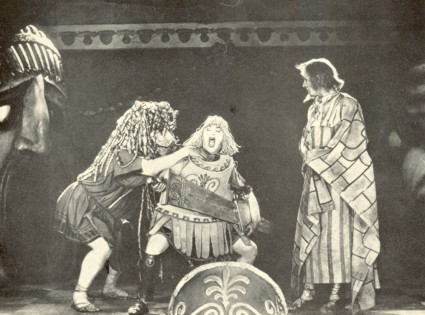
Ein Sommernachtstraum

The tragedy of Pyramus and Thisbe, from Ein Sommernachtstraum

Welcome to day two of the Bioscope Festival of Lost Films, and to our special venue this evening, the Court Electric Theatre in London’s Tottenham Court Road. Opened in 1911, this select venue seats 420, and normally its patrons are entertained by an Italian orchestra. For this evening, however, to play the special music composed by Hans May for our lost film, we have Eric Borchard’s American jazz band, brought over at great expense following their acclaimed performances accompanying the film in Berlin.

And what a treat we have for you. Ein Sommernachstraum is a fascinating film, strangely and undeservedly forgotten by the posterity that is to come. It is, of course, based on William Shakespeare’s comedy, A Midsummer Night’s Dream, which is the title it has been given in America, though in Britain it has been rather curiously renamed Wood Love. It is the last silent film to be made of a Shakespeare play, and one of the oddest of that distinctly odd genre.

The plot, as you will know, revolves around two pairs of Athenian lovers, whose fortunes are mixed up with the fairy band of the forest and a group of comic workmen rehearsing a play, whose performance forms the uproarious conclusion to both film and play. However, the film takes numerous liberties with Shakespeare, as you will see. The character Shakespeare calls Bottom is here called Zettel, and is played by the great Werner Krauss (who you will recall played Iago in the 1922 German version of Othello and Shylock in the 1926 Der Kaufmann von Venedig). Oberon is played by a woman, the Russian ballet dancer Tamara. A battle between Greek warriors and the female Amazon army is shown, such as Shakespeare never thought to stage. Theseus is seen using a telephone.

Indeed this is not a conventional, nor respectful interpretation. It satirises the performance of Shakespeare, and the rather confused critics have variously described it as being ribald, charming, stagey, sincere, magical, dull, and grotesque. The Berlin censors pronounced it as being forbidden to juveniles. That this is intentionally a radical production can be seen from the presence of contributors such as the well-known poet and critic Alfred Henschke, writing the titles which slyly parody Shakespeare, while director Hans Neumann has been previously distinguished as a producer of titles such as Robert ‘Caligari’ Weine’s strikingly expressionist Raskolnikov. Yet some critics see it only as being conventionally charming, with such magical features as double exposures for appearing and disappearing fairy folk.

The British critic Oswald Blakeston has had some curious things to say about the film in the journal Close-up:

We all know the respectable whose lives are led in a patch of arid ground shut in by a complicated geometrical pattern of lines. Valeska Gert [playing Puck] steps beyond the lines as a hierophant to show what fun one can get from being released; Krauss steps beyond the lines to show what a great actor he is. The Gert puts out her tongue at the audience in devilment; the Krauss puts out his tongue for the audience to see how well he can act the part of a devil … There are more things in this picture more ineluctably Rabelasian that I have ever discovered in the most boisterous Rabelasian comedy … The heartiness in this picture is not biased, it spreads to the simple pleasure of hacking a man in two with a battle-axe.

We are not entirely sure what Mr Blakeston is on about (and we will leave you the pleasure of seeking out a dictionary to find out what ‘hierophant’ means), but clearly the film is a challenge to the senses.

And let us not forget the music. Hans May’s music, performed by jazz band with strings, has divided opinion, but Variety calls it “a real advance in scores for accompanying comedy pictures”. May playfully combines Wagner with Tin Pan Alley, closely scoring for such comic scenes as the battle with the Amazons, and frequently in performance the audience has burst into applause at the musical flourishes alone. As with the intertitles, the music forms an ironic commentary on Shakespeare’s play.

The film has enjoyed a long run at Berlin’s Nollendorf Platz theatre, where it has appeal for a discerning audience, but doubts must be expressed whether it can enjoy a similar kind of success in America or Britain. We are very pleased to be screening it here this evening, but feel that no film burdened with the title Wood Love will last long in the British cinemas.

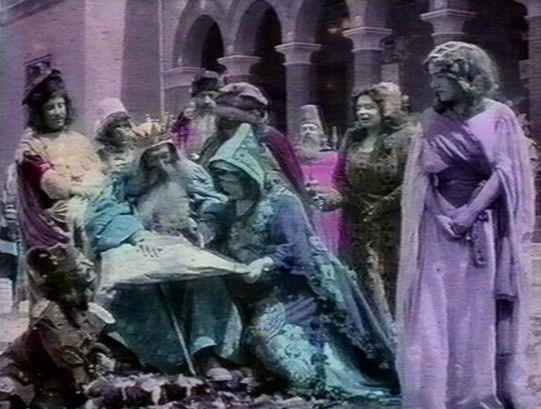
Hamlet (1907)

Georges Méliès contemplates Yorick’s skull

The lost short that accompanies Ein Sommernachtstraum is an appropriate one: Hamlet (France 1907). How wonderful to see the great Georges Méliès play the Dane! How wonderful too to have Shakespeare’s greatest, but undoubtedly lengthy play, brought to a far more manageable and agreeable length of ten minutes. All the essential details are there: Hamlet at the graveside, his madness aggravated by the sight of visions, Hamlet meeting his father’s ghost, Hamlet meeting the ghost of his love Ophelia, the duel before King Claudius, and the death of Hamlet. Clearly the film displays a bold use of flashbacks and much of M. Méliès’ favoured use of camera trickery. One great artist putting his distinctive stamp upon the work of another.

So ends our screening for this evening. Be sure to return tomorrow, when we shall be at the Casino de Paris to see a truly sensational American production.

They said that

Kafka Goes to the Movies

OK, here are the answers to yesterday’s poser. The six people commenting on the experience of going to the cinema in the silent era were all notable authors, albeit four of them wrote the comments before they found fame.

Quotation no. 1 – “Nothing of my former mind seems to have remained except a heightened emotiveness which satisfies itself in the sixty-miles-an-hour pathos of some cinematograph or before some crude Italian gazette-picture” – This is James Joyce, writing to his brother Stanislaus while living in Rome in 1907. Joyce was twenty-five years old, working in a bank, and a long way from literary fame. He was to become a regular cinema-goer, despite failing eyesight, and of course managed a cinema in Dublin for a brief period 1909-1910 – though that had more to do with money (which did not come his way) than any love of early film.

Quotation no. 2 – “If I had my way, I would build a lethal chamber as big as the Crystal Palace, with a military band playing softly, and a Cinematograph working brightly” – This is D.H. Lawrence, writing to Blanche Jennings in 1908, imagining how he might dispose of society’s outcasts. It’s a familiar quotation, from its use in John Carey’s book The Intellectuals and the Masses: Pride and Prejudice Among the Literary Intelligentsia, 1880-1939 (1992). Lawrence was contemptuous of the cinema – elsewhere he describes it as the “triumph of the deaf and dumb”. His first novel was three years away.

Quotation no. 3 – “Was at the movies. Wept. Lolotte. The good pastor. The little bicycle. The reconciliation of the parents. Boundless entertainment” – This is Franz Kafka, aged thirty, writing short stories, and touring around Prague with his good friend Max Brod, with whom he went to the cinema. There is an extraordinary book by Hanns Zischler, Kafka Goes to the Movies (2003), which identifies the films the pair saw, from Kafka’s and Brod’s diaries, tracks them down in reviews and archives (where they survive), and writes a history of Kafka’s emotional life and cultural life through the films that he saw. There’s an extract from it here. Zischler is now working on a similar project on James Joyce.

Quotation no. 4 – “the encroachment of the cheap and rapid-breeding cinema” – This is T.S. Eliot, and it comes from one of his most celebrated essays, ‘Marie Lloyd’, published in 1922. Eliot praises one form of working-class entertainment, but expresses loathing for its successor, the cinema, the phrase ‘rapid-breeding’ unpleasantly melding the growth in cinema-building with his sense of an animalistic, proletarian audience that filled him with horror.

Quotation no. 5 – “In spite of my earnest resolution never again to waste time at a cinema I have spent both yesterday and this afternoon in that unprofitable way” – The man with the addiction for going to the cinema is Evelyn Waugh. It comes from his diary entry for 3 September 1924, the day after he had vowed not to go the cinema “promiscuously”. The entry for 4 September however records, “Last night I slept ill; I think through excess of cinemas. I went to two yesterday”. This clearly was an addicition of some kind, and visits to the cinema are regularly recorded in Waugh diaries. Around this time he made scurrilous amateur films with Terence Greenidge, Elsa Lanchester and others, but had yet to complete his first novel.

Quotation no. 6 – “They have never seen the savages of the twentieth century watching the pictures” – This is from Virginia Woolf’s celebrated 1926 essay, ‘The Cinema’. Woolf was intrigued by film of reality, which she found to be at a curious remove from reality. Woolf was genuinely interested in the possibilities of the cinema, the potential it offered for a new way of seeing. Her ‘savages’ metaphor, however, I find mysterious.

The reactions of the literary intelligensia to the early cinema is a subject that fascinates me, and we’ll have more on the Bioscope in future posts – particularly those writers who found that they could make money out of the movies, or who were inspired to take up the camera themselves.

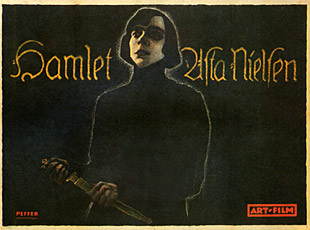
Asta Nielsen’s Hamlet

Hamlet

Asta Nielsen

Just back from the British Shakespeare Association conference, where I was able to tell them about the International Database of Shakespeare on Film, Television and Radio project that I’m supervising. This is an attempt at a ‘complete’ database of all Shakespeare-related titles ever produced in those three media, and so it will of course included all silent Shakespeare films. The ‘interim’ version of the database currently available doesn’t include any silents as yet, and you’ll have to wait for the proper release of the database in summer 2008 to see the full resource in all its glory.

The conference saw the first British presentation (on DVD) of the new restoration of the 1921 German Hamlet, starring Asta Nielsen. A tinted distribution print was discovered recently and has been restored by the Deutsche Filminstitut, using supplementary footage from the French distribution version in the Centre National de la Cinématographie. The film has long been available in black-and-white, but this the first time since the film’s original release that it has been possible to see it in its original colours, the processing work having been done by those acknowledged experts in silent film colour restoration, Haghefilm. The restoration then received its premiere at the Berlin Film Festival.

Hamlet was made for Nielsen’s eponymous production company, directed by Sven Gade and Heinz Schall. It is the best-known of silent Shakespeare films, if not quite (to my mind) the best of those that survive. The extraordinary aspect of the film is, of course, that Hamlet is played by a woman. For this they found academic justification, basing their interpretation on the scholarly endeavours of one Edward P. Vining, whose 1881 book The Mystery of Hamlet posited that the oddities of Hamlet’s behaviour might be explained by the fact that he was a woman in disguise. There had been (and continues to be) a tradition of female Hamlets, including Sarah Bernhardt, a glimpse of whose interpretation was filmed in 1900 (with accompanying sound effects).

Vining’s odd thesis helped legitimise Nielsen’s decision to play the part on film, but it is her luminous, intense performance that justifies it. She is extraordinary in the film, seeking to convey Hamlet’s agonising through diva-like dumbshow alone. The film has its dull patches, plus some unfortunate moments guaranteed to bring out the giggles in a modern audience, since a key aspect of the revisionist plot is that Hamlet is in love with Horatio (cue hoots of laughter when the astonished Horatio discovers, by manual examination, that the dying Hamlet is a woman). Shakespeareans may also be intrigued to find that Claudius dies in a fire, while it is Gertrude who administers the poison which she then drinks by accident – so all of those lying dead at the end of the film are women. The direction seldom rises above the routine, but there is a keen sense of palace life going on while the central figures progressively, and madly, destroy one another. It also gives no sense of a forced conversion from stage to screen – this is a wholly, and successfully reimagined work.

The best thing about the new restoration is its score by Michael Riessler. This blends conventional musical instrumentation with ‘archaic natural sounds’ and electronica. I found it extraordinarily haunting, and sympathetic to the film’s style and performances. The colour is colourful.

I don’t know when the restoration may get further UK screenings, but in the meanwhile, why not take a look at Tony Howard’s newly-published Women as Hamlet: Performance and Interpretation in Theatre, Film and Fiction, which tells the history of women playing Hamlet is a most entertainining and informative way. It has much to say on the film, and has Nielsen on the cover.

The Invention of Hugo Cabret

Méliès shop

http://www.theinventionofhugocabret.com

The Invention of Hugo Cabret is a children’s book (designed for 9-12 year-olds), written and illustrated by Brian Selznick and published this year. Set in Paris in 1931, it tells of a young orphan boy, Hugo Cabret, who is reduced to stealing to find food to eat, but then rescues an automaton from a museum fire. Seeking pieces to repair the figure, he steals pieces from a toy store by a railway station. Then he is caught. Now read on…

Our interest is that the toy store keeper is Georges Méliès. The illustration above from the book echoes the famous photograph of Méliès at his kiosk on the Gare Montparnasse, years after he had lost his film business and disappeared into obscurity, and just at the point of his re-discovery by film historians. Méliès becomes a leading character in the story, introducing Hugo to the world of early film. The book is a graphic-novel-with-text, and incorporates images from Méliès’ films.

There’s a website, www.theinventionofhugocabret.com, which has information on the ideas behind the book, including a page on Méliès, and a Flash slide show of some of the book’s illustrations.

There’s a video interview with Selznick, emphasizing his fascination for the Méliès story, on the ExpandedBooks.com site. It shows many illustrations from the book, from which we learn that Selznick makes a particular point of depicting shoe-heels in his drawings (Méliès’ film library was notoriously melted down to make, amongst other things, shoe-heels).

Rumour has it that Martin Scorsese is considering making a film based on the novel, or at least that John Logan, scriptwriter for The Aviator, is writing a screenplay.

The Ground Beneath Her Feet

Alan Rickman and Mike Figgis

Salman Rushdie’s 1999 novel The Ground Beneath Her Feet has been turned by composer Victoria Borisova-Ollas into a multimedia semi-opera, which premiered at the Manchester International Festival on June 29th. The multi-layered, fabulist blending of the Orpheus and Euridyce myth with the tale two Bombay rock stars involves the Hallé orchestra, electric guitars, readings by Alan Rickman, and – the reason for its notice here – a silent film directed by Mike Figgis, who has also directed the stage production.

Figgis’ half-hour film echoes the action, as indicated in this extract from a Guardian article:

Figgis is putting together a combination of still images and brief snatches of action – a “tableau vivant” is how he describes it to me in between takes at the small studio in Battersea, London, where he is filming over four days, working with a small budget and revelling in it. “I enjoy the fact that you’re very clear about what your limitations are and they’re not negotiable,” he says. “You can’t suddenly stop traffic or get extras. I woke up this morning and thought, ‘I wonder if they’re going to get enough denim farmwear together [for a scene set in the American midwest]. I remembered I had two denim work jackets and some cowboy neckerchiefs, so I brought them in.”

Figgis is anxious not to produce images that overpower the music (“I have to behave – and I am, I really am,” he says), and he does not intend to tell the story literally. Instead, he will provide filmic allusions that echo both story and score. “The book uses magic realism,” he says. “Fables dovetail and parallel each other. Film should try and function in the same way. But it needs to be very simple. It can’t be doing the sort of fireworks that would take the audience out of the music. It’s an interesting reversal. I’m a composer, too, so I do film scores. The function of the film score is to support the image. This is the opposite: the imagery is to support the music.”

An intriguing reversal indeed, to have a silent film acompanying a score (actually it happens a lot, but is promoted the other way round). However, I’ve found frustratingly little to describe the actual content of the film, nor any news as yet of any other performances. There are reviews to read in The Guardian and The Times, though they make little reference to the film.

Visiting the Volta

Volta then and now

I’m back from few days in Dublin, and naturally I paid a visit to 45 Mary Street. Why so? Because it was here in December 1909 that Dublin’s, indeed Ireland’s, first cinema was situated, manager one James Joyce. The author of Ulysses‘s contribution to literature is rather more considerable than his contribution to cinema history, but it is nevertheless a diverting tale.

Joyce was living in Trieste, Italy, and ever on the look-out for money-making schemes, when he fell in with a group of businessmen who ran a group of cinemas in Trieste and Bucharest, and teasingly told them that he knew of a city of half a million inhabitants without a single cinema. This was Dublin, of course, which had had plenty of film exhibitions before 1909, but no dedicated venue for film up to that date. A contract was signed between them in October 1909, and Joyce was sent over to Dublin to prepare things. He found a suitable venue at 45 Mary Street, off Sackville Street, and spent the next two months preparing what was named the Volta Cinematograph. He hired the staff, oversaw the fitting out of the venue, and heavily promoted the coming attraction with sandwich board men, press notices and the like.

The Volta opened on 20 December 1909, with this programme (correct original language titles and credits in brackets):

  • The Bewitched Castle (possibly Le Chateau Hanté, Pathé 1909)
  • The First Paris Orphanage (possibly La Première Pierre d’un Asile pour Orphelins, Pathé 1908)
  • Beatrice Cenci (probably Beatrice Cenci, Cines 1909)
  • Devilled Crab (possibly Cretinetti ha ingoiato un gambero, Itala 1909)
  • La Pouponnière (Une Pouponnière à Paris, Éclair 1909)

The Volta seated about 600-700 (200 kitchen chairs were at the front for those paying the top prices). It was a simple shop conversion i.e. no racking, and only the plainest of comforts. Doors opened at 5.00 pm and there were continuous 35 to 40-minute programmes every hour up to 10.00 pm. One extraordinary feature was that the titles of the films were all in Italian – Joyce received the films direct from the Trieste source rather than through English film exchanges, and so handbills were given out with English translations. Music was supplied by a small string orchestra, led by Reginald Morgan. Tickets were 2d, 4d and 6d, children half price.

Joyce did not stick around for long, leaving the cinema in the hands of one Francesco Novak, while he went back to Trieste on 2 January 1910. So his involvement in the actual running, and programming, of the cinema was minimal, though he did remain in touch with the business for a few months as it staggered along, hampered by poor presentation, competing attractions, and undoubtedly a paucity of American films. The business was sold at a loss to the British company Pronvincial Cinema Theatres in June 1910, and continued as a cinema (known for a while as the Lyceum, before it became the Volta once more) until 1948.

There has been quite a bit of interest among some academics in Joyce’s association with the Volta, as reported in an earlier post. This centres on the degree to which Joyce’s “choice” of films might be reflected in his writings (unlikely – he had little to do with the selection of films, which were simply the titles generally available at the time) and how much the idea of cinema itself can be found in his art (a stronger line of enquiry – he was always an enthusiastic filmgoer). As you will see from the photographs, the Volta has not fared as well as some of Dublin buildings associated with Joyce. The site is now part of Penney’s department store, and is not recognisable as having once been a cinema with a unique literary association.

There is a new book, An A to Zed of All Old Dublin Cinemas, collated and self-published by George Kearns and Patrick Maguire. It is mostly a collection of contemporay clippings and photographs, and has useful information on the Volta, including two photographs that I’ve not seen before, both from the 1940s, as is the left-hand image above. Sadly, no photograph of the Volta from the time when Joyce was there is known to survive.

But why not go along for yourself this June? Bloomsday (16th June, the day on which Ulysses is set) is always celebrated with a range of events, and this year these include a tour of Dublin cinema sites, including the Volta, led by Marc Zimmerman, author of another (forthcoming) book on Dublin cinemas. Here the blurb from the James Joyce Centre site:

JOYCE’S VOLTA CINEMA & BEYOND – A GUIDED WALKING TOUR

Start: James Joyce Centre, 35 North Great George’s Street
Duration: ca. 90 minutes
Finish: Irish Film Institute/Cinema, 6 Eustace Street

Tour: This tour visits James Joyce’s Volta cinema (opened 1909 as Ireland’s very first dedicated picture house) as well as a further 15 historic cinemas in Dublin’s city centre ranging from early conversions of Georgian buildings to lavish Art Deco venues, giving a detailed account of their cultural history, architecture and significance. The tour will be illustrated with numerous historic and interior photographs.

Guide: Marc Zimmermann is a building conservation engineer and the author of The History of Dublin Cinemas (book out in May and avail. during the tour). He founded the Cinema Heritage Group in 2006 and issues a free e-newsletter, The Cinematograph [subscribe from: NOSPAMheritage_events@yahoo.com]

Date: 14th June 2007 & 17th June 2007
Time: 7.00pm (14/6) & 2.00pm (17/6)
Venue: James Joyce Centre, 35 North Great George’s Street
Tickets: €10 / €8conc.
Advanced booking advised

There are other Joycean film-related events taking place.

Silent Shakespeare

lear1.jpg

A first of some kind has been announced by the Shakespeare’s Globe theatre on London’s South Bank. On 23 April (Shakespeare’s birthday), the white walls of the Globe will be effectively converted into screens, as a 45-minute programme of silent Shakespeare titles from the BFI National Archive will be projected on the outside of the theatre. The films, already known through the BFI/Milestone Silent Shakespeare DVD, will be accompanied by Laura Rossi and Fourth Dimension string quartet – Rossi composed the score for the DVD. The screenings take place at 7.00 and 8.00 pm.