Sentiment and Sensation

boutdezan.jpg

The Museum of Modern Art in New York has an exhibition of posters for silent films, Sensation and Sentiment: Cinema Posters 1912–14. It runs May 23–August 27, 2007. The posters come from the renowned collection of Dutch film distributor Jean Desmet (1875–­1956), and advertise American, British, Danish, French, and Italian films dating from 1912 to 1914. The exhibition also has rare photographs documenting the earliest sites of film exhibition in the United States. The exhibition is accompanied by a related film series in July and August. The wonderful poster above for Bout-de-Zan et le crime au telephone (1914) is all that’s illustrated on the website, alas.

(Bout-de-Zan is the little boy in the picture. He was played by René Poyen (1908-1968), who portrayed the character, a child always distinctively dressed as an adult, in a string of short comedies made by Louis Feuillade for Gaumont)
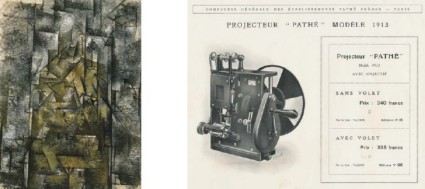
Picasso, Braque and Early Film in Cubism

braqueandprojector1.jpg

What sounds like a remarkable exhibition is opening at the PaceWildenstein gallery, East 57th Street, New York. It’s called Picasso, Braque and Early Film in Cubism, and it builds on art dealer Arne Glimcher’s feeling that Picasso and Braque were enthusiasts for early cinema, and that what they saw on the screen helped contibute to their new art i.e. cubism. The exhibition (which runs April 20-June 23) features nineteen paintings by Picasso and Braque, nine original works on paper, sixteen prints, two books, photographs, projections of early films, vintage cameras, projectors, and other objects.

It’s an intriguing theory, but with scant actual evidence. Surviving correspondence reveals nothing. Picasso saw his first film in 1896, there are assorted references to his friends and associates going to see films in the 1900s, and art historians claim to have detected relevant elements of imagery or technology in the paintings, but mostly the exhibition will have to be based on conjecture and suggestion. No matter – it’ll set minds thinking, and it’ll be further demonstration that early film did not (and could not) exist in cultural isolation. There’s an article in the New York Times, ‘When Picasso and Braque went to the movies‘, which gives the background to the exhibition.

Clearly there is something in the air here. Check out earlier posts on Lynda Nead’s essay about the image of artists in early film, and the Moving Pictures exhibition about the influence of early cinema on some American realist artists.

The Devil in the Studio

The Devil in the Studio‘ is an article by Professor Lynda Nead of Birkbeck College, London, which has just been published in the Tate’s online journal Tate etc. The essay covers the depiction of artists in films 1896-1910. Lynda Nead has been coming up with some of the most interesting new ideas and contextualisation in early film studies around at the moment. The essay has a lot to say about how the young art of film engaged with and challenged the elder statesman that was fine art (a theme recently the subject of comment on this blog). “The young upstart surpassed the illusionistic capacities of the traditional arts and flaunted its special effects to ridicule the artist.” Food for thought.

Moving Pictures

Oh to be in Washington, as this exhibition sounds excellent. Moving Pictures: American Art and Early Film is running 17 February-20 May at the Phillips Collection, 1600 21st Street, NW, Washington, DC 20009. As the blurb says, “This exhibition will present American realist painting from the late 19th and early 20th centuries side-by-side with the earliest experiments in film. Approximately 100 works, including nearly 60 short films (a few minutes long) by Thomas Edison, the Lumière Brothers, and the Cinémathèque Française, along with works by American masters such as George Bellows, William Merritt Chase, Thomas Eakins, Maurice Prendergast, and John Sloan, will provide a new context for looking at the artists’ choice and presentation of subject matter. For the first time, film will be fully integrated into the history of American art.”

The connection between art and early film is a fascinating subject that needs to be explored more. The work of chronophotographers like Eadweard Muybridge, trying to capture reality through sequence photography, had a particular fascination for realist artists like Frederic Remington, whose paintings of horses must be seen in the light of Muybridge’s famous achievement of photographing a galloping horse. And then the emergence of moving pictures themselves provided an extra challenge for artists who had already had to face up to photography, provoking them into new ways of expression. The early filmmakers were the first surrealists!