Channel 4 has had another of its engrossing list programmes; this one was Fifty Films to See Before You Die. And, guess what, there wasn’t a silent film in it. In fact there were only six black-and-white films in it (A Night at the Opera, This Sporting Life, Touch of Evil, A Bout de Souffle, The Apartment and Manhattan). Our film critics, who selected this list, evidently see very little beyond their own lifetimes. And clearly many of them do not see silent films at all – probably literally so. Do we have separate film histories here? It’s been interesting to see in some recent film histories and reference books how themes in film history often seem to start in 1930, or are divided up into the silent and sound eras. Silent cinema has become a foreign country.
Category Archives: General
Terra Media

A key aspect of The Bioscope’s mission is to highlight resources for the study of silent film, particularly those not well known or obvious.
A model example is Terra Media. This is a one-man marvel of information on the history of media, beautifully arranged, and filled with riches. Its centrepiece is Chronomedia, a detailed chonology of media history year-by-year. As the site says, “Chronomedia is designed to become the most comprehensive and accurate timeline of developments in communications media ever compiled. By integrating references to all audio-visual media—film and cinema, radio and television, cable and satellite, interactive (multi)media, photography, telegraphy, telephony and even printing and publishing—it becomes easier to see the parallel developments and interactions that have formed the media scene we know today.” The year-search option alone is a joy to see, individual entries are to the point, and it is all very satisfactorily cross-indexed, linked and illustrated.
There are other sections on quotations, the history of television as public performance, the quest for home video, a reference section, and a fascinating section on British media legislation. There are further sections on statistics (including early British cinema circuits) and contemporary documents (none covering the silent era). The site continues to grow, and is just such a pleasure to use. Its editor is David Fisher, whose day job is editor of the media news and market research journal Screen Digest. Take a look.
The first Rachael Low lecture
For anyone who finds themselves in Nottingham on 26th April – this is the first in a series of annual lectures celebrating the work of Rachael Low and British film history. And it’s free.

Edwardian hoodies
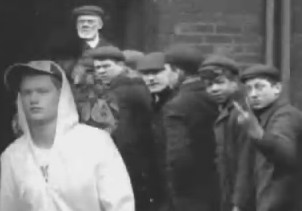
Anyone watching BBC television at the moment will have seen the trailer for the BBC4 Edwardians season. The trailer uses footage from the now renowned Mitchell and Kenyon collection of mostly actuality films of life in nothern England 1900-1914, digitially treated to mix the people of Edwardian times with such modern figures as a pizza delivery motorbike, a ‘golf sale’ signboard, rock concert fans, a policeman with a gun, and a hoodie. So of course they’re just like us and we’re just like them. You can see the trailer here (click on ‘Watch the season trail’).
Update – For all those who have been looking, the music that accompanies the trailer is Fashion Parade, by Misty’s Big Adventure. More details from the band’s MySpace site.
Goad
As some of you will know, the Goad plans were insurance plans of cities in Britain and elsewhere by Chas. E. Goad. If one searches the COPAC union catalogue of British academic and research libraries (http://www.copac.ac.uk) under ‘maps’, over 6,000 such plans and sets of plans come up. Over a thousand of these are for the period 1880s to 1920.
In the period after 1900, buildings used as cinemas or classed as cinemas are sometimes indicated on these plans, as such buildings were of course known fire hazards. Probably film stores would have been charted too. I have long thought, even before these plans were so well catalogued online on COPAC, that an interesting project for someone would be to use these plans to locate such film-related buildings.
Many of the Goad plans cover Canadian towns and cities, and I believe that, as the originals were lost in a fire in a store in Canada some years ago, these British copies (mainly held in the British Library) are the only surviving examples. Where else would one find an insurance map of Moose Jaw in 1909? British and Canadian early film scholars please note.
The Written Word
Today I was looking over an article I located from the Illustrated London News dated August 19, 1922. The title of the piece is “The Birth of the Cinematograph: From Still to Moving Pictures”. This particular article was written by Will Day. Day was an enthusiastic collector of many things, among them some of the early apparatus of pre-cinema and moving pictures. The article is a very interesting document in that it relates much of the pre-cinema history as opposed to traditional moving images. It also has me reflecting on another group of individuals in motion picture history. People such as Day, Merritt Crawford, Earl Thiesen and countless others spent an inordinate amount of time and energy in the attempt to document moving image history. When you think about it, if not for these men, much sole source data such as first person interviews and correspondence might not exist. In many cases actual footage, and equipment is no longer available, so this turns out to be our only method of providing a sense of the history of the Industry. I have found it fascinating in the course of my own research; be it by design or by accident to locate and find written histories left by many more people who played a part in the development of the film industry.
A Tour of the Cinema Museum with Ronald Grant
I’m a bit wary about adding YouTube clips to The Bioscope. My pernickety film archivist principles will prevent me from posting anything that’s been ripped off illegally from somewhere else, so I’ll try to stick to legitimately posted stuff which is of interest. So, let’s start with this wonderful tour of The Cinema Museum, the treasure trove of film memorabilia held in the former Lambeth workhouse where Chaplin’s mother was incarcerated. It isn’t open to the public alas, but this five-minute tour is a real treat, with programmes, music scores, posters, films, memorabilia, costumes, equipment, journals and stills, all crammed in so that there’s barely room to move.
A good read or two
Having expressed disappointment at the Silent Cinema book by Brian Robb, what should the person new to silents read as an introduction to the subject? There’s not much among new publications (please somebody let me know if you have opinions otherwise), but I’ve come up with a top ten that I would recommend.
1. Karl Brown, Adventures with D.W. Griffith (1973)
Out of print, but easy to find second hand, this a memoir by the assistant cameraman to Billy Bitzer, who was D.W. Griffith’s cinematographer. It is an eye-witness account of the making of Birth of a Nation and Intolerance, written with immense charm, wit and memorable observation. There is no other book like it for conjuring up the excitement and creativity of early filmmaking. It’s a terrific read, funny and informative, making you wish that you had been there too.
2. Ivan Butler, Silent Magic: Rediscovering the Silent Film Era (1987)
Another book from someone who was there. Ivan Butler saw his first film in 1915 and went on to become a film historian. This is a marvellously evocative account of the films he saw in the silent era, year-by-year, with sharp observations not only on the notable films and stars of the period but also many names and titles now forgotten. You get a real sense of what it was like to be a regular filmgoer in the 1920s (in Britain). It’s out of print, but well worth tracking down.
3. Edward Wagenknecht, The Movies in the Age of Innocence (1962)
A classic survey of the silent screen from the early one-reelers to the 1920s, concentrating on American silent cinema. It is literate and enthusiastic in equal measure, mixing personal recollection with wise observation. And it’s still in print.
4. David Robinson, Chaplin (1985)
Charlie Chaplin’s own Autobiography is a candidate for this list, but my vote goes for this exhaustive, amazing biography, 792 pages and yet you may want to read it all at single setting. It makes best use of unprecentend access to the Chaplin archives, and it is just such an amazing, Twentieth Century story.
5. Brian Coe, The History of Movie Photography (1981)
If you have to have one book on motion picture technology (and it’s worth having one), this is it. It doesn’t just cover the silent era, but for that period alone (and the ‘pre-cinema’ of the nineteenth century and before) it is the best, clearest and most helpfully illustrated publication yet produced. All good film archivists swear by it. Of course it’s out of print, but not hard to find.
6. George Pearson, Flashback: The Autobiography of a British Film Maker (1957)
Pearson was a schoolteacher, aged thirty-seven, when in 1912 he gave up his steady career to become a film director and writer with the Pathe company in Britain. This is a touching, thoughtful and often inspiring memoir from someone who toiled during the difficult years of British filmmaking. His hopes for film as an art and as a source of instruction are inspiring, even if his personal achievements were relatively humble. It’s also just a very readable and observant account of the British film industry over three decades.
7. Charles Musser, Before the Nickelodeon: Edwin S. Porter and the Edison Manufacturing Company (1992)
OK, this scholarly and very detailed work isn’t every beginners idea of where to begin, but if your interest is in the scholarly excitement generated by early cinema, and how the field of film before 1914 can be a source of ideas, debate and theory, this is the book for you. It uses the carer of Edwin S. Porter (director of The Great Train Robbery) as a way into a deep understanding of how the motion picture industry emerged, ably situated within a broader socio-cultural framework. It has inspired many other such studies, but hasn’t really been beaten yet.
8. Kevin Brownlow, The War The West and The Wilderness (1978)
Most would put Brownlow’s famous The Parade’s Gone By in such a list, but this is my favourite of his books, which shows us that there was much more to the silent cinema than the conventional fiction feature film. This is about the pioneers who went out and filmed wars and revolutions, went exploring with the camera, and recorded the wild West in the first years of cinema. It’s particularly good on the actuality filming of the First World War, and films of polar exploration. It’s a book about discovery which has discoveries itself on every page. There’s such enthusiasm and admiration on every page. It’s out of print of course, and copies tend to be a bit costly – but, go on, treat yourself.
9. Walter Kerr, The Silent Clowns (1975)
Another classic. No book conjures up better the skill and immense fun of the great silent comedians. It has definitive observations on Chaplin, Keaton, Lloyd, Laurel and Hardy, Langdon and a host of other, it is richly illustrated, and it has wise things to say on what we laugh at and why.
10. Garth Jowett, Film: The Democratic Art (1976)
This is a social history of American film. There have been far too few such histories, as though film existed solely on the screen, without any wider social significance. This book does what any sensible history of such a phenomenon should do: it looks at the social, political, cultural and economic forces which drove cinema, with the focus on audiences and institutions. It goes beyond the silent cinema period, but if you want to see how film in the silent era interacted with society (and you should), this is a very good place to start.
Silent Cinema

Silent Cinema by Brian J. Robb is a new publication on the subject for the general reader that seems to have come out of nowhere. The author has previously written books on Johnny Depp, Keanu Reeves and Brad Pitt, while for for Kamera Books this is their first book. The blurb promises: “Through a study of the earliest origins of cinema to the stars, comedians and directors who became popular from the late-Victorian ear [sic] to the end of the 1920s, and including a look at the earliest Hollywood scandals of the time, ‘Silent Cinema’ will be a handy guide to the art of cinema’s silent years in Hollywood and across the globe.” It also comes with a DVD including extracts from Son of the Sheik, Phantom of the Opera, The Perils of Pauline, Salome and Orphans of the Storm. And it’s only £5.95 on Amazon.co.uk at the moment. Must be worth a punt.
Silent MySpace
A surprising number of silent film figures have pages on MySpace. Here’s some of them, though mostly of interest for the phenomenon rather than the reliable information that they might provide:
- Betty Balfour
- Vilma Banky
- Lionel Barrymore
- Clara Bow
- Charlie Chaplin
- Douglas Fairbanks
- Greta Garbo
- Lilian and Dorothy Gish
- D.W. Griffith
- Buster Keaton
- Barbara La Marr
- Harry Langdon
- Max Linder
- Harold Lloyd
- Colleen Moore
- Nazimova
- Mary Pickford
- Mack Sennett
- Gloria Swanson
- Rudolph Valentino
- Erich von Stroheim
And probably many more.
 The Bioscope