Early Hitchcock

Hitchcock Collection

http://www.amazon.com

Alfred Hitchcock was an exceptional silent filmmaker before he moved to sound (and one could argue he remained a pre-eminent silent filmmaker throughout his career). This Region 2 DVD set of early Hitchcock films has just been released, containing two of the ten silent features that he made (if you include the silent version of Blackmail). The nine-DVD set features the silents The Ring and The Manxman, and the sound films Blackmail, Champagne, Murder, Rich and Strange, The Skin Game and Number Seventeen. The extras include a scene from the silent version of Blackmail, an alternative ending to Murder, archive footage of actress Anny Ondra, and a 50-minute documentary Hitchcock’s Early Works.

Birt Acres on CD

It is perhaps inevitable, given the different trajectories of the twin pioneers of British film, Birt Acres and Robert Paul, that while the latter gets the deluxe DVD treatment from the BFI (see previous post) with book to follow, his one-time partner and later bitter rival Acres has his biography published on CD from a small publisher for the interest of the select few. While Paul became a rich and successful man, noted in all film histories, Acres’ name remains little known, his work unfamiliar even to specialists in the field. Frontiersman to Film-maker: The Biography of Film Pioneer Birt Acres, FRPS, FRMetS 1854-1918, published by The Projection Box, is worth checking out by anyone interested in the earliest years of filmmaking, and in seeing how family history can be used to humanise people from this remote period of film history. The biography is written by Alan Birt Acres, his grandson, and tells the story of the man who was the first person to take and project a 35mm film in the UK. Not all of it stands up to rigorous historical enquiry, but it conjures up a credible picture of the man, is beautifully illustrated, and offers plenty of leads for those keen to research further the still mysterious roots of filmmaking in the 1890s.

Robert Paul on DVD

RW Paul

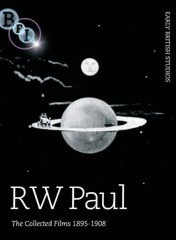
RW Paul DVD cover, from http://www.bfi.org.uk

The British Film Institute has published a DVD of practically all of the surviving films made by Robert William Paul, one of the leading pioneers of British cinema. R. W. Paul: The Collected Films 1895-1908 contains sixty-two films, including comedies, dramas, trick films, actualities from the Anglo-Boer War, Paul’s notorious film of the disastrous launch of HMS Albion in 1898 (notorious because Paul carried on filming after people had been knocked into the water, some fatally, though his boat picked up survivors), travel films from Spain, Portugal, Egypt and Sweden, and news footage of the 1896 Derby and Queen Victoria’s Diamond Jubilee through London on 22 June 1897. The DVD runs for 147 mins, with piano accompaniment by Stephen Horne, and a commentary and booklet by Ian Christie, whose book on Paul comes out later this year.

A synopsis of the life-work of Alfred West

The 1912 catalogue of the films of Alfred J. West, A Synopsis of the Life-Work of Alfred West, has been published online in PDF format by the Wessex Film and Sound Archive. Alfred West (1857-1937) was the man behind ‘Our Navy’ and ‘Our Army’, hugely popular multi-media shows comprising films, photographs, songs and dramas. West was active as a filmmaker from 1897-1912, based at Southsea, Hampshire, UK. His patriotic, militaristic and sentimental shows were popular across Britain and the Empire, and for many who came to see the shows they were their first experience of motion pictures. There is a website dedicated to West which is maintained by his great-grandson, David Clover, who has been instrumental in getting the catalogue published. The original is held in the British Library.

Update (August 2008): The weblink for the document has now changed to http://www3.hants.gov.uk/wfsa/wfsa-collections/navy-marines.htm.

Chaplin saved

Despite Ian Hislop’s best efforts, Charlie Chaplin was saved from Room 101 because Paul Merton refused to put him there (see previous post). Hislop railed against not only Chaplin but “all silent films”. Merton called on pianist Neil Brand to accompany Chaplin clips on the big screen, followed by ‘silent’ film of Hislop himself. The audience seemed to lap it up, but Hislop remained stonily unconvinced.

Room 101

Look out on British TV for the comedy programme Room 101 on Friday 9 February at 22.00. The guest is Private Eye editor Ian Hislop nominating his pet hates for consigning to Room 101, and they include Charlie Chaplin. The doyen of silent film pianists, Neil Brand, will be accompanying a Chaplin clip with the hope of saving Chaplin’s reputation. the programme is hosted by silent film comedy enthusiast Paul Merton, who will hopefully put up some form of defence. We’ll have to see.