Seeing the unseen world

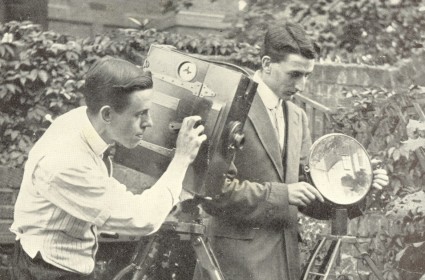
Francis Martin Duncan with microcinematographical equipment

Opening today is an exhibition at the Science Museum on the history of the science film. Entitled Films of Fact, it looks at the development of scientific films and television programmes from 1903 to 1965. Its subject, and that of the book that accompanies it, is not really scientific film as in film used in the study of science, but rather the presentation of science on film. So it’s about popularisation and communication.

Films of Fact as a title comes from the name of the company of social documentarist Paul Rotha, once renowned not just as a filmmaker but as a theorist and film historian. But the exhibition also focuses on an earlier period, when science film meant films of nature, and it has generated quite a bit of press interest in one film in particular, Cheese Mites, made by zoologist Francis Martin Duncan in 1903 using microcinematopgrahic equipment (microscope + cine camera, basically) for producer Charles Urban. Urban had had the extraordinary idea of putting science films before a music hall audience, in a show he called The Unseen World. This contemporary review from the Daily Telegraph gives an idea of the astonished audience reaction:

Science has just added a new marvel to the marvelous powers of the Bioscope. A few years ago it was thought sufficiently wonderful to show the picture of a frog jumping. Go to the Alhambra this week and you may seen upon the screen the blood circulating in that same frog’s foot. This sounds a trifle incredible, but it is an exact statement of the truth. The new miracle has been performed by the adaptation of the microscope to the camera which takes the Bioscope films. Last night The Charles Urban Trading Company Ltd, who has taken the photographs, had many other miracles to show and explain to a fascinated audience. There was a blood-curdling picture of cheese-mites taking their walks abroad, the tiny creatures looking on the screen as large as small crabs. The minute hydra which lives in stagnant water appeared shooting out its tentacles and taking a meal … Twenty-five minutes, the length of the exhibition, is a long time to give to a Bioscope turn, but the rapt attention of the audience and the thunders of applause at the conclusion testified to the way in which popularity had been at once secured by these unique pictures.

Cheese Mites (1903)

Cheese Mites was the hit of the show, and is only one the Unseen World films to survive (the BFI has it). Originally the film just showed the magnified creatures. Later Urban added a comic framing story, as this Charles Urban Trading Company catalogue entry explains:

A gentleman reading the paper and seated at lunch, suddenly detects something the matter with his cheese. He examines it with his magnifying glass, starts up and flings the cheese away, frightened at the sight of the creeping mites which his magnifying glass reveals. A ripe piece of Stilton, the size of a shilling, will contain several hundred cheese mites. In this remarkable film, the mites are seen crawling and creeping about in all directions, looking like great uncanny crabs, bristling with long spiny hairs and legs.

Unfortunately, these extra scenes don’t survive. There’s a news report on the BBC site about the exhibition, which include the Cheese Mites film, so do take a look, and ponder the alarm that was said at the time to have spread among cheese manufacturers, who begged for the film to be stopped being shown. There’s also an article in this week’s New Scientist magazine which tells the story behind the film and that of Percy Smith, a later collaborator with Charles Urban, who made such classics as The Balancing Bluebottle (1908) and The Birth of a Flower (1910), employing time-lapse photography, before going on to make the once-famous series The Secrets of Nature in the 1920s and 1930s.

The Acrobatic Fly (a retitled version of The Balancing Bluebottle), made by Percy Smith in 1908. As Smith explained, “The fly is quite uninjured and is merely supported by a silken band when performing with weights which would otherwise overbalance it. When its feats are accomplished it is allowed to fly away.”

And then there’s the book. Timothy Boon’s Films of Fact: A History of Science in Documentary Film and Television is something quite special. It’s a history of a type of film which has barely been covered by historians, and has much that is new or revalatory, for the silent era and beyond. But it’s also a cultural history, which addresses why these films were made, what the popularisation of science means, and how science relates to society at large. It’s an exciting read, and I’ll try and give it more space at another time, while looking at the literature of the early science film in general. Anyway, Charles Urban, F. Martin Duncan and Percy Smith are the flavour of the moment, which is unexpected but should be fun while it lasts. I saw Cheese Mites and Percy Smith’s The Acrobatic Fly shown before an audience this evening, and they excited much the same mixture of amusement and amazement as they did a century ago. The filmmakers of old did know a thing or two.

The Science Museum exhibition runs until February 2009.
Méliès by instalments

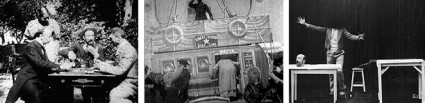
Une Partie de cartes, Entre Calais et Douvres and Un Homme de têtes, from http://filmjournal.net/melies

Parbleu! The publication of the Flicker Alley five-disc set of (most of) the works of Georges Méliès has already sparked off a lot of interest and investigation, some of it centred on identifying those titles which exist but aren’t included on the DVDs. But now we have Georges Méliès: An in-depth look at the cinema’s first creative genius. This is a new blog/research tool from Michael Brooke, part of the new Filmjournal blogging site. Brooke (a regular contributor to the BFI’s Screenonline site) has taken on the task of reviewing everyone of the 173 films on the Flicker Alley set, in chronological order. Each film is given under its English and French titles, with date, catalogue number and length; illustrated with a frame still; the action described; a detailed review follows (including comments on the DVD quality); then links (usually IMDB, Wikipedia and YouTube).

It’s well done and is going to build up into a really useful resource. The emphasis is very much on stylistic innovations, but there’s more to Méliès than magic and film form. His films were grounded in social and political realities (it’ll be interesting to see how his films of the Dreyfus affair are covered), and in ways of storytelling that reach way back before the upstart cinema. Anyway, an excellent effort so far, and an answer to the complaint on this blog that there weren’t any good Méliès sites out there. It looks like one is building up film by film before our eyes.

Putting up statues to Charlie

This intriguing news report just turned up on a Kazakhstan news site:

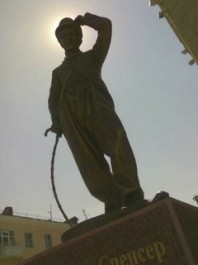
A monument to Charlie Chaplin has appeared in Kostanai last week. As reported, it is the 12th in the world. The very fact of a sculpture to the cinematographe idol being installed in our city is quite weird for the town’s standards, especially taking into account that the only movie theatre in Kostanai was recently demolished. In any case, now we have Charlie and a bench near charlie. And as Farid writes in the local newspaper, “the bench is good enough to sleep on it — that’s practical, because we have as much vagabonds in town as in NYC in early 1900s”.

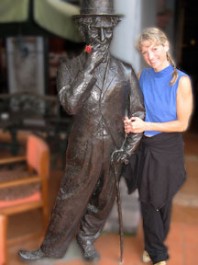
What intrigues me is where the other eleven statues are. I wasn’t able to find a helpful source for this, and so I set out to track them down for myself – though it all depends on how you define ‘statue’. Anyway, I thought I’d share this information with you; certainly it’s pleasing to see how admiration for silent cinema’s most celebrated practitioner is marked worldwide in bronze. So to start with (left) we have the twelfth and most recent statue, that which has gone up in Kostanai.

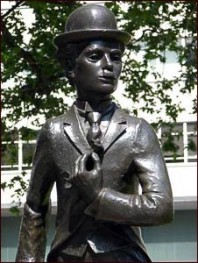
Next, there’s the renowned statue of Chaplin in London’s Leicester Square. He is located in the heart of London’s movieland, with cinemas all about him, while his fellow statues in the Square are Isaac Newton, William Shakespeare, Sir Joshua Reynolds, John Hunter (a pioneer of surgery), and William Hogarth. The Chaplin statue is by John Doubleday, and was created in 1981.

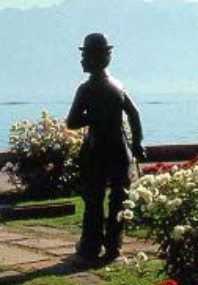
On to Chaplin’s final home, Vevey in Switzerland. In the Square Chaplin, Quai Perdonnet is you’ll find the double of John Doubleday’s statue, showing the little tramp looking out over his favourite view of Lake Geneva and the Alps. It is said to be the subject of pilgrimage, and certainly there are plenty of blogs out there showing people photographed next to Chaplin, leaving flowers there, or even kissing the statue. It was erected in 1982, and is a copy of the Leicester Square statue.

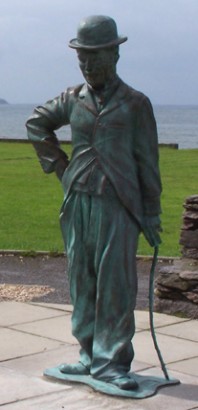
Our next statue is in the seaside town of Waterville, Co. Kerry, Ireland. Waterville was a favourite holiday destination of the Chaplin family. The legend on a stone nearby reads, “For the man who made the movies speak in the hearts of millions. Charlie spent many years in our midst as a welcome and humble guest and friend to many. This image was created by sculptor Alan Ryan Hall. It was funded by the generosity of Josephine Chaplin and by the EU Leader Programme”. It was unveiled in 1998.

And on to Norway. In Oslo, near the Frognerpark, in front of the Coliseum cinema there is a bronze statue of Charlie Chaplin by the renowned Norwegian sculptor (well, renowned to Norwegians, anyway) Nils Aas, dated 1976. Frustratingly, I haven’t been able to track down an image of this in situ [see comments], but here at least is a studio copy. There doesn’t seem to have been any special association of Chaplin with Norway, unlike most of the other statues on view here.

Now let’s away to China, no less. This statue is located outside the ‘Old Film Cafe’. Duolan Road, Hongkou District, Shanghai. The personal connection is that Chaplin secretly honeymooned in Shanghai with Paulette Goddard in 1936. No information as to sculptor or date, but much like most of the statues on display here, you have to say it looks nothing like him. It’s so easy to capture the outline figure, so difficult to capture the man.

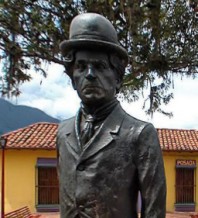
I’m not quite sure why there should be a statue on Charlie Chaplin in Venezuela, but there is. It is located in the city of Mérida, where it is to be found in the Plazoleta Charles Chaplin. No information that I can find as to artist or reason. So on to Disneyland Paris, where a statue of Charlie Chaplin welcomes visitors to the Production Courtyard, but I’ve not yet found a picture of this one.

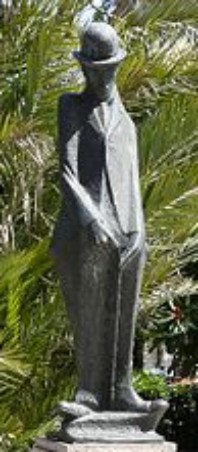
And now we travel to Alassio in Italy. This sheltered spot on the Ligurian coast (the Italian Riviera) is another place where Chaplin often stayed on holiday. The legend on the base of the elongated and not terribly Chaplin-like statue simply reads ‘Charlot’. No information as yet on sculptor or date.

The statue on the left is located in Gabrovo, a small mountain town in Bulgaria. Gabrovo and Gabrovians are apparently the butt of Bulgarian national jokes, but they have responded ingeniously by creating a museum of humour and satire. So it is an appropriate location for a statue of Chaplin. The statue was created by Georgi Chapkanov, and is situated next to Don Quixote and Sancho Panza. It also wins some marks for being a little different.

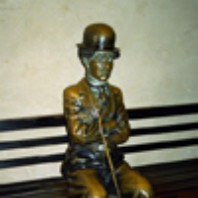
This sitting statue of Chaplin is to be found in the foyer to the Roosevelt Hotel, along Hollywood Boulevard, Los Angeles. It common with most of the statues, there is particular reason for its location. It was at the Roosevelt Hotel where Chaplin received his Academy Award for The Circus in 1929. Another favourite subject for a host of tourist photos.

Well, that makes eleven. Where’s the twelfth? I don’t think the twelve-foot statue of Kermit the Frog as Chaplin outside the Jim Henson Studios (the former Chaplin Studios) really counts. Nor do assorted figures of Chaplin outside restaurants. I think I’ll go with the statue of him outside the Hollywood Entertainment Museum in Los Angeles, which is pleasingly dynamic (pictured left). If anyone knows of any others, or has more information about those described, do say.

Update (16 March 2009): For the news story about the attempt to build a giant statue of Chaplin in India, which have aroused religious protests, see The 13th Statue.

Georges Méliès, magicien du cinéma

http://www.cinematheque.fr

Why so much activity concerning Georges Méliès just now? First the (virtually) complete DVD box set of his work released by Flicker Alley, and now a major exhibition with lavish catalogue, screenings, DVDs etc from the Cinémathèque française. He’s neither one hundred years born nor one hundred years dead. In fact he’s seventy years dead, and that’s the point. Under European copyright law, 2008 is the year when the works of Georges Méliès, who died in 1938, come out of copyright, under the rule which says a creative work remains in copyright until seventy years after the death of the author.

So M. Méliès has become fair game – a fact which can be of no small amount of irritation to the Malthete-Méliès family which has so assiduously guarded his legacy until now. They had nothing to do with the acclaimed Flicker Alley set, but they have co-operated with the Cinémathèque française exhibition, which opens in Paris on 16 April and which is described in some detail (in French) on the Cinémathèque’s website.

Where to start? The exhibition itself is divided into three sections: Magie et cinématographe, Le Studio Méliès de Montreuil and L’univers fantastique de Méliès, covering his life, background, work and influence. Many artefacts not previously exhibited in public are promised, and Méliès is championed for the modern generation as the master of special effects and fantasy cinema, foreshadowing Georges Lucas and Steven Spielberg. A 360-page catalogue has been produced, edited by Jacques Malthete et Laurent Mannoni, with some 500 illustrations, which from reports I’ve had so far sounds like an outstanding production in itself.

There are two DVDs published to coincide with the exhibition. The first, Georges Méliès, produced by StudioCanal/Fechner Productions, is a two-disc set featuring thirty remastered Méliès films 1896-1912, with 32-page booklet but no indication of what film titles are included nor their source.

The second DVD is Méliès, le cinémagicien, another two-disc set, produced by Arte Vidéo. This features a documentary, La magie Méliès, by Jacques Mény (1997, 130 mins), a selection of fifteen of the films from 1898 to 1909 (55 mins in total) and the renowned Georges Franju film Le grand Méliès (1952, 37 mins) which is also available on the Flicker Alley set.

This documentary, which introduced many to his films for the first time, features Méliès’ son André, playing his father, and Méliès’ second wife and star of many of his films, Jehanne d’Alcy (then aged ninety).

And there’s more. There are screenings in April-May of Méliès films and in June-July of ‘L’héritage méliès’. A complete Méliès filmography is also promised, which will be a boon, particularly if it goes the whole hog and identifies the films by Star-Film catalogue number (his production company), length, English release title, which copies are extant and where. Meanwhile, Méliès, magicien du cinéma looks like a very good reason to visit Paris over the next few months (as though there weren’t reasons enough anyway, but you know what I mean).

Where to find out more about Georges Méliès? It’s a shame – indeed something of a mystery why there isn’t a single good site dedicated to him (interesting to see that http://www.melies.com, http://www.georgesmelies.com, http://www.georgesmelies.org and http://www.georgesmelies.fr have all been bought up opportunistically by domain sellers). Cinémathèque Méliès (in French) is a so-so effort of ancient design which I’ve had trouble accessing, but you can trace it back through the Wayback Machine. The Magical World of Georges Méliès likewise isn’t going to win any design awards, but it has a biography, filmography, and links to his films on YouTube. There’s a useful one page biography (written by David Robinson) on the Who’s Who of Victorian Cinema website. The Flicker Alley DVD set Georges Méliès: First Wizard of Cinema (1896-1913) has already been championed here, and serious questions will have to be asked of any silent film enthusiast who hasn’t purchased a copy before the year is out.

As for reading matter, apart from the new catalogue (which is in French, of course), a really good book in English doesn’t exist. The best, albeit slim and not easy to track down nowadays, is David Robinson’s Georges Méliès: Father of Film Fantasy (1993). Elizabeth Ezra’s Georges Méliès (2000) is one for the film studies courses. A standard, substantial, up-to-date biography in English (I don’t know of one in French, either) ought to be written – we repeat so much that has already been written in the film history/film studies field, and yet we leave a yawning gap like this. So you will have to make do with Brian Selznick’s haunting children’s book, The Invention of Hugo Cabret (2007), already championed by The Bioscope, in which Georges Méliès features as a central character. And wait to see if Martin Scorsese really does decide to make a film out of it.

Where the wild things are

Percy Smith

Percy Smith (left), from F.A. Talbot’s Moving Pictures: How They are Made and Worked (1912)

It’s been a long time in coming, but it’s been well worth the wait. Today saw the launch of WildFilmHistory, a site dedicated to recognising 100 years (so they say) of wildlife filmmaking. Produced by the Wildscreen Trust and supported by Lottery funding, this is a multimedia guide to one hundred years of natural history filmmaking, from the pioneering days when stop-motion films of flowers opening wowed them in the music halls to the age of Attenborough and beyond.

The site is biographical in focus, and at its centre are ninety-one (so far) mini-biographies of wildlife filmmakers, twenty-nine of them with accompanying oral history recordings, which very usefully come with PDF transcripts. So you get interviews with the likes of David Attenborough, Hans and Lotte Haas, Desmond Morris, Tony Soper and the late Gerald Thompson, but also the academic Derek Bousé, whose excellent history Wildlife Films investigates our period – more of which below. There’s also a very useful timeline.

But of greatest value for our purposes are the film clips of early wildlife films. There are thirteen of them (many from the British Film Institute collection):

  • Das Boxende Känguruh (1895) – Max Skladanowsky’s film of a boxing kangaroo and its trainer Mr Delaware.
  • Rough Sea at Dover (1895) – Something of a surprise choice, Birt Acres’ self-explanatory film which they argue is “considered by some to be the first natural history orientated film”.
  • Pelicans at the Zoo (1898) – Pelicans at Regent’s Park Zoo, made by the British Mutoscope and Biograph Company, a breathtakingly beautiful film if seen on 35mm (it was originally shot on 70mm), a little more prosiac in Flash.
  • Spiders on a Web (1900) – A new one on me. This was apparently made by G.A. Smith and features two spiders in close-up, viewed through a circular mask (but no web to be seen). Clearly an extract from a longer film.
  • St. Kilda, Its People and Birds (1908) – Made by Oliver Pike, this shows both human and animal life on St kilda, off Scotland, at a time when it was still inhabited by people.
  • The Birth of a Flower (1910) – Exquisite stop-motion photography of flowers opening, complete with stencil colouring, made by the great Percy Smith for Charles Urban.
  • The History of a Butterfly – A Romance of Insect Life (1910) – A fully-fledged natural history film, made by James Williamson, with a fair bit of nitrate damage to remind us of the precious state in which some of these films survive.
  • The Strength and Agility of Insects (1911) – Eye-popping pyrotechnics performed by flies, who juggle corks, twirl matchsticks etc. This is actually a re-issue of an earlier film, The Balancing Bluebottle (1908), filmed by our hero of the era, Percy Smith, for Charles Urban once again. No animals was injured during the making of this film (honest).
  • Secrets of Nature: The Sparrow-Hawk (1922) – One of the famous British Instructional Films series of educational films from the 1920s/30s, this was made by Captain C.W. R. Knight (the site’s synopsis mistakenly says in one place that Percy Smith made the film, though he was associated with many Secrets of Nature productions) (Captain Knight turns up twenty years later as the eagle-tamer in Powell and Pressburger’s I Know Where I’m Going, trivia fans).
  • Secrets of Nature: The Cuckoo’s Secret (1922) – Another title from The Secrets of Nature, this time filmed by Oliver Pike and produced by ornithologist Edgar Chance
  • With Cherry Kearton in the Jungle (1926) – Cherry Kearton was the most celebrated naturalist of the era, and with his brother Richard more or less pioneered the art of wildlife photography and then cinematography. This is a ‘greatest hits’ compilation of some of his African natural history films.
  • Simba (1928) – An African travelogue (extracts only) made by the enterprising American couple Martin and Osa Johnson, blending actuality with staged scenes, and alarmingly also blending shooting with both camera and gun.
  • Dassan: An Adventure in Search of Laughter Featuring Nature’s Greatest Little Comedians (1930) – Cherry Kearton anticipates The March of the Penguins by several decades.

And so it continues up to the present day, with many marvellous clips which both amaze and cause a sigh of happy nostalgia (Zoo Quest, Jacques Cousteau). A little oddly, the site includes pages for films that they haven’t tracked down yet – these include Oliver Pike’s In Birdland (1907), which they argue was the first true wildlife film (hence the centenary), but unfortunately no copy is known to exist.

This is a very well produced site, on which a huge amount of effort has been expended on clearing and producing the clips, esearching the history, and presenting the interviews. The early film clips are wonderful to see, even if I miss one or two titles that I think should have been there (e.g. Herbert Ponting’s fine penguin footage from his films of Captain Scott’s Antarctic expedition). The site opens up the history of wildlife film, demonstrating an interconnected heritage, championing excellence, and encouraging us all to find out more.

Wildlife Films

So, if you are interested in finding out more, where should you go? Well, as mentioned, I strongly recomennd Derek Bousé’s Wildlife Films (2000). This is a first-rate history of wildlife filmmaking and television production, good not only on the plain history but on the mysteries of the genre, which ever since its earliest days has had to adopt assorted entertainment strategies, particularly storytelling, to make its work palatable to a mass public. It is thoughtful and informative. Also recommended is the similarly thought-provoking Animals in Film (2002) by Jonathan Burt. There’s also the recent BBC publication, Michael Bright’s 100 Years of Wildlife (2007), which is aimed at the popular end of the market, but does at least name check people such as Kearton, Smith and Urban.

WildFilmHistory is a wonderful resource, which promises to grow and welcomes any information on new material that they might use. In the spirit of the great filmmakers it champions, go explore.

Emile Cohl

Emile Cohl

Emile Cohl

1895, the journal of l’Association française de recherche sur l’histoire du cinéma (AFRHC), has published a special issue on the work of Emile Cohl (1857-1938), the brilliant French graphic artist and pioneer of the animation film.

Cohl (born Emile Eugène Jean Louis Courtet) first established himself as a caricaturist, cartoonist and writer in the 1880s/90s. In 1908 he joined the Gaumont film company, originally as a writer. He soon graduated to directing comedy, chase and féerie (magical films in the style of Georges Méliès) films, but then moved to making animation films, a kind of film only just starting to be created, largely through the example in America of J. Stuart Blackton, whose Humorous Phases of Funny Faces (1906) and Haunted Hotel (1907) opened up a whole new world of cinematic possibility.

Cohl worked with line drawings, cut-outs, puppets and other media. He also took the idea of animation one step further by cresting a character, Fantoche. His first animated film, the delightful stick figure Fantasmagorie (1908), is held to be the first fully animated film, employing 700 drawings on sheets of paper, each photographed separately. Cohl developed a distinctive personal style of animation, where a figure would metamorphose into some unexpected different image, taunting notions of reality and logical sequence.

Fantasmagorie

Fantasmagorie

Cohl made over 250 films between 1908 and 1923, working for Gaumont, Éclair (including a spell in America), Pathé and others. Thirty-seven (some of uncertain attribution) survive in film archives, and Fantasmagorie is available on Lobster Films’ Saved from the Flames DVD. There is an elegantly designed website (in French), www.emilecohl.com. He is also the subject of an exceptional biography by Donald Crafton, Emile Cohl, Caricature, and Film (1990) which I warmly recommend, not only for being a thorough, readable and richly illustrated account of his life and works, but for all the context it provides for French cultural life, graphic art, and the early film industry.

The special issue of 1895 is in French, though on the 1895 website there are abstracts in English. A couple of the pieces are available to read in full (in French). There is a family history from Pierre Courtet-Cohl, an articles not just on his animated films but on his work in caricature, photography and cartoon strips.

A proper DVD anthology of Cohl’s work would be seem to be more than overdue. Beware of some films on YouTube credited to Cohl which are not his work – Fantasmagorie (alas, ripped from the DVD release) and Le Rêve D’un Garçon De Café (aka Le songe du garçon de café or The Hasher’s Delirium, available only as a brief extract) are his; The Automatic Moving Company (confused with Cohl’s Le Mobilie fidèle) and Le Ratelier are not.

The first wizard of cinema

Georges Méliès: First Wizard of Cinema

Georges Méliès: The First Wizard of Cinema, from http://www.flickeralley.com

2008 is not four weeks old, and yet what will have to be the silent DVD release of the year has already been announced. It won’t become available before 3 March 2008, but that just gives you a month’s worth of delicious anticipation, awaiting Flicker Alley’s thirteen-hour, five-disc DVD release, Georges Méliès: The First Wizard of Cinema (1896-1913).

The collection brings together over 170 films, comprising nearly all the surviving films of Georges Méliès (he made just over 500), from his first 1896 production Une partie de cartes (discovered by yours truly some twelve years ago – my very modest claim to early cinema fame), to his uproarious final film, Le voyage de la famille Bourrichon (1913). It includes such classics as Voyage dans la lune (A Trip to the Moon), Les quatres cent farces du diable (Satan’s Merry Frolics) and A la conquète du pôle (The Conquest of the Pole). Fifteen of the films are reproduced from partial or complete hand-colored original prints, while thirteen are accompanied by the original English narrations meant to accompany the films, written by Méliès.

The collection has been put together by the pre-eminent preservationist-producers Eric Lange (of Lobster Films) and David Shepard, from archival and private holdings in eight countries. A major extra is the half-hour documentary, Le Grand Méliès (1953), made by Georges Franju, which features Georges Méliès’ widow and star of many of his films, Jehanne d’Alcy and André Méliès portraying his father.

The Moon

Le voyage dans la lune

Georges Méliès (1861-1938), the pre-eminent artist of early cinema, a creator of ingenious fantasies coming out of his magicianship background, but which employ the cinema’s own entrancing trickery to the full. The sheer joy of filmmaking that his films express means that his best work does not date and continues to delight each generation that comes across him (just take a look at some of the admiring comments made of the many films of his to be found on YouTube). He is particularly deserving of the complete box set treatment, even if the majority of the films that he made are now lost (though more titles keep turning up). It is seventy years since his death, and presumably it is no accident that the DVDs are appearing this year, since under European law his films should be coming out of copyright in 2008 i.e. the rule that says copyright remains in a film production until seventy years after the death of the author. What the position is of the Méliès family, who have been so protective of his heritage up until now, I don’t know. Perhaps one of our knowledgeable readers might be able to say.

At any rate, warmest congratulations to Messrs. Lange and Shepard for a herculean piece of work, and to Flicker Alley for issuing such an ambitious release. It’s available at special pre-order price of $71.96 (do note that it will be Region 1 DVD). I’m off to pre-order mine.

(There will be more on Méliès on the Bioscope in a couple of months or so’s time, if I ever finish a small project I’m working on)

William Haggar’s phantom ride

William Haggar

William Haggar, from http://www.williamhaggar.co.uk

Talking, as we have been, about lost films, here’s an interesting piece from the South Wales Echo (we cast our investigative net widely here at the Bioscope) on a theatre show devised by performance group Good Cop Bad Cop:

Haggar remembered in ‘rough and ready’ show

WILLIAM Haggar was one of the first pioneers of cinema in a silent age where actors ‘spoke’ volumes with just a simple frown or smile.

A travelling entertainer from Essex, he settled in Wales and transformed live entertainment into the cultural industries of the early 20th Century.

Now his work is being resurrected by two-man company Good Cop Bad Cop, which has been commissioned by Chapter for three nights of experimental theatre.

In what has been described as a rough-and-ready production, John Rowley and Richard Morgan, who set up Good Cop Bad Cop in 1995, take to the stage for their performance of Phantom Ride.

Based on a series of lost silent footage, Phantom Ride aims to rejuvenate memories from a selected 32 of Haggar’s films in a creative leap of faith by the theatre group.

The two actors, who met when they worked with Welsh theatre company Brith Gof, have brought on board newcomer Louise Ritchie for the project.

The show will be performed purely through stand-up acting on a stage which has been stripped bare of scenery, props and bright lighting.

Each will give a brief synopsis of Haggar’s work and recount memories of those switched-on enough to have handed down thoughts about his films so that future generations could get an insight into a disappearing film era.

It will then be up to audiences to visualise the rest, albeit prompted by storytelling monologues and a background soundtrack.

John Rowley, co-artistic director of Good Cop Bad Cop, says they are still making changes to the production which is how the pair usually work best.

He said: “We are still working on it.

“Although the show is on Wednesday we’ll piece it together right up until Tuesday night.

“It’s rough and ready in a way. It’s not like going into the theatre seeing bright lights, scenery and costumes. It’s based on a series of lost films which do not exist any more.

“In the silent movie era after the people watched the film they didn’t care what happened to the footage which was combustible, so they went to powder.

“A lot of work has been done to restore them in different parts of the world but a lot have been lost. I think only eight exist at the moment and they are in fragments.”

During the 70-minute show the audience is expected to play its part by using imagination and imagery.

John added: “What we are interested in is the live raw experience of an audience member, and the relationship between the audience and the performer which is often kind of negative in traditional theatre.

“We will be using the same space as the audience as it’s not a built-up stage.

“It could be some of the audience end up standing next to the actor listening to them as if it was a personal conversation.

“That part of the audience is then turned into part of the performance.”

I like the idea of getting the audience to contribute to the imaginative recreation of a lost film. That sort of engagement with the audience is very much in the spirit of Haggar, who toured the fairgrounds with his films and knew that it was those who came to see the show that really made the films what they were. William Haggar is the great pioneer of Welsh cinema, responsible for such lively works as A Desperate Poaching Affray (1903) and The Life of Charles Peace (1905), and the subject of Peter Yorke’s recent biography. Yorke has also produced a website about Haggar and his book, at www.williamhaggar.co.uk.

Good Cop Bad Cop: Phantom Ride can be seen at Chapter, in Cardiff, Wednesday, January 23, to Friday, January 25, at 8pm. Further information from the Chapter website.

Bach releases DeMille

Bach Films

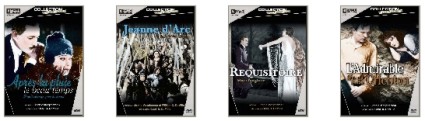
Cecil B. DeMille DVDs, from http://www.bachfilms.com

My thanks to Herr Graf Ferdinand Von Galitzien for the information that the French company Bach Films have released ten Cecil B. DeMille silents on DVD. The titles are:

The Cheat (1915) – with Sessue Hayakawa, Fannie Ward
Carmen (1915) – with Geraldine Farrar, Wallace Reid
Joan the Woman (1917) – Geraldine Farrar and Raymond Hatton
The Whispering Chorus (1918) – with Raymond Hatton and Kathlyn Williams
Old Wives for New (1918) – with Elliott Dexter and Florence Vidor
Don’t Change Your Husband (1919) – with Elliott Dexter and Gloria Swanson
Male and Female (1919) – with Thomas Meighan and Gloria Swanson
Why Change Your Wife (1920) – with Thomas Meighan and Gloria Swanson
The Affairs of Anatol (1921) – Gloria Swanson and Wallace Reid
Manslaughter (1922) – with Leatrice Joy and Thomas Meighan

All are retailing at 7.00€. All are Region 2, and appear to have French titles only. I can’t find any information about the music. At any rate, it’s a remarkable selection, with perhaps Joan the Woman, starring the opera singer Geraldine Farrar (who enjoyed a surprisingly successful career in silent films, given that her chief asset – her voice – was absent), the outstanding classic if you had to go for just one.

I’d not heard of Bach Films before now. Other silent DVDs on their list are D.W. Griffith’s Way Down East (1920), Orphans of the Storm (1922), Broken Blossoms (1919), Intolerance (1916) and Sally of the Sawdust (1925), all of them accompanied by assorted Griffith Biograph shorts; Douglas Fairbanks in The Three Musketeers (1921), Robin Hood (1922), Don Q, Son of Zorro (1925), The Black Pirate (1926) and The Iron Mask (1929); and Tod Browning’s Shadows (1922).

I don’t attempt to keep up with all silent film DVD releases here on The Bioscope, because there are other well-established sources that provide such a service very well. Check out the Silent Films on DVD section on Silent Era, or the impressively-extensive Silent Films on DVD site.

RIP Minoru Inuzuka

The last director to have made a silent film in the 1920s died last month. While Portugal’s Manoel De Oliveira, who made Douro, Faina Fluvial in 1931 is still with us (and still working), Japan’s Minoru Inuzuka directed his first silent feature in 1927, Sunae shibari: Dai-nihen, having previously contributed to the script of Kinugasa’s classic Kurutta ippêji (A Page of Madness) (1926). He was 106 years old.