Eloquent gestures

eloquent_gestures

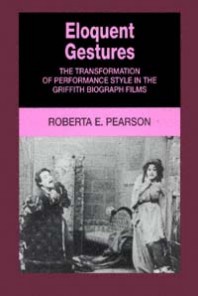
It’s been a while since we added anything new to the Bioscope Library. A new wing has been added to the tottering edifice that is Bioscope Towers, and first on the fresh new set of shelves therein is Roberta E. Pearson’s Eloquent Gestures: The Transformation of Performance Style in the Griffith Biograph Films, published by the University of California Press in 1992. This is one of the titles that the enlightened UCP has made available for free online as one of its eScholarship Editions offerings. It is a model ebook presentation, as well as being one of the most interesting and stimulating books written on the films of David Wark Griffith.

The book’s subject is the changes in the style of the actors’ performances in the films of D.W. Griffith, particularly between 1909 and 1912. Pearson sets this up in a delightful introduction in which she imagines Josiah Evans, “a man with a civic conscience who belongs to several progressive reform organizations”, attending a Broadway storefront picture show in 1909 in which he sees a film entitled The Drunkard’s Reformation, which he rather enjoys because it reminds him of the blood-and-thunder stage melodramas of his youth.

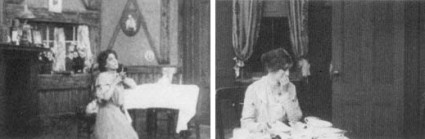
The acting of the young wife as she depicts her misery and desperation particularly affects him. She collapses into her chair and rests her head on her arms, which are extended straight out in front of her on the table. Then, in an agony of despair, she sinks to her knees and prays, her arms fully extended upward at about a forty-five degree angle.

Three years later he visit the Rialto Theatre on 14th Street, a considerably classier venue than that 1909 nickelodeon, and is struck in particular by a film entitled Brutality. It is similar in theme to the earlier film…

… but this moving picture does not remind him of the blood-and-thunder melodramas of his youth. The acting is the equal of Mr. Gillette’s in Sherlock Holmes or even of that in the Belasco play he and Lydia had attended last night. Particularly impressive is the young wife’s despairing reaction to her husband’s harsh treatment and abandonment. After he leaves for the saloon, the wife walks back to the dining-room table covered with the debris of their evening meal. She sits down, bows her head, and begins to collect the dishes. She looks up, compresses her lips, pauses, then begins to gather the dishes once again. Once more she pauses, raises her hand to her mouth, glances down to her side, and slumps a little in her chair. Slumping a little more, she begins to cry. How differently this actress portrays her grief from her counterpart in A Drunkard’s Reformation. A lot has changed in those three-and-a-half years since his first visit to a nickelodeon.
drunkard&brutality

A Drunkard’s Reformation (left) and Brutality, from Eloquent Gestures

How the films of D.W. Griffith moved on from the one style to the next is the subject of Pearson’s book. It traces in meticulous detail the transformation from an acting style inherited from the stage meodramas of an earlier era, to a nuanced style that benefitted from ‘realist’ developments in literature and theatre. It wasn’t there in 1909; it was there in 1912, and by examining closely the films made in that intervening period and being attuned to contemporary cultural developments, the path from the one to the other can be drawn. This is what Pearson does.

It is a very detailed study, one grounded a theoretical language which may not be to everyone’s taste, but the author needs to negotiate the pitfalls that terms such as “naturalism”, “realism” and “melodrama” can lead to. She wants to be precise about the meaning of words which are used all too loosely in general critical discussion (“melodrama” in particular), and to ground what one sees in these films, and what one sees in changing, in a close understanding of what was going on at the time. As she says:

The study of cinematic performance demands that we not depend upon our own aesthetic judgments, which we tacitly deem eternal and unchanging. Rather, we must acknowledge history by attempting to understand the aesthetic standards of another time and place, of a culture very different from our own.

The rest you must read for yourselves, and I warmly recommend that you do so. Though this is very much a thesis turned into a book, with all of the formal argument structures that one recognises (such as having an introduction which rubbishes the opposition), it illuminates understanding – not just of Biograph films, but of any cultural artefact from any period which we may be tempted to interpret from our personal aesthetic experience but which needs to be seen, first and foremost, as the product of its own times.

The ebook presentation is excellent. The book is divided up into hyperlinked chapters, and page breaks are indicated where they occur in the original, which is good for accurate citation. Notes in the text are hyperlinked to a notes section at the end, the index has hyperlinks so you can go directly from term back to the text, and the illustrations are available in small and full size versions. Finally there is a search box enabling to search the entire text of the book. Excellent all round. Into the Bioscope Library it goes.

The balancing bluebottle

bluebottle

The Balancing Bluebottle (1908)

A delightful programme was broadcast today on BBC Radio 4, The Balancing Bluebottle. It’s a 30-minute documentary on the life and work of Percy Smith, pioneering naturalist filmmaker. It’s presented by Tim Boon, curator at the Science Museum, whose recent book Films of Fact is a history of science documentary on film and television.

Normally I would pen you a paragraph or three on Smith’s career, but it’s been a long week (it’s been a long month) and I’m going to take a short cut by giving you this section from my Charles Urban site:

F. Percy Smith (1880-1945) was a modest but brilliant pioneer of scientific filmmaking. He was a clerk with the Board of Education whose hobby was photographing nature, notably magnified pictures of insects. One of these, a photograph of a bluebottle’s tongue, came to Urban’s attention, and in 1907 he invited Smith to do similar work with a motion picture camera. Failing to persuade his employers of the value of film as an educational tool, Smith joined Urban full-time in 1910. Smith’s films soon gained considerable attention, notably The Balancing Bluebottle and The Birth of a Flower, showing plant growth through stop-motion cinematography in Kinemacolor. Smith’s films were made at his Southgate home and involved meticulous preparation over many months. When war broke out in 1914 he made a series of animated war maps for Urban’s Kineto company before becoming a photographer with the Navy. After the war he did a little more work for Urban before he found greater fame with the Secrets of Nature series of nature films, made for British Instructional Films, which gained wide acclaim and were popular for two decades. He is one of the great names in scientific filmmaking.

Smith’s films entrance and instruct to this day. The Balancing Bluebottle itself featured bluebottles performing seemingly extraordinary feats of strength. Tied down with silk (and released unharmed afterwards) the bluebottles juggle a cork, a ball and a stick. The film caused a sensation at the time and can still leave an audience open-mouthed today.

  • A 1910 re-edited and reissued version of the film, under the title The Acrobatic Fly, is available on YouTube, courtesy of the BFI
  • A further retitled and reissued version from 1911, under the title The Strength and Agility of Insects, is available on WildFilmHistory
  • Smith’s 1910 film The Birth of a Flower is available to view at WildFilmHistory

The programme features Sir David Attenborough, Bryony Dixon from the BFI, Jenny Hammerton from AP Archive, and (recorded in a windy side alley off Leicester Square), one Luke McKernan. It’s available for the next seven days on BBC iPlayer, and is warmly recommended for its charm and insight.

When Paul met Hitch

hitchpaul

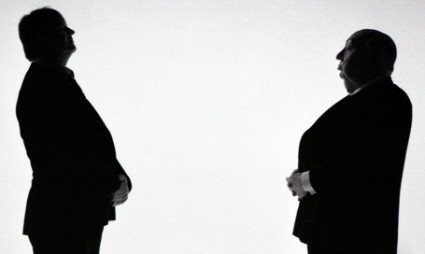
Look this Sunday for the latest stage in Paul Merton’s noble quest to educate us all into a film history some are in danger of forgetting, when BBC4 screens Paul Merton looks at Alfred Hitchcock. OK, so Hitchcock’s not exactly neglected yet, but he’s more of a name (or a body shape) than five decades of superlatively creative filmmaking to many, and we’re promised that Merton (he’s the one on the left, by the way) will include Hitchcock’s silents in his investigation. Indeed the subject of his programme is specifically Hitch’s British films, the majority of which were silent.

Screenings will be 28 Feb 2009, 21:00; 01 Mar 2009, 00:10; 01 Mar 2009, 03:10; 01 Mar 2009, 22:00 and 04 Mar 2009, 00:05. And it’ll be on iPlayer, of course.

Update: Talking of things Hitchcock, there’s an exhibition currently running at the Deutsche Kinemathek in Berlin on Hitchcock and production, Casting a Shadow: Creating the Alfred Hitchcock Film. The exhibition, which runs until 10 May 2009, has a special focus on Hitchcock’s time in Berlin studios in the 1920s, and there’s an article by William Cook about the exhibition, ‘The Master and Murnau‘ in The Guardian which discusses what Hitchcock gained from working at the Babelsberg studio for Emelka and seeing F.W. Murnau directing Der Letze Mann.

Cecil B. DeMille and American Culture

demille

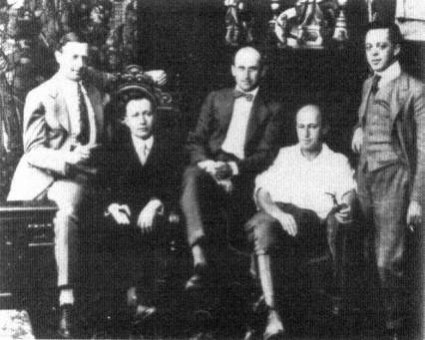
Cecil B. DeMille (second from right) poses with Jesse L. Lasky, Adolph Zukor, Samuel (Goldfish) Goldwyn, and Albert Kaufman after the Famous Players-Lasky merger, from Cecil B.DeMille and American Culture

Not all of the e-books that are freely available online are titles that have been out of print for decades. The University of California Press is one publisher that has boldly made the decision to make some of its relatively recent books available online to all, as part of its general eScholarship Editions initiative. Among the titles available are some silent cinema subjects. We’ve already mentioned Charles Musser’s Before the Nickelodeon. Now we have Sumiko Higashi’s Cecil B. DeMille and American Culture: The Silent Era.

This is an acclaimed study of the films of Cecil B. DeMille as they reflected American culture of the 1910s and 1920s. It is not a film history as such, but rather a social history, with a body of films as evidence. Higashi demonstrates how DeMille integrated cinema into what she calls ‘genteel culture’ by making the spectacle that it provided reflect middle-class ideology. DeMille took his subjects for films from texts – plays, novels, short stories – that were familiar to a middle-class audience, reflecting their world and its concerns. The DeMille we think of today was the producer of gargantuan Biblical epics, but the DeMille of the silent era was first a filmmaker artfully attuned to ‘genteel’ tastes, and then a trendsetter, whose 1920s films influenced advertising and consumer culture. The varied films discussed include Carmen, What’s His Name, Chimmie Fadden, Kindling, The Dream Girl, The Golden Chance, The Cheat, Joan the Woman, Old Wives for New, Don’t Change Your Husband, Why Change Your Wife?, The Affairs of Anatol and The Ten Commandments.

Cecil B. DeMille and American Culture, as with other UCP eScholarship Editions, is commendably well presented in chapterised form, with hyperlinked notes and index making it eminently searchable. There is also a filmography, and the welcome presence of all of the book’s illustrations (something not always offered with ebook editions). All in all, a stimulating read and a most helpful reference source, which now goes into the Bioscope Library.

Harold Shaw and De Voortrekkers

voortrekkers

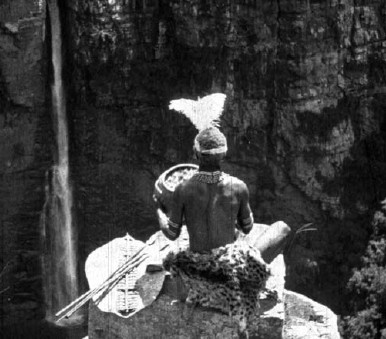
Still from De Voortrekkers, showing Zulu warrior Sobuza, who converts to Christianity. From Jane M. Gaines’ essay ‘Birthing Nations’ in Metter Hjort and Scott Mackenzie (eds.), Cinema and Nation (2000)

The London African Film Festival is taking place 29 November-7 December 2008, a wide-ranging celebration of African cinema involving a number of venues across London. The programme brings together an imaginative programme of new and classic titles, with some eye-catching surprises. Among the latter, the one that is catches this eye in particular is De Voortrekkers.

This 1916 epic film was one of the first South African dramatic film productions, and tells the story of the Boers’ Great Trek, concluding with a reconstruction of the 1838 Battle of Blood River, where a few hundred Voortrekkers (Afrikaners) defeated several thousand Zulus. Commemorating as it did their view of a highly contentious area of history, the film came to be revered by Afrikaners. It enjoyed a long after-life in South African classrooms and was (and may still be) shown annually on the date of the Battle of Blood River (16 December). For a long time remained unseen outside of the Afrikaner community, though copies have been available on video from a Canadian company, Villon Films, for some while now.

De Voortrekkers was one of four films made during a short period in South Africa by the remarkable Harold Shaw (1876-1926), whose full story needs to be told properly by someone some day. Briefly, Shaw was an American, who began his career in film as an actor with Edison in 1908, graduating to film director and moving to the IMP company. His best known work from this first period is the haunting fantasy film, The Land Beyond the Sunset (1912), now recognised by the National Film Preservation Board, which has placed it on its National Film Registry for permanent preservation as a national film treasure.

haroldshaw

Shaw (left) moved to Britain in 1913 to direct for London Film Productions, making such prestigious titles as The House of Temperley (1913) and Trilby (1914). His best British work, for me, is a barely-seen 1916 propaganda piece, You (1916), which encourages various people to support the war effort by means of a piece of paper that floats from person to person, asking each ‘What are YOU doing for your country?’ It is so creatively put together. That same year he ventured out with actress wife Edna Flugrath to South Africa, where he had been hired by African Film Productions. His first film for them, De Voortrekkers (1916), which starred Flugrath, was sensationally successful locally and even gained some screenings overseas (in the USA it was known as Winning a Continent). The scenario was written by historian Gustav Preller, and its version of the Great Trek emphasised the common point of view between Britons and Afrikaners (the Anglo-Boer War was long past and the political stress was now on the strength of the Union) and the ‘savagery’ of the native peoples (who, the film argues, are led to rise against the Boers by Portuguese traders). News reports at the time stressed the authenticity of the props and costumes and the huge numbers involved: hundreds of extras, black and white, many of them mine employees. Telling tales were told of a filmed charge which was undertaken too enthusiastically, the ‘natives’ neglecting to fall dead and instead assaulting some of the Europeans, with mounted police having to restore order. The completed film ran for some two hours.

rose_of_rhodesia

The Rose of Rhodesia, from http://www.slottsbio.com

Disagreements with the production company led Shaw to withdraw from a follow-up film on the Zulu wars, Symbol of Sacrifice (1918, directed by Dick Cruikshanks), fragments of which survive and are apparently available on a DVD entitled Isandlwana, Zulu Battlefield. Instead he made a melodrama about stolen diamonds for a rival producer, The Rose of Rhodesia (1917), which was recently discovered in the Netherlands and is attracting growing academic interest. Shaw and Flugrath made a third film (now lost), a horse-racing drama entitled Thoroughbreds All (1919), then returned to Britain.

Shaw next went another strange journey, to the Soviet Union to film Land of Mystery (1920), a melodrama (now lost) set in the USSR and loosely based on the life of Lenin, whose strange history (the story was written by Basil Thompson, who was high up in the British secret service) is covered in Kevin Brownlow’s Behind the Mask of Innocence. Shaw made more films in Britain, including two H.G. Wells adaptations, Kipps (1921) and The Wheels of Chance (1922), before returning to America to direct for Metro. He then died in a motor car accident in 1926.

It’s an extraordinary personal history, and one day someone needs to do Harold Shaw’s strange career adequate justice. As it is, he has a small but dedicated band of devotees around the world, myself among them (we used to gather around a table at the Pordenone silent film festival – it wasn’t a very large table). Meanwhile, De Voortrekkers, which I’ve yet to see, comes to the Barbican in London on 3 December, screening with Joseph Albrecht’s 1938 129-mins epic Building a Nation (Bou van ‘n Nasie), another piece of Afrikaner apologetics. The films runs for 60 mins and musical accompaniment will be provided by Juwon Ogungbe with piano and traditional instruments such as the kalimba and marimba. Both films clearly need to be seen in the context of Afrikaner nationalism and racism, but it is good to see De Voortrekkers move from its time of closet, propagandist screenings to a public festival where it can be viewed in the fuller context of African film production, past and present.

Pordenone diary 2008 – day three

The Verdi at night

There is a lot that goes on at Pordenone. While the main film shows takes place in the Verdi theatre, in three sessions (from 9.00, 14.30 and 20.30), supplementary screenings (often 16mm or video formats) take place in a side theatre, the Ridotto. This is also the venue for the weekly talks given to the Collegium, a gathering of selected students who are attached to the festival for the week and write a paper at the end of it. There are masterclasses each day, on the art of combining music with silent film. There is a book fair, which has book launches every evening. There are assorted special events and lectures, notably the Jonathan Dennis Memorial Lecture (named after a much-admired New Zealand film archivist who died too young), which this year was given by Eileen Bowser. And there are meeting of specialists groups, such as Domitor and Women and Film History International.

In between all this, it is essential to take time out and sit at one of the pavement cafes (the Posta, opposite the Verdi, for choice), with cappucino at the ready, waiting for the world to stoop by for a chat. The world invariably does. Pordenone is the ideal spot for learning about others’ projects, exchanging ideas, hatching schemes. So, hello to all those I met – including a smattering of Bioscope regulars – and look out for the fruits of projects large and small, maybe, one day. Some of these took precedence over the films shown, hence some of the gaps in the reports (which I hope those who saw the films may rectify by adding their impressions to the comments, please).

And so to Monday 6 October. Out there in something called the real world stockmarkets crashed, banks crumbled to dust, and you wondered first if there would be any airlines to fly us back, and then if that would really be such a bad thing. In our world, we had Jacques Feyder and, to these eyes, the interesting issue of servants. There were four of Feyder’s earliest films on show, all part of the ‘French touch’ strand. Des Pieds et des Mains (1915) told its romantic tale ingeniously through shots of hands and feet alone; Tetes de Femmes, Femmes de Tete (1916) had two women wittily getting the better of the errant husband of one of them; Un Conseil d’Ami (1916) echoed this by having a man puzzled by his social failure advised by a wiser, older man; and La Faute d’Orthographe (1919) told a comic tale of an ambitious officer worker let down by his inability to spell, his salvation unexpectedly coming in the form of a burglar at the office who corrected the man’s spelling on an application form while about his own business.

These were elegant, artfully-composed works, notable for emphasis on close shots, so that one saw relatively little of the broader social background, and instead concentrated on eyes, faces, and details of house interiors. And servants. I was fascinated by the compliant figures who appeared at the edge of a frame, merely to announce an arrival, pour a drink and deliver a message. This was class-bound stuff, accepted as the norm – how such a narrative should be constructed, who it should be about, how they should behave. There’s a famous line uttered by the title character in Pinero’s play The Second Mrs Tanqueray, which sums it up:

Servants are only machines made to wait upon people – and to give evidence in the divorce courts.

But I wanted to know where the servants went once they respectfully slipped out of shot. There were other worlds out there, to the edges, away from the selfish concerns of the characters on which the films chose to concentrate. I enjoy picking out these counter-narratives, the stories one can imagine running through the film that were not in the filmmakers’ conscious mind – or perhaps they were, as these early Feyder films were notable for the precision with which shots were populated and framed. In two of the films, the great Françoise Rosay – towering figure in French cinema, and of course Feyder’s wife – appeared as a figure in the background; in one a guest at a party, on another a passenger on a bus. These were films that encouraged you to look closely, films to savour.

Poster for The Sorrows of Satan, from Wikipedia

And then it was the Griffith of the day, The Sorrows of Satan (1926). As I’ve said, the late Griffiths were films I’d managed to avoid up til now, and I came to them with prejudices gleaned from the standard film histories. Re-reading some writings subsequently, I can see that these films have always had their champions, but the general audience reaction at Pordenone was one of genuine surprise that the films were so good. To my mind, the best of them was The Sorrows of Satan.

The omens were not good. A tale of young love thwarted by the appearance of Satan himself, taken from the novel of the ludicrously moralistic Victorian novelist Marie Corelli, filmed by a man whose lapses into Victorianism show him at his worst. The startling opening shot of angels and devils at war above a giant heavenly staircase may have confirmed the worst fears of some, or else alerted us to a sense that here was a film with the courage of its convictions and the skill to display them. The two lovers are played by Ricardo Cortez, as an aspiring writer living in a garret, and Carol Dempster (on fine, mannerism-free form – her final screen role), another aspiring writer living next door. The relationship between the two is built up gradually, with a fine sense of pace and telling detail (as was evidenced in the best parts of Sally of the Sawdust). Then Cortez rages against his fate, specifically against God, and suddenly Adolphe Menjou has appeared at his side. This was one of the best appearances in a film that I can remember. We know he’s the Devil, but he’s also Menjou at his mostly Gallically elegant, fresh from A Woman of Paris, looking just so pleased with everything and in total control of all about him.

He leads Cortez away from Dempster and into a debauched social life (excellent change in visual scale), culminating in marriage to ultra-vamp Lya de Putti, which anyone could have told him was going to end in tears. Again and again there were striking camera set-ups (clearly inspired by German cinema), with telling composition and atmospheric, apposite lighting. It was all terribly moralistic, of course, but entirely justified within the parameters it had established. Mercifully we weren’t shown Menjou turning into his Satan self – it was far more effective to show just the winged shadow and the horror on Cortez’s face. In the end, when Satan has been shaken off, the lovers are reunited, but there is no other reward. Neither becomes the great writer each aspired to be – forgiveness is all. I thought this was a great film.

Frank Scheide speaking to the Collegium

I made a tactical error in bypassing Gloria (1921), a commemorative record of ceremonies held to mark the death of 650,000 Italian troops in the First World War, which reports suggest was extrordinary. Instead I went to one of the Collegium sessions, on theatre and film. There were interesting short addresses given by David Mayer, Phil Carli and especially Frank Scheide, on the relationship between vaudeville/variety and film, but I wasn’t entirely sure what the Collegium (students attached to the festival for the week) were expected to get out of it all. Speaking to some past and present Collegium members, it seems that culmulatively the concept works, as they learn from each other, and of course experience the Giornate in all of its richness over the week.

The Corrick Collection is a collection of short films collected by an Australian family of touring entertainers from early in the last century. The first part of the collection was presented last year; in part one of the remainder, we saw a selection of real gems – an unidentified record of the coronation of Edward VII in 1902; Pathé’s 1903 tableaux-like Marie-Antoinette, featuring a gruesome scene where she is taunted in prison by a severed head on the end of a pole; a 1908 Pathé travel film of life in Sudan; and a dazzling trick film with cut-out figure made by British magician-turned-filmmaker Walter Booth, The Hand of the Artist.

This was followed by a hour-long documentary on the work of the festival’s great discovery, Alexander Shiryaev, but we’ll cover him in full in the report on Day Seven.

Tactical error no. 2 was missing The Kiss of Mary Pickford (1926), the delightful Soviet comedy inspired by the visit of Fairbanks and Pickford to the USSR, though I did see it once years ago. For many that I spoke to it was one of the highlights of the festival.

In the evening, we went on holiday. Maciste in Vacanza (1921) was one of a great number of films made in Italy following the huge success of Cabiria which were vehicle for the strongman from that film, Maciste, played by Bartolomeo Pagano. Here were saw Pagano more or less as himself, a strongman film-star beset by fans wherever he goes, who needs urgently to go on vacation to recover his strength. So he does, in a little car which he rather disturbingly refers to as his wife, though he is still pestered at every turn (‘Maciste, please move my cottage nearer the town’ asks an elderly countrywoman). While the film was in this self-referential mood it was great fun. Then it got caught up in a mystery plot set in a castle with too many intertitles and rather lost its momentum, but overall it was a happy piece of fun.

The film was shown, along with other Italian silents at the festival, in tribute to the late film historian and Pordenone stalwart, Vittorio Martinelli. So we also saw a sonorised nature film on the life of the cricket, from nature film specialist Roberto Omegna, and a travelogue of Sicily. And so ended Day Three for me, missing the late night French film Paris en Cinq Jours for a discussion on film archives and their collaborative future in the UK.

Keep your eyes peeled for Day Four, where we will see the evils of war, the first films ever made, a Japanese actor playing a Hindu living in Scotland, and why Keystone represents the spirit of America.

Pordenone diary 2008 – day one
Pordenone diary 2008 – day two
Pordenone diary 2008 – day four
Pordenone diary 2008 – day five
Pordenone diary 2008 – day six
Pordenone diary 2008 – day seven

Lost sites

Here at The Bioscope we do our best to alert you to interesting new web resources on the subject of silent cinema, or indeed sites that have been around for a while but aren’t necessarily well known. But what about sites that are no more? We’ve all experienced the frustration of the dead link, discovering that some site or page has been taken down because the domain registration wasn’t kept up, the page was taken down because the owner thought it no longer of interest, or the web links on a site have all been changed. Whatever the reason, the Net is an impermanent place, and many worthwhile sites in our field are around no more.

Happily we have the Internet Archive and its ‘Wayback Machine‘, which has archived a great deal of the Internet (85 billion web pages from 1996 to 2008), taking ‘snapshot’ records of sites periodically (usually every few months). Images are not always retained, and you can’t find movie files, databases or other such complexities in the archive, but you will find the plain HTML. But how do you know what to look for? There is no subject guide or keyword searching (yet). You have to know the web address, and even then that only find you what you knew was there to find. What about those lost sites that you never knew were lost?

Despair not. The Bioscope presents this initial guide to some of the silent cinema sites and web pages which can no longer be found on the Web as such, but do lurk within the Internet Archive. There will be many more than those listed below, of course, but it’s a start (do let me know if you know of any). All links will take you to the Internet Archive record.

The Silents Majority
Old hands will have recognise the gentleman at the top of this post as ‘Merton of the Movies’, the silent town crier who featured on Diane MacIntyre and Spike Lewis’ The Silents Majority, the essential silents information site before it disappeared in 2003 and Silent Era took its place. Here you can still find biographies, reproductions of articles, featured books and videos, photo gallery, guest articles and Cooking with the Stars. Not everything remains (some images and the QuickTime movies won’t be found there), but it’s still a treasure trove. Check also for the final year of its existence when it changed its URL and became www.silentsmajority.com.

A Trip to the Moon
A simple but engaging site dedicated to Georges Méliès’ Voyage Dans La Lune, with an essay on the film, Méliés’ own outline and commentary for the film, film stills (not of terribly high quality, unfortunately), and extracts from the associated imaginative literature of Wells, Verne, Poe and others.

Questions Regarding the Genesis of Nonfiction Film
A stimulating essay on early non-fiction filmmaking, its essence, problems of definition, and neglect by film scholars, by renowned Japanese scholar Komatsu Hiroshi. It does exist elsewhere in print in the journal Documentary Box, but a key text like this ought not to be lost to the online research community.

The Human Motor
This stems from a scientific project to map the human body by the University of Colorado, and was part of a larger site, Building Better Humans. It has sound information on the chronophotography of Etienne-Jules Marey and Eadweard Muybridge, complete with a fine selection of images.

Les Frères Lumière et le Japon 1895-1995
This site accompanied a touring exhibition of films shot in Japan in the 1890s by the Lumière cameramen François-Constant Girel and Gabriel Veyre. It comprises an excellent essay (in French) on the first films and filmmaking in Japan by Hiroshi Komatsu.

Eadweard Muybridge: Father of Motion Pictures
An imaginative, beautifully-designed site on the master photographer who captured motion. Some of the photographs no longer appear, but there some animated gifs of Muybridge sequences, and the whole thing is just done with such style.

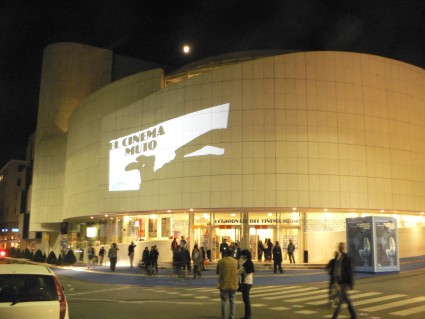
Dive cinema muto
Italian site (in Italian) devoted to silent film actresses, especially the Italian ‘divas’ such as Lyda Borelli and Francesca Bertini, plus other femme fatales such as Asta Nielsen and Theda Bara. With biographies, essays and illustrations.

Archiving the Internet is becoming a subject of increasing concern. The Internet Archive leads the field, of course, but the UK Web Archiving Consortium is building up to the day when every UK website will be archived as a matter of legal deposit. For those intrigued by dead sites in general, take a look at Ghost Sites of the Web (these are sites that still exist on the Web, but which have been abandoned).

Please let me know of any lost sites (as opposed to dead ones that just aren’t updated any more) on silent cinema, and I’ll update this list. Note also that not every lost site may necessarily be found on the Internet Archive – the website whose passing I most regret, Charl Lucassen’s beautiful Anima site on chronophotography and other optical delights, once one of the genuine treasures of the Web, is nowhere to be found at all. Such a loss.

Time travelling

The Time Travellers of 1908, from http://www.gmfilm.co.uk

I’ve added a new section among the links for Modern Silents, a subject that, as regulars will know, has been covered here from time to time. Modern silents until recently were occasional curiosities (Le Bal), spoofs (Silent Movie), imitations of slapstick (The Plank), eccentricities (Juha) or lacked dialogue merely because they featured dinosaurs (One Million Years B.C.). But the arrival of cheap digital equipment, broadband and YouTube has encouraged experimentation in this field (as it has in so many others). More than that, there seems to be growing interest in the stylistic tropes of silent cinema as an means of expression today among a number of accomplished filmmakers, of whom the Canadian Guy Maddin is the best known.

The Bioscope will continue to pay attention to such work, so let’s kick things off afresh by looking at Martin Pickles. He is a British filmmaker, whose G.M. Film site is named after his 2001 film G.M., which took its title and inspiration from Georges Méliès. Pickles does not produce pure silent films so much as work with the aesthetic and historiography of silent film in creating some of his own work.

Take, for example, Time Travellers of 1908. This short film follows two explorers, using a time-machine shaped like a movie camera, as they visit 21st century London. It was shot entirely on Edwardian hand-cranked cameras with original lenses, and the soundtrack recorded on a 1909 Edison phonograph. There is a real sense of modern London viewed anew (is it accident or ingenuity that makes their first shot of modern London a view of Trafalgar Square taken from much the same spot as Wordsworth Donisthorpe chose for his proto-movie of 1890?)

Or there’s G.M. itself, in which an Edwardian gentleman (looking not unlike Georges Méliès) is tormented by spirits who appear through holes in the wallpaper. In the simple but effective Camera Obscura a man dreams of a ballet dancer but finds himself literally tied to his office desk. And Trafalgar Square makes another appearance in Century’s End, a ‘film-poem’ of London filmed between midday and midnight on 31 December 1999, shot on 16mm at 16fps but telecine-ed at 25 fps, as Pickles says, ‘in order to give it the jerky look of an old Edwardian film’. One would usually protest at the notion of silent films being jerky and run at the wrong speed, but here the choice is knowing and apposite.

All these and more are available as QuickTime movies on the G.M. Film site, with background explanations on their production, rationale and funding. All are short, all are ingeniously creative. Seeing such work makes you realise how silent films will continue to have a creative life because they represent a form of artistic expression which is now set in time. They constitute a vision of things, a discrete way of telling stories, that will always have an appeal to some filmmakers. There was far more to silent films, even (or especially?) early silents, than the relatively simple aesthetic referenced in Pickles’ films, but what matters here is not the pastiche but the acknowledgment from today of a particular way of seeing things. They are an act of time travelling, whether we view the originals or whether we endeavour to imitate them.

I’ll keep on the lookout for more such filmmakers, and would welcome any recommendations.

The Silent Film Bookshelf

The Silent Film Bookshelf was started by David Pierce in October 1996 with the noble intention of providing a monthly curated selection of original documents on the silent era (predominantly American cinema), each on a particular theme. It ended in June 1999, much to the regret to all who had come to treasure its monthly offerings of knowledgeably selected and intelligently presented transcripts. The effort was clearly a Herculean one, and could not be sustained forever, but happily Pierce chose to keep the site active, and there it still stands nine years later, undeniably a web design relic but an exceptional reference resource. Its dedication to reproducing key documents helped inspire the Library section of this site, and it is a lesson to us all in supporting and respecting the Web as an information resource.

Below is a guide to the monthly releases (as I guess you’d call them), with short descriptions.

October 1996 – Orchestral Accompaniment in the 1920s
Informative pieces from Hugo Riesenfeld, musical director of the Rialto, Rivoli and Critierion Theaters in Manhattan, and Erno Rapee, conductor at the Capitol Theater, Manhattan.

November 1996 – Salaries of Silent Film Actors
Articles with plenty of multi-nought figures from 1915, 1916 and 1923.

December 1996 – An Atypical 1920s Theatre
The operations of the Eastman Theatre in Rochester, N.Y.

January 1997 – “Blazing the Trail” – The Autobiography of Gene Gauntier
The eight-part autobiography (still awaiting part eight) of the Kalem actress, serialised over 1928/1929 in the Women’s Home Companion.

February 1997 – On the set in 1915
Photoplay magazine proiles of D.W. Griffith, Mack Sennett and Siegmund Lubin.

March 1997 – Music in Motion Picture Theaters
Three articles on the progress of musical accompaniment to motion pictures, 1917-1929.

April 1997 – The Top Grossing Silent Films
Fascinating articles in Photoplay and Variety on production finance and the biggest money-makers of the silent era.

May 1997 – Geraldine Farrar
The opera singer who became one of the least likely of silent film stars, including an extract from her autobiography.

June 1997 – Federal Trade Commission Suit Against Famous Players-Lasky
Abuses of monopoly power among the Hollywood studios.

July 1997 – Cecil B. DeMille Filmmaker
Three articles from the 1920s and two more analytical articles from the 1990s.

August 1997 – Unusual Locations and Production Experiences
Selection of pieces on filmmaking in distant locations, from Robert Flaherty, Tom Terriss, Frederick Burlingham, James Cruze, Bert Van Tuyle, Fred Leroy Granville, H.A. Snow and Henry MacRae.

September 1997 – D.W. Griffith – Father of Film
Rich selection of texts from across Griffith’s career on the experience of working with the great director, from Gene Gauntier, his life Linda Arvidson, Mae Marsh, Lillian Gish and others.

October 1997 – Roxy – Showman of the Silent Era
S.L. Rothapfel, premiere theatre manager of the 1920s.

November 1997 – Wall Street Discovers the Movies
The Wall Street Journal looks with starry eyes at the movie business in 1924.

December 1997 – Sunrise: Artistic Success, Commercial Flop?
Several articles documenting the marketing of a prestige picture, in this case F.W. Murnau’s Sunrise.

January 1998 – What the Picture Did For Me
Trade publication advice to exhibitors on what films of the 1928-1929 season were likely to go down best with audiences.

February 1998 – Nickelodeons in New York City
The emergence of the poor man’s theatre, 1907-1911.

March 1998 – Projection Speeds in the Silent Film Era
An amazing range of articles on the vexed issue of film speeds in the silent era. There are trade paper accouncts from 1908 onwards, technical papers from the Transactions of Society of Moving Picture Engineers, a comparative piece on the situation in Britain, and overview articles from archivist James Card and, most importantly, Kevin Brownlow’s key 1980 article for Sight and Sound, ‘Silent Films: What was the right speed?’

April 1998 – Camera Speeds in the Silent Film Era
The protests of cameramen against projectionsts.

May 1998 – “Lost” Films
Robert E. Sherwood’s reviews of Hollywood, Driven and The Eternal Flame, all now lost films (the latter, says Pierce, exists but is ‘incomplete and unavailable’).

June 1998 – J.S. Zamecnik & Moving Picture Music
Sheet music for general film accompaniment in 1913, plus MIDI files.

July 1998 – Classics Revised Based on Audience Previews
Sharp-eyed reviews of preview screenings by Wilfred Beaton, editor of The Film Spectator, including accounts of the preview of Erich Von Stroheim’s The Wedding March and King Vidor’s The Crowd, each quite different to the release films we know now.

August 1998 – Robert Flaherty and Nanook of the North
Articles on the creator of the staged documentary film genre.

September 1998 – “Fade Out and Fade In” – Victor Milner, Cameraman
The memoirs of cinematographer Victor Milner.

October 1998 – no publication

November 1998 – Baring the Heart of Hollywood
Somewhat controversially, a series of articles from Henry Ford Snr.’s anti-Semitic The Dearborn Independent, looking at the Jewish presence in Hollywood. Pierce writes: ‘I have reprinted this series with some apprehension. That many of the founders of the film industry were Jews is a historical fact, and “Baring the Heart of Hollywood” is mild compared to “The International Jew.” [Another Ford series] Nonetheless, sections are offensive. As a result, I have marked excisions of several paragraphs and a few words from this account.’

December 1998 – Universal Show-at-Home Libraries
Universal Show-At-Home Movie Library, Inc. offered complete features in 16mm for rental through camera stores and non-theatrical film libraries.

January 1999 – The Making of The Covered Wagon
Various articles on the making of James Cruze’s classic 1923 Western.

February 1999 – From Pigs to Pictures: The Story of David Horsley
The career of independent producer David Horsley, who started the first motion picture studio in Hollywood, by his brother William.

March 1999 – Confessions of a Motion Picture Press Agent
An anonymous memoir from 1915, looking in particular at the success of The Birth of a Nation.

April 1999 – Road Shows
Several articles on the practive of touring the most popular silent epics as ‘Road Shows,’ booked into legitimate theatres in large cities for extended runs with special music scores performed by large orchestras. With two Harvard Business School analyses from the practice in 1928/29.

May 1999 – Investing in the Movies
A series of articles 1915/16 in Photoplay Magazine examining the risks (and occasional rewards) of investing in the movies.

June 1999 – The Fabulous Tom Mix
A 1957 memoir in twelve chapters by his wife of the leading screen cowboy of the 1920s.

And there it ended. An astonishing bit of work all round, with the texts transcribed (they are not facsimiles) and meticulously edited. Use it as a reference source, and as an inspiration for your own investigations.

John Barnes RIP

It is with sadness that I have to report the death of John Barnes, film historian, collector, curator and filmmaker. John is best known for the five volume series The Beginnings of Cinema in England, 1894-1901, his unparalled study of the earliest years of English cinema. Begun in 1976, completed in 1998, it is as much a work of archaeology as historiography. John’s real passion was for the technology of film in the 1890s, and he was prodigious and exhaustive in tracking down every kind of motion picture machine from the period, explaining its distinctive qualities, tracing its use and recording its ownership.

Around this deep understanding of the technology of the era, he weaved stories of the personalities of the time (his great hero was Robert Paul, whose battles with fellow pioneer and rival Birt Acres he recorded with journalistic fervour), the modes of exhibition, and especially the films – each volume of his history contained filmographies of the whole of British film production for one year, information gleaned from catalogues, journals, posters, flyers, and a host of other sources. Details of hundreds of films from this era have been identified from Barnes’ work alone, a huge benefit to scholars and film archivists alike. An era of cinema that previously had been idly documented and frequently misinterpreted was enriched by an exhaustive study that has inspired a huge range of subsequent studies. No one has been able to write about this period of cinema history without reference to the works of John Barnes. He found the material, provided the signposts, and his work remains the sure foundations on which all other research in the field must be built.

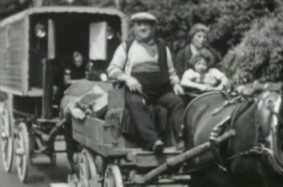
With the Gypsies in Kent (c.1938), film by John and Bill Barnes, from Screen Search

John and his twin brother William (who survives him) were born in 1920 and discovered film during the 1930s, becoming enthusiastic amateur filmmakers while still at school. Two of their films, Gems of the Cornish Riviera (1936) and Cornish Nets (1938) featured at the Pordenone silent film festival in 1997, the year in which both were awarded the prestigious Prix Jean Mitry for services to silent film scholarship. Eighteen of their silent films are now held by Screen Archive South East in Brighton, including The Wheat Harvest (c.1935), In the Garden of England (c.1938) and With the Gypsies in Kent (c.1938), clips from which can be seen on the Archive’s Screen Search site.

On leaving school the brothers studied film design and technique at Edward Carrick’s AAT film school, at which time they began collecting Victorian optical toys and associated literature, often frequenting the bookshops of London’s Cecil Court which three decades before had been ‘Flicker Alley’, home to the nascent British film industry. They hatched a plan to collect artefacts and documents that would trace the history of motion pictures from the 17th to the 20th centuries, an ambition put on hold while they served in the Royal Navy during the Second World War.

After the war, the brothers moved to St Ives in Cornwall, where Bill opened a second-hand bookshop. It was in rooms above this shop in 1951, during the Festival of Britain, that the brothers put on the first exhibition of their film history artefacts, the success of which encouraged them to collect all the more. This was at a time when relatively little was appreciated about pre-cinema tchnologies, and John’s great work was not simply to collect such objects but to understand them, explain them and to be able to contextualise them. Eventually the bookshop was closed and the brothers sold by catalogue alone, supplying books and artefacts to scholars and film museums around the world.

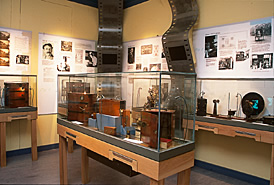
Objects collected by John and Bill Barnes now in Hove Museum

In the 1960s, while Bill went filming overseas, John and his wife Carmen (who also survives him) opened the Barnes Museum of Cinematography in St Ives. This famous collection attracted film scholars from around the world, and its catalogues became treasured documentary sources as serious interest grew in the roots of cinema. Collecting continued, and many objects were lent to museums around the world or formed the subject of illustrations in numerous text books. The Museum never found a London home, as John had hoped, and closed in 1986, its pre-cinema holdings going to the Museo Nazionale del Cinema in Turin, while much of the remainder is now housed in Hove Museum, near Brighton.

But John’s greatest monument is The Beginnings of the Cinema in England. The series began in 1976 with the book of that title, which documented the arrival of film in England, 1894-1896. Establishing his style, the book traced the history through the machinery, out of which followed the personalities involved, the modes of exhibition, and a thorough filmography for the period. It would be hard to underestimate the value this book (which was revised and republished in 1998) to the early cinema specialist. It simply defined a period. Subsequent research has built on his work, and occasionally challenged its findings (Barnes’ arguments around the so-called ‘Paul-Acres camera’), but those solid foundations remain. It was followed by volumes doggedly documenting the cinema in Britain (he wavered between England and Britain in his descriptions) for 1897 (perhaps his best work), 1898, 1899 and 1900, the whole series eventually being republished in a uniform edition by University of Exeter Press in 1998. While the original volumes are quite rare, the re-issued set can be found relatively easily and cheaply and is strongly recommended to any serious student of early film. In the historiography of British film, only Denis Gifford and Rachael Low can match John Barnes’ achievements.

John Barnes devoted his life to the history of cinema. He was as much a pioneer in his field as were those whose lives and technologies he championed in theirs. He faced innumerable battles with publishers and institutions, but that all goes with the part played in being an independent scholar-collector. His knowledge, unfailing help and sturdy friendship were valued by scholars and enthusiasts around the world, and his parting (he died on June 1st) will be recognised as a huge loss. But few of us who work in this field will be able to leave behind so much of such solid and lasting value: objects rescued, identified and their importance recognised; documents saved, preserved and republished; films identified and treasured; and books written that preserve the knowledge of a lifetime and which will benefit research for many years to come.

I’ll finish with a section from a review I made of The Beginnings of Cinema in England when the series was republished, as it rather sums things up for me:

Enthusiasm is the key to John Barnes’ history. Perhaps the chief reason why this area of film studies is so vital, is that in the hearts of its enthusiasts it is as if it were happening now. While other areas of academic cinema history seem doomed to atrophy, as films that were once entertaining no longer entertain, Victorian cinema is alive with debate and discovery … This is perhaps Barnes’ greatest achievement, to have achieved the trick that film has always claimed to do, to abolish time. Thanks to the finest work of empirical early film history that there is, the cinema of the 1890s is very much with us still.

Thank you John.