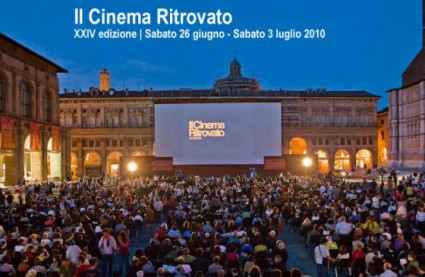
Bologna’s memorable days

http://www.cinetecadibologna.it/cinemaritrovato2010

I’m a bit late with this report on the upcoming Cinema Ritrovato festival at Bologna, but frankly the Bolognese are all too good at hiding the information on their website (come on guys, it’s not even listed on your calendar). Anyway, the festival takes place 26 June-3 July, and as usual the festival’s “memorable eight days” brings together a remarkable range of archive films from the silent and sound eras, maintaining its well-deserved reputation for catholicity, scholarship and quality presentation.

The major silent cinema elements are the traditional centenary survey of a year of cinema which has now reached 1910; the start of a retrospective of proto-auteur Albert Capellani; all of John Ford’s surviving silents; and cross-linking with the Women and Silent Screen conference, also taking place in Bologna.

Here’s the welcoming blurb from the festival site:

Bologna’s eight days and nights of cinephilic paradise from June 26 to July 3 will take place in four locations: the twin screens of the Cineteca’s Lumière cinema, one dedicated to silent cinema (which will feature images of life from exactly 100 years ago) and the other to sound, showcasing, for example, little known films of Italy as it was during the period 1945-48; the Arlecchino cinema, a haven for films requiring the size of a larger screen; and of course Piazza Maggiore, which will host splendid restorations like Visconti’s Il Gattopardo brought by the Film Foundation, or the new complete version of Lang’s Metropolis, for whom we can thank the Murnau Stiftung and Stiftung Deutsches Kinemathek, with the original score by Gottfried Huppertz, performed by the Orchestra of the Teatro Comunale di Bologna conducted by Frank Strobel. What a wonderful surprise it will be to rediscover the films that started it all – the first actuality films, street views, masterpieces by the Lumière brothers bristling with their newly restored beauty thanks to the Institut Lumière in Lyon.

Year 1910 of our history of cinema, compiled year after year film by film, includes encounters with bright stars like Mistinguett and Stacia Napierkowska, with a debuting Francesca Bertini and Léonce Perret, and cinematic explorations of real and fictional worlds in the first feature length films. In addition to this section, Mariann Lewinsky is also curating a retrospective – destined to grow over the years – about Albert Capellani, a director who contributed enormously to the development and worldwide success of Maison Pathé, one of the first auteurs and a crucial figure for the growth of the seventh art in connection with the other arts and the pursuit of photogénie.

The largest section is dedicated to John Ford. Just like the previous retrospectives on Josef von Sternberg and Frank Capra organized by Il Cinema Ritrovato, this section will feature all of Ford’s existing silent output (about twenty films from 1917), as well as some of his first sound films, including Pilgrimage (1933), a true masterpiece. 3 Bad Men (1926) will be shown in Piazza Maggiore with a new score by Timothy Brock to be performed by the Orchestra of the Teatro Comunale di Bologna. Joseph McBride, the author of the brilliant biography Searching for John Ford, will curate a special dossier on the director, and several great historians, friends of Il Cinema Ritrovato, will make their contribution as well.

Another important name in American cinema and festival protagonist, Stanley Donen, will be our guest this year, more than sixty years after his debut with On the Town and more than fifty years after the golden age of musical ended – after which Donen continued his career beautifully with his personal brand of elegant comedy (Charade, 1963, and Two for the Road, 1967). And of course the best known and loved of them all, Singin’ in the Rain (1952), will be shown in Piazza Maggiore.

Anni difficili, “Difficult years”, is the title of a section dedicated to Italian cinema from 1945-48: an intense, crucial (and yet largely unknown) period, full of incredible conflicts and uncertain victories – a time when two world systems were fighting over the soul and the economy of the country. The showing of films like Roma città libera (Marcello Pagliero, 1946), Il sole sorge ancora (Aldo Vergano, 1946) and Caccia tragica (Giuseppe De Santis, 1947) will be complemented by films made in other European countries at the time: They Made Me a Fugitive (Alberto Cavalcanti, 1947), Retour à la vie (Henri-Georges Clouzot, Jean Dréville, Georges Lampin, André Cayatte, 1949), Iris och löjtnantshjärta (Alf Sjöberg, 1946) and In jenen Tagen (Helmut Käutner, 1947).

As for the film world surrounding Chaplin, this year the spotlight is on Robert Florey, an eclectic, talented Frenchman in Hollywood who was the assistant director of Monsieur Verdoux. Though the larger part of his work was routine, Florey created films that were incredible for their experimental audacity and their "tender madness" much loved by Luis Buñuel: The Life and Death of 9413 – A Hollywood Extra (1928), a film version of Poe’s Murders in the Rue Morgue (1932) and The Beast with Five Fingers (1946).

The festival would not be the same without restorations of films left to the ravages of time sponsored by the World Cinema Foundation. Among the most anticipated a Fondation Pathé Archives restoration, Boudu sauvé des Eaux (Jean Renoir, 1932).

Just like at past editions, this year several “dossiers” will unearth rare or unseen materials relating to some of the greatest filmmakers: Fellini, Godard and Pasolini, letting viewers discover a whole world in the brief space of an hour.

The festival will be accompanied by a large exhibition about Fellini, Fellini. Dall’Italia alla luna, curated by Sam Stourdzé and promoted by the Cineteca and MAMbo-Museo d’Arte Moderna di Bologna. The exhibition will be on display in the museum until July, 25. The exhibition is a larger version of last year’s show in Paris. Drawings, posters, period illustrated magazines, scene and set images all make for a seductive journey through popular images and the filmmaker’s creative workshop.

Il Cinema Ritrovato’s program takes place this year after the international conference Women and the Silent Screen, now in its sixth year. Sponsored by Women and Film History International and organized by the Dipartimento di Musica e Spettacolo-Università di Bologna and the Cineteca di Bologna, the conference will be held from Thursday, June, 24 to Saturday, June 26, and will feature about one hundred lectures (in English) on different issues about women and silent film (see wss2010.wfhi.org). Our festival has always dedicated energy and time to presenting the feminine creative forces in silent film, with sections on divas and comedy actresses. This year we have started a new chapter about women in complicated stories of crime, revenge and espionage, introducing viewers to the powerful Astrea, charming Josette Andriot and beautiful Berta Nelson.

The festival also sponsors the Film Publishing Fair (Books, DVDs, Antiquarian and Vintage Materials) and Il Cinema Ritrovato DVD Award (7th edition). We would like to remind you that Il Cinema Ritrovato will host two seminars: the continuation of the Film Restoration Summer School / FIAF Summer School 2010 (deadline for submitting application is postponed to April 23rd) co-organized with the FIAF and ACE and with the support of the Media Plus Programme, and a workshop for European quality cinema exhibitors organized by Europa Cinemas and Progetto Schermi e Lavagne. Enrollment in each seminar requires separate registration, available on the website indicated below.

You are most cordially welcomed to the most memorable eight days of 2010.

Further information on the festival is on the site, in Italian, though there is no day-by-day programme (that I can find). Also worth seeking out on the site is a list of every film featured at the festival 1986-2009 (in Excel spreadsheet form) giving title, date, country and director, plus PDFs of festival publications and its DVD award winners 2004-2009. All wonderful stuff – once you can find it.

Sounds and Silents

http://www.birds-eye-view.co.uk/kingsplace

Sounds and Silents is an off-shoot of the annual Bird’s Eye View festival of women filmmakers. The strand brings together classic silent films starring iconic actresses and innovative musical accompaniment by female artists.

Its latest manifestation is Sounds and Silents at King’s Place, bringing silents to one of London’s latest art venues. Four films are to be screened 27-29 May, and here are the programme details:

The Temptress with original live score from Natalie Clein
Dir. Fred Niblo, USA 1926
Hall One, Thur May 27, 7.30pm

Narcissistic Elena (Greta Garbo) drives every man she meets to despair. One of her victims, Manuel Robledo tries to escape, but this time Elena is in love and she follows him from Paris to his native Argentina.

Natalie Clein

‘Clein plays everything with passion’ – The Times

Natalie Clein’s exceptional musicality has earned her a number of prestigious prizes including the Classical Brit Award for Young British Performer of 2005, the Ingrid zu Solms Cultur Preis at the 2003 Kronberg Academie, and the BBC Young Musician of the Year aged just 16.

My Best Girl with original live score from Elysian Quartet
Dir. Sam Taylor, USA 1927
Hall One, Fri May 28, 7.30pm

Maggie (Mary Pickford) falls in love with Joe, her new colleague in the stock room, unaware that he is the son of the department store owner working undercover to prove his business skills.

Elysian Quartet

‘Feisty boundary pushers, four supremely talented classical musicians’ – Metro

The Elysian Quartet is one of the UK’s most innovative young ensembles. They have worked with artists as diverse as virtuoso beat-boxer Killa Kela, jazz pianist Keith Tippett, and experimental electronic composer Simon Fisher-Turner.

I Don’t Want to be a Man! with original live score from Zoe Rahman / The Danger Girl with original live score from Juice
Dir. Ernst Lubitsch, Germany 1919 / Dir. Clarence G Badger, USA, 1916
Hall One, Sat May 29, 7.30pm

– Ossi’s father hires a guardian to educate his rebellious daughter. Escaping from house arrest dressed as a man, Ossi begins to investigate whether life is more liberated this way.

– When vampish Helene (Gloria Swanson) uses her charms on Bobbie, Gloria breaks up the pair by disguising herself as a man to seduce Helene.

Zoe Rahman / Juice

‘One of the finest young pianists in Europe’ – The Observer

– Zoe Rahman has firmly established herself as one of the brightest stars on the contemporary jazz scene. Zoe has recorded four critially acclaimed albums, her second ‘Melting Pot’, wasnominated for the 2006 Mercury Music Award and was voted ‘Jazz Album of the Year’ at the 2006 Parliamentary Jazz Awards.

– Juice is an experimental vocal trio specialising in vibrant, theatrical performances commissioned countless new works. They draw on world music, jazz, folk and pop and have been featured on BBC Radio 3 and Classic FM and Resonance FM.

King’s Place (“a creative hub, a dining venue, a conference and events centre, and office complex”) is at 90 YorK Way London N1, close by King’s Cross and St Pancras stations. More details, including tickets, from the Bird’s Eye View site.

San Francisco Silent Film Festival

Norma Talmadge in The Woman Disputed (1928), from http://www.silentfilm.org

This year’s San Francisco Silent Film Festival takes place 15-18 July at the Castro Theatre, and what is quite frankly a sensational programme has just been announced. The biggest draw is going to be the new version of Metropolis, but the programme is choc-a-bloc with classics everyone should see, rediscoveries, surprises, and some of the funniest comedy short films ever made. Here are the details:

Thursday, July 15th

The Iron Horse (USA, 1924, 150 mins, 35mm)
Directed By: John Ford
Cast: George O’Brien, Madge Bellamy
Accompanied By: Dennis James
Set in mid-19th century America, The Iron Horse is the silent era’s version of How the West Was Won, weaving its themes of romance and history around the story of the building of the first transcontinental railway. This glorious print is the only surviving 35mm print of the American version.

Friday, July 16th

Amazing Tales from the Archives 1 (60 mins)
Lost Films from the Silent Era: Presentations by Joe Lindner of the Academy of Motion Picture Arts and Sciences, and Paula Félix-Didier and Fernando Peña of Museo del Cine, Buenos Aires (the archivists responsible for finding the lost Metropolis footage).
Accompanied By: Donald Sosin

A Spray of Plum Blossoms (China, 1931, 100 mins, 35mm)
Directed By: Bu Wancang
Cast: Ruan-Lingyu, Jin Yan
Accompanied By: Donald Sosin
One of the most prolific Chinese directors of the silent era, Bu Wancang based this film on William Shakespeare’s “Two Gentlemen of Verona,” setting the action in China, circa 1930 and casting China’s favorite on-screen couple, Ruan Ling-yu and Jin Yan. Like any Shakespeare comedy, Plum Blossoms is replete with star-crossed lovers, mistaken identity, and a satisfying happy ending. By situating the play in the ’30s-era Chinese army, the “gentlemen” of the Shakespeare’s title are the film’s officers, the duke is a warlord, and his daughter’s ladies-in-waiting are military police!
Presented with both Mandarin and English intertitles.

Rotaie (Italy, 1929, 74 mins, 35mm)
Directed By: Mario Camerini
Cast: Käthe von Nagy, Maurizio D’Ancora
Accompanied By: Stephen Horne
One of the most important Italian movies of the late silent period, Rotaie is the story is of two young lovers, very poor and on the brink of suicide, who come into a bit of temporary good luck. Finding a lost wallet in a train station, the lovers hop a train to two thrilling weeks of high living. The film’s exquisite style is influenced by the expressionism of German master F.W. Murnau. Presented with Italian intertitles accompanied by a live English translation.

Metropolis (Germany, 1927, 148 mins, Digital)
Directed By: Fritz Lang
Cast: Rudolf Klein-Rogge, Brigitte Helm
Accompanied By: Alloy Orchestra
When Fritz Lang’s masterpiece debuted in Berlin in January, 1927, the sci-fi epic ran an estimated 153 minutes, but in order to maximize box office potential the German and American distributors cut the film to 90 minutes for its commercial release. For decades crucial scenes from the film were considered lost. In 2001, the Munich Film Foundation assembled a more complete version with additional footage from four contributing archives, and Metropolis had a premiere revival at 124 minutes (widely believed to be the most complete version that contemporary audiences could ever hope to see). But, in 2008 archivists from the Museo del Cine in Buenos Aires made a spectacular discovery—a 16mm dupe negative of Metropolis that was considerably longer than any existing print! That discovery led to this remarkable restoration and Metropolis can now be shown in Fritz Lang’s original—25 minute longer—complete version. Digital print from Kino International. Special Guests: Paula Félix-Didier and Fernando Peña of the Museo del Cine, the pair who found the lost footage!

Saturday, July 17th

The Big Business of Short, Funny Films (62 min)
The Cook (USA, 1918, 22 min), Pass the Gravy (USA, 1928, 22 min), and Big Business (USA, 1929, 18 min)

Variations on a Theme: Musicians on the Craft of Composing and Performing for Silent Film (70 mins)
This special moderated program will shine a light the process of composing scores for silent films. Pianists Donald Sosin and Stephen Horne will take part, along with organist Dennis James, Mont Alto Motion Picture Orchestra, Alloy Orchestra, and Swedish musician and composer Matti Bye. Chloe Veltman, Bay Area culture correspondent for The New York Times and producer and host of public radio’s VoiceBox, will moderate.

The Flying Ace (USA, 1926, 65 mins, 35mm)
Directed By: Richard E. Norman
Cast: Lawrence Criner, Kathryn Boyd
Accompanied By: Donald Sosin
Richard E. Norman was among the first to produce films starring African-American actors in positive roles. Between 1920 and 1928, the Norman Film Manufacturing Co. produced six feature-length films as part of a movement to establish an independent black cinema at a time when blacks were demeaned in mainstream movies. The Flying Ace is the only Norman film that survives and its story of a crime-fighting ace pilot is still a crowd-pleaser! 35mm print from Library of Congress.

The Strong Man (USA, 1926, 75 mins, 35mm)
Directed By: Frank Capra
Cast: Harry Langdon, Priscilla Bonner
Accompanied By: Stephen Horne
This Harry Langdon comedy will be shown in a pristine print from Photoplay Productions in England. Frank Capra’s second feature, this effervescent slapstick has Langdon as Paul Bergot, a mild-mannered Belgian soldier who goes on the road with German strongman Zandow the Great after World War I. When they get to the States, Paul searches for (and finds) his American sweetheart pen pal.

Diary of a Lost Girl (Germany, 1929, 116 mins, 35mm)
Directed By: Georg Wilhelm Pabst
Cast: Louise Brooks, Kurt Gerron
Accompanied By: Mont Alto Motion Picture Orchestra
Diary of a Lost Girl represents the second and final work of one of the cinema’s most compelling collaborations: G.W. Pabst and Louise Brooks. Together with Pandora’s Box, Diary confirmed Pabst’s artistry as one of the great directors of the silent period and established Brooks as an “actress of brilliance, a luminescent personality and a beauty unparalleled in screen history.” (Kevin Brownlow) This version has been mastered from a restoration of the film made by the Cineteca di Bologna with approximately seven minutes of previously censored footage. 35mm print of Kino International.

Häxan: Witchcraft Through the Ages (Sweden , Denmark, 1922, 90 mins, 35mm)
Directed By: Benjamin Christensen
Cast: Maren Pedersen, Clara Pontoppidan, Elith Pio, Oscar Stribolt
Accompanied By: Matti Bye Ensemble
Benjamin Christensen’s legendary film uses a series of dramatic vignettes to explore the scientific hypothesis that the witches of the Middle Ages suffered the same hysteria as turn-of-the-century psychiatric patients. But the film itself is far from serious—instead it’s a witches’ brew of the scary and darkly humorous. 35mm restored, tinted print from the Swedish Film Institute.

Sunday, July 18th

Amazing Tales from the Archives 2 (60 mins)
Presentations by Annette Melville (National Film Preservation Board) and Mike Mashon (Library of Congress, Moving Image Section)
Accompanied By: Stephen Horne
Presentations by Annette Melville (National Film Preservation Board) and Mike Mashon (Library of Congress, Moving Image Section)

The Shakedown (USA, 1929, 70 mins, 35mm)
Directed By: William Wyler
Cast: James Murray, Barbara Kent, Jack Hanlon
Accompanied By: Donald Sosin
Restored to 35mm by George Eastman house, The Shakedown is a superb action-drama about a boxer whose life changes when he meets up with an orphan boy. Director William Wyler is most celebrated for his talkies (The Best Years of Our Lives, Ben Hur, Funny Girl) and this uplifting tale is a splendid introduction to the master’s early career. Beautiful camerawork, fast-paced editing, and remarkable effects make this a riveting feature. Leonard Maltin will interview the children of director William Wyler onstage.

Man with a Movie Camera (USSR, 1929, 70 mins, 35mm)
Directed By: Dziga Vertov
Accompanied By: Alloy Orchestra
Considered one of the most innovative and influential films of the silent era. Startlingly modern, this film demonstrates a groundbreaking style of rapid editing and incorporates innumerable other cinematic effects to create a work of amazing power and energy. This dawn-to-dusk view of the Soviet Union offers a montage of urban Russian life, showing the people of the city at work and at play, and the machines that endlessly whirl to keep the metropolis alive. Vertov’s masterpiece employs all the cinematic techniques at the director’s disposal — dissolves, split-screens, slow motion, and freeze-frames — to produce a work that is exhilarating and intellectually brilliant.

The Woman Disputed (USA, 1928, 110 mins, 35mm)
Directed By: Henry King, Sam Taylor
Cast: Norma Talmadge, Gilbert Roland
Accompanied By: Stephen Horne
This splendid romance is a true discovery, starring the extraordinary Norma Talmadge as a goodhearted streetwalker who is coveted by Austrian and Russian rivals. “I have just seen The Woman Disputed and it’s a remarkable piece of filmmaking. The plot takes Maupaussant’s Boule de Suif to extremes, but it succeeds so well as a brilliant piece of film craft that it MUST be brought back to life.” (Kevin Brownlow).

L’Heureuse mort (France, 1924, 83 mins, 35mm)
Directed By: Serge Nadejdine
Cast: Nicolas Rimsky, Lucie Larue
Accompanied By: Matti Bye Ensemble
This remarkable comedy stars Nicolas Rimsky as Parisian dramatist Théodore Larue whose latest premiere is a disaster. His reputation gone, Larue takes a sea voyage, during which he is swept overboard in a storm and lost. The press and the literary world react with an abrupt revaluation of his work, elevating him to the stature of France’s greatest dramatist. His widow finds herself in possession of a hugely valuable literary property… At which point, Larue — inopportunely — returns home. But, dramatist above all, he decides to masquerade as his colonialist brother Anselme, while industriously turning out posthumous works by Théodore. But then the real Anselme turns up with his Senegalese wife… Beautiful 35mm print from the Cinémathèque Française. Presented with French intertitles accompanied by a live English translation.

The festival website is choc-a-bloc itself with things to explore, quite apart from standard stuff like ticketing details. Every film is illustrated, well described, and comes with links to the IMDB, biography of the musician, recommendations for other film like it in the festival (if you like L’Heureuse mort they suggest you try out The Cook), and chances to mark your favourites through Twitter, Digg and such like. You can view the programme by date, title or musician, follow the very active festival blog, catch up on news from the festival, read articles from past festival programmes, and more.

All in all it looks like quite some four days. The Bioscope particularly recommends The Shakedown, Pass the Gravy and (because it has a particular fondness for silent Shakespeare) A Spray of Plum Blossoms – a pleasant surprise to see that rather delightful curio included in the programme. Lucky all you who can get there.

Slapsticon returns

Slapsticon is a four-day film festival of rarely seen comedies from the silent and early sound eras, held at Arlington VA every July. This year’s festival takes place 15-18 July at Rosslyn Spectrum Theatre, Arlington, and the programme has just been announced:

Thursday July 15, 2010
12:00 pm — Spectrum Doors Open

1:00 pm

* The Great Radio Comedians (1971)

3:00 pm — Weiss-O-Roni II

* Thick and Thin (1929) — Snub Pollard, Marvin Loback
* Taking the Count (1929) — Ben Turpin, Leo White
* Deaf, Dumb and Blonde (1928) — Poodles Hanneford
* Dizzie Daze (1928) — Jimmy Aubrey

5:00 pm — Dinner Break

7:00 pm — Abbott and Costello Rarities, including Africa Screams (1949) in 35mm

9:00 pm

* The Covered Schooner (1923) — Monty Banks
* Too Many Kisses (1925) — Richard Dix, Harpo Marx

Friday July 16, 2010
8:00 am — Spectrum Doors Open

9:00 am — Early Comedies:

* Medium Wanted as Son-In-Law (1908) — Pathé Comedy
* Miss Stickie Moufie Kiss (1914) — Mr. and Mrs. Sidney Drew
* Cruel and Unusual (1915) — Musty Suffer
* Poor Policy (1914) — Billie Ritchie, Henry Bergman
* Mishaps of Musty Suffer: Going Up (1916) — Harry Watson Jr.
* The Feudists (1913) — John Bunny, Sidney Drew
* Lizzy’s Dissy Career (1915) — Neal Burns, Victoria Forde
* Goodnight Nurse (1916) — Neal Burns
* Ham at the Garbage Gentlemen’s Ball (1915) — Ham and Bud

11:00 am — Kids ‘N’ Animals

* Ladies’ Pets (1921) — Snooky the Humanzee
* Dad’s Boy (1923) — Buddy Messinger
* The Knockout (1926) — Dippy Do Dads
* Buster’s Picnic (1927) — Buster Brown
* The Smile Wins (1928) — Our Gang

12:30 pm — Lunch Break

2:00pm — The Sennett Spot

* Shot in the Excitement (1914) — Al St. John, Alice Howell
* Don’t Weaken (1920) — Ford Sterling, Charlie Murray
* The Funnymooners (1925) — Ralph Graves
* Ice Cold Cocos (1926) — Billy Bevan, Andy Clyde
* The Bluffer (1930) — Andy Clyde
* Courtin’ Trouble (1932) — Charlie Murray, Arthur Stone

4:00 pm — Rob Stone Rarities

6:00 pm — Dinner Break

8:00 pm

* The Round-Up (1920) — Roscoe “Fatty” Arbuckle
* Pop Tuttle’s Movie Queen (1922) — Dan Mason

10:00 pm

* Horse Shy (1927) — Edward Everett Horton
* Wide Open (1930) — Edward Everett Horton

Saturday July 17, 2010
8:00am — Spectrum Doors Open

9:00 am — Cartoon Show

10:30 am — Hal Roach Comedies

* Peculiar Patient’s Pranks (1915) — Harold Lloyd
* Pardon Me (1921) — Snub Pollard
* Shoot Straight (1923) — Paul Parrott
* Cuckoo Love (1927) — Glenn Tryon, Chester Conklin
* Fallen Arches (1933) — Charley Chase
* Taxi Barons (1933) — Taxi Boys

12:30 pm — Lunch Break

2:00 pm

* Modern Love (1929) — Charley Chase
* South of the Boudoir (1940) — Charley Chase

4:00 pm

* You Made Me Love You (1934) — Stanley Lupino, Thelma Todd

6:00 pm &nmash; Dinner Break

8:00 pm

* The Caveman (1926) — Marie Prevost, Tom Moore

10:00 pm — Talkie Shorts

* Fireproof (1929) — Lupino Lane
* Dangerous Youth (1930) — Daphne Pollard
* Gents of Leisure (1931) — Chester Conklin, Vernon Dent
* Old Sawbones (1935) — Andy Clyde

Sunday July 18, 2010
9:00 am — Spectrum Doors Open

10:00 am — More Talkie Shorts

* Honeymoon Trio (1932) — Al St. John, Walter Catlett
* In a Pig’s Eye (1934) — Clark and McCullough
* I Don’t Remember (1935) — Harry Langdon
* Down the Ribber (1936) — Leon Errol
* Teacher’s Pest (1939) — Charley Chase

12:00pm — Lunch Break

1:30 pm

* Luck (1923) — Johnny Hines
* Broken China (1927) — Bobby Vernon
* A Briny Boob (1926) — Billy Dooley

3:30 pm — Ones for the Road

* Papa’s Boy (1928) — Lloyd Hamilton
* Drama Deluxe (1927) — Lupino Lane
* Fluttering Hearts (1927) — Charley Chase

Ah, what joyous things silent and early sound comedies are by their names alone. There’s all the information need on location, accommodation, and registration on the festival site. And, as final temptation, a little bird tells me that those attending may very well be able to see something “that will add a new title to the Charlie Chaplin filmography”. Intriguing.

The show goes on

Among all the hurdles that the valiant British Silent Film Festival has had to face over the past thirteen years as it has fought to keep going, one that its organisers cannot have imagined would ever be a problem is volcanoes. Quite a few millennia have passed since Leicester was last troubled by volanic eruptions, but perhaps it was appropriate that The Lost World was screened at the festival to remind us of climactic conditions when dinosaurs last ruled the earth.

So yes, the cloud of volanic ash currently spreading itself over Europe and taking us all back to a pre-aeroplane age of clear skies, parochial occupations and holidays at home affected the British Silent Film Festival too. Phil Carli, who flew over from America to play piano ended up stranded in Dublin, and a group of Norwegians intending to present a specially prepared programme of polar films remained firmly in Norway, while the films themselves were uploaded then downloaded to the festival overnight in a process that took several hours. So somehow the show went on, and many congratulations to those who fought to ensure that it did. The theme of the festival was exploration, science and nature, and it took a spirit of adventure and some science to overcome what nature decided to throw at us.

British Silent Film Festival audience settling down to witness With Allenby in Palestine and Lawrence in Arabia

I was only there for the one day, and the event continues until tomorrow, so this isn’t a festival report. I will just note the two main presentations on the Friday, for the record (and if anyone wants to add their impressions of the rest of the festival to the comments, please do). First was the work-in-progress show devised and presented by Neil Brand and myself, a partial recreation of With Allenby in Palestine and Lawrence in Arabia. This was the title of a multimedia show presented by the American journalist Lowell Thomas over 1919-1920 (described in detail in an earlier post) which brought ‘Lawrence of Arabia’ to popular attention.

Thomas’ original show was a mixture of music, photographic slides (many of them coloured) and film clips. We used our edited version of an original script held by Marist College Archives in the USA, original images taken by Thomas’ photographer Harry Chase from the collections of Marist and the Imperial War Museum, and a few clips from Chase’s films – showing Arab forces, T.E. Lawrence himself with Emir Feisal and Lowell Thomas, an scenes of motorised transport in the Arab army camp – also from the IWM. Neil read out Thomas’ original words in an easy-going American accent intended to emulate Thomas’ own delivery, while I introduced and manned the laptop, as the whole show was delivered by that magic lantern de nos jours, PowerPoint.

Did it work? I hope so. It was a 40-minute extract from what was originally a two-hour show, and it was presented in a rough-and-ready low-res manner because it was done in a huge hurry and on a budget of nil – thanks to the kind co-operation of Marist and the IWM. There seem to be two lessons to be drawn here. One is the importance of Thomas’ show in building up the Lawrence legend. All the Lawrence biographies acknowledge the importance of With Allenby in Palestine and Larence in Arabia in creating popular enthusiasm for Lawrence and the Arab revolt. But the chance to experience this key work has never been there before, as its component parts lay scattered. A full-scale restoration of the show would seem to be a more than worthwhile exercise, though some sort of balance in the presentation needs to be struck between the show as it actually was and the need for contextualisation, since much of what Thomas told was factually dubious or least over-romanticised.

The second lesson of the show is to realise the importance of the multimedia show at that time. There were numerous other examples of shows which combined live presenter with film, still images and music, in a form that we might now describe as televisual. The Victorian tradition of the lecturer with his magic lantern carried on long into the silent era, with films simply being added to the mix. Adventurers, propagandists and entertainers could combine multimedia with their own personal charisma to create complex entertainments whose importance as popular entertainments is not always fully recognised. Film archives restore films, other archives collect photographs or documents, but ‘restoration’ seldom entails bringing all these elements together. At the festival we saw the films of Roald Amundsen (covered below), which were originally part of a lecture show that combined these with photographs and Amundsen himself as presenter. Herbert Ponting, Scott’s photographer, did likewise, and Ernest Shackleton was inspired by Lowell Thomas’ example to lecture himself to the films and photographs taken of his 1914-16 Antarctic expedition taken by Frank Hurley. Thomas and Harry Chase went on to produce ‘travelogues’ of India and Afghanistan. The Shackleton expedition film South (1919) was shown during the festival, but were Shackleton’s lecture script ever to turn up there would be a strong imperative for a new kind of restoration, once which combined film, images and someone able to project Shackleton’s commanding personality as presenter, proud of his achievements yet night after night forced to lecture to audiences before images of his expedition’s failure – all so he might recover the expedition’s costs.

An extract from A Dash to the North Pole (1909), a Charles Urban production showing footage taken 1903-04 by Anthony Fiala of the Ziegler North Pole expedition, re-released in 1909 to capitalise on the polar fever of 1909 when Robery Peary supposedly reached the North Pole and Shackleton came within 112 miles of the South Pole

All of which leads us to the other main event of the day, The Race to the Pole – a programme of Arctic and Antarctic film from the so-called heroic age of polar exploration, which was to have been presented by Jan-Anders Diesen from University of Lillehammer in Norway, but thanks to the Eyjafjallajoekull eruption (remember that name) was presented by Festival organiser Bryony Dixon instead. Happily Bryony knows quite a bit about polar film, having overseen the restoration of Herbert Ponting’s The Great White South (1924), due to be premiered at this year’s London Film Festival, and it was a relaxed, assured and informative presentation in trying circumstances.

The Bioscope has been contemplating a series of posts on polar exploration films for some while now, and I won’t go into detail about the films now, but we did see sequences from Anthony Fiala’s expedition to the Arctic of 1903-04 (illustrated above), the Wellman polar expedition of 1906 (sadly without seeing the balloon with which Wellman hoped – and failed – to make it to the North Pole), a sneak preview of the BFI’s restoration of the Scott/Ponting film with quite astonishing colour tinting and toning likely to cause a sensation when it gets unveiled in full in November, and film of Shackleton’s funeral on South Georgia from the expedition film Southwards on the Quest (1922), an expedition sadly curtailed by its leader’s death by heart attack on the journey out.

But the highlight was the sixteen minutes of film taken of Roald Amundsen’s successful Norwegian expedition to the South Pole – the man who won the race. Few know that Amundsen took a cinematograph with him. It was operated by Kristian Prestrud, and the films show Amundsen’s ship the Fram, life on board and at the Framheim base camp, whales and penguins, and some singularly evocative shots of dog teams leading their sledges and drivers away into the distance. As said, the films were presented to audiences (in Britain and Norway) in the form of a lecture show, intercut with photographs and Amundsen’s own commentary. It would have been the next best thing to being there – and considerably warmer.

The show goes on today and tomorrow, and hopefully next year and many years after that. Congratulations to all on keeping things going despite acts of God and man, finding a space not only for British silents but increasingly for other silents from around the world, and with a commendable emphasis on imaginative presentation and unearthing less obvious material. Long may it continue.

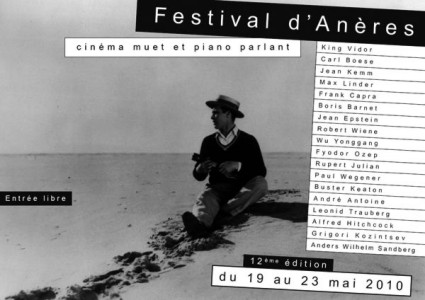
Bienvenue au Festival d’Anères

http://festival.aneres.free.fr

The Festival d’Anères, silent film festival takes place 19-23 May 2010 at Anères in Hautes-Pyrénées department, southern France. The programme has just been announced, and it’s a really excellent one:

Wednesday 19 May

17:00 Son premier film
d. Jean Kemm
with Grock, Pierrette Lugand, Gaston Dubosc
1926 / France / 1h52 / video
Copy: Film Régents (Archives Jacques Haïk)
Music: le groupe Magine – Saxophones: Alexandra Grimal; Voice and effects: Lynn Cassiers; Drums: Mathieu Calleja

21:00 The Phantom of the Opera
d. Rupert Julian
with Lon Chaney, Mary Philbin, Norman Kerry
1925 / USA / 1h32 / video
Copy: Lobster Films
Piano: Roch Havet; Voices: Kova Réa, Marion Dhombres; Voice and guitars: Guillaume Farley

Thursday 20 May

12:00 Seven Years Bad Luck
d. Max Linder
with Max Linder, Alta Allen, Ralph McCullough
1921 / USA / 1h02 / video
Copy: Lobster Films
Piano: Jacques Cambra

14:00 The Three Must-Get-Theres
d. Max Linder
with Max Linder, Bull Montana, Frank Cooke
1922 / USA / 55 minutes / video
Copy: Lobster Films
Music: a group of young musicians under the guidance of Mauro Coceano

17:00 Cœur fidèle
d. Jean Epstein
with Gina Manès, Léon Mathot, Edmond Van Daële
1923 / France / 1h27 / video
Copiy: Pathé / Cinémathèque française (D.R.)
Guitar: Paco El Lobo

19:00 Concert: Manu Galure

21:00 The Lodger: A Story of the London Fog
d. Alfred Hitchcock
with Ivor Novello, Marie Ault, Arthur Chesney, June Tripp
1927 / UK / 1h11 / 35mm
Copy: Carlotta Films
Accordion, trumpet: Virgile Goller; Saxophones: Florent Lalet; Double bass: Guillaume Guérin

Friday 21 May

11:30 Miss Mend (Episode 1)
d. Fédor Ozep and Boris Barnet
with Natalya Glan, Igor Ilyinsky, Vladimir Fogel, Boris Barnet
1926 / USSR / 1h28 / video
Copiy: Lobster Films
Music by Aidje Tafial: trumpet: Xavier Bornens; saxophones, flute: Olivier Py; piano: Roch Havet; double bass: Jeff Pautrat; drums: Aidje Tafial

14:00 The Strong Man
d. Frank Capra
with Harry Langdon, Priscilla Bonner, Gertrude Astor
1926 / USA / 1h15 / 35mm
Copy: Photoplay Productions
Piano: Jacques Cambra

17:00 La Terre
d. André Antoine
with Armand Bour, René Alexandre, Germaine Rouer, Jean Hervé, Émile Mylo, Berthe Bovy
1921 / France / 1h37 / video
Copy: Gaumont Pathé Archives
Violins: Frédéric Norel; clarinet, saxophone, machines: Sylvain Rifflet

19:00 Concert: Kova Réa

21:30 The Vagabond
d. Charlie Chaplin
1916 / USA / 25 min.
Music: Famille Gouffault
+
Novyy Vavilon (New Babylon)
d. Grigori Kozintsev et Leonid Trauberg
with David Gutman, Yelena Kuzmina, Andrei Kostrichkin
1929 / USSR / 1h15 / video
Original music by Dmitri Shostakovitch, arranged by Baudime Jam
Violin 1: Elzbieta Gladys; Violin 2: Survier Flores Lopes; Viola:Baudime Jam; Cello: Jean-Philippe Feiss; clarinet: Béatrice Berne

Saturday 22 May

11:30 Miss Mend (Episode 2)
de Fédor Ozep and Boris Barnet
with Natalya Glan, Igor Ilyinsky, Vladimir Fogel, Boris Barnet
1926 / USSR / 1h28 / video
Copy: Lobster Films
Music by Aidje Tafial: trumpet: Xavier Bornens; saxophones, flute: Olivier Py; piano: Roch Havet; double bass: Jeff Pautrat; drums: Aidje Tafial

14:00 Klovnen
d. Anders Wilhelm Sandberg
with Gösta Ekman, Karina Bell, Maurice de Féraudy
1926 / Denmark / 2h08 / video
Copy: Danish Film Institute
Music: le groupe Magine: saxophones: Alexandra Grimal; Voice and effects: Lynn Cassiers; Drums: Mathieu Calleja

17:00 Die Königin vom Moulin Rouge
d. Robert Wiene
with Mady Christians, André Roanne, Livio Pavanelli
1926 / Austria / 1h27 / video
Copy: Cinémathèque de Toulouse
Piano: Karol Beffa

19:00 Concert: Aldona

21:30 Der Golem, wie er in die Welt kam
d. Paul Wegener and Carl Boese
with Paul Wegener, Albert Steinrück, Lyda Salmonova
1920 / Germany / 1h26 / 35mm
Copy: Murnau Stiftung / Transit Film
Saxophone: Léonard Le Cloarec; Piano: Bertrand Allagnat; Bass: Antoine Reininger; Drums: Julien Bonnard

Sunday 23 May

11:30 Miss Mend (Episode 3)
d. Fédor Ozep and Boris Barnet
with Natalya Glan, Igor Ilyinsky, Vladimir Fogel, Boris Barnet
1926 / USSR / 1h14 / video
Copy: Lobster Films
Music by Aidje Tafial: trumpet: Xavier Bornens; saxophones, flute: Olivier Py; piano: Roch Havet; double bass: Jeff Pautrat; drums: Aidje Tafial

14:00 The Mystery of the Leaping Fish
d. Christy Cabanne and John Emerson
with Douglas Fairbanks
1916 / USA / 24 min.
Guitar, piano: Quentin Buffier; Flute: Julia Guillonton
+
Go West
d. Buster Keaton
with Buster Keaton, Howard Truesdale, Kathleen Myers
1925 / USA / 1h10 / video
Saxophone: Léonard Le Cloarec; Piano: Bertrand Allagnat; Bass: Antoine Reininger; Drums: Julien Bonnard

17:00 Shennü
d. Wu Yonggang
with Ruan Lingyu, Zhang Zhizhi, Li Keng, Li Junpan
1934 / China / 1h20 / video
Copy: ZZ Productions
Original music by Baudime Jam
Played by quatuor Prima Vista: Violon 1: Elzbieta Gladys; Violon 2: Survier Flores Lopes; Viola: Baudime Jam; Cello: Jean-Philippe Feiss

19:00 The Crowd
d. King Vidor
with Eleanor Boardman, James Murray, Bert Roach
1928 / USA / 1h29 / 35mm
Copy: Photoplay Productions
Piano: Karol Beffa

21:30 – grand ball

A fine programme indeed, and really good to see after tales of the festival having struggled to find sufficient funding to continue. The attention paid to the music accompaniment looks particularly commendable. More details can be found on the festival website (in French), and if any Bioscopist is intending to go, or knows someone who is, it would be good hear what the festival is like.

Toronto Silent Film Festival

http://www.ebk-ink.com/tsff

Acknowledgments to the ever-useful The Silent Treatment (the online PDF silent film newspaper) for news of the Toronto Silent Film Festival, which had previously escaped the Bioscope’s radar. This is a new festival, running 6-15 April 2010, so congratulations to all involved on having set it up. Here’s the programme, taken from the festival’s website:

Opening Night:
Tuesday April 6 Casa Loma
8pm
Toronto Theatre Organ Society presents:
Seven Chances 1925 USA
Director: Buster Keaton
Buster Keaton, Snitz Edwards, T. Roy Barnes
56 min
b/w with 2-strip Technicolor sequence

Musical Interpretation: Clark Wilson on the Wurlitzer Theatre Organ

Buster thinks his luck has turned a corner when he’s left $7 million in a will. The hitch-he must marry by 7pm on his 27th birthday and guess which day it is. So after completely offending his girlfriend, he sets out to find a willing bride only to strike out all 7 times. His friends do him a favour and place an advert for a bride willing to marry for money. The first 45 minutes is a great comedy film, the last 15 sends it into the stratosphere of insanity with the greatest chase scene in film history.

Preceded by Big Business with Laurel & Hardy

Thursday April 8 Fox Theatre
7pm
The Black Pirate 1926
Director: Albert Parker
Starring: Douglas Fairbanks, Billie Dove
88min
2-Strip Technicolor
Musical Interpretation: Laura Silberberg
Film introduced by Taylor Whitney, Archivist, Preservation Specialist of “Preserving the Past”, Rochester NY

“One of the silent era’s most spectacular blockbusters.
Fairbanks’s astonishing acrobatics remain as dazzling and as fresh today.”
The world’s greatest swashbuckler, Douglas Fairbanks, takes to the sea with cutlass in hand for the first great pirate movie and a gorgeous example of early Technicolor.

Sunday April 11 Revue Cinema
4pm
A THOUSAND LAUGHS
The Forgotten Clowns of Silent Comedy

Films introduced by programmer Chris Seguin, writer
Six Short Comedies featuring;

Roscoe ‘Fatty’ Arbuckle started out as one of Mack Sennett’s Keystone Kops, and quickly became Charlie Chaplin’s one serious rival. Nobody combined subtle charm with rowdy slapstick so artfully, and the innocent joy of 1919’s Love demonstrates precisely why he was so popular. Arbuckle’s career would be destroyed (unfairly) by scandal a few years later, but he would enjoy a comeback after a decade’s banishment from movie screens, just before his premature death at age 46 in 1933.

Lloyd Hamilton was, according to Charlie Chaplin, “the one actor of whom I am jealous.” His prissy, disapproving demeanour elevates the any-cliché-for-a-laugh approach of Breezing Along, where banana peels, exploding cigars and bum-pinching crabs are all par for the course. Consider yourself lucky that Breezing Along is still around to enjoy today – while Hamilton made more than 250 films in 20-year comedy career, most were destroyed in a studio fire in the 1930s.

Charley Chase’s sophisticated slapsticks of the 1920s seemed determined to prove one thing: folks back then sure liked sex. Men were wolfs, women were Hottentots, and Charley was generally caught in the middle. The split-second two-timing of Too Many Mammas was directed by Leo McCarey (The Bells of St. Mary, Duck Soup) while Charley’s starring series for Hal Roach Studios would last well into the ‘talkie’ era.

Snub Pollard started his film career as comedy sidekick to Harold Lloyd; when Lloyd moved on to bigger and better things, Pollard got his own starring series. His personality didn’t extend far beyond his hangdog moustache, but Snub could deliver a gag like nobody’s business – Looking For Trouble is the proof in the pudding. And we can guarantee you’ve seen this forgotten clown before – he’s the rain-soaked gent to whom Gene Kelly hands his umbrella at the end of Kelly’s classic Singin’ in the Rain number.

If Stan Laurel is remembered today, it’s as the wispy half of the comedy team of Laurel & Hardy. But the whimpering, slow-witted sidekick of pompous Oliver Hardy is nowhere to be seen in his solo work, where he’s usually a jackrabbit go-getter with more energy than brains. The Pest is a perfect example of Laurel’s fast & furious pre-Hardy style, and a great argument for having a giant catskin rug in the house at all times.

Goon-faced Larry Semon (a kind of a silent comedy precursor to Big Bird) had a simple philosophy: bigger is better. His films had the biggest pratfalls, the fattest fat men, and gooiest giant jars of jams and the most frantic finales. The Show doesn’t miss a trick, and includes the kind of budget-busting climax that made Semon a serious rival to Chaplin in the 1920s. (PC Warning: Black people will get white flour on their faces, white people will get black coal dust on their faces.)

Musical Interpretation: Andrei Streliaev

Tuesday April 13 Innis Town Hall
7:30pm

Man with a Movie Camera Soviet Union 1929
Director: Dziga Vertov
68min

Musical Interpretation: Richard Underhill and Astrogroove

This exhilarating experimentation of filming and editing knocks the audience for a loop with its playful and provocative style. Its expression of ideas without words turns it from a documentary of the day of the life of a Soviet city to an escalating feast for the eyes. Climb into the time machine and try to figure out who is watching whom.

Closing Night:
Thursday April 15 Innis Town Hall

7:30pm

Spotlight on Germany Double Feature

Films introduced by Angelica Fenner, Associate Professor of German & Cinema Studies, U of T

Adventures of Prince Achmed Germany 1926
65min
Director: Lotte Reiniger
Musical Interpretation: William O’Meara

The film print of Adventures Of Prince Achmed was made possible through the generous support of Liz Bartliff of the Sutton Group-Security Real Estate http://www.liztorontorealestate.com

German artist Lotte Reiniger took years to complete The Adventures of Prince Achmed, now the world’s oldest surviving animated feature. This is your chance to see her take on the Arabian Nights, in a fully restored print with vibrant tinting. Each of Reiniger’s all-black, jointed silhouettes moves fluidly against backgrounds recalling the ornate architectures of Ancient China and Persia. Beautiful or grotesque, locked in combat or touching their hands and lips to one another, her figures remain elegant, erotic and utterly human.

followed by…

Berlin: Die Sinfonie der Grosstadt
Berlin, Symphony of a Great City Germany 1927
62 min
Director: Walter Ruttmann
Musical Interpretation: William O’Meara

The essence of the city and the intimacies of its people are captured in this fluid cinematic tone poem. The filmic composition creates a romanticized, abstract view. From the arrival in pre-dawn of a locomotive to the gritty realities and unsettling scenes that follow throughout the day and into the night, Berlin and its people never gives up on its sheer joy of life.

A fine introduction to silent film for anyone, and I like the phrase ‘musical interpretation’. Check the festival website for venue and tickets information, and useful information on the (mostly local) musicians involved.

British Silents

http://www.britishsilents.co.uk

We’ve already made note of the British Silent Film Festival, being held at the Leicester Phoenix 15-18 April 2010, with the theme The World Before You: Exploration, Science and Nature in British Silent Film. However, there is reason to do so again on account of a detailed programme now having been made available, and the welcome appearance of a festival website. For some while now the festival has lacked a proper online presence – a WordPress blog helpd keep the flame alive, but now we have a proper www.britishsilents.co.uk, which includes not only details of the upcoming, 13th festival, but all previous festivals going back to 1998. Congratulations to the team on getting this up and running.

These are the programme details (with a modest contribution from yours truly, if that’s any sort of an incentive):

The World Before You: Exploration, Science and Nature in British Silent Film

Thu 15 April 11am
Q Ships
Long before Dunkirk, the little ships of Britain played a deadly game of cat and mouse with the German U-Boats. Underneath their modest exteriors these merchant ships were bristling with concealed weaponry, designed to lure the submarines to their doom.
UK/1928 Geoffrey Barkas/Michael Barringer

Thu 15 April 2pm
Beeman, Birdman, Hunter, Spy: the heroic age of the wildlife filmmaker
A particular breed of explorer from the earliest days of films was the wildlife cameraman. These intrepid pioneers risked life and limb, inventing their own equipment, travelling to the remotest parts of the planet to bring us unprecedented access to the natural world and inevitably having a few adventures along the way. This selection will show the work of J. C. Bee-Mason, Oliver Pike, Jim Corbett, and the legendary Colonel F.M. Bailey.
Presented by Bryony Dixon

Thu 15 April 4pm
The Masks of Mer
World Premiere of his new film presented by Michael Eaton
Writer, director Michael Eaton presents the world premiere of his new film about a unique film shot in the Torres Straits by Alfred Haddon in 1898, lasting for less than a minute, and the world’s first example of anthropological cinema. The Masks of Mer tells the extraordinary story of this experiment and traces the masks worn in the sacred initiation ceremony Haddon filmed. And, for the first time since Haddon himself publicly presented the work, his films are ‘synchronised’ with the team’s phonographic recordings.
Dir Michael Eaton, UK 2010, 60mins

Thu 15 April 6pm
The Bridal Party in Hardanger/Brudeferden i Hardanger
Presented by Jan-Anders Diesen and Halldor Krogh
A spectacular film based on one of the most famous paintings in Norway; Bridal Voyage on the Hardanger Fjord from 1848. Set amid stunning mountain and fjord scenery, this is the epic story of intertwining lives, love and loss during the lifetime of a young woman. A visual masterpiece that is both moving emotional drama and an authentic portrait of the vanishing cultures of the people who lived and farmed in the mountains of Western Norway.
This film will be screened with the new music score composed by Halldor Krogh
Dir: Rasmus Breinstein, Norway 1926, 74mins

Thu 15 April 9pm
The Sheik
Based on the steamy 1921 bodice ripper by Edith Maude Hull, this tale of passion between an aristocratic English woman and an Arab Sheik is the film that brought Valentino to prominence. He exudes a brooding, muscular sexuality which has lost none of its potency today and watching this film 90 years later, it is easy to see why his premature death drove women to despair and suicide.
Dir: George Melford, USA 1921. 80 mins
+
Crossing the Great Sagrada
Dir Adrian Brunel, UK

Fri 16 April 9am
She
Rider Haggard on Film
A sumptuous adaptation of Rider Haggard’s best-selling 1887 fantasy about a Cambridge professor’s quest for a lost kingdom in the heart of Africa where he encounters a magnificent sorceress who rules over her people as ‘She who must be obeyed’. This version was actively supervised by Haggard himself and stars Betty Blythe in the role later reprised by Ursula Andress.
Dir: Leander de Cordova, UK 1925, 2hrs
Fri 16 April 11.15am

With Lawrence in Arabia
Presented by Neil Brand and Luke McKernan
Neil Brand and Luke McKernan’s work in progress (in collaboration with the IWM) to recreate, using original text, slides and film extracts, Lowell Thomas’s famous lecture-cum-spectacle which is credited with creating and publicising the legend of Lawrence of Arabia. Thomas himself, a fascinating and flawed character but a master showman, delivers the narration.

Fri 16 April 12.15pm
Exploration, Adventure and Science Films from the Imperial War Museum Collection
presented by Toby Haggith

Fri 16 April 2.15pm
Sam’s Boy
Sam’s Boy is adapted by Lydia Hayward from one of the stories of W. W. Jacobs whose pet subject was the marine life or as Punch sardonically put it “men who go down to the sea in ships of moderate tonnage”. Filmed in the Thames estuary and on the Kentish coast this is a charming tale of an urchin in need of a father.
Dir: Manning Haynes, UK 1922 63mins
+
Premieres of recovered short films from the Scottish Film Archive presented by Janet McBain, including:
To Rona on a Whaler UK 1914, 12mins
In the Calm Waters of the Yare UK 1910, 6mins

Fri 16 April 4.15pm
The Race to the Pole: Britain and Norway
A programme of short films documenting early Polar exploration
The extraordinary story of the race to the South Pole by Amundsen and Scott is put into context by polar film expert Jan-Anders Diesen from Norway. The programme concludes with an extract of the BFI National Archive’s forthcoming restoration of The Great White Silence, Herbert Ponting’s record of Scott’s final expedition to Antarctica introduced by Bryony Dixon.

Fri 16 April 6.15pm
The Lost World
The first film adaptation of Conan Doyle’s classic novel of the land that time forgot and the prototype of every dinosaur movie since including Jurassic Park. Wallace Beery and Bessie Love star as Professor Challenger and Paula White who set out from London to rescue Paula’s father, the explorer Maple White lost on the Amazonian plateau where dinosaurs still roam. Conan Doyle took his family to see the film in 1925 and loved this version. Perfect family entertainment, then!
Dir: Harry O Hoyt, USA 1925, 100mins

Fri 16 April 9pm
South: Sir Ernest Shackleton’s Glorious Epic of the Antarctic
With a special musical score by Neil Brand
The definitive account of Shackleton’s legendary 1914-1916 Endurance Expedition, magnificently filmed by photographer Frank Hurley. A monumental document of human survival against all odds amidst the backdrop of some of the most stunning and inhospitable scenery on earth.
Prod. Imperial Trans-Antarctic Film Syndicate/ photography Frank Hurley, UK, 1919, 80mins

Sat 17 April 9am
Coast
Like the TV programme, we will trace the British coastline through its stories but we’ll be doing it using archive film from the silent days. With tales of great tempests, rough seas, daring rescues and tragic wrecks, of thronging docks, fishing ports and shipyards as well as scenes of a calmer nature, along the cliffs and beaches of our island home.
Introduced by Bryony Dixon
90mins

Sat 17 April 11am
Women in Silent Britain
Exploration into the hidden histories of women in silent British cinema is gathering momentum and this session will look at some of the fascinating and intrepid women working in film during this period, as writers, producers, technicians and critics as well as actresses.
Presented as part of the AHRC Women’s Film History Network – UK/Ireland that was recently set up to encourage new research into women’s contribution to cinema.

Sat 17 April 2pm
Family Matinee (PG)
Up the Pole
Get your coat on and join us on for a cornucopia of polar-themed cartoons and comedies featuring screen legends Ben Turpin, Buster Keaton, Jerry the Troublesome Tyke, Pimple and Bonzo the Peppy Pup, all struggling with inclement weather and harsh times. With live piano accompaniment (and much more) from Neil Brand.
This programme is dedicated to Dave Berry who brought Jerry the Troublesome Tyke back to our screens and devoted his life and work to the silent cinema that he loved.
Running time 80mins

Sat 17 April 2.15pm
A Maid of the Silver Sea
Husband and wife team Ivy Duke and director/ actor Guy Newall play opposite each other in this tale of familial conflict and mysterious death on a small island in the English Channel. The peaceable local fishing community is torn apart by the discovery of silver which threatens their way of life and matters get worse with the arrival of the English manager who falls in love with a local woman and is framed for murder.
Dir: Guy Newall, UK 1922, 63mins
Sat 17 April 4pm

The Annual Rachael Low Lecture
Presented by Tim Boon
This year’s Rachael Low lecture will be given by Tim Boon, Chief Curator of the Science Museum.
Tim Boon is the author of the recently published and highly acclaimed Films of Fact: A History of Science in Documentary Films and Television. He is also working with the BFI on a forthcoming DVD of the pioneering science and nature series Secrets of Nature. Rachael Low is a key figure in the history of the study of early and silent British cinema. Her pioneering studies published as The History of the British Film 1895-1929 (BFI) are an unrivalled source for students on the subject and the remain the unchallenged standard work in this field. Each year, the Festival pays tribute to her work by inviting a distinguished cultural commentator to give an illustrated lecture on a particular aspect of silent cinema.

Sat 17 April 6pm
The St Kilda Tapes
Live music, archive film and multi-media presented by David Allison
Using the evacuation of St Kilda in 1930 as a starting point, and with St Kilda evacuee Norman Gillies acting as narrator, this acclaimed show takes you on an emotional journey from the lonely Atlantic island to Glasgow, New York and Canada, before a triumphant and poignant return to St Kilda. With archive film and live music performed on guitar, 100 year old zither, ukulele and sampler, The St Kilda Tapes explores the themes of migration and home featuring archive films, St Kilda; Britain’s Loneliest Isle and A New Way to A New World.

Sat 17 April 9pm
Tol’able David (PG)
Accompanied with a new Blue Grass music score by Damian Coldwell, together with Nick Pynn on fiddle and Appalachian dulcimer and Lee Westwood on guitar
A thrilling David and Goliath story set in the beautiful Virginian Mountains. When the murderous Hatburn gang murders young David Kinemon’s older brother, the gentle David swears to protect his widowed mother and brothers and sisters. With a towering central performance by Richard Barthelmess as the young hero, and the unforgettable Ernest Torrence as the leader of the criminal gang. “Tol’able David is one of the enduring classics of the American screen.” Kevin Brownlow
Dir. Henry King, US 1921 100 min.
Preserved by The Museum of Modern Art, New York with funds provided by The Film Foundation.

Sun 18 April 9am
New Discoveries in British Silent Film
This programme will include new discoveries in British silent film, including regular contributor David Williams & Tony Fletcher with his programme called ‘Before and after Nanook’, examining how early filmmakers looked at cultures and societies before 1922.

Sun 18 April 11am
For Those in Peril on the Sea: Drifters and The Trawler Film
For centuries the deep sea fishermen were a mainstay of our island nation and this is revealed by the fascination with the trade by filmmakers since the earliest days. At the very end of the silent era John Grierson took the tradition of the trawler film and combined it with all the techniques of filmmaking that had developed over the decades to make his remarkable, lyrical film, Drifters, which heralded in a new era for the actuality film, the age of the documentary. This programme will show the whole of Grierson’s film and extracts from its antecedents.
Presented by Steve Foxon and Bryony Dixon.
Dir John Grierson, UK 1929, 80mins total

Sun 18 April 2pm
The Dodge Brothers performing to The Beggars of Life
The Festival is pleased to welcome the fabulous Dodge Brothers featuring Mike Hammond (guitar/ banjo), Mark Kermode (double bass/accordion), Aly Hirji (guitar/mandolin) and Alex Hammond (percussion) with guest Dodge Brother Neil Brand, performing their particular brand of Americana to William Wellman’s legendary tale of Depression-era, rail-riding hobos played by the iconic Louise Brooks and Jim Arlen.
Dir. William Wellman, USA 1928, 100mins

Sun 18 April 4pm
Climb Every Mountain
Jan Faull of the BFI presents a programme of mountaineering films including extracts from the ill-fated 1924 British Everest expedition immortalised on film in The Epic of Everest.

Sun 18 April 6pm
The Battle of the Ancre and the Advance of the Tanks
With a musical medley, specially reconstructed by Stephen Horne and Toby Haggith
The sister film to The Battle of the Somme, The Battle of the Ancre was filmed between September and November 1916 and contains the first shots of tanks in use at the Front and fraternization between German prisoners and their British captors. The work to reconstruct the original medley for this important First World War film has taken many months with the music suggested in the cue sheet being discovered as far away as Australia. After previewing this project at the 2009 Festival, we are pleased to present the completed score performed by Stephen Horne, Sophie Langdon and Martin Pyne and presented by Toby Haggith.
Dir: Geoffrey H Malins/J.B McDowell, UK 1917, 73mins

There are festival passes available, either a 4-day pass at £95 (£70 concessions) or a 1-day pass at £45 (£30 concession). Festival passes include lunch each day and tea and coffee during breaks. Tickets are also available for individual films and presentations, for which prices vary. For further information, visit the festival site or call Phoenix Square Box Office on 0116 242 2800.

Giornate database

Pordenone catalogues

In 2002 the Giornate del Cinema Muto (aka Pordenone Silent Film Festival) produced a CD-ROM that listed and described every film shown at the festival 1982-2001. The CD-ROM is now out of print, but what was really wanted was an online version which could be updated year by year. And now we have it.

The Giornate database lists every one of the 6,330 films featured at the festival 1982-2008. You can search by year, title, director, year of release, production company, country and archive. It is a little disappointing that no searching is offered by cast member or other credits, still more that there is no searching of descriptions or a free-text search generally. Hopefully such functionality can be introduced later (such search options are available on the CD-ROM version), but as it is the database is still a very useful and welcome resource.

The database lists every film shown at the festival since 1982, with additional entries for films which have been shown more then once (i.e. in later years). The information available varies, with no synopses for earlier years, though that’s because such data was not included in the festival catalogue/booklet. More recent records are richer in detail as the catalogue has become an ever more handsome production, with background information in both English and Italian. What every record does provide is title, any alternative titles, year of production, year in which it was shown at the festival, the production company, director (where known), format (i.e. 35m, 16mm etc), the film speed at which it was shown, its duration, and the archive which supplied the copy. You even get the name of the musician who played to the film.

Such core data yields all sorts of information. For instance, the festival has shown 473 films directed by D.W. Griffith, 104 films made in 1905, 71 films made by the Cines company, 374 films made in Germany, and 505 films from the Nederlands Filmmuseum. One can find out so much – not just about the contents of films shown at the festival, but their provenance and location. Moreover, it is information that was rigorously researched in the first place for the Pordenone catalogue, and which can be relied upon. Also, there are records here for films from across the world of silent cinema which the researcher will simply not be able to find anywhere else. It is a treasure trove.

That said, it could be even better. The potential for searching by credits or across synopses has been mentioned. However, it might be that the festival could open up this resource still further to our research community, with a bit of Web 2.0 functionality. For instance, where there are gaps in the data for earlier years (if this is the case – it’s not clear is the database represents all the published information in the festival catalogues from 1982), volunteers might be willing to type in the missing text or credits. Contributing archives could add updated information on prints that they provide, likewise the scholars who contributed information to the catalogue could add updated information – in both cases not altering the original catalogue record, but putting data into a separate notes field. Anyone might contribute comments on films that they have seen – obviously with some form of moderation. Databases are such powerful tools – we mustn’t just see them as searchale lists, but instead must make full use of them as structured and updatable data.

But even as it is the Giornate database is a fabulous resource, and one that hopefully will be updated year-on-year from now on. Grateful thanks and congratulations are due to the Giornate del Cinema Muto for making the database available to all. Go explore.

Film Biënnale 2010

http://www.filmmuseum.nl/biennale

Film Biënnale (formerly Filmmuseum Biënnale) is a festival of music, art and film held in Amsterdam and organised by EYE Film Institute Netherlands. EYE is the new institute for film in the Netherlands, uniting the Filmbank, Holland Film, the Nederlands Instituut voor Filmeducatie and the Filmmuseum. This year it takes place 7-11 April, with over thirty screenings with seminars and lectures. The Biënnale always has a srong silent film element, this year bolstered up by particular emphasis on film restoration. Here’s how the press release describes the highlights:

The Man with a Movie Camera
The Film Biennale will kick off in Muziekgebouw aan ’t IJ with the screening of The Man with a Movie Camera. Dating from 1929, this cinematographic masterpiece by Russian film pioneer Dziga Vertov continues to impress with its powerful visual style and clever montage of urban life in the Soviet Union. EYE Film Institute Netherlands has restored a ‘vintage print’ from its own collection.

British composer Michael Nyman – best known for his work with Peter Greenaway and the soundtrack to The Piano (1993) by Jane Campion – wrote a special score for the film. This score will be performed live by the Michael Nyman Band.

7 April 8.15 pm Muziekgebouw aan ’t IJ [Attendance is by invitation only]

Meet the MoMA; American film collection highlights
Our guest archive at this Biennale is the Department of Film at The Museum of Modern Art (MoMA) in New York. Founded in 1935 as the Film Library of the modern art museum, this collection now includes more than 22,000 films and four million film stills. Covering all periods and genres, it is the most important international film collection in the United States. The Film Biennale aims to reflect the full diversity of this rich collection with a programme incorporating everything from (experimental art films), to Hollywood classics, to silent movies. The material has been specially selected by the Department of Film and The Museum of Modern Art (Rajendra Roy, Joshua Siegel, Anne Morra, Katie Trainor, and Peter Williamson).

The Meet the MoMA programme includes works by Andy Warhol, Hollis Frampton, classics such as All About Eve (Joseph L. Mankiewicz, 1950), Lady Windermere’s Fan (Ernst Lubitsch, 1925), and highlights from MoMA’s own Cruel and Unusual Comedy programme, focusing on the American slapstick film. Screenings will be introduced by Anne Morra and Ron Magliozzi of the MoMA.

8 to 11 April in EYE (Vondelpark)

From Scratch to Screen
On 8 April, EYE offers the audience a chance to find out more about the challenges involved in restoring silent films. This day aims to underline the ongoing commitment of EYE to preserve and present silent films, despite the complexities presented by the fragile state of the film material. Throughout the day unique film finds and restoration projects will be screened (including several world premieres) illustrating different restoration approaches, with introductions by experts in the field. The day opens with the short film Waffen der Jugend (1912), the first film by Robert Wiene, the acclaimed director of Das Cabinet des Dr. Caligari (1919). This unique print unexpectedly turned up in a building that was about to be demolished in Rotterdam in 2009. Among the other highlights of the day is Liquidator (2010) by Karel Doing, an outstanding project making innovative use of existing archive images of Willy Mullens’ silent film Haarlem (1921). Karel Doing will present his digital adaptation immediately after the screening of Haarlem, preserved as it was found in 2008.

Following the premiere of the most recent Bits&Pieces episodes, another EYE discovery, Glorious Lady (1919) starring Olive Thomas, will be screened for the first time.

8 April 10 am -4.30 pm EYE (Vondelpark)

The Bankruptcy Jazz Live!
One of the highlights of the Film Biënnale is the multimedia film experience The Bankruptcy Jazz Live!, a co-production between Roxy Movies (Frank Herrebout and Leo van Maaren) and EYE Film Institute Netherlands. The Bankruptcy Jazz is the recent and only film based on a scenario written by Belgian poet Paul van Ostaijen in 1921, at a time when Europe was still in ruins. It is the world’s first true Dadaist scenario. The work features a 1920s style, employing an experimental, Dadaist collage technique to combine ready-made film footage and audio. The result is a turbulent, avant-garde spectacle. During the Dutch premiere in Bimhuis, The Bankruptcy Jazz will be staged with singers, actors, a children’s choir and jazz band conducted by composer Wouter van Bemmel. Van Bemmel will also make use of voice samples, sound effects, and music excerpts. Frank Roumen of EYE is directing the performance.

8 April 8.30 pm Bimhuis

Michael Curtiz before Hollywood
Before immigrating to the United States in 1926, Michael Curtiz, director of the Hollywood classic Casablanca (1942), was a very important figure in the thriving Hungarian film industry. Between 1912 and 1919, as Mihály Kertész, he made over forty silent movies – primarily popular genres, but also a few propaganda films. The Film Biennale will dedicate a whole day to screen his entire extant Hungarian work; inspired by the recent discovery of two silent feature films. The programme includes the premiere of the recently discovered and restored feature film Az Utolsó Hajnal (1917), as well as providing an exclusive opportunity to see A Tolonc (1914) while the restoration work is still ongoing. The Austrian film Fiaker nr. 13 (1926) from the EYE collection will also be screened.

The Curtiz Day will be moderated by film historian David Robinson, with contributions by Vera Gyürey and Gyöngyi Balógh (Magyar Nemzeti Filmarchivum), film restorers Simona Monizza and Annike Kross (EYE Film Institute Netherlands), and Miguel A. Fidalgo (author of Michael Curtiz; Bajo la sombra de ‘Casablanca’ [T&B editores, 2009]).

9 April 10 am – 5.15 pm EYE (Vondelpark)

Sessue Hayakawa: Hollywood’s first exotic superstar
Sessue Hayakawa (1889-1973) is primarily remembered for his role as the Japanese colonel in David Lean’s The Bridge on the River Kwai (1957). Less well-known is the fact that he was the first non-Caucasian Hollywood star and producer, and with his good looks and intense gaze he was also a veritable heartthrob at the beginning of the last century. He was especially praised for his subtle, non-theatrical acting style. Through his own production company, Hayakawa produced over twenty films, breaking through the stereotypical casting that required Asians to play ‘the villain’. On 10 April, EYE Film Institute Netherlands presents four successful films from Hayakawa’s career. The same evening, the unique (yet incomplete) EYE print of His Birthright (William Worthington, 1918) will be “completed” by stage actors (this performance is in Dutch only, with no translation!). EYE also has the one and only remaining print of The Man Beneath (William Worthington, 1919). The recently restored film will be screened in Pathé Tuschinski with new music by composer Martin de Ruiter, performed live by the National Symphonic Chamber Orchestra conducted by Jan Vermaning.

Hayakawa Day 10 April 10.30 am -5 pm EYE (Vondelpark)
His Birthright 10 April 8.30 pm Compagnie Theater (in Dutch, without translation!)
The Man Beneath 11 April 11 am Pathé Tuschinski

BaBa ZuLa plays Enis Aldjelis
Rounding off the Film Biennale is a spectacular performance by the internationally acclaimed Turkish group BaBa ZuLa, which will accompany the screening of Ernst Marischka’s film Enis Aldjelis – Die Blume des Ostens (1920) in Paradiso. Long before he became famous for his Sissi-series starring Romy Schneider, director Marischka shot this silent movie in Istanbul about ‘intimate Turkish life’, with an all-Austrian cast, including his wife Lily Marischka as Enis.
Hailing from Istanbul, BaBa Zula is renowned for high-energy live performances, mixing authentic Turkish rhythms, traditional instruments and electronic dub in their music.

Enis Aldjelis was originally discovered in EYE Film Institute Netherlands’ collection and restored by Filmarchiv Austria in 1991. A digitised English version produced by EYE will be screened at this event.

11 April 8.30 pm Paradiso

AMIA Seminar and The Reel Thing XXIII edition
EYE Film Institute Netherlands is hosting a day for film archive professionals on 7 April consisting of a morning seminar about on-line projects and an afternoon programme dedicated to recent film restorations.

The morning programme, organised on behalf of the international Association of Moving Image Archivists (AMIA), highlights recent projects offering on-line access to audiovisual archives. The aim of AMIA is to create an international platform for people and organisations involved in the preservation and presentation of audiovisual archives.
The afternoon programme, the XXIII edition of The Reel Thing, presents the most recent developments in film restoration and preservation, with demonstrations of both traditional and digital techniques. Michael Friend and Grover Crisp, both of Sony Pictures Entertainment, are organising this innovative programme featuring various presentations.

Attendance is free of charge. Please register directly on the AMIA website

7 April 9.30-12.30 am AMIA Seminar EYE Film Institute Netherlands
7 April 1.30-5.30 pm The Reel Thing EYE Film Institute Netherlands

film3 [kyü-bik film]
A new exhibition entitled film3 [kyü-bik film] will open on 8 April, in Culture Park Westergasfabriek, showcasing new installations and performances by eleven young film artists. Tying in with the exhibition, a book by the same name is being published, with essays and in-depth interviews. EYE Film Institute Netherlands will screen a film programme by two of the featured artists. The complete selection of short films can be seen in the Moving Concepts mobile cinema. Participating artists are: Rosa Barba, Nora Martirosyan, Roel Wouters, Daya Cahen, Jan de Bruin, Tijmen Hauer, Joost van Veen, Sietske Tjallingii, Telcosystems, Renzo Martens and Guido van der Werve.
film3 [kyü-bik film], 9 Apr – 2 May in KunstENhuis, Culture Park Westergasfabriek

Film programme: Episode I (Renzo Martens) and Number 12 (Guido van der Werve),
10 April 5.45 pm EYE (Vondelpark)
Moving Concepts mobile cinema will visit various Biënnale venues from 8 to 11 April

The full film programme (in Dutch but with information in English) is available in the Issu format (i.e. a page-turnable online document) here.

All the screenings and meetings listed here are in English, and all silent films will be accompanied by live music. For the complete Biënnale programme, schedule and other details please see: www.filmmuseum.nl/biennale. For tickets, fill in the accreditation form (here). The standard accreditation costs €50.00, payable on arrival. This gives you entrance to all screenings taking place in EYE (Vondelpark, 3). However, many performances are not repeated, and the number of seats is limited, so reservations in advance are recommended. Further information from the Film Biënnale website.