A propos de Pordenone

http://www.michaelnyman.com

As some may know, the composer Michael Nyman was scheduled to appear at last year’s Pordenone silent film festival, playing a piano accompaniment to Jean Vigo’s A Propos de Nice. As those who were there will know, he wasn’t able to attend and we got John Sweeney (who was excellent) playing to the film instead. But it’s just been announced that Nyman will be coming to this year’s festival, to accompany the same film, thus fulfilling a promise, which is very noble.

Nyman (best known to the film world for his Peter Greenaway and Michael Winterbottom scores and Jane Campion’s The Piano) has demonstrated a taste for accompanying silents before now. He has presented A Propos de Nice alongside Paul Strand’s experimental work Manhatta as a part of his show ‘The Piano Sings’, and of course he scored Dziga Vertov’s Man with a Movie Camera for the BFI DVD release.

For the full Pordenone programme (so far) click here, or for the Bioscope’s account of it (sans Nyman), click here.

Silent Films Days in Tromsø 2008

The Phantom Carriage (Körkarlen), from http://www.tiff.no

An offshoot of the Tromsø International Film Festival (which takes place in January), Silent Film Days in Tromsø (now in its third year) takes place 3-7 September at the Norwegian town. This year there’s a programme of international classics with musical accompaniment from Neil Brand, Ben Model, the Matti Bye ensemble, and HYSJ: Ola Rokkones and Herborg Rundberg ensemble. Here’s the programme (in Norwegian, but you’ll work it out):

Onsdag 3. september

15.00
THE SILENT PIANIST SPEAKS
Store og små øyeblikk fra stumfilmhistorien presentert ved musiker Neil Brand.

Torsdag 4. september

19.00 Åpningsforestilling
THE BIG PARADE
Den nest største kassasuksessen i stumfilmens historie.

Fredag 5. september

17.00
THE LODGER: A STORY OF THE LONDON FOG
Hitchcocks første thriller gjorde han til stjerneregissør.

20.00
THE PHANTOM CARRIAGE
Banebrytende svensk spøkelseshistorie

Lørdag 6. september

12.00
SILENT CLOWNS: KORT OG KOMISK
Klassiske stumfilmkomedier til glede for store og små.

15.00
FROSTY CELLULOID
“De første opptakene fra områder som tidligere hadde vært hvite flekker på kartet”

21.30
PAN
Første filmatisering av Hamsuns hyllest til naturen.

Søndag 7. september

15.00
SEVEN CHANCES
Fluktscenene filmverden aldri vil glemme.’
Forfilm: A Reckless Romeo

19.00
SOMETHING NEW
Både kjeltringer og kaktuser møter sin overkvinne i den nådeløse mexicanske ørkenen.
Forfilm: Sheriff Nell’s Tussle

More details from the festival website (which has text in English).

Lined up for Pordenone

The programme for this year’s Giornate del Cinema Muto at Pordenone, Italy (4-11 October) continues to evolve, but it’s been some months since we outlined some of the promised highlights, so it seems a good idea to point out the programme as it now stands. As always, the programme is divded up into strands:

Musical Events
4 October 2008 [20.30]
Sparrows (dir.: William Beaudine; United Artists, 1926)
produced by and starring Mary Pickford

11 October 2008 [20.30]
Les Nouveaux Messieurs (Albatros, FR 1929)
dir.: Jacques Feyder; cast: Gaby Morlay, Albert Préjean, Henry Roussell

The traditional opening and closing prestige films with orchestral accompaniment. Sparrows is accompanied by the premiere of a score composed by Jeffrey Silverman, performed by the Orchestra Sinfonica del Friuli Venezia Giulia, conducted by Hugh Munro Neely. Feyder’s Les Nouveaux Messieurs has a new score by Pordenone regular Antonio Coppola, performed by l’Octuor de France.

Tribute to Vittorio Martinelli
La fanciulla, il poeta e la laguna (Carmine Gallone, 1922)
Tutto per mio fratello (Latium Film, 1911)
Maciste in vacanza (Itala Film, 1921)
La vita dl grillo campestre (Roberto Omegna)
Sicilia illustrata (Ambrosio, 1907)

A selection of Italian silents shown in tribute to the late Italian historian Vittorio Martinelli (see the Bioscope’s obituary notice)

Alexander Shiryaev
Richard Williams Masterclasses

The first-ever complete retrospective of the films of Alexander Shiryaev, made privately 1906-1909, which use animation as a means of recording choreography. Plus a masterclass from the great modern animator, Richard Williams.

The French Touch (1915-1929)

An eclectic selection of French films, programmed by Lenny Borger, including works by Jacques Feyder, Raymond Bernard (Triplepatte), René Hervil (Knock), Gaston Ravel (Figaro), Jean Renoir (Tir au Flanc), Augusto Genina (Totte et sa Chance) and René Barberis (La Merveilleuse Journée)

Hollywood on the Hudson

Programme of New York-based films, to accompany Richard Koszarski’s new book, Hollywood on the Hudson. Titles include His Nibs (Exceptional Pictures, US 1920-21), Enchantment (Cosmopolitan Productions, US 1921), The Headless Horseman (Legend of Sleepy Hollow Corp., US 1922), The Green Goddess (Distinctive Productions, US 1923), Little Old New York (Cosmopolitan Pictures, US 1923), Janice Meredith (Cosmopolitan Pictures, US 1924) and The Show Off (Famous Players-Lasky Corp., US 1926).

W.C. Fields

With some convenient overlaps with other festival sections, the programme features Pool Sharks (1915), Janice Meredith (1924), Sally of the Sawdust (1925), It’s the Old Army Game (1926), So’s Your Old Man (1926), Running Wild (1927) and The Golf Specialist (1930).

The Griffith Project, 12 (1925-1931)

Pordenone’s long-running D.W. Griffith restrospective finally comes to an end with Sally of the Sawdust (1925), The Sorrows of Satan (1926), The Drums of Love (1928), The Battle of the Sexes (1928), Lady of the Pavements (1929), Abraham Lincoln (1930), prologues to the reissue of The Birth of a Nation (1930), The Struggle (1931).

Early cinema
– Brighton in Pordenone
– W.K.L. Dickson
– The Corrick Collection, 2
– Before The Lonely Villa
The Evidence of the Film (Thanhouser, 1913)

Mish-mash of early cinema subjects including a programme commemorating the 30th anniversary of the legendary FIAF congress held in Brighton, which did so much to establish early cinema studies (see Bioscope post), a programme of W.K-L. Dickson films to accompany Paul Spehr’s new biography, and part two of the collection of films owned by the Corrick family, vaudevillians who toured Australia in the 1900s.

Films and History – WW1-90 years
Austrian newsreels
Danish newsreels
Gloria: Apoteosi del Soldato Ignoto (1921)
Umanità (Elvira Giallanella, 1919)
If My Country Should Call (Joseph De Grasse, Ida May Park, 1916)
– The Messina Earthquake

Pordenone usually tries to include non-fiction films in its programming, and this selection commemorates the 90th anniversary of the end of the First World War, with two war dramas from women filmmakers, and actualities of the Messina earthquake of 1909.

Rediscoveries and Restorations
Bardelys the Magnificent (King Vidor, 1926)
Cikáni ([Gipsies], Karel Anton, 1921)
Ed’s Co-ed (Carvel Nelson, James Raley, 1929)
Gribiche (Jacques Feyder, 1926)
Ihr dunkler Punkt (Johannes Guter, 1929)
When Flowers Bloom (Haghefilm/Selznick School Fellowship 2008)
– Sessue Hayakawa
– Max Linder
– Keystone

A rich selection of new discoveries and restorations, the highlight undoubtedly being the much-discussed Bardelys the Magnificent, directed by King Vidor and starring John Gilbert.

Portraits
The Boot Cake
David Gillespie: A Life of Film (2008)
Homage to Mary Pickford
Mary Pickford: The Muse of the Movies (2008)
Poteslui Meri Pikford (Sergei Komarov, 1926)
Katie Melua: “Mary Pickford” (promo video, 2007)

David Gillespie (left), who sadly died earlier this year, was a projectionist, film collector and dedicated attendee of Pordenone, even when his eyesight had almost totally failed. He would sit in the front row, still delighted in such shadows as he could sense. A documentary was made about him by friends and completed shortly before he died. There’s a tribute to him on the Pordenone site. At the other end of some spectrum, Mary Pickford is recognised by a new documentary, Sergei Komarov’s The Kiss of Mary Pickford, and – surprise surprise – the pop video for Katie Melua’s ‘Mary Pickford’ (already covered by the Bioscope).

21st Century Silents

No details as yet.

A really marvellous programme – goodness knows how they are going to fit it all in. There’s also the Collegium, FilmFair, music masterclasses, and the Jonathan Dennis Memorial Lecture, which will be given by Eileen Bowser. Full details of registration, transportation and accommodation are on the festival site.

The Bioscope will be providing daily reports, but if you’ve not been before and are wavering over whether to do so, this really is the year to take the plunge. Just think of David Gillespie, barely able to see and yet loyally and lovingly coming back year after year. Makes the usual excuses seem a little on the feeble side…

Hope maybe to see you there.

Cinecon and Cinesation

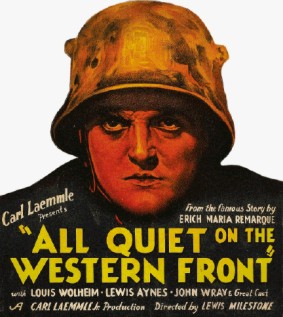
All Quiet on the Western Front, from http://www.cinephiles.org

In all these notices of upcoming silent festivals and the like, I’ve neglected two major American events in the calendar. So, as a quick catchup…

Cinecon
The Cinecon 44 Classic Film Festival takes place over Labor Day weekend, 28 August 1 September, in Hollywood. The festival feature nearly thirty silent and early sound features and multiple short subjects, with an emphasis on titles rarely given public screenings. This year’s lineup include Douglas Fairbanks in The Mollycoddle (1920), UCLA’s recent restoration of Tillie’s Punctured Romance (1914), Harold Lloyd in The Freshman, Larry Semon in Spuds (1927), Lon Chaney in a resotration of the long-lost Triumph (1917), Tom Mix in Sky High (1922) and Hobart Bosworth in The Blood Ship (1927).

Cinesation
The Cinesation film preservation festival takes place Film Preservation Festival 25-28 September, at the Lincoln Theatre, Massillon, Ohio. It also showcases silents and early sound features. The programme (particularly the short subjects) is still being finalised, but among the promised titles are Kenneth Harlan and Viola Dana in The Ice Flood (1925), Ken Maynard in The Grey Vulture (1926), Madge Bellamy in Soul of the Beast (1923), Oliver Thomas in Everybody’s Sweetheart (1920), Sessue Hayakawa in The Typhoon (1914), Lillian Gish in Sold for Marriage (1916), Constance Talmadge in Her Sister from Paris (1925) and the silent version of All Quiet on the Western Front (1930).

2nd International Silent Film Festival

Last year an unexpected and boldly-named addition to the world’s silent film festival was the 1st International Silent Film Festival, held in Manila in the Philippines. Well, one year on and here comes the 2nd International Silent Film Festival, to be held 26 August-8 September. Films are shown accompanied by live bands and again with ‘original scores’ (whatever that might mean). Here’s the programme:

FILMS WITH LIVE MUSIC
7pm, Shang Cineplex Cinema 1, Shagrila-la Plaza

Aug 26 The Black Man with a White Soul (El negro que tenía el alma blanca), Spain
music by Novo Concertante Manila
Aug 27 Cascading White Threads (Taki-no-shiraito), Japan
music by Bob Aves
Sep 2 Faces of Children (Visages d’enfants), France
music by JackRufo with Yosha
Sep 3 The Oyster Princess (Die Austernprinzessin), Germany
music by Noli Aurillo (with Louie Talan, Wendel Garcia and Kakoy Legaspi
Sep 4 Cabiria (Italy)
music by Caliph8 (with Malek Lopez and Matt Deegan)

FILMS WITH ORIGINAL SCORE
7pm, Shang Cineplex Cinema 1, Shagrila-la Plaza

Aug 28 Erotikon (Czechoslovakia)

FILMS WITH ORIGNAL SCORE
5pm, Listening In Style, 5/F Shangri-la Plaza

Aug 29 The Black Man with a White Soul (El negro que tenía el alma blanca), Spain
Sep 5 Cascading White Threads (Taki No Shiraito), Spain
Sep 6 Faces of Children (Visages d’enfants), France
Sep 7 The Oyster Princess (Die Austernprinzessin), Germany
Sep 8 Cabiria (Italy)

The International Silent Film Festival is back with a bigger and better lineup! This year, original participants Goethe-Institut Manila, Instituto Cervantes and Japan Foundation are joined by the embassies of the Czech Republic, France and Italy in treating moviegoers to screenings of classic silent films scored live by local bands. In addition, some of the films will also be shown with the original score in Listening In Style.

The German contribution to the festival is the 1919 Ernst Lubitsch film “The Oyster Princess (Die Austernprinzessin)”. In it, a pampered American oyster tycoon (Victor Janson) decides to find a prince to marry his daughter (Ossi Oswalda),but things don’t go quite as planned. Along the way, there are mishaps, misunderstandings and a foxtrot sequence that must be seen to be believed. Director Ernst Lubitsch was said to have “the Lubitsch touch”, a hard-to-define quality that makes his films masterpieces of sophisticated comedy. As this early and rare film makes clear, the Lubitsch touch was present almost from the beginning. Accompanying the film is a live score by legendary guitarist Noli Aurillo.

Other films to watch out for in the festival are “Cabiria” from Italy, “Erotikon” from the Czech Republic [sic], “Cascading White Threads” (Taki-no-shiraito) from Japan, “The Black Man With A White Soul” (El negro que tenía el alma blanca) from Spain and “Faces of Children” (Visages d’ enfants) from France.

The festival has grown in ambition from last year when there were just three titles screened, and it is impressively cosmopolitan in its range (interestingly, no American titles have been programmed). Further details on the Goethe-Institut Manila site.

Just like it was in the olden days

http://www.silentfilmfest.org.nz

Another day, another silent film festival. This time its New Zealand, and it’s the Silent Film Festival at Opitiki (‘Cinema – just like it was in the olden days’), which runs 5-6 September. Taking place in Opotiki’s Art Deco theatre, the festival encourages attendees to dress up in period style and travel in vintage cars. Piano accompaniment will be provided by Nick Giles-Palmer, and the films are accompanied by period shorts and newsreels courtesy of the New Zealand Film Archive.

Here’s the programme:

The Mark of Zorro 1920 ~ 93mins
In old Spanish California, the oppressive colonial government is opposed by Zorro, masked champion of the people, who appears out of nowhere with flashing sword and an athletic sense of humour, scarring the faces of evildoers with his Mark ‘Z’. Meanwhile, beautiful Lolita is courted by villainous Captain Ramon, rich but effete Don Diego… and dashing Zorro, who is never seen at the same time as Don Diego. As Zorro continues to evade pursuit, Ramon puts the damsel in distress…

Fairbanks’ prodigious athletic prowess and tremendous enthusiasm made the original movie a great success and enormous sets gave him plenty of room to swash and buckle in. His astonishing acrobatics amaze even modern audiences, particularly in the film’s climax.

Saturday 6th Sept ~ 7.30pm ~ Main Theatre ~ $14

It – starring Clara Bow 1927 ~ 77mins
Clara Bow, one of the most adorable actresses to grace the silent screen, stars in this delightful romantic comedy. As Betty Lou Spence a shopgirl at Waltham’s Department Store, she falls for her boss, the handsome Cyrus Waltham, Jr. and decides that he is to be her husband. With the help of his friend Monty and her own ‘It’ factor, Betty tries to win the man of her dreams.

Clara Bow’s vitality and sexiness defined the liberated woman of the 1920s and she became one of Hollywood’s brightest lights. Clara was known as The ‘It’ Girl. As well as representing sex-appeal, ‘It’ symbolized the tremendous progress women were making in society. Her dynamic performance as the cute, bubbly, down-to-earth Betty makes this film one of the most charming and entertaining silents as well as providing an interesting slice of history.

Saturday 6th Sept ~ 2pm ~ Main Theatre ~ $14

Venus of the South Seas 1927 ~ 77mins
Visited infrequently by the supply schooner ‘The Southern Cross’ lies the little island of Manea. The owner of the island has made a fortune in copra and pearl but more precious than all these treasures is his adored daughter – Shona, the most skilful diver in the South Seas. Romance blossoms when a yacht anchors in the mystic moonlit harbour and Shona swims out to meet it. A pearl pirate attempts to steal the pearls but is foiled by the young man Shona falls in love with.

Annette Kellerman, who plays Shona, was a champion diver and swimmer who made headlines in 1907 when she was arrested in Boston for wearing a one-piece bathing suit. The exterior scenes were filmed in Nelson, the interior in Christchurch.

Friday 5th Sept ~ 7.30pm ~ Main Theatre ~ $14

Intolerance 1916~3.5hr Spectacular!
Intolerance and its terrible effects are examined in four eras, spanning several hundreds of years and cultures. Themes of intolerance, man’s inhumanity to man, hypocrisy, bigotry, religious hatred, persecution, discrimination and injustice achieved in all eras by entrenched political, social and religious systems, create a spectacular and dramatic epic.

Director D.W. Griffith’s ambitious silent film masterpiece is one of the milestones and landmarks in cinematic history.

Saturday 6th Sept ~ 9.30am ~ Little Theatre
Includes buffet lunch.

Films of Opotiki
From the New Zealand Film Archives – a fascinating historical record of small town NZ.

A special compilation of films made by local electrician & projectionist John Wilkinson, between 1950-1974, forms most of this presentation. A fascinating record of Opotiki life they include films of the Opotiki port and the arrival of MV Waiotahi, dramatic scenes of thermal activity on White Island in 1956, terrible flood devastation in Opotiki and the clean-ups. Street parades, school kids in fancy dress and on floats, marching girls and Opotiki High performing the haka…and more. Another home movie by Ester and Deryk Rogers documents the cultivation of kumara at Maraenui in the 50’s. The programme begins with local personality, Epi Shalfoon, and His Melody Boys (1930) jazz band playing ‘E Puritai Tama e’.

By popular request, the programme concludes with the award winning short film, Two Cars One Night, (2003) made by Taika Waititi, which was filmed in the Te Kaha pub car park.

Friday 5th Sept ~ 1pm ~ Main Theatre ~ $14

Buster Keaton in ‘The Goat’ 1921 ~ 27mins
Madcap chases and hilarious displays of physical agility are the highlights of this frenetic Buster Keaton short. Dumb luck sets some policemen on his trail – after a series of innovative escapes, he gets mistaken for a murderer with a price on his head, which means the people that aren’t chasing him are fleeing from him. Nonstop laughter.

&

Harold Lloyd in ‘Sailor-Made Man’ 1921 ~ 46mins
Comedy great, Harold Lloyd, plays baseball-mad twerp ‘Speedy’ Swift. When his girl’s father insists that, before he will agree to Speedy marrying his daughter, he must first prove that he can do something more worthwhile than act the playboy, he joins the navy, just like that! Classic slapstick feature-length movie, especially in the final scenes.

Both showing together (total time: 75mins)
Fri 7th Sept – 11am and 4.30pm
Sat 8th Sept – 4.30pm
Sun 7th Sept – 11am, 1pm and 3pm

More details on booking, timetable, and a gallery showing how people have got into the spirit of things in past festivals can all be found on the site.

Forssa festival

http://www.forssasilentmovie.com

Rejoicing in the challenging (to the non-Nordic tongue) but magnificent name Mykkäelokuvafestivaalit, but having the more manageable alternative title of Forssa International Film Festival, this Finnish festival of silent films returns to Forssa 29-30 August. Now in its ninth year, the festival brings together an international programme of classics and rarities, usually with an element of local film as well.

There’s no background information on the site in English (as yet), but here’s the programme:

29 August
17:00 Nuori Luotsi
19:30 Speedy
22:00 The Lost World

30 August
12:00 The Kid Brother
14:30 Chaplin programme: The Floorwalker, The Cure, The Adventurer
17:00 Tarzan of the Apes
19:00 Girl Shy
22:00 Faust

The site includes a page on Harold Lloyd and, usefully, details of programmes from previous years.

Bioscope Newsreel no. 5

Merton on the road again
Following its hugely successful tour of the UK in 2008, Paul Merton’s Silent Clowns show, with accompanist Neil Brand, will be hitting the road again in Spring 2009. Merton and Brand will be giving eight shows at the Edinburgh fringe festival 8-16 August. Read more.

Silents in Shasta County
The Shasta County Arts Council of Redding, California, is holding its annual silent film festival, 24-25 October. Highlights include Metropolis, Blackmail and Peter Pan with actors reading out the intertitles to make the show more child-friendly. Read more.

A course in slapstick
The Museum of Modern Art, New York, is holding a course over five Wednesday, November-December on slapstick, entitled ‘Cruel and Unusual Comedy: Social Commentary in the American Slapstick Film’. The instructors are Ron Magliozzi, Steve Massa and Ben Model, who also provides the music. Read more.

Singing the silents
Published in paperback this month is Ken Wlaschin’s The Silent Cinema in Song, 1896-1929: An Illustrated History and Catalog of Songs Inspired by the Movies and Stars, with a List of Recordings. It is the history of the response of popular song to the silent cinema, with information on availability of recordings. Read more.

‘Til next time!

The best of British

Since 1998, the British Silent Film Festival has been flying the flag for the British silent film. The Festival was established by a group of enthusiasts determined determined to overturn the traditional prejudices that had been all to evident two years before in Kevin Brownlow’s television series Cinema Europe: The Other Hollywood, which had been scathing of British silents. For Brownlow, the mean and badly-made British films of the silent era were not just of negligible aesthetic interest, but the idea of them had helped establish the sort of general prejudice against silent films which he had dedicated his career towards fighting.

The Festival (which located itself in Nottingham after a first year at Leicester) wanted not just to screen the best and most interesting of British silent films, but to encourage research, publication, and innovative presentation. Academic papers were welcome, but they had always to be accompanied by film clips, for which the resources of the BFI National Archive were effectively at their disposal. A speciality was made of musical accompaniment, with such regulars as Neil Brand, Phil Carli, John Sweeney and Stephen Horne. The Festival also welcomed non-fiction film quite as much as fiction.

From humble beginnings, this ever-inventive combination of festival and academic conference has built up an international reputation, and has undoubtedly done much to encourage the revival of interest in British silent film, which has found welcome outlet in DVD releases, festival screenings and television programmes. Throughout the festival has been organised and programmed by Bryony Dixon and Laraine Porter, always on a shoestring, and frequently on half a shoestring. Political events, the outcome of which is still uncertain, have cast a cloud over the future of the Festival – I’ll report more on this once the dust has settled – but meanwhile in September the BFI Southbank (the National Film Theatre as was) is putting on a season of highlights from the Festival’s past.

Creatively entitled The Best of the British Silent Film Festival, this is the programme:

26 September 18.20
The Olympic Games on Film 1900-1924
Luke McKernan present a programme of archive film on the early Olympic Games, from chronophotographs of American athletes at the Paris Games of 1924, to Harold Abrahams and Eric Liddell of Chariots of Fire fame at the Paris Games of 1924. The programme has a special focus on the London Games of 1908.

26 September 20.40
The Ware Case (1928)
Dynamic and surprisingly cinematic adaptation of a famous stage courtroom drama. Directed by Manning Haynes, with Stewart Rome, Betty Carter, Ian Fleming. Adapted by Lydia Hayward, one of many female screenwriters now beginning to be rediscovered as a result of the Festival’s interest in women film-makers.

27 September 16.00
When All Films Were Short
Lucky-dip programme of short films – quirky, funny, macabre, sensational, persuasive – of the kind that the Festival has made a special point of championing.

27 September 18.45
The Battle of the Somme (1916)
Special preview screening of the Imperial War Museum’s new restoration of the outstanding feature-length ‘documentary’ of the First World War, filmed by Geoffrey Malins and J.B. MacDowell and edited by Charles Urban. The music will be played by Stephen Horne and Martin Pyne, recreating the original musical suggestions from the film’s 1916 screening.

27 September 20.40
The Lure of Crooning Water (1920)
The quintessential British pastoral film, and example of the sort of rediscovery which as helped demonstrate that there was a strengthening tradition of filmic storytelling in the silent period concerned with the British landscape. Directed by Arthur Rooke, with Guy Newall and Ivy Duke.

28 September 16.00
True Crime on Film
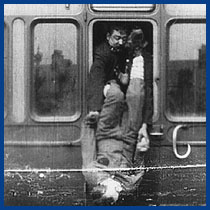
An illustrated history of true crime in film, featuring execution films, terrorists and assassins, murderers and embezzlers, with a particular focus on the stories of Charles Peace (William Haggar’s 1905 The Life of Charles Peace is illustrated above) and Thomas Goudie. Presented by Michael Eaton, Vanessa Toulmin and Bryony Dixon.

28 September 18.20
The Triumph of the Rat (1927)
Ivor Novello, most popular British star of the 1920s, in the second of the hugely popular Rat trilogy, directed by Graham Cutts.

28 September 20.40
The First Born (1928)
Miles Mander’s fluid, cinematic masterpiece (illustrated at top of post), on the double-standards of the English upper classes, has emerged from obscurity to enjoy increasing acclaim as one of the finest of British silents. Starring Mander and Madeleine Carroll.

Members’ priority postal booking opens 4 August; members’ priority online and phone booking opens 11 August; public booking opens 15 August. Hope to see some of you there.