Drakula halála

Bioscope Festival of Lost Films

Hungary 1921

Director: Lajthay Károly
Production company: Corvin Filmgyár
Cinematographer: Eduard Hoesch
Scenario: Lajthay Károly, Mihály Kertész (Michael Curtiz)
Based on the character created by Bram Stoker

Cast: Paul Askonas (Drakula), Margit Lux (Mary Land), Elemér Thury (Doctor), Lajos Réthey (Fake doctor), Aladár Ihász (Assistant), Karl Götz (Funny man), Dezsö Kertész (George), Lajos Szalkay, Zoltán Dezső, Hatvani Károly, Oszkár Perczel, Károly Hatvani, Anna Marie Hegener, Paula Kende, Lene Myl, Magda Sonja, Béla Tímár

Five reels
Distributor: Jenö Tuchten
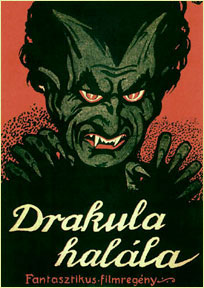
Drakula halála poster

Poster for Drakula halála

Welcome all to the final screening in the inaugural Bioscope Festival of Lost Films. This evening we find ourselves in Leicester Square, in the cinema that has the honour of being the first such venue to have opened in London’s motion picture heartland. It was the 5th June 1909 when it first opened its doors, as the select Bioscopic Team Rooms. Soon it changed its name to the Circle in the Square, which name we rather prefer to its later name of the Palm Court Cinema, still more to its eventual fate – conversion into an Angus Steak House. There is room for 250 of you (if some stand), and the music is provided by the indefatigable and certainly inimitable Ena Baga.

And what a chilling offering we have for you tonight. It is with some pride (and not a little trepidation for fear of the effect it might have on some of the more nervous among you) that we present Drakula halála, a Hungarian tale of horror and fantasy as mysterious in its history as it is in its subject matter. Mystery, for example, surrounds the date of its production, but we are assured that – despite the several claims for it to have been made two years later – Drakula halála was produced in 1921 and was reportedly first shown in Vienna that year, though it was re-exhibited in Budapest in 1923. So the estimable F.W. Murnau in Germany who we hear is planning a film based on the legend of Dracula may have more resources at his disposal, yet he will be second with his subject matter. But finding any certain facts about our film’s production has been difficult (having no one on the Festival staff with a working knowledge of Hungarian has been a handicap).
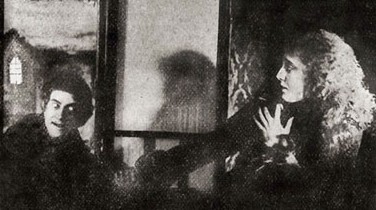
Paul Askonas (Drakula) and Margit Lux (Mary)

Paul Askonas (Drakula) and Margit Lux (Mary)

The title of the film translates as The Death of Dracula, but the story is not that of the novel by Bram Stoker. Instead it tells of the orphaned Mary who is sent against her will to a psychiatric hospital. There one of the inmates claims to be the undead Dracula, and he begins to haunt her dreams. Although she escapes from the hospital and eventually marries a noble forester, visions of Dracula still fill her mind, and she remains unsure whether all that happened to her was some awful dream or horrid reality.

The Hungarian film industry is a modest one, and one that has suffered greatly under the political turmoil in that country. In 1919, the revolutionary Béla Kun established a Communist government, which collapsed after just a few months, to be replaced by the brutal military regime of Miklós Horthy. Kun had nationalised the film industry and an ambitious plan of production was drawn up. But the anti-Semitic Horthy despised the film industry, and persecuted many filmmakers (the unfortunate director Sándor Pallós was tortured to death for having made a film based on a novel by Gorky). Many in the industry fled, such as Sándor László Kellner (Alexander Korda) and Mihály Kertész (Michael Curtiz), who is believed to have contributed to the script of Drakula halála. The industry continues, but in a greatly reduced state, close to the point of bankruptcy.

Paul Askonas as Drakula

Paul Askonas as Drakula

Thus Drakula halála is one of just a handful of films being made in Hungary at this time. Most are based on light popular novels, but this film is very different. Its star, Paul Askonas, has appeared in both Hungarian and Austrian films, usually of a fantastical or horrific nature, such as Labyrinth des Grauens (1921, Labyrinth of Horror). It is tempting to see this vision of dark threats, uncertainty and nightmares as somehow reflecting its troubled land and film industry, a place where reality may be a still greater nightmare than those encountered in one’s dreams. Director Lajthay Károly, a specialist in thrillers and someone praised for his uniquely atmospheric style, never directed another film – why, and whatever happened to him? (There are rumours of a drink problem) So many mysteries, so many more fantasies than certain facts…

Hungary is the land of lost silent films. 600 films made between 1912 and 1930, and just forty-five complete films survive. Drakula halála is not among them – or is it? Are we to believe the claims of a dubious Italian site dealing mostly in adult films, which claims to know of a 16mm print with a thirteen-minute fragment of the film? We choose not to believe it. The internet is awash with such fantasies. Here at the Bioscope Festival of Lost Films we deal only with true loss. Only when a film can no longer be seen does it, for us, become strangely, truly alive. Undead, even.

Life Without Soul

Publicity sheet for Life Without Soul, from http://frankensteinia.blogspot.com

To accompany this film we have broken our rules somewhat and gone for another five-reel feature rather than a short. But what a double-bill, to be able to offer you: Drakula halála and Life Without Soul. This 1915 film, made by the Ocean Film Corporation of New York, is similar to our main feature in that it presents the story of Frankenstein as a dream that explores the borderland between life and death. Frankenstein’s name has become William Frawley, a doctor living in modern times who dreams that he creates a humanoid monster (played by Percy Darrell). Despite acclaim for Mr Darrell’s chilling portrayal of a man without a soul that yet catches the audience’s sympathy, the film has not been a success. We hear that its 1916 re-edited re-issue included extra scenes taken from scientific films about the reproductive habits of fish. It is unclear why.

Do not believe the fantasist who on that modern innovation the Internet Movie Database, writes about this film as though he has seen it. He has not. It is lost, as have been all the films in this Bioscope Festival of Lost Films. We hope that you have enjoyed our selections. Please leave the cinema quietly, and a safe journey home to you all.

Pleasant dreams.

Nosferatu trailer

Eureka Video has released a YouTube trailer for its forthcoming DVD release of Nosferatu. The two-disc set comes with commentary track by Brad Stevens and R. Dixon Smith, and an hour-long German documentary on the film by Luciano Berriatúa. It’s a F.W. Murnau-Stiftung restoration complete with Hans Erdmann’s original score, performed by the Radio Symphony Orchestra Saarbrücken conducted by Berndt Heller. There’s also a 96-page booklet with articles by David Skal, Thomas Elsaesser, Gilberto Perez and Enno Patalas (former director of the Münchner Stadtmuseum/Filmmuseum, where he was responsible for the restoration of many German classics, including Nosferatu). The Region 2 DVD is released on 19 November. Kino Video will be releasing the Region 1 version in the USA. The trailer looks fantastic – we are starting to get spoiled with deluxe DVD presentations of silent classics.

Update: Do take a look at the Kino Video entry for the film, which includes a Flash video on the digital restoration of the film, one of the DVD extras.

Segundo de Chomón

I’ve just found about this rare screening of films by the Spanish director Segundo de Chomón, taking place at Tate Modern on Friday 6 July at 19.00pm. Segundo de Chomón is one of the masters of early fantasy film, overshadowed rather by Georges Méliès, but whose trick films are no less intoxicating or ingenious, filled as they are with sorcerers, mystics, devils and exotic dancers. The sixty-minute programme includes all these titles (several of which are coloured prints, heightening the exoticism of the scenes):

Poules aux Oeufs D’Or, 1905
Antre Infernal, 1905
Antre de la Sorcière, 1906
Spectre Rouge, 1907
Armures Mysterieux, 1907
Scarabée D’Or, 1907
Metempsycose, 1907
Excursion Incoherente, 1910
Legende du Fantôme, 1908

Stephen Horne is playing the piano, for what is an excellent programme of films little seen but once seen unlikely to be forgotten. Early cinema was a magical place. Further information from the Tate site. It’s part of the Dali & Film season, and Dali would have loved them.

British Pathe – part one

British Movietone (see 26 February post) is one British newsreel now available in its entirety online, but the most important British newsreel collection – and one which goes back to the silent era – to be found on the web is British Pathe. Pathé newsreels ran in Britain from 1910 to 1970, while the company also produced cinemagazines like Eve’s Film Review and Pathé Pictorial, as well documentaries and other shorts. 3,500 hours of this collection was made available online in free low resolution download form four years ago, thanks to funding from the Lottery-based New Opportunities Fund.

The British Pathe site is therefore a superb resource for discovering silent non-fiction film, and in future posts I’ll be providing a guide to some of the treasures to be found. However, I’m going to start with the unexpected – fiction films. Pathé somehow picked up assorted pre-First World War films, some though not all made by its French parent company, and these got digitised alongside the newsreels and are available on the site. There is no index to these fiction films, so below is a list of some of the ones that I have been able to find, with descriptions and some attempts at identifying them, as few are given correct titles or dates:

(the first title given is that on the British Pathe database – enter this in the search box to find the film)

THE FATAL SNEEZE = comedy in which a man suffers from an increasingly violent sneeze. This is That Fatal Sneeze (GB Hepworth 1907).

THE RUNAWAY HORSE = comedy in which a runaway horse causes chaos. This is a famous comedy of its time, Le Cheval Emballé (FR Pathé 1907).

FLYPAPER COMEDY = This is a French comedy with Max Linder, in which Max has flypaper sticking to him which he then finds sticks to everything else.

THE FANTASTIC DIVER = early trick film in which a man dives into a river fully clothed then returns by reverse action in a swimsuit.

THE RUNAWAY GLOBE = Italian? comedy in which a giant globe intended for a restaurant runs away down a street and is chased by a group of people before being sucked up by the sun, only to be spat out again.

THE MAGIC SAC [sic] = French trick film in which an old man hits people with a sack and makes them disappear.

MYSTERIOUS WRESTLERS = French trick film where two wrestlers pull one another to bits. This is a brilliant George Méliès trick film, Nouvelle Luttes Extravagantes (FR Star-Film 1900).

ATTEMPTED NOBBLING OF THE DERBY FAVOURITE = section from a British racing drama, made by Cricks and Sharp in 1905.

THE POCKET BOXERS = trick film in which two men place two miniature boxers on a table and watch them fight.

ESCAPED PRISONER RETURNS HOME = guards wait while prisoner bids a tearful farewell to his sick wife. This must be a James Williamson film, perhaps The Deserter (GB 1904).

LETTER TO HER PARENTS = extract from a drama at which elderly parents are upset at a message they receive.

ASKING FATHER FOR DAUGHTER’S HAND = scenes from a film where a fiancée has to prove himself to the father.

HAVING FUN WITH POLICEMEN = British comedy in which two legs stick out of a hole in an ice-covered pond, placed there by boys to trick a policeman.

POINT DUTY = a policeman is run over by a car and put back together again. This is How to Stop a Motor Car (GB Hepworth 1902).

THE MOTOR SKATER = comedy where man buys a pair of motorised skates and causes chaos.

RUNAWAY CYCLIST = comedy where man buys a bicycle and causes chaos (as can be seen, this was a common theme for comedies of the period).

FIRE = mixture of actuality film of a fire brigade and a dramatised fire rescue. This is Fire! (GB Williamson 1901).

HAMLET = scene with Hamlet and his father’s ghost, using trick photography, from Sir Johnston Forbes-Robertson’s production of Hamlet, a feature-length film (GB Hepworth 1913).

THE DECOY LETTER = early, rudimentary Western, where a soldier lures away an innkeeper with a decoy letter and attempts to assault his wife.

THE VILLAGE FIRE = comedy fire brigade film. This is The Village Fire Brigade (GB Williamson 1907).

THE RUNAWAY CAR = French comedy in which three men try to ride a bicycle and then a car.

RESCUED BY ROVER = a dog finds a kidnapped baby. This is of course the famous Rescued by Rover (GB Hepworth 1905).

Anyone who recognises the descriptions where the film has not been identified, or has the time to take a look at the films and identify them, or finds other fiction films on the site, do let me know.