Bioscope Newsreel no. 5

Merton on the road again
Following its hugely successful tour of the UK in 2008, Paul Merton’s Silent Clowns show, with accompanist Neil Brand, will be hitting the road again in Spring 2009. Merton and Brand will be giving eight shows at the Edinburgh fringe festival 8-16 August. Read more.

Silents in Shasta County
The Shasta County Arts Council of Redding, California, is holding its annual silent film festival, 24-25 October. Highlights include Metropolis, Blackmail and Peter Pan with actors reading out the intertitles to make the show more child-friendly. Read more.

A course in slapstick
The Museum of Modern Art, New York, is holding a course over five Wednesday, November-December on slapstick, entitled ‘Cruel and Unusual Comedy: Social Commentary in the American Slapstick Film’. The instructors are Ron Magliozzi, Steve Massa and Ben Model, who also provides the music. Read more.

Singing the silents
Published in paperback this month is Ken Wlaschin’s The Silent Cinema in Song, 1896-1929: An Illustrated History and Catalog of Songs Inspired by the Movies and Stars, with a List of Recordings. It is the history of the response of popular song to the silent cinema, with information on availability of recordings. Read more.

‘Til next time!

Convening with Buster

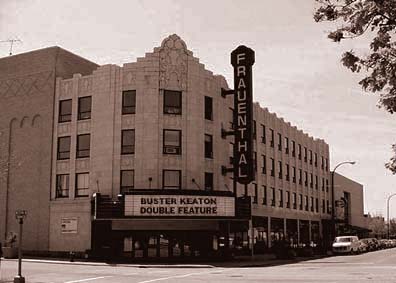
Frauenthal Theatre, Muskegon, from http://www.silent-movies.org/2008

The 14th Annual International Buster Keaton Society Convention, organised by that excellent crowd the Damfinos (if you have to ask you haven’t watched enough Keaton films yet) will be held 3-4 October, in Muskegon, Michigan (Keaton home town). Attendees this year are promised the exclusive screening of “a radically different print of a silent Keaton feature not shown anywhere in over 80 years”. Other highlights include the lost film from the 1957 stage production of Merton of the Movies in which Keaton starred, presentations on assortedl aspects of Keaton’s career, an authors’ panel featuring George Wead, David Macleod and Imogen Smith, author of the new book Buster Keaton: The Persistence of Comedy, screenings including a double bill of Battling Butler and The Navigator, plus a baseball game played on the same ground used by Buster when a child.

Full information on the convention, registration and acommodation from www.silent-movies.org/2008.

Fight pictures

I wrote a post a while ago on two new books on boxing and modern culture. I’ve just started reading Kasia Boddy’s Boxing: A Cultural History, which is a real treasure trove, so more on that in due course.

I’ve not yet laid eyes on Dan Streible’s Fight Pictures: A History of Boxing and Early Cinema, which is going to be a real treat, but anyone who’s in New York might like to know about an illustrated lecture the author will be giving at Light Industry, a new venue for film and electronic art in Brooklyn. The event takes place on 6 May at 8.00pm, and costs $6.

Here’s the blurb:

Between 1894 and 1915, the first generation of filmmakers produced more than 250 motion pictures with boxing and prizefighting as their subject. Fight pictures were among the most conspicuous, profitable and controversial productions of early cinema. From 1912 until 1940, U.S. law banned the interstate distribution of film recordings of prizefights. Congress enacted the law to suppress the celebrity of the first black heavyweight champion, Jack Johnson, titleholder from 1908 to 1915. Yet, only a few years after the start of the ban, fight pictures flourished again. Throughout the 1920s and 30s these supposedly criminal records were nearly ubiquitous in movie houses and other venues. In conjunction with his newly released book Fight Pictures: A History of Boxing and Early Cinema, Dan Streible presents glimpses of some of these ephemeral films, most of which no longer survive or exist only in fragments. Also on screen will be much of the ephemera – posters, photographs, cartoons, advertisements and the like – that accompanied these “moving fight pictures.”

See the likes of:
Corbett and Courtney Before the Kinetograph (1894)
Corbett-Fitzsimmons Fight (1897)
A Scrap in Black and White (1903)
Squires vs. Burns, Ocean View, Cal., July 4th, 1907 (1907)
Jack Johnson: Der Meister Boxer der Welt (1911)

It’s a compelling history, one well worth telling and telling again. More from the ring in the near future.

Colourful stories no. 7 – Reviving Kinemacolor

David Cleveland

David Cleveland operating a Kinemacolor projector

We continue with our series on the history of early colour cinematography, but take a diversion out of the past to the present day – Monday February 25th, to be precise – for the very best of reasons. Because today, at the British Film Institute’s J. Paul Getty Conservation Centre in Berkhamsted, Hertfordshire, we witnessed a rare recreation of ‘true’ Kinemacolor.

The screening was organised by film archivists David Cleveland and Brian Pritchard, who decided to mark the centenary of Kinemacolor by exhibiting the world’s first natural colour motion picture system in its correct form, using an original Kinemacolor projector. Kinemacolor films have been shown in composite colour or computer synthesized forms, or so customised that they will run at normal speed on a normal projector, but not since 1995 at the Museum of the Moving Image has anyone attempted to show Kinemacolor as it was originally done – black-and-white film run through a projector fitted with a red and green rotating filter, at double speed (thirty or more frames per second). It is rarer still to employ an original projector (the MOMI show used a customised 1920s Ernemann projector).
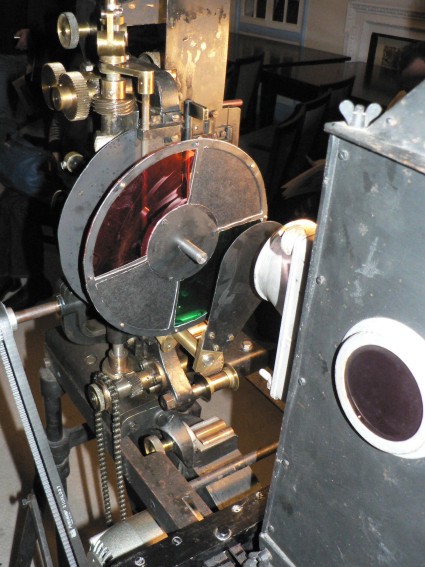
Kinemacolor projector

Kinemacolor projector no. 19 (rear view showing colour filter)

The projector was generously loaned by Wirral Museum, which also allowed the archivists to replace missing parts and to make the machine operable, so long as it would be returned to its original museum state once they had finished with it. It is Kinemacolor projector no. 19, with original colour filter. Cleveland and Pritchard aimed to be as authentic as possible, with two limitations – they could not show nitrate films, fairly obviously, and for similar health and safety reasons they could not use an arc light (they used a filament blub instead).

We gathered in a small room, with chandelier adding an appropriate touch of class to the proceedings (less so the windows necessarily blacked out with black bags and tape). The small audience comprised archivists from the BFI National Archive, a smattering of academics, and as guests of honour, Kinemacolor’s producer Charles Urban’s step-grandson Bruce Mousell and his two daughters.

David introduced the event and the projector, then we were shown three of the sample Kinemacolor films held in the BFI National Film Archive. Tragically few Kinemacolor films survive today, and all that the UK’s national archive holds are some test films which were never shown publicly. These were retained by the system’s inventor G.A. Smith, who passed them on to Brighton collector Graham Head, whose collection in turn went to the Cinema Museum in London. Two of the prints we saw were therefore struck from original negatives, with a third taken from a dupe neg. This film was shown first, Cat Studies (c.1908), a short single shot of a cat (a black-and-white cat at that), which served to help make adjustments to the filter, since we started off with the wooden board with a hole through which the cat looked appearing green, because the rotating filter had been aligned incorrectly.
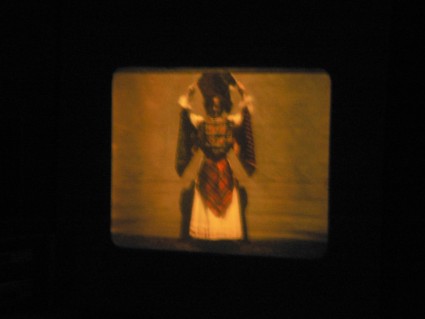
Woman Draped in Patterned Handkerchiefs

Projection of Kinemacolor test film Woman Draped in Patterned Handkerchiefs

There then followed Woman Draped in Patterened Handkerchiefs (c.1908), whose action is self-explanatory, a film clearly designed to demonstrate basic colour effects; and Pageant of New Romney, Hythe and Sandwich (1910), an actuality film rejected at the time for being too contrasty. In truth, the sample Kinemacolor films held by the BFI are poor examples of the colour system, showing little in the way of effective colour, and the latter film in particular demonstrating the hazards of fringing (the alternating red/green records meant that the film record could not always keep up with movement, resulting in red or green ‘fringes’).

But, after a pause for reloading and a talk from Brian Pritchard on the customising of the projector and Smith’s ingenious use of sensitizing chemicals (without which Kinemacolor would not have worked at all), we were shown a beautiful Kinemacolor film loaned by the Nederlands Filmmuseum. This was Lake Garda, Italy (1910), a travelogue of the Italian beauty spot, whose picture postcard images showed up the colour to exquisite effect. We saw panoramic views of the lake, buildings, boats with red and yellow sails, and a delightful sequence where three musicians in a small boat serenaded the camera. Being full of gentle motion, the muted, subtle colour was shown to its best effect, being particularly good at rendering white buildings and reflections in the water. Kinemacolor, using as it did red and green filters, could not logically depict blue, yet blue we saw in the sky and water. This is all down to our gullible brains, reconstituting what seems optically logical to us. The sky should be blue, so we see blue.

What was also interesting was the colossal noise. The motorised projector had to rattle through at a speed of thirty frames per second, and the racket drowned out all conversation. The image on the screen had to be kept quite small, to retain as much brightness as possible (Kinemacolor absorbs a great deal of light). We all wondered how on earth they coped projecting Kinemacolor in large theatres, where the throw would have been considerable. We also marvelled at the skill of the original projectionists, who had to cope not only with a double-speed projector, but changing colour effects owing to differences in filters used (the cameramen would change then accoding to the light conditions encountered) and all of the hazards of correct colour synchronisation.

Bruce Mousell

David Cleveland (right) with Charles Urban’s step-grandson Bruce Mousell and his daughters

The demonstration revealed many of the problems, but also several of the beauties of Kinemacolor, and made one wish for more such screenings to be organised. As David Cleveland explained in his notes to the show:

Several archives have a few examples of Kinemacolor films in their collections, and the usual process is to make a composite film copy of the red and green images onto one new Eastman Color inter-negative, and normal colour prints therefrom. Of course this takes on Eastman Color characteristics, and the colour is not the same as originally seen. Scanning is probably the answer, but here again it needs to be carefully done so that the colour is as near to the original filters as possible … and that the result is not a smooth ‘television’ type picture, but an image that resembles the projected picture of a century ago. Only this way can Kinemacolor be put into context with the development of colour films.

It is a great shame that, in its centenary year, Kinemacolor remains so elusive. Cleveland and Pritchard had the greatest difficulty getting films from other archives, and it is to be hoped that there may be greater co-operation over any future events. So few Kinemacolor films survive (maybe thirty or so, out of the hundreds originally produced), and more must be done to preserve them, to make them accessible in original as well as the more convenient composite form, and to uncover more – because there are undoubtedly ‘lost’ Kinemacolor films out there. Kinemacolor appears to be ordinary silent black-and-white film to the untrained eye. Only when you look closely do you see alterations in tonal emphasis from frame to frame. Many archives, I am sure, are sitting on Kinemacolor films and are not aware of the fact. 2008 would be a good year in which to start conducting a search to locate them.
2008 – The Year of Colour

Kinemacolor poster

A happy new year to one and all!

2007 was a productive year for The Bioscope, from small beginnings, and I hope that the coming year will see the service continue to gow and for the archive of useful content to build up. In 2008 I’ll be continuing to provide news on events, festivals, conferences, screenings, DVD releases and online resources for early and silent cinema. The Library of freely-available digitised documents will continue to grow (there is quite a backlog of titles to be added in due course), and I hope to add new features and maybe indulge in a redesign somewhere along the line.

However, the major theme running through 2008 will be colour cinematography in the silent era. 2008 sees the centenary of the first public exhibition of Kinemacolor, the world’s first natural colour motion picture system. Pedants may say that the centenary of Kinemacolor might have been 1906/2006 (when it was patented), 1907/2007 (when it was exhibited in a preliminary form to an audience of film professionals) or 1909/2009 (when it was first called Kinemacolor and was first exhibited to a paying public). But 1 May 1908 was when the system was first shown to a startled general audience at Urbanora House, Wardour Street, London – and that’s good enough for me.

So throughout 2008 there will be posts on colour cinematography to 1930. Not just Kinemacolor (though there will be plenty on that), but the experimental efforts that preceded it, hand-painted and stencil colour, tinting and toning, Biocolour, Cinechrome, Chronochrome, Kodachrome, Prizmacolor, Technicolor, Polychromide, Kodacolor, and more. There will be potted histories, archive documents, illustrations and (if I can find them) film clips. It’ll all build up into a year-long series to cherish and keep.

Lastly, here’s a checklist of some of the silent film events taking place over the year (all of which and more will be recorded in the Calendar section):

14-18 January – The Bioscope Festival of Lost Films
17-20 January – Slapstick 2008 silent comedy festival, Bristol
24-27 January – StummFilmMusikTage festival, Erlangen
9 February – Border Crossings: Rethinking Early Cinema conference, Berkeley
22-23 February – Kansas Silent Film Festival
13-16 March – Cinefest, Syracuse
26-28 March – City in Film conference, Liverpool
3-6 April – British Silent Cinema Festival, Nottingham
11-13 June – The Fifth International Women and the Silent Screen conference, Stockholm
17-21 June – Domitor conference, Peripheral Early Cinemas, Perpignan and Girona
28 June-5 July – Il Cinema Ritrovato, Bologna
11-13 July – San Francisco Silent Film Festival
8-10 August – Capitolfest, New York
28 August-1 September – Cinecon festival, Hollywood
25-28 September – Cinesation festival
4-11 October – Giornate del Cinema Muto, Pordenone

Keep reading, keep commenting, and tell your friends.

Image and Sound

Friese-Greene film

Strange things going on at the Tate. This Friday, 7 September, Tate Britain is hosting Image and Sound, which it describes as

Iconic British silent films shown with live music dominate the enormous central gallery, and Steve Beresford, Scanner and David Toop perform together for one night only.

The event is organised by Artprojx (“a co-marketing, event production and creative strategic consulting agency”), and mixes artists’ films with experimental music/sounds and British silents – in this case, Anthony Asquith’s A Cottage on Dartmoor (1929), with Stephen Horne at the piano, and Claude Friese-Greene’s The Open Road series of colour films 1924-25, with the much-travelled Neil Brand on the piano.

Goodness knows how the ‘iconic’ silents will blend in with the experimental sounds, artists’ films (including Haris Epaminonda’s Light, Tarahi II, Tarahi IIII, Tarahi V, Michael Nyman’s Moscow 11.19.31, and what sounds like a special treat, Emily Wardill’s Basking in what feels like ‘an ocean of grace’, I soon realise that I’m not looking at it, but rather that I AM it, recognising myself). With a bar available in the gallery and folk wandering to and fro, it should make for an interesting happening, but possibly not the ideal circumstances in which to savour the silents (though they are at least in their own room, The North Duveens).

Still, why not go along and support Neil and Stephen, and see if I’m wrong. The Tate’s growing commitment to exhibiting silent film is commendable, and if they can continue to place the films before new audiences, even if the settings may sometimes be challenging, this can only be to the good. Doors open at 6.00pm with tickets on a first-come-first-served basis, and the event runs til 10.00pm. The central Image and Sound event runs 7.00-9.00, The Open Road is at 6.30 and A Cottage on Dartmoor at 7.45.

There’s rather more information on the Artprojx site than on the Tate’s.

Damfinos convention

The Three Ages

The Three Ages (1923), from http://www.busterkeaton.com

The 13th Annual Damfino Convention takes place in Muskegon, Michigan, 5-6 October. This the annual convention of the International Buster Keaton Society. Promised attractions include a baseball game on the field where Buster played as a child, a ‘Know Your Keaton’ trivia quiz, a Keaton memorabilia auction, scholarly presentations, and a costume party. Among the screenings is a rare showing of The Three Ages (1922), Keaton’s first feature film, which co-starred Margaret Leahy, winner of a British ‘find-a-film-star’ competition, whose poignant story I tell in an essay available on the Damfinos website (you’ll find it in the Articles section).

Queen Victoria comes to Canterbury

Queen Victoria’s Diamond Jubilee

General bookings opened today for Queen Victoria’s Diamond Jubilee at the Canterbury Festival. This is a show I’ve devised which recreates the tour around London taken by Queen Victoria on 22 June 1897, to mark the sixtieth year of her reign. In taking the audience around London, the show integrates photographs, eye-witness testimony and original films (from the BFI National Archive) of the procession, shown in correct sequence. The eye-witness testimony, including the words of Kier Hardie, Edward Burne-Jones, Molly Hughes, Beatrice Webb, Mark Twain and Queen Victoria herself, is read by Neil Brand (an actor as well as our most celebrated silent film accompanist) and Mo Heard, with Stephen Horne playing the piano. And I’m the presenter.

The show is taking place Friday 19th October, 8.00pm, at the International Study Centre, which is in the precincts of Canterbury Cathedral. Tickets are an entirely reasonable £12, and full details of how to book are on the Festival website.

Segundo de Chomón

I’ve just found about this rare screening of films by the Spanish director Segundo de Chomón, taking place at Tate Modern on Friday 6 July at 19.00pm. Segundo de Chomón is one of the masters of early fantasy film, overshadowed rather by Georges Méliès, but whose trick films are no less intoxicating or ingenious, filled as they are with sorcerers, mystics, devils and exotic dancers. The sixty-minute programme includes all these titles (several of which are coloured prints, heightening the exoticism of the scenes):

Poules aux Oeufs D’Or, 1905
Antre Infernal, 1905
Antre de la Sorcière, 1906
Spectre Rouge, 1907
Armures Mysterieux, 1907
Scarabée D’Or, 1907
Metempsycose, 1907
Excursion Incoherente, 1910
Legende du Fantôme, 1908

Stephen Horne is playing the piano, for what is an excellent programme of films little seen but once seen unlikely to be forgotten. Early cinema was a magical place. Further information from the Tate site. It’s part of the Dali & Film season, and Dali would have loved them.

Queen Victoria’s Diamond Jubilee

Mr Hunt

110 years ago, on 22 June 1897, Queen Victoria processed through London to mark sixty years of her reign. Numerous motion picture cameramen were positioned around the route, including Birt Acres, Robert Paul, R.J. Appleton, Dr J.H. Smith, Alexandre Promio (filming for Lumière), Henri Lavanchy-Clarke, Alfred Wrench and John Le Couteur. A number of these short film survives, mostly in the collection of the BFI National Archive. Ten years ago I put together a commemorative show which combined the surviving films with photographs from around the route and actors reading our eye-witness testimony from Mark Twain, Edward Burne-Jones, Molly Hughes, G.W. Steevens and others. Recently I revived the show, and this is just a bit of advance notice that it will be featuring at this year’s Canterbury Festival, on Friday 19 October, with Stephen Horne on the piano, Neil Brand (away from the piano for once) taking the male parts and Mo Heard the female parts, with me as narrator. Booking opens 13 August!

The image above shows a section of the crowd in the stands outside St Paul’s Cathedral, where the main ceremonies took place (the Queen being too infirm to scale the steps and go inside). In the centre of the photograph you can see the camera and tripod of Mr Hunt, one of Robert Paul’s team of cameramen. And you can see footage taken by Paul himself (positioned on the other side of the square, in this QuickTime video clip from the New Zealand Film Archive.