Music for experimental film

I missed this excellent-looking DVD release from Kino when it appeared late last year, but no harm in drawing attention to it now.

Music for Experimental Film is a collection of avant garde film classics from the 1920s, with music from former Television guitarist and front man Tom Verlaine plus producer/guitarist Johnny Rip. Originally a live show, the DVD features the original films with the music accompaniment for the most played live from a selection of the concerts.

The films featured are:

L’Étoile de Mer (France 1928 12 mins Man Ray)

The Fall of the House of Usher (USA 1928 13 mins James S. Watson & Melville Webber)

The Life and Death of 9413 A Hollywood Extra (USA 928 11 mins Slavko Vorkapich and Robert Florey)

Emak-Bakia (France 1926 13 mins Man Ray)

Rhythmus 21 (Germany 1921 3 mins Hans Richter)

Brumes d’Automne (France 1929 12 mins Dimitri Kirsanoff)

Ballet Mécanique (France 1924 10 mins Fernand Léger)

To judge from the extracts Kino have provided on the YouTube promo (Emak-Bakia, Rhythmus 21 and Ballet Mécanique) the marriage of delicate post-punk guitar and the visual purity of the films (all the better for the occasional scratches and blemishes earned through age) works particularly well. An apposite and haunting combination.

The first wizard of cinema

Georges Méliès: First Wizard of Cinema

Georges Méliès: The First Wizard of Cinema, from http://www.flickeralley.com

2008 is not four weeks old, and yet what will have to be the silent DVD release of the year has already been announced. It won’t become available before 3 March 2008, but that just gives you a month’s worth of delicious anticipation, awaiting Flicker Alley’s thirteen-hour, five-disc DVD release, Georges Méliès: The First Wizard of Cinema (1896-1913).

The collection brings together over 170 films, comprising nearly all the surviving films of Georges Méliès (he made just over 500), from his first 1896 production Une partie de cartes (discovered by yours truly some twelve years ago – my very modest claim to early cinema fame), to his uproarious final film, Le voyage de la famille Bourrichon (1913). It includes such classics as Voyage dans la lune (A Trip to the Moon), Les quatres cent farces du diable (Satan’s Merry Frolics) and A la conquète du pôle (The Conquest of the Pole). Fifteen of the films are reproduced from partial or complete hand-colored original prints, while thirteen are accompanied by the original English narrations meant to accompany the films, written by Méliès.

The collection has been put together by the pre-eminent preservationist-producers Eric Lange (of Lobster Films) and David Shepard, from archival and private holdings in eight countries. A major extra is the half-hour documentary, Le Grand Méliès (1953), made by Georges Franju, which features Georges Méliès’ widow and star of many of his films, Jehanne d’Alcy and André Méliès portraying his father.

The Moon

Le voyage dans la lune

Georges Méliès (1861-1938), the pre-eminent artist of early cinema, a creator of ingenious fantasies coming out of his magicianship background, but which employ the cinema’s own entrancing trickery to the full. The sheer joy of filmmaking that his films express means that his best work does not date and continues to delight each generation that comes across him (just take a look at some of the admiring comments made of the many films of his to be found on YouTube). He is particularly deserving of the complete box set treatment, even if the majority of the films that he made are now lost (though more titles keep turning up). It is seventy years since his death, and presumably it is no accident that the DVDs are appearing this year, since under European law his films should be coming out of copyright in 2008 i.e. the rule that says copyright remains in a film production until seventy years after the death of the author. What the position is of the Méliès family, who have been so protective of his heritage up until now, I don’t know. Perhaps one of our knowledgeable readers might be able to say.

At any rate, warmest congratulations to Messrs. Lange and Shepard for a herculean piece of work, and to Flicker Alley for issuing such an ambitious release. It’s available at special pre-order price of $71.96 (do note that it will be Region 1 DVD). I’m off to pre-order mine.

(There will be more on Méliès on the Bioscope in a couple of months or so’s time, if I ever finish a small project I’m working on)

Blackpool and the North West on film

Notice of a couple of shows of rare actuality film of Blackpool and the North West of England taking place this weekend in Blackpool. Organised by the British Film Institute, the North West Film Archive and the National Fairground Archive as part of the latter’s ‘Admission all Classes’ project, the programme is as follows:

Saturday 12th January

Pavilion Theatre, Winter Gardens, Blackpool

11.30am – BFI presentation of historic Blackpool

Blackpool High Tide (1913)
The Open Road (c.1925) Blackpool extract
Blackpool: A Nation’s Playground (c.1935)
Mining Review 2nd Year No 12 (1949)
Holiday (1957)

Grand Edwardian Magic Lantern Show

Professor Heard and company take us on a musical, magical excursion from the age of Victorian magic lantern show to the birth of the cinema picture palace.

2.30pm – North West Film Archive presentation of historic Blackpool

Blackpool Seafront (1899)
Royal visit to Lancashire (1913)
Prince of Wales visit to Blackpool (1927)
Blackpool Kaleidoscope (1963)

Grand Edwardian Magic Lantern Show

7.00pm – Electric Edwardians: the Films of Mitchell & Kenyon
With piano accompaniment
commentary by Professor Vanessa Toulmin

Sunday 13th January

The Grand Theatre, Blackpool

1.30pm – Mitchell & Kenyon: North Lancashire and Cumbria
Including:
Employees Leaving Williamson’s Factory, Lancaster (1901)
The Return of the Lancaster Volunteers (1901)
His Worship the Mayor Leaving Lancaster Town Hall (1902)
Opening of the Blea Tarn Reservoir (1902)
Panoramic View of the Morecambe Sea Front (1901)
Parade on West End Pier Morecambe (1901)
Parade on Morecambe Central Pier (1902)
Douglas Harbour Paddle Steamer (1902)
The King’s Ride in the Isle of Man (1902)
Employees Leaving Furness Railway Works, Barrow (1901)
Employees Leaving Messrs Vickers and Maxim’s in Barrow (1901)
Royal Visit to Barrow & Launch of H.M.S. Dominion (1903)
Workers at Carr’s Biscuit Works, Carlisle (1901)
Scenes of Carlisle (1901)

7.30pm – Mitchell & Kenyon: Central Lancashire
including:
Workforce at Horrocks Miller & Co, Preston (c. 1901)
Preston North End v Wolverhampton Wanderers (1904)
Preston North End v Aston Villa (1905)
Turn out of the Preston Fire Brigade (c. 1901)
Return of the East Lancashire Regiment (1902)
Preston Street Scenes (1904)
Whitsuntide Fair at Preston (1906)
Leyland May Festival (1905)
Les Montagnes Russes, Blackpool’s Latest Attraction (1902)
Blackpool North Pier (1903)
Steamboats at Blackpool North Pier (1903)
Blackpool Victoria Pier (1904)
Blackpool Promenade Extension (1905)
Lytham Club Day Carnival (1902)
Lytham Trams and Views along the Route (1903)
Panaromic view of Southport Promenade (c. 1902)
Southport Carnival and Trades Procession (1902)
The ‘hands’ leaving work at North-street Mills, Chorley (1900)
Chorley Coronation Processions (1911)

For booking on Saturday, visit the Blackpool Live site. For booking on Sunday, visit the Blackpool Grand site.

And while we’re considering things Lancastrian, do take note of the North West Film Archive‘s excellent new DVD release, Liverpool on Film 1897-1967, which includes Lumière films of Liverpool taken in 1897, as well as other silent actuality material, handsomely presented. What better way to celebrate Liverpool as the 2008 City of Culture?

Bach releases DeMille

Bach Films

Cecil B. DeMille DVDs, from http://www.bachfilms.com

My thanks to Herr Graf Ferdinand Von Galitzien for the information that the French company Bach Films have released ten Cecil B. DeMille silents on DVD. The titles are:

The Cheat (1915) – with Sessue Hayakawa, Fannie Ward
Carmen (1915) – with Geraldine Farrar, Wallace Reid
Joan the Woman (1917) – Geraldine Farrar and Raymond Hatton
The Whispering Chorus (1918) – with Raymond Hatton and Kathlyn Williams
Old Wives for New (1918) – with Elliott Dexter and Florence Vidor
Don’t Change Your Husband (1919) – with Elliott Dexter and Gloria Swanson
Male and Female (1919) – with Thomas Meighan and Gloria Swanson
Why Change Your Wife (1920) – with Thomas Meighan and Gloria Swanson
The Affairs of Anatol (1921) – Gloria Swanson and Wallace Reid
Manslaughter (1922) – with Leatrice Joy and Thomas Meighan

All are retailing at 7.00€. All are Region 2, and appear to have French titles only. I can’t find any information about the music. At any rate, it’s a remarkable selection, with perhaps Joan the Woman, starring the opera singer Geraldine Farrar (who enjoyed a surprisingly successful career in silent films, given that her chief asset – her voice – was absent), the outstanding classic if you had to go for just one.

I’d not heard of Bach Films before now. Other silent DVDs on their list are D.W. Griffith’s Way Down East (1920), Orphans of the Storm (1922), Broken Blossoms (1919), Intolerance (1916) and Sally of the Sawdust (1925), all of them accompanied by assorted Griffith Biograph shorts; Douglas Fairbanks in The Three Musketeers (1921), Robin Hood (1922), Don Q, Son of Zorro (1925), The Black Pirate (1926) and The Iron Mask (1929); and Tod Browning’s Shadows (1922).

I don’t attempt to keep up with all silent film DVD releases here on The Bioscope, because there are other well-established sources that provide such a service very well. Check out the Silent Films on DVD section on Silent Era, or the impressively-extensive Silent Films on DVD site.

Oswald the Lucky Rabbit

Oswald the Lucky Rabbit

Oswald the Lucky Rabbit

Walt Disney is in the process of releasing a series of Treasures DVDs presenting assorted gems from its past. The latest in the series features Oswald the Lucky Rabbit. Oswald has been rather left out of Disney mythology, largely because Disney lost hold of the rights. Oswald was Disney’s all-animation cartoon series, preceded by the live action and animation mix of Alice in Cartoonland, but itself preceding the Mouse. The animation is basic by the standards that Disney would introduce in the 1930s, but is graced with enough inventive touches and decent gags to please more than just the animation archaeologist.

Twenty-six Oswald titles were produced by Disney over 1927-1928, with animation by Ub Iwerks, Friz Freleng, Rudolf Ising and others. But Disney lost the rights to the character in a battle with his distributor, Winkler Productions, and producer Charles Mintz continued with the series out of the silent and into the sound era, with many of Disney’s animators abandoning him and joining Mintz. After further business shenanignas, the series continued as Walter Lantz productions, distributed by Universal, up to 1938.

Years passed, and we find ourselves in 2006. After years of trying, Disney recovered the rights to the original twenty-six, Disney-produced Oswalds, and began a process of tracking down the best possible materials from archives around the world. Thirteen of the series now appear on Walt Disney Treasures – The Adventures of Oswald the Lucky Rabbit, a two-DVD set released in America. The titles are:

Oh, Teacher (1927)
Great Guns (1927)
The Mechanical Cow (1927)
All Wet (1927)
Oh What a Knight (1928)
Sky Scrappers (1928)
Trolley Troubles (1927)
The Fox Chase (1928)
Bright Lights (1928)
Tall Timber (1928)
Rival Romeos (1928)
Ozzie of the Mounted (1928)
The Ocean Hop (1927)

Additional titles on the DVD are three Alice comedies (Alice Gets Stung, Alice In The Wooley West, Alice’s Balloon Race), the post-Oswald Disney classics Skeleton Dance (1928), Steamboat Willie (1929) and Plane Crazy (1928), and Leslie Iwerks’ (Ub’s granddaughter) 1999 documentary, The Hand Behind the Mouse: The Ub Iwerks Story. Robert Israel provides an organ music score, and there is audio commentary as well.

Find out more about Oswald from the Toonpedia site, and read the Disney side of events from a February 2006 press release. And get the Walter Lantz side of the history from the Walter Lantz Cartune Encyclopedia.

Two new titles from Eureka

Last Laugh and Woman in the Moon

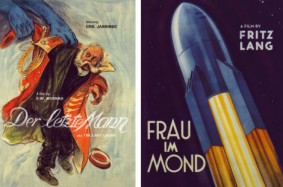
Eureka Entertainment has announced the UK release of two DVDs, F.W. Murnau’s Der letzte Mann (The Last Laugh) and Fritz Lang’s Frau im mond (Woman in the Moon). Both titles will become available on 21 January 2008. Below is some blurb from Eureka for each of the titles:

Der Letzte Mann (1924)

A landmark work in the history of the cinema, Der letzte Mann represents a breakthrough on a number of fronts. Firstly, it introduced a method of purely visual storytelling in which all intertitles and dialogue were jettisoned, setting the stage for a seamless interaction between film-world and viewer. Secondly, it put to use a panoply of technical innovations that continue to point distinct ways forward for cinematic expression nearly a century later. It guides the silent cinema’s melodramatic brio to its lowest abject abyss — before disposing of the tragic arc altogether. The lesson in all this? That a film can be anything it wants to be… but only Der letzte Mann (and a few unforgettable others) were lucky enough to issue forth into the world under the brilliant command of master director F.W. Murnau.

His film depicts the tale of an elderly hotel doorman (played by the inimitable Emil Jannings) whose superiors have come to deem his station as transitory as the revolving doors through which he has ushered guests in and out, day upon day, decade after decade. Reduced to polishing tiles beneath a sink in the gents’ lavatory and towelling the hands of Berlin’s most-vulgar barons, the doorman soon uncovers the ironical underside of old-world hospitality. And then — one day — his fate suddenly changes…

Der letzte Mann (also known as The Last Laugh, although its original title translates to “The Last Man”) inaugurated a new era of mobile camera expression whose handheld aesthetic and sheer plastic fervour predated the various “New Wave” movements of the 1960s and beyond. As the watershed entry in Murnau’s work, its influence can be detected in such later masterpieces as Faust, Sunrise, and Tabu — and in the films of the same Hollywood dream-factory that would offer him a contract shortly after Der letzte Mann‘s release. The Masters of Cinema Series is proud to present the original German domestic version of the work that some consider the greatest silent film ever made.

SPECIAL FEATURES

  • New, progressive encode of the recent, magnificent film restoration
  • Der letzte Mann – The Making Of – documentary by Murnau expert Luciano Berriatúa [41:00]
  • New and improved optional English subtitles (original German intertitles)
  • Lavishly illustrated 36-page booklet with writing by film scholars R. Dixon Smith, Tony Rayns, and Lotte H. Eisner — and more!!!

Frau im mond (1929)

Frau im Mond is: (a) The first feature-length film to portray space-exploration in a serious manner, paying close attention to the science involved in launching a vessel from the surface of the earth to the valleys of the moon. (b) A tri-polar potboiler of a picture that manages to combine espionage tale, serial melodrama, and comic-book sci-fi into a storyline that is by turns delirious, hushed, and deranged. (c) A movie so rife with narrative contradiction and visual ingenuity that it could only be the work of one filmmaker: Fritz Lang.

In this, Lang’s final silent epic, the legendary filmmaker spins a tale involving a wicked cartel of spies who co-opt an experimental mission to the moon in the hope of plundering the satellite’s vast (and highly theoretical) stores of gold. When the crew, helmed by Willy Fritsch and Gerda Maurus (both of whom had previously starred in Lang’s Spione), finally reach their impossible destination, they find themselves stranded in a lunar labyrinth without walls — where emotions run scattershot, and the new goal becomes survival.

A modern Daedalus tale which uncannily foretold Germany’s wartime push into rocket-science, Frau im Mond is as much a warning-sign against human hubris as it is a hopeful depiction of mankind’s potential. The Masters of Cinema Series is proud to present for the first time in the UK the culmination of Fritz Lang’s silent cinema, newly restored to its near-original length.

SPECIAL FEATURES

  • Brand new film restoration by F. W. Murnau-Stiftung
  • Original German intertitles with newly-translated optional English subtitles
  • 36-page booklet which includes a newly revised analysis by Michael E. Grost on the film, and on Fritz Lang’s body of work as a whole — and more!

God’s soldiers

Joseph Perry

Joseph Perry, from http://www.salvationarmy.org.au

While at Pordenone I met with Tony Fletcher, early film researcher extraordinaire, who told me about a DVD made by the Salvation Army, William Booth – God’s Soldier. This includes a substantial amount of film of Booth, the founder of the Army, in the early years of the twentieth century. The Salvation Army site includes a clip from the film, showing Booth’s motor tour through Britain in 1904 (unfortunately with added-on crowd noises and sound effects). It just goes to show how it’s worth looking in odd places to find early film materials.

It’s also a reminder of the great importance played by the Salvation Army in early film history, and I thought I provide a quick survey with links to assorted online resources. Many social interest groups and charities took an interest in using moving pictures to support their work, almost as soon as films were first made widely available on screen in 1896. None was more active in this area than the Salvation Army, particularly in Australia.

Herbert Booth

Herbert Booth, from http://www.victorian-cinema.net

There in 1896 Herbert Booth, rebellious son of William, joined Joseph Perry, who ran the Army’s Limelight Department. Together they added film to the Limelight Department’s multi-media show of Bible stories and uplifting instruction, which combined magic lanterns, photography, choral singing and sermons to create powerful, and hugely popular, narrative spectaculars. One such show, Soldiers of the Cross, first created in 1900, is sometimes cited as being the world’s first feature film, though in fact it was not a single film but rather a combination of slides, film, scripture and song. Moreover, it was preceded by an earlier effort, the two-and-a-half-hour Social Salvation (1898).

Booth and Perry built a glass-walled film studio at 69 Bourke Street, Melbourne in 1898. The room still exists as a archive and museum maintained by the army, with exhibits on the Limelight Department’s work. Initially they filmed with a Lumière Cinématographe, but by 1901 the were using a Warwick Bioscope. Soldiers of the Cross was exhibited across Australia, but Herbert Booth clashed with Salvation Army command in London, and left the Army in 1902, moving to San Francisco and taking Soldiers of the Cross with him. Perry continued in the film industry, increasingly making secular films, and continued as a film distributor into the 1920s.

William Booth himself made good use of film to propagandise for his cause. He had a film cameraman assigned to the Army, Henry Howse, who went with him to the Holy Land in 1905, and filmed many, if not all, of the early films of Booth featured in the God’s Soldier DVD. The original films are now preserved in the BFI National Archive.

There is an excellent site, Limelight, telling the story of the Limelight Department in Australia, based on a 2001 Australian Broadcasting Commission programme and exhibition. This has extensive information on the people behind the Limelight Department, the films they made and used, their tours, and the broader context of Australian early film history.

The Salvation Army in Australia provides its own history of the Limelight Department and its filmmaking activities, plus a history of the making of Soldiers of the Cross.

The National Film and Sound Archive in Australia has a feature on Soldiers of the Cross, which includes selections of the magic lantern slides that were a part of the show (none of the original film is known to survive, but the show did include some Lumière life of Christ films, which do survive).

The Who’s Who of Victorian Cinema site has biographical entries on Herbert Booth and Joseph Perry.

Much research has been done into the Salvation Army and its use of film in these early years by the American scholar Dean Rapp. His essay, ‘The British Salvation Army, the Early Film Industry and Urban Working-Class Adolescents, 1897-1918’, in 20th Century British History 7:2 (1996), is well worth tracking down (it’s available online through some academic subscription services).

Finally, the Salvation Army continues to make use of moving images, and has an active video unit.

A Throw of Dice on DVD

Throw of Dice

http://filmstore.bfi.org.uk

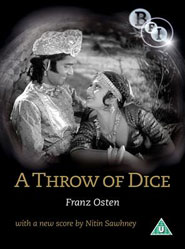
After its outing as a live experience in Trafalgar Square (the home for silent films in London these days) in the summer, the BFI is releasing Franz Osten’s 1928 A Throw of Dice (Prapancha Pash) on DVD. It comes with Nitin Sawhney’s orchestral score which was first played at that open-air screening.

A Throw of Dice is one of three Anglo-German films set in India and directed by Osten, working with Indian actor-producer Himansu Rai. As the blurb tells us:

After the beautiful Sunita nurses Ranjit back to health following dramatic events during a royal tiger hunt, his wicked rival Sohat persuades him to risk his kingdom and his love in a fateful game of dice. Shot on location in Rajasthan, the film features over ten thousand extras and an impressive array of horses, elephants and tigers. Its star actors all had major careers in Indian cinema and remain legendary and much-loved figures. Rai stars in the role of nefarious Sohat, with Charu Roy as Ranjit, and Seeta Devi (the Anglo-Indian actress born Renee Smith) as Sunita.

The BFI contonues to find inventive ways in which to exhibit, promote and contexualise silent films. Here a competent if somewhat ponderous late silent, long thought of as a diverting curiosity of interest mostly to the specialist, is spruced and re-invented as a movie of the moment. It’s all in the marketing.

Nosferatu trailer

Eureka Video has released a YouTube trailer for its forthcoming DVD release of Nosferatu. The two-disc set comes with commentary track by Brad Stevens and R. Dixon Smith, and an hour-long German documentary on the film by Luciano Berriatúa. It’s a F.W. Murnau-Stiftung restoration complete with Hans Erdmann’s original score, performed by the Radio Symphony Orchestra Saarbrücken conducted by Berndt Heller. There’s also a 96-page booklet with articles by David Skal, Thomas Elsaesser, Gilberto Perez and Enno Patalas (former director of the Münchner Stadtmuseum/Filmmuseum, where he was responsible for the restoration of many German classics, including Nosferatu). The Region 2 DVD is released on 19 November. Kino Video will be releasing the Region 1 version in the USA. The trailer looks fantastic – we are starting to get spoiled with deluxe DVD presentations of silent classics.

Update: Do take a look at the Kino Video entry for the film, which includes a Flash video on the digital restoration of the film, one of the DVD extras.

The Open Road

The Open Road

http://filmstore.bfi.org.uk

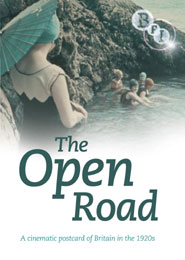
The BFI has just released its latest silent DVD, The Open Road. This is the colour footage of a road trip from Land’s End to John O’Groats filmed by Claude Friese-Greene 1924-25, which formed the basis of the 2006 BBC2 series, The Lost World of Friese-Greene, already released on DVD. The series was an attempt to emulate the success of The Lost World of Mitchell and Kenyon, with the same presenter, Dan Cruikshank, but without any of the social history or the great sense of revelation.

This BFI release presents the footage sans Cruikshank in what it calls a “special compilation of highlights”, which presumably means the extant footage from Friese-Greene’s footage minus the boring, repetitive bits, where he tests out the colour system and films rather too many rose bushes.

Claude Friese-Greene was the son of William Friese-Greene, the not-quite British film pioneer whose efforts to create motion pictures in the early 1890s were romantically but misleadingly portrayed in the film The Magic Box. Having failed to invent motion pictures, Friese-Greene tried to invent motion picture colour instead. It’s a convulted story that I’ll be telling you some other time, but essentially his experiments with a two-colour process (alternate frames stained red and green) were taken up by his son Claude, who improved the system signficantly and launched it as a 26-part travelogue in 1925. It made little impact at the time (the whole series was probably never released), and has been absent from practically all histories of colour cinematography. But restoration work by the BFI National Archive has demonstrated that, with a little bit of help from modern printing methods and digital technology, the results are really quite beautiful, and give a sweetly nostalgic view of Britain in the 1920s.

The 64mins DVD comes with a score by pianist Neil Brand and violinist Gunther Buchwald. It’s very interesting to see how the BFI is both getting documentaries made out of previously little-known archive film, and then following up with DVD releases of the original footage. It’s worked well with Mitchell and Kenyon, and I hope it works for them again.

Read here on the BFI’s site about The Open Road and the history of its restoration (which involved much re-editing of hat was originally very jumbled material.

Read this account of the Friese-Greene Colour process on the BBC History site.

Or read the shotlist of the pre-edited Friese-Greene footage (all 11,821 feet of it) in the BFI National Archive, diligently done by someone, somewhere, a long long time ago…