Talking silents

talkingsilents1_4

Talking Silents, vols. 1-4

One of the great treasures available to anyone with a serious interest in the history of silent cinema is the Talking Silents series produced by Digital Meme. This is a series of ten DVDs of Japanese silents films, with two or three titles per disc. Silent cinema continued in Japan well into the 1930s, but survival rates for Japanese silents make for sorry reading. It is estimated that between 95-99% of all Japanese silent films are lost (with almost none before 1923 owing to the destruction of the Nikkatsu film store in the Tokyo earthquake). Those that do survive are often in a poor condition. Classics such as Kinugasa Teinosuke’s A Page of Madness (1926) and Yasujiro Ozu’s I Was Born But… (1932) are well-known, but what is so interesting about the Digital Meme series is that it includes comparatively routine genre works, so that one gets a real taste of popular Japanese silent cinema.

The striking feature of the series is the use of benshi narration. In the silent era (and even for a while the sound period), Japanese films were accompanied by narrators, an inheritance from the Japanese theatrical tradition. Originally each part in a film was taken by a separate off-screen performer, until the film industry rebelled against this theatrical domination, around 1920, and the single benshi tradition began. The benshi were the stars of Japanese silent cinema: audiences revered theme, and the performers developed individual styles. The DVDs include narrations from recordings made of benshi in the 1970s and 80s, and recreations of the style by Midori Sawato. The narration is an optional feature, and the films carry both the original Japanese titles and English translated titles.

The films present fine mixture of styles, including samurai tales and contemporary dramas, with some early titles from the great master Kenji Mizoguchi. This is full list:

Talking Silents 1:

* Taki no Shiraito (The Water Magician)
Produced by Irie Production, 1933
98 minutes / 24 fps
Directed by Kenji Mizoguchi
Cast: Takako Irie, Tokihiko Okada, Ichiro Sugai

* Tokyo Koshinkyoku (Tokyo March)
Produced by Nikkatsu Uzumasa, 1929
28 minutes / 24 fps
Directed by Kenji Mizoguchi
Cast: Shizue Natsukawa, Reiji Ichiki, Isamu Kosugi

Talking Silents 2:

* Orizuru Osen (The Downfall of Osen)
Produced by Daiichi Eiga, 1935
90 minutes / 24 fps
Directed by Kenji Mizoguchi
Cast: Isuzu Yamada, Daijiro Natsukawa, Ichiro Yoshizawa

* Tojin Okichi
Produced by Nikkatsu Uzumasa, 1930
4 minutes / 24 fps
Directed by Kenji Mizoguchi
Cast: Yoko Umemura

Talking Silents 3:

* Orochi (Serpent)
Produced by Bantsuma Production, 1925
74 minutes / 24 fps
Directed by Buntaro Futagawa
Cast: Tsumasaburo Bando, Misao Seki, Utako Tamaki

* Gyakuryu (Backward Flow)
Produced by Toatojiin, 1924
28 minutes / 16 fps
Directed by Buntaro Futagawa
Cast: Tsumasaburo Bando, Benisaburo Kataoka, Teruko Makino

Talking Silents 4:

* Koina no Ginpei, Yuki no Wataridori (Koina no Ginpei, Migratory Snowbird)
Produced by Bantsuma Production, 1931
60 minutes / 24 fps
Directed by Tomikazu Miyata
Cast: Tsumasaburo Bando, Kikuya Okada, Reiko Mochizuki

* Kosuzume Toge (Kosuzume Pass)
Produced by Makino Tojiin, 1923
39 minutes / 16 fps
Directed by Koroku Numata
Cast: Banya Ichikawa, Shinpei Takagi, Tsumasaburo Bando

Talking Silents 5:

* Kurama Tengu
Produced by Arakan Production, 1928
71 minutes / 24 fps
Directed by Teppei Yamaguchi
Cast: Kanjuro Arashi, Takesaburo Nakamura,
Reizaburo Yamamoto, Kunie Gomi and Keiichi Arashi

* Kurama Tengu Kyofu Jidai (The Frightful Era of Kurama Tengu)
Produced by Arakan Production, 1928
38 minutes / 16 fps
Directed by Teppei Yamaguchi
Cast: Kanjuro Arashi, Reizaburo Yamamoto, Kunie Gomi and Keiichi Arashi

Talking Silents 6:

* Nishikie Edosugata Hatamoto to Machiyakko (The Color Print of Edo: Hatamoto to Machiyakko) (1939, Shinko Kinema, 65 min.)
Directed by Kazuo Mori
Cast: Utaemon Ichikawa, Yaeko Kumoi, Shinpachiro Asaka, Wakako Kunitomo

* Dokuro (Skull) (1927, Ichikawa Utaemon Production, 32 min.)
Directed by Sentaro Shirai
Cast: Utaemon Ichikawa, Kokuten Takado, Ritsuko Niizuma

Talking Silents 7:

* Oatsurae Jirokichi Koshi (Jirokichi the Rat) (1931, Nikkatsu, 61 min.)
Directed by Daisuke Ito
Cast: Denjiro Okochi, Naoe Fushimi, Nobuko Fushimi, Minoru Takase

* Yajikita Sonno no Maki (Yaji and Kita: Yasuda’s Rescue) (1927, Nikkatsu, 15 min.)
Directed by Tomiyasu Ikeda
Cast: Goro Kawabe, Denjiro Okochi

* Yajikita Toba Fushimi no Maki (Yaji and Kita: The Battle of Toba Fushimi(1928, Nikkatsu, 8 min.)
Directed by Tomiyasu Ikeda
Cast: Goro Kawabe, Denjiro Okochi

Talking Silents 8:

* Kodakara Sodo (1935, Shochiku Kamata, 33 min.)
Directed by Torajiro Saito
Cast: Shigeru Ogura, Yaeko Izumo

* Akeyuku Sora (1929, Shochiku Kamata, 71 min.)
Directed by Torajiro Saito
Cast: Yoshiko Kawada, Mitsuko Takao

Talking Silents 9:

* Roningai Dai Ichiwa (1928, Makino Production, 8 min.)
Directed by Masahiro Makino
Cast: Komei Minami, Juro Tanizaki, Toichiro Negishi

* Roningai Dai Niwa (1929, Makino Production, 72 min.)
Directed by Masahiro Makino
Cast: Komei Minami, Hiroshi Tsumura, Toichiro Negishi

* Sozenji Baba (1928, Makino Production, 32 min.)
Directed by Masahiro Makino
Cast: Komei Minami, Shinpei Takagi, Toroku Makino

Talking Silents 10:

* Jitsuroku Chushingura (Chushingura: The Truth)
Produced by Makino Production, 1928, 64 min.
Directed by Shozo Makino
Cast: Yoho Ii, Tsuzuya Moroguchi, Kobunji Ichikawa, Yotaro Katsumi

* Raiden
Produced by Makino Production, 1928, 18 min.
Directed by Shozo Makino
Cast: Toichiro Negishi, Arata Kaneko, Masahiro Makino

talkingsilents5_8

Talking Silents vols. 5-8

You get a little in the way of extras on each of the DVDs: a commentary from film critic Tadao Sato, an introduction by modern benshi Midori Sawato. The Digital Meme site has downloadable PDFs of introductions by Tadao Sato. The DVD booklets are thin and half in Japanese, half-English. What is noteworthy is the offer made to educational institutions. Digital Meme makes the series available under three prices: Home Use (allowing individual viewings), Rental Use (allowing institutions to give their members and affiliated persons the right to rent the collection and take it out of their libraries) and Institutional Screening Rights Agreement (for institutions that want to screen the DVDs to a public audience within their premises, or at an affiliate, on a non-commercial basis).

Digital Meme also make available a 1980 documentary on DVD on the life of film actor Tsumasaburo Bando, Bantsuma: The Life of Tsumasaburo Bando (Bantsuma: Bando Tsumasaburo no shogai), and a 4-DVD set Japanese Anime Classic Collection. This is a treasure trove of early Japanese animation, with some of the translated titles delightfully giving indication of their idiosyncratic content: The Tiny One Makes It Big, Dekobo the Big Head’s Road Trip, Why is the Sea Water Salty?, The Duckling Saves the Day. A section of the Digital Meme site gives details of each of the 55 titles on the four-disc set, with frame stills and some synopses. The set comes with English subtitles (and Chinese, and Korean), some live benshi narration, and examples of anime with synchronised audio tracks from gramophone records.

dekobo

Dekobo no Jidosha Ryoko (Dekobo the Big Head’s Road Trip)

And there’s more. Digital Meme also markets Masterpieces of Japanese Silent Cinema, a DVD-Rom which includes extracts from forty-five films, a database of 12,000 film titles, almost 1,000 stills, posters, original programmes and leaflets, interviews with film veterans, and reference articles, making it an interactive encyclopedia of Japanese silent film, albeit at a price of 18,000 Yen (around $180) which means only institutions are likely to purchase it.

For more on Japanese silent cinema, here’s a few handy sources:

Laterna Magicka

As the Bioscope celebrates the immient arrival of its 300,000th visitor (keep on coming by folks, and tell your friends), here’s a taster for a sixty-minute documentary, Laterna Magicka, about the filmmaker Bill Douglas and his astonishing collection of pre-cinema artefects which now make up the Bill Douglas Centre for the History of Cinema and Popular Culture at the University of Exeter. The documentary has been made by Sean Martin and Louise Milne and produced by 891 Filmhouse in association with Accidental Media. It is to be included in the BFI DVD and Blu-Ray release of Douglas’ 1986 film Comrades, which features a magic lanternist as a central figure. The film, which tells the tragic story of the Tolpuddle martyrs, pioneers of British trade unionism, is released on both formats on 20 July.

Bardelys the Magnificent

bardelysdvd

Good news, because the silent film discovery of the past year or so, Bardelys the Magnificent, is released next month by Flicker Alley. The 1926 MGM film, starring John Gilbert and based on a typically swashbuckling novel by Rafael Sabatini, was directed by King Vidor – his first film after The Big Parade. Thought lost and long-lamented (a brief excerpt existed in the Marion Davies film Show People), a print of the film turned up in France in 2006. Restored by the continually splendid Lobster Films, the film started doing the rounds of archive film festivals late last year, and has proven to be a popular delight. The DVD version comes with a period score by the Mont Alto Motion Picture Orchestra provides a lovely score of period photoplay music, and an alternate piano score by Antonio Coppola (one suspects that alternate scores are shaping up to be a new trend). English titles have been inserted according to the original script, and a gap in the rediscovered footage is bridged with stills, titles, and footage from the original trailer.

Accompanying the main feature is Monte Cristo (1922), based on the Alexandre Dumas novel, starring Gilbert as Edmond Dantes. As with Bardelys, this was a lavish production in its day, which now survives in almost complete form through a single “worn and choppy” print found in the Czech Republic. English titles have been added from the original script, and Neal Kurz plays the piano score based on period French music. Extras on the DVD are an audio essay on John Gilbert by Jeffrey Vance and Tony Maietta, and a new thirty-minute documentary, Rediscovering John Gilbert, featuring an on-camera interview with his daughter and biographer, Leatrice Gilbert Fountain.

Bardelys the Magnificent and Monte Cristo: The Lost Films of John Gilbert is released as a 2-disc set on 14 July.

More from Warners

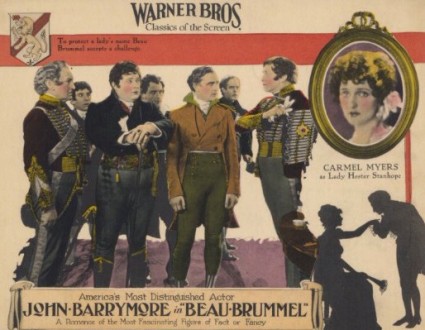
beaubrummel

http://www.imdb.com

You will recall the recent good news that Warner Bros. has established a made-to-order DVD service for films from its archives that might not otherwise receive a DVD release. The films are being made in DVD-R format, burned to order, and priced at $19.95 for DVD copies in the post, $14.95 for downloads, and they can be ordered from www.warnerarchive.com. The only downside is that the titles are not being made available outside the USA, though the hope is that this will change in the future.

Warners have promised to keep adding to what was an original list of 150 titles (which ranges from the 1920s to the 1980s), and the latest batch includes more silents. The titles are:

  • Beau Brummel (US 1924 d. Harry Beaumont), with John Barrymore, Mary Astor, Carmel Myers
  • The Sea Hawk (US 1924 d. Frank Lloyd), with Milton Sills, Enid Bennett
  • The Better ‘Ole (US 1926 d. Charles Reisner), with Syd Chaplin, Harold Goodwin, Jack Ackroyd
  • The First Auto (US 1927 d. Roy Del Ruth), with Russell Simpson, Frank Campeau
  • Old San Francisco (US 1927 d. Alan Crosland), with Dolores Costello, Warner Oland
  • When a Man Loves (US 1927 d. Alan Crosland), with John Barrymore, Dolores Costello
  • The Divine Lady (US 1929 d. Frank Lloyd), with Corinne Griffith, Victor Varconi

The DVDs will be available from June 15, making the total number available in this way (not just silents) 2007, with a total of 300 titles promised by the end of this year.

An excellent dumb discourse

ruggero

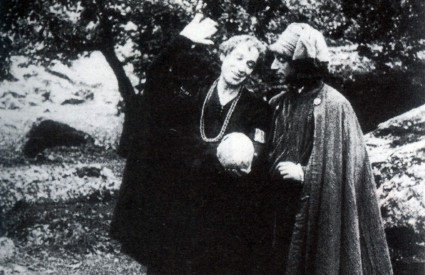
Ruggero Ruggeri as Hamlet in Amleto (1917)

It was the fervent belief of many in the early years of cinema that justification for the medium lay in how it interpeted stage drama. At a time when censorious authorities looked down upon the dubious cinema (with its low class audiences) and cinema was reaching out for respectability (and properties that were out of copyright), Pathé with its Film d’Art and Film d’Arte Italiana companies, and Adolph Zukor’s policy of ‘Famous Players in Famous Plays’ showed that there was financial good sense in bringing high-class drama to the cinema screen, however mutely.

The pinnacle of stage drama was, of course, William Shakespeare, and film companies in the silent film era took on the Bard with enthusiasm. The numbers are extraordinary. Some two hundred films, most of them one-reelers of the pre-war period, were produced that closely or loosely owed something to one or other of Shakespeare’s plays. Some film companies showed a particular interest: Vitagraph filmed Antony and Cleopatra, Julius Caesar, Macbeth, Othello, Richard III, Romeo and Juliet (all 1908), King Lear, A Midsummer Night’s Dream (1909), Twelfth Night (1910) and As You Like It (1912). Thanhouser made A Winter’s Tale (1910), The Tempest (1911), The Merchant of Venice (1912), Cymbeline (1913) and King Lear (1916). Cines, Kalem, Biograph, Ambrosio, Gaumont, Eclair, Nordisk, Milano and several others filmed the plays.

This was more than enthusiasm for high culture; it was good business. Shakespeare films appealed to an audience which found costume dramas in general to be a treat, and which was accustomed to boiled-down Bard from school texts and stage productions which concentrated on the highlights from the plays (such as the Crummles’ hectic production of Romeo and Juliet portrayed in Charles Dickens’ Nicholas Nickelby). Of course, not everyone wanted to see high culture quite as much as the cinema sometimes wanted to be associated with such culture (see the cartoon at the end of this post), but more than enough were impressed, and entranced.

Once films became longer – ironically as the cinema became closer in form to the theatre – the number of Shakespeare films fell, because longer productions were more of a challenge to audiences. But even then there was a burst of activity in 1916 (the tercentenary of Shakespeare’s death), with half-a-dozen or more productions in that year alone, and versions of the plays continued in silent form throughout the 1920s, with four key titles coming from Germany – Hamlet (1920, with Asta Nielsen as the Dane), Othello (1922, with Emil Jannings and Werner Krauss), Der Kaufman von Venedig (The Merchant of Venice) (1923, with Henny Porten) and Ein Sommernachtstraum (A Midsummer Night’s Dream) (1925, Werner Krauss again).

thetempest

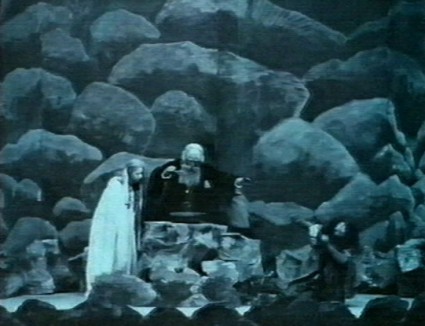
Prospero in his cave, from The Tempest (Clarendon 1908)

So where is the literature to back up this self-evidently significant corner of silent film history? Sadly, until recently, there has been very little. The silent film enthusiasts and film scholars have shied away from Shakespeare as being falsely worthy and far too uncinematic, while the Shakespeareans looked down on cinema per se, while finding the very notion of silent Shakespeare an absurdity. Jack J. Jorgens, a noted scholar, went so far as to write these dreadful words in his Shakespeare on Film (1977):

First came scores of silent Shakespeare films,one- and two-reelers struggling to render great poetic drama in dumb-show. Mercifully, most of them are lost.

Oh dear, oh dear. However, there was one work which almost eccentrically fought against the tide. Robert Hamilton Ball’s Shakespeare on Silent Film: A Strange Eventual History (1968) is one of the most remarkable books ever produced on silent cinema. It is a passionately-pursued archaeological investigation into every kind of Shakespeare film made during the silent era, encomapssing parodies, allusions, plot borrowing as well as ‘conventional’ adaptations, with Ball diggedly tracking down every obscure reference, every hidden print, every list of intertitles, with abundant fervour and an infectious interest in the people involved. This magnum opus has been cherished by the dedicated few for four decades, and for most of that time its discoveries and assertions have been taken as gospel. Yet even Ball ended his investigations with these disappointing words:

Silent Shakespeare film could not be art, a new art. The aesthetic problem is how to make good film which is good Shakespeare. It could not be good Shakespeare because too much was missing.

It is has been the task of a few of us (and I’ve been involved) to prove those words wrong. Silent Shakespeare was good Shakespeare, not because of what was missing, but because of what was there to be seen – a new medium expressing itself imaginatively while asserting its social worthiness and cultural relevance. To study silent Shakespeare films is to see films discovering what they could do. Yes there are histrionics at times, and yes there is some aburdity involved when complex plots are crammed into a ten-minute reel, but equally there is artistry, feeling and subtlety of interpretation. Have you ever seen a ballet of Romeo and Juliet and complained that the words were missing? Of course not. Shakespeare without the words is not a lesser form, but simply a form that requires its own special understanding. It expresses the significance of its subject within its specific constraints – which is precisely what art is.

The tide started to turn with the release of the British Film Institute’s video compilation Silent Shakespeare (1999), a work that was a revelation to many. Even hardened theatricals could see the special virtues in the Clarendon Film Company’s delightful reworking of The Tempest (1908) or the elemental passion evident in Ermete Novelli’s stunning performance in Re Lear (1910). The DVD has found its way onto many a university library shelf, while a number of scholars have begun to take on the silent Shakespeare film with fresh eyes – among them Jon Burrows, Roberta Pearson, Anthony Guneratne and Kenneth Rothwell.

buchanan

The leading champion, however, has been Judith Buchanan, whose quite marvellous Shakespeare on Silent Film: An Excellent Dumb Discourse is published this month by Cambridge University Press. This is the sympathetic, understanding account of a phenomenon that we have been waiting for. It is not a comprehensive history of the silent Shakespeare film – Buchanan defers to Ball in that respect – instead it concentrates on exemplary films and on uncovering the social, cultural and economic contexts. So it is that an opening chapter details a nineteenth-century legacy of performance, with particular attention to Shakespeare and the magic lantern, showing that the silent Shakespeare film was part of an established tradition. Chapters then follow on the first Shakespeare film, King John (1899), featuring Herbert Beerbohm Tree (also on the BFI DVD); Shakespeare films of the ‘transitional era’ between the early and late 1900s, with close, engrossing readings of Clarendon’s The Tempest and Film d’Arte Italiana’s Othello (1909); the ‘corporate authorship’ of Vitagraph’s productions; the contrasting interpretations of Hamlet by Hepworth (a renowned British 1913 production with theatrical great Sir Johnston Forbes Robertson) and Amleto, a 1917 Italian film starring Ruggero Ruggeri, little-known but perhaps the most accomplished extant realisation on Shakespeare on silent film (it’s crying out for the two Hamlets to be released jointly on DVD); the several films of the tercentary year, including the rival Romeo and Juliets starring Francis X. Bushman/Beverley Bayne and Theda Bara/Harry Hilliard, both films alas lost; the German productions of the 1920s; and wordless Shakespeare today (there are some stage productions experimenting with silence, notably Paata Tsikurishvili’s Synetic Theatre).

It’s written for a literary studies audience, but it is grounded in exemplary original research (Buchanan has toured the world to track down the relevant prints) and it is a pleasure to read. There is much here to detain anyone keen to extend their knowledge of film history. She knows her films as well as her plays – a rare and most welcome combination. Above all, Buchanan opens up the subject in all its richness of theme, inviting others to explore further, illuminating the films that we are so fortunate have survived. We will still turn to Robert Hamilton Ball for his extensive documentary evidence, but to Buchanan for her sophisticated understanding.


romeocartoon

A 1913 cartoon from London Opinion, speaking for anyone resistant to the cinema’s occasional urge to impress Shakespeare upon us. Taken from Stephen Bottomore, I Want to See this Annie Mattygraph: A Cartoon History of the Coming of the Movies

If you are keen to seek out silent Shakespeare films for yourself (and you should, you really should) this is what’s currently available on DVD:

  • Silent Shakespeare: includes King John (Biograph 1899), The Tempest (Clarendon 1908), A Midsummer Night’s Dream (Vitagraph 1909), Re Lear (Film d’Arte Italiana 1910), Twelfth Night (Vitagraph 1910), Il Mercante di Venezia (Film d’Arte Italiana 1910), Richard III (Co-operative 1911) [BFI] [Milestone]
  • Thanhouser Presents Shakespeare [Thanhouser series vol.7]: includes The Winter’s Tale (1910), Cymbeline (1913), King Lear (1916) [Thanhouser]
  • Richard III (Shakespeare Film Company 1912) [Kino]
  • Othello (Wörner-Filmgesellschaft 1922): also includes Duel Scene from Macbeth (Biograph 1905), The Taming of the Shrew (Biograph 1908), Roméo se fait bandit (Pathé 1910), Desdemona (Nordisk 1911) [Kino]

The International Database of Shakespeare on Film, Radio and Television, an online filmographic database not yet officially released but available in a test version, hopes to be comprehensive for the silent Shakespeare film. Buchanan herself provides a filmography (restricted to films mentioned in her text), including the location of archive prints. Around forty silent Shakespeare films survive today, mercifully.

Opening up the Warners archive

redlily

Ramon Novarro and Enid Bennett in The Red Lily (1924), from http://www.warnerarchive.com

As some will certainly have heard by now (the Bioscope has been taking a bit of a nap of late, partly induced by faulty Internet connection), Warner Bros. has announced a made-to-order DVD service for 150 films from its archives. These are titles not currently available on DVD and which would not, in the normal course of events, have made it onto commercial DVD. Strictly speaking, they are DVD-Rs (i.e. burned rather than fully authored), produced to order, though reports are that they are of high quality.

The films are priced at $19.95 for DVD copies in the post, $14.95 for downloads, and they can be ordered from www.warnerarchive.com. Our interest,of course, is in the silents, and those being made available are:

  • Scaramouche (US 1923 d. Rex Ingram) with Ramon Novarro, Alice Terry
  • Souls for Sale (US 1923 d. Rupert Hughes) with Barbara La Marr, Eleanor Boardman
  • The Red Lily (US 1924 d. Fred Niblo) with Ramon Novarro, Enid Bennett
  • Exit Smiling (US 1926 d. Sam Taylor) with Beatrice Lillie, Jack Pickford
  • The Temptress (US 1926 d. Fred Niblo) with Greta Garbo, Antonio Moreno
  • Love (US 1927 d. Edmund Goulding) with Greta Garbo, John Gilbert
  • The Red Mill (US 1927 d. William Goodrich) with Marion Davies, Owen Moore
  • Spring Fever (US 1927 d. Edward Sedgwick) with Joan Crawford, William Haines
  • The Smart Set (US 1928 d. Jack Conway) with Alice Day, Jack Holt
  • The Trail of ‘98 (US 1928 d. Clarence Brown) with Dolores del Rio, Harry Carey
  • The Kiss (US 1929 d. Jacques Feyder) with Greta Garbo, Conrad Nagel
  • The Single Standard (US 1929 d. John S. Robertson) with Greta Garbo, Nils Asther
  • Wild Orchids (US 1929 d. Sidney Franklin) with Greta Garbo, Lewis Stone

So, a rich collection of the obscure and the famous, and in case you are wondering why MGM titles are there, that’s because Warners now represents a large chunk of the MGM library, such are the mysteries of collection deals. Information on the films on the site is a bit scanty, but you do get a brief video clip for each one, and the quality seems excellent.

But before those outside the USA get out the banker’s card, please note that the DVDs are – for the moment – only available for purchase in the USA. Word is that this will change in the not too distant future. Also promised are many more titles, at a rate of twenty a month (not all silents, of course), with Warners suggesting that eventually its entire archive of 5,000 titles could be made available – that is, where titles aren’t given a conventional DVD release (around 1,200 titles have been issued conventionally by Warner Home Video). Priority has been given to titles where there is satisfactory transfer materials from broadcasts (and all the silents come with scores, as all have been shown on TCM), but more will follow, particularly as the project has reportedly been highly successful already (the DVDs were first offered on Monday).

This sort of initiative has long been suggested by film enthusiasts, arguing that low-cost, basic production quality releases would be better than no DVDs at all. Apparently it is the downturn in the economy which has led Warner Bros. to go down this path, though that may just be the timing, because it is reported that they have been planning this move for two years. It has also been argued as an alternative strategy in the face of market saturation – we’ve all got too many DVDs on our shelves – but this is an initiative aimed at the specialist, with sales expected to be just a few thousand per title. It’ll be interesting to see what happens if the scheme proves more successful than Warners have been expecting. Might they re-think their strategy and issue more standard DVDs of supposedly uncommercial titles?

Information on further releases, and when they become available beyond the USA, will get published here as and when we hear of it.

A hero of the valleys

dlg8

The young David Lloyd George’s dream of David and Goliath. All images in this post are frame grabs from the DVD of The Life Story of David Lloyd George

How do we judge a film that no one saw? The audience gives a film meaning, or at least historical specificity. There are many examples of films that have never been seen (quite a few from recent British cinema history) because they were deemed uncommercial, and other grand projects that were never completed, such as Sergei Eisenstein’s Que Viva Mexico or Orson Welles’ Don Quixote. But the completed film that stands up as an exceptional work of art, that was a strong commercial possibility in its time, and whose exhibition could have changed film history (in a modest way) – such examples are rare.

One such example has just found its way to a DVD release after a remarkable history of idealism, political intrigue, slander, subterfuge, disappearance, rediscovery and restoration. The Life Story of David Lloyd George was made in 1918, vanished before any cinema audience had a chance to see it, and re-emerged to astonished acclaim in 1994. Its place must be in virtual history rather than actual film history, because its story is one of if onlys and maybes. But what a story it is.

dlg5

Norman Page as David Lloyd George, Alma Reville as his daughter Megan

The story begins with the Ideal Film Company, formed by the brothers Harry and Simon Rowson in 1911 to distribute films, before moving into production in 1915. Excited by the interest shown by the public in official films of the war, the Rowsons decided to make an epic drama about the origins and purpose of the war, employing none other than Winston Churchill – then in the political wilderness following the Dardanelles disaster – to furnish ideas which would be turned into a scenario by Eliot Stannard. When Churchill returned to the cabinet in summer 1916 the original project was dropped, only to transmogrify into a biography of the new Liberal prime minister, David Lloyd George (the Rowsons were strong supporters of the Liberal party). Conceived as an epic story of a man who from humble beginnings rises to lead his country through to victory in the greatest war known to man, it was an undertaking unlike anything attempted in cinema to that date, nor would it have any subsequent parallel until the American and Soviet biopics of the 1930s onwards (Young Mr Lincoln, Wilson, Lenin in October etc.). But those conform to the classical dramatic conventions of their time, and their subjects were long dead – Lloyd George was, and remains, unique in subject and form.

The script was written by a noted historian (though without film experience) Sidney Low. The director was Maurice Elvey, gradually rising to the top of his profession, at least in British film terms. The cast were a mixture of Ideal stalwarts and lookalikes, most notably in the latter case the stage actor Norman Page, whose uncanny performance as Lloyd George carries the film (Page watched Lloyd George in full flow in the House of Commons and gives us what is probably a highly accurate record of his mannerisms). Alma Reville, later to marry Alfred Hitchcock, plays Lloyd George’s daughter Megan, and Ernest Thesiger can be spotted as Joseph Chamberlain. Helen Haye (not credited on the DVD but recently identified) plays Lloyd George’s mother.

dlg3

The Birmingham Town Hall riot scenes

The film’s production was announced to the trade press in February 1918, under the title The Man Who Saved the Empire. It was not the only propagandist feature film epic to be made in Britain at this time, with American directors brought in by British official film interests to make Hearts of the World (D.W. Griffith) and Victory and Peace (Herbert Brenon), but it was the only one made on such a scale with private money only. Filming proper began towards the end of August and astonishingly was completed by the end of September. It took place in several of the historical locations, including the north Wales of Lloyd George’s childhood, Birmingham and London. Shaping up to be two-and-a-half hours long, there were suggestions that the film could be released as a serial, but excitement was high at what promised to be the outstanding British film release of the year.

In October the trouble started. Horatio Bottomley, the rabble-rousing, influential owner of the nationalistic journal John Bull, began a campaign against the film. Essentially his line was that the film was a disgrace because it was being made by Germans. The Rowsons were Jews, real name Rosenbaum, and in Bottomley’s nakedly bigoted mind, Jews were equated with Germans. Bottomley’s campaign against the film (Ideal won a libel suit against him) brought a lot of unwelcome publicity, and may have added to a sense of awkwardness felt by some in the government at the production of a film lauding the achievements of the prime minister at the time of an impending general election (one took place in December 1918, just after the war ended).

In the end, none of the evidence that we have really explains what happened next. The Ideal company were paid off, to the sum of £20,000 (around half a million pounds in today’s money), which was the cost of the film’s production – though no recompense for the anticipated returns. Lawyers for the government turned up, paid Ideal in twenty one thousand pound notes, took the negative away with them in a taxi – and that was the last that anyone saw of it, publicly at least. Someone in power thought it worth a lot of money to prevent the film from being shown, but to this day no one can really say why, and the documentary record (including a memoir written by Harry Rowson) is tantalisingly vague.

dlg6

Symbolic illustration of a theme from one of Lloyd George’s speeches, showing the Allies learning to pull together

The only evidence we have for the film after this date is a reference in the diary of Frances Stevenson – Lloyd George’s secretary and mistress – over a year later. On 24 February 1920 she wrote:

Last night went to see a film of D’s life which Captain Guest had put on the screen in No 12 [Downing Street] – a perfectly appalling thing. The idea was all right but the man who was supposed to be D. was simply a caricature. I begged D. not to let it be shown. Mrs Ll. G. very angry with D. because she said I had put D. against it because I had objected to the domestic scenes in it!

Were there plans to show the film in 1920? Is Stevenson referring to this time, or 1918, when she says “I begged D. not to let it be shown”? Might she be speaking of a different film entirely? We do not know. The Life Story of David Lloyd George was no more, unseen by anyone, little more than a footnote in a history or two. British film historian Denis Gifford interviewed Maurice Elvey in 1967, shortly before he died, when Elvey said (with remarkable sang froid in the circumstances):

This I suppose must have been one of the best films I ever made or ever shall make … It is such a shame it has disappeared.

In 1994 the film was discovered. It was in a barn at the home of Viscount Tenby, David Lloyd George’s grandson. It was in pristine condition, though in an unassembled form. Considerable effort and ingenuity effort was required from the only recently-formed Wales Film and Television Archive to piece the film together. As the first sequences were constructed and shown to film historians and Lloyd George experts, the general reaction was astonishment. Instead of the quaint drama that, to be honest, we had been expecting, here was a film of skill and power, possessed of a fervour and a commitment to the issues of the day that were electrifying. The film had its premiere – literally so – on 5 May 1996 (precided by a showing on 27 April for an invited audience) at the MGM cinema, Cardiff, accompanied by the Cardiff Olympia Orchestra playing a score by Welsh composer John Hardy. Since that time it has had screenings around the world, usually with Neil Brand accompanying on piano, and it gained recognition as a unique classic. But there has been a huge struggle on the part of the National Screen and Sound Archive of Wales (as they are now called) to get the film issued on DVD. Now, at last, with pseudo-orchestral score by Brand, it is available for all to see – and it is a film that demands to be seen.

dlg4

Elderly inhabitants of the workhouse, freed by Lloyd George’s introduction of an old age pension scheme, materialise outside the workhouse walls

The Life Story of David Lloyd George tells the story of its subject from childhood to wartime victory (the film was completed before the war was won), relayed in key scenes selected to demonstrate a calling to national duty and a desire to overturn injustice. The early scenes, showing Lloyd George’s upbringing in Wales, have not been given the praise that should be their due. They capture an atmosphere of modesty, devoutness and dedication towards one’s fellow man which is moving in its general effect, and deeply touching in its detail, grounded as it is in an affectionate portrait of late Victorian Welsh society.

Lloyd George is shown triumphing in the law and local politics through his oratory and commitment to noble causes. He gains notoriety through his anti-Boer War (1899-1902) stance, illustrated by a speech he gave at Birmingham Town Hall which occasioned a near riot in the streets, which the film recreates with truly extraordinary newsreel-style realism, helped by many hundreds of extras. If these scenes impress by their documentary quality, the film’s greater power comes in how it illustrates the revolutionary effect of Lloyd George’s time as Chancellor of the Exchequer, introducing old age pensions and and the National Insurance Act (1911). The very rightness of the actions moves us now, and surely must have had – or would have had – an overpowering effect on a contemporary audience, for whom these great changes were recent occurrences.

dlg7

While most celebrate the homecoming of loved ones after the war, one woman represents those mourning the dead

Other vigorous tableaux follow, clearly inspired by the newsreels (Lloyd George himself was a consumate performer for the news cameras), notably the Queen’s Hall suffragette riots. The film makes much use of an impressive House of Commons interior set, peopled by lookalikes, shot and perfomed with an easy realism that could fool some into thinking they were watching actuality. The film dips somewhat in its second half when the First World War begins. Lloyd George served brilliantly as minister of munitions before becoming prime minister in 1916, but there is paradoxically less drama on show once the film has arrived at the climactic stage to which its first half has been building. The battle scenes are convincing, likewise Lloyd George’s visit to the Front, and there is a prolonged sequence inside a munitions factory which may lack dramatic interest but as a seemingly documentary record is superbly shot. But our emotions are not re-engaged until the film’s final scenes, when the war comes to an end. Troops line up on the parade ground in their hundreds, fall out, then run to their waiting loved ones, at which point they materialise into civilian clothes. Amid all the happiness, one woman turning her head and weeping stands for all those whose loved ones were not returning home. Shown live, it catches the audience’s breath every time.

It is not a film for every one. Those hoping for either a more conventional human interest story, or a political drama, may be disappointed. Its newsreel-style – a deliberate aesthetic choice to reflect the way in which many of the audience were most familiar with Lloyd Geoge as a public figure – lessens the emotion while it heightens the sense of living history. It is unlike any other silent film in intent and form. But watch The Life Story of David Lloyd George, and then try and take seriously one of the conventional dramas of the war made duing the war – Hearts of the World for example – and they come across as pitiable, not so much in their execution or use of dramatic convention as in their absence of real social and political feeling. The Life Story of David Lloyd George is not realistic as such, despite its newsreel inspiration. It is pure hagiography. But more than any other film of the period it manages to articulate what people were fighting for. Which is what the Rowsons had wanted for their epic war film, right from the beginning.

dlg9a

Lloyd George addresses the camera in the film’s final scene: ‘There must be no “next time”‘

The film runs for 152 minutes. Viewers will see from time to time sequences which clearly do not quite fit. Titles referring to Moses are followed by film of Boadicea (the film has several such emblematic sequences); Lloyd George’s vision of his prime ministerial predecessors has obvious re-take shots; longueurs in the latter half would undoubtedly have been edited down had the film been completed for release. The film had to be pieced together without a running order, and a place found for every extant shot, somehow. Tinting records came with the film, the colour richly but sensitively reproduced by the Wales archive.

On the DVD you get 47 mins of extras, including an interview with composer Neil Brand which goes beyond the thinking behind his sumptuous score to consider the value of silent film generally. It is a tour de force from Neil which I would recommend showing to anyone wanting to understand what the silent film means for us today. Kevin Brownlow is interviewed, stating that the film would have changed film history (particularly in Britain) had it been shown – Britain’s The Birth of a Nation. Would it have been a huge financial success though? I think Ideal may have ended up with a problem on their hands – a long film, without stars, partisan in politics, perhaps too reliant on the patriotic uplift occasioned by the war. But we’ll never know.

The DVD is available for purchase online from the National Library of Wales’ shop, price £18.99, or if you are passing through Aberystwyth, visit the shop in person. Those intrigued by the history should certainly check out David Berry and Simon Horrocks’ book David Lloyd George: The Movie Mystery (1998), which includes Harry Rowson’s memoir, and essays from Lloyd George’s biographer John Grigg, Nicholas Hiley, Sarah Street, Roberta Pearson, John Reed (who restored the film) and others. Information on the film, the archive that restored it, and a short video clips can be found on the Moving History website. Finally, on my personal site, there the text of a talk I gave on the British epic film of the silent era which puts The Life Story of David Lloyd George in that particular context.

The Life Story of David Lloyd George will never fit easily into film history, because it was never seen, and because there has never been anything else like it. But it is a major work irrespective of film history, and the National Screen and Sound Archive of Wales have done us a great service in making available to all.

Down to the sea in ships

under_full_sail

The latest DVD offering from the creative and painstaking people at Flicker Alley is a rather surprising package, Under Full Sail. Following on from the imaginative packaging of silent film on the immigrant experience as Perils of the New Land, this latest offering brings together a selection of silent films on the theme of sailing ships. The centrepiece is The Yankee Clipper (1927), directed by Rupert Julian and produced by Cecil B. De Mille, a drama of the China tea trade, filmed aboard an 1856 wooden square-rigger, starring William Boyd, Elinor Fair and Frank ‘Junior’ Coghlan. The additional titles are Around the Horn in a Square Rigger (1933), Alan Villiers’ account of the voyage of the barque Parma from Australia to England in the 1933 Grain Race; The Square Rigger (1932), a sound short showing life aboard the schoolship Dar Pomorza; Ship Ahoy (1928), a record of a schooner employed in the North American lumber trade; and a ten-minute sequence from Down to the Sea in Ships (1922), which records a whale hunt on board the 1878 wooden ship Wanderer out of New Bedford, Massachusetts.

All of which looks like an interesting attempt to beef up The Yankee Clipper, which is not that well-known a title, with films which would otherwise have been unlikely to find their way onto DVD, producing a package that ought to reach beyond silent film specialists to a wider market intersted in sailing history. Films don’t just tell stories, they tell histories, so let’s hope the release is a success and that Flicker Alley can provide us with more such socio-historically informed DVDs. For the silent film music buffs, the release is also notable for being (surprisingly) the solo DVD premiere of renowned organist Dennis James, who accompanies The Yankee Clipper on an original-installation 1928 Wurlitzer pipe organ, recorded at Seattle’s Paramount Theatre.

Whatsoever a man soweth

joy

The lastest archival DVD release from the perpetually inventive folk at the British Film Institute is The Joy of Sex Education. A compilation of British sex education films from 1917 to 1973, it has attracted a fair bit of media attention, not too surprisingly. You can read about the sound film attractions of the release on MovieMail, but this post is just to record the presence of three silent films on the disc, with music accompaniment by Dave Formula (formerly of Magazine). Of these, the most notable title is the earliest – Whatsoever a Man Soweth (1917)

Sex education films, or public hygiene films, first appeared during the First World War, when military authorities became concerned by the spread of venereal disease among soldiers, which was rendering them unfit for duty. Whatsover a Man Soweth, 38mins long, is a British production made by Joseph Best, who had been a newsreel editor and who would go on to direct some intriguing African-themed films in later years (including the Paul Robeson title My Song Goes Forth, 1937). Whatsoever was sponsored by the British War Office for use with for the Canadian Army (there was a close connection between British and Canadian official filmmaking, largely owing to the Canadian Max Aitken, later Lord Beaverbrook, heading the War Office Cinematograph Committee), though the film seems to have been exhibited widely among Allied troops in general.

whatsoever

The film sets out not so much to instruct as to scare. Its story concerns Dick, a Canadian soldier on leave in London. He encounters a prostitute outside the National Gallery, but is warned away from her by a passing officer. Dick is then taken to a hospital to see victims of venereal disease, the film taking some delight in showing us rotting limbs. Pages from a Final Report of the Commission on Venereal Diseases explain the nature of hereditary syphilis to the audience, and we get to see the spirochetes in a syphilitic sore under a microscope. But the fun does not stop there. Dick visits a schoolfor the blind, learning that half of the children there became blind through hereditary VD. After the war, Dick’s brother Tom visits prostitutes in London. On his return to Canada, his wife becomes infected with syphilis. Tom undergoes a cure, but his wife gives birth to a baby who is born blind.

Kevin Brownlow writes about the film in Behind the Mask of Innocence, and cites examples of some of the striking intertitles, both coy and direct:

“Do nothing of which you could be ashamed to tell you sister or your mother”.

“Daddy took a chance”.

“There is no such thing as a safe prostitute. They are practically all diseased”.

“Every child has a right to be born clean into this world, and than man is to be pitied whose own flesh and blood looks him in the face to say, ‘Curse you, Dad, I was dirty born and you are the reason why!'”

Brownlow writes about other such films made during the war, such as the American Fit to Win (1917), The Scarlet Trail (1918), Open Your Eyes (1919) and End of the Road (1919). The best-known title of the period to tackle the theme was Damaged Goods, originally a 1902 play by Eugene Brieux and filmed with some boldness in America in 1915 and with great coyness in Britain in 1919 (this survives, but perhaps as it is a drama rather than a sex education film as such it is not included in the BFI set). There was a colour film on venereal disease whose exhibition was organised by Charles Urban for exhibition to troops in London and France in 1917-18. Information on this lost film is scarce, but it sems to have been a Kinemacolor Company of America production from 1913, originally shown at American recruiting stations, which Urban re-exhibited using a refinement of Kinemacolor called Kinekrom. In a 1982 letter from one-time Kinemacolor employee William Crespinel to Kevin Brownlow he recalls “that horrid, yet important medical film on the various stage of syphilis”.

The other silents on the disc are characteristically timid Any Evening After Work (1930, 27 mins) and How To Tell (1931, 21 mins).

The Joy of Sex Education comes with an illustrated booklet which has introductory essays by Tim Boon (Science Museum, London), Hera Cook (Lecturer in the History of Sexuality, University of Birmingham) and Katy McGahan (Non-Fiction Curator, BFI National Archive) who curated the films first as a BFI Southbank show and now as a DVD.

Update: There is a video clip from Whatsoever a Man Soweth (with its decidedly less-than-period soundtrack) on the BBC News site, as part of an article on the history of the sex education film.

Lloyd George in London

lifestoryimage

Norman Page (David Lloyd George) and Alma Reville (Megan Lloyd George) in The Life Story of David Lloyd George (1918), from National Screen and Sound Archive of Wales

I’ll have more to say about this event nearer the time, but here’s a general notice that there is to be a screening of The Life Story of David Lloyd George (1918, d. Maurice Elvey) at the British Library on Sunday, 15 February. This key film in British film history tells the story of the Libreral Prime Minister David Lloyd George, focussing on his engagement with the major issues of the day, from his opposition to the Anglo-Boer War, to the introduction of old age pensions, to his activity as Minister for Munitions in the First World War, leading to his appointment as Prime Minister midway through the war.

Two things are particularly remarkable about the film. The one is mystery surrounding its disappearance – the film was never exhibited before the public, and there seems to have been a government pay-off to prevents its screening, after which the film disappeared for decades until its happy rediscovery in 1994. Secondly, there is its exceptional quality, both as ambitious human/political drama, quite unlike anything one might normally expect of a British film from this period, and then the sheer quality of the print, which is a joy to behold. The film has not been shown in London since its premiere (literally so) in 1996, and if you can get to see it I really recommend doing so. It is an epic without histrionics, prosaic and visionary at the same time.

The film will be accompanied by Neil Brand on the piano, and the screening will be introduced by television historian Dan Snow, who happens to be Lloyd George’s great-grandson. The reason for putting off more information at this stage is the happy news that the National Screen and Sound Archive of Wales is publishing its long-promised DVD of the film next month (with Neil Brand score), coinciding with the screening.

The film is being shown as part of the British Library’s Taking Liberties exhibition (on the history of civil liberties in Britain). The screening runs 14.00-17.00 (with interval) at the Conference Centre, British Library,tickets priced £6 (concessions £4). More information on booking here.

As said, more on the background to the film when the DVD comes out. Meanwhile, David Berry’s book, David Lloyd George: The Movie Mystery gives the full history behind an exceptional film.