Times for free

http://archive.timesonline.co.uk

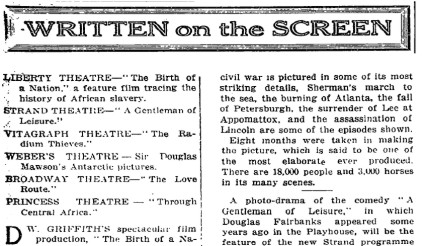
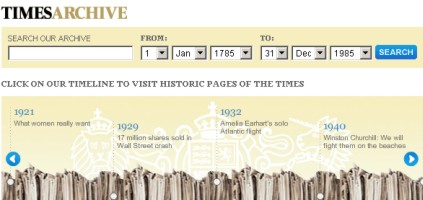
Regular readers will know how we try to track the availability of digitised newspaper online, highlighting the great opportunities they provide for researching silent cinema subjects. Now, seemingly out of the blue, The Times has made its archive freely available online. Previously available only to institutions by subscription, the Archive of 20 million articles dating 1785 to 1985 has been opened up to everyone.

To make use of the service you have to register with Times Online, during which process it is revealed that the archive is being made available for free for a limited period only, so grasp the opportunity while you can. But presumably an individual user subscription service will eventually follow (as employed by The Guardian Archive), which will be a boon long-term for the researcher not attached to an academic institution.

Those who have used the Times Archive before now (i.e. via Gale) will notice small differences in searching (only a basic search option – keyword and date) and results, but there is one major new feature. User are now provided with the OCR text i.e. the underlying, scanned text, which isn’t available with the Gale version. The option is called Full Text. This is great for copying and pasting, but do note it’s uncorrected text (the OCR software reads what it can, but sometimes struggles with unclear type). Here, for example, is the uncorrected text of The Times‘ report on the debut of the Kinetoscope in Britain, from its issue of 18 October 1894:

The latest, and not the least remarkable, of Mr. Edison’s inventions is the kinetoscone, of wnhich a private demonstration vas given last evening at 70, Oxford-street. This instrument isv,o the eye what Edison’s phonograph is to the ear,1An that it reproduces living movements of the most complex and rapid character. To clearly understand the effect it is necessary to explain the cause, but to appreciate the result the working of the invenzion m3ust be wit- nessed. The moving and, apparently, living figures in the kinctoseope rre produced iii the following manner :-3r. Edison has a stage upon which the per- fcrmances he reproduces are enacted. These perform- ances are recotded by taking a series of 43 photographs in rapid succession, the time occupied in tal.ing them hu-ing one second only. Thus every grogressive phase oa every single action is secured, an the photographs are successively reproduced on a film or celluloid of the length required for recording a gircn scene. When this film is passed before the eye at the same rate of speed as that at which the photographs were tae1cn the photographically disjoiuted parts of a given action are united in one comDlete whole. Tus, hsu posing a per-on to be photogranhed tlkng off his cat -as is done in one case-the successive views repre- senting the phase of action at every 4Zrd part of a second are joined up, and the complete operation of talking off the coat is presented to tLe eve as it would appear in reality In other words, the kinetoscope is aperfect reproduction of living action without sound. The apparatus in which ihis reproduction takes place is a cabinet about 4ft. high, 2ft. wide, and lIt. Oin. deep. It contains the celluloid film band, the apparatus for reconstructing the disjointed views and a small electric motor for driving the apparatus. The chief detail of the mechanism is a flat metal ring havingo a slot in it, ;hich makes about 2,000 revolutions per mitnute. The film pusses rapddl over the ring, beneath which is a light. The spectator looks tnrough a lens on to the film, and every action recorded on it pasSe under his view. Ten machines here shown in ohich the most rapid and compler actions wrere faithfullly reproduced. One scen,e repre- sentS a blacksmith’s shop in full ope.-ation, with tbree mnen hammering iron on an anvil, and wvho stop in their work to take a drink. Eiach drinks in turn and passes the pot of beer to the other. The smoke Frmm trhe fon.Te is seen to rise most perfectly. In another view a Spanish dancer is showvn going through her graceful evolutions, as is also Amna Belli in her serpentine dance. There is likewise a wrestling scene and a cock fight, in which the feathers are seen to fly in all directions. All the featnres of an original stage productioa are given, of course on a small scale, but possibly only for the vresent on a smaU scale, for 21r Edison promises to add the phono- graph to the kinetoscope and to reproduco. plays. Then by amplifying the ph nu”rapl and throwing the pictures on a screen, ma’fg them life size, he will give the world a startling reproduction of iluman life. THE KIATUTOSCORE.

So, in need of a little editing, and also a warning that any keyword you type in will not yield every instance of that word across the whole of the Archive (and if you type in the word KIATUTOSCORE, sure enough you get the above article).

The Times Archive has already become a standard academic reference source, an online journal of record to match the paper’s print pretensions, and the exciting route to countless new research avenues. Free or paid for, this is going to open up the resource still further. How truly lucky we are.

There’s more information on using the Times Archive and other digitised newspaper collections for searching silent cinema subjects in an earlier Bioscope post, but it’s high time we have a round-up report that covers all the resources that have appeared over the past year (with more promised soon). I’m working on it.

Update: The free offer ends on 18 September 2008. Thereafter there is to be a charge for viewing search results, with three ways of charging: Day pass: £4.95, Monthly membership: £14.95, or Annual membership: £74.95.

19th Century UK periodicals

Here at the Bioscope, when highlighting digitised resources, we tend to go for those that are freely available to all. However, it is worth pointing out some of those which are restricted to subscribers, institutions or educational users, either because you the reader may fall into such categories, or they may be resources that you can find (or request that they be subscribed to) at your local library.

Which leads us to 19th Century UK Periodicals. This new resource describes itself as “a major new multi-part series which covers the events, lives, values and themes that shaped the 19th century world.” It’s being published in stages, and Series 1, on New Readerships, provides access to close to 100 periodicals, mainly based on the collections of the British Library and the National Library of Scotland. Five series are planned, across 600 journals, the others being Empire, Culture, Working Life and Knowledge.

New Readerships is dedicated to the changes and influences in political and rural life, children’s literature and leisure, and includes such varied journals as The Northern Star, The Satirist, British Women’s Temperance Journal, The Boy’s Own Paper, Country Gentlemen, Pick-Me-Up, Little Wide Awake, Fun, Ladies Fashionable Repository, Bailey’s Monthly Magazine of Sport, and Punch.

And there is plenty there for the early film researcher. Using our trustworthy test search term of Kinetoscope, we get 115 hits, starting with The Sporting Times facetiously noting the appearance of “Mr Edison’s latest little toy” in its edition of 20 October 1894, through to The Turf, on 13 October 1900, noting that the racehorse Kinetoscope would be running at the two mile Handicap Hurlde Race at Sandown on Saturday. I’m sure there’s an interesting paper to be written on the undistinguished racing career of Kinetoscope, whose naming after a contemporary technology anticipates Sanyo Music Centre and others of that ilk by several decades.

Other terms such as Cinematograph (215 hits), American Biograph (175 hits), Mutoscope (31 hits), Animatograph (11 hits) or Bioscope (6 hits) bring up results that are fascinating not only for the incidental bits of concrete information they provide (particularly through advertisements), but also for they way they demonstrate how the idea of the medium swiftly became pervasive. You knew about the moving pictures through your light reading, before you might have had any chance to see them.

As an example of what can be find, he’s an intriguing little insight into perceptions and expectations of the medium. The Country Gentleman (27 January 1900, p. 103) is commenting on films at the time of the Anglo-Boer War:

Though several of our variety theatres announce exhibitions of war pictures, they are in reality nothing of the sort, but merely cinematograph pictures of the combatants preparing for the fight, or places of special interest at the present time, such as Pretoria, Kimberley, Mafeking, etc. Sightseers who believe they are going to witness an actual battle have hitherto been disappointed. But in the future this is likely to be altered, for the Warwick Trading Company, through their assistants at the front, have just received a consignment of films representing actual battles, skirmishes, etc., and these photographs are now being rapidly developed. Within a few days, therefore, all of us will doubtless have an opportunity of seeing what an actual battle looks like, and gain some idea of the horrors of warfare.

Fascinating to see that desire for the horrors of warfare to be served up as entertainment in the variety theatres, and the use of term ‘sightseers’ to describe proto-cinemagoers.

You can find out more about 19th Century UK Periodicals from the publishers, Gale. It’s not freely available, and do note these sorts of resources are aimed at (and priced at) institutions, not individuals. So go seek out your local institution.

The spice of life

One of the frustrating things for the online early film researcher has been the lack of film reviews available from the film trade press, as opposed to those in newspapers, whose digitised availability has been covered here several times. One exception in the Pacific Film Archive’s Cinefiles database, mentioned recently. Another is the venerable American film journal Variety, a selection of whose archive reviews are being put online.

It’s only a selection, so one hopes that it will continue to grow, but what’s there already is choice stuff, not least because they’ve selected some of the more familiar titles from the silent era. Seaching is either by word or by year, with a calendar of hyperlinks to individual years (some of them divided up into quarters). So, for the earliest year of the archive, 1914, you can find reviews on The Battle of the Sexes, The Escape, Home Sweet Home, Judith of Bethulia, Tess of the Storm Country and Tillie’s Punctured Romance. While for 1923 you get Anna Christie, Safety Last, The Christian, The Covered Wagon, Fury, Hollywood, The Hunchback of Notre Dame, Our Hospitality, Peg O’ My Heart, Ruggles of Red Gap, Scaramouche, The Ten Comandments, The Three Ages, The Wandering Jew and A Woman of Paris. Quite a year.

As a sample (from 1923) of what you’ll find, here’s that rarity for the time, Variety saying something positive about a British film:

The Wandering Jew

Stoll. Director Maurice Elvey; Screenplay Alicia Ramsey

Matheson Lang
Hutin Britton
Malvina Longfellow
Isobel Elsom
Florence Sanders
Shayle Gardner

With this Stoll picture Matheson Lang established a right to be regarded as a screen star. Throughout his impersonation of the Jew, condemned to wander through the ages, arrogant, proud, though broken-hearted, ever within reach of happiness, but always overtaken by disaster just as he is about to grasp his heart’s desire, is masterly.

The story follows the Temple Thurston play fairly close. In the opening scenes we see the Jew, Matathias, and his lover, Judith, his reviling of the Saviour on His way to Calvary and the dreadful outlawry which sent him into the world a wanderer. Thirteen hundred years pass and he is among the Crusaders; again a lovely woman loves him, but again fate stands between him and happiness, and so the story goes down the years until at last the Inquisition gives him the peace and eternal rest which before have always been denied him.

Spectacularly, the production is very fine and the subject is treated with great reverence by Maurice Elvey.

Conversely, here’s Variety in 1928 somewhat at variance with posterity, dismissing a film now widely considered to be one of the outstanding masterworks of the silent cinema:

The Wind

M-G-M. Director Victor Seastrom; Screenplay Frances Marion, John Colton; Camera John Arnold; Editor Conrad A. Nervig; Art Director Cedric Gibbons, Edward Withers

Lillian Gish
Lars Hanson
Montagu Love
Dorothy Cumming
Edward Earle
William Orlamond

Some stories are just naturally poison for screen purposes and Dorothy Scarborough’s novel here shows itself a conspicuous example. Everything a high pressure, lavishly equipped studio, expert director and reputable star could contribute was showered on this production. Everything about the picture breathes quality. Yet it flops dismally.

Tragedy on the high winds, on the desolate desert prairies, unrelieved by that sparkling touch of life that spells human interest, is what this picture has to offer. It may be a true picturization of life on the prairie but it still remains lifeless: and unentertaining.

The story opens with an unknown girl, Letty (Lillian Gish), from Virginia, train-bound for her cousin’s ranch, which she describes as beautiful to the stranger, Roddy (Montagu Love), who has made her acquaintance informally.

Roaring, blinding wind and sandstorms immediately frighten the girl. She remains in a semi-conscious state of fright throughout, excepting at the close of the picture.

At Beverly’s (Edward Earle) ranch the girl becomes too popular with Cora’s (Dorothy Cummings) children and is forced to leave. The girl then accepts a proposal from Lige (Lars Hanson), whom she had laughed at the night before. During a round-up of wild horses, brought down by a fierce northern gale, Roddy forces his way into Lige’s home and stays there for the night with Letty.

All in all, a very welcome selection of classic reviews (which goes on up to the present day), which hopefully may be expanded in due course.

Papers Past

Papers Past

Papers Past, http://paperspast.natlib.govt.nz

Yet another digitised newspaper collection, but this is one of the best I’ve yet come across. It is Papers Past, the National Library of New Zealand’s website which boasts one million pages of digitised New Zealand newspapers and periodicals, covering the years 1840 to 1915, all of it freely available.

The site is a model of clarity and usefulness. It features forty-four newspapers (twenty-three of them word-searchable so far) from all regions of New Zealand, from The Daily Southern Cross to the Wanganui Herald. There is a simple search option and and advanced option, which allows filtering by date, paper and content type (articles, advertisement or illustration captions). And there are plenty of relevant results for the early film researcher. The word ‘kinetoscope’ gets 312 hits; ‘kinemacolor’ gets 168; ‘bioscope’ scores 1,133. Nor is all the content restricted to New Zealand news, as many of the results are news reports from around the world (particularly UK and USA).

There are many useful but unobstrusive extra features, such as the option to have preview images; to sort results by best match, date, title (article or newspaper) or content type; a search history facility; and a welcome use of ‘breadcrumbs’ (a line of links below the top menu to show you where you are on the website). Just about the only thing to criticise is some amusing slips with the OCR (optical character recognition), so that Eadweard Muybridge’s The Horse in Motion gets translated as The House in Motion. And, yes, it lets you see the underlying OCRed text as well as the image of the scanned document.

Plus the whole site is available in English or Māori.

A first-rate resource.

Harper’s Magazine

Harper's Magazine

Another day, another digitised historical journal. This time it is the American general interest monthly Harper’s Magazine, which has been going since 1850.

It has puts its archive, 1850-2007 online, arranged in a singularly helpful manner by rows of years, then months within each year. Articles come up with thumbnails images, title, author, hyperlinked keywords (very useful), and some lines of text marked by whatever keyword you may have used. I spotted numerous film references for the pre-1930 period, including eye-catching articles by Arnold Bennett, Homer Croy, George Bernard Shaw and editor William Dean Howells, plus literary references to the medium in short stories by figures such as Rudyard Kipling, Joseph Conrad and Henry James.

It is particularly elegantly expressed, but it does come at a modest price – $16.97, for a year’s subscription of the journal, which also entitles you to a year’s access to the archive site.

Guardian Digital Archive

As promised, The Guardian (1821-1975) and The Observer (1900-1975) newspapers have been placed online from today. The web address is http://archive.guardian.co.uk.

This is another huge boon for research in our area, and I’ve found and downloaded assorted gems from The Guardian already. A powerful eye-witness account of the Bazar de la charité fire in Paris (6 May 1897, p 8), an enthusiastic report on microcinematography (15 August 1903, p. 7), a leader on the rise of the picture theatre (3 July 1911, p 6), a report on Maurice Elvey filming Hindle Wakes (set in Lancashire) (28 October 1926, p 11), a fascinating article on watching films in Moscow in 1927 (5 January 1927, p 16), and a wonderful piece on ‘Flicker Alley’ (17 October 1911, p 14), the name given for Cecil Court, the short London street near Leicester Square, which was the home of London’s early film businesses before they all moved on to Wardour Street.

Its windows show wild-looking mechanical contrivances that, whatever they may really be, always seems so concentrated that one thinks of them as the very intestines of machinery; and the men who go in and out of the doors (usually in groups of four or five with a voluable one a little ahead) having a hustling, sharp-eyed, yet half-whimsical look … The cinematograph trade is yet too young to have evolved a type, but it seemed to me that the denizens of Flicker Alley (as they call this passage) all have something characteristic that marks them off from ordinary men. Possibly the endless films they look at affects the eye-nerves or teahes the mind to think of the eye as something to switch off and on – a glance, a calculation, another look, a “glad eye,” another calculation, and so on. They flicker. Their conversation flickers too, mainly in rapid Yankee slang jerked at a hard pace, a well-known figure there creating the flicker illusion best with an inimitable stutter. They run about all over Europe and America, these quick, handy, cheery people, and some seek to rival the cosmopolitanism of the cinematograph by making their speech a compote of foreign catchwords. You see no old men. The “father of the trade” looks about forty. With them antiquity was last week, and posterity is coming round to look at their films to-morrow.

I wrote earlier that the service would be free for the first month, but I was wrong – it is half price for this month, which means, for instance, that a twenty-four hour pass will cost you £3.97. Use the Advanced Search, not the Simple Search, as it allows you to sort results in date order, and to search across articles, or picitures, or advertisements. Searching itself is free; you pay to see the article, which can be printed or stored in a MyCollection page.

Some quibbles. I couldn’t make images print using Firefox; use Explorer instead. The search results give you an image of the heading of the item, which does not always indicate when it is relevant to your search, and some time is wasted opening up irrelevant pages. Your search word is underlined in blue on the selected documents, which has the unfortunate effect of sometimes obscuring the words underneath. You only get four or five results per page, which is frustrating and makes searching for the right record more of a chore than it should be. You cannot go from an article you’ve viewed to the rest of the newspaper for that day, though there is an alternative browse option which lets you look at the full newspaper for any one day. But you cannot narrow subject searches by day, or even year.

Minor gripes aside, this is a treasure trove. Remember that for most of this time period, the Guardian was based in Manchester, which gives a different slant to its news coverage. Also, despite The Observer search option saying that covers 1900-1975, there seem to be no records available prior to 1932.

Update: The Guardian is currently offering a free introductory 24-hour pass to its Digital Archive, presumably for a short period only.

Now here comes the Guardian and Observer

Regulars will know that we try and keep up with the steady stream of digitised newspapers collections appearing across the world, which are opening up research into silent film (and a few other subjects besides, of course). The latest is the British newspaper The Guardian, along with its Sunday partner The Observer. This article was published recently in The Guardian‘s Media section (with thanks once again to the eagle-eyed David Pierce for alerting The Bioscope):

Every edition of the Guardian and Observer newspapers is to be made available via a newly launched online digital archive.

The first phase of the Guardian News & Media archive, containing the Guardian from 1821 to 1975 and The Observer from 1900 to 1975, launch on November 3.

It will contain exact replicas of the original newspapers, both as full pages and individual articles. and will be fully searchable and viewable at guardian.co.uk/archive.

Readers will be offered free 24-hour access during November, but after this trial period charging will be introduced.

The rest of the archive will launch early in 2008, making more than 1.2m pages of digitised news content available, with Observer content available from its launch as the world’s first Sunday newspaper in 1791.

New reports featured in the archive cover events including the 1793 execution of Louis XVI, the defeat of Napoleon at Waterloo in 1815, and the 1833 abolition of the slave trade, the first and second world wars and the assassination of the US president, John F Kennedy.

“The launch of the archive will revolutionise the way in which users are able to access our historic content, whether for academic research or personal interest,” said Gerard Baines, the head of syndication and rights, GNM.

“The archive will offer historical coverage to both consumers and academics of the most important events recorded during 212 years of publishing history,” GNM added in a statement.

“With microfilm stock and paper copy in danger of degrading beyond repair, the launch of the archive ensures the preservation of the papers’ legacy.”

Silicon Valley firm Olive Software started digitising the archive in December last year.

GNM chose ProQuest CSA to be the exclusive global distribution partner for universities, libraries and corporate accounts.

Rod Gauvin, the ProQuest senior vice-president of publishing, said: “The vivid and fearless reporting by both newspapers has set journalistic standards not only in the UK, but also worldwide.

“Indeed, globally many rely on the Guardian and the Observer for unbiased, thoughtful reporting on events in their own country.”

Fingers at the ready come November 3rd…

New York Times

New York Times

http://www.nytimes.com

Here on The Bioscope we’ve had several items on the digitised newspaper collections that are available online, both for free and via assorted subscription options. The latest news on this front promises to be the most significant such resource yet, especially for those of us interested in researching the history of early film.

The New York Times has been available in digitial form back to 1851 for some time now, under subscription. Two things have just occured. Firstly, the NYT has dropped its subscription scheme, and now offers free access to its archives back to 1987, and for articles between 1923 and 1980 articles are available for purchase at $3.95 a time, or a ten-article pack of $15.95 (over a period of thirty days). But the sensational change as far as we’re concerned is that everything before 1923 is now held to be in the Public Domain, and hence is being made available for free.

The documents are available in PDF format only, though keyword searches operate across the whole texct, not just headlines. To access the service, go to the New York Times front page at www.nytimes.com and type in your search term in the search box, then select the option NYT Archive 1851-1980. If you are searching for a phrase, put this in inverted commas. You can sort the search results by closest match or date – newest or oldest first. Each result gives you the opening lines of the article, then the option to view the whole piece in PDF format. Articles from 1923 onwards give you a free preview of the opening lines. The first few searches are uninterrupted, but then it seems you have to register (for free), for which for some reason they want to know what you earn, your profession, and the number of people employed in your company. You may deal with such hurdles as you see fit.

It is amazing, and I can’t begin to tell the gems and discoveries I’ve made already in just a couple of hours’ searching. I’m still in shock at coming across a letter from 8 October 1905 which seems in all seriousness to recommend filming lynchings so they can reach a wider audience through the Kinetoscope. I’ve comes across Kinemacolor films I’ve never heard of before. And I’ve found such useful things on when terms first became common (I’d no idea before now that the word nickelodeon was in use before there were motion pictures). Though I suspect the first reference to the word ‘television’ in 1853 may be an OCR error… (but take a look at the article ‘Sending Photographs by Telegraph’ from 24 February 1907)

With this, the Chronicling America resource, and other newspaper collections covered in the Times Past and More Times Past posts, the research opportunities are just huge. How lucky we all are.

(My thanks to David Pierce for alerting me to this and other newspaper resources)

More times past

Colorado newspapers

More information on digitised newspaper collections. Colorado’s Historic Newspaper Collection covers newspapers published in Colorado 1859-1923, an amazing 120 titles being available. The site uses the ingenious Olive Software programmes has been adopted by a number of digitised newspaper collections. Just type in your search term, make sure to tick the box marked Search All Publications, then there are various options for refining your search query. Search result provide you with an image of the article in question, which you click to view full size. Results for silent cinema subjects vary. There is plenty to be found searching on Charlie Chaplin and Mary Pickford, precious little on D.W. Griffith or Kinemacolor. Note also that the site works best with Internet Explorer.

Some other American historic newspaper sites out there (which are freely available) include Utah Digital Newspapers (1850-1950) and the Brooklyn Daily Eagle (1841-1902). Many more such collections are described in the earlier Times past post.

Journal of the Society of Motion Picture Engineers

The latest set of motion picture-related documents to be added to the Internet Archive by the Prelinger Library is the Journal of the Society of Motion Picture Engineers. The SMPE (later the SMPTE i.e. Television was added to the name) was founded in 1916, and continues to this day as the “leading technical society for the motion imaging industry”. The Society’s journal, known know as SMPTE Motion Imaging Journal, also goes back to 1916, and the Prelinger team have so far digitised the annual volumes 1930-1954, plus a volumes of synopses of papers published 1916-1930. They will carry on up to 1962 (also they won’t be digitising the pre-1930 volumes as they don’t have a complete set).

There are numerous classic papers relating to the silent cinema period, and not just those published before 1930. The various volumes come with indexes to aid searching, but here are some noteworthy papers:

  • Merritt Crawford, ‘Pioneer Experiment of Eugene Lauste in Recording Sound’, October 1931, Volume 17
  • Oscar B. Depue, ‘My First Fifty Years in Motion Pictures’, December 1947, Volume 49
  • W.K. Laurie Dickson, ‘A Brief History of the Kinetograph, the Kinetoscope and the Kineto-phonograph’, December 1933, Volume 21
  • Carl Gregory, ‘Early History of Motion Picture Cameras for Film Wider than 35-mm’, January 1930, Volume 14
  • Louis Lumière, ‘The Lumière cinematograph’, December 1936, Volume 27
  • Robert W. Paul, ‘Kinematographic Experiences’, November 1936, Volume 27
  • E. Kilburn Scott, ‘Career of L.A.A. LePrince’, July 1931, Volume 17

As usual, the individual volumes can be downloaded in DjVu, PDF and TXT formats.