The Brazilian scene

a_scena_muda

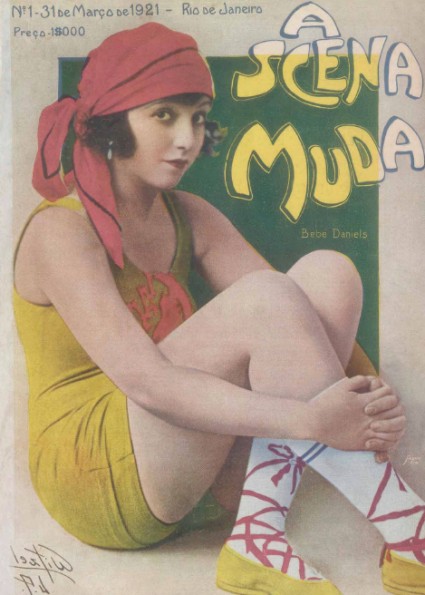
Bebe Daniels on the front cover of A Scena Muda, 1921 no. 1

It is frustrating for the silent film researcher that, while there are some excellent online resources which provide with extensive acess to digitised newspaper collections, there are all too few film journals from our period that have digitised. Specialist resources are always going to be that much more difficult to finance. But look beyond the English language, and there are treasures to be found. In the first of two posts covering non-English digitised collections, let me introduce you to Brazil’s Biblioteca Digital das Artes do Espetaculo. This site makes available the runs of two Brazilian film journals, A Scena Muda (1921-1955) and Cinearte (1926-1942), digitised by the Biblioteca Jenny Klabin Segall. While it’s certainly going to help if you know Portuguese, the colour front covers (mostly of Hollywood stars) are a design delight all by themselves. Within you will find news, reviews, photographs, gossip, advertisements, and regular features on the Brazilian feature film.

cinearte

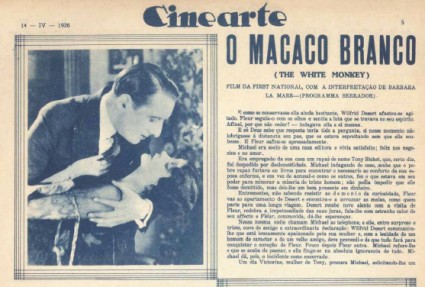
A page from Cinearte, 1926 no. 7

The sites are easy to navigate. From the front page, click on As Revistas. You will then be presented with three drop-down boxes, from which you can choose which of the two journals you want to see, then select whether you want to browse by year or number, and then select from the range offered. Searching by year you get a row of thumbnails of the front covers. The documents themselves are in PDF format, of good quality, though they don’t appear to be word-searchable. However, there is an advanced search option, to be found under Pesquisa, where you can search across both journals for individual words (handy for name searches, for example). So well worth browsing even if Portuguese is one of those languages you’ve never quite grasped fully, and for judging the balance between Hollywood and the native industry in the Brazilian mind.

My thanks to Teresa Antolin for bringing this to my attention. Part two tomorrow.

Update (August 2011): The link for the site has now changed to http://www.bjksdigital.museusegall.org.br/busca_revistas.html

Digital 19th Century Britain

newsbycine

Headline from Penny Illustrated Newspaper, Saturday, 8 July 1911, from http://newspapers.bl.uk/blcs

There has been much fuss this week about the Digital Britain report, a blueprint for the country’s broadband future in which services, entertainment, knowledge and the health of the economy to come are pinned to the hope that everyone will be linked up to a frankly measly 2Mbps connection by 2012. The report has come in for much criticism, chiefly because it poses more questions than answers, but it does also cover important areas such a digital literacy (so everyone is able to navigate their way through this new world and enjoy a common level of benefits) and points out innovative models which have made digitised collections available to all.

A model example, highlighted in the report, is the British Library’s 1800-1900 Newspapers project. I must admit to a vested interest here, as the BL helps pay the rent that keeps up the tottering edifice that is Bioscope Towers. But by any measure this is a marvellous resource, exceptional in its content and presentation, but also a model of how a major digitised collection can be created that brings benefit to all.

Digitisation costs money. We know that are billions of pages in the world’s libraries, we know we’d like to have them all at our fingertips, and we know we’d rather not pay for it. The BL’s newspaper collection represents some 750 million pages. The new resource present 2 million of these. The money has come from a UK educational body which funds resources for higher education, the Joint Information Systems Committee, and a commercial partner, Gale Cengage. The JISC paid for the digitised newspapers to be made available for free to UK universities, while the public had to visit the British Library physical site to see the resource.

nineteenth

That was the case for the past year or so, but from today the commercial side of the deal kicks in. Gale Cengage co-funded the project on the understanding that it could make the newspaper resource available to the online public, under a subscription model. You can buy a 24-hour pass for £6.99 which allows you to view up to 100 articles, or you can buy a seven-day pass with 200 article views for £9.99. There is plenty, however, that is available for free – two newspapers, The Graphic and Penny Illustrated Paper, are free (the search page has a tick box where you can search for free content only), you can search and browse the database, see thumbnails of any article, and even call up a window which shows your chosen term in context – as in the example above, which gives us the heartening information that Trewman’s Exeter Flying Post or Plymouth and Cornish Advertiser was able to tell its audience about the Edison Kinetoscope on 10 March 1894. There are also a number of freely available PDF examples tied to some excellent background histories.

The sheer range of newspapers is eye-opening, including such titles (just to start from the top) as the Aberdeen Journal, Baner Cymru, Belfast News-Letter, Birmingham Daily Post and Brighton Patriot (along with forty-four others). The major papers that carried on into the 20th and 21st centuries, such as The Times and The Guardian are not there, both because they are ongoing businesses and because they have developed their own commercial digital archives. And although the title says 1800-1900, the actual range is 1800-1913 – ideal for early cinema studies.

So, using our regular search term of ‘kinetoscope’, there are 433 hits overall, and five available for free. So there is a huge amount you can discover about the spread nationally of the first motion picture film device, even if some of those articles will not lead you to Edison’s invention but rather to a not very successful racehorse given that name (an early example of product sponsorship or simply the whim of a technologically-savvy owner? Someone should be researching this). ‘Cinematograph’ yields 1990 hits, sixty-one of them free. You can either view the article, the full page, or browse that issue. One other handy feature – each thumbnail says whether what you have looked for comes under News, Arts & Entertainment, Advertising, Business News or People, depending on the section from which it comes.

The model of a commercial body paying for the digitisation of out-of-copyright material like this, making it available to all through (relatively) low-cost subscription, while the host library gets its collection digitised and can make the results freely available onsite, is hopefully one that may lead to still greater access to newspaper content from this era. 2 million pages done; just 748 million left to do. While you’re waiting, go explore.

Medical matters

capillaries

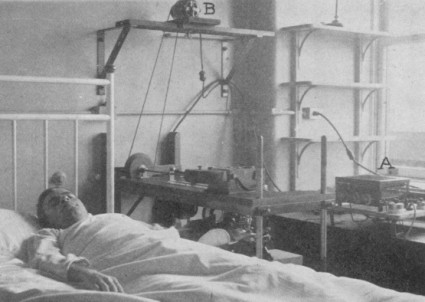
Fig 1: Photograph of the apparatus for cinematographic photomicrography of the capillaries of the nail fold in human subjects. A = an adjustable resistance; B = a motor, operated by a foot switch. From J. Hamilton Crawford and Heinz Rosenberger,’An Apparatus for Studies of Human Capillaries’, Journal of Clinical Investigation, 26 April 1926

Here at the Bioscope we like to keep an eye on online resources for the study of silent cinema, in particular digitised journals and newspapers. Few such resources exist online which are dedicated solely towards silent film, but there are plenty of a general or of a specialism other than film which contain material of great value to us. Plenty has been written here about newspapers, which you would expect to have worthwhile material, but our subject now is something a little more off the beaten track – medical journals.

It could be argued – in fact it has been argued – that it was scientific and medical investigation that brought about the invention of cinema. Chronophotographers in the 1880s and 90s, such as Etienne-Jules Marey, Georges Demeny, Ernst Kohlrausch and Albert Londe, used the emerging technology of motion picture film to record and analyse movement (chiefly human movement), generally with a medical or therapeutic aim in view. When motion pictures properly appeared on the scene, although they flourished as an entertainment, there were a number of medical investigators who took advantage of the new technology, such as Eugène-Louis Doyen (who filmed his operations in the late 1890s/early1900s) and Jean Comandon, who used microcinematographic film in completing his 1909 doctoral thesis De l’usage clinique de l’ultra-microscope en particulier pour la recherche et l’étude des spirochètes, and who went on to make films for Pathé. Other early explorers with a camera on the science/medicine border included Lucien Bull, Pierre Noguès, Gheorge Marinescu, Alejandro Posadas, Osvaldo Polimanti and Joachim-Léon Carvallo.
capillaries2

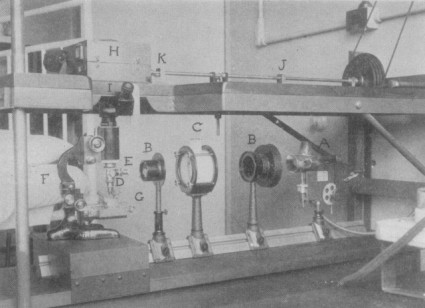
Fig. 2: Photograph showing details of the apparatus for cinematography of the capillaries. A = arc lamp; B = condensing system; C = heat filter; D = system for direct illumination; E = polarizer; F = microscope; G = stand for finger; H = camera; I = observation side piece; J = shaft; K = clutch

So it may not come as a surprise to find the cinematograph included among medical papers of the period, though the extent to which it is, and the number of people engaged in using motion pictures for medical investigation throughout the silent period, is nevertheless remarkable. Evidence of this can be found in digitised medical journals of the period, of which the major source is PubMed Central, the U.S. National Institutes of Health free digital archive of biomedical and life sciences journal literature. PMC is a digital library for a worldwide scientific and biomedical community, dedicated to the preservation and free access. It began operating in 2000, and in 2007 a UK offshoot, UK PubMed Central was launched. What is of interest to us is that its archive includes many runs of historical journals, covering (for our purposes) the 1890s to the 1920s, among them the British Medical Journal, The Journal of Medical Research, The Proceedings of the Royal Society of Medicine etc.

And there is plenty to discover. Just type in ‘cinematograph’ or ‘kinematograph’ (the most productive terms) and you will uncover a world of pioneering investigation. There is a 1918 article ‘Cinematograph Demonstration of War Neuroses’, on the renowned film of shell shock victims at Netley (previously covered by the Bioscope here), ‘The Rôle of the Cinematograph in the Teaching of Obstetrics’ (1920), ‘Kinematograph Film illustrating Anastomosis of Facial Nerve in Cases of Facial Palsy’ (1925), ‘The Cinematograph in Medical Education’ (1928) and ‘Cinematograph Demonstration of Methods of Bone-grafting’ (116). There is a number of pieces on the question whether going to the cinema was bad for your eyesight. There are references to key investigators such as Marey, Comandon, Marinescu and Doyen. And there are incidental references that intrigue, such as the British Medical Journal noting with some interest its receipt of a booklet on Kinemacolor (“With the motion of the picture and the natural colour representation, together with a certain amount of stereoscopic relief, all rolled into one, it is difficult to see what further conquests in this direction realism has to make”).
capillaries3

Fig. 3: Print of part of a cinematographic film taken by the method described

All of the documents are available in word-searchable PDF format, immaculately ordered and referenced, as one would expect. One can also find articles and reviews from more recent times that cover our area. Of course, the number of film enthusiasts keen to read a paper entiteld ‘An Apparatus for Motion Photography of the Growth of Bacteria’ is likely to be outnumbered to some considerable degree by those who would rather seek their entertainment elsewhere. But for those of an enquiring mind, PMC is an absolute treasure trove for anyone keen to explore how the motion picture developed in its earliest years as a tool of discovery, and gives evidence that the medical community was, from the outset, welcoming of the new medium where it could advance understanding.

There are other such medical journal databases. The British Medical Journal has puts its whole archive online, searchable by year or by subject terms. It appears that the content is the same as that to be found on PMC, but one should never assume. Next, there is the archive of historical nursing journals made available by the Royal College of Nursing. This does have material which is not on PMC, and the terms ‘cinematograph’, ‘kinematograph’ and even ‘kinetoscope’ all yield interesting results. Here, for example, is an account from The British Journal of Nursing, 15 November 1919, on a screening of the film The End of the Road:

By the courteous invitation of the National Council for Combating Venereal Diseases (London and Home Counties Branch), we attended a private exhibition of an Educational Cinematograph Production. bearing the above title. This powerful film is authorised by the Council, and produced With the approval of the Ministry of Health at the Alhambra Theatre, It is scarcely necessary to state that the splendid endeavours of the N.C.C.V.D. are bearing abundant fruit. Only a few years ago the production of a play handling social and sex questions with such frankness would not have been possible on our English stage. To-day a mixed audience watches it with the reverent silence of a Church congregation, a proof that the senseless prudery which has been so largely responsible in the past for an enormous amount of preventable disease, misery and degradation is breaking down, and giving place to a more sane, enlightened, and wholesome attitude of mind.

In the case of both the BMJ archive and that of the RCN, the article are available for free, as word-searchable and downloadable PDFs.

The history of early medical film can be traced in Virgilio Tosi’s Cinema Before Cinema: The Origins of Scientific Cinematography (first published in Italian 1984 and in English in 2005) which is accompanied by a DVD, The Origins of Scientific Cinematography, which demonstrates the work of chronophotographers, ethnographers, scientists and doctors who used film at the turn of the last century. The DVD contains some beautiful and occasionally eye-popping images (my favourite is a German doctor, Ernst von Bergmann, from 1903, who swiftly amputates a leg and then makes a bow to the camera).

Other studies around this area include Marta Braun, Picturing Time: Work of Etienne-Jules Marey (1830-1904) (one of the most beautiful books I know, as well as brimming over with intelligence) and Lisa Cartwright, Screening the Body: Tracing Medicine’s Visual Culture, a thought-provoking study of the meaning and intentions of the medical film, boldly arguing for its alliance with the avant garde and popular culture. Not published yet, but allied to Cartwright’s preoccupations, will be Hannah Landecker’s book which has the working title Cellular Features: A History of Biological Film in Science and Culture, information on which can be found here. As Landecker notes, while many medical films were shown only to specialists, or were used for instructional purposes, others made it into the popular cinema – notably the films of Jean Comandon.

One of the interesting things is that people didn’t draw the line between science and entertainment … It was all seen as film — something new. People were really excited that they could see something they’d never seen before — films of far-away places and of small things inside the body.

Has that line been drawn since? Dr Doyen’s 1902 film of the separation of Siamese twins ended up being shown on fairgrounds (and can be found on YouTube, if you know where to look), and only last month Channel 4 gave us The Operation: Surgery Live. Medical film is popular film, because we are drawn to watch it. It is certainly a part of film history that it would be wrong to ignore.
Discovering Australia (and beyond)

sbds

http://sbdsproto.nla.gov.au

There are some key developments underway in information services and how libraries – and in particular national libraries – deliver to their public in an online digital future. Firstly, catalogues and content are coming together, so that when you search for a title a book, film, journal, object or whatever, the item itself – in digital form – turns up and not just a record describing it. The Fondation Jérôme Seydoux Pathé is a good example of a catalogue on a film subject some of whose records include digitised resources (images).

Secondly, there is the promise of the purely digital library. Examples of these exist in the academic and commercial sectors, where a target audience expects immediate access to tailored content, while Project Gutenberg and the Internet Archive have pioneered the notion of general access to a wide range of digital artefacts in the public domain. The Bibliothèque nationale de France’s Gallica is an example of a national collection’s digital initiative, and internationally UNESCO recently launched the World Digital Library. A significant new step is the Korea’s National Digital Library, which will acquire, hold and deliver purely digital content.

Third, and the subject of this post, is the integration of these elements with content beyond that held by any one institution. In a purely digital and online environment, users are going to be less and less concerned about what any one library, archive or other information organisation has on its shelves, except as a hallmark of quality, and far more interested in finding all that they want in one place. Union catalogues exist which perform this function (for example, Worldcat, or Copac for UK university libraries), but add the content as well and it is not about attracting users to your doors but about delivering the content to wherever those users may be – at home, on the road, at your library, at another library.

This represents a fundamental shift in how knowledge is managed and how major institutions with national responsibility for preserving, describing and making accessible content do so in an environment where they are not necessarily the portal through which the user discovers and makes use of such content.

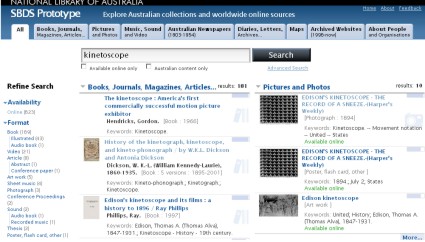
What do I mean by this? Well, the example to consider is the recently-launched ‘discovery service’ from the National Library of Australia, the SBDS Prototype. It’s unclear what SBDS stands for, but in practice the model is a simple one. It enables you to search across a number of collections, in Australia and beyond it, across books, journals, pictures, photographs, films, music, sound, newspapers, manuscripts, maps and archived websites. At its heart are several services provied by the NLA, including Australian Newspapers, the Pandora web archive and Picture Australia, but there are also general Australian services such as Australian Research Online, and world resources such as OAIster (a union catalogue of digital resources), Hathi Trust (digital books in the public domain), the Library of Congress, the Internet Archive and Wikipedia.

This isn’t a tool for discovering everything about everything. It is “focussed on Australia, Australians, and items found in Australian collecting institutions”. Also it is a work in progress and some elements are not yet functioning, such as Advanced Search. Nor does every record comes with the content in digital form, but it tells you where the content is available online and allows to to restrict searches to online content. So, if we narrow things down to silent cinema, and use our habitual search term for testing out new resource, what do we get when typing in ‘kinetoscope’? These are the results by format:

* Book (169)
o Illustrated (43)
o Audio book (1)
* Video (21)
* Article (8)
o Abstract (1)
o Conference paper (1)
* Art work (5)
* Sheet music (4)
* Photograph (3)
* Conference Proceedings (2)
* Sound (2)
o Audio book (1)
o Recorded music (1)
* Thesis (2)
* Poster, flash card, other (1)

And this is how it looks:

sbdssearch

I have to admit to some confusion here, as the number of search results (761) does not match the number of formats supposedly represented (chiefly, it seems, because formats does not include archived webpages, of which ‘kinetoscope’ brings up 462, mostly from Russell Naughton’s Adventures in Cybersound site). But, fine detail aside, the results are plentiful, and can be narrowed down to content available online, or by decade, keyword, author/contributor, language, or from solely Australian sources. Click on any one record, and you are taken to a full catalogue record, which indicates from which participating resource the information came, and a second click takes you to that site directly (click on ‘available online’ and it takes you to the external site directly), though be warned that not everything that is described as being online turns out to be the artefact itself. There is a great deal to be found beyond material of purely Australian interest. Very quickly I found production photographs from Greed at the Online Archive of California, a 1915 song sheet ‘Those Chaplin Feet‘ from John Hopkins University’s JScholarship, and a 2006 lecture on video by Hal S. Barron, ‘Screening the rural: the American countryside in silent film‘, from Claremont Colleges Digital Library.

It’s all a bit bewildering, as well as exciting. It’s a portal designed for Australian interests, but the implications are huge, once all national institutions start to go down this route – and once supra-national resources start opening up valued resources to researchers. Where will ownership then lie? Will anyone care? How will standards be maintained? What competing systems will there be? Who will visit a research library again, except when they fancy a nice day out? Interesting times lie ahead.

The Stage

thestage

New (at least to me) among the digitised historical journals now available online by subscription is The Stage. This is well worth taking note of. The Stage Directory (A London and Provincial Theatrical Advertiser) was founded in February 1880 as a monthly newspaper, and continues (as a weekly) to this day. Its entire archive 1880-2007 has been digitised and put online, covering over 6,500 issues or above 170,000 individual pages reporting on the goings on of the British stage and beyond.

The importance for us is that The Stage has always kept an eye on the motion picture business, and for the silent era it was assiduous in recording the activities of this new strand of showbusiness. A series of articles from 1907 entitled “Cinematograph Notes” records new businesses, film releases, licensing issues and so forth, “Latest Films” is very handy in giving titles of new releases, and another series “Film Facts & Fancies” starting in 1919, written by ‘Figaro’, reports on the cinema world with a knowing eye.

The Stage documented the engagements of actors, and one can trace their travels across the British provincial theatres, seeing also where the variety shows were starting to introduce the cinematograph. Here one can spot names that were later to be famous: in a notice from 30 July 1903 of a performance of Sherlock Holmes at the London Pavilion, the writer notes:

A faithful portrait of Billy is given by Master Charles Chaplin, who shows considerable ability, and bids fair to develop into a clever and capable actor.

Once can follow Chaplin many performances as Billy, and then later with the Karno troupe, up and down the country, before he found his fortune on the screen.

The Stage Archive is available by subscription. There is a timed pass system, with twenty-four hours’ access costing £5, one week £15, one month £30, three months £60, six months £100 and one year £150. Once you have subscribed, you have options to browse by date, so you can scroll through an entire issue (I recommend this to start with, as it gives you an idea of layout and the contents of the regular sections), or you can search by word (or phrase in quotation marks) across all types of ‘clippings’ (i.e. sections), or by article, picture or advertisement. You can search by the time periods 1880-1900, 1901-1950 or 1914-1918 (and later periods, of course), and can order search results chronologically or by relevance.

Those familiar with digitised newspaper collections will soon recognise that The Stage Archive has been produced by Olive Software‘s ActivePaper system. Search results give you the date and page number of the issue and a snippet of the article itself (usually a headline), which you click on to open up the full article. This can be a little frustrating when you have many search results, as there is little way of telling one article from another (many of the Chaplin notices are simply titled ‘Provinces’, for instance), so it may be a little laborious investigating the more popular subjects. You get the full article in facsimile form, with your search term highlighted, and you can print these or file them away in a ‘My Collection’ facility, but there is no way to get at the underlying OCR text, unfortunately.

If you don’t subscribe, you can still use The Stage Archive to search material, you just won’t have access to the articles themselves. But there is more from The Stage that you can access without paying any subscription. The Stage produced an annual yearbook which for the silent era is another rich source of information, particularly for its directory listing of film associations, its advertisements, and especially its reports on legal cases, always fascinating for the realism they provide behind the tinsel of so much cinema reportage. The Internet Archive has the volumes for 1908-1919. The PDFs are a large size (30-50MB), but don’t forget that they are word-searchable. Look out in particular for Arthur Coles Armstrong’s long article in the 1914 volume, “My Lady Kinema – The Eleventh Muse”. And from the 1916 volume, this report on a court case caught my eye:

ELINOR GLYN v. WESTERN FEATURE FILM CO. AND G. BLACK.- ALLEGED CINEMATOGRAPHIC INFRINGEMENT OF NOVEL.

In the Chancery Division, before Mr. Justice Younger, Mrs. Elinor Glyn, the author of and owner of the copyright in “Three Weeks,” brought an action against the defendants for an injunction restraining the defendants from making or authorising the public exhibition of kinematograph films under the title of Pimple’s Three Weeks (without the option).

The defendants pleaded that their film Pimple’s Three Weeks (without the option) was an original dramatic work within the meaning of the Copyright Act, 1911, and that they were entitled to use their film.

The action against the defendant George Black was settled before the case came into Court.

And the reason it was settled is that the judge decided that Three Weeks was an immoral work, and so did not merit any copyright protection, irrespective of whether a parody could be seen as infringing in the first case.

Plenty to discover, whether paid for or free (and acknowledgments to Bioscope regular Penfold for bringing The Stage Archive to my attention).

Taking flight

taube

German aviator Otto Linnekogel with camera operator on a Rumpler Taube, from Flight 15 May 1914

While the growth in digitised historic newspaper collections has proved a huge boon for the silent film researcher, there are specialist journals now being digitised and made available online which hold valuable material that one might not immediately suspect was there. A model example has recently been made available, Flight.

Flightglobal has put up the entirety of Flight magazine, from 1909 to 2005. Every issue has been scanned and is fully searchable in PDF format. There are save and print options, and you can copy and paste the uncorrected OCR text from the PDFs. Searching is by keyword or you can browse by year, and with each search result it is easy to browse back and forth from page to page, handily visible in thumbnail form. The term you have search for is highlighted on the PDF. Search can be limited by date range, so it is easy to narrow things down to our era. It’s a model service, and it’s all free.

And there is plenty there on motion pictures. Film and flight grew up together, with some of the pioneers of sequence photography being closely allied to those experimenting with powered flight towards the end of the nineteenth century, and as each made its appearance on the public stage they fed off each other (an essay I wrote on this subject is available from my personal site, here). For many people, the first sight they had of an aeroplane was not in the sky but on a cinema screen, when newsfilms such as those of the influential Rheims airshow of 1909 (the first gathering of the world’s aviators) amazed audiences everywhere. Films recorded the great aviators of those heroic times, they promoted air races and air meetings, they created exciting dramas in which aviators and their machines served as natural heroes. In return, aviation revelled in the attention the cinema brought to the field, used the cinematograph as demonstration of the feats aviators could achieve, equipped planes with cameras, and planes were used as speedy means of transporting films.

All of this can be traced through the pages of Flight. Useful search terms to use include ‘cinematograph’, ‘cinemato’ (often the fuller word is broken up), ‘bioscope’, ‘kinematograph’, ‘cinema’, ‘films’ and ‘Pathe’. For example, searching under ‘bioscope’ gives you this report from 25 April 1914 of aviator B.C. Hucks and unnamed newsreel operator filming the Royal Yacht in the English channel:

On Tuesday morning after a trial flight with the operator to get him used to his peculiar position—he faced towards the tail—I started off across the Channel at exactly 11 a.m. in brilliant sunshine and very little wind, exactly half an hour after the departure of the Royal Yacht from Dover. It took me some time to pick up the Royal Yacht as there was a considerable mist on the surface of the sea, but after about fifteen minutes’ flying, I noticed a haze of smoke and as this was the only sign of activity in the neighbourhood I made for it and discovered my quarry. The French cruisers had already joined the escort, and to give my operator every facility I dived down to about 400 ft. and enabled him to get a fine picture of the mid-Channel scene.

I circled the fleet completely on three occasions, being then right out of sight of land. As we were nearing Calais I hovered about and flew over Calais Harbour at the precise moment of the entry of Their Majesties’ Yacht, when my photographer obtained what turned out to be a most magnificent and novel film. I then made direct for the Calais Aerodrome, flying over the town at 800 ft, I landed at 12 noon, when I was presented with a bouquet from the Mayor of Calais and also learnt that I was the first English airman to land at Calais.

The operator then extracted the exposed film which I fixed in the passenger seat of my machine together with the bouquet, and at 1.45 I started off for Hendon. I struck the English coast at the exact point of my departure, followed the railway line to Ashford, and on reaching the outskirts of London, I took last year’s Aerial Derby course to Hendon, where I arrived at 2.35. I had covered the 125 miles in 110 minutes. The journey overland was a very bumpy one, there being a terrible lot of remous owing to the extreme heat of the sun.

On landing, the film was handed to a representative of the Warwick Bioscope Chronicle Film, and rushed off to Charing Cross Road, where it was developed, a print made, and a complete record of the King’s journey from London to Calais was shown at the matinee performance at the Coliseum at 5.20. Actually, the film was delivered to the Coliseum at 4.45.

Flight and film were both equated with speed and modernity – the one recorded the instant moment, the other could deliver it to you before it had lost any freshness. Aviation clearly revelled in its association with film. It enjoyed asserting its superiority by telling tales of nervous cameramen filming stunts while on board, but also emphasised the cinematograph’s value as documentary record. There was commercial sense involved as well, as some of the long-distance flights such as those undertaken by Alan Cobham in the 1920s were part-financed by the filming rights. There is also interest in aviation as the subject of film drama, as in this report from 18 December 1914, which concerns British aviator Claude Grahame-White:

I was greatly interested in a “trial run” of a new Imp cinematograph drama produced for the Trans-Atlantic Film Co. Ltd., entitled, “The Secret of the Air.” It will be “released” on January 21st, 1915, and should appeal to a number of FLIGHT readers, since it shows, incidentally to the “story,” several scenes from Hendon at its best in bright sunlight as we all like to remember it. It would not be fair to reveal the plot, but it is sufficient to state that the airman’s part is played by Claude Grahame-White, who, in those days, before the war claimed his services in a more serious capacity, revealed himself as an amateur film actor of no mean order. Among the other scenes witnessed on this film, and only indirectly connected with the “story,” is a very exciting start by the late Gustav Hamel on his 50 h.p. Bleriot in a nasty side wind, and an equally fine landing showing Hamel in his best form. As a reminiscence of Hendon’s great days, “The Secret of the Air” is well worth seeing, apart from the interest attached to the “plot.”

There is much to be discovered, though little that I have found so far in the way of handy illustration – just the one photograph, reproduced above, of a camera on board a plane, plus several images from the air taken from films. Anyway, a very welcome new resource, and my thanks to Nick Hiley for drawing it to my attention. Go explore.

Making of America

moa_cornell

The recent piece on ‘The Kinetoscope of Time‘ alerted me to Making of America, an online library of digitised primary sources on America social history “from the antebellum period through reconstruction”. This project, managed jointly by Cornell University Library and the University of Michigan, with funding from the Andrew W. Mellon Foundation, began in 1995. The current digital libraries are available on two websites, and they contain a number of documents on pre-cinema and early motion pictures.

The Cornell University Library site is based upon 109 monographs (267 volumes) and 22 journals (955 volumes) dating primarily between 1840-1900. The twenty-two journals used include The Atlantic Monthly, Harper’s New Monthly Magazine, The North American Review and Scribner’s Magazine. There are also numerous digitsed books. With the 1900 cut-off date, we are looking at the earliest years of motion pictures, along with the so-called pre-cinema era, and profitable keywords to employ include Kinetoscope, Cinematograph, and Magic Lantern. Here are some of the stand-out texts available:

The University of Michigan’s site boasts an amazing 10,000 books and 50,000 journal articles from 19th century imprints. The subject browsing option appears to contain no keywords for motion pictures or their precursors, and I have found nothing of any consequence in our field – others may be able to say otherwise.

Turn up the gramophone

phonofilm

Projecting with the De Forest Phonofilm system, from The Gramophone, March 1927

It’s been a while since we’ve been able to bring you news of digitised newspapers or journals accessible online, but here’s a treat for the new year. The Gramophone, the esteemed classical music journal, has just put up in its entire archive since 1923.

It’s searchable by keyword, date range and type of item, with results refinable by decade. So searches can be narrowed to the 1920s, and there is plenty on silent cinema for us to investigate. Search results give you the item title, the first few lines, date and page number. Individual items then give you a PDF of the page (though it is necessary to register first to access these), with the option to browse further through that issue, and the OCRed text (with the occasional wobble in the character recognition). It is very easy to use,with an array of handy extras you can explore for yourselves. How it was paid for, it doesn’t say, but the service is free.

So, what will we find on silent films in The Gramophone? A surprising amount, if sometimes tangentially expressed. A good example is this piece by J.B. Hastings, from April 1925, entitled ‘The Gramophone and Film Music’, on how cue sheets were put together:

The average person will be astonished to find how much time and trouble are spent in fitting suitable music to film plays. But the big film companies have come to realise that a really good picture play can be ruined by the accompaniment of inappropriate music, and, incidentally let me whisper, they have found that even a feeble production can be made fairly, tolerable by the ingenious use of the orchestra. So, with each super film, is issued a list of ” musical suggestions,” complete with the cues and signs necessary to fit the various selections to the screen action. In many cases the actual full music score, timed to a note, is hired out with the film. Since I have had the experience of compiling a large number of such lists—I forget whether the exact number runs into millions or merely thousands—perhaps I may be permitted to indicate here how it is done.

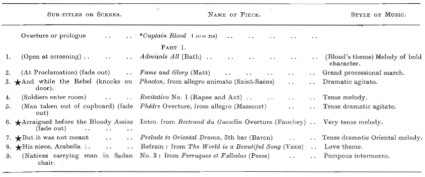
The film is projected in the cinema company’s private theatre and there I see the film with an assistant—and a stop watch. From the moment the first scene starts I am literally thinking in music. With a love scene I try to imagine just that type of sentimental melody that will exactly fit the picture, and move on in sympathy with it. A fight—then I endeavour to find an “agitato” of a tempo that will synchronise as near as possible with the speed and tensity of the film. Dramatic situations, storms, fires, sea scenes—all call for special treatment. As the film goes through, the “changes” are noted either by the sub-titles that precede them, or action on screen. In illustration of this I reproduce here a fragment of a typical “musical suggestions” sheet.

cuesheet_gramophone

The first column contains the cues, column 2 the music and composer, column 3 the style of the piece. Those cues marked with a (*) are the opening words of the sub-titles. Brackets indicate action on screen. Both types of cue indicate a change in the action or tempo. No. 9, for instance, shows a quick change from a quiet appealing melody to a pulsating allegro. It will be easily seen that a cinema orchestral leader must be on the alert the whole time. It might almost be said that he must work with one eye on the screen and the other on his music.

Many big photoplays call for a great number of “changes”—absolutely essential if the resultant entertainment is to be perfect. One of the most difficult films I have ever had to “fit” is Captain Blood, which is now showing throughout the country.

Mr. Rafael Sabatini’s story is so full of action and varying moods, and has been filmed with such faithfulness that no less than seventy changes are necessary, though this does. not mean seventy different selections. The chief “themes” in this story are (a) love; (b) dramatic; (e) sea battles and (ci) the “Captain Blood” theme itself. All these are there in various shades and emphasis.

As an introduction we start with the Captain Blood song, specially written as an overture or prologue. This is followed by Admirals All (Hubert Bath) and is used, in all, in eight different places.. For the love theme I have chosen The World is a Beautiful Song (Vane), and the principal seafighting scenes, Beethoven’s King Stephen overture from “presto,” varying this with various “incidental symphonies” specially written for film use.

Here is an extract from the music which I have fitted to the comparatively quiet first reel of Captain Blood:

cuesheet_gramophone2

Compare this with the smashing character of the music towards the end, when the terrific battle of Port Royal, Jamaica, is introduced. Here you will notice indication of “effects”.

cuesheet_gramophone3

Naturally, many cinemas cannot, for various reasons, follow the “official” musical suggestions in their entirety, especially as it is only in cases of exceptional films like Captain Blood that the complete score, correctly numbered and marked, can be hired from the film company.

No orchestra library under the sun can hope to contain every composition that may be wanted; and no musical director knows off-hand the exact nature of every composition in existence. It is here that the gramophone is so useful. When he finds himself “stuck” for a suitable number the musical director can always turn to the gramophone for guidance as to the style and tempo of any selection, the title of which seems to indicate possibilities. Moreover, many cinema orchestral leaders, to my knowledge, gain valuable hints from the reviews of records and music published in THE GRAMOPHONE.

In conclusion, I would say that the modern super-cinema, with its often excellent orchestra, together with the great study given to the musical side of films by cinema companies, is having a marked effect upon the musical taste of the British public.

What with this and broadcasting—both tending to familiarise the “Man in the Street” with all that is best in music—it is not surprising that the gramophone firms are experiencing what can most aptly be termed “a record boom.”

And, briefly, an editorial from April 1929 casts an interesting light on payment for musical accompaniment in cinemas, in this case involving the future composer of many a British film score, Malcolm Sargent:

Dr. Malcolm Sargent, at the age of thirty-three, has just refused to play the cinema organ for half an hour every day at 12s. 9d. a minute. This shows a more genuine horror of the instrument than even I could have fancied possible in these days of hard struggling for economic existence. What puzzles me, however, even more than Dr. Sargent’s devotion to art is why it should be worth while for a West End cinema theatre to pay £7,000 a year to any man, whatever his acrobatic and musical ability, to play their organ three times daily throughout the year for ten minutes at a session. I really should very much like to know the name of the cinema theatre which was prepared to offer this price, and I think Dr. Sargent owes it to his professional brethren with lower ideals than himself to reveal the name…

And there’s much more to discover, including some fascinating material on the coming of sound, as the illustration of the De Forest Phonofilm system at the top of this post indicates. Just type in ‘cinema’ or ‘film’ as a keyword, and start browsing.

Let Google do your digitising for you

As regulars will know, the Bioscope tries to keep track of digitised historical newspaper collections around the world, with an eye to their value for researching early film history. And we’ve told you before about Google’s News Archive Search option which allows you to search across multiple historic news resources, both free and subscription-based.

Now Google is upping the ante considerably by offering newspapers to pay for the digitisation of their collections if the owners will then let Google show the stories for free. Here’s an Associated Press report on the story:

SAN FRANCISCO (AP) — Google Inc. is trying to expand the newspaper section of its online library to include billions of articles published during the past 244 years, hoping the added attraction will lure even more traffic to its leading Internet search engine.

The project announced Monday extends Google’s crusade to make digital copies of content created before the Internet’s advent, so the information can become more accessible and, ultimately, Google can make more money from ads shown on its Web site.

As part of the latest initiative, Google will foot the bill to copy the archives of any newspaper publisher willing to permit the stories to be shown for free on Google’s Web site. The participating publishers will receive an unspecified portion of the revenue generated from the ads displayed next to the stories.

Google is touting the program as a way to give people an easier way to find a rich vein of history. The initiative also is designed to provide a financial boost to newspaper publishers as they try to offset declining revenue from print editions that are losing readers and advertisers to online news sources.

“I believe this could be a turning point for the industry,” said Pierre Little, publisher of the Quebec Chronicle-Telegraph, which touts itself as North America’s oldest newspaper, with editions dating to 1764. “This helps us unlock a bit of an asset that had just been sitting within the organization.”

Besides the Chronicle-Telegraph, other newspapers that have already agreed to allow Google to copy and host their archives include the Pittsburgh Post-Gazette and the St. Petersburg Times in Florida. Google declined to specify how many other papers have signed up or how much the company has budgeted for the project.

Google already has committed to spending tens of millions of dollars to make electronic copies of books and other material kept in dozens of libraries around the world. The book-copying program, launched in 2004, has triggered a lawsuit from group of authors and publishers that alleges it infringes on copyrights — a charge that Google is fighting.

Major newspapers including The New York Times and The Washington Post began to give Google’s search engine access to some of their electronic archives in 2006. But those results frequently displayed only news snippets. Readers often had to pay a fee to see the entire article.

Besides being free, the newspaper archives hosted by Google will be presented in the same way they originally appeared in print, said Adam Smith, Google’s product management director.

Finding the old newspaper stories initially will require searching through Google’s “news” or “news archive” section. The newspaper archives should start showing up on Google’s main results page within the next year, Smith said.

Well, we’ll keep an eye on this, and hope soon to have for you a round-up of all the newspaper collections in past Bioscope posts with update on new collections appearing worldwide.

For your selection

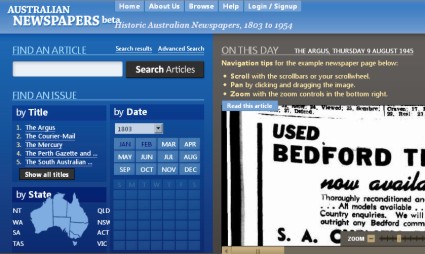
Australian Newspapers beta, http://ndpbeta.nla.gov.au/ndp/del/home

As regular readers will know, the Bioscope tries to keep an eye on the various newspaper and journal digitisation projects taking place around the world, some commercially-driven, some undertaken with public money. One long-awaited project has been the Australian Newspaper Digitisation Program, which has just reached the Beta test stage.

The National Library of Australia, in collaboration the Australian State and Territory libraries, is undertaking a huge, long-term programme to digitise out of copyright Australian newspapers. The aim is to produce a free online service allowing full-text searching of newspapers published in each Australian state an territory, from 1803 (when the first Australian newspaper was published, in Sydney), to 1954, when copyright kicks in (intriguingly late).

The programme is ongoing, but on 25 July a Beta service was released to the public, offering 70,000 newspaper pages from 1803 onwards, with additional pages to be added each week (as of 8 August there are 91,577 pages available). The service is very much in test mode, and they request that users provide feedback (while bearing in mind that the service is not official as yet).

So, how do we go about using it, and what is there to find on silent film? Simple search options are by any word within a text (uncorrected OCR), newspaper title (currently eleven on offer), state and date (with an attractively laid-out calendar option). You can use inverted commas to search on a phrase. The many advanced search options include combinations of terms, range of dates, length of article, and the option to search under types of article – advertising, detailed lists etc., family notices, news, and illustrated. You can also sort results by relevance, earliest or most recent date. In short, all the useful options that you would hope to see.

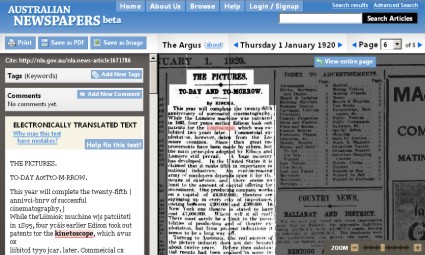
Article display page

Search results give a list of article titles with the name of the newspaper, date, page number and the first few lines of OCRed text. Most usefully, you are also given links for the same search term to the Australian National Bibiliographic Database and Picture Australia. The Article Display page, as illustrated above, shows the article with the search term highlighted, a zoom option and option to see the full page. On the left is the uncorrected OCR text, and options to add your own tags or comments (if you are logged in). And you can print, save as PDF, or save as image. Which pretty much covers everything.

On film subjects, there is plenty – though with some surprising gaps, probably explained by the absence of those editions yet to be digitised. Inevitably, there much to be found on the early Australian film business itself. So, our traditional text term ‘kinetoscope’ yields only two hits (both from the 1920s). ‘Charlie Chaplin’ scores 927, ‘Mary Pickford’ 600, ‘Norma Talmadge’ 175, ‘Kinemacolor’ 32, ‘Vitagraph’ 123, ‘Cinematograph’ 685, and so on. Turning to Australian silent films, good subjects to investigate include ‘On Our Selection’ (280, but that includes stage versions and the 1932 sound film as well as the 1920 silent), ‘West’s Pictures’ (281 for a renowned exhibitor), ‘Frank Hurley’ (83 for Australia’s national photographer), ‘Australasian Films’ (79 for the leading native film company) and ‘Raymond Longford’ (27 for the film director).

Finally, if you visit the Browse page, there’s a list of all the tags (keywords) that have been used to classify items – these include ‘classic movies’, ‘movie stars’ and ‘silent films’, but sadly only one article so far is so described. Time for us all to get tagging.

I’ll be doing a fresh round-up of newspaper digitisation sites some time soon. Meanwhile, go explore.