… and London screen history

Angel Islington

The Angel cinema in Islington, 1917

Hot on the heels of that last post on the East Finchley Phoenix comes news of a one-day event at Birkbeck College on London’s screen history. Organised by the University of London Screen Studies Group, in association with the London Screen Studies Centre, Birkbeck College and Film Studies journal, the event on Friday 14 March brings together a range of recent work on London’s heritage of film production and particularly reception. Here’s the programme:

London Screen History

Birkbeck College, Malet Street, London WC1
9.30–18.00 Lecture Theatre B33

  • Ian Christie: Introduction
  • Michele Daniels: The Coming of Talking Films to London, 1928-29
  • Jude Cowan: ‘The First Film Studios at Ealing: Warwick Trading Company 1907-1909 and Barker Motion Photography 1909-1918’
  • Pierluigi Ercole: ‘Little Italy on the brink: London Italians and War Films, 1915-1918’

11.00-11.30 tea and coffee

  • Brigitte Flickinger (Heidelberg): ‘Living and leisure: Cinema-going in London in the 1910s and 1920s – a view from outside’
  • Luke McKernan (British Library): ‘Children’s cinemagoing in London before WW1’

13.00-14.00 Lunch

  • Charlotte Brunsdon (Warwick): ‘Shaping the Cinematic City: Three London Journeys’

15.00

  • Toby Haggith: Early London housing films
  • Angela English, Jenny Davison: ‘Their Past Your Future and working with London community groups’
  • Roland-Francois Lack: ‘Still Point of the Turning World: Piccadilly Circus in Film’

16.30-17.00 Tea and coffee

  • John Sedgwick (London Metropolitan): ‘The commercial significance of London’s West End cinemas’
  • Richard Gray (CTA): ‘London’s cinema buildings’

The programme has been published a bit late in the day, but it’s a terrific line-up (your humble scribe notwithstanding), so do come along (there’s a small charge for tea and coffee) and see if we can get the audience to outnumber the speakers, at least by a little bit.

Colour and the moving image

Kinemacolor banner

In this our year of colour, here’s a call for papers on a pertinent conference, which comes out of an ongoing three-year research project at the University of Bristol which is examining the histories of Kinemacolor and Technicolor in Britain.

Colour and the Moving Image: History, Theory, Aesthetics, Archive

Conference: 10th July – 12th July 2009, Bristol, UK

Keynote speakers: Tom Gunning (University of Chicago), Laura Mulvey (Birkbeck)

‘An inquiry into colour can take you just about anywhere’ (David Batchelor, Chromophobia, 2000)

Call for Papers: This conference addresses questions emerging through a renewed interest in colour film and as an interdisciplinary subject. The event is part of an AHRC-funded project on colour film, led by Professor Sarah Street. While colour is a fundamental element of film forms, technologies and aesthetics it is rarely singled-out for analysis. The aim of the conference is to extend previous work on colour and to consider its form and functions from a range of perspectives within four major strands: histories and technologies; film theory; philosophies and aesthetics of colour; the ethics, practices and theories surrounding the deterioration and conservation of colour film. In addition to formal conference papers, the event will include screenings of prints from the BFI National Film Archive. We invite proposals which address broad issues raised by colour and the moving image. The conference will provide a forum for discussion which is informed by, and directly addresses, the interrelations of the theory, history and aesthetics of colour film and of moving image technologies in their broadest sense. Proposals which focus on questions of colour in one or more of the following areas are particularly welcome:

– star systems
– reception theory
– pre-filmic, pro-filmic and onscreen spaces
– fantasy, spectacle, realism and/ or ‘natural’ colour
– colour theory
– synaesthesia: theories and practices of the interrelations of colour, sound, music as sensation
– chromophilia/chromophobia
– distanciation and avant garde film
– colour and genre
– film histories and new technologies: video, DVD, small screen technologies as new viewing spaces
– Colour systems including Kinemacolor, Dufaycolor, Chemicolor, Agfacolor, Technicolor, Eastmancolor

We invite abstracts of c.200 words for individual papers or pre-constituted panels consisting of 3 papers to be submitted by 1st September 2008. Please send abstracts to dram-colourconference@bristol.ac.uk. If you prefer to submit your abstract by post, the address is as follows: Colour and the Moving Image Conference, c/o Dr Liz Watkins, Department of Drama: Theatre, Film, Television, Cantocks Close, Woodland Road, University of Bristol, Bristol, BS8 1UP, UK.

Colour and the Moving Image: History, Theory, Aesthetics, Archive is hosted by the Department of Drama: Theatre, Film, Television, University of Bristol, UK with support from the Arts and Humanities Research Council. Screenings in co-operation with the BFI National Film Archive, UK and supported by Screen as one of its 50th Anniversary regional events.

Modernism and visual culture

And another call for papers and conference coming up. You have to look a little harder at this one to see the silent cinema connection, but it’s there.

MODERNISM AND VISUAL CULTURE

1st-2nd November 2008
Oxford University, UK

Keynote Speakers
David Trotter (Cambridge University)
Laura Marcus (Edinburgh University)
Maggie Humm (University of East London)

“A writer … has need of a third eye whose function is to help out the other senses when they flag.” (Virginia Woolf, 1925)

In the wake of recent analyses of the landscape of visual cultures at the end of the nineteenth century, new contexts have become available for understanding the emergence and shape of modernism. This conference seeks to unpick our tangled model of the relationships between the established arts in the modernist period and between modernism and popular culture, and to illuminate the types of reactions occasioned in the established arts by the emergence of modern mass media. Papers on any aspect of the relationship between modernist literatures and cultures with visual culture, including cinema and fine art, are welcome.

Possible questions to consider:

  • Are recent claims for modernism’s affinity with popular culture anything new?
  • Was Cubism’s debt to chronophotography a model for – or an exception to – modernism’s relationship with photo-chemical reproduction?
  • Was the ‘modernity’ to which the established arts responded actually the emergence of a rival new cultural landscape comprised of cinema, variety theatre, instantaneous photography, stage illusions, the moving panorama, mass spectator sports, moving-image lantern shows, the illustrated short story and the cartoon strip?
  • Did literary modernism emerge in emulation of the innovations occurring in modernist painting?
  • What role did modernism play in altering established theories of visual culture?
  • Can modernism and late-nineteenth-century popular visual culture be seen as the twin products of a single preceding historical development?
  • What singular and identifiable properties, if any, did such related forms as cinema, cartoon strips or shadowgrams have in impacting on the existing arts?
  • Were the different modernisms of the various established arts the product of their varying vantage points on new media forms?
  • If new visual media generated modernism, did they do so by threatening to become art forms themselves, or by throwing the distinct qualities of the existing arts into relief?
  • Were modernists already modernists when their work adopted the traits of various new forms of visual culture?
  • Is realism in cinema equivalent to modernism in the existing arts?
  • Was the reflexivity learned by the group of polymedia practitioners we call modernists the basis of modernist form in all of the arts?

Speakers are encouraged to use visual material in their presentations. Send 300-word abstracts for 20-minute papers to Andrew Shail (andrew.shail [at] at-annes.ox.ac.uk), by 1 April 2008. Panel proposals are welcome – please include contact details and affiliations for all speakers.

Heady stuff.

Funny people these foreigners

A call for papers has been issued for ‘Funny People these Foreigners’, an international conference on international comedy, organised by the Communication, Cultural and Media Studies Research Centre, the University of Salford. After the success their conference last year, ‘What Have You Got In That Box? – Comedy and Regional National Identity’, they are inviting proposals for papers that investigate any aspect of comedy with an international perspective. Suggested topics might include:

* Breaking language barriers – successful comedy crossovers
* Les Visiteurs
* Roberto Benigni
* Asterix
* M. Hulot
* USA/UK transfers: successes and failures
* Silent Cinema
* National/International Comedy stars
* Dubbing vs subtitling debate
* British Comedy in international markets
* Comedy co-productions
* Film and TV Comedy and national identity
* Viva Los Simpsons! Universality of humour

And all points in between. Proposals (maximum 300 words) should be sent to Dr C.P. Lee (c.lee [at] salford.ac.uk) or Dr Andy Wills (a.willis [at] salford.ac.uk), by 17 March. The conference will take place 5-6 June 2008.

2008 – The Year of Colour

Kinemacolor poster

A happy new year to one and all!

2007 was a productive year for The Bioscope, from small beginnings, and I hope that the coming year will see the service continue to gow and for the archive of useful content to build up. In 2008 I’ll be continuing to provide news on events, festivals, conferences, screenings, DVD releases and online resources for early and silent cinema. The Library of freely-available digitised documents will continue to grow (there is quite a backlog of titles to be added in due course), and I hope to add new features and maybe indulge in a redesign somewhere along the line.

However, the major theme running through 2008 will be colour cinematography in the silent era. 2008 sees the centenary of the first public exhibition of Kinemacolor, the world’s first natural colour motion picture system. Pedants may say that the centenary of Kinemacolor might have been 1906/2006 (when it was patented), 1907/2007 (when it was exhibited in a preliminary form to an audience of film professionals) or 1909/2009 (when it was first called Kinemacolor and was first exhibited to a paying public). But 1 May 1908 was when the system was first shown to a startled general audience at Urbanora House, Wardour Street, London – and that’s good enough for me.

So throughout 2008 there will be posts on colour cinematography to 1930. Not just Kinemacolor (though there will be plenty on that), but the experimental efforts that preceded it, hand-painted and stencil colour, tinting and toning, Biocolour, Cinechrome, Chronochrome, Kodachrome, Prizmacolor, Technicolor, Polychromide, Kodacolor, and more. There will be potted histories, archive documents, illustrations and (if I can find them) film clips. It’ll all build up into a year-long series to cherish and keep.

Lastly, here’s a checklist of some of the silent film events taking place over the year (all of which and more will be recorded in the Calendar section):

14-18 January – The Bioscope Festival of Lost Films
17-20 January – Slapstick 2008 silent comedy festival, Bristol
24-27 January – StummFilmMusikTage festival, Erlangen
9 February – Border Crossings: Rethinking Early Cinema conference, Berkeley
22-23 February – Kansas Silent Film Festival
13-16 March – Cinefest, Syracuse
26-28 March – City in Film conference, Liverpool
3-6 April – British Silent Cinema Festival, Nottingham
11-13 June – The Fifth International Women and the Silent Screen conference, Stockholm
17-21 June – Domitor conference, Peripheral Early Cinemas, Perpignan and Girona
28 June-5 July – Il Cinema Ritrovato, Bologna
11-13 July – San Francisco Silent Film Festival
8-10 August – Capitolfest, New York
28 August-1 September – Cinecon festival, Hollywood
25-28 September – Cinesation festival
4-11 October – Giornate del Cinema Muto, Pordenone

Keep reading, keep commenting, and tell your friends.

Re-envisioning the child in Italian film

Re-envisioning the child in Italian film

http://www.sall.ex.ac.uk

Re-envisioning the Child in Italian Film: New Perspectives on Children and Childhoods from Early Cinema to the Present is a conference being held 14-15 July 2008 at the University of Exeter. Normally we don’t allow non-words like ‘re-envisioning’ here at The Bioscope, but this promises to be an interesting congruence of Italian studies, film studies and childhood studies. The conference blurb assures us that “whilst the recurrent presence of the filmic child has been acknowledged within traditional film historiography, its changing role and status has until recently suffered from a peculiar critical neglect.” They are asking for papers on the following:

* Representations of children in early cinema
* The child in historical drama/costume drama
* The role of the child in Italian film criticism
* Child actors
* The politicisation of children and childhoods
* Violence and the traumatised child
* Childhood and innocence
* The lost, endangered or missing child
* The resurfacing of lost childhoods/the ghosts of childhood
* The child and questions of gender and sexuality
* Childhood and genre
* Childhood under postmodernity and the ‘death of childhood’
* Re-reading the child in Neorealism
* The child in global cinema
* Childhood and immigration

The representation of children in early cinema is a subject that merits serious academic investigation, and though the concentration on Italian rather narrows the field, hopefully there will be someone to take on the theme. The Call for Papers closes 1 February 2008. Further details from The School of Arts, Lenguages and Literatures, University of Exeter.

Non solo dive

Non solo dive

http://www.nonsolodive.com

More information is now available on Non solo dive (Not Only Divas), a conference and retrospective on women and silent Italian cinema. The conference takes place in Bologna, 14-16 December, and here’s the line-up:

Friday, December 14

2.30 PM – Welcoming addresses

3.00 PM-6.30 PM – Session I:

Jane Gaines – Duke University and Columbia University (USA)
Are They Us?: Our Work on Women Working in the International Silent Film Industry
Christine Gledhill – University of Sunderland (UK)
Rethinking Women’s Film History from Britain
Elda Guerra – Associazione Orlando
Beyond Boundaries: The Women’s Movement at the turn of the 20th Century, and the Emergence of a New Subjectivity

Alberto Friedemann – Associazione Fert
Women Entrepreneurs in the Turin Film Industry during the Silent Period
Andrea Palladino – Documentary Filmmaker
The Amazing Story of Frieda Klug: Research Hypothesis for a Documentary about the Origins of Italian Cinema

Discussion

Saturday, December 15

9.30 AM-1.00 PM – Session II:

Cristina Jandelli – University of Florence
“The Sharpest of Them All”: Diana Karenne
Teresa Antolin – Archivio in penombra
Elena and the Men: Francesca Bertini and Film Historiography
Elena Dagrada – State University of Milan
The Temptation of Silence: Eleonora Duse and the Cinema

Elena Mosconi – Catholic University of Milan
Divas and Anti-Divas in Early Italian Cinema: Elettra Raggio and Astrea
Valeria Palumbo – Journalist, L’Europeo
Viper: the Myth of Anna Fougez
Ester De Miro D’Ayeta – University of Genoa
Sewing Celluloid Ribbons: The Obscure Career of Esterina Zuccarone, Editor and Working Woman in Turin

Discussion

3.00 PM-6.30 PM – Session III:

Luca Mazzei – University of Florence
Alone in the Dark. Memories and Narratives of Italian Female Viewers between 1898 and 1916
Silvio Alovisio – University of Turin
The Image of the Spectatrix in the Italian Film Press of the Twenties
Gina Annunziata – University of Siena
Matilde Serao and the Cinema

Roberta Gandolfi – University of Parma
“New Women” of the Italian Theater between Reform and Tradition, Feminism and Modernism
Vittorio Martinelli – Italian Association for Research in Film History
Origins of the Italian Star System
Claudia Gianetto – Museo Nazionale del Cinema
Gigetta Morano: An “Irresistible Force”

Discussion

Sunday, December 16

10.00 AM – 1.00 PM – Session IV:

Kim Tomadjoglou – American Film Institute (USA)
Rethinking the Cinema of Elvira Notari
Irela Nuñez, Franca Farina – Cineteca Nazionale
Women’s Films of the Cineteca Nazionale: Restored and to be Restored
Micaela Veronesi – Italian Association for Research in Film History
A Woman Wants to “Recreate the World”. Umanità, by Elvira Giallanella

Stella Dagna – Museo Nazionale del Cinema
In the Giant’s Shadow. Second Lead Actresses in the Maciste series
Elena D’Amelio – University of Padua
Damned and Beautiful. Powerful Women of the Italian Epic Genre

Discussion

Monica Dall’Asta – University of Bologna
Conclusions

That’s an impressive, specialised but wide-ranging line-up, and to complement it there’s a retrospective of relevant films running 2-15 December at the Cinema Lumière, Bologna. The highlights are two new restorations: Elvira Giallanella’s pacifist film Umanità (1919), restored by the Cineteca Nazionale and the Orlando Association, and Elvira Notari’s ‘A Santanotte (1921), a Neapolitan melodrama, restored by the same institutions in association with George Eastman House. Notari is the subject of Giuliana Bruno’s influential study, Streetwalking on a Ruined Map, and is now something of a cult figure. There are other Notari films on show, a collection of comedienne Lea Giunchi’s short films, Cenere (1916) (the only film of the legendary stage actress Elenora Duse), Francesca Bertini and Gustavo Serena’s Assunta Spina (1915), Giulia Rizzotto’s A Mosca Cieca (1921), and more.

The full conference and retrospective programme is downloadable here (PDF, 212MB, in Italian), and the website www.nonsolodive.com (also in Italian) will be active from 26 November. Clearly, knowing Italian will help, but English translation will be provided throughout the conference.

The rationale behind the event is given in this earlier post.

The Idea of America

…or, to give it its full title, The Idea of America in Nineteenth-Century British Culture, 1776-1914. The is a conference to be held at the Institute of English Studies, University of London 27-28 June 2008, for which the final call for papers has just been issued. There’s a film potential there, as the conference blurb offers:

The meaning of America to those beyond its borders has rarely been the subject of such passion and global conflict as it has been in the past seven years. If we look to the long nineteenth century, however, the idea of America in British culture suggests that there is a lively pre-history of competing and opposed notions of the emergent republic. From the new world of revolution, individual liberty, democracy and freedom to the home of plutocracy and Philistinism; from avatar of the mechanical city to the last hope of utopias in the wilderness, America emerged, and continued to accrete meanings, as diverse as its landscape.

This interdisciplinary conference invites scholars to reflect on the ideas, representations and transmissions of America in Britain during the period in question. Possible subjects might include: republicanism; liberty; revolution; democracy; populism; utopias; individualism; feminism; transcendentalism; frontiers; landscapes; pioneers; displacement; plutocracy; commerce; art-collection. We encourage papers that might pursue these or other subjects using travel-writing, letters, essays, photography and painting, early film, records of travelling shows and extravaganzas in addition to fiction, poetry and drama.

Abstracts of 250-300 words should be sent to the conference organisers, Dr Ella Dzelzainis, School of English and Humanities, Birkbeck College, University of London (e.dzelzainis [at] bbk.ac.uk) and Dr Ruth Livesey, Department of English, Royal Holloway, University of London (ruth.livese [at] rhul.ac.uk), by November 15th 2007.

Domitor on the periphery

Domitor

The 2008 Domitor conference has changed its title and varied somewhat its terms of reference. Previously it was going to be called ‘The Regional Dimension in Early Cinema’. Now it rejoices in the title ‘Peripheral Early Cinemas’. By which they seem to mean early cinema on the edges: geographically, industrially, culturally and temporally. But let them express it in their own words:

Call for Papers: Domitor 2008

The next biannual conference of Domitor will take place from Tuesday 17 June-Saturday 21 June in Catalonia, that is, Girona, Spain, and Perpignan, France. For the first time a Domitor conference will traverse national frontiers. The topic selected, appropriate for this unique setting, is:

PERIPHERAL EARLY CINEMAS

Rationale

The notion of “Peripheral cinemas” is geographical concept: cinema that is made or viewed far from the institutional center (for example, national capitals). But the designation is not only spatial. It also involves cinemas produced on the margins of developing industrial and cultural institutions.

“Peripheral” then, connotes “regional” or “provincial,” but these characterizations are relative to the specific historical period. It was Barcelona, for instance, that was the actual capital of Spanish filmmaking in 1900. Furthermore, the idea of “regional” or “provincial” is not relevant to numerous places (Italy, USA, not to mention non-Western countries).

As a result, the concept of “local cinema” becomes very problematic.

Issues and Questions envisioned

1. Institutional context. The operative conceptual tool of the Center-Periphery antinomy. To identify peripheral early cinemas reflects as well the institutional forms of centrality that were springing up. Where is the institutional “center” in early cinema?

2. Models and types of production. Can we speak of a “central model” —such as the cinema of attractions—and other “peripheral models,” such as travel films, tableaux vivants, publicity, etc…? Amateur films and military films are “peripheral” today in relation to commercial institutional production. Were they in the time of early cinema? Was women’s cinema, to the extent that it existed in the early period, peripheral?

3. The sociological level. Is there a sociological center —“bourgeois” film—for example, an English “working class” cinema? Is this distinction valid at the level of production? Reception? The two combined?

4. Industrial and peripheral exhibition systems. How did exhibition systems develop from a center? Were they aligned with specific ideas of a geographical center? Were there alternative forms of film exhibition not dependent on a center, for example in rural locations or the outskirts of large cities? Examples would be comparisons between Torino/Roma in Italy, Paris/Marseille or Paris/Nice in France or Madrid/Barcelona in Spain. Did this dichotomy function in cinematic environments everywhere, especially outside of Europe?

5. Historiography. Film history traditionally has been written from the center about the center. This is becoming less the case in recent years and relates to early cinema. Has historiography established a certain centrality in early films studies that we should consider revising? Furthermore, was it like that in the writing of the time? Is this centrality the norm in Western countries? At the same time, is the history of non-Western cinemas relegated to the periphery?

6. The study of representation: the “colonial” gaze. One puts in this category all the forms of viewing that emanate from the center to the periphery. How did that function in cinema at its origins? Peripheral and folkloric relationships? How did cinema take into account “minority” cultures at the turn of the 19th and 20th centuries? The relationship of periphery to center would accordingly by first and foremost defined in terms of the gaze.

Included in this examination are “peripheral” cinematographic practices that gaze upon peripheral” cultures from outside as subjects. This would include “tourist,” “ethnographic” and neighboring filmmaking.

In order to avoid over-extending and overflowing the topic, we are not counting scientific, advertising or instructional films. Certainly, this is another issue, since one could maintain that they were “peripheral” in relation to institutional cinema.

Sending Proposals

Those wishing to submit a proposal should send a proposal of no more than one page to the selection committee by 31 December 2007. (The e-mail addresses will be posted on the Domitor website when available.) The papers must be original unpublished research. Languages accepted are English, Catalan, Spanish and French. The papers should be no more than 10 pages (A4) or 12 pages (US letter). The final text must be submitted by 30 April 2008 to allow for translation. The presentation should last no more than 20 minutes.

A selection of papers from the conference will be published in a trilingual volume.

Membership in Domitor is not required to submit a proposal. However, in order to present a paper at the conference, membership in the organization is mandatory.

Why the prejudice against scientific, advertising or instructional films, eh? There’s always something that gets pushed to the margins. And if everything’s on the edge of something else, is there a mainstream or a centre at all? Further information (if not necessarily illumination) can be found on the Domitor website. For those who don’t know, Domitor is the leading international organisation for the study of early cinema, its main activities being a bi-annual conference followed by a volume of published papers. Details of past publications from conferences going back to 1990 can be found here.

Networks of Entertainment

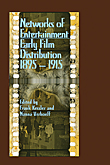
Networks of Entertainment, from http://www.johnlibbey.com

Not on the Domitor site as yet are details of the most recent publication, Networks of Entertainment: Early Film Distribution 1895-1915, edited by Frank Kessler and Nanna Verhoeff, and published by John Libbey, which derives from the 2004 conference. The publisher’s blurb describes the book thus:

This collection of essays explores the complex issue of film distribution from the invention of cinema into the 1910s. From regional distribution networks to international marketing strategies, from the analysis of distribution catalogues to case studies on individual distributors these essays written by well-known specialists in the field discuss the intriguing question of how films came to meet their audiences. As these essays show, distribution is in fact a major force structuring the field in which cinema emerges in the late 19th and early 20th century, a phenomenon with many facets and many dimensions having an impact on production and exhibition, on offer and demand, on film form as well as on film viewing. A phenomenon that continues to play a central role for early films even today, as digital media, the DVD as well as the internet, are but the latest channels of distribution through which they come to us. Among the authors are Richard Abel, André Gaudreault, Viva Paci, Gregory Waller, Wanda Strauven, Martin Loiperdinger, Joseph Garncarz, Charlie Keil, Marta Braun, and François Jost.

I thumbed through it at Pordenone, and it looks well worth getting hold of.

Not only divas

Not Only Divas: Women Pioneers of Italian Cinema is an international conference taking place in Bologna, Italy, 14-16 December. The event is being promoted by the University of Bologna, the Biblioteca italiana delle Donne, the Associazione Orlando and the Women’s Film History Association. I haven’t been able to find any information about it online except in Italian, so here’s a translation from a flyer:

Until recently, the issue of women’s contribution to the creation and development of the film industry has been largely ignored in historiographical research, producing an image of silent cinema as a territory exclusively dominated by male agency and desire. In the last few years, however, a new line of international research has revealed a surprsing number of traces of women’s creative and professional participation in the silent film industry, showing clearly that the very few feminine names that have been traditionally credited in official film histories are in fact only the visible part of a much larger iceberg. One of the most interesting results of this research is actually to have revealed that in all national cinemas during the silent period the women working in the film industry in non-acting roles were far more numerous than in any other period of film history.

Though peculiar in many aspects, the case of Italian cinema is no exception. Besides Elvira Notari, pioneer of Neapolitan cinema, who has no doubt to be recalled as one of the most productive women directors of all times (second, perhaps, only to Alice Guy) and Francesca Bertini (the widely celebrated Diva, who in her late years repeatedly claimed for herself the maternity of her films), many others are the women who succeeded in entering as professionals the sphere of a mainly masculine industry. We can think as an example of the nowadays forgotten names of directors like Diana Karenne, Gemma Bellincioni, Giulia Cassini, Elettra Raggio; of screenwriters like Renée de Lion or Nelly Carrère; or even of a film distributor like Fanny Kluge.

The Not Only Divas Conference is the first step in a multiannual research project aimed at producing new knowledge on such pioneering figures by means of an articulated series of events, including film retrospectives, film restorations and publications.

More generally, the International Conference intends to stimulate a reflection on the scope of movement that was available in Italian silent cinema, in a particularly conservative socio-cultural context, for all the forms of feminine expression or women’s representation that are impossible simply to reduce to the tradiditional figure of the Diva.

The following thematic and methological issues will be considered :

  • Reconstruction of Italian women film pioneers’ biographies and production
  • Forms of women’s representation in Italian silent cinema
  • The anti-Divas: comic actresses and muscle-women
  • Women’s professional agency in the Italian socio-cultural context of the silent period
  • Italian silent cinema and female audiences
  • Relationships among women across film, theater and literature
  • Comparative analysis of the women’s role in Italian and foreign cinemas
  • The feminist movement in Italy during the silent period
  • The problem of sources: women’s history in the Italian film history

Conference director: Monica Dall’Asta, Università di Bologna

Please write for information to angelita.fiore [at] unibo.it

Excellent stuff, all part of a major re-investigation of women’s roles in silent cinema which is taking place worldwide at the moment. But I would like to know who it is can say for certain that there were more women working in the film industry in the silent period than at any other time. How has this been determined? If they mean behind-the-scenes roles (office workers, early film processing etc) and not just ‘creative’ roles, perhaps this may be right. But I’d like to see the evidence.