Bioscope Newsreel no. 7

Bardelys on TV
Bardelys the Magnificent (1926), the recently-discovered King Vidor feature starring John Gilbert, will get its television premiere on France 3 on 12 October, as part of the Cinéma de Minuit strand. The film will also be appearing the same week on the big screen for the first time in eight decades at the Pordenone Silent Film Festival. Read more.

Conference call
The 30th Annual Meeting of the Southwest/Texas Popular and American Culture Association takes place 24-28 February 2009 at Hyatt Regency, Albuquerque, New Mexico. The meeting covers many aspects of cinema, and the Area Chair for Silent Film is seeking papers and presentations on any aspect of Silent Film. Suggested topics include D.W. Griffith’s art, Garbo, Modern Silent Films and Filmmakers, Bronco Billy and the Rise of the Western, Studios and companies during the silent age, The birth of Talkies, Al Jolson, Lillian Gish, Silent Documentaries, Silent Horror films, Hitchcock’s silent movies, Edison, Birth of Science Fiction and the Fantasy Film, Edwin Porter. Abstracts and titles should be sent by 15 November to Rob Weiner (Rweiner5 [at] sbcglobal.net). Read more.

Quasimodo rocks
Vox Lumiere, the enterprising troupe that puts on rock musical versions of silent film classics, is bringing its intepretation of Lon Chaney’s The Hunchback of Notre Dame to DPTV-Detroit Public TV in the USA. The production is scheduled to air in December as part of the PBS National Pledge Drive. Read more.

Memories of Lloyd
The Ghent Film Festival, which runs 7-18 October, is including a retrospective of Harold Lloyd comedies, under its ‘Memory of Film’ section. The films featured are Movie Crazy, Safety Last, Speedy, and the sound film Welcome Danger. Read more.

‘Til next time!

Social fears and moral panics

A call for papers has been issued for the next IAMHIST conference, due to be held in Aberystwyth, Wales, 8-11 July 2009, and incorporating the 3rd Gregynog Media History Conference. IAMHIST, or the International Association for Media and History, is an organisation comprising scholars, filmmakers, archivists and broadcasters interested in the intertwined themes of history and film (and television, and radio, and related media). It holds a conference every two years, and in 2009 the theme is to be ‘Social Fears and Moral Panics’ – certainly something with great potential for those engaged with the silent film era. Here’s how they describe it:

The aim of the conference is to explore both the role of the media in addressing, highlighting or perpetuating social fears, and the mass media itself as a perceived moral agent and/or threat. Topics to address might thus include questions of media content and/or language; concerns about public intrusion; censorship and the freedom of information; the reporting of crimes or disasters; invasion and security fears in times of peace or war; religious, cultural and/or linguistic fears; fears relating to youth or children, or to minority groups; fears relating to particular behaviours, pursuits or leisure activities; ‘golden ageism’.

We welcome paper proposals that address the theme in both contemporary and/or historical perspective; proposals which engage with the theme comparatively (both geographically and temporally); and proposals which engage with theoretical approaches, including the social theory of moral panic.

We also welcome proposals on their work in progress from postgraduate and early-career scholars in the field of media history, including on topics that may not be on the conference theme.

Proposals for complete panels (three themed papers) are welcome, as well as individual paper submissions. Papers presented at the conference should be 25-30 minutes in length and should use illustrative material (for instance film clips) wherever possible.

Abstracts of no more than 300 words per paper should be sent to Dr Sian Nicholas by 14 November 2008 at iamhist2009@aber.ac.uk c/o Department of History and Welsh History, Aberystwyth University, Penglais, Aberystwyth, Ceredigion SY23 3DY, Wales UK.

The conference is being organised by IAMHIST, in association with the Centre for Media History and Departments of History and Welsh History, and Theatre, Film and Television, Aberystwyth University, the Department of Media and Communications, Swansea University, and the journals Historical Journal of Film, Radio and Television and Media History, with the support of the National Screen and Sound Archive of Wales, National Library of Wales, Aberystwyth.

For further details, see the call for papers on the Aberyswyth University web site. For further information on IAMHIST and its many activities and interest, visit www.iamhist.org. And for the Bioscope’s take on last year’s conference, held in Amsterdam, on empires and such like, go here.

Incidentally, you do wish those planning such events took a look at the calendar (even the Bioscope’s calendar) first. There are now three conferences on history and the visual media taking place in Britain in July 2009 – the others are Visual Empires at the University of Sheffield, and Colour and the Moving Image at the University of Bristol. Come on somebody – show a little consideration, please.

A thousand imbeciles together in the dark

A call for papers has gone out for the 3rd Edinburgh International Film Audiences Conference, which will take place 26-27 March 2009 at the Filmhouse, Lothian Road, Edinburgh. Taking its cue from a line by Billy Wilder, the conference takes as its theme “Is the audience ever wrong? Exploring the worlds of film audiences.”

The conference is interested in all kinds of empirical research into film audiences, from any time period and any country. This is area of ever-increasing importance in film studies generally, as evidenced by a body such as the HOMER Project which is dedicated to research into cinema audiences, and particularly silent cinema, as demonstrated by such online projects as Cinema Context and the London Project, and publications from Richard Abel, Melvyn Stokes et al (some of these were listed in a recent post on The Birth of a Nation)

Here’s the full call:

“An audience is never wrong. An individual member of it may be an imbecile, but a thousand imbeciles together in the dark – that is critical genius.” Billy Wilder made this comment about audiences but just how much do we know about what film audiences think and how often are they credited with being geniuses or more often seen as imbeciles? Empirical research into film audiences is a small but developing field and this conference continues its aim of providing a space where those involved or interested in this area can come together to share research findings and discuss future ideas. Whilst the conference will appeal primarily to academics it is not confined to them. Previous conferences have had contributions from those directly involved in the film industry and this is to be welcomed. We are very pleased to announce that the opening and closing speakers have been confirmed. The opening speaker is Professor Ian Christie, from the School of Art, Film and Visual Media, Birkbeck, University of London. He is Vice President of Europa Cinemas, an EU funded organisation which supports exhibitors throughout Europe who show European films, and a Trustee of the Independent Film Parliament. He is also a regular reviewer and broadcaster on film matters. The closing speaker is Dr Sean Perkins. He has been Research Executive at the UK Film Council since 2001. His research interests include UK and global theatrical markets, the UK video and online markets, film on television and film audiences. He has managed research projects on the impact of local cinema and a qualitative study of avid cinemagoers.

There is only one criterion for proposed papers: they should be concerned with empirical research into film audiences. The audiences can be anywhere in the world and for any genre of film. They can be historical pieces of work that explore the construction of film audiences through governmental policy or pieces that look at the construction of fans via archival material. We are happy to receive abstracts from students and new researchers as well as established researchers no matter what their background is.

The conference takes place over two days in the heart of Edinburgh. One of the main attractions for participants is that we only run single track sessions – no more difficult decisions about who to go and listen to or the awful experience of presenting to just a couple of people whilst everyone else has gone to hear the famous speaker! Everyone is guaranteed a decent audience plus 30 minutes to present their paper followed by 15 minutes of questions – and we are very proud of our reputation regarding time-keeping.

Abstracts of no more than 300 words should be submitted as virus-free MS Word or rtf attachments, to Dr Ailsa Hollinshead no later than 31st August 2008. Abstracts will be reviewed by external referees and all contributors will be notified of the outcome by 30th September 2008. Copies of the conference paper will have to be with Dr Hollinshead by mid January 2009. There will be a bursary for the best student paper, which can include undergraduates as well as postgraduates (subject to proof of status). Successful candidates will be expected to book a place within one month of their paper being accepted. Costs and application forms can be obtained from the conference website.

More information is available on the conference website, including abstracts from last year’s conference.

Instruction, amusement and spectacle

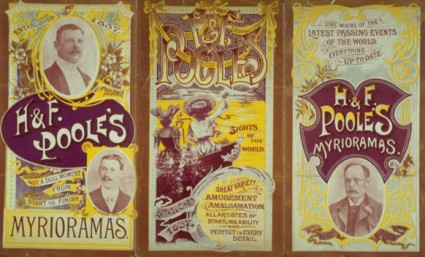
Programme for Poole’s Myriorama show at Victoria Hall in Exeter, 1896, from http://www.sall.ex.ac.uk/projects/screenhistorysw

A call for papers has gone out for Instruction, Amusement and Spectacle: Popular Shows and Exhibitions 1800-1914, a conference taking place 16-18 April 2009, at the Centre for Victorian Studies, University of Exeter.

The conference aims to examine the eclectic range of popular entertainments in the nineteenth and early twentieth century, with a particular focus on exhibition practices. The intention is to provide a forum that brings together the range of research currently being undertaken by different disciplines in this area, including film studies, Victorian studies, history of science, performance studies, English literature, art history and studies of popular culture.

Potential topics could include but are not limited to:

  • The role of visual entertainments (e.g. magic lantern, panoramas, dioramas, photography, peep shows)
  • Early cinema: exhibition and reception
  • Local and regional exhibition cultures
  • Science and technology: demonstration and instruction
  • Improvement and rational recreation
  • Exhibitions of ‘Otherness’ (e.g. freak shows, ethnographic shows, minstrels)
  • Music hall, pantomime, vaudeville and variety
  • Public lectures and lecturing
  • Galleries, museums and civic institutions (e.g. The Royal Polytechnic Institution, Mechanics Institutes)
  • Travelling shows, fairgrounds and circuses
  • World’s Fairs and international exhibitions
  • Magic, illusion and spiritualism
  • Concerts, recitals and readings
  • Pleasure gardens, tourism and seaside exhibitions
  • Dance and physical performance
  • Literary and other representations of popular entertainments
  • Showmen and showmanship
  • Audiences: composition and reception
  • Intermediality and exhibitions
  • Image, narrative and performance

Proposals are invited of no more than 300 words, to be sent together with designation and affiliation to victorianshows@exeter.ac.uk, no later than 31 October 2008.

The conference is one output of the Arts and Humanities Research Council-funded project AHRC funded project Moving and Projected Image Entertainment in the South West 1820-1914 at the University of Exeter, which is using a regional study to demonstrate the extensive national distribution of moving and projected images between 1820 and 1914.

City & country

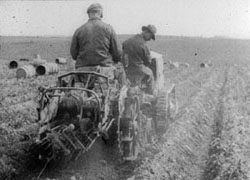
The How and Why of Spuds (1920), National Archives Collection

This year’s Northeast Historic Film’s Summer Symposium takes place 25-26 July, at Bucksport, Maine. Northeast Historic Film collects, preserves, and makes available to the public, film and videotape of interest to the people of northern New England, and holds an annual symposium which focuses on regional film, much of it amateur, and stretching back to the 1920s. This year’s theme is City & Country:

Images and archetypes of the city and the country as seemingly distinct locations and ways of life have remained a potent force in the cultural imagination since the mid 19th century. Even though the transformations of industrial culture and mobility have changed rural and urban landscapes and lifestyles, the ideas and images associated with the City and the Country continues to thrive as traditional poles of modern experience. They are where we anchor the dreams and fears of technology and tradition, and where we are animated by hopes of progress and the comforts of nostalgia. As Raymond Williams noted of this powerful duality, “the contrast of country and city is one of the major forms in which we become conscious of a central part of our experience and of the crises of our society.”

More information as ever from the website.

Forgotten faces

http://www.filmmuseum.nl

One of the sad, or at least frustrating aspects of archival work on early films is trying to identify reels where there is no convenient main title to identify the film for you, and you can’t tell who the performers are. For every Pickford or Chaplin, there were hundreds of second and third tier players, probably not much known about at the time, and recognised by only a dedicated few now. And below they came those whose names were probably never known, who hoped for a little fame and never found it. If you can’t recognise them, or you can’t name the film in which they appear, film and performers remain in limbo, orphaned, acting for no one. Who are you, you ask, peering ever more closely at the screen in the hope of some subliminal clue. You take frame stills and show them to colleagues, leaf through the reference books, scroll through endless lists of film titles looking for some hopeful match between the action on the film fragment you have seen, trying to imagine these things with the mind of a 1910s film producer. Find the right title, or find a name, and you’re restoring someone back to some sort of a life. It’s a precious responsibility.

So it is that the Nederlands Filmmuseum, which has made something of a speciality of curating unidentified films, has put together a PowerPoint slide show of actresses from the silent era that either they are unable to identify, or of whom they know frustratingly little. They’ve done this to coincide with the upcoming Women and the Silent Screen Conference, being held in Stockholm 11-13 June, and they are inviting anyone who can to help identify the names. So, visit the conference site to download the PowerPoint, or take a look at the faces here. From the faces above, who is it on the left who appears in a British Lupino Lane film of the 1910s? Who is the actress (centre) who was found in a fragment of a mid 1920s comedy for Fox or Universal with Fred Spencer and Billy Bletcher? And can anyone name the actress (right) in a 1910s film which features Austrian and British officers going on a hunting party, who end up shooting a lion?

http://www.filmmuseum.nl

Or what of these? The actress on the left played the character of Cunegonde in a popular series of comedies 1911-1913 for the French company Lux, but no one knows her name. In the centre, this unidentified player appears in a Universal Century comedy fragment, dating around 1922, with Jimmy Adams and Jack Earle. And who on the right plays the title character in a Powers Company film of 1910 entitled The Lady Doctor?

If you have any idea, the Filmmuseum would love to hear from you. And, from the grave, the women would doubtless thank you too.

Peripheral vision

Time has crept up all too quickly, and I’ve only just realised that the Domitor conference is this month. The theme is ‘Peripheral Early Cinema’, meaning looking at the edges of early cinema, and it’s taking place at Girona, Spain, and Perpignan, France, 17-21 June. The conference has already been trailed here, but for the record, here’s the line-up of speakers and events, from the conference website:

MONDAY JUNE 16

20:00 Welcome at the Museu del Cinema

(Optional visit to the city 18 :00 to 20 :00. Departure place: Museu del Cinema)

TUESDAY JUNE 17

9:00 Welcome participants (Auditori Narcís de Carreras “la Caixa”)
9:30 Opening Domitor
10:00 Presentation: Frank Kessler, François de la Bretèque
10:15 Production et réalisateurs (1)

– WALLER G. ( Indiana Univ. ): Toward a taxinomy of local films in the United States
– MINGUET BATLLORI J. (Univ. Autònoma de Barcelona): De la périphérie au centre. Segundo de Chomon et les attractions Pathé

11:00 Pause
11:30

– O’BRIEN C. (Carleton, Canada ) Lighting and cinematography in Griffith’s Biograph Shorts: electrification and film style, from east to west
– BASTIDE B. (Univ. Marne la Vallée): Fernand Itier, pionnier du cinéma dans le Gard
– DE LA BRETEQUE F. (Univ Montpellier 3 et Institut Jean Vigo): Dialectique du central et du provincial chez un représentant par excellence de l’institution dans le cinéma français des années 10: retour sur Louis Feuillade
– LECOINTE T. (Rectorat de Montpellier): Doit-on considérer, dans l’historiographie du cinéma français en 1896 que: les frères Lumière sont au centre du dispositif originel et les concurrents, des systèmes d’exploitation périphériques? Paris est centre de distribution et les régions, un réseau périphérique annexe?

13:00 Lunch
15:00 Production et réalisateurs (2)

– FLETCHER T. (London): The cinematograph in Rhyl
– WOOD D. M.J. (Univ. Autónoma México): Surviving early Mexican film on the border of the periphery?

Distribution, exploitation (1)

– COSANDEY R. (Ecole cantonale d’art, Lausanne): Une histoire régionale du cinéma: centre et périphérie. Le cas suisse
– KESSLER F. & LENK S. (Univ. Utrecht, Nederlands Institut voor Beeld en geluid): Un centre périphérique : émergence et institutionnalisation du spectacle cinématographique à Düsseldorf
– IVERSEN G. (Univ. Trondheim, Norvège): Working in the periphery: two itinerant German exhibitors in Norway before 1910
– VAN BEUSEKOM A. (Utrecht Univ.): The Netherlands at the institutional periphery in the exhibition and distribution of major American films: the role of travelling showmen in the late teens.

18:00 Guided tour Museu del Cinema
20:00 Projection lanterna magica Laura Minici Zotti. (Saló de descans del Teatre Municipal de Girona)

WEDNESDAY JUNE 18

9:00 Welcome participants (Auditori Narcís de Carreras “la Caixa”)
9:30 Communications.

Distribution, Exploitation (2)

– SANCHEZ SALAS D. (Univ. Rey Juan Carlos): La creación de la periferia cinematográfica en España 1912-1915
– BRAUN M. and KEIL C. (Univ. Toronto): No centre, no periphery? Early film exhibition in Ontario, Canada

11:00 Pause
11:30

– MOORE P. (Univ. Ryerson, Ontario ): The region as mediating scale
– OLLSON J. (Univ. Stockholm): Negoiationg peripheral feature market: Kristianstad-Stockholm-Paris or Malmo- Copenhagen-Berlin
– PROSKUROVA O. (Univ. Latvia): cinematographic in Latvia: re-animation of its publics (1895-1917)
– VERGOLIN L. (Il Cinema ritrovato, Bologna): Un cas de cinéma périphérique: Bologne en 1907

13:00 Lunch
15:00 Réception: Situation du spectateur, périphérie face au centre (1)

– GAUDREAULT A. et LIU Y. (Univ. Montréal, Univ. Fujian): A la recherche du bonimenteur chinois…
– LACASSE G. (Univ. Montréal): Le film bonimenté, du centre à la périphérie
– BALAN C. (Univ. St Andrews): The metaphysics of the eyes: Undestanding Ottoman spectatorship in the precinematic era
– ASKARI K. (West. Washington Univ.): Nonsynchronous reception at the Grand Cinema, Teheran
– OZEN M. (Amsterdam): At the periphery of Europe : early cinema in the Ottoman capital Istambul
– CHATTERJEE R. (Univ. Westminster): Peripheral encounters: early cinema in Calcutta

20:30 Projection Les origines de notre cinéma, “périphéries péninsulaires”, organisé par la Filmoteca de Catalunya (Cinema Truffaut)

THURSDAY JUNE 19: transfert

9:00 Departure Museu del Cinema
9:30 bus Figueras
10:30 Visit Museu Dali (In collaboration with the Fundació Gala-Salvador Dalí)
12:30 Departure Peralada
13:00 Lunch Peralada
15:30 Departure Collioure
16:30 Visit Collioure
18:30 Departure Perpignan
20:30 Buffet offert par le Conseil général au Palais des Rois de Majorque
21:30-45 Concert Palais des Rois de Majorque
22:30 Open air screening Palais des Rois de Majorque

FRIDAY JUNE 20

9:00 Welcome participants – Université de Perpignan
9:30 Réception: Situation du spectateur, périphérie face au centre (2)

– CHRISTIE I. (University College, London) L’effet de présentation des films du ‘centre’ dans les régions coloniales pendant les premiers temps
– SOTO VAZQUEZ B. (Univ. Rey Juan Carlos): De la periferia de ultramar al centro de la metrópolis. El cinematógrafo y la guerra de Cuba vistos desde España

11:00 Pause
11:30 Niveau intermédiatique, rapport à d’autres séries culturelles

– WALTZ G. (USA) “Half real-half reel” entertainments: On the periphery of stage and screen
– KING R. (Toronto) Small-town slapstick; regional populism and regional pastoralism in transitional-era US comedy
– PHILLIPS W D. (New York Univ.): Place and utility of satire in early cinema
– HORAK L. (Berkeley) “The forgotten practice of cross-gender casting in early American film: Edna/Billy Foster at the Biograph Company.”

13:00 Lunch
15:00 Historiographie

– ABEL R. (Univ. Michigan): Small town newspapers about promotion and exhibition of motion pictures through the website newspaperarchive.com
– ALONSO GARCIA L. (Univ. Rey Juan Carlos): Desplazamientos: la reintegración de los estudios del cine primitivo en la historia de los medios
– BRAUN B. (Univ. Trier): Early local films in moderns applications

17:00 Round table

– CHEFRANOVA O (…): From garden to kino: central and peripherial in Evgenii Bauer’s artistic career, Moscow 1880-1917
– DULAC N. (Univ. Montréal, Univ. Paris III Sorbonne-Nouvelle): Les jouets optiques et la genèse du cinéma: discours déterministe et « cinémato-centrisme » au tournant du 20e siècle
– CHEMARTIN P. GAUTHIER P. (Univ. Montréal, Univ. Catholique Louvain et Univ. Montréal, Univ. Lausanne): Genre, série culturelle ou institution parallèle? La question du dessin à transformations et des premiers temps du dessin animé

17:00 Visit of Perpignan
22:00 Présentation Domitor (Arsenal – Institut Jean Vigo)
22:30 Open air screening (Arsenal – Institut Jean Vigo)

SATURDAY JUNE 21

9:00 Welcome participants (Arsenal – Institut Jean Vigo)
9:30 Réception: Situation du spectateur, périphérie face au centre (3)

– MACHETTI SANCHEZ S. (Univ. de Lleida): le center à l’niv. Lleida): El centre a l’ombra de la perifèria. Estudi quantitatiu del consum cinematogràfic dels primers temps en àmbits locals
– VERONNEAU P (Cinémathèque Canadienne, Montréal): Vivre dans la périphérie: stratégies de résistance

11:00 Pause
11:30 Gender

– MAULE R. (Concordia Univ.): Problematizing the trans-national from a feminist perspective : early cinema, modernity, and western-centered approaches to early cinema
– GAINES J. (Columbia Univ.): Anonymities: uncredited and as-yet-unknown contributors in early cinema

Genres, périphérie dans l’espace générique (1)

– SUAREZ CARMONA L. (Girona): Pornografia i erotisme en el cinema dels primers temps a Barcelona
– CONDON D. (Centre for media Studies, Maynooth, IRL): Rejecting the tourist gaze in provincial Irish picture Houses in the early 1910s

13:00 Lunch
15:00 Genres, périphérie dans l’espace générique (2)

– DAHLQUIST M. (Stockholm Univ.): Screening Congo in Swedish churches – Johan Hammar’s missionary films 1915-16
– PETERSON J. (Univ. Colorado, Boulder): Travelogues and immigrants
– SARGEANT A. (Univ. Warwick): From soap wrappers to soaps

16:30 Closing speech: JOST F. (Univ. Paris 3)
17:00 Visit Institut Jean Vigo
19:00 Cocktail

I like a programme that allows space for pauses. It’s been some years now since I went to a Domitor conference – for those intrigued, Domitor is the international organisation for the study of early cinema, to which many of the great and the good in the small world of early cinema studies belong. Its major manifestation is its bi-annual conference, with associated publications. More information as always on the conference website.

Women and the Silent Screen conference

Tsuru Aoki and her husband Sessue Hayakawa in Courageous Coward (1919)

The Fifth International Women and the Silent Screen Conference is being held at Stockholm University, Sweden, 11–13 June 2008, and a full programme with screenings has now been published. The aim of the conference is to “celebrate the diversity of women’s engagement with silent cinemas across the globe”, and it’s very interesting to see the current issues being covered by the papers and some of the unfamiliar films which are being put back on the screens in response to such new debates. This is why we have research; so we can see more.

Here’s the outline conference programme:

Wednesday, June 11

Keynote address
Jane Gaines – Women and the Cinematification of the World

11:00–12:45
Parallel Sessions 1.1
National and Transnational
Rosanna Maule – Feminist Film History and the (Un)problematic Treatment of Trans-nationalism in Early Cinema
Christine Gledhill – Mary Pickford: Emerging Stardom and Transnational Circulation
Sanjoy Saksena – Image of Women in Colonial and Post-Colonial Indian Cinema
Phil Powrie – Josephine Baker and Pierre Batcheff in La Sirène des tropiques (1927)

Sharpened Pencils
Domenico Spinosa – The didactic-instructive task of cinema (1907-1918) in the Italian women writings
Luca Mazzei – Going to movies wearing a skirt and handling a pen. Women writing about cinema 1898-1916
Luigia Annunziata – Matilde Serao and the cinema
Louis Pelletier – Ray Lewis and the Birth of Canadian Film Culture

Germaine Dulac
April Miller – Pure Cinema, Pure Violence: Murder as Avant-Garde Aesthetic in Germaine Dulac’s La Coquille et le Clergyman and La Souriante Madame Beudet
Tami M. Williams – An Invitation to a Voyage: Cross medial spatial metaphors, modes of transport and sexual liberation in the cinema of Germaine Dulac
Catherine Siberschmidt – The concept of spectatorship in Germaine Dulac’s film theory
Sarah Keller – “Optical Harmonies”: Sight and Sound in Germaine Dulac’s Integral Cinema

13:45–16:00
Parallel Sessions 1.2
Conceptualizing “Female Pioneers”
Shelley Stamp – Lois Weber’s ”Feminine Hand” at Rex
Karen Ward Mahar – Working Girls: The Masculinization of American Business in Film and Advice Literature in the 1920s
Isabel Arredondo – Forgetting Women Film Pioneers: Juliet Rublee and the Myth of the Avant-Garde
Mark Lynn Anderson – The Real Dorothy: Mrs. Wallace Reid, the Newspaper, and Feminist Film Historiography
Monica Dall’Asta – What Means to Be a Woman: Theorizing Feminist Film History Beyond the Essentialism / Constructionism Divide

Case Studies in Stardom
Tijana Mamula – Ideal Situation: Projecting Knowledge in Prix de Beauté
Miya Tokumitsu – f(Swoon): The Function of the Female Swoon in Silent Film
Nicole Beth Wallenbrock – The Hollywood Flapper dies an Expressionist Death (Louise Brooks in Pandora’s Box)
Galen Wilson – Performance of Anxiety: Les Vampires and the Crisis of Gender in the Fin-de-Siecle
Hélène Fleckinger -“The wicked woman” On the character of Irma Vep in Les Vampires of Louis Feuillade

Authorship and Screenwriting
Vincent L. Barnett – The Novelist as Hollywood Star: Author Royalties and Studio Income in the 1920s
Alexis Weedon – Elinor Glyn the Author On Page and Screen
Stephan Michael Schröder – The conditions of freelance script writing – example Harriet Bloch
Claus Tieber – Between Sentimentalism and Modernity: The narrative structure of Frances Marion’s screenplays
Anke Brouwers – The Name Behind the Titles: Women, Authorship and Silent Screenwriting

Thursday, June 12

9:00–10:45
Parallel Sessions 2.1
Cross-Gender Casting and Lesbian Characters
Astrid Söderbergh Widding – Flickan i frack – A Case of Cross-Dressing
Laura Horak – Edna/Billy Foster, the Biograph “Boy”
Fiona Philip – Veiled Disclosures and ‘Speaking Back’: Borderline (1930) and the Presences of Censorship
Susan Potter – Opening up Pandora’s Box

American Stardom
Mary Desjardins – A Method to this Madness? The Myth of the Mad Silent Film Star
Charlie Keil – ’Studio Girls’: Female Stars and the Logic of Brand Names
Jeannette Delamoir – Mary Pickford and Louise Lovely: The silent motion-picture star in the age of reproduction
Tricia Welsch – From Pratfalls to Glamour: Gloria Swanson at Triangle

(Re)discovering Female Filmmakers 1
Nathalie Morris – “Alma isn’t Talking”: The Early Career of Alma Reville aka Mrs Alfred Hitchcock
Claudia Preschl and Elisabeth Streit – Making Noice (Proud to be loud). Women in the Silent-Period of Austrian Film History
Anne Bachmann – Parallel stories? Ebba Lindkvist’s brief career and the film version of a
theatrical play
Annemone Ligensa – “A Cinematography of Feminine Thought”: The Novel The Dangerous Age (1910) by Karin Michaelis and Its Filmic Adaptations

Parallel Sessions 2.2
(Re)considering Genres and “Feminine Tastes”
Lea Jacobs – On Hating Valentino: The Rejection of the Romantic Drama in the American Cinema of the 1920s
Annette Förster – Humorous reflections on acting, filmmaking and genre in comic film productions by Adriënne Solser, Musidora, and Nell Shipman
Kristen Anderson Wagner – “Ever on the Move”: Silent Comediennes and the New Woman

Fashion and Fandom
Mila Ganeva – Women between Screenwriting and Fashion Journalism: The Case of Ruth Goetz
Therése Andersson – Beauty Box – Film Stars and Beauty Culture in Early 20th Century Sweden
Andrea Haller – “Flimmeritis” and Fashion – Early intermedial practices of female movie fandom in Imperial Germany
Lisa Stead – “It costs nothing to wish!” Female Fan Writing and Self-Representation in the British Silent Cinema

(Re)discovering Female Filmmakers 2
Marcela de Souza Amaral – Alice Guy and the narrative cinema
Mike C. Vienneau – The discursive Art of Alice Guy: The cinema and the feminine silent word
Jindiška Bláhová – “The lady crazy about film” – demystifying Thea 􀀀ervenková, the mystery woman of the early Czechoslovak cinema
Micaela Veronesi – A woman wants to create the world. Umanità by Elvira Giallanella

14:00–15:45
Parallel Sessions 2.3
Stardom and Intermediality
Anne Morey – Geraldine Farrar: A Film Star from Another Medium
Victoria Duckett – A new anachronism: Sarah Bernhardt and the modern theatrical film
Elena Mosconi – The Star as an Artist: Italian Divas between Symbolism and Liberty
Maria Elena D’Amelio – Damned Queens. Two case studies on the dark ladies in Cabiria and Maciste all’inferno films

(Re)discovering Female Filmmakers 3
Begoña Soto Vázquez – How to research the exception: the power of the unknown
María Cami-Vela – Women, bullfighters and identity in Spanish Silent Cinema: Musidora
Bárbara Barroso – Virgína de Castro e Almeida: writing, producing and envisioning film
Nadi Tofighian – Isabel and José – the pioneer tandem filmmakers of the Philippines

More than Filmmakers
Anne Marit Myrstad – Film censorship, morality and female identity: Fernanda Nissen, a case study
Joshua Yumibe – The Gendering of Color and Coloring of Films: Female Film Colorists of the Silent Era
Christopher Natzén – Greta Håkansson – a female conductor in a time of change during the transition to sound film in Sweden 1928-1932
Tony Fletcher – Laura Eugenia Smith and the Biokam Films

16:15–18:00
Parallel Sessions 2.4
Film Festivals and Screening Networks
Kay Armatage – Women’s Cinema, Film Festivals and Their Contribution to Women’s Film History
Ingrid Stigsdotter and Kelly Robinson – ‘Clowning Glories’: A Case Study of a Festival Programme and its Audiences
Rebeca Ibanez-Martin and Andrea Gautier Sansalvador – Women as Archivers of Films Made by Women: the Project of Envideas

Russian Pioneers
Dunja Dogo – Re-editing History in the Works of Esfir’ I. Šub (1927-30)
Ilana Sharp – Esfir Shub’s Costructivist Non-Fiction Film and Soviet Silent Cinema
Lauri Piispa – Vera Kholodnaia: Queen of Screen, Slave of Love
Michele Torre – A woman of all trades: Zoia Barantsevich, a pioneer in early Russian cinema

Asta Nielsen
Ansje van Beusekom – Asta Nielsen in the Netherlands in 1920
Annette Brauerhoch – Between Pleasure and Pain: Asta Nielsens Acting Acts
Heide Schlüpmann – Playing History – Asta Nielsen in Early Cinema
Karola Gramann – Screening and discussion

Friday, June 13

9:00–10:45
Parallel Sessions 3.1
Three Histories, One Archive
Jennifer Horne – Premediations: Previewing for Better Motion Pictures, 1916-1930
Mark Garrett Cooper – The Universal Women: An Institutional Explanation
Richard Abel – Unexplored Margaret Herrick Library Resources, 1910-1916

Chinese Stardom
Yiman Wang – Between “Yellowface” and “Yellow Yellowface” – Anna May Wong and Her Chinese Audience during the Interwar Era
Erin Kelley – Dance, Stardom, and the Trans-National Celebrity Status of Anna May Wong
Qin Xiqing – Pearl White and the New Female Image in Chinese Silent Cinema
Yuan Chen – Wang Hanlun, a ‘successful’ Runaway Nora in Early Chinese Film Industry
Ruixue Jia – Silence can kill: rethinking Rua Ling-yu’s tradgedy

Images of Women
Constance Balides – Moralizing Typologies to Sociological Personalities: Delinquent Women in Early Social Problem Films
William Van Watson – Enrico Guazzoni’s Marcantonio and Cleopatra: The Feline-Feminine Construct and the Colonial Dangers of Heavy Petting
Selin Tüzün Gül – From stage to the screen: Actresses as one of the symbols of Turkish modernization project
Tommy Gustafsson – The Significance of the New Woman in Swedish Silent Film

11:15–13:00
Parallel Sessions 3.2
Politics of Ethnicity
Denise McKenna – What Happened to Myrtle? Latina Stars in Early Hollywood
Ora Gelley – Race and Gender in D.W. Griffith’s The Birth of a Nation (1915): Patterns of Narration and Vision
Nina Cartier – I Get Lifted?: Delineating Uplift’s Restrictions Upon Black Female Desire in Silent Era Race Films
Kyna B. Morgan – The First African American Woman Film Producer: Maria P. Williams and The Flames of Wrath

European Stars and Audiences
Dominique Nasta and Muriel Andrin – Engaging National Emotions on Screen: European Silent Women in “strikingly effective” Melodramas
Anna Cabak Rédei – Garbo as ’Greta’ in Pabst’s The Joyless Street (1925)
Irina Novikova – Female Stars of Cinematic Peripheries – Lilita Berzinja (Latvia)
Silvia Horváth – Feminine (self-)staging in the Hungarian Silent Film of the 1910th

Strike a Pose: Female Models and Magicians
Cynthia Chris – Censoring Purity
Pierre Chemartin and Nicolas Dulac – The pose as performance: Early cinema acting and the female stereotype
Matthew Solomon – Women and the Trick Film

An extraordinary line-up indeed. And here are the films scheduled for evening screenings, with the conference organisers’ notes and comments. Note in particular the premiere of the restoration of the recently rediscovered Mary Pickford title, The Dawn of Tomorrow:

LA RUSE DE MISS PLUMCAKE / MISS PLUMCAKE’S TRICK (France, 1911)
35mm b/w print from the Nederlands Filmmuseum
180 meters, 5 mins (18fps)
Dutch inter-titles
Prod: Pathé Frères / SCAGL
Director: Georges Monca
Script: unknown
Cast: Mistinguett, Andree Pascal, Charles Lorrain

This comedy offers us the music-hall star and future ‘queen’ of the revue, Mistinguett, in the role of a maid that is mistaken for her American mistress while visiting Paris. Mistinguett makes a parody of the
attractiveness of American women and lampoons Parisian men’s idolatry with them. The film’s inclusion in the program serves three purposes: first, because the print is incomplete, it may be taken as an example of a fragment, one of the core topics of this conference; second, bringing the existence of this rare print of a Pathé-SCAGL comedy with Mistinguett to the attention of feminist film historians; and third, calling attention to Mistinguett’s significance to the relations between French music-hall and cinema in the early 1910s, which deserves more research.

DIE LANDPOMERANZE / THE UNWIELDY COUNTRY WOMAN (Germany, 1917?)
35mm (Desmet method) colour print from the Nederlands Filmmuseum
540meters (ca)., 26mins (18fps)
German intertitles
Prod: Treumann-Larsen Film GmbH
Director: Dr. R. Portegg aka Rosa Porten and Franz Eckstein
Script: Rosa Porten
Cast: Rosa Porten (Isa), Franz Verdier (Caspar Freiherr), Max Wogritsch (Jürgen von Oesterlingk)

Isa’s father, a wealthy gentleman of the countryside, wants her to marry Jürgen. However, Jürgen is rather prejudiced towards country women. Furthermore, he is attracted to a rich girl from the city. Upon hearing this, Isa, who doesn’t want to get married anyway, swears to teach Jürgen a lesson. For this purpose, she leaves her house and applies for a job (disguised as a boy) at Jürgen’s household. This fast-paced comedy, written and directed by Rosa Porten herself, appears in almost no written sources. It is therefore no surprise that this film was lost for many years, until this incomplete print appeared in the Nederlands Filmmuseum collection, carrying the original German titles. Die Landpomeranze has been preserved in 2008 in order to be presented for the very first time at this conference. Given the impossibility to complete the missing ending, due to complete lack of written sources, the preserved print has an open end, in hope that the missing reel(s) get discovered somewhere in the future.

Trailer DIE GESUNKENEN / THE SUNKEN (Germany, 1925)
35mm b/w print from the Nederlands Filmmuseum
65 meters, 3 mins (18fps)
German inter-titles
Prod: Aafa Film
Director: Rudolf Walther-Fein
Script: Ruth Goetz and Leo Heller, based on the novel by Luise Westkirch
Cast: Asta Nielsen, Olga Tschechova, Hans Albers, Wilhlem Dieterle, Otto Gebühr

Dutch trailer from the presumed lost Asta Nielsen film Die Gesunkenen (1925), a drama based on a scenario by Ruth Goetz after the novel Diebe (Thieves) by Luise Westkirch. The Dutch censorship board noted about the film (2340 meters, + 117 minutes): ‘rough milieu’, ‘cocaine abuse’, ‘prostitution’, ‘ladies and gents of suspect repute’. In addition to Nielsen, the film featured the actors William Dieterle, Otto Gebühr, Olga Tschechowa and Hans Albers.

‘A SANTANOTTE / HOLY NIGHT (Italy, 1922)
35 mm colour print restored by Associazione Orlando (Bologna), Cineteca Nazionale (Rome) and George
Eastman House (Rochester, USA), with the endowment of the Italian Ministry of Culture.
1250 meters, 61 mins (18 fps)
Italian inter-titles
Prod: Films Dora (Neaples), “Serie grandi lavori popolari.”
Director: Elvira Notari
Script: Elvira Notari, based on the song ‘A Santanotte by Eduardo Scala (words), Francesco Buongiovanni
(music).
Photography: Nicola Notari.
Principal cast: Rosè Angione (Nanninella), Alberto Danza (Tore Spina), Eduardo Notari (Gennariello), Elisa
Cava (madre di Tore), Carluccio, a student of Notari’s school of acting.
Original length: mt. 1285.

Based on a popular Neapolitan song by Eduardo Scala and Francesco Buongiovanni, ‘A santanotte was one of the greatest hits of Elvira and Nicola Notari’s Dora Films. It tells the tragic story of Nanninella, a waitress who supports her alcoholic and abusive father Giuseppone. She is in love with Tore, but her father prefers the deceptive Carluccio. When Giuseppone accidentally dies, Carluccio accuses Tore of murder. Nanninella is forced to accept Carluccio’s marriage proposal hoping that this will convince him to withdraw his accusations against Tore. As she tries to escape with Tore on the day of her wedding, the film ends in death and misery. The story has several points in common with that of Assunta Spina, a popular theatrical drama by Salvatore Di Giacomo that Francesca Bertini had adapted into a film in 1915. Yet Notari’s film surpasses its predecessor in its crude representation of patriarchal oppression, offering a powerful melodramatic interpretation of the everyday experience of so many Italian working class women at the beginning of the century.

DIE BÖRSENKÖNIGIN / THE QUEEN OF THE STOCK-EXCHANGE (Germany, 1916)
35mm colour print from the Nederlands Filmmuseum
1090 meters, 52 mins (18fps)
Dutch inter-titles
Prod: Neutral Film
Dir: Edmund Edel
Script: Edmund Edel
Cast: Asta Nielsen, Aruth Wartan, Willy Kaiser-Heyl

Asta Nielsen plays the proprietor of a copper mine on the verge of ruin. After the plant manager has traced a new copper vein, she buys the almost worthless shares and therewith secures the finances of the mine and herself. Gratefully, she makes the manager, with whom she is also in love, a share-holder. But when he deceives her with another woman, she takes revenge with great sovereignty. The film is particularly interesting for its setting – the male-dominated milieus of an industrial plant and of the stock-exchange – and for Nielsen’s superior role in it, which she plays with both style and gusto.

Trailer VADERTJE LANGBEEN / DADDY LONGLEGS (The Netherlands, 1919)
35mm b/w print from the Nederlands Filmmuseum
32 meters, 1 min (18fps)
Dutch inter-titles
Prod: Mary Pickford Co.
Director: Marshall Neilan
Script: Agnes Johnson, based on the novel by Jean Webster
Cast: Mary Pickford (Jerusha Abbott), Milla Davenport (Mrs. Lippett)

Among the few silent trailers of the Filmmuseum collection, this stylish trailer is remarkable for the drawings it contains. Discovered and preserved in 2004 during the international Mary Pickford research project by Christel Schmidt, this film has only been shown in Amsterdam during the Pickford program. Although the trailer shows nothing of the film itself, it constitutes an important evidence to prove the
popularity of Mary Pickford with Dutch audiences.

THE DAWN OF A TOMORROW / NATTENS SKUGGOR (USA, 1915)
35mm colour print from the Archival Film Collections of the Swedish Film Institute
1283 meters, 66 mins (17 fps)
Swedish inter-titles
Prod: Famous Players Film Co.
Director: James Kirkwood
Script: Eve Unsell, based on the novel and the play The Dawn of a Tomorrow by Frances Hodgson Burnett
Principal cast: Mary Pickford (Glad), David Powell (Dandy), Forrest Robinson (Sir Oliver Holt), Robert
Cain (his nephew)

This conference screening will be the premiere of the restored Mary Pickford film The Dawn of a Tomorrow, a film that was considered lost until a tinted nitrate print with Swedish inter-titles surfaced in 2005. The film is set in London and Pickford plays Glad, ”the poorest and happiest of all orphans”. During the course of the film, this angel in a Dickensian world gives shelter to an evicted mother and child, prevents a suicide, intervenes to inhibit domestic violence, and convinces her sweetheart to reform. The beauty of the close-ups displays an extraordinary preciseness of expression that makes this long lost Pickford film a revelation to watch.

FLICKAN I FRACK / THE GIRL IN TAILS (Sweden, 1926)
35mm colour print from the Archival Film Collections of the Swedish Film Institute
2506 meters, 115 mins (19 fps)
Swedish inter-titles
Prod: AB Biografernas Filmdepôt
Director: Karin Swanström
Script: Hjalmar Bergman, Ivar Johansson, based on the novel Flickan i frack by Hjalmar Bergman
Principal cast: Einar Axelsson (Ludwig von Battwhyl), Magda Holm (Katja Kock), Nils Arehn (her father),
Georg Blomstedt (Starck, the headmaster), Karin Swanström (Hyltenius, the vicar’s wife), Erik
Zetterström (Curry, Katja’s brother)

An early example of cross-dressing in Swedish film, a restored version of the comedy Flickan i frack will be screened at the conference for the first time ever. Magda Holm plays Katja, a bright, small-town daughter of an inventor who cares more for the upbringing of his son than his daughter. When Katja’s request for money to buy a new dress for the examination ball is turned down by her father, she decides to attend the ball dressed in tails, creating a further scandal by drinking and smoking cigars. Flickan i frack was Karin Swanström’s fourth and last film as a director, and she also plays one of the leading parts in the film. The film was remade in 1956.

BILLY’S STRATEGEM / DE LIST VAN BILLY (USA, 1912)
35mm b/w print from the Nederlands Filmmuseum, courtesy of the AFI.
290 meters, 14 mins (18fps)
Dutch inter-titles
Prod: Biograph
Director: D.W. Griffith
Script: George Hennessy
Cast: Edna Foster (Billy), Wilfred Lucas, Claire McDowell, Inez Seabury, Robert Harron, William Butler

Billy and his sister are home with their grandfather, while their parents are out working. Their house gets attacked by the Indians, who get past the grandfather. However, Billy has a plan; he finds a way to get out of the house and blows up the house with the Indians in it. This Griffith film, starring Edna Foster as Billy, was repatriated from the Nederlands Filmmuseum archive to the USA, through the AFI, back in 1974. The film was then restored by the AFI, and a projection print, still carrying Dutch titles was kindly donated to the Filmmuseum Collection.

COURAGEOUS COWARD /SUKI’S REHABILITATIE (USA, 1919)
35mm (Desmet method) colour print from the Nederlands Filmmuseum
283 meters, 14 mins (18fps)
Dutch inter-titles
Prod: Haworth Pictures
Director: William Worthington
Script: Frances Guihan, based on a story by Tom Geraghty
Cast: Sessue Hayakawa (Suki Iota), Tsuru Aoki (Rei Oaki)

Suki Iota, a young Japanese-American lawyer, is investigating a murder case and is secretly in love with his custodian’s niece, Rei. When Suki realizes that Rei’s boyfriend Tom is involved in the murder case, he drops it, despite being called a coward for his actions. The only surviving fragment of this long lost film is its last reel. Despite the fact that most of the action is lost, Nederlands Filmmuseum decided to make a presentation print of this fragment, since it is still worthwhile to watch Tsuru Aoki and her real-life husband Sessue Hayakawa in the few romantic scenes that have survived. Another point of interest is the way in which Aoki’s character gets criticized in the film as a young woman of Japanese origins who in her eagerness to become Americanized neglects her own roots.

UMANITÀ / HUMANKIND (1919)
35 mm colour print restored by Associazione Orlando (Bologna) and Cineteca Nazionale (Rome), with
the endowment of the Italian Ministry of Culture.
720 meters, 35 mins (18 fps)
Italian inter-titles
Prod: Liana Film (Rome)
Director: Elvira Giallanella
Script: Based on Vittorio Emanuele Bravetta’s poem Tranquillino dopo la guerra vuol ricreare il mondo
Principal cast: a little boy (Tranquillino), a little girl (Serenetta)

Presented in an introductory title as a “humoristic-satirical-educational” work, the film is centered on two young siblings, Tranquillino and Serenetta, who get up during the night to steal from the jam jar and play with Daddy’s cigarettes. The smoke gives Tranquillino a terrifying dream: the world has been destroyed by a terrible war and his attempts to recreate the world only makes him retrace and redo the mistakes of humankind during the course of history, from dictatorship to war. The backward trip throughout the pastmakes the kids realise that history has been built on arms and war. Desperate and frightened, they seek help in prayer and are finally saved by a bearded God, who appears in the sky and takes them in his arms. Based on a poem for children by Vittorio Emanuele Bravetta, Umanità is the only title in Elvira Giallanella’s filmography as a director. A quite mysterious figure, Giallanella was involved in film production since 1913, when she participated in the founding of the Vera Film company, which produced one of the first Futurist films, Mondo baldoria (1913). It is uncertain whether Umanità was ever screened, as it’s not listed in the censorship archives and never mentioned in period film magazines.

KAERLIGHED OG PENGE / LOVE OR MONEY aka OUTWITTED (Denmark, 1912)
35mm colour print from the Nederlands Filmmuseum
260 meters, 13 mins (18fps)
Dutch inter-titles
Prod: Nordisk Films Kompagni
Director: Leo Tscherning
Script: Harriet Bloch
Cast: Else Frölich, Oscar Stribolt

Kaerlighed og penge is a comedy after a scenario by Harriet Bloch in which men’s intentions with women are getting spoofed. Both the situation and the plot are rather surprising. The main character, Karen, is a well-to-do single mother with a son. She has three admirers courting her: a lieutenant, a poet and a wealthy man. This amuses rather than impresses her, and she candidly questions if they are after her love or her money. One day, her friend from America, Ebba, visits Karin, who seizes the opportunity to throw a party. Together they concoct a test to find out about each man’s true intentions… and they are having a ball while evaluating the outcome.

PAS DE FEMMES! / NO WOMEN! (France, 1920)
35mm (Desmet method) colour print from the Nederlands Filmmuseum
506 meters, 27 mins (18fps)
Dutch inter-titles
Prod: Film Denizot, Marseilles
Director: Vincenzo Denizot
Script: unknown
Cast: unknown

This comedy is exceptional in two respects: first, it seems to be an unknown French production by the Italian director Vicenzo Denizot, known from Maciste-films; and most importantly in the context of this
conference, it seems a rare counterpart to the many anti-suffragette films of the time: it ridicules antifeminism. A luxury hotel by the sea is occupied by a bunch of spoiled girls eager for excitement beyond their daily routines of gourmet dining and playing tennis. The chief rascal among them is Suzy, who preferably drives her governess to despair with her unruliness. One day, a notorious anti-feminist arrives together with his nephew, to recover from the stress of campaigning against furious women. He demands to be served only by men and chases the chamber maid from his room. The girls agree that this is an affront to women’s dignity and Suzy is appointed by lot to scheme and lead their vengeance…

DIE LIST EINER ZIGARETTENMACHERIN / WANDA’S TRICK (Germany, 1918)
35mm colour print from the Nederlands Filmmuseum
920 meters, 45 mins (18fps)
French inter-titles
Prod: Treumann-Larsen Film GmbH
Director: Dr. R. Portegg aka Rosa Porten and Franz Eckstein
Script: Wanda Treumann
Cast: Wanda Treumann, Heinrich Schroth, Marie Grimm-Einödshofer

This is a film produced by and starring German comedienne Wanda Treumann, and co-written and co-directed by Rosa Porten. Rosa Porten made films in the 1910s together with her husband Franz Eckstein, using the pseudonym Dr. R. Portegg. According to contemporary press, they were known for their proficient direction. The film mixes comedy with romance and social drama. It focuses on the interrelations of gender and class and on a factory girl’s independent spirit, business competence, and sense of humour. The plot has a serious undertone, but both its comic twists and Treumann’s guileless acting lend it a striking breeziness and a pro-lib edge.

A remarkable selection, with a palpable sense of exciting discovery. All details of the conference and screenings, including registration, accommodation, location and so forth, can be found on the conference website.

Visual empires

The fourth Visual Delights conference, Visual Empires, will take place at the University of Sheffield between 3-5 July 2009, and a call for papers has been issued.

Popular visual cultures have been central to the construction and propagation of imperial and colonial narratives and have helped define the nature of Empire. They have been intrinsically linked to discourses about the rise and fall of Imperial fortunes in the 19th and early 20th centuries and have been studied as both evidence of imperial attitudes to race and colonial subjects and as propaganda texts which helped spread and cement imperial and colonial ideologies. This conference seeks to explore this rich visual archive and to examine the roles played by popular visual culture in the construction of narratives concerning issues of race, identity, colonial and imperial ideologies, nationalism, patriotism and the ‘Visual Empire.’

We would like to receive suggestions for papers with deal with these issues in popular cultural forms such as photography, advertising, cinema, theatre, the magic lantern, ethnographic display and world’s fairs before 1930. Suggested themes could include:

  • Photography and constructions of ‘otherness’
  • Ethnographic display and racial identities
  • Advertising and imagined colonies
  • Cinema and the mapping of Empire
  • The magic lantern and the topography of Empire
  • Music hall and the patriotic show

Abstracts of no more than 500 words should be sent to Simon Popple (s.e.popple [at] leeds.ac.uk) or The Louis Le Prince Centre, The Institute of Communications Studies, The Houldsworth Building, The University of Leeds, Leeds LS2 9JT, UK. The deadline for submissions is 1 November 2008.

The conference will be jointly hosted by the Louis Le Prince Centre, University of Leeds and the National Fairground Archive, University of Sheffield. It is held in conjunction with the journal Early Popular Visual Culture.

Between page and film

The Manxman

Anny Ondra in Alfred Hitchcock’s The Manxman (1929), based on the Hall Caine novel, from 1000 Frames of Hitchcock

The Institute of English Studies at the School of Advanced Study, University of London is hosting a one day event with the imposing title of Cross-media cooperation between the publishing, theatrical and film industries: an interdisciplinary colloquium. The event takes place Saturday 12 April, and is an output of an AHRC-funded project on cross-media cooperation in Britain in the 1920s and 1930s.

The project is looking at the origins of the syndication or marketing of an author’s rights across several media, so common today, which it locates in the 1920s and 1930s. The aim of the colloquium is to draw together research from different disciplines to examine the extent of cross-media cooperation between media professionals, agents, and authors and ask how the past has shaped practices of the present day.

And here’s the programme, which has plenty on the cross-relationship in Britain between popular literature and film in the silent era:

Panel 1
Prof Alexis Weedon (University of Bedfordshire)
Some observations on cross-media co-operation in Britain in the 1920s and 1930s
Dr Vincent L. Barnett (University of Bedfordshire)
Elinor Glyn. The Novelist As Hollywood Star
Dr Mary Hammond (University of Southampton)
Hitchcock and Hall Caine: the Victorian Bestseller on the Silent Screen

Panel 2
Dr Amy Sargeant (Reader in Film, University of Warwick)
Frederick Britten Austin: Boy’s Own Stories, Girls’ Romances and Interwar Politics
Nathalie Morris (University of East Anglia)
Eminent British Authors and the Stoll Film Company
Dr Caroline Copeland (Napier University)
Katherine Cecil Thurston’s Chilcote

Panel 3
Dr Simon Frost (Institute of literature, media and cultural studies, University of Southern Denmark)
A Toga Tale of Ingomar the Barbarian: in print, in drawing rooms, at fairgrounds and in Hollywood
Dr Lawrence Napper (University of Greenwich and at King’s College, London)
‘Not over-exercising our intellectual powers in the choice of subjects’: The Gainsborough scenario department, 1929-31

Panel 4
Dr Simone Murray (recorded presentation from Monash Australia)
What Are You Working On?: the shifting role of the author in an era of cross-media adaptation
Prof Juliet Gardiner
Talk: Contemporary adaptation of Atonement

No indication on the colloquium web page as to when it starts or ends, or whether those panels overlap, but it does tell you that it is priced at £30 standard; £20 members/concessions, that the venue is Senate House, University of London, Malet Street, London WC1E, and that spaces are limited so early booking is advisable.

Registration forms are on the site, and more information can be got from Jon Millington, Events Officer, Institute of English Studies, Senate House, Malet Street, London WC1E 7HU; tel +44 (0) 207 664 4859; Email jon.millington [at] sas.ac.uk.