Cinema across media: the 1920s

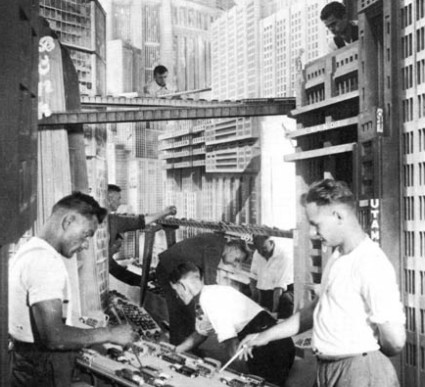
Conference image for Cinema Across Media, showing the construction of miniatures for Metropolis

Cinema Across Media: The 1920s is the title of what is promisingly advertised as the First International Berkeley Conference on Silent Cinema. It takes place 24–26 February 2011 at the University of California, Berkeley, and describes itself as follows:

Cinema’s institutional consolidation in the 1920s enlisted practitioners from many other fields and transformed the entire ensemble of established media. Avant-garde cinemas borrowed extensively from a variety of artistic practices, while the “cinematic” became the new standard for both modernist aesthetics and popular culture. Today’s multimedia environment brings cinema of the 1920s into new focus as the site of rich intermedial traffic, especially if the term “media” encompasses not only recording technologies and mass media, such as photography, phonography, radio, and illustrated press, but also the physical materials used for aesthetic expression, such as paint, print, plaster, stone, voice, and bodies.

Indeed what do they know of silent cinema who only silent cinema know. The starry line-up of plenary speakers will be Thomas Elsaesser (University of Amsterdam), Tom Gunning (University of Chicago), Gertrud Koch(Free University of Berlin), Paolo Cherchi Usai (Haghefilm Foundation) and Anthony Vidler (Cooper Union), and the full conference schedule has been issued, plus screenings (at the Pacific Film Archive Theater), as follows:

Saturday, Feb 19th

Pre-conference screening at 6.00pm of The Complete Metropolis, Fritz Lang (Germany, 1926)

Wednesday, Feb 23rd

Pre-conference screening at 7:30 pm of Rien que les heures, Alberto Cavalcanti (France, 1926)

Introduced by Anne Nesbet, Judith Rosenberg on Piano

Preceded by
Architecture d’aujourdhui (Pierre Chenal, France, 1930)
Die Neue Wohnung (Hans Richter, Switzerland, 1930)

Thursday, Feb 24th

4–5:30 pm

Tom Gunning, From the Cinema of Attractions to the Montage of Attractions: The Art of Running Film History Backwards

7–9:30 pm

Screening of L’Inhumaine (Marcel L’Herbier, 1924)
Introduction by Gertrud Koch
Judith Rosenberg on Piano

Friday, Feb 25th

9–10:30 am

Gertrud Koch, Off/On/In: Configurations of voice, body and apparatus

11 am–12:30 pm

“Local” Aesthetics and the Aesthetics of Location

Sarah Keller, Approaches to Truth: Jean Epstein and Intermedial Revelations of the 1920s

Luciana Corrêa de Araújo, Movie prologues in Rio de Janeiro (1926–1927)

Laura Isabel Serna, Picturing la patria: Ethnography, Costumbrismo, and Mexican Feature Film Production in the 1920s

The Body: Forms, Models, Constructions

Weihong Bao, Plastic Cinema, Flexible Media: Dan Duyu’s Amateur Art of Beauty and the Politics of Intermedial Embodiment in 1920s China

Kaveh Askari, Sculpture, Modeling, and Motion-Picture Craft: Promoting Rex Ingram at Metro

Mark Lynn Anderson, Deserts of Modernity: Valentino and The National Geographic

2–3:30 pm

Cinema, Light, Architecture

Megan Luke, Film-Space, Light-Architecture: Theo van Doesburg and Kurt Schwitters

Brian Jacobson, Producing Cinema and Industrial Modernity at the Cité Elgé, 1919–1929

Noam Elcott, Invisible Architectures

Media Consolidation and Conglomeration

André Gaudreault & Louis Pelletier, From Photoplays to Pictures: An Intermedial Perspective on the Names for “Moving Pictures” in the Late Silent Era

Charlie Keil, Inventing Hollywood for the 1920s

Ross Melnick, The Emergence of Convergence: Intermediality and the Convergence of Film, Broadcasting, and Music Publishing and Recording in the 1920s

4–5:30 pm

Anthony Vidler, The Promenade Architecturale: Space and Movement in 1930s Modernism from Eisenstein to Le Corbusier

7–8:45 pm

Paolo Cherchi Usai, The Unbearable Lightness of Canon: Silent Comedies in the 1920s

Pass the Gravy (Fred L. Guiol, 1928)
Springtime Saps (Les Goodwin, 1927)
Should Men Walk Home? (Leo McCarey, 1927)
Judith Rosenberg on Piano

Saturday, Feb 26th

9–11 am

Mobilizing the Archive: Projectors, Exhibitors, Industries

Plenary Roundtable

Haidee Wasson, Suitcase Cinema: The Case of the Portable Film Projector

Dino Everett, Old Dog New Tricks: Using 9.5mm films to revisit the final films of Vitagraph

Masaki Daibo, Umbilical links or discontinuities—Reconsidering the Early Japanese Sound Cinema in terms of Phonofilms

Kim Tomadjoglou, Itinerant Exhibitors Felix and Edmundo Padilla

David Wood, Sound, Colour and Intertitles in Silent Black and White Films: On Originality and Performance in 1920s Mexican Cinema

Jan-Christopher Horak, The Czech Film Industry in the 1920s: Questioning National Cinema

11:30 am–1 pm

Film Artistry and Multimedia Practice

Tami Williams, The Musicality of Gesture in the Cinema of Germaine Dulac

Oksana Bulgakowa, Eisenstein as multimedia artist, Peter Greenaway as his curator

Lucy Fischer, La Roue (The Rail), Silent Cinema and the “Wheels of Consciousness”

Theory, Performance, Fantasy

Johannes von Moltke, Classical Film Theory: A Novel

Jason McGrath, From Semiosis to Mimesis: Performance in Chinese Drama and Film Theory of the 1920s

Doron Galili & Yuri Tsivian, The Skybook: A Ubiquitous Media Fantasy

2:30–4 pm

Intermediary Zones: Film and the Avant-Gardes

Jennifer Wild, Reproductive Reception: The case of Francis—Marcel

Diane Wei Lewis, Words on Film: Avant-Garde Artist Murayama Tomoyoshi in “The Film Age”

Michael Cowan, The Moving Surface of Design: Abstraction and the Weimar Advertising Film

Sound, Aesthetics, Technology

Michael Raine, The limits of silent cinema: Ozu Yasujiro and the “neo-film sans silence”

Anupama Kapse, Song and Dance in the Indian Silent Film

Rob King, Stultification and Sensation: The Impact of Sound on the American Slapstick Tradition, 1928–1929

4:30–6:30 pm

Thomas Elsaesser, Cinema Across Media: Expanding the Avant-Garde beyond the Political Divide

Plenary Roundtable:
Thomas Elsaesser, Tom Gunning, Gertrud Koch, Paolo Cherchi Usai, Anthony Vidler

Well, that’s a heady line-up of speakers and subjects, while showing that silent film conferences are always going to have a clear advantage over any other kind of academic conference because you can get to do something like screening Pass the Gravy. It shows how dynamic the field is these days, and how much rich and genuinely international work is going, particularly looking at the interconnections between cinema and other media with which it always was so closely intertwined.

The conference site has details of speakers, locations, registration (it’s all free) and accommodation. It looks like the major event it has set out to be, and it will be very interesting to see what outputs derive from the conference and whether it does become the first in a series. If any Bioscopist is going to the conference and can report on some or all of it, do get in touch. I certainly wish I could be there – but I can’t.

For your diaries

Audience at the Pordenone silent film festival

In case you hadn’t noticed, 2011 is upon us, and in case you are wondering how you are going to fill it with worthwhile cultural activities, here’s what the year ahead holds for us in the way of silent film festivals, conferences and such like. Information on these is (or will be in due course) given in greater detail in the Bioscope’s Conferences and Festivals sections, while a summary listing of all events coming up is maintained in the Calendar section.

Things kick off in January with Slapstick, the annual festival of slapstick film celebrated in Bristol, UK. This year’s event takes place 27th-30th and features the usual mix of silent comedy greats (Chaplin, Keaton, Langdon) alongside live comedians of today (Neil Innes, Graeme Garden, Barry Cryer) – plus Kevin Brownlow and Shaun the Sheep (sadly not at the same time). The StummFilmMusikTage Erlangen is a festival of silent film music held in Erlangen, Germany. The 2011 festival dates haven’t been announced as yet, but they always seem to leave it to the last minute.

February sees the San Francisco Silent film Festival’s Annual Winter Event on the 12th. The Kansas Silent Film Festival is held annually in Topeka, Kansas. This year’s festival takes place 25th-27th and has as its special guest Harold Lloyd authority Annette D’Agostino Lloyd. Films to be featured include Speedy, Chang and Wings. The august-sounding First International Berkeley Conference on Silent Cinema will be held at Berkeley, University of California, 24th-26th on the theme Cinema Across Media: The 1920s.

It’s all happening in March. We have the annual Cinefest, at Syracuse, New York, scheduled for 17th-20th, programme to be announced. The enterprising Killruddery Silent Film Festival takes place 10th-13th in Bray, Ireland, though the website is still showing the 2010 programme. A new silent film festival makes its appearance this month. The Hippodrome Festival of Silent Cinema, billed as Scotland’s first, will held in Bo’ness, 18-20 March. More news on this nearer the time. Over 24th-27th there’s the small Festival du film muet held at the Café-Théâtre Barnabé, Servion, Switzerland. Starting in March (30th) and ending in April (7th) is the Toronto Silent Film Festival, now in its second year, with Maciste all’Inferno (126), Faust (1926), It (1927) and more on the bill. For the specialist, The Construction of News in Early Cinema is a seminar (conference really) being organised by the Museu del Cinema and the University of Girona, Spain, 31st March-1st April. Expect a report from the Bioscope on this, as I’m a guest speaker.

April sees the British Silent Film Festival, which returns to the Barbican in London 7th-10th with the theme Going to the Movies – Music, Sound and the British Silent Film. It takes place in conjunction with the Sounds of Early Cinema in Britain conference taking place 7th-8th at the Institute of Musical Research and the Barbican. Doing Women’s Film History: Reframing Cinema History is a conference with a strong silent cinema element taking place 13th-15th at the University of Sunderland, UK.

In May there’s the classic film convention Cinevent, held as always in Columbus, Ohio. 2010’s convention takes place 27th-30th, which promises such titles as The Passing of the Third Floor Back (1918), Dick Turpin (1925) and The Sky Pilot (1921).

In June we have the festival of silent cinema held annually at Hautes-Pyrénées, France, the Festival d’Anères, usually held in May but now shifting to June 8th-12th. No programme details as yet. In Bologna, Italy there is Il Cinema Ritrovato, the outstanding festival of restored films (always with a strong silent element). No dates or details of the programme have not been released as yet. The Broncho Billy Silent Film Festival will be held at Fremont, California in June, but again no dates yet.

July sees The Second Birth of Cinema: A Centenary Conference, to be held over 1st-2nd at Newcastle University, UK. André Gaudreault, Philippe Marion, Joe Kember and the ubiquitous Ian Christie are promised as keynote speakers. San Francisco hosts the San Francisco Silent Film Festival, this year over 14th-17th. Expect programme information in May. Slapsticon is the annual festival of silent and early sound film comedy, held in Arlington, Virginia, which this year is 14th-17th. Or there should be the International Silent Film Festival, a festival of classic silent films held each July in Manila – no dates or programme available as yet. One of the impressively-programmed silent film festivals of last year was StummfilmLiveFestival, held by the Babylon Kino, Berlin. This year’s festival runs 16th-31st and promises to be just as eye-catching with a complete retrospective of Charlie Chaplin’s films.

Then there’s August, which gives us New York’s Capitolfest, its annual summer classic and silent movie festival, taking place 13th-14th. Janet Gaynor is the featured star. Aosta in the Italian Alps hosts Strade del Cinema, a silent film festival with a strong emphasis on musical acompaniment (no exact dates or programme released as yet – they invariably leave things until the last minute). In São Paulo, Brazil there’s the always very good Jornada Brasileira de Cinema Silencioso, a silent film festival now in its fifth year (no exact dates or programme details as yet). It’s a busy month and Bonn in Germany will have its Bonner Sommerkino, a festival of silent film which is yearly growing in importance, this year taking place 11th-21st.

September kicks off with Cinecon, the annual classic film festival held in Hollywood, which runs 1st-5th, followed closely by Finland’s Forssa Silent Film Festival, also known as Mykkäelokuvafestivaalit, which takes place 2nd-3rd. The charming Opitiki Silent Film Festival will be held this month in Opitiki, New Zealand. Over 22nd-25th there’s the silent and early sound film festival Cinesation in Massillon, Ohio, USA, while over the 23rd-24th we have the Annual Buster Keaton Celebration, the Buster Keaton-themed festival held in Iola, Kansas. Silents of a different, modern kind feature in the Toronto Urban Film Festival, a public film festival of one-minute silent films held in Toronto, Canada. No dates as yet.

October is of course Pordenone month. The Giornate del Cinema Muto, or Pordenone Silent Film Festival, takes place in Pordenone, northern Italy, and in 2010 runs 1st-8th. So far we’re promised The Wind with live orchestra conducted by Carl Davis. The queues are probably forming already. Also in October, but no dates or programme announced as yet, should be Australia's Silent Film Festival, held in Sydney.

I don’t have much information on them, having not covered them before now, but November should see the Bielefelder Film+MusikFest in Germany and December is the time for Poland’s Festival of Silent Films, held in Krakow and organised by Kino Pod Baranami. Both seem to be well-established annual festivals.


If you know of other festivals or conferences I should be including, please me know through the comments. I’ll be adding new events (or updated information) to the Conferences and Festivals sections in any case, and will publicise individual events nearer to their start times in any case. Of course, silents turn up as special screenings in other kinds of festival, such as the London Film Festival and Telluride Film Festival, but I’ve kept this listing to those events largely dedicated to silent films themselves. Such festivals and conferences are a labour of love and a huge challenge to put on, logistically and financially, particularly in these difficult times – do support them if you can.

When films go astray

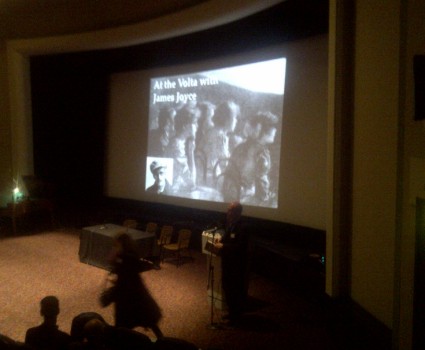
John McCourt introducing me (not there – I’m taking the picture) for the ‘At the Volta with James Joyce’ show, Glasgow Film Theatre, 10 December 2010

I’m back from my latest film adventure, which this time took me to Glasgow to present ‘At the Volta with James Joyce’, a programme of films programmed by Joyce at the Volta cinema in Dublin at the end of 1909/early 1910. I’ve written on a number of occasions on this story (here, here, here, and here, not to mention here. Oh, and here too), so no need to add any more, except to say that this was presented as part of the December 1910 Centenary Conference – the centenary being that of modernism (which Viriginia Woolf decided began 100 years ago – specifically she prononouned that “on or about December 1910 human character changed”). So it was full of modernists, who are full of brains and hifalutin jargon yet great people to go out for a drink afterwards.

But what made the event memorable for me is what went on behind the scenes. Owing to the snow that has hit the UK over the past week or so (though thankfully there was a thaw in Glasgow when I was there) there has been a big delay in deliveries of all kinds and – to keep the story simple – we discovered on the afternoon before the show that the films were sitting in a vault awaiting collection by DHL who were still dealing with a 7-day backlog. Much panic and frantic phone calls ensued. I thought briefly of carrying the films with me on the plane (not really practical, and likely to cause comment in airport security). However we found some of the Volta films on a DigiBeta tape which was copied onto DVD, though most of them had German intertitles and we had no translation. But a second DVD that had been lent to the pianist (the excellent Forrester Pyke) had further films with English titles, albeit with timecode at the top of the image. With five films on one DVD arrriving by car from Stirling and me flying up to Glasgow with three films on a second DVD (with a Google Translate approximation into English for the longest German-intertitled film, which I then read out while it was screened), and with two hours to spare, we had a show.

It’s always hazardous programming films, especially early films, where the more things you have to show the more things there are to go wrong. You can get the wrong film sent to you, you can be sent the right film can but find a different film inside, you can get a different film with the same title as the one you want to show (two films from the 1900s called Cheese Mites and two from the 1940s called Dressed to Kill at the BFI have always caused confusion). You can get films with a reel missing. On one occasion, which has passed into legend, the BFI’s print of A Night to Remember was sent for a screening at MOMA as part of a major British cinema retrospective, only for MOMA to discover that the last reel wasn’t there. Undaunted, BFI staff on hand went on stage and acted out the final reel – to what degree I’m not sure, since the final reel does feature the sinking of the Titanic, of course.

I had a similar experience myself at a conference in Bristol, when I was talking about the first ever Shakespeare film, King John (1899), which had recently been re-discovered. Owing to a series of errors, which I fear were my fault, the film hadn’t turned up. So I put up a still image, got up in front of the audience, and acted out the entire film. This wasn’t quite as much of a challenge as it might seem, since the film is just minute long and chiefly features King John in his death agonies, and though I’m no actor I can do death agonies. Anyway, it brought the house down.

On another occasion, at the Museum of the Moving Image in London, we were putting on a show of Chaplin rarities, and had announced beforehand that we would be showing the super-rare The Life Story of Charles Chaplin (1926), a British-made semi-documentary, semi-biography which Chaplin’s lawyers got banned. Unfortunately at the last minute the rights-owner refused us permission to screen the film, which was ironic. So all we could do was hold the tape copy that we had before the audience and say that, we promised to show it to you and here it is. They were remarkably good about it in the circumstances.

Anyway, the show must always go on, and my thanks go to everyone behind the scenes in Glasgow and London who turned what looked like being a disaster into a particularly successful screening. You just never know how things are going to turn out.

There’s a 1910 Conference blog report on the Volta show here. For the record (because no film list could be given out on the evening), here are the films that were shown:

  • La Course au Mouchoir (France 1909 d. Adrien Vély p.c. Pathé/S.C.A.G.L.)
  • Come Cretinetti paga i debiti (Italy 1909 d. André Deed p.c. Itala)
  • A Glass of Goat’s Milk (UK 1909 d. Percy Stow p.c. Clarendon)
  • Une Conquête (France 1909 d. Georges Monca p.c. Pathé)
  • Saffo (Italy 1909 d. Oreste Gherardini p.c. Societa Anonima Pineschi)
  • Une Pouponnière à Paris (France 1909 p.c. Éclair)
  • Bianca Capello (Italy 1909 d. Mario Caserini p.c. Cines)
  • Il signor Testardo (Italy 1909 p.c. Itala)

Update: I neglected when writing this post to say something about the conference itself. I only heard a few papers, and overall the conference was covering modernism across all the arts and culture. Nevertheless there were a number of papers that addressed film or film-related subjects. I heard Katy Mullin speak about H.G. Wells’ 1909 novel Ann Veronica, comparing his propulsive heroine to the heroines of screen railroad dramas. John McCourt spoke on ‘Joyce, Ulysses and the Corruptions of Cinema’ with remarkable extracts from the unpublished diaries of Stanislaus Joyce (James’ brother) on filmgoing in Trieste in 1909-10 (including seeing pornographic films akin to those made by Saturn Films of Austria, samples of which can be found on the Europa Film Treasures site). It’s a huge shame permission has not been granted to publish the diaries. Cleo Hanaway spoke on ‘Joyce’s Ulysses and Early Films as Phenomenological Texts’ which was tough stuff to take in after a late night but made me want to read Maurice Merleau-Ponty and to consider whether we now (or then) view films as subjects or objects.

I would also like to have heard Keith Williams speak on Wells, Joyce and Object Animation (looking at literary parallels between literature and trick films); Rosalind Leveridge on the ‘kaleidoscopic change’ for cinema in 1910; Anthony Paraskeva on Joyce and the actress Eleonora Duse (the Italian stage great who made just the one film, Cenere); and Maria Antonia Velez Serna, who is doing excellent work on early cinema and Scotland, looking at exhibition and distribution patterns. There is so much interesting work going on in our field outside the confines of film studies – and the more it goes on outside those confines, the better.

Roll away the reel world

And roll away the reel world, the reel world, the reel world!

So says James Joyce in Finnegans Wake, thereby giving a handy headline for anyone producing anything relating to Joyce and film, something which has grown as a subject of scholarly interest in recent years. Its most recent expression is Roll Away the Reel World: James Joyce and Cinema, a collection of essays edited by John McCourt and published this month by Cork University Press.

The book brings together talks given at last year’s conference, exhibition and film festival on James Joyce held at Trieste in Italy, which the Bioscope reported on at the time. The book includes an essay by myself on James Joyce’s management of the Volta cinema in Dublin December 1909-January 1910 (Ireland’s future literary giant was looking for a get-rich-quick scheme and thought that cinema management was the answer. It wasn’t). I’ve also contributed a filmography of all the film shown at the Volta from December 1909 to mid-April 1910, previously published in an obscure Irish journal and now updated and now a lot more accessible for the assorted Joyceans who have been emailing me for years now in pursuit of a copy of the original list.

There is more on silent cinema in the book, which makes it worth seeking out for anyone interested in the relationships between early film and literature. Indeed it is exciting to see how very well the current generation of literary scholars engage with both media. Erik Schneider writes on the history of the Volta from the Trieste angle (Joyce teamed up with some Triestine businessmen to launch the Volta initiative); Katherine Mullin writes on “Joyce, Early Cinema and the Erotics of Everyday Life” (on Edison, Biograph and peephole movies); Maria DiBattista and Philip Sicker each write on Georges Méliès in “The Ghost Walks: Joyce and the Spectres of Silent Cinema” and “Mirages in the Lampglow: Joyce’s ‘Circe’ and Méliès’ Dream Cinema” respectively; Carla Marengo Vaglio looks at a joint music hall and cinema relationship in “Futurist Music Hall and Cinema” while Marco Camerani explores the stage performer-turned-film perfomer angle further with “Circe’s Costume Changes: Bloom, Fregoli and Early Cinema”. And other writers carry on the argument into the sound era, from John Huston to Jean-Luc Godard to Mel Brooks.

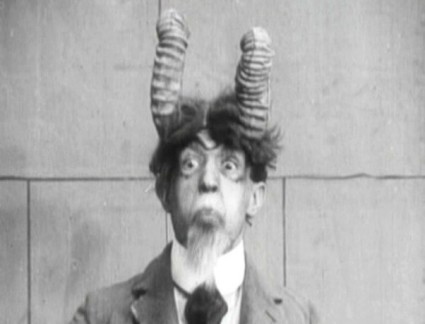
A Glass of Goat’s Milk, from BFI National Archive

And if all that wasn’t enough, and if in particular you want to see the films shown at the Volta, then do take note of the December 1910 Centenary Conference being held in Glasgow, 10-12 December 2010, which takes as its theme Virginia Woolf’s notorious pronouncement that “on or about December 1910 human character changed”. As part of this event, on 10 December at 20:30 at the Glasgow Film Theatre I will be presenting “At the Volta with James Joyce” – an introductory talk followed by a screening of thse films, shown at the Volta during Joyce’s period of involvement with the cinema:

Une Pouponnière à Paris (France 1909, p.c. Éclair)
A Glass of Goat’s Milk (Great Britain 1909, d. Percy Stow p.c. Clarendon)
The Way of the Cross (USA 1909, p.c. Vitagraph)
Aviation Week at Rheims (Great Britain 1909, p.c. Pathé
Come Cretinetti paga i debiti (Italy 1909, d. André Deed p.c. Itala)
Bianca Capello (Italy 1909, d. Mario Caserini p.c. Cines)
Pêche aux Crocodiles (France 1909, p.c. Pathé)
Une Conquête (France 1909, d. Georges Monca p.c. Pathé)

The BFI National Archive has put together a compilation of the Volta films it holds (the BFI holds the majority of the surviving films known to have been programmed at the Volta). This is available to researchers able to get to its central London site (do book ahead, as with all BFI viewings). If you want live music accompanying the films and me burbling on about the history, then come to Glasgow.

Performance, realisation and reception

The AHRC-funded Beyond Text Network “The Sounds of Early Cinema in Britain” has issued a call for papers for The Sounds of Early Cinema in Britain: Performance, Realisation and Reception. The conference takes place Thursday 7-Friday 8 April 2011, at the Institute of Musical Research and the Barbican Centre, London. The deadline for abstracts is 30 November 2010. Here’s the invitation in their words:

We invite papers from all relevant disciplines for the last in a series of events designed to establish and develop a research network concerned with the sonic dimensions of “silent” film exhibition in Britain, interpreted in the broadest possible sense. Papers concerning the performance, presentation and/or reception of these sonic practices are particularly welcome, as are presentations by composers and performers. We are especially interested in papers on British practices, but welcome proposals facilitating comparisons.

Research questions might focus on:

  • Film accompaniment manuals and photoplay collections
  • Key British cinema performers
  • Sonic and musical practices in Britain compared to elsewhere, variations in practices according to county or region, rural versus urban setting, and exhibition context
  • Aspects of cine-variety
  • How differing sonic practices shape our understanding of silent films
  • Relationships between sonic practices and developments in the narrative structure and purpose of early films (e.g. educational, ‘stories’, newsreel, etc.)
  • The practice and/or reception of live accompaniment of early cinema in Britain today (avant garde/pop/historically conscious …)

They invite abstracts of 250 words for individual papers of up to 20 minutes, which should be e-mailed, as a Word attachment, to music@sas.ac.uk with the subject line: The Sounds of Early Cinema in Britain. They will also consider shorter presentations of around 10 minutes on specific issues relating to the conference themes. These may be grouped into a panel, or sent individually. You should include your name and title, institutional affiliation (if any), email address, and postal address.

As in 2009, the conference will be running alongside the peripatetic British Silent Film Festival 2011, which takes place 7-10 April 2011 at the Barbican. Papers that include a practice element (composition, performance) are particularly welcome for that day.

Postgraduate students working in this, and/or related areas may apply for one of two scholarships (to include basic travel and accommodation, and conference fee and refreshments). Applicants should send the following information to music@sas.ac.uk, marking the subject line “PG Scholarships, The Sounds of Early Cinema in Britain: name, institution where studying, and an outline of their (related) research project.

More information about the Network, whose previous events have been advertised here, can be found http://projects.beyondtext.ac.uk/soundsearlycinema/index.php.

For questions about the conference or Network, please contact either Dr Julie Brown (Julie.Brown [at] rhul.ac.uk) or Dr Annette Davison (a.c.davison [at] ed.ac.uk)

The construction of news

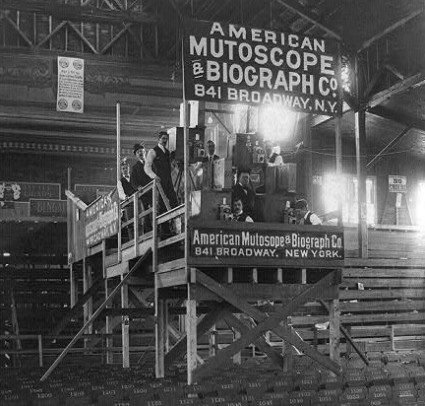
American Mutoscope and Biograph camera team filming the Jeffries-Sharkey boxing match, 1899

Here at the Bioscope we like to champion silent cinema in its many different forms, which has included a number of posts on newsreels. Not all readers may feel quite the same interest in early newsfilm, but there is now evidence that others are thinking along the same lines.

The Museu del Cinema, The Department of Geography, History &
History of Art at the University of Girona, and the Spanish Ministry of Science & Innovation Project are co-organising a two-day seminar entitled The Construction of News in Early Cinema. The seminar (which sounds near enough to a conference to me) is one of a series of seminars that have been held on the origins and history of cinema (La construcción de la realidad en el cine de los orígenes), and will be held at the Auditori Narcís de Carreras in Girona, Spain, 7-8 April 2011 (update: the dates are now 31 March-1 April).

A call for papers has been issued (deadline 31 October 2010), which can be downloaded in full here (PDF), but here are the main bits:

The film industry emerged at a key moment in the development of the written and graphic press and it would not be too long before it was playing a role in creating the imaginary of current affairs through images. Although these news images did not begin to be gathered together into a specific programme until the year 1908 thanks to Pathé Frères, in the very beginnings of cinema there were already images of current events, royal visits, official openings, sports events or exceptional situations that were to bind the image to its present context and bring it into the territory of what could be deemed as newsworthy …

The proposed seminar will focus on trying to define the relationship between cinema and news, to see how it began to build the news imaginary that presaged many of the questions of the future news images both in the subsequent newsreels and in those that came along with the birth of television … The time period of the study is to be from 1895 up to 1914, since we believe that the newsreels underwent a different development with the outbreak of World War I. The proposal of the seminar is to establish a methodology of research and reflection in the context of news and, eventually, to find out how and if we can talk about a kind of birth of the documentary image.

As in previous editions, the Seminar will be divided into two alternating parts. The first will involve theoretical reflection on the central theme with various presentations from leading experts. In the second part, the aim is to enable various researchers to present and discuss with the
participants their research into pre-cinema and early cinema.

Papers can be on the specific subject of the seminar or presentations of ongoing studies into pre-cinema or cinema before 1915. For the former, these are the themes the organisers suggest:

Terminological approaches. What do we talk about when we talk about news event films, or newsreels in the field of early cinema? How can we define the images that recorded contemporary events that became part of the framework of newsworthiness established by the press? At what point in time can we start talking about newreels?

Precedents in the concept of news. Cinema began as a place of intermediality that brought together work from various forms of expressive media. From this point of view, we want to see how the concept of current events was present in such spectacles as the magic lantern shows, panoramas, illustrated journals and illustrated vignettes or how it took on a key role in the construction of the collective imaginary in Wax Museums. Also significant at the time was the idea of Teatro por horas (popular hour-long performances) that included representations of contemporary issues. Another precedent in current affairs worth studying was photojournalism and its relationship with cinematographic news.

Limits of the notion of current affairs. The inclusion of filmic images into what was real entails research not only into news, but also into the construction of the touristic imaginary and the documentation of the industrial world. Given these premises, we are interested in defining what the limits of current affairs really are. What is considered an event? When and how long did an event remain current at the beginning of the century?

Cinematographic news models: films of real events, images of war, royal visits, official openings, fashion events, festivals and sporting events. We have to consider that the field of filming sports events is of fundamental importance in developing the image of events in general and the subsequent setup of live television. Early cinema included frequent showings of boxing matches.

Re-enactments news. We want to see how certain news items were re-enacted, how the staging of the scene is achieved, which elements document the truth and which are fictional.

The role of the lecturers accompanying the news presentations. Did the figure of the lecturer appear when news was projected? Which was his role?

The relationship between the written and the graphic press. Establishing a bridge between what the pictures show and what the press of the time explained. Analysis of the development of cinema as information from the perspective of the history of the press.

The position of the camera with regard to the event: the point of view of the camera and the staging with regard to royal visits and displays of authority. When does the camera arrive after an event has occurred? How was more than one camera used to film certain sporting events? Who were the historical personalities who believed in the power of the camera and wanted to be filmed in order to increase their fame and the other personalities who did not?

The contexts of the audiences: how were the cinematographic news shows of the time received? Was there a relationship between what the viewer believed and the hypothetical “truth” of images? What was the timing involved in showing news events? Were there incidents or events that could be seen the next day since they were processed and shown quickly? How can we relate the timing of early cinema with the search for live events that were subsequently carried out on television?

What was lacking in cinematographic news? The images built up a highly specific reality througha series of ideological factors: race, power, colonialism, sexism, etc. What historical events were not shown? What was outside the field of news? What was the relationship between political censorship and news?

The regular newscasts. The newsreels of Pathé Frères began to be screened regularly in 1908. A study of the Pathé model and how it was received in the context of the period.

Reusing contemporary news events in film making. Films such as “The Fall of the Romanov Dynasty” (Esfir Shub, 1927) and “Paris, 1900” (Nicole Vedrès, 1948) are films that were put together using news items from before 1914. What significance did the images have in the compilation of documentaries made during the time period?

Summaries should be no more than 60 lines, to be emailed to institutestudis@museudelcinema.cat, following the guidelines set out in the full call for papers. Papers can be given in Catalan, Spanish or English. It is expected that papers presented at the seminar will be published, “provided that they have been defended by the author during the seminar”. So there you go.

The First International Berkeley Conference on Silent Cinema

Eileen Percy, from the front cover of Brazilian film fan magazine A Scena Muda, 1921, available from www.bjksdigital.museusegall.org.br

A call for papers has been issued for what is being billed as the First International Berkeley Conference on Silent Cinema. Conferences specifically on silent cinema don’t come around too often, and the suggestion that this might be the first in a series is certainly exciting news. The conference will take place 24-26 February 2011 at Berkeley, University of California and the Pacific Film Archive, and has the title Cinema Across Media: The 1920s. Here’s the conference blurb:

Cinema’s institutional consolidation in the 1920s enlisted practitioners from many other fields and transformed the entire ensemble of established media. Avant-garde cinemas borrowed extensively from a variety of artistic practices, while the “cinematic” became the new standard for both modernist aesthetics and popular culture. Today’s multimedia environment brings cinema of the 1920s into new focus as the site of rich intermedial traffic, especially if the term “media” encompasses not only recording technologies and mass media, such as photography, phonography, radio, and illustrated press, but also the physical materials used for aesthetic expression, such as paint, print, plaster, stone, voice, and bodies.

We welcome proposals from scholars in a variety of disciplines, including music, architecture, literature, art history, theater, dance, and performance studies, and encourage international and comparative perspectives. The temporal boundaries for “the 1920s” include the transition to sound cinema. Workshop proposals from archivists and others interested in present-day media platforms (DVD, Internet, etc.) and their effect on silent film scholarship are welcome. The conference will last two-and-a-half days and include keynote lectures, concurrent panels, workshops, and screenings at the Pacific Film Archive with live musical accompaniment.

Proposals should include a title, an abstract (300 words), a short bio (100 words), and any A/V needs. Proposals must be submitted by October 15, 2010 to theconference@berkeley.edu. Notification will follow by mid-November.

There’s no conference web page as yet, but I’ve added the detail to the Bioscope conferences page and will update details there as and when they are advertised.

The second birth of cinema

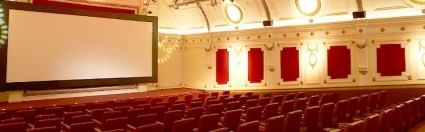
The Electric Cinema, Notting Hill, London, which celebrates its centenary in 2011. See www.electriccinema.co.uk.

The problem with centenaries is that they only come around once every 100 years. This is a long time to wait, especially if you want to celebrate 100 years of cinema, because we all put on our party hats for that way back in 1995 (or 1996). But some are clearly not happy with waiiting, or more precisely are not entirely satisfied with 1895 (or 1896) as the starting date of what we call cinema. It started a technology, but did it start a phenomenon? What is cinema anyway?

Well, whether it’s because of an intellectual problem, or because film study academics love any excuse for a scholarly knees-up, there has been a call for papers for a conference entitled The Second Birth of Cinema: A Centenary Conference. Taking place at Newcastle University, UK 1-2 July 2001, and with Newcastle University, 1-2 July 2011, and with André Gaudreault, Philippe Marion, Ian Christie and Joe Kember as keynote speakers, it takes as its theme the approximate centenary of the breakaway of cinema from other media to the point where it stood out as an individual medium. And that occured in 1911? They are certainly going to have plenty to debate. Here’s the conference blurb:

This conference commemorates cinema’s ‘second birth’, the historical developments and departures that broke cinema’s subordination to other media to give us the medium, the industry and the building that we know as ‘the cinema’.

If, as André Gaudreault and Philippe Marion have recently insisted, cinema was born once as a technology and then again as a medium, just when and how did this occur? What caused film practice, the film business and film discourse all to generate a media identity for cinema? How did we get from ‘animated photography’ to ‘the pictures’?

Possible questions to consider:
Was cinema’s ‘second birth’ a radical short-term event or a gradual and imperceptible change? What was the most significant cause? Was this ‘second birth’ a matter of maturation or deliberate manipulation? What people and organisations were most instrumental in bringing it about, and how did it vary from country to country? How extensively was cinema’s audience contract re-written? What kinds of genealogies were invented for cinema, what genealogies were forgotten, and what genealogies were actively disavowed? Was cinema drafted into bourgeois culture, or did it fashion its own unique identity? Did this period create a lasting identity card for cinema, or were third and fourth births still to come? How did contemporaries register this change? How early did the process of reinventing cinema begin, and when, if ever, did it end? And what date stands out as the watershed? Indeed, was 2011 a good choice for the centennial year?

Abstracts are invited for 20-minute papers on any aspect of this ‘event’ in any part of the world. Please send abstracts, by email attachment, to Andrew Shail at a.e.shail [at] ncl.ac.uk, with the subject line ‘Second Birth of Cinema’, by the 30th of September 2010.

There’s no web page as yet, but I’ll add details as and when they appear to the Bioscope’s Conferences page.

This is not the only event which has laid claim to the mysterious second centenary. Last year’s Continuous Performance exhibition at the University of Kent (images from which are now on the Bioscope’s Flickr site) ostensibly celebrated 100 years of cinema, while this December’s 1910 Centenary Conference at the University of Glasgow looks at 100 years of modernism, including film within its frames of reference. Or check out William Drew’s 100 Years of Hollywood and the Stars site, which recognises the centenary of both Hollywood and the movie star in 2010. Or pick your own centenary.

Update: (September 2010)
There is now a website for the conference, at http://conferences.ncl.ac.uk/secondbirth.

Doing women’s film history

http://wfh.wikidot.com

Here’s news of an international conference taking place in April 2011 organised by the AHRC-funded Women’s Film History Network – UK/Ireland which is certain to attract some papers covering the silent film era, where there has been so much research activity of late.

Doing Women’s Film History: Reframing Cinema History

13-15 April 2011

Centre for Research in Media and Cultural Studies
University of Sunderland

This international conference will bring together researchers in women’s film history, archivists, collections managers and contemporary women practitioners. It will explore current developments in researching women’s participation in film production, distribution, exhibition, criticism and film-going in different parts of the world and in all periods. It will ask what the discovery and documentation of women’s past activity in and around cinema implies for the writing of film history in general and will consider how the history of post-1970s women’s filmmaking is to be resourced and developed. The conference will seek to address issues such as:

  • women’s film historiography: filling gaps in existing film history or changing film history?
  • impact of gender-oriented research methods & sources for the histories of male and female workers
  • gender in the archives, catalogues and collections
  • impact of women on cinema as audiences, campaigners, fans
  • relationship between feminism, women’s and gender histories
  • crossing the silent/sound history divide
  • women’s film history after second wave feminism
  • national/international/transnational connections and interactions
  • creation of canons, exhibition & programming practices, curricula and teaching
  • relation of women’s film history then and women’s film practice now

The Conference will also report on and seek feedback on three Workshops that will have preceded it in order to involve wider participation in developing the future of the Network.

A call for papers will follow more detailed planning in early June. In the meantime, for more information about the Network please visit the Network wiki and the Conference Development pages where you can post any suggestions and comments via linked page headings.

From silent screen to digital screen

The Bioscope on the pier at Weston-Super-Mare, c.1910

From Silent Screen to Digital Screen: A Century of Cinema Exhibition is a two-day conference to be held at De Montfort University, Leicester, 10-11 July 2010. The conference, to be hosted by the Cinema and Television History (CATH) Research Centre in DMU’s Faculty of Humanities, will celebrate a century of cinema exhibition since the Cinematograph Act 1909, the first major legislation relating to moving pictures in Britain, coming into force on 1 January 1910.

Keynote speakers will include Richard Gray of the Cinema Theatre Association, and others to be confirmed.

Proposals are invited on any aspect of cinema exhibition including:
audiences, technologies, cinema design and building, programming,
legislation and other aspects of the cinemagoing experience. If interested you should sent abstracts (500 words) with a short biography including contact details to Stuart Hanson (shanson [at] dmu.ac.uk) and Steve Chibnall (schib [at] dmu.ac.uk) by 23 April 2010. There isn’t a web page for the conference as yet, but I’ll add one to this post just as soon as one appears.

The conference gains its title from Stuart Hanson’s recent book From Silent Screen to Multi-screen: A History of Cinema Exhibition in Britain Since 1896, a commendable and rather useful work, which was covered by the Bioscope (a little too nitpickingly, I fear) here.

Update: The deadline for abstracts has now been put back to 14 May.