Colourful stories no. 11 – Kinemacolor in America

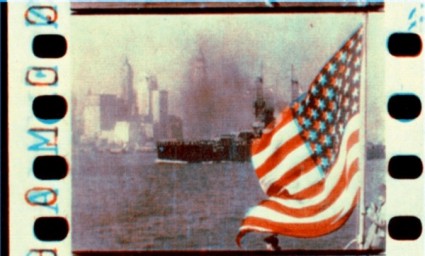
Unidentified Kinemacolor film of New York harbour (synthesised colour image)

We return, after something of a break, to our series on the history of colour cinematography in the silent era. We’re still not done with the history of Kinemacolor, the dominant natural colour process before the First World War, and there will be posts on Kinemacolor in America, Britain, and in other countries, then a post on Kinemacolor’s unhappy demise, before we move onto other colour systems.

Kinemacolor was first exhibited in America at Madison Square Gardens on 11 December 1909. 1,200 members of the film trade and general press gathered to hear George Albert Smith and Charles Urban explain their system and show twenty Kinemacolor subjects, including a film taken by John Mackenzie calculated to inspire the audience, which showed 20,000 schoolchildren forming the American flag. The intention was to find a buyer for the American rights. Urban tried to do a deal with the Motion Picture Patents Company, the monopolistic organisation which had been established in January 1909 to licence film production, distribution and exhibition exclusively, through control of the patents of Edison and others, but he failed to do so. His business timing was unfortunate, both because the MPPC was striving earnestly to stifle all independent film activity in America, and because the special equipment required for Kinemacolor ran counter to its wish to standardise the American film industry.

Children Forming United States Flag at Albany Capitol, from the 1912 Kinemacolor catalogue (note that this is an ordinary colour illustration, not a Kinemacolor ‘print’ – it was impossible to reproduce Kinemacolor as a still image).

Urban returned home disappointed, but he was pursued by two businessmen from Allentown, Pennsylvania, Gilbert Henry Aymar and James Klein Bowen. They secured the patent rights for $200,000 (£40,000), with a plan to exhibit Kinemacolor through a system of local licences in variety theatres rather than picture houses. They established the Kinemacolor Company of America in April 1910, planning not to produce their own films (at least initially), instead relying on showing British product. The business was badly mishandled, and eventually a New York stock speculator, George H. Burr & Co., paid $200,000 for the patent rights and floated a new Kinemacolor Company of America. The resultant company with patent rights was then sold in April 1911 to John J. Murdock, a theatre magnate.

Kinemacolor enjoyed a good year in 1911 owing to a succession of British royal events (including the coronation of King George V) which looked spectacular in colour. Audiences flocked to Kinemacolor theatres, happy to pay higher prices for a classy product and generally making the film industry marvel at the high tone of the proceedings and the money rolling in. But an American business could only go so far showing long newsfilms of British royalty. The Kinemacolor Company of America wanted to show fiction films. The British fiction films were uniformly terrible – so they needed to produce their own.

1913 Motion Picture News advert for Kinemacolor

A big problem with Kinemacolor was that it was an additive system. Essentially this means that it composed its colour record by the addition of separate colour records (television works on the same principle), but in doing so it absorbed a lot of the available light. The result was that it was not a good idea to shoot Kinemacolor in the studio; you had to film in good natural light (many of the British films were not filmed in Britain but in Nice, France).

So, technically, the odds were stacked against them when they set out to produce their first film. In a bout of wild over-ambition, they choose to produce The Clansman, based on a dramatised version of Thomas Dixon’s grotesquely racist novel about the Ku Klux Klan. A deal was signed with the Southern Amusement Company, producers of The Clansman play, and the perfomers were to be from the Campbell MacCullough Players, one of the several stock companies which were touring the States with the production. The director was William Haddock. Filmed throughout 1911 in the New Orleans area, as the stock company went on the road with the play, the ten-reel film (Kinemacolor films were double the length of standard films owing to the altenating red-green records) was completed in January 1912 at a cost of $25,000.

Then what? No one is sure. One suggestion is that there were problems over the story rights, though one can hardly believe that they would film for an entire year without being sure that they had full permission from Dixon to do so. The other argument is that the film was technically inept and unshowable, but again you’d have thought someone might have spotted this over the course of the year. Whatever the reason, it was never shown publicly. Film trade journalist Frank Woods, who had contributed to the script of The Clansman, showed what he’d written to one D.W. Griffith, who then went off and filmed The Birth of a Nation, based on the same novel. Had the Kinemacolor version been exhibited, Griffith would presumably never have made his film, and film history might have been completely different.

A new head of the Kinemacolor Company of America, Henry J. Brock, took over late in 1912, and studios were established at 4500 Sunset Boulevard in Hollywood. Its first film, after the debacle of The Clansman, was a two-reeler Western, East and West (1912). But production and exhibition continued to be beset by technical problems, and too few films were produced to sustain the company, despite it eventually obtaining a licence from the Motion Picture Patents Company in August 1913, making it the only new company to join the trust after its original formation. Exhibitors in particular resisted including Kinemacolor films requiring separate projection facilities within their programmes. The Hollywood studio closed in June 1913, taken over by the D.W. Griffith company, which renamed it the Fine Arts studio, where The Birth of a Nation would be filmed. The Kinemacolor Company of America opened a studio in New York in October 1913, but gradually faded from view. It ceased production in 1915.

The lesson from the Kinemacolor Company of America was that colour alone was not enough. Karl Brown, who worked for Kinemacolor processing negatives, noted the audience reaction:

Our little one-reel pictures were made to exploit color for color’s sake. There was one about a hospital fire, showing lots of flames; another, from a Hawthorne story about a pumpkin that becomes a man, showed up the golden yellow of the carved jack-o’-lantern very well indeed. There was another about British soldiers, featuring the red and gold and white of their uniforms.

The audiences at the California seemed to care nothing about our beautiful colors. What they wanted was raw melodrama and lots of it, and what seemed to stir them most of all was the steady flood pictures made by a man named D.W. Griffith…

That man again. Brown noticed the way things were going and left to join Griffith as assistant to his cinematographer, Billy Bitzer.

Lillian Russell in what may be a frame still from Kinemacolor film of her (I can’t remember where the image comes from). As with other ‘colour’ images of Kinemacolor, the colour is not true Kinemacolor – in this case, it seems to be a still taken from a colour print approximating the colour effect.

The Kinemacolor Company of America produced both non-fiction and fiction. Among the former, its most spectacular production was The Making of the Panama Canal (1912), a nine-reeler, lasting around two hours, which enjoyed a considerable reputation in its time. Dramatic production was headed by David Miles, with directors including William Haddock, Gaston Bell, Jack Le Saint and Frank Woods; members of the stock company included Linda Arvidson Griffith (Mrs D.W. Griffith), Mabel Van Buren, Murdock MacQuarrie, Clara Bracy and Charles Perley, while theatre great Lillian Russell made a short film with Kinemacolor, entitled How to Live 100 Years, which she included in a touring show of hers promoting physical fitness. The cameramen (the real stars of the show) included John Mackenzie, Alfred Gosden, Victor Scheurich and Harold Sintzenich.

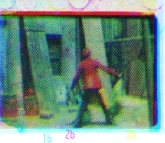
A demonstration reel from DeBergerac Productions showing how the effect of Kinemacolor can be achieved synthetically, using Kinemacolor film shot in Atlantic City and New York, c. 1913, plus what looks like a dance scene from an unidentified drama.

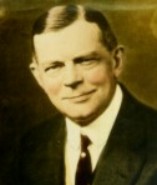
Few Kinemacolor Company of America films survive (few Kinemacolor films of any kind survive, full stop). One reel of three of The Scarlet Letter (1913), based on the Nathaniel Hawthorne story and starring Linda Arvidson Griffith is held by George Eastman House. The Library of Congress has two examples of ‘Mike and Meyer’ comedies from 1915 starring the famous vaudeville team of Lew Fields and Joe Weber, produced by a subsidiary company, the Weber-Fields-Kinemacolor Company. The UCLA Film and Television Archive has a few seconds of Lillian Russell, presumably from How to Live 100 Years. A handful of actualities also survive – a few frames showing President William Howard Taft, scenes of passers-by in Atlantic City and New York (see above). The rest – and we have no clear idea of the extent of the Kinemacolor Company of America’s production – is gone.

Further reading:
Eileen Bowser, The Transformation of Cinema: 1907-1915 (1990)
Karl Brown, Adventures with D.W. Griffith (1973)

Colourful stories no. 10 – Happy centenary!

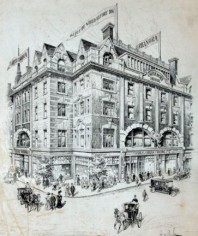
The projection hall at Urbanora House, where the first Kinemacolor films seen in public were shown

On 1 May 1908 a special demonstration was held for the press at 89-91 Wardour Street, London. The occasion was the opening of Urbanora House, a prestigious new home for the Charles Urban Trading Company, the leading British film company. Previously based at nearby Rupert Street, the CUTC had relocated to much larger premises, and in doing was to have an important effect on the future of the British film industry, as it was the first film company to move to Wardour Street, soon to become the unofficial home of the native film industry (a symbolic role that it arguably retains to this day).

Urbanora House was designed to dazzle. For anyone who believed that the British film business was a minor industry of ramshackle appearance and sometimes seedy reputation, the new building was a bold statement of better intent. The 250 attendees, representatives of daily newspapers, the photographic and cinematograph trade press, and the film industry, were led through stylish, well-appointed room after room. The Kinematograph and Lantern Weekly was particularly struck by its implications for the industry.

Urbanora House makes an impression on the member of the trade first of all because of its spaciousness but even more noticeable is the manner in which that space has been used. The many thousand feet of floor space are divided up among the bewildering number of departments so that hardly an inch is wasted. The building is at once factory and office. On the ground floor are the distributing offices, secretary’s office, advertising and correspondence departments and the projection hall. The latter calls for special notice. It is easily the largest in the English trade, accommodating over one hundred if necessary, and is beautifully fitted up. The size of the hall allows of a picture of a size equal to that of most public exhibitions being shown. The projection hall, like the entrance hall and staircase is beautified by a series of pictures, many reproducing scenes with which Urban films have already familiarised the trade.

The floors above continued the wonders of Urbanora House (left): the drying room with drums capable of drying 12,000 feet of film per hour, the rooms for film processing and equipment manufacture, a studio on the top floor, with Ladies and Gentlemen’s dressing rooms adjacent, and rooms for experimental work and colour cinematography. The latter was the day’s triumphal flourish. All were ushered into the projection hall, where there was to be an exhibition of ‘Animated Photographs in natural colours’. This was the first public exhibition of the two-colour motion picture process which had been patented by G.A. Smith in 1906 and whose development had been funded by Charles Urban, whose mansion Urbanora House was. 1 May 1908 was therefore the first time that the public saw motion pictures in natural colour.

Smith gave an introductory talk, explaining the as yet imperfect system that they were to witness, and having some barbed words for other inventors whose claims to have produced motion picture colour had not been backed up by any presentable results:

Another motive which prompts me publicly to exhibit my early results is the desire to bring to a crisis a sort of intellectual scandal. I have been actively engaged with Mr. Urban in the art of the Bioscope for the past twelve years, and during the greater part of that time have heard of people and have met people who claimed to be able to take pictures in natural colours. The Patent Office is presumably littered with the specifications of inventors who are free with their theories and loud in their claims. But we never see their performances! We frequently meet with gentlemen who tell us of their patented ideas, but never have they yet come to the practical point of showing us the thing on the sheet. So well is this state of things recognised and smiled at that I am beginning to be nervous of being placed in the same class and am therefore willing to take you into my confidence and exhibit my experimental results in the hope that other claimants will be sportsmanlike enough to follow my example if they are able.

Smith then went on to stress the universality of the equipment that he had used, before showing a selection of subjects, apologising for their rough-and-ready state and stating (a little ingenuously) that they were not taken with any thought of presenting them before an audience. Today, alas, only a handful of Kinemacolor (as the system would be named in 1909) films survive, but the two test films below indicate the sort of thing Smith and Urban exhibited before the press that day:

Tartans of Scottish Clans and Woman Draped with Patterned Handkerchiefs, two Kinemacolor test films held by the British Film Institute. The woman in the second film may be G.A. Smith’s daughter Dorothy

We don’t know precisely what films were shown, but we do know that to demonstrate the effectiveness of the colour, the audience was invited to compare them with Autochrome photographs of the same subjects, which included Smith’s wife Laura and daughter Dorothy. Smith described them as “improvised test subjects rigged up on the lawn as close to my Laboratory door as possible” i.e. they were filmed at his house ‘Laboratory Lodge’ in Southwick, just outside Brighton. The audience was duly delighted by the results, though there was at least one note of qualification. As enthralled as it was by the building, the Kinematograph Weekly nevertheless recognised imperfections in the colour films, even if they were acknowleged to be an obvious improvement on artificially-coloured films:

… we must observe that, as present produced, there are fringes of complementary colours, red and green, outlining swiftly moving portions of the composition. Thus, so long as the movement is of a moderate speed or the object is a considerable distance from the camera, this defect is not apparent, but when the object is in rapid motion and is located a very short distance from the lens, two sucessive images are sufficiently dissimilar to make absolute registration of the complementary images impossible, hence the coloured outlines.

That’s a good explanation of the inherent limitation of Kinemacolor, that the successive red and green records inevitably could not capture precisely the same image if the subject was in motion, and one which the system was never to overcome.

And so motion picture colour was launched upon the world. It’s not a centenary that’s likely to be picked up on by the broadsheets, or frankly even the motion picture press, alas. So let’s raise a glass here, and if you’re in London some time, take a look at the bottom of Wardour Street, where Urbanora House still stands, indeed with a grand stone fascia on top still bearing the name ‘Urbanora House’. That’s where it all began.

Happy centenary!

Albert Kahn and his wonderful world

http://www.albertkahn.co.uk

Enthusiasts for Albert Kahn, autochrome photography and the BBC series The Wonderful World of Albert Kahn will be delighted to learn that there is now a BBC website devoted to Kahn. Its prime purpose is to promote the new book The Wonderful World of Albert Kahn: Colour Photographs from a Lost Age, by David Okuefuna (published 24 April), but it also has a selection of autochrome images, linked to a map of the world (courtesy of Flickr), a biography of Kahn and information on the Musée Albert-Kahn in Paris. The latter section refers to DVDs, implying that these come out of the BBC/ Musée Albert-Kahn collaboration. There is no further information given. My understanding has been is that there were no plans for a DVD release of the series, but that the museum might be releasing its own DVDs. I’ll try to find out more.

Further information on Albert Kahn, including a more extensive set of links with information on autochromes in general and the films taken as part of his ‘Archives of Planet’ project can be found on the Searching for Albert Kahn post on this site.

Colourful stories no. 9 – They do it with stencils

Pathécolor machine printing room, from F.A. Talbot, Moving Pictures: How They are Made and Worked (1912)

As films grew longer, and their production increased, through the 1900s, so the idea of adding colours by hand became uneconomic. A mechanised system was required, and at around the same time that experiments were taking place in Britain to develop natural colour motion pictures, in France first Pathé and then Gaumont started developing processes for the mass production of multi-colour-tinted film prints through the use of stencils. This was a labour-intensive process (employing mostly female operatives – see pictures above and below) which could only be carried out by well-capitalised businesses with international distribution, and in the mid-1900s France dominated the world’s motion picture business. Hence France became the home of artificial motion picture colour.

Women workers preparing Pathécolor films, from Moving Pictures: How They Are Made and Worked

Pathé introduced its stencil colour process in 1905, but the system in principle was not new, having been adopted from methods used for colouring postcards and wallpaper. A number of prints of any one film title would be made, each representing the different colours to be employed in the eventual film (i.e. a film featuring red, green, blue and yellow would require four original prints). The areas in each of the original prints to be coloured would be marked out and cut with scalpels. Each cut-out print would be laid over the final projection print and each colour would be applied in turn. 600 women were employed at the Pathé factory by 1906 to produce colour prints in this way.

However, great mechanisation was soon brought in, led by Henri Fourel, who ran the Pathé colour studio in Vincennes. In 1908 Pathé introduced a pantograph mechanism to improve production. A master print would be rear-projected onto a ground glass screen, one frame at a time, which enabled the operator to have a far clearer view of the image. She would then move a pointer over the screen, marking out the area to be treated with one colour. The pantograph allowed for greater precision of line, and a needle at the other traced marked out the corresponding area on a second print. This would be repeated for each colour required. It was painstaking work, and still very labour-intensive, with an estimated 300 women operators employed. About one metre of film per colour was produced in an hour. When all the stencils had been cut, the gelatin emulsion was removed from each and they were then run in turn through a staining machine in precise registration with the master print. The cumulative result was a finished print stained in multiple colours – or rather multiple prints, since at least 200 colour copies had to be produced to make the system economic.

This demonstration of the stencil colour process is taken from Brian Coe’s The History of Movie Photography. The original film is on the left; then follows (L-R) the stencils cut for each colour (top row) and the application of that colour (bottom row) for red, blue, brown, green and yellow respectively.

The Pathé system produced images of frequently exquisite quality, with a notable precision of colour. Colours were not applied to every kind of film, but generally to those kinds of films which it was felt would be best enhanced by colour: exotic travelogues, costume dramas, magical films etc. Such films would be billed as the highlight in cinema programmes, and were more expensive for exhibitors than common film titles. As indicated, the industrial, labour-intensive process could only be supported by major producers with extensive distribution, and Pathé’s only rival in stencil colour was to be Gaumont, which came up with a similar process around 1908.

An unidentified fragment of a Pathé stencil colour film, date uncertain (c.1910?)

Another stencil colour example, from the same collector, again undated (early 1910s probably) and location unknown. Anybody recognise the building and gardens?

Pathé and Gaumont would continue with stencil colour into the 1920s, and the finest examples of their art are among the treasured items of the world’s film archives (there is a particularly strong collection at the Nederlands Filmmuseum). Stencil colour films have also inspired a growing body of academic work looking at the aesthetics and meanings of early colour. Strongly recommended is Tom Gunning’s essay ‘Colorful metaphors: the attraction of color in early silent cinema‘, originally published in the Italian journal Fotogenia (there is a version online in English), which looks at the special nature of early colour, seen in the context of the use of colour in other media (posters, books, advertisements etc.). For Gunning, it was not that the stencil colour films were more true to nature, but that they were an attraction in themselves, offering a ‘sensual intensity’, acting as a ‘signifier of fantasy or as a metaphor’.

However, just as Pathé introduced its improved colour system to the world in 1908, a rival system from Britain was announced, which did not use artificial colour but instead boasted that only its photographic colour was true to nature. The commercial and ideological (i.e. in debates over reality) between the systems that would later be known as Kinemacolor and Pathécolor will be covered in a later post.

Further reading:
Bregtje Lameris, Pathécolor: “Perfect in their renditions of the colours of nature”, in Living Pictures vol. 2 no. 2 (2003)
Brian Coe, The History of Movie Photography (1981)

Colourful stories no. 8 – Painted by hand

Annabelle

Hand-coloured print of Annabelle Butterfly Dance (1895), from Before Hollywood: Turn-of-the-Century American Film (1897)

So far our history of colour in silent cinema has focussed on Kinemacolor and its antecedents. However, as significant as the ‘natural’ colour system was technically and aspirationally for the new industry, for most filmgoers of the period their experience of colour was more likely to be one of the several ways producers found of adding colours to film artificially.

We’ll be covering each of these various methods – stencil colour, tinting and toning, dye colours, coloured celluloid – but the method that came first, a direct inheritance from magic lantern practice, was painting individual frames by hand.

The first motion pictures to be shown to the public were those exhibited on the Edison Kinetoscope peepshow. These presented too small an image to the viewer to make colouring them a sensible course of action. But as soon as films were projected on a screen, producers thought about colouring them. The first such examples were therefore films originally shot for the Kinetoscope and now re-shown on a big screen, such as Annabelle dancing her butterfly dance, illustrated above. A coloured film of a serpentine dance (another of Annabelle’s specialities) was included in the first programme of the Edison Vitascope projector at Koster & Bial’s Music Hall, New York on 23 April 1896.

Loie Fuller

Loïe Fuller, a hand-coloured Pathé film dated 1905, from http://postdance.wordpress.com

Only a handful of films were selected for colouring, however. The process was immensely time-consuming, and hence expensive. Subjects for colouring were chosen with care, and were naturally those subjects which came over as most naturally ‘colourful’ in themselves. Films of dancers were among the first such subjects in the 1890s, with the colours not only reproducing the appearance of costumes but in the case of the renowned French dancer Loïe Fuller attempting to echo the striking use of coloured light in her stage performances.

Hand-colouring meant applying colours by means of tiny brushes to one frame at a time, a space measuring just one inch by three-quarters of an inch. It was reported of Edward Henry Doubell, a noted producer of coloured lantern slides (which were a far easier three inches square), that he was able to colour two to three frames per day of the Robert Paul films that he was colouring in 1896 – and, of course, we are talking about around sixteen frames for every second of projected film. The colours used were water-based or alcohol-based dyes, which were applied to the emulsion side of the film.

La Biche au Bois

Hand-coloured Demeny-Gaumont film on 60mm, from 1896, showing dancers from La Biche au Bois stage show at the Théâtre du Châtelet, Paris, from Brian Coe, The History of Movie Photography (1981)

The great problem with hand-coloured films, apart from their expense and the time needed for their production, was accuracy of registration. The artist had to ensure consistency of colouring from frame to frame, allowing for movement, and surviving examples frequently demonstrate some haphazard application of colour as the subject moves, even while selected examples (such as La Biche au Bois above) are exquisite in their meticulous effects. The established practice came to be of teams of colourists – almost invariably women – to each of whom would be assigned a single colour for painting. The method continued into the mid-1900s, and there are dazzling examples for example in the recent Flicker Alley DVD release Georges Méliès: First Wizard of Cinema.

However, as films became longer the hand-colour method inevitably became impractical. Audiences evidently valued coloured films, and higher prices would be paid for them by exhibitors, but a mechanised means of their production had become essential, and in the mid-1900s both the Pathé and Gaumont firms developed such systems. As Britain became home of natural colour cinematography, so France developed methods for mass producing artificially coloured films for worldwide export. Which we shall move on to next time.

Recommended reading:
Brian Coe, The History of Movie Photography (1981)
Paul Read and Mark-Paul Meyer, The Restoration of Motion Picture Film (2000)

Colour, colour and more colour

A call for papers has been issued for a special issue of the Journal of British Cinema and Television on colour in British cinema and television. Organised by the University of Bristol’s ongoing AHRC-funded project on the history of colour cinematography in Britain, the call asks for proposals of 400-750 words to be sent to the editors Simon Brown and Sarah Street by 1 April 2008. Each article (subject to your proposal being accepted, of course) should be no more than 8,000 words and no less than 5,000 words. They are interested in any area that relates to colour and British cinema and television from any period, but are particularly interested in articles on the following themes:

  • Particular colour processes that were used in Britain
  • Early colour television
  • Colour and home movies
  • Colour in feature films
  • Colour and British animation and/or documentary and/or avant-garde
  • Issues of colour restoration
  • The use of colour in contemporary television series such as The British Empire in Colour
  • An interview with someone who has worked with colour or who has particular views on the use of colour in film and/or television (this should not exceed 5,000 words)
  • Textual analyses of the use of colour
  • Colour and theory
  • Colour and audiences

Omnivorous stuff. Details on house style, length and other issues can be found on the Edinburgh University Press website, and the contact details of the editors are simon.brown [at] kingston.ac.uk and sarah.street [at] bris.ac.uk.

Colour and the moving image

Kinemacolor banner

In this our year of colour, here’s a call for papers on a pertinent conference, which comes out of an ongoing three-year research project at the University of Bristol which is examining the histories of Kinemacolor and Technicolor in Britain.

Colour and the Moving Image: History, Theory, Aesthetics, Archive

Conference: 10th July – 12th July 2009, Bristol, UK

Keynote speakers: Tom Gunning (University of Chicago), Laura Mulvey (Birkbeck)

‘An inquiry into colour can take you just about anywhere’ (David Batchelor, Chromophobia, 2000)

Call for Papers: This conference addresses questions emerging through a renewed interest in colour film and as an interdisciplinary subject. The event is part of an AHRC-funded project on colour film, led by Professor Sarah Street. While colour is a fundamental element of film forms, technologies and aesthetics it is rarely singled-out for analysis. The aim of the conference is to extend previous work on colour and to consider its form and functions from a range of perspectives within four major strands: histories and technologies; film theory; philosophies and aesthetics of colour; the ethics, practices and theories surrounding the deterioration and conservation of colour film. In addition to formal conference papers, the event will include screenings of prints from the BFI National Film Archive. We invite proposals which address broad issues raised by colour and the moving image. The conference will provide a forum for discussion which is informed by, and directly addresses, the interrelations of the theory, history and aesthetics of colour film and of moving image technologies in their broadest sense. Proposals which focus on questions of colour in one or more of the following areas are particularly welcome:

– star systems
– reception theory
– pre-filmic, pro-filmic and onscreen spaces
– fantasy, spectacle, realism and/ or ‘natural’ colour
– colour theory
– synaesthesia: theories and practices of the interrelations of colour, sound, music as sensation
– chromophilia/chromophobia
– distanciation and avant garde film
– colour and genre
– film histories and new technologies: video, DVD, small screen technologies as new viewing spaces
– Colour systems including Kinemacolor, Dufaycolor, Chemicolor, Agfacolor, Technicolor, Eastmancolor

We invite abstracts of c.200 words for individual papers or pre-constituted panels consisting of 3 papers to be submitted by 1st September 2008. Please send abstracts to dram-colourconference@bristol.ac.uk. If you prefer to submit your abstract by post, the address is as follows: Colour and the Moving Image Conference, c/o Dr Liz Watkins, Department of Drama: Theatre, Film, Television, Cantocks Close, Woodland Road, University of Bristol, Bristol, BS8 1UP, UK.

Colour and the Moving Image: History, Theory, Aesthetics, Archive is hosted by the Department of Drama: Theatre, Film, Television, University of Bristol, UK with support from the Arts and Humanities Research Council. Screenings in co-operation with the BFI National Film Archive, UK and supported by Screen as one of its 50th Anniversary regional events.

Colourful stories no. 7 – Reviving Kinemacolor

David Cleveland

David Cleveland operating a Kinemacolor projector

We continue with our series on the history of early colour cinematography, but take a diversion out of the past to the present day – Monday February 25th, to be precise – for the very best of reasons. Because today, at the British Film Institute’s J. Paul Getty Conservation Centre in Berkhamsted, Hertfordshire, we witnessed a rare recreation of ‘true’ Kinemacolor.

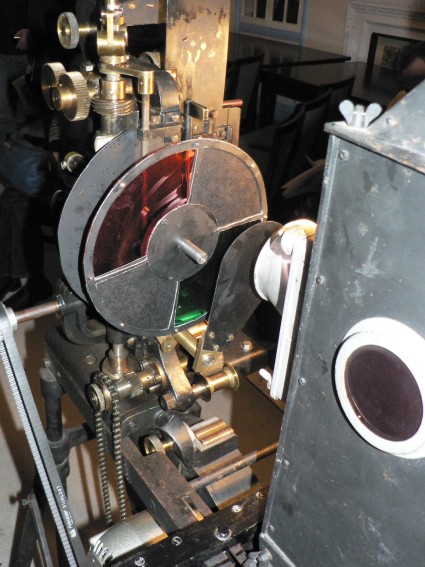
The screening was organised by film archivists David Cleveland and Brian Pritchard, who decided to mark the centenary of Kinemacolor by exhibiting the world’s first natural colour motion picture system in its correct form, using an original Kinemacolor projector. Kinemacolor films have been shown in composite colour or computer synthesized forms, or so customised that they will run at normal speed on a normal projector, but not since 1995 at the Museum of the Moving Image has anyone attempted to show Kinemacolor as it was originally done – black-and-white film run through a projector fitted with a red and green rotating filter, at double speed (thirty or more frames per second). It is rarer still to employ an original projector (the MOMI show used a customised 1920s Ernemann projector).

Kinemacolor projector

Kinemacolor projector no. 19 (rear view showing colour filter)

The projector was generously loaned by Wirral Museum, which also allowed the archivists to replace missing parts and to make the machine operable, so long as it would be returned to its original museum state once they had finished with it. It is Kinemacolor projector no. 19, with original colour filter. Cleveland and Pritchard aimed to be as authentic as possible, with two limitations – they could not show nitrate films, fairly obviously, and for similar health and safety reasons they could not use an arc light (they used a filament blub instead).

We gathered in a small room, with chandelier adding an appropriate touch of class to the proceedings (less so the windows necessarily blacked out with black bags and tape). The small audience comprised archivists from the BFI National Archive, a smattering of academics, and as guests of honour, Kinemacolor’s producer Charles Urban’s step-grandson Bruce Mousell and his two daughters.

David introduced the event and the projector, then we were shown three of the sample Kinemacolor films held in the BFI National Film Archive. Tragically few Kinemacolor films survive today, and all that the UK’s national archive holds are some test films which were never shown publicly. These were retained by the system’s inventor G.A. Smith, who passed them on to Brighton collector Graham Head, whose collection in turn went to the Cinema Museum in London. Two of the prints we saw were therefore struck from original negatives, with a third taken from a dupe neg. This film was shown first, Cat Studies (c.1908), a short single shot of a cat (a black-and-white cat at that), which served to help make adjustments to the filter, since we started off with the wooden board with a hole through which the cat looked appearing green, because the rotating filter had been aligned incorrectly.

Woman Draped in Patterned Handkerchiefs

Projection of Kinemacolor test film Woman Draped in Patterned Handkerchiefs

There then followed Woman Draped in Patterened Handkerchiefs (c.1908), whose action is self-explanatory, a film clearly designed to demonstrate basic colour effects; and Pageant of New Romney, Hythe and Sandwich (1910), an actuality film rejected at the time for being too contrasty. In truth, the sample Kinemacolor films held by the BFI are poor examples of the colour system, showing little in the way of effective colour, and the latter film in particular demonstrating the hazards of fringing (the alternating red/green records meant that the film record could not always keep up with movement, resulting in red or green ‘fringes’).

But, after a pause for reloading and a talk from Brian Pritchard on the customising of the projector and Smith’s ingenious use of sensitizing chemicals (without which Kinemacolor would not have worked at all), we were shown a beautiful Kinemacolor film loaned by the Nederlands Filmmuseum. This was Lake Garda, Italy (1910), a travelogue of the Italian beauty spot, whose picture postcard images showed up the colour to exquisite effect. We saw panoramic views of the lake, buildings, boats with red and yellow sails, and a delightful sequence where three musicians in a small boat serenaded the camera. Being full of gentle motion, the muted, subtle colour was shown to its best effect, being particularly good at rendering white buildings and reflections in the water. Kinemacolor, using as it did red and green filters, could not logically depict blue, yet blue we saw in the sky and water. This is all down to our gullible brains, reconstituting what seems optically logical to us. The sky should be blue, so we see blue.

What was also interesting was the colossal noise. The motorised projector had to rattle through at a speed of thirty frames per second, and the racket drowned out all conversation. The image on the screen had to be kept quite small, to retain as much brightness as possible (Kinemacolor absorbs a great deal of light). We all wondered how on earth they coped projecting Kinemacolor in large theatres, where the throw would have been considerable. We also marvelled at the skill of the original projectionists, who had to cope not only with a double-speed projector, but changing colour effects owing to differences in filters used (the cameramen would change then accoding to the light conditions encountered) and all of the hazards of correct colour synchronisation.

Bruce Mousell

David Cleveland (right) with Charles Urban’s step-grandson Bruce Mousell and his daughters

The demonstration revealed many of the problems, but also several of the beauties of Kinemacolor, and made one wish for more such screenings to be organised. As David Cleveland explained in his notes to the show:

Several archives have a few examples of Kinemacolor films in their collections, and the usual process is to make a composite film copy of the red and green images onto one new Eastman Color inter-negative, and normal colour prints therefrom. Of course this takes on Eastman Color characteristics, and the colour is not the same as originally seen. Scanning is probably the answer, but here again it needs to be carefully done so that the colour is as near to the original filters as possible … and that the result is not a smooth ‘television’ type picture, but an image that resembles the projected picture of a century ago. Only this way can Kinemacolor be put into context with the development of colour films.

It is a great shame that, in its centenary year, Kinemacolor remains so elusive. Cleveland and Pritchard had the greatest difficulty getting films from other archives, and it is to be hoped that there may be greater co-operation over any future events. So few Kinemacolor films survive (maybe thirty or so, out of the hundreds originally produced), and more must be done to preserve them, to make them accessible in original as well as the more convenient composite form, and to uncover more – because there are undoubtedly ‘lost’ Kinemacolor films out there. Kinemacolor appears to be ordinary silent black-and-white film to the untrained eye. Only when you look closely do you see alterations in tonal emphasis from frame to frame. Many archives, I am sure, are sitting on Kinemacolor films and are not aware of the fact. 2008 would be a good year in which to start conducting a search to locate them.

Colourful stories no. 6 – Inventing Kinemacolor

Urban and Smith

Charles Urban (left) and George Albert Smith

Kinemacolor, the world’s first successful motion picture colour system, was invented by George Albert Smith. Smith (1864-1959) is one of the most fascinating figures in early cinema, and had already enjoyed a remarkable career prior to his work on colour cinematography.

In 1881, when aged seventeen Smith began a career as a stage mesmerist. He joined up with journalist Douglas Blackburn in a ‘second sight’ act. In such an act, very popular during the 1880s, the performer ‘transmitted’ information, ostensibly by thought alone, to his blindfolded accomplice about objects presented to him by members of the audience. The act attracted the attention of the credulous Society for Psychical Research. Smith took up with the SPR, becoming the subject of many of its experiments in hypnosis over the next few years, as well as being made private secretary to the SPR’s honorary secretary, Edmund Gurney. Leaving the SPR, in 1892 Smith developed a pleasure garden at St Anne’s Well, Hove, where people could encounter refreshments, lawn tennis, fortune tellers, a monkey house and Smith himself giving lantern shows. It was probably only natural that Smith would show a keen interest in moving pictures, and by 1897 he had acquired a camera and was making films. The creative imagination behind such titles as Grandma’s Reading Glass (1900), As Seen Through a Telescope (1900), The Kiss in the Tunnel (1899), Santa Claus (1898) and Let Me Dream Again (1900), with their use of cross-cutting, close-ups and subjectivity, has seen Smith acclaimed today as one of the important filmmakers of the period.

Let Me Dream Again

G.A. Smith’s Let Me Dream Again, with Tom Green and Smith’s wife Laura Bayley, from http://www.screenonline.org.uk

Smith’s most significant film work of the time, however, and certainly the most profitable, was his film processing business. It is unclear how Smith, with his background in psychical research, magic lanterns and pleasure gardens, came to acquire the necessary technical knowledge to pursue such a business with such success, but – already selling his films through them – he took on the processing work of the Warwick Trading Company in November 1898, as well as dealing with a number of independent filmmakers.

It was through this work that Smith came into close contact with Charles Urban, Warwick’s managing director. As already described, Urban had encouraged and then personally invested in the Lee and Turner three-colour system, and when Turner died in 1903 Urban turned to Smith to try and make the stubborn system actually work.

Smith knew his colour photography. He had an Ives Kromskop (covered in an earlier post), and he was well aware of the experiments on still and motion colour photography by his Hove neighbours William Davidson and Benjamin Jumeaux. They had come up with the idea of employing two rather than three colour filters to create a motion picture colour record, and though their efforts met with failure, Smith recognised that here was the germ of a practical solution.

It took him three years. His breakthrough was not simply in choosing two-colour filters (red and green, or close variations on those basic colours) but in his understanding of the sensitizing chemcials needed. Film stock at the time was orthochromatic; that is, it was not fully sensitive to the full colour spectrum. It was good for the blues and greens, but excluded oranges and reds. This was fine enough for monochrome results, but fatally flawed for convincing colour. For that they needed panchromatic stock, which would be sensitive across the whole visible spectrum, but such stock did not exist at the time.

So Smith had to panchromatise his own film stock, and he was fortunate that at the very time he began his experiments, German chemists were coming up with satisfactory sensitisers. However, the right way forward was far from instant, and the method of bathing the negative stock in the dyes frequently yielded very uneven results. Smith worked his way through a wide range of colour sensitisers, finally achieving an acceptable balance that in particular had a sensitivity to red.

Charles Urban recorded the moment when their trials achieved success. There are a number of suspect features in his account (he seems to be confusing the scene with the earlier Lee and Turner experiments), but he is surely right in recalling the emotion of the moment:

One Sunday – we were ready for the first real two-colour test. It was beautiful sunshiny day. Smith dressed his little boy and girl in a variety of colors, the girl was in white with a pink sash, the boy in sailor blue waving a Union Jack; we had the green grass and the red brick house for a setting. This was in July 1906. It took about thirty seconds to make the exposures on a specially prepared negative film after which we went into Smith’s small dark room to develop the results in absolute darkness. Within two hours we had dried the negative, made a positive print of the 50 feet length, developed and dried it – and then for the grand test. Even today – after seventeen years, I can feel the thrill of that moment, when I saw the first result of the two-colour process – I yelled like a drunken cowboy – ‘We’ve got it – We’ve got it’.

Smith patented his colour system in November 1906 (it would only become known as Kinemacolor in 1909). This is the outline description from the patent:

1. An animated picture of a coloured scene is taken with a bioscope in the usual way, except that a revolving shutter is used fitted with properly adjusted red and green colour screens. A negative is thus obtained in which the reds & yellows are recorded in one picture, & the greens & yellows (with some blue) in the second, & so on alternately throughout the length of the bioscope film.

2. A positive picture is made from the above negative & projected by the ordinary projecting machine which, however, is fitted with a revolving shutter furnished with somewhat similar coloured glasses to the above, & so contrived that the red & green pictures are projected alternately through their appropriate colour glasses.

3. If the speed of the projection is approximately 30 pictures per second, the two colour records blend & present to the eye a satisfactory rendering of the subject in colours which appear to be natural.

The novelty of my method lies in the use of 2 colours only, red and green, combined with the persistence of vision.

This patent was later to cause no end of trouble, and eventually would be revoked, owing to the imprecision of its language. But that was nine years away. The full text of the patent (B.P. 26671 of 1906) can be found on the esp@acenet web site or in its American version (issued 30 November 1909) from Google Patents.

Kinemacolor camera

Kinemacolor camera, showing the red and green rotating filter

Kinemacolor therefore worked like this. Black-and-white film was exposed through a camera which was equipped with a rotating red and green filter. The film had to be taken at approximately double the normal speed, thirty frames per second. Thus successive frames recorded a ‘red’ and a ‘green’ record (a consequence of this was colour fringing when filming an object in motion, because what were supposed to be exactly adjacent records were slightly separated in time). The result was then exhibited through a projector similarly equipped with a rotating red and green filter, at thirty f.p.s. The result, after much experimentation with the exact type of filters and chemicals (not covered in any detail by the patent), was a motion picture colour record with a remarkably convincing natural colour effect. It could not be natural colour, of course (there was no blue, in effect), but it was convincing enough for most purposes, and what is more audiences became convinced that they could see the colours that were not there. Smith, the former mesmerist and trick filmmaker, knew all about the propensity, even the need for audiences to be fooled by what appeared on the screen. He described the illusion thus:

One has a very curious illustration about that with flags. I very often amuse myself about it, because this matter of blue has been on my mind a good deal, and I have discussed it a good deal. There is a rather curious thing that crops up in everyday life about blue, and that is in the Union Jack. You will find a Union Jack is very often indeed in a shocking state; it is a sort of dull drey [sic], red and black almost, and yet if you were to say to anybody, What colour is that? he would say, Red and blue; but when you took it down you would find there was no blue in it, it is red and black and dark grey, but no blue at all. I do not deny that you do get blue in Union Jacks, but it is called blue often when it is not; it is described as the good old blue and red Union Jack.

Kinemacolor was to be as much an act of faith as it was a plain technical achievement. It was the nurturing of that faith in audiences that was to bring out the genius in Charles Urban, as the entrepreneur behind Kinemacolor, and it is with Urban that we will take the story out of the inventor’s laboratory and on to its spectacular appearance on the world stage.

Recommended reading:
Brian Coe, The History of Movie Photography (1981)
D.B. Thomas, The First Colour Motion Pictures (1969)

Note: The quotation by Charles Urban comes from an unpublished (at the time) 1921 paper, ‘Terse History of Natural Colour Kinematography’. The Smith quotation on the colour blue comes from the documents accompanying the 1913 court case Natural Color Kinematograph Company, Limited (in liquidation) v Bioschemes Ltd.

Colourful stories no. 5 – The Brighton School

Davidson-Jumeaux two-colour system

Davidson-Jumeaux two-colour system from 1904, blue-green image on the left, orange image on the right

We might note, in passing, that almost all these pioneers were living in Brighton and that they were all in their individualistic and several ways certain that they, and they alone, had inventions worth a fortune. Why did they not collaborate? Were they mutually acquainted? We shall probably never know.

So wrote Adrian Klein, author of the exceptional history and technological survey, Colour Cinematography, first published in 1936. For it is an intriguing fact that most of the pioneers of colour cinematography in what we can call the pre-Kinemacolor era were located in and around the Brighton area, 1898-1906. And in answer to Klein, yes, they were mutually acquainted, some did collaborate, and this is their story.

It was the French film historian Georges Sadoul who first coined the phrase ‘Brighton School’ in the 1940s, to describe a small group of experimenters in motion picture form, among them Esmé Collings, G.A. Smith and James Williamson, who were based in the Brighton and Hove area. The notion of a ‘school’ is a misleading one, though it has proved an enduring term in early film studies, but there was undoubtedly a grouping of like-minded filmmakers, photographers and technicians, larger in composition than Sadoul realised, and dedicated mostly not to innovations in film form to please future film historians, but in a holy grail for the new film industry, colour cinematography. The chief ‘members’ were Alfred Darling, William Norman Lascelles Davidson, Benjamin Jumeaux, Edward Grün, Otto Pfenninger, William Friese-Greene, Charles Urban and George Albert Smith.

Alfred Darling

Alfred Darling, from http://www.victorian-cinema.net

Alfred Darling (1862-1931) was not an experimenter in colour cinematography himself, but he was a technician of genius, whose presence in the area (he lived at 25 Ditchling Rise, Hove) gave huge impetus to the local cinematography industry. His engineering business supplied cinematographic equipment for the Warwick Trading Company, the major British film business of the late 1890s/early 1900s era. It was he who constructed Bioscope cameras and projectors for Warwick, and who supplied much of the equipment used by his experimenting neighbours.

Kammatograph

The Kammatograph, from http://www.victorian-cinema.net

Captain William Norman Lascelles Davidson (c.1871-c.1944), formerly of the 4th Battalion The Kings (Liverpool) Regiment, was an enthusiastic amateur inventor, pursuing the goal of both colour photography and colou cinematography. He claimed to have spent £3,000 in his quest (multiply figures from the early 1900s by 100 to have an idea of equivalent costs today). His first patent for a putative three-colour cinematography system was issued in 1898, which he followed by with a patent for a three-colour still photography method the following year. No working model emerged from either, but in 1901 he teamed up with his neighbour Dr Benjamin Jumeaux to work on the Kammatograph, a filmless device which recorded motion pictures in a spiral on a disc, invented by Leo Kamm. They experimented with two colour filters, instead of three, an inspiration that may have come from the man who probably processed their films – or else he was to take the idea from them – their near neighbour G.A. Smith. Other experiments followed in 1903 and particularly 1904, with their invention (B.P. 7,179 of 1904) which employed twin prisms creating a blue-green and orange record with the pictures side by side, exposed simultaneously (see illustration at top of this post). But the results demonstrated were criticised for poor definition and unnatural colour effects. Davidson then took on William Friese-Greene as his employee, and other demonstrations would follow in 1906, with similar lack of practical success. Davidson then fades out of the picture, still something of a mystery figure.

Davidson-Jumeaux (?) three-colour experiment

Mystery three-colour experiment (c.1903) believed to be by Davidson and Jumeaux, part of the Will Day collection, Cinémathèque française

Three-colour composite

Computerised synthesis of what the above colour record might have looked like

Dr Benjamin Jumeaux (c.1852-?) is still more of a mystery. He lived in Southwick, just outside Brighton, as did Davidson and Smith. He was born in Ceylon (Sir Lanka), of Anglo-French parentage. In the 1901 census he is described as a physician, surgeon and artist. He is named on patents alongside Davidson, but also had patents issued under his own name, demonstrating that he was not simply a financier to the experiments. Included in the Will Day collection at the Cinémathèque française is an extraordinary piece of film, 82mm wide, with three parallel black-and-white images, each registering a red, green and blue image. The Cinémathèque has identified this as Davidson-Jumeaux, apparently through evidence suplied by a perforator, but I have come across no evidence of such a film featuring in their public demonstrations.

Dr Edward F. Grün, or Grune, also lived in Southwick, and was close friends with G.A. Smith. His hobby was inventions in colour photography, and he became briefly celebrated in 1902 for his invention of a ‘fluid’ lens, with coloured fluids within the camera lens itself. Ingenious but pointless, the idea did not catch on. Grün’s would feature as a key witness in a 1913 court case between Kinemacolor and a rival colour system, Biocolour, where his muddled testimony revealed his uncertain grasp of technology as well as events. More on that story in a later post.

Otto Pfenniger

Otto Pfenninger colour photograph of Brighton beach, 1906, from Royal Photographic Society

Otto Pfenninger (1855-?) was Swiss-born, but living in Brighton by the 1890s, where he ran a photography business. He became closely associated with the other Brighton experimenters, especially Davidson and Jumeaux, whom he assisted in some form, but his prime interest was always still photography. He wrote on his experiences in a book, Byepaths of Colour Photography (1921) published under the pseudonym O. Reg, from which the rare (unique?) frames of a Davidson-Jumeaux two-colour experiment in 1904 at the top of this post derives. He devised his own three-colour still photography system, demonstrated by the photograph above of Brighton beach in July 1906.

William Friese-Greene

William Friese-Greene, from http://www.victorian-cinema.net

William Friese-Greene (1855-1921) had had a long association with Brighton through his business partnership with Esmé Collings before he moved from Essex to 203 Western Road, Brighton in 1905. Here he became the paid employee of Captain Davidson, whose experiments were conducted at 20 Middle Street, Brighton. Friese-Greene already had a patent for a three-colour cinematography system in his name from 1898, and issued another with Davidson in April 1905 (B.P. 9,465 – it employed a beam-splitting prism), which he would subsequently boast was the ‘master patent’ for colour cinematography. It was of no such thing, but the full story behind Friese-Greene’s vainglorious efforts to invent colour cinematography must receive full treatment later in this series.

Charles Urban

Charles Urban

Charles Urban (1867-1942) was not an inventor nor a resident of Brighton, but he was a major figure on the scene, and the most important person in colour cinematography in the period up to the First World War, for his championing of Kinemacolor. Urban had first become interested in colour cinematogaphy when Edward Turner and Frederick Lee (subjects of an earlier post) came to his Warwick Trading Company in 1901 looking for financial support for their three-colour system. When Warwick the company lost interest, Urban took on the financing of the project himself. Turner died in 1903, but, undeterred, Urban passed on the development work to his close associate G.A. Smith. Urban came down to Brighton every weekend (or so he claimed) as Smith’s experiments progressed, making himself an honorary ‘Brighton School’ member. Much more on his history is to follow.

George Albert Smith

George Albert Smith, from http://www.victorian-cinema.net

And then there is George Albert Smith (1864-1959), long-lived enough that he might have corrected Adrian Klein, had he a mind to. He lived in Brighton and Southwick, and had already enjoyed a colourful career as mesmerist, showman, filmmaker and film processor for the Warwick Trading Company. He had worked with Lee and Turner, he knew all about the two-colour experiments of Davidson and Jumeaux, he knew all the others, knew what they had done right and all the more importantly what they had done wrong. In particular, he had taken note of the two-colour experiments of Davidson and Jumeaux, and thought he knew how he could make such an idea work, not least by application of his superior knowledge of sensitising photographic materials.

So tune in next week, for the invention of Kinemacolor.

Recommended reading:
Luke McKernan, ‘The Brighton School and the Quest for Natural Colour’, in Vanessa Toulmin and Simon Popple (eds.), Visual Delights – two: Exhibition and Reception (Eastleigh: John Libbey, 2005)