Screen heritage survey

Magic lantern slide from National Media Museum

Magic lantern slide from the National Media Museum, http://www.nationalmediamuseum.org.uk

A online survey was launched today, to uncover collections in the UK with moving image and screen-related artefacts. It is organised by a body called the Screen Heritage Network (of which the organisation I work for, the British Universities Film & Video Council, is a member). The survey is open to any UK collection with artefacts relating to the moving image and screen-related media which may be accessible to the public or researchers. There are ten categories of artefact being sought:

1. Film production equipment
2. Television and video equipment
3. Animation and special effects
4. Sound
5. Sets and costumes
6. Cinema and projection
7. Magic lanterns, slide projectors and viewers
8. Toys and games
9. Installations
10. Documentation

The information gathered will be used to create the first-ever online database of moving image and screen-related objects in UK collections.

Behind this activity lies a definition of ‘screen heritage’ which goes beyond moving picture to encompass the machinery that produces and exhibits them, the culture that supports them, and a notion of ‘screen’ that extends beyond cinema and television back to magic lanterns and forward to video games, consoles and the handheld technologies of today.

So the survey, in looking at artefacts, is concentrating on just a part of this vision of what ‘screen heritage’ comprises. It’s all most appropriate to the study of silent cinema, and where silent cinema fits in within the broader scheme of things. Do take a look at the project site, and if you know of a museum or other heritage organisation within the UK that ought to be taking part, and which we may have missed, let us know.

The Film Industry

British film studio

Unidentified British film studio, from The Film Industry

Just arrived in The Bioscope Library is The Film Industry (1921), by Davidson Boughey. This British publication is a relatively short but knowledgeable and helpful account of film production techonology and techniques, from a British perspective. It was much used by Rachael Low in her classic work, The History of the British Film 1918-1929. Boughey covers the history of film production (with an emphasis on British legislation), the manufacture and use of cinematograph film, the cinematograph camera, developing film, printing, tinting and toning, titling, the set-up of a motion-picture studio (particularly useful for the picture of British conditions, which were somewhat behind Hollywood), the production of films (again very informative on British practice), fiction films, travel, topical and scientific films, distribution, publicity, projection and exhibition. Boughey also provides useful figures on cinema attendance, the numbers employed by the cinema industry, and investment in film. It’s available from the Internet Archive in DjVu (3.5MB), PDF (11MB) and TXT (179KB) formats.

The Theatre of Science

The Theatre of Science – hard to imagine a general guide to the cinema having such a title nowadays. But Robert Grau’s The Theatre of Science: A Volume of Progress and Achievement in the Motion Picture Industry was published in 1914, when cinema was seen as a home of knowledge as much as place of entertainment (at least among commentators), a product of science and a technical achievement par excellence.

Grau’s book, published in a limited edition of 3,000, has become a standard reference source for the early cinema period. It provides an extraordinary amount of detail on the history and development of motion pictures in America to 1914 – their technological, economic, social and artistic changes, and the key events and personalities involved. Grau (a theatrical agent) was witness to much of the history he describes, and if his understanding of the development of the pictures towards the ideal of the theatre, he was a keen observer who provides hugely useful factual information on histories such as the rise of the nickelodeons and the emergence of a film trade press which scarcely exist elsewhere. He champions the names of pioneers of the industry who would otherwise be forgotten, the run-of-the-mill performers as well as the stars, and the book is rich in portrait photographs. It has much information on the leading and not so leading film companies of the period, and is at all points particularly interested in the business of making pictures. It is thrilled with how motion pictures were made, sold and exhibited, and for that enthusiasm alone it is strongly recommended.

It’s available from the Internet Archive in DjVu (21MB), PDF (66MB), b/w PDF (23MB) and TXT (711KB) formats, and it’s been added to the Bioscope Library.

Diverting Time

The Egyptian Hall

Courtesy of Maney Publishing, publishers of The London Journal, I am able to publish a PDF of my new essay, ‘Diverting Time: London’s Cinemas and their Audiences, 1906-1914’. Between 1906 and 1914, there were over 1,000 venues exhibiting film in London. They attracted a vast new, largely working class, audience, drawn to an entertainment which was cheap, conveniently located, placed no social obligations on those wishing to attend, and which was open at a time that suited them. The essay examines the rapid growth of the first cinemas in London and the impact that they had on audiences, particularly in terms of the value they offered, not simply economically but in terms of time spent.

The essay gets its title from Montagu Pyke, cinema chain owner, occasional rogue, and author of a fascinating pamphlet on the potential of cinema, Focussing the Universe (1910), in which he writes:

The Cinematograph provides innocent amusement, evokes wholesome laughter, tends to take people out of themselves, if only for a moment, and to forget those wearisome worries which frequently appal so many people faced with the continual struggle for existence. It forms in fact – I like the word – a diversion. It is in some respects what old Izaak Walton claimed angling to be: An employment for idle time which is then not idly spent, a rest to the mind, a cheerer of the spirits, a diverter of sadness, a calmer of unquiet thoughts, a moderator of passions, a procurer of contentedness.

Did anyone ever write a truer set of words to describe the appeal of cinema?

The essay is just one output from a research project into the film business in London before the First World War which was hosted at Birkbeck, University of London. Another output online, to which the essay refers in details, is the London Project Database of London film businesses and cinemas to 1914. More will follow, in due course.

Silent cinema in Ulster

Picture House

The Ulster Folk & Transport Museum, in Cultra, Co. Down, is known for its exhibitions on the way of life of the people of Northern Ireland, including not just artefacts but sometimes relocated original buildings. Current activity at the museum is seeing the installation of a traditional hardware shop, a draper’s shop, a dispensary, and a cinema. True to form, the cinema originally operated in the upstairs of a barn in the town of Gilford, in the 1920s. It has now been rebuilt in its entirety at Cultra, and the intention will be to operate it as a cinema once more.

There a BBC northern Ireland report on the story here and a Northern Ireland Executive press release here. The latter fascinatingly gives the costs of installing the Gilford Silent Cinema:

EU Programme for Peace and Reconciliation (NITB) £541,441
Department of Culture, Arts and Leisure £432,269
Heritage Lottery Fund £177,900
Foundation for Sport and the Arts £34,500
Total £1,186,110

Which seems like quite a lot of money. But, as the Northern Ireland Museums Minister said,

“In today’s world children instantly understand the technology behind DVDs, television and film. The learning spaces in the cinema will play a key role in helping them understand film production in days gone by. This can only benefit everyone and contribute to a better and more tolerant society.”

Well, amen to that.

Crazy Cinématographe on DVD

As promised, a little more information on Crazy Cinématographe, released this month by Edition Filmmuseum. Crazy Cinématographe is a concept centred around the programmes of touring fairground film shows in the early years of the twentieth centuy. It is a touring show, the inspiration for a conference (Travelling Cinema in Europe, 6-8 September 2007, Luxembourg), and now a DVD.

It is a 2-DVD set presenting a European “cinema of attractions” 1896-1916, such attractions including piano-playing dogs, contortionists, circus acts, trick films, serpentine dances and animated toys. It’s an odd mishmash, and it’s unlikely that all the titles were shown in fairground shows (for example, Dr John Macintyre‘s X-ray films of 1897), but it’s the spirit of the thing that counts. This is the line-up of titles:

DVD 1: Europäisches Kino der Attraktionen

* Will Evans, the Musical Eccentric GB 1899, 1′
* Anarkistens Svigermoder DK 1906, 4′
* Dansa Serpentina F 1900, 1′
* Le Roi des Dollars F 1905, 2′
* L’Homme mystérieuxF 1910, 6′
* Le Réveil de Chrysis F 1897-99, 1′
* Premier Prix de violoncelle F 1907, 3′
* Agoust Family of Jugglers GB 1898, 1′
* Les Tulipes F 1907, 4′
* Dr. Macintyre’s X-Ray Film GB 1896, 1′
* Dr. Macintyre’s X-Ray Cabinet GB 1909, 1′
* Bain des dames de la cour F 1904, 1′
* 13 The Adventures of “Wee Rob Roy” No. 1 GB 1916, 4′
* Les Kiriki, acrobates japonais F 1907, 3′
* The ? Motorist GB 1906, 3′
* Photographie d’une étoile F 1906, 2′
* Les Chiens savants F 1907, 5′
* Horrible Fin d’un concierge F 1903, 2′
* A Peace of Coal GB 1910, 3′
* Miss Harry’s femme serpent F 1911, 3′
* Bain de pieds à la moutarde F 1902, 2′
* Scène pornographique F 1909, 2′
* L’Amblystôme F 1913, 7′
* Le Barbier fin de siècle F 1896, 1′
* Lèvres collées F 1906, 2′
* The Tale of the Ark GB 1909, 6′
* Fâcheuse Méprise F 1905, 1′
* Sculpteur moderne F 1908, 6′
* Acrobati comici I 1910, 5′
* Fox terriers et rats F 1902, 1′
* Saïda a enlevé Manneken-Pis B 1913, 7′
* Au revoir et merci F 1906, 2′

DVD 2: Lokalfilme aus der Großregion Luxemburg/Trier/Saarbrücken

* Das malerische Luxemburg 1912, 6′
* Übertragung der Gebeine des Hl. Willibrord 1906, 2′
* Echternacher Springprozession 1906, 5′
* Schlussprozession Octave 1911, 3′
* Kavalkade 1905, 2′
* Blumenkorso 1906 1906, 3′
* Trauerzug für Großherzog Wilhelm IV 1912, 5′
* Eidesleistung der Großherzogin Marie-Adelheid 1912, 5′
* Marie-Adelheid im Kino 1912, 1′
* Ein Besuch in der Champagnerfabrik Mercier 1907, 9′
* Autofahrt durch Trier ca. 1903, 2′
* Domausgang zu Trier 1904, 2′
* Domausgang am Ostersonntag 1909, 3′
* Fronleichnamsprozession in Trier 1909, 3′
* Bilder aus Trier 1902-1909, 5′
* Leben und Treiben auf dem Viehmarkt 1909, 2′
* Blumenkorso 1914 1914, 3′
* Straßenszenen in Saarbrücken ca. 1908, 5′

Musical acompaniment is by John Sweeney and Günter A. Buchwald, there is audio commentary in German, English, French, Luxemburgish and Trier dialect, and an eight-page booklet written by early film scholar Martin Loiperdinger. And it’s Region 0, so all DVD players can play it. The DVD is released on June 25th. Further details from the Edition Filmmuseum site.

How to Run a Picture Theatre – part 8

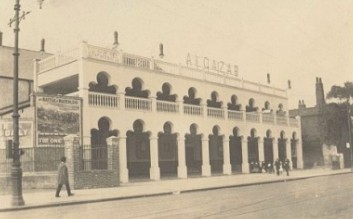
Alacazar, Edmonton

We come to the eighth and last instalment of the series of extracts taken from the c.1912 guide How to Run a Picture Theatre. We have covered selecting and fitting out the building, taking on staff, and putting together an effective programme. The last thing to consider is the licence.

In January 1910 the Cinematograph Act was introduced, the first piece of government legislation directed at the new film and cinema industry. Previously, cinema had had to be licensed under schemes designed for music or theatre performance, though the majority of them chose to avoid such bureaucratic necessities (there are even some examples of cinemas that put on purely silent shows, to avoid the demands for a music licence). The unregulated nature of the industry, and in particular the threat that such venues posed as a risk risk, led to the drafting of the Cinematograph Act. Despite its ‘compulsory’ nature, there were many cinemas which chose to ignore the new scheme and pay the fines, as Jon Burrows’ recent research into cinemas in London pre-1914 has shown. But the coming of the Cinematograph Act ultimately encouraged the huge boom in cinema construction that swiftly followed its publication. There were 4,000 cinemas in Britain and Ireland by the end of 1914.

Obtaining a License. The Cinematograph Act 1909. Under the Cinematograph Act, 1909, it is compulsory that every place to which the public is admitted, where exhibition in which inflammable films are used, shall be licensed …

It is not, however, necessary to obtain a license for premises used not more than six days in a year for a kinematograph exhibition provided that notice of such shows are given to the County Council or the Chief Police Officer, but these occasional exhibitions must confirm to the regulations …

The penalty for using an unlicensed building for an entertainment which comes within the meaning of the Cinematograph Act is a fine not exceeding £20, with a penalty of £5 per day as long as the offence continues, and power is given to the authority to revoke the license.

Music and Dancing License. Every kinematograph theatre in which music is employed – except such music be provided by automatic means – must possess a music and dancing licence.

In the case of premises situated in the Administrative County of London these are granted in November of each year …

All eight parts of How to Run a Picture Theatre can be accessed here.

(The photograph shows the Alcazar in Edmonton, one of the new breed of super-cinemas, which seated 2,000. It opened in 1913, and the poster outside advertises the British & Colonial epic The Battle of Waterloo, released in that year.)

Moving Pictures in Westminster

The Moving Pictures exhibition on the film and cinema business is London before the First World War will be on show at the City of Westminster Archives Centre 5-30 June. The exhibition, which was previously shown at Hornsey Library and Hampstead Museum, focusses on the highly active film industry and cinema business in London before 1914, with an emphasis on the relationship with local communities. The exhibition is based on The London Project, a research project hosted by Birkbeck College, London, which resulted in The London Project database of film businesses and cinemas in London before the First World War.

There are associated talks taking place at the Centre on 19 and 26 June, at 6.00 pm (admission free). The Archives Centre is located here.

For the weekend of 23-24 June the exhibition will move temporily from the Archives Centre to feature as part of West End Live, in Leicester Square.

The Glow in Their Eyes

Some of the most interesting work going on in early film studies (in fact, film studies in general) at the moment is the empirical work being done on audiences. There is an international organisation, HOMER, devoted to the subject, and Cinema Context in Amsterdam (subject of an earlier post) is one only example (albeit a spectacular one) on the work that is going on internationally. This call for papers for a conference is therefore particularly interesting:

The Glow in Their Eyes

Global perspectives on film cultures, film exhibition and cinemagoing

International Conference, Brussels, 15-16 December 2007

The aim of the conference is to review the current state of research in the history of moviegoing and film exhibition and distribution. We seek to bring together scholars dealing with these subjects from all over the globe. The growing number of case studies in local film history increases the need for comparative studies of cities, regions, and nations, while the relationship between micro and macro history(ies) is becoming a major issue for the field. The analysis of patterns and networks in film culture also calls for special attention to methodology. The conference aims to bring European perspectives on cinemagoing and film exhibition into dialogue with British, American and Australian research, and with research elsewhere in the world, in Africa, South America and Asia.

The conference aims to explore and map several crucial tensions arising from the issues of exhibition and cinemagoing, including:

  • The attention given to “top down” forces of industry, commerce and ideology as against “bottom up” forces of experience, consumption and escapism;
  • Contesting concepts of public and private space in media experience;
  • Questions relating to cinema’s integration into to the metropolitan experience of modernity, compared to its role in the construction of community in less urbanised and rural areas.

In line with the ECREA film studies section philosophy (www.ecrea.eu) the conference approaches the phenomenon of cinema in a broad, socio-cultural sense: cinema as content, as cultural artefact, as commercial product, as lived experience, as cultural and economic institution, as a symbolic field of cultural production, and as media technology. On a methodological level, the conference is open to multiple approaches to the study of historical and contemporary cinema: film text, context, production, representation and reception. Cultural studies perspectives, historical approaches, political economy, textual analysis, audience research all find their place within this scope.

The conference also signals the completion of two major interuniversity research projects, one in Belgium (‘The Enlightened City. Screen culture between ideology, economics and experience. A study on the social role of film exhibition and film consumption in Flanders (1895-2004) in interaction with modernity and urbanisation’), and one in Australia (‘Regional Markets and Local Audiences: Case Studies in Australian Cinema Consumption, 1927-1980’). These research projects use a combination of oral histories, archival documentation, demographic data and media reportage and personal papers to examine the audience experiences and business practices of cinemas in Belgium and Australia.

The conference is supported by the International Cinema Audiences Research Group (ICARG), and will be the second international gathering of the Group’s work on the HOMER (History of moviegoing, exhibition and reception) Project, following the successful ‘Cinema in Context’ conference held in Amsterdam in April 2006. The conference will be preceded by an ICARG workshop.

Confirmed Keynote Speakers: Annette Kuhn (University of London); Richard Maltby (Flinders University)

Possible topics for papers are e.g.:

  • Film exhibition, cinemagoing and film experience in relation to theories of imperialism, postcolonialism, etc.
  • Long term tendencies such as the rise of cinemas in rural and urban environments, the boom of cinemagoing, the decay and subsequent closure of many (provincial and neighbourhood) cinemas and the rise of multiplexes
  • Tensions between commercial and/or ‘pillarised’ film exhibition, between urban and rural areas, and between provinces and regions
  • Institutional developments, geographical location and programming trends
  • Audience and film experiences in urban and rural contexts
  • A comparative international perspective on cinemagoing and exhibition
  • Diasporic cinemagoing practices
  • Representations in films of cinemagoing, film exhibition, film culture(s)
  • Reflections on methods: How to reconcile/combine large scale analysis vs in depth case study? How to link up national or regional databases on exhibition and cinemagoing?

A selection of papers presented on the conference will be published in an edited volume in 2008 (publisher to be confirmed). Please submit abstracts (500 words) with short bio to Gert.willems2 [at] ua.ac.be and Liesbeth.vandevijver [at] @ugent.be before 6 July 2007. Speakers will be notified of acceptance by 31 July 2007.

Website (under construction): www.cinemagoingconference.ugent.be