Roll away the reel world

joyce

http://www.jamesjoyce.ie

2009 sees the centenary of one of the odder corners of early film history. In December 1909, the then unknown James Joyce, future author of Dubliners, Ulysses and Finnegans Wake, opened a cinema in Dublin. This was through no particular passion for film; Joyce was merely seeking the means to get rich quick, and like a good many other people at the time, he saw the new cinema business as the way to do so. Cinemas were springing up all over Europe, and in Trieste – where Joyce was based – he had fallen in with a group of cinema owners, to whom he sold the idea of a city in Europe which had a half a million inhabitants, and yet not a single cinema. That city was Dublin, and although recent research indicates that there probably were one or two cinemas in Dublin at that time (and numerous film shows not in cinemas as such), Joyce’s business partners were interested enough to send him across to Dublin to establish the Volta Cinematograph.

Happily for literature, Joyce turned out to be a hopeless cinema manager, or rather he left the business all too quickly in other hands, only to see the hoped-for source of his fortune rapidly fail. The Volta (which was located at 45 Mary Street) floundered, as much through competition from other film entertainments as its own mismanagement, and it was sold at a loss in June 1910. Joyce’s own specific involvement with the cinema was brief, but intense. He spent several weeks setting up the business, staffing and equipping, promoting it, obtaining a cinematograph licence, and – it is to be assumed – selecting the films.

It is this last element that continues to attract scholarly interest. What films were shown at the Volta, what role did Joyce play in their selection, what did he think of such films, and what traces of the cinema can be uncovered in his art? These questions are all to be covered in in a two-day conference organised by the Trieste Joyce School and the Alpe Adria Film Festival, entitled ‘Roll away the reel world’: James Joyce e il Cinema, to be held 15-16 January 2009 at the Sala Tessitori of the “Consiglio della Regione Friuli Venezia Giulia, piazza Oberdan, 5, Trieste, Italy.

huguenot

Le Huguenot (Gaumont 1909 d. Louis Feuillade), shown at the Volta 24-26 January 1910

Speakers include Luke McKernan (yours truly), who will introduce a programme of films known to have been shown at the Volta and give a talk, ‘James Joyce and the Volta Programme’, Eric Schneider (‘Dedalus among the film folk’), Maria di Battista (‘The Ghost Walks: Joyce and the spectres of silent cinema’), Louis Armand (‘Joyce and Godard’), Jesse Meyers (‘James Joyce, Contemporary Screenwriter?’), Cleo Hannaway (‘”See ourselves as others see us”: Cinematic Ways of Seeing and Being in Ulysses’), Marco Camerani (‘Circe, Fregoli and Cinema’), Carla Marengo Vaglio (‘Joyce, between futurist music-hall and cinema’), Philip Sicker (‘Mirages in the Lampglow: Joyce’s “Circe” and Méliès’s Dream Cinema’), Katy Mullin (‘Joyce, Early Cinema and the Erotics of Everyday Life’), Davide Maschio (‘On Bute’s Finnegans Wake’), and Keith Williams (‘Odysseys of Sound and Image: “Cinematicity” and the Ulysses Adaptations’).

Added to all that, the Alpe Adria Film Festival, or Trieste Film Festival, is hosting a retrospective on Joyce and cinema, running 15-22 January, co-ordinated by Elisabetta D’Erme; and there is to be an exhibition, entitled Trieste, Joyce and Cinema: A History of Possible Worlds curated by Erik Schneider, tracing the connections between Joyce’s imaginative world, the city, and the cinema. For further information on the conference, which is free of charge and open to all, contact Professor John McCourt at mccourt [at] units.it, or visit the Trieste Joyce School site for the programme details.

100 years ago

One of the elements of early cinema shows that is frequently forgotten is the presence of a lecturer. It certainly wasn’t the case for every show, and as cinemas spread, got bigger, and intertitles became common, the lecturer became redundant. But this inheritance from the variety theatres and fairground shows where films were first exhibited lingered for a time as cinemas were first developing and many felt the need to have the sometimes bewildering action on the screen explained to them.

How common were such lecturers? It is interesting that in all the memoirs of early cinema-going in London, of which I’ve made a special study, there is not a single mention of someone talking to the pictures. Nevertheless, there were definitely some around, though by the time of this article from The Bioscope of a hundred years ago they starting to become anachronistic. The article, with its quaint language and references to Greek oratory, is describing an ideal, much as other articles from this time describe the sort of music that the author feels should be played in cinemas, rather than the music that actually was.

So we have to read between the lines, and to understand that everything the writer says the lecturer should not do is what the average lecturer almost invariably did.

Explain the Pictures!

The Most Pressing Need of the Day is an intelligent description of Film Plots and Travel Pictures

There seems to be a tendency amongst present day managers to quietly lean back on the reputations they built up in the early years of the industry, confident that the impetus which they engendered then by real grit and toil will carry them along and keep them in the front rank for all time. We must always be on the qui vive. We must not be deceived and deluded by a long period of properity, but must watch for fresh and new fields of enterprise. Good pictures and good prices must not be the only consideration.

One of the most urgent requirements to-day is that every picture shall be introduced to the audience in a manner that will ensure the good points of the film being intelligently appreciated. The developments in the selection and the building up of subjects during the last few years have schooled us until we are quite decided that the lay mind – the mind which is not always devoted to the manufacture and the elucidation of screen mysteries – is quite incapable of seeing and of comprehending the inner nature and the underlying humanity which are the life and soul of to-day’s great creations. Nowadays the lecture is an attribute to success. Some managers have seen it already; others are slowly discovering the fact; while as to the remaining many, we are going to explain to them why they should lecture and how. And if they accept our advice, and act on it, we shall not wait long for their thanks.

Verbal explanation is necessary, finally, because it is impossible to place on the screen real pathos and real humanness – these must be preserved from the full glare of people’s eyes or the effect is lost; secondly, because spectators will not trouble to look for these latent qualities unless the search is suggested to them; and, thirdly, because educational travel pictures minus an explanation of why they should be considered important enough to occupy the screen tend to make interest wane and eventually to fade away altogether.

The Greek orator, when asked what was the essence of speech making, answered “Delivery”. The essence of giving a lecture on a bioscope picture is not distinguished by such a word. The lecturer’s key to success is “to tell the tale”. It should be told simply, clearly and intellectually. The lecturer should know the picture well before he attempts to explain it to others. He should keep perfect pace with the projecting machine, should quietly indicate the inner cause when the outer result is taking place. He should indulge in no stock phrases, no personal reminiscences which the picture may recall, no opaque phrases, no drawn-out, windy sentences; in fact, nothing which could possibly lower his description in the estimation of any single member of his audience. Let him always keep well in mind that he is talking to an assembly, not to a few of his acquaintances, who would probably laugh at his jokes and listen to his rhetoric merely for the sake of their friendship. Audiences do not tolerate any admixture of personality. They want the discription [sic] to be clear, unalloyed, to serve the purpose which it is intended to serve.

But while endeavouring to make himself understood by using words which everyone knows and sentences the meaning of which will be readily grasped by all, the lecturer must guard against falling into the opposite error – that of making his explanation too elementary. Either extreme is wrong, and not wanted. By making his story too academical he will run the risk of being thought by a portion of his audience, to be aiming higher than is necessary, and if he is so unfortunate as to lose himself for a moment, the chaos, which is always threatening, comes; while if he goes too far in the other direction his listeners will accuse him of looking down on them. So the only sensible course to pursue is a middle one. Let the words used be ordinary ones, but let the construction of the sentences be perfect. Do not have your lecture “scrappy” and disconnected. The more intellectual people object strongly to this, and never listen to it more than once.

Above all else, make the story bright. Make your explanation worthy of the beautiful picture you are showing. Every description can be made bright and sparkling, for it is not the subject but the way it is exploited that determines the amount of interest the narrative shall be accorded. Travel films can be described with a swing and a healthy raciness which help the listener to persuade himself that he, too, is bounding along and partaking of the pleasure of actual expedition, while the picture of sentiment and pathos lends itself to that terseness and conciseness which, while bordering almost on the abrupt, is the real acme of of pathetic narrative. Do not have your lecture like a few dry old extracts hitched up from a text book, and, without boring the audience, make yourself felt. Be an authority on the subject in hand; be the larger half of the show.

And when you have done all this you have faithfully discharged your duty. You have sown the seed of success and can look forward to the harvest. You begin to reap exactly one week after the inauguration of the lecture, and the crop increases weekly. So try it. Engage a lecturer or improvise one from your own material. Whether you have spoken in public or not matters little. Study your audiences, work on the ideas I have attempted to explain, and watch for the crowds being turned away.

The Bioscope, 10 December 1908, p. 5

Particularly amusing is the implication that there were lecturers who attempted to provide commentaries to films they had not seen. If all that you are doing is conducting a running jokey conversation with your friends in the audience, perhaps you may even have got away with it.

One last thought. Is this high-minded commentator (who ought to have read some of his own words about the use of clear language) thinking more of lecturers for magic lantern shows than cinema shows? He refers to film dramas and travel pictures, but there is more of an air of the church hall than the electric theatre about this curious piece.

The cinema king

pyke_vanityfair

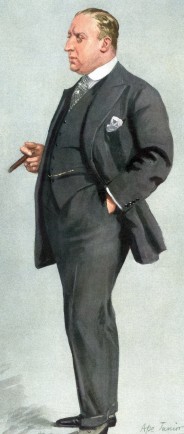
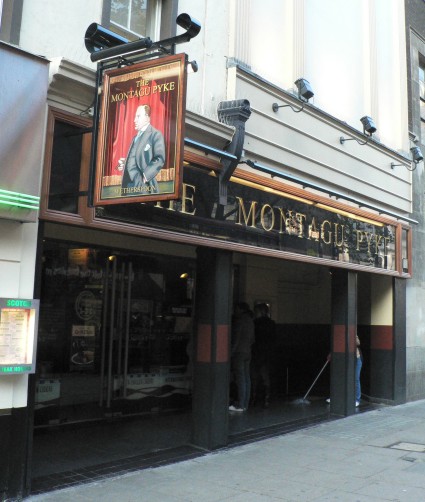
Should you find yourself in London’s Charing Cross Road, on the right-hand side looking south, halfway between the Palace Theatre and Foyles book store, you will find a bar. It bears the extraordinary name of The Montagu Pyke. It is part of the Wetherspoons chain, and is apparently a popular and fashionable spot. A sign outside bears the picture of an assured Edwardian gentleman in an immaculate suit, sporting a monocle, cigar in hand. He is Montagu Pyke, and for a time he was most renowned person in British film. For Monty Pyke was the cinema king.

A huge onrush of cinema building occured in London following the passing of the Cinematograph Act (the first UK legislation devoted to the new industry) at the end of 1909. Fortunes were to be made in this new business so attractive to a mass audience which, though it didn’t pay much for its pleasures, was prepared to turn up once or twice a week, every week, to the cinema. For a new breed of speculators, it looked like a licence to print money. That’s certainly how it must have appeared to Montagu A. Pyke, a former commercial traveller, gold miner and bankrupted stock market gambler. Pyke had seen crowds lined up in Oxford Street to see Hale’s Tours (films of journeys shown inside a rocking rail carriage) and decided this was the business for him.

Obtaining a £100 loan from a City business friend, Pyke formed Recreations Ltd in 1908, with nominal capital of £10,000, but no assets of his own. He identified a property in Edgware Road:

… firstly because it is a very thickly populated neighbourhood, and secondly, it appeared to me from the class of people one sees daily on the streets that they would make an appreciative audience if you gave them good value and the prices were right.

Pyke found two shop properties at 164-166 Edgware Road, and recalled that they were next door to Funland, a shop show which operated for a short period in 1908/09 and undoubtedly played its part in influencing the choice of location, as a proven film-going attraction. He raised money by exploiting society connections and spinning tales of vertiginous profits, including £1,000 from Lady Battersea, sister of Lord Rothschild. Pyke placed his first cinema in a populous neighbourhood with good passing trade, and offered a continuous show between twelve noon and midnight, with prices at 3d, 6d and a shilling. Programmes lasted between an hour and an hour and fifteen minutes. Takings, he recalled, were £400 a week, against outgoings of just £80, and Pyke embarked on a rapid programme of expansion, with investors queuing up to join him.

Initially Pyke’s cinemas were shop conversions, but his policy soon turned to larger venues in prestige locations. Each building was given the generic title of Cinematograph Theatre. Each cinema was also a limited company in itself (a common feature of cinema capitalisation at this time), but he established an umbrella company Amalgamated Cinematograph Theatres Ltd in 1910, with £150,000 capital, by which point he was managing five cinemas. At its peak, the ‘Pyke Circuit’ included fourteen cinemas in central London.

The Pyke Circuit

  • Recreations Theatre – 164/166 Edgware Road – opened 19 March 1909
  • Finsbury Park Cinematograph Theatre – 367-369 Seven Sisters Road – 1 October 1909
  • Walham Green Cinematograph Theatre – 583 Fulham Road – 29 December 1909
  • Ealing Cinematograph Theatre – 22 Ealing Broadway – 5 January 1910
  • Pyke House Cinematograph Theatre – 19, 21 & 23 Oxford Street – 17 February 1910
  • Shepherds Bush Cinematograph Theatre – 57/57A Shepherds Bush Green – 3 March 1910
  • Piccadilly Circus Cinematograph Theatre – 43-44 Great Windmill Street – 5 March 1910
  • Hammersmith Cinematograph Theatre – 84-88 King Street – 1910
  • Clapham Junction Cinematograph Theatre – St John’s Hill – 27 July 1910
  • Elephant and Castle Cinematograph Theatre – 47/51 Walworth Road – 5 November 1910
  • Croydon Cinematograph Theatre – 62 & 64 North End – 21 December 1910
  • Peckham Cinematograph Theatre – 166 Rye Lane – February 1911
  • Brixton Cinematograph Theatre – 101 & 103 Brixton Hill – 10 March 1911
  • Holloway Cinematograph Theatre – 71/83 Seven Sisters Road – 29 March 1911
  • Balham Cinematograph Theatre – 172 High Road – 1911
  • Cambridge Circus Cinematograph Theatre – 105/107 Charing Cross Road – 26 August 1911

Pyke’s business methods were highly dubious, and soon exposed. A committee of investigation formed in 1912 uncovered numerous business irregularities, including dividends being paid out that had not been earned. Pyke was the most notorious exploiter of investors’ eagerness to profit from the cinema craze. His strategy was based on the assumption that the boom would be short-lived, tempting avaricious investors with quick-term profits from a pyramid of flotations. He certainly profited handsomely himself. From a salary of £25 a week in 1908 he had risen in 1911 to paying himself £10,000 a year. As the cinema business only established itself all the more, and competition from larger and more competently managed rivals grew, Pyke’s business necessarily collapsed. He had only two cinemas in operation by the end of 1913 (Piccadilly Circus and Cambridge Circus), and was made bankrupt in 1915, the same year in which he was accused of manslaughter following the death of an employee in a nitrate film fire at the Cambridge Circus venue. Pyke’s ambitions to expand into the provinces were never realised. Amalgamated itself was reconstituted as a company in December 1916 and continued to manage five theatres (Edgware Road, Finsbury Park, Oxford Street, Walham Green and Shepherd’s Bush) to the end of the war.
pykebook

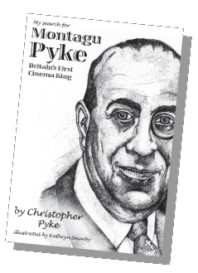
Pyke had been the most prominent figure in the British film business for a short while, but he disappeared into obscurity. Few cinema histories mention him, and it was only with the growth of interest in a social history of British cinema that researchers started to recover his story. Their task was helped by the publication of a chapter of Pyke’s otherwise unpublished autobiography, When I Was the Cinema King, in an edition of Picture House, the Cinema Theatre Association journal (no. 10, 1987). The text was made available by his grandson, Christopher Pyke, who has now produced a website devoted to Pyke and to selling a book, a self-published combination of biography of Pyke, using his memoir, and an account of Pyke’s own investigation into his grandfather’s history. The book, My Search for Montagu Pyke: Britain’s First Cinema King, can only be ordered online from CPI Book Delivery. It was launched last month at the Montagu Pyke bar.

I’ve long had a fondness for Monty Pyke. He was a rogue of sorts, and an employee did die in a fire at one of his premises, even if he was acquitted of manslaughter. But he had his philosophical side, and I’m fond of quoting lines from a 1910 pamphlet of his, Focussing the Universe (also reproduced in that issue of The Picture House). In an earlier post I gave you his use of the words of Isaac Walton to suggest the profound sense of cinema as a diversion. In this passage, he recognises its universal appeal:

Not least of the charms of the Picture Theatre for me is the fact that it is, in the real sense of the word, catholic, appealing not only to men and women of every class and degree, but to men, women and children of all ages. Before its advent, the process of amusing or interesting the child at a public entertainment was a somewhat difficult one, while the possibility of instructing him or her thereat, was never considered at all … The Picture Theatre, if it has done nothing else, has brought delight to the minds and souls of thousands upon thousands of mites in this great Metropolis, some of whom look upon it as the one oasis in the desert of their dull and sordid lives.

The signboard outside the former Cambridge Circus Cinematograph Theatre (where the fire took place) depicts Pyke in his pomp, adapted from the 1911 Vanity Fair portrait of him at the top of this post. He would be proud.
pykebar

The Montagu Pyke, 105-107 Charing Cross Road, London

This post is adapted from my 2006 paper on London’s first cinema circuits, Unequal Pleasures: Electric Theatres (1908) Ltd. and the early film exhibition business in London, which you can find on my personal website.

100 years ago

100 years ago, The Bioscope was relieved that a certain type of film was certain to be no more:

Indecency’s Decline and Fall

The indecent picture is departing, unwept, unhonoured, and unsung. It has been tried in the balance of public opinion, and has been found wanting. It has been adjudged by the general consent of the public to be “not what we want.” The great majority of manufacturers and showmen have known all along that clean amusement is what is wanted by that section of their patrons which really matters. They have relegated the questionable film to the zone of undesirables, and so, banned by the respectable frequenter of our great picture halls, and uncountenanced by the bulk of manufactuers and dealers simply because they respect public opinion, and themselves recognise the evil which would most assuredly be the result of its constant exhibition. The indecent picture is gradually disappearing. It is mortifying to think that the man whose sole mission on earth seems to be to pull the world down into the mire, should ever have found a place in the bioscope world. But it is gratifying to note that with the steady rise of this form of entertainment into the favour of the populance [sic], there arose men who were ready to give the people real healthy diversion, to minister to the man, not to the beast. The result we all know. It has been the big jump into popularity of the really elevating yet dramatic picture, a huge slump in the output of the low-down manufacturer, and a big increase in the number of patrons who are in search of a good, sensible form of recreation, for themselves and for their children, and who are willing to pay for it. Bioscope entertainments must necessarily have a big hand in the moulding or the marring of a country’s morals, and it behoves us as fellow-workers for the general good of all mankind, to all lend a hand in the work of stamping out this evil altogether and placing those dealers and manufacturers who are inclined to look on it with an encouraging eye, in their proper places – outside the bioscope business.

The Bioscope, 6 November 1908, p. 3.

How indecent did they mean by indecent? Pornographic films of every hue had been produced from practically the start of cinema, but these were really only encountered in ‘smoking concerts’, men’s clubs and brothels. Pathé kept films it described as Scènes grivoises d’un caractère piquant in its catalogue during the early 1900s, and there were companies like Austria’s Saturn Films (examples of whose output can be found on the Europa Film Treasures site) producing coyly erotic films, but these would not have made into the public halls and proto-cinemas of London at this period.

Yet clearly there were shows not reported by the film trade press whose existence threatened the reputation of the industry. Although some research has been done on early pornographic films, little written evidence remains, as might be expected. While one can speculate on what to read between the lines of this editorial piece, what is most striking about it is the sense of responsibility coming out of general popularity. “Bioscope entertainments must necessarily have a big hand in the moulding or the marring of a country’s morals … ” – that’s big claim for what was still a relatively small industry, albeit one just about to mushroom in size to a remarkable degree. The editor of the Bioscope evidently foresaw this, and the anguished debates over motion pictures and morality which were to follow – and which have remained with us, in one form or another, ever since.

Lessons from Toledo

There has been quite an on-rush of new material appearing on the Internet Archive, some of it relating to our subject and period, and I’ll be working my way through selected titles and adding them to the Bioscope Library. First up is the Reverend John J. Phelan’s Motion Pictures as a Phase of Commercialized Amusement in Toledo, Ohio (1919). This is another example of a social survey driven by moral concerns rather than social science itself, and the distaste implied by the book’s title is reinforced by these lines from its introduction:

Students of social science are in quite general agreement as to the necessity of community control
of public commercialized amusements.

And yet there is rather more to this study than disdainful suspicion of popular taste for the movies. To begin with, Phelan recognises the virtues, listing these key advantages that motion pictures offered society:

1. The providing of a reasonable-priced and highly entertaining form of amusement.
2. Convenience both as to accessibility and continuous play hours.
3. The promotion of family unity – as seen in attendance of the entire family.
4. The counteraction against the influence of the brothel, saloon, public dance hall and other questionable forms of amusement.
5. A provision for amusement and relaxation.
6. The supplying of information in regard to travel, history and world events.
7. The treatise of high moral and educational themes.
8. The movies as an “art.”

So, while Phelan feels that the movies may appeal to those “who feed their nature upon the abnormal, distorted, suggestive and far too often, vicious things of life”, he feels that they are capable of “moral and educational worth”. But what makes his study valuable for us is that he wants to back up his understanding of motion pictures with empirical data.

Using Toledo as his subject, Phelan tells the number, type, size, location, ownership and function of the different cinemas in his town (there were six in 1919). He tells us of their proximity to other forms of commercialised amusements (saloons, dance halls etc.). We learn of their value, the rental fees charge, and the cost of machinery, fabric, employees, musicians, advertising, lighting and heating. He supplies figures on the composition of audiences, prices of admission, and the construction of cinema programmes. We learn what it cost to invest in the cinema business, the operating expenses and the revenue. This is all very useful data.

Phelan provides evidence of studies conducted at individual schools. There is a long list of suitable educational films, by itself an illuminating guide to how this new branch of the film business was starting to blossom. There is plenty on the moral issues, censorship and the hoped-for attractions of “non-commercialized” amusements valiantly fighting their losing battle against the irresistible attraction of the screen. Intriguingly, Phelan ends each section of the book with a series of questions for other “social studies” students, indicating the sort of things they should be asking of their own territories should they intend to conduct similar surveys.

The book concludes with substantial appendices. These includes a valuable bibliography; examples of relevant legislation; a list of all Ohio cinemas with owners, managers, seating, location and number of employees; sample questionnaires; sample testimony from juvenile courts; and much more. Beyond the moralising, this is study with a great deal of practical information to inform a particular study of American film-going in 1919 – well worth investigating further.

100 years ago

Back to our series of pieces from the original film journal The Bioscope, published 100 years ago to the day. Today we consider the dreadful crime of having music at a film show, and on a Sunday too…

The Camden Case

PROPRIETORS FINED FOR INCLUDING MUSIC IN PROGRAM, AND SUNDAY SHOWS BARRED

Some months ago, itwill be remembered, Mr. Robert Arthur, Mr. Walter Gibbons, and Mr. W.H. Terrell were bound over at Clerkenwell Sessions, a jury finding them guilty of having carried on a music-hall entertainment at the Camden Theatre without having a license from the London County Council.

At the Sessions on Tuesday, it was alleged that the terms of the recognisances of the parties had been broken, and notice had been served upon them to attend the court to show why they should not be forfeited.

Mr. Horace Avory said the house was closed after the conviction until Monday 14th September, when without any license being obtained from the L.C.C., the theatre was opened with an animated picture entertainment, along with music. There were also Sunday performances.

The music, counsel argued, was not incidental to or subsidiary to the entertainment, but was independent and substantial. This was shown by the fact that so soon as the selections ceased, the gallery became noisy, and quieted down again when it re-started.

Mr. Muir said his client, Mr. Robert Arthur had absolutely nothing to do with the place at all since the early days of the former proceedings.

Mr. George Elliott did not dispute the facts, but disputed that what was done was an infringement of the Act.

Mr. Barnes, solicitor for the prosecution, said the music was supplied by an electrical orchestral piano. The entertainment would have been a dull one with no music, because the intervals were very long. People joined in the choruses, and sang.

Mr. Muir asked that, as Mr. Arthur had no desire to offend, he might be allowed to go.

Mr. Wallace, K.C.: Certainly.

Mr. Walter Gibbons called on his own behalf, said he was not conscious at any time of having violated his recognisances. The public came to see the bioscope.

Mr. Wallace, K.C., items of the Sunday program as follows:-

The Pneumatic Policeman. (Laughter.)
Ali Baba and the Forty Thieves.
“The Sign of the Cross.”
The Reluctant Dog.
Yachting on the Solent.

Is that a Sunday program?

The Witness: Yes, they are all pictures which no one can object to on a Sunday.

Mr. Wallace, K.C., found that defendants (Messrs. Gibbons and Terrell) had violated their recognisances.

He fined them 40s. each, requiring an undertaking that there should be no music at week-day performances, and no performances at all on Sunday.

Mr. Wallace intimated that he did not think defendants deliberately intended to violate their obligations.

The Bioscope, 30 October 1908

Before the Cinematograph Act of 1910, there was no licensing scheme for moving picture shows in Britain, something which exercised the authorities greatly. The London County Council, which oversaw the licensing of entertainments in the capital, could licence public shows under three categories: music, music and dancing, or stage. Film shows fitted none of these per se, so had to obtain a licence for music or music and dancing if they were not to be in danger of being closed down by the L.C.C for having failed to conform to the Disorderly Houses Act of 1751. Most complied, but quite a number prefered (or had no option but) to risk it, or even in some cases put on film shows without music.

Sunday film shows were another vexed issue for the L.C.C., it being considered that entertainments of any kind on a Sunday were unwelcome, but friviolous and doubtless immoral bioscope shows especially so. Venues liked show films on Sundays, because they drew the crowds, but to keep sweet with the L.C.C. suitably ‘harmless’ programmes were concocted for Sunday shows.

The Cinematograph Act, introduced in January 1910, was established to monitor this mushrooming new public entertainment by establishing a licensing scheme specifically tailored towards it. It was the first piece of legislation in the UK which recognised the film business.

Walter Gibbons (1871-1933) had been in the film exhibition business for a decade by this point. He inherited a music hall empire and in 1910 built the London Palladium as his flagship venue. He would be knighted for his services to British variety theatre, but ended his life bankrupt.

Travellin’ on

There has been steadily increasing interest in the ambulatory nature of much of early cinema. Before films were fixed to a venue, they were frequently to be found on the move. Fairgrounds, a form of entertainment continually on the move, became a regular home for film shows in the late 1890s to early 1900s, and travelling showmen to film shows from town to town. Recent research work has uncovered extensive information on the early ‘travelling cinema’, as the term seems to be. Most notable in this field has been the body of work that followed the discovery of the Mitchell & Kenyon collection of non-fiction films from the Edwardian era, films commissioned by town hall showmen and fairground operators, generally located in the north of England.

A second body of work has looked at what was happening on the European mainland. A conference on travelling cinema in Europe took place in Luxembourg in September 2007, accompanied by the Crazy Cinématographe shows (revived for this year) and DVD release. Now we have the proceedings of the conference published as Travelling Cinema in Europe, edited by Martin Loiperdinger and published by KINtop. Though it has a German publisher, the book is in English. The book provides a diverse look at the commercial heyday of the travelling cinema in the first decade of the twentieth century, with a particular focus on Luxembourg and the Greater Region, with another section looking at non-commercial travelling cinemas from the 1920s onwards. Here’s a chapter listing:

Martin Loiperdinger – Introduction

Travelling Cinema in Europe before the First World War

Vanessa Toulmin – ‘Within the Reach of All’: Tavelling Cinematograph Shows on British Fairgrounds 1896–1914

Matthew Solomon – Fairground Illusions and the Magic of Méliès

Mustafa Özen – Travelling Cinema in Istanbul

Ralf Forster – Easy to Handle and Part of the Novelty: Equipment for Travelling Cinemas in Early Trade Catalogues

Daniel Fritsch – The Paradoxical Austrian Travelling Showmen’s Magazine Die Schwalbe

Joseph Garncarz – The Fairground Cinema: A European Institution

Travelling Cinema in Luxembourg and the Greater Region before the First World War

Uli Jung – Travelling Cinematograph Shows in the Greater Region of Luxembourg: An Overview

Paul Lesch – Travelling Cinematograph Shows in Luxembourg

Brigitte Braun – Marzen’s Travelling Town Hall Cinematograph in the Greater Region of Luxembourg

Non-commercial Travelling Cinema in Europe from the 1890s to the 1960s

Torsten Gärtner – The Church on Wheels: Travelling Magic Lantern Mission in late Victorian England

Thomas Tode – Agit-trains, Agit-steamers, Cinema Trucks: Dziga Vertov and Travelling Cinema in the early 1920s in the Soviet Union

Urszula Biel – German and Polish Agitation through Travelling Cinemas in the 1920s in Upper Silesia

Yvonne Zimmermann – Training and Entertaining Consumers: Travelling Corporate Film Shows in Switzerland

Christian Kuchler – Catholic Travelling Film Shows in West Germany after the Second World War

Epilogue

Claude Bertemes – Cinématographe Reloaded: Notes on the Fairground Cinema Project Crazy Cinématographe

The travelling cinema work can in turn be seen as part of a wider investigation of the relationship of early cinema to society, which is at last taking place. It was not just what they saw, but how they saw it, that matters. There is a growing body of work that is looking the composition of the programme, the location and strategies of venues, the composition of audiences, the location of audiences and their relationship to the entertainments offered to them, the time that they had to devote to such diversions and the value that could be placed on that time, the role of the audience in contributing to the early cinema experience – all of this informs us of early film’s social significance. Without such knowledge, our understanding of the films is barren.

100 years ago

As promised, the Bioscope is starting up a new occasional series, to be called 100 Years Ago, which will reproduce texts from the original British film trade journal The Bioscope, from exactly 100 years ago.

The Bioscope included reports on film and film exhibition around the world, and this piece reported on a strike of nickelodeon projectionists and singers (songs were a common part of early cinema shows) in Chicago.

Artistes and Operators Strike

A somewhat humourous situation recently arose in Chicago, where the ladies and gentlemen who warble such sweet music at the five-cent picture shows joined forces with the bioscope operators and “struck.” There are now over 400 picture shows, employing about 900 people, and they have formed an Operators’ Union. The strikers complain that some of them have been forced to work twelve hours a day. One of the leaders say [sic] “I have known several instances where they did not have time to stop for their meals. I saw a performer bite into a sandwich, leave it on a chair until his act was done, and then finish it.

“If we cannot secure eight-hour days and the pay we ask, this army of employees will stand at the doors of these amusement places Monday and persuade patrons not to enter until the union demands are met.”

On the following Monday, Miss Leonora Drake stood in front of a five-cent theatre on the West Side, and warbled the latest illustrated song. Actors and actresses stop [sic] beside her, and when the crowd paused to listen they called out to them:

“Stay where you are. Don’t go in that theatre. It’s unfair. We’re on a strike, and if you’re with us stay on the outside. She’ll sing. Don’t you think that’s worth a decent salary?”

And while Leonora sang, theatre patrons stood outside and listened.

All over the city striking five-cent theatre artists adopted similar tactics to compel theatre owners to agree to union demands. Vaudeville performers did their turns for nothing out in the middle of the street; teams danced and sang, and moving picture operators, with no machines to operate, explained to the crowds what the strike was for, and declared that five-cent theatre artists were being driven like slaves for the entertainment of the public.

Latest advices [sic] from the scene of war do not tell us if the strike is ended yet.

The Bioscope, 16 October 1908, p. 17

I don’t know what happened to the strike, but on leisure (including cinema) and the eight hours in the day rallying call of American workers at this time, see Roy Rosenzweig’s classic Eight Hours for What We Will: Workers and leisure in an industrial city, 1870-1920 (Cambridge university Press, 1983).

Quebec and Québec

F. Guy Bradford (left), Joe Rosenthal (right) and the Living Canada travelling company, c.1903 (Cinémathèque québécoise)

Another day, another site goes up with unique silent film content, richly contextualised. Truly the online world is our archive. This time it is Le cinéma au Québec au temps du muet/Cinema in Quebec in Silent Era, an impeccably bilingual site giving us the history of early cinema in Quebec, Canada.

Quebec has a distinctive early film history. It is a tale coloured by its geography, its French heritage, local regulations, audiences and enthusiasms, and by snow. Particularly, it is a tale shaped by the dedicated efforts of a hardy band of pioneers, such as James Freer, Henry de Grandsaignes d’Hauterives and Léo-Ernest Ouimet. It is a tale of travelling cameramen (Joe Rosenthal, William Paley) and travelling exhibitors (F. Guy Bradford), an adventurous cinema with a spirit of newness and discovery about it.

The site has been put together with impressive thoroughness and local pride. There are extensive, knowledgable texts on such themes as the history of cinema in the area, biographies, audiences, film companies, sponsorship (the Canadian Pacific Railway made much use of film to promote its activites), censorship and travelling cinema. There are twenty or so films, available in low and high bandwidth, mostly non-fiction, including such titles as Skiing at Quebec (Edison 1902), Mes espérances en 1908 (Ouimet 1908), The Building of a Transcontinental Railway in Canada (Butcher 1909), Put Yourself in their Place (Vitagraph 1912 – fiction film set in Quebec) and the sobering Forty Thousand Feet of Rejected Film Destroyed by Ontario Censor Board (James and Sons 1916). All have musical accompaniment by Canada’s own Gabriel Thibaudeau.

There are also three lively ‘interactive journeys’ which you can take through the ‘Rural Milieu (1897-1905)’, ‘Working-Class Milieu (1906-1914)’ and ‘Middle-Class Milieu (1915-1930)’, which is an interesting way in which to divide up cinema history. Plus you will find documents, photographs, further background texts (some in French, some in English, some in both), and educational activities and a good, eclectic set of links (where you may learn that The Bioscope is ‘Plus qu’un blogue’ – merci beaucoup). An historical timeline is also offered, though I’ve not been able to make the link work. All in all, an exceptional piece of work, lovingly constructed, with discoveries a-plenty to be made.

The site is a collaborative effort between GRAFICS, the Bibliothèque et Archives nationales du Québec and the Cinémathèque québécoise. Acknowledgments to Bruce Calvert on the indispensible silent film forum Nitrateville for information on this site.

Filmarchiv Leuzinger

Ben Hur exhibited at Meisterschwanden, Switzerland, May 1930, from http://www.filmarchiv-leuzinger.ch

I was introduced to this website a while ago (by its author), and thought you ought to know about it. The subject of Filmarchiv Leuzinger is a small town family cinema business from Rapperswil, Switzerland. It was founded by restaurant owner Willy Leuzinger, who began organising film screenings in his restaurant in 1909, going on to open two cinemas in the Lake Zurich district. In 1919 he began a touring cinema business, the Wanderkino Leuzinger, which dominated film exhibition in north-eastern Switzerland from the mid-1920s to 1943. Leuzinger was also a filmmaker, shooting many local topicals (local newsfilms) throughout the 1920s, around eighty of which survive. After Willy Leuzinger’s death in 1935, his eldest daughter took over, and today his granddaughter Marianne Hegi still runs three cinemas, in Rapperswil and Altdorf.

The Wanderkino Leuzinger in 1923

All of this is a charming story, but in the hands of Mariann Lewinsky Sträuli it has been turned into an eye-catching and evocative website. Filmarchiv Leuzinger (click on the Übersicht link to find the main ‘archive’ page) arranges an archive of family memorabilia – biographies, photographs, documents, music, background information and film clips in thematic columns to create an innovative and enticingly explorable site that opens up the Leuzinger’s world. The film clips (in QuickTime format, with MPEG-4, DVD-quality downloadable versions also available) show local festivals, parades, fairs, gynmatic events, and so on, each meticulously described. Every clip, image, audio file or other link leads to a page of information (with larger versions of the images), progressively building up a resonant picture of time, place and occupation.

It is a delightful site, quite an inspiration in conception and design. Unfortunately for the linguistically-challenged English speaker, it is in German. But don’t let that deter – it’s clear enough just from looking that it is a fine piece of social and cinema history (the numerous photographs of cinemas in the 1920s and 30s will delight many), put together with a loving archivst’s care. Mariann Lewinsky Sträuli prrogrammes section of Il Cinema Ritrovato in Bologna, teaches film history at the University of Zurich and directs restoration projects at Memoriav, the Swiss audiovisual heritage organisation.

Go explore.